The Machine That Hears a Mountain Think
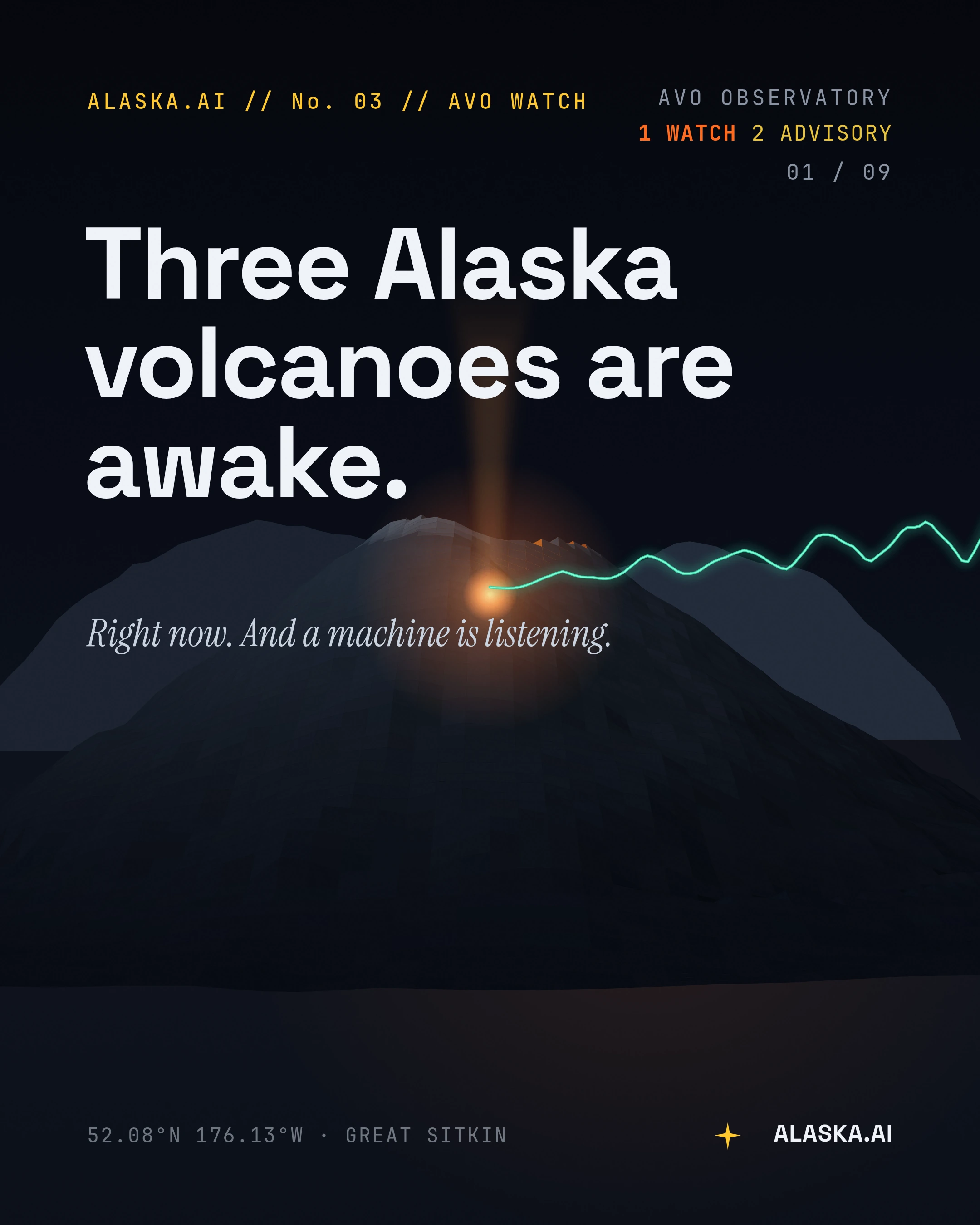
Three Alaska volcanoes are on elevated alert at once, and an AI built in Fairbanks is what stands watch over them.
The deck
SWIPE, SCROLL OR CLICK A SLIDE TO GO FULLSCREEN · 9 SLIDES
The story
Great Sitkin is erupting lava. Kupreanof and Shishaldin are stirring, and about 50,000 people fly over that airspace every day.
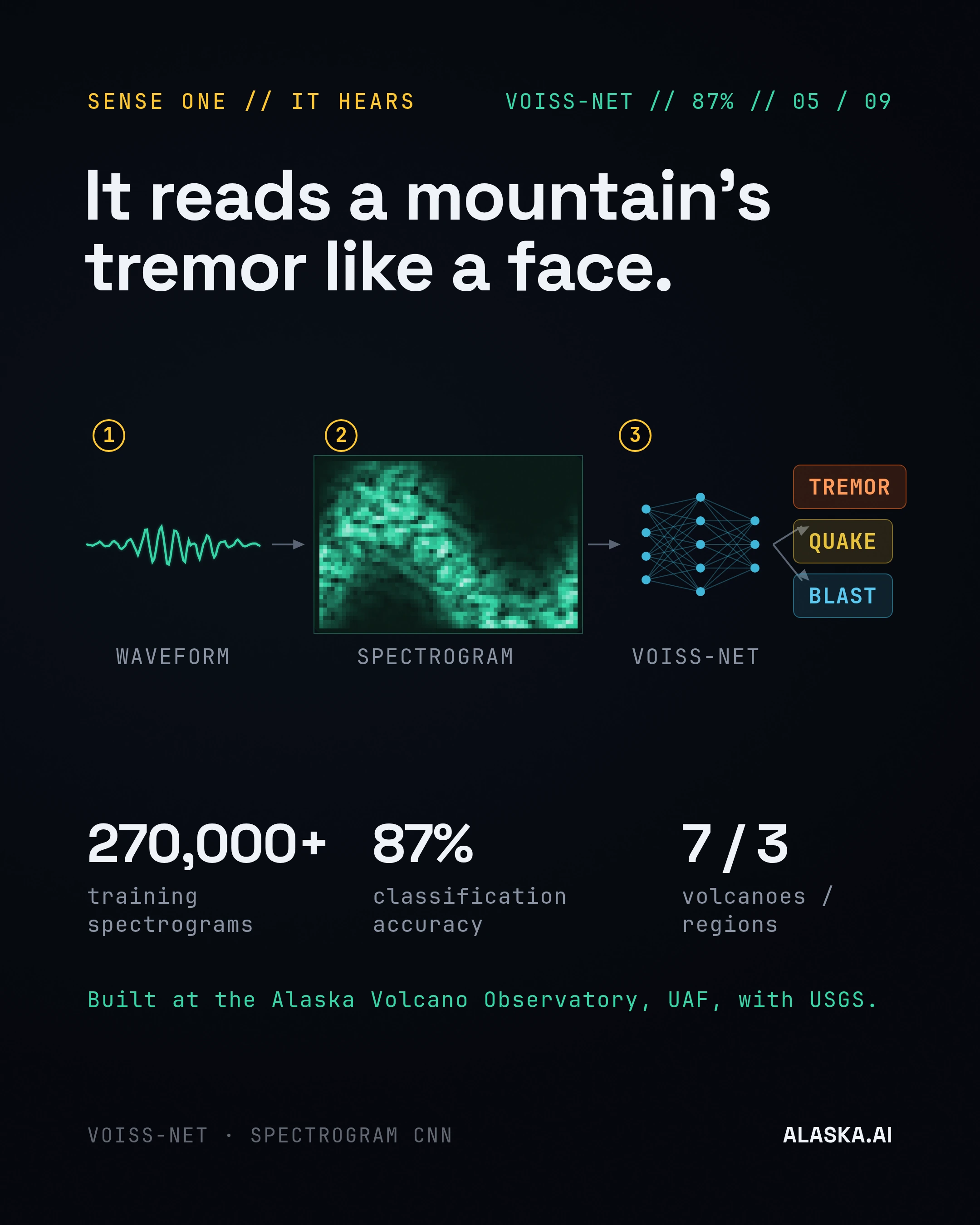
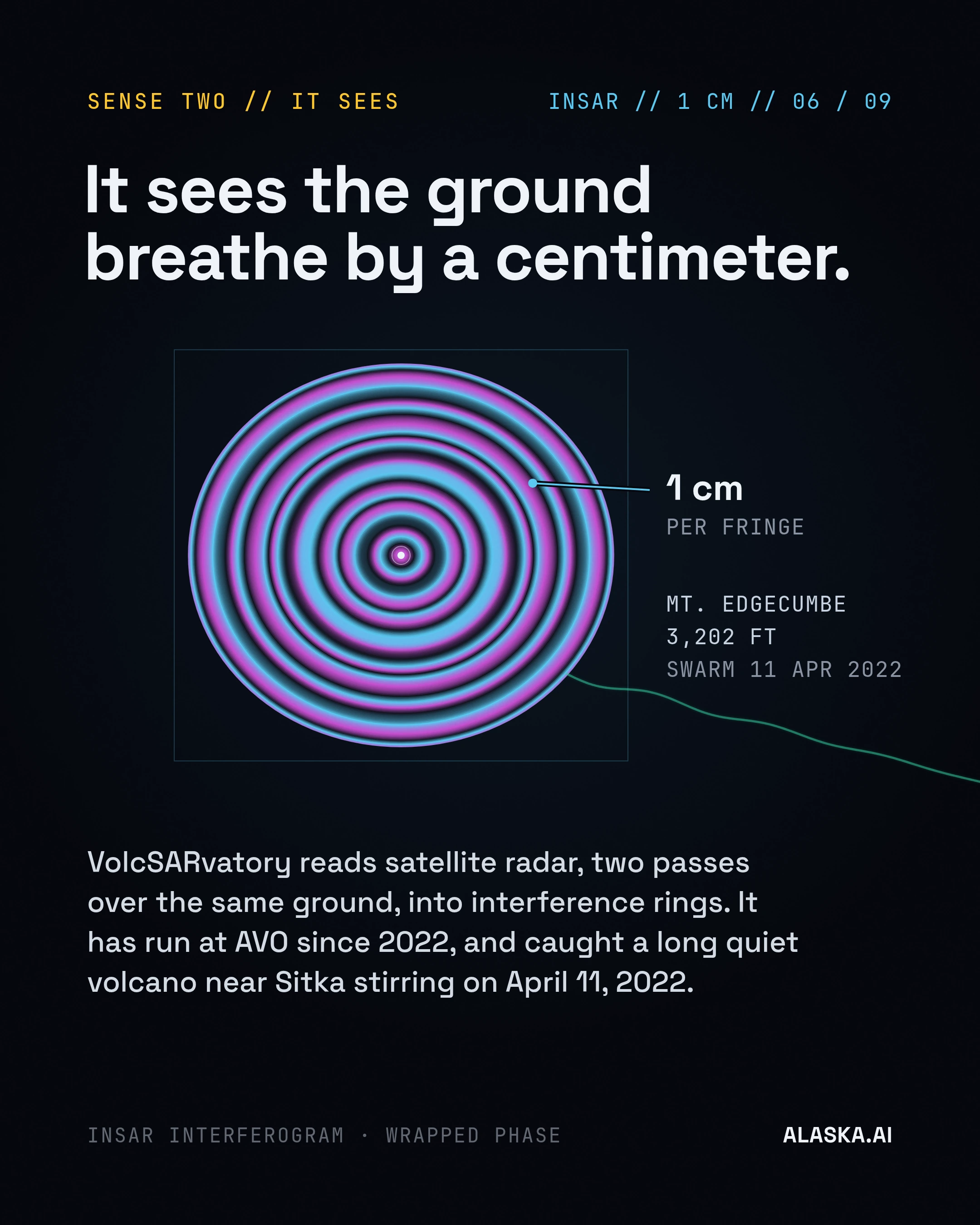
This deck walks through the two machine senses doing the watching. VOISS-Net is a neural ear, trained on more than 270,000 spectrograms to read tremor at 87 percent accuracy. VolcSARvatory is a satellite eye that catches a centimeter of ground swell from orbit. Both were built at UAF and are now scaling to all five US volcano observatories.
Kupreanof has no ground sensors at all, so is a machine watching from orbit really enough?
What we verified
27 CLAIMS, EACH RE-FETCHED FROM ITS SOURCE BEFORE THIS DECK SHIPPED
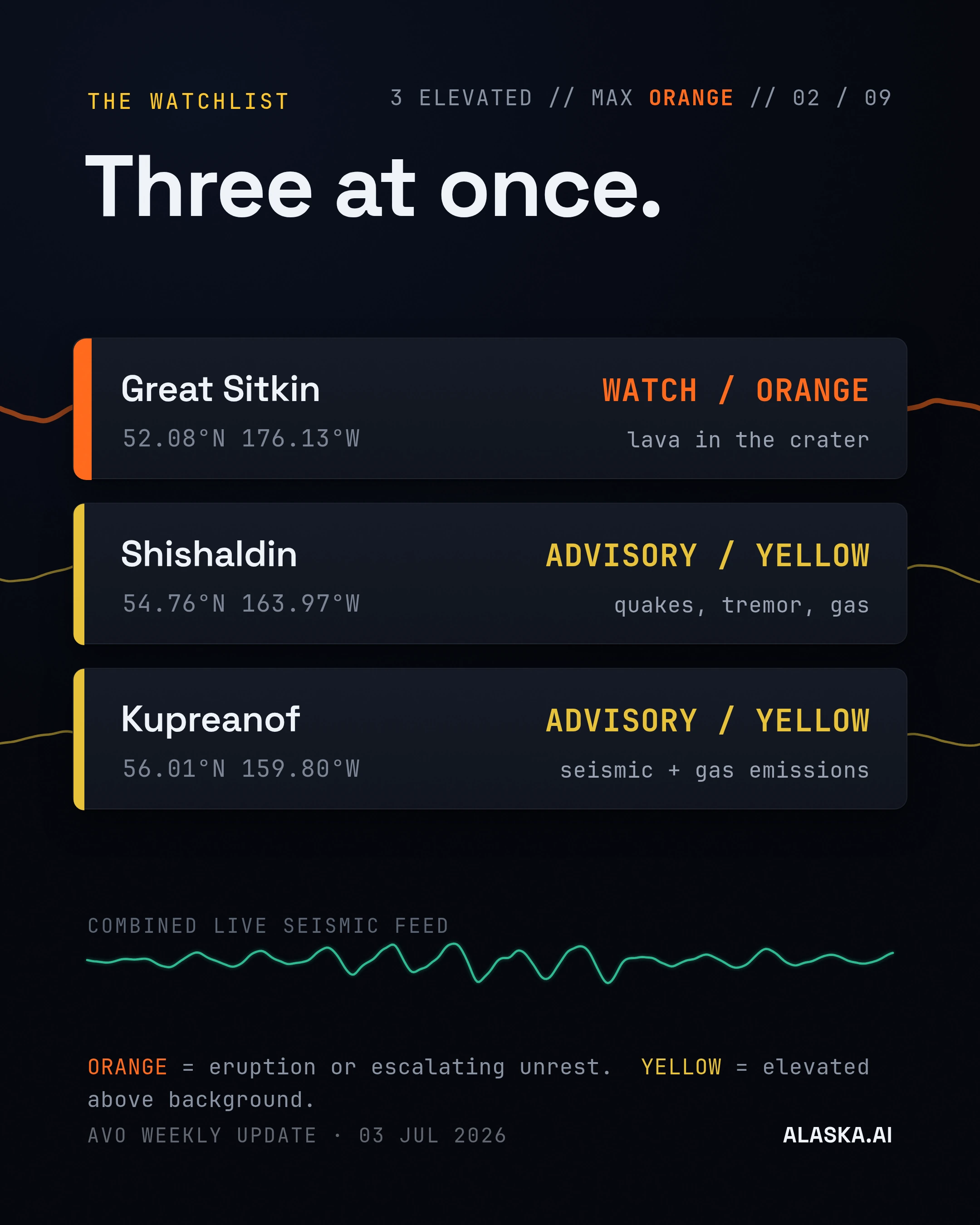
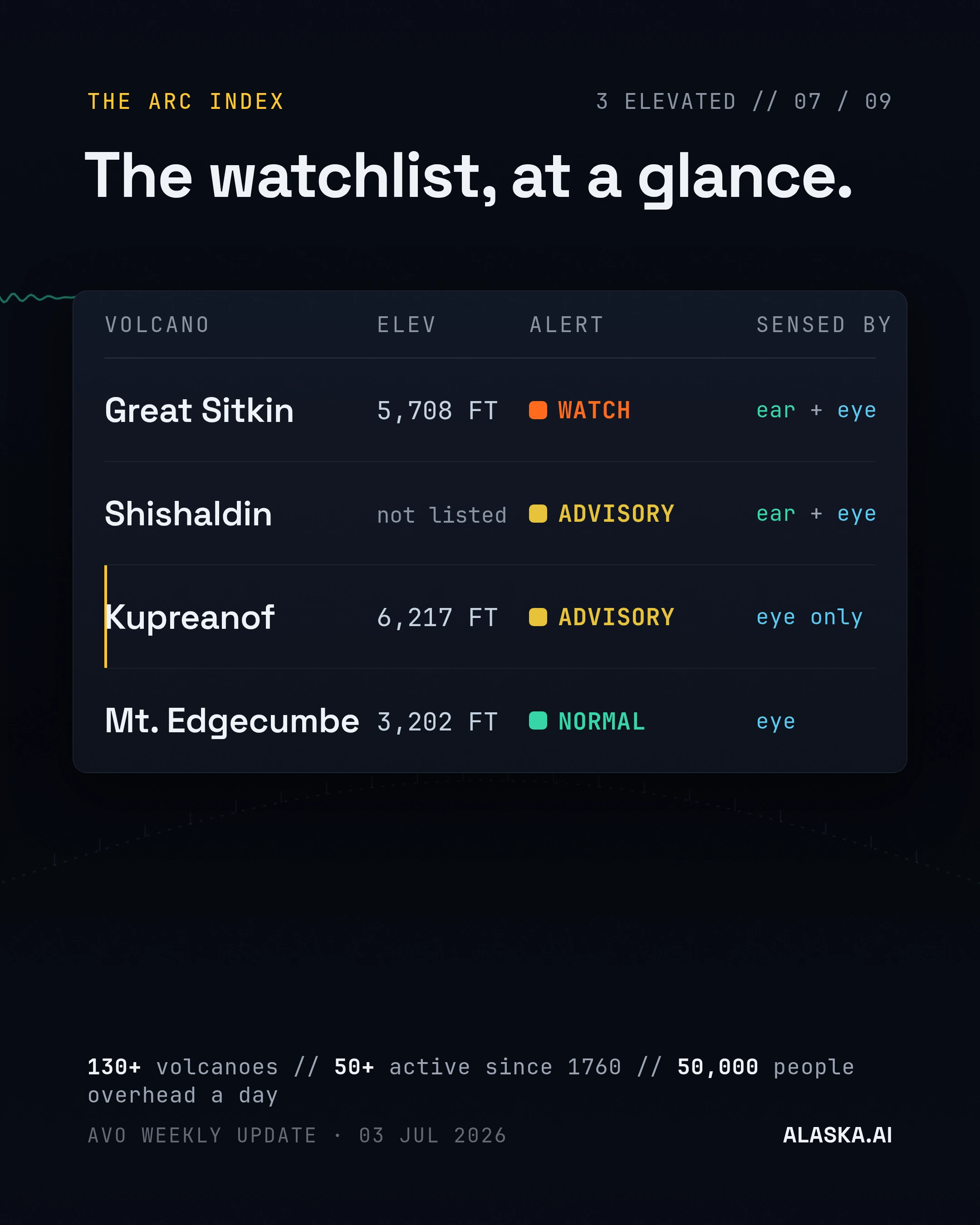
As of the July 3, 2026 AVO weekly update, Great Sitkin volcano was at Volcano Alert Level WATCH and Aviation Color Code ORANGE, with a slow lava eruption continuing in the summit crater.
VOISS-Net achieves 87% classification accuracy on the test set.
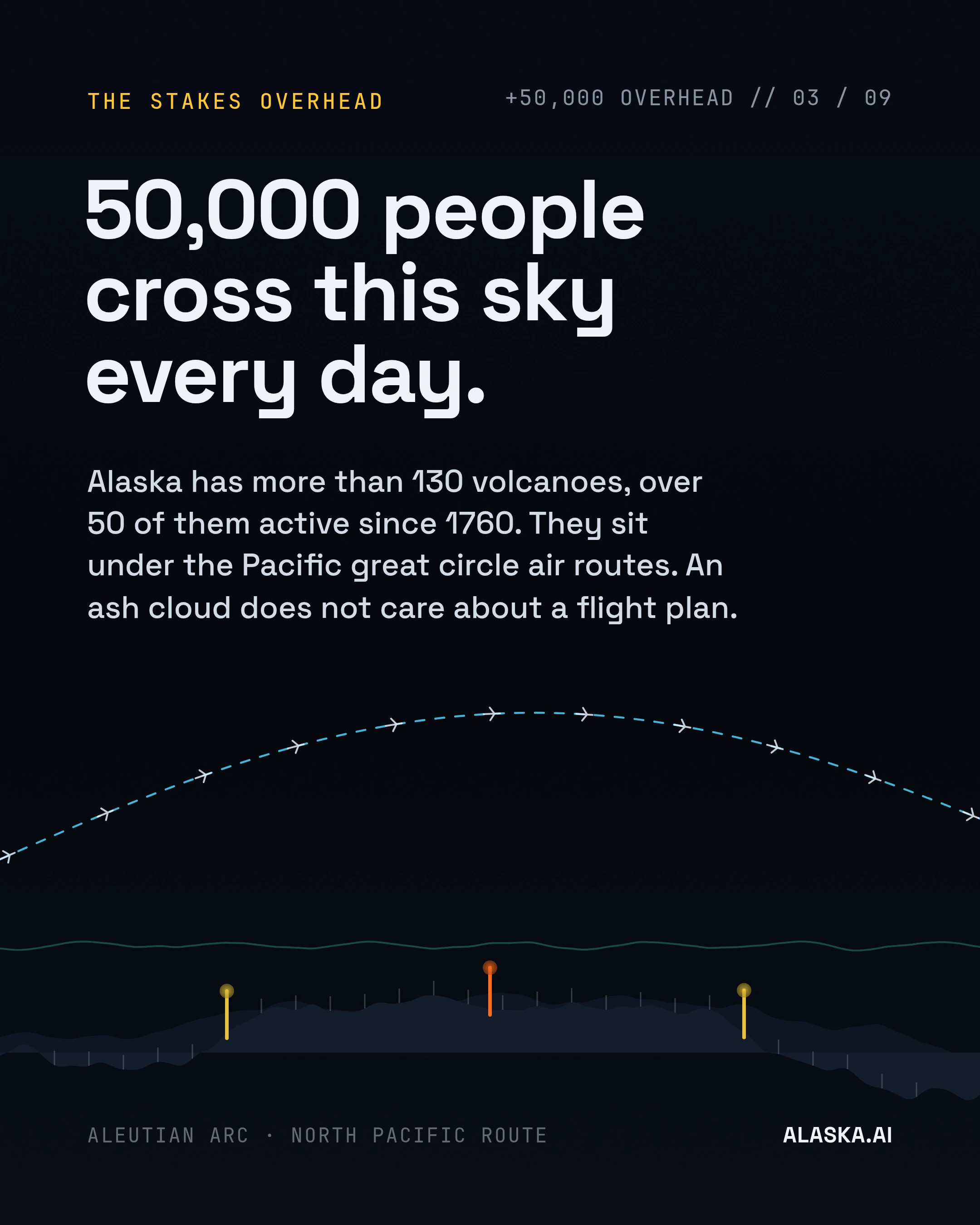
Alaska contains over 130 volcanoes and volcanic fields that have been active within the last two million years.
About 90 Alaska volcanoes have been active in the last 10,000 years, and more than 50 have been active in historical time (since about 1760).
Alaska's volcanoes sit under Pacific great-circle aircraft routes traversed by more than 50,000 people per day, and can erupt ash into that airspace.
As of July 3, 2026, Mount Kupreanof was at Volcano Alert Level ADVISORY and Aviation Color Code YELLOW, with seismic activity and volcanic gas emissions observed.
USGS defines Volcano Alert Level WATCH as heightened/escalating unrest with increased eruption potential, or an eruption underway that poses limited hazards.
USGS defines Volcano Alert Level ADVISORY as elevated unrest above known background level, closely monitored.
Great Sitkin volcano summit elevation is 5,708 feet (1,740 m).
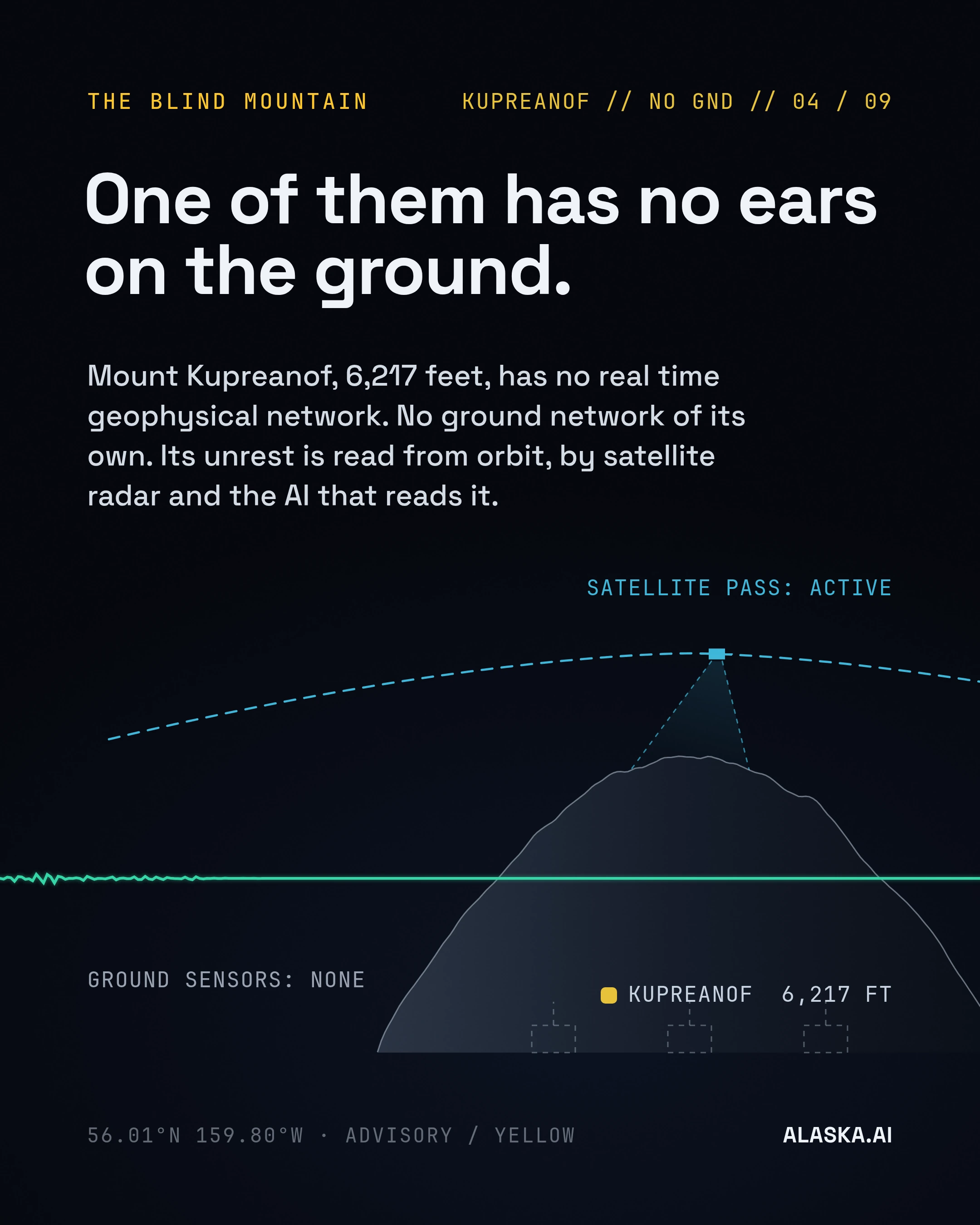
Mount Kupreanof summit elevation is 6,217 feet (1,895 m).
Mount Edgecumbe summit elevation is 3,202 feet (976 m).
As of July 3, 2026, Shishaldin volcano was at Volcano Alert Level ADVISORY and Aviation Color Code YELLOW, with continuing unrest.
Mount Kupreanof has no real-time geophysical monitoring network and is watched primarily via satellite and regional networks.
The July 3, 2026 AVO weekly update reported three Alaska volcanoes in elevated status simultaneously, Great Sitkin (Watch/Orange), Kupreanof (Advisory/Yellow), and Shishaldin (Advisory/Yellow).
AVO monitors these volcanoes with a multi-sensor network including local seismic, geodetic and infrasound sensors, satellite data, web cameras, and regional infrasound and lightning networks.
VOISS-Net is a generalized deep-learning (spectrogram-based CNN) model built to detect and classify volcano seismicity such as tremor, explosions, earthquakes and long-period events.
VOISS-Net was trained on more than 270,000 spectrograms.
VOISS-Net was developed using data from seven volcanoes across three regions, five Alaskan volcanoes, Mt. Etna in Italy, and Kilauea in Hawaii.
VOISS-Net was developed collaboratively by scientists at the Alaska Volcano Observatory / University of Alaska Fairbanks and the U.S. Geological Survey.
VolcSARvatory uses interferometric synthetic aperture radar (InSAR) to detect ground movement as small as 1 centimeter.
The Alaska Volcano Observatory at UAF has used a prototype of VolcSARvatory since early 2022.
VolcSARvatory's usefulness became apparent during an earthquake swarm at long-quiet Mount Edgecumbe volcano near Sitka on April 11, 2022.
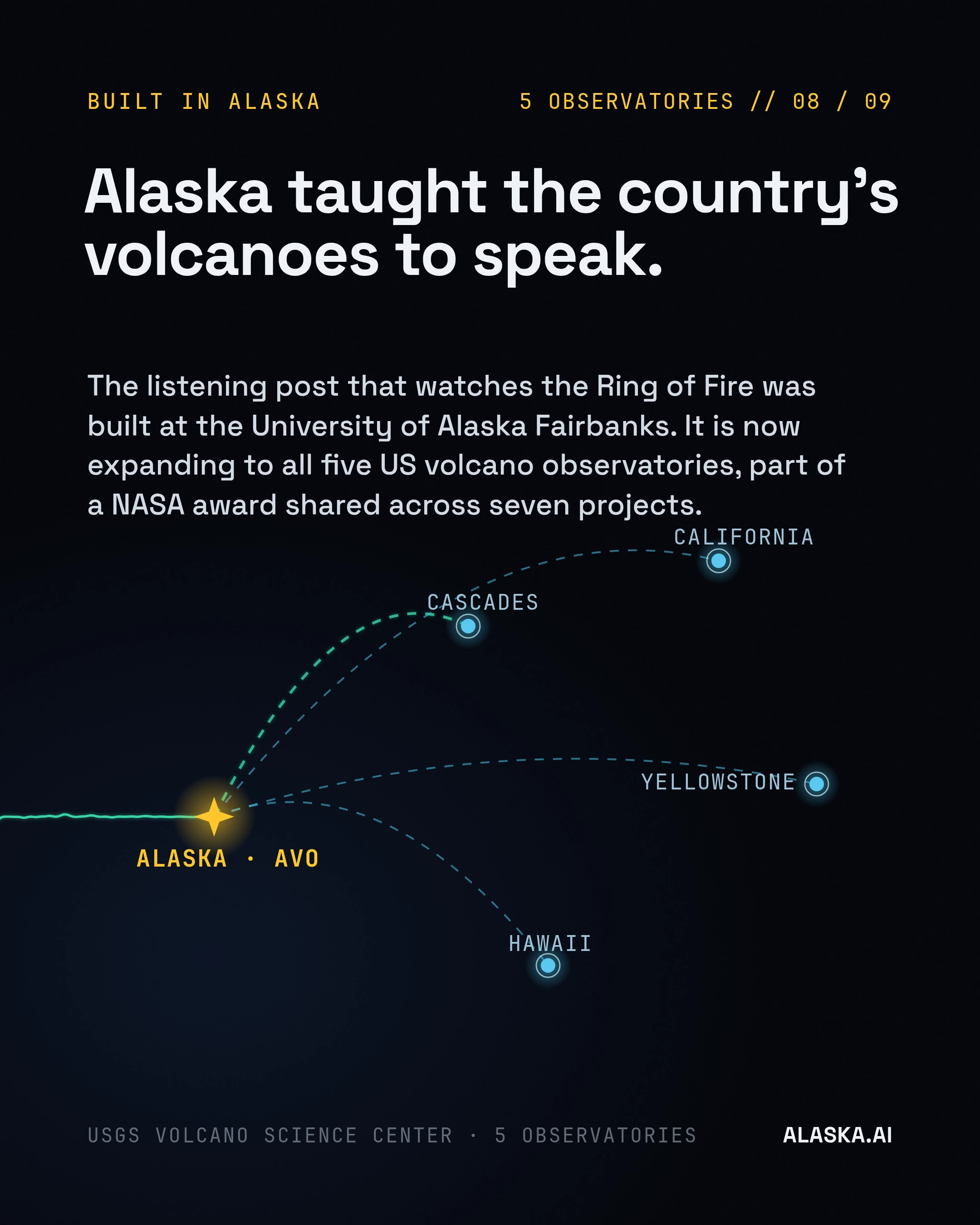
VolcSARvatory is being expanded to all USGS volcano observatories; the USGS Volcano Science Center operates AVO plus four other U.S. volcano observatories (five total).
The UAF VolcSARvatory expansion is one of seven NASA Disasters Program proposals that share $6.3 million over two years.
Democratic gubernatorial candidate Tom Begich argued Alaska must not fall behind on AI policy.
Gubernatorial candidate Jonathan Kreiss-Tomkins warned that the AI industry has understated public risk.
Kreiss-Tomkins emphasized Alaskan data sovereignty, saying Alaskans' data belongs to Alaskans alone.
Beats
This article is on Alaska AI research and science. Each beat page keeps every decision and every article on that subject in one place.