The Ladder Stops at Fifth Grade
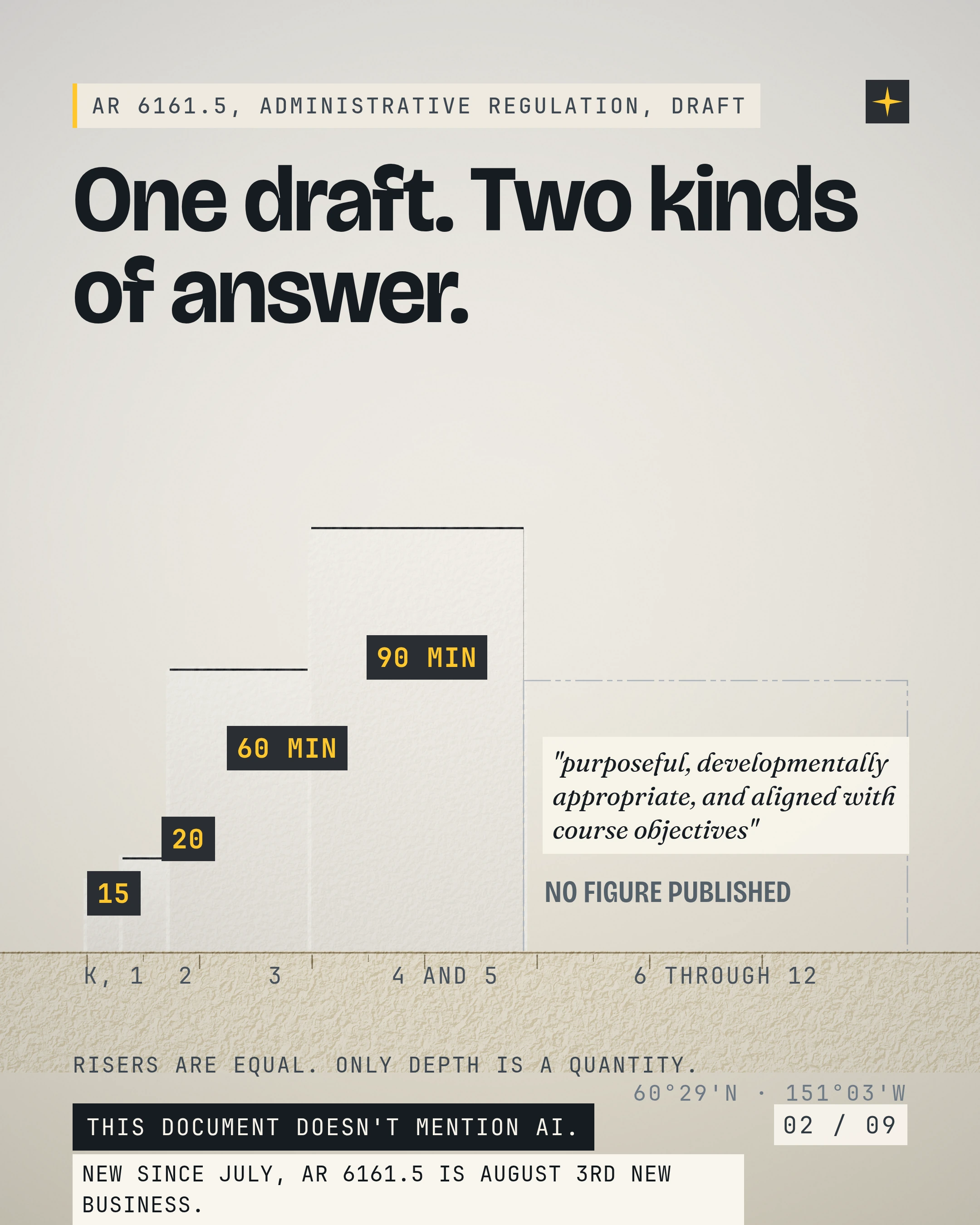
15 minutes a day. That is the routine technology cap a Kenai Peninsula Borough School District draft would set for kindergarten.
The deck
SWIPE, SCROLL OR CLICK A SLIDE TO GO FULLSCREEN · 9 SLIDES

The story
The draft reached the Policy Review Committee on August 3rd. For secondary schools it says "routine daily technology limits are not established". Grades 6 through 12 get adjectives instead. It never mentions AI.
This page covered the district's AI rulebook in July. The minute ladder is new since then.
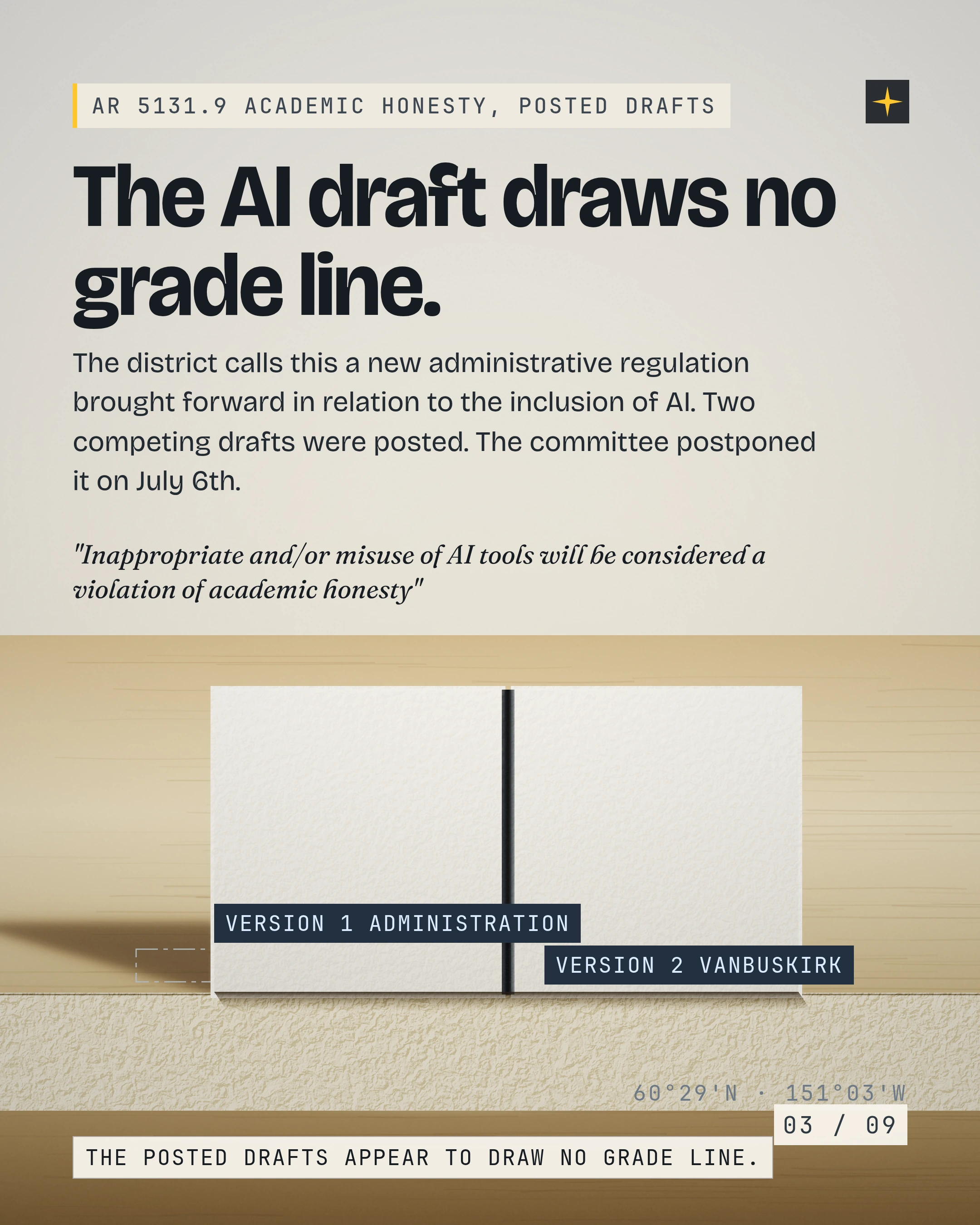
The regulation the district ties to "the inclusion of AI" was on that same agenda in two competing drafts. Neither appears to draw a grade line. Nothing is adopted.
Students start August 19th districtwide.
The minute ladder as drafted, the AI drafts with no grade line, and the seven documents that moved in one day.
Does the AI regulation need grade lines too, or is one standard right for a five year old and a senior?
What we verified
58 CLAIMS, EACH RE-FETCHED FROM ITS SOURCE BEFORE THIS DECK SHIPPED
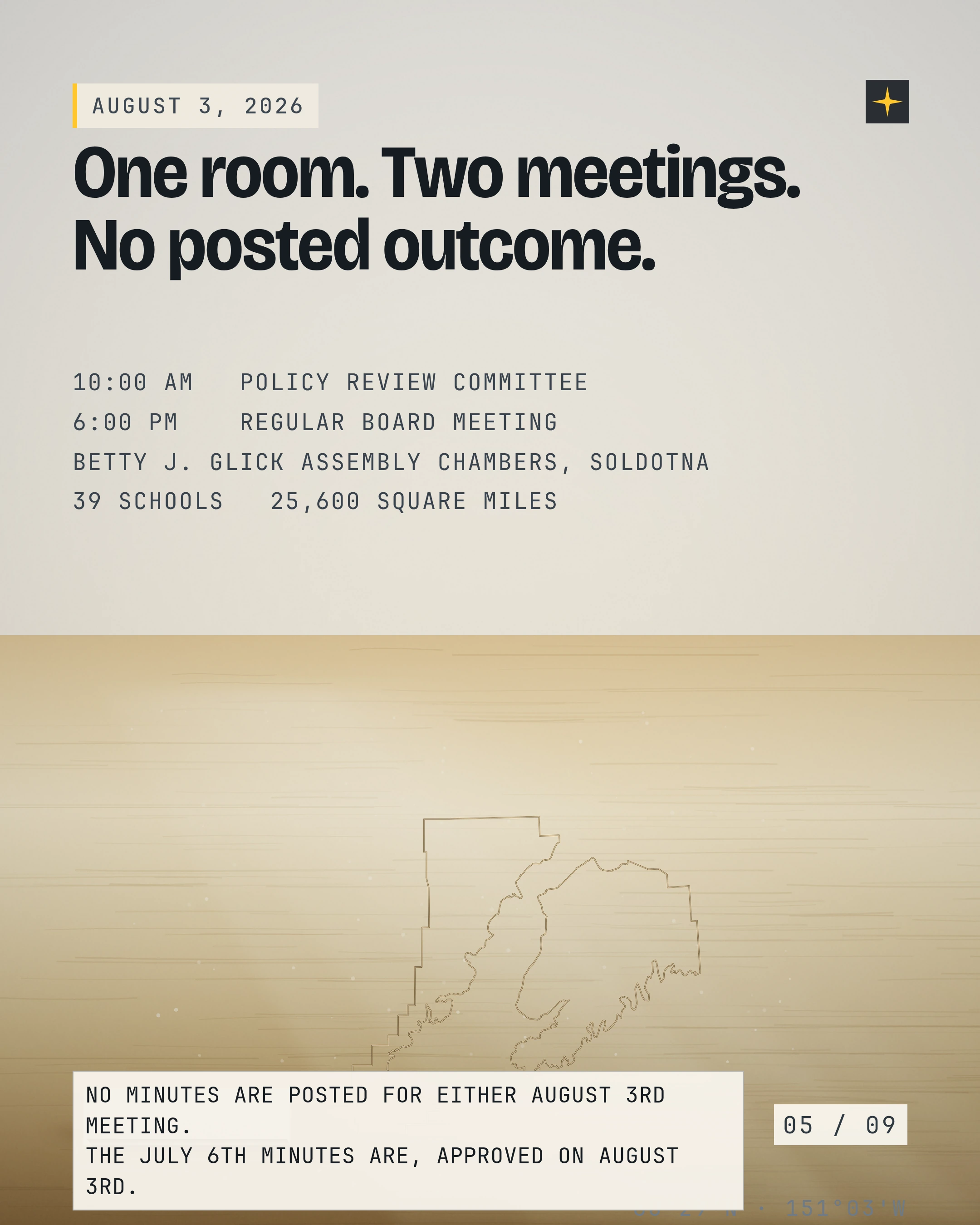
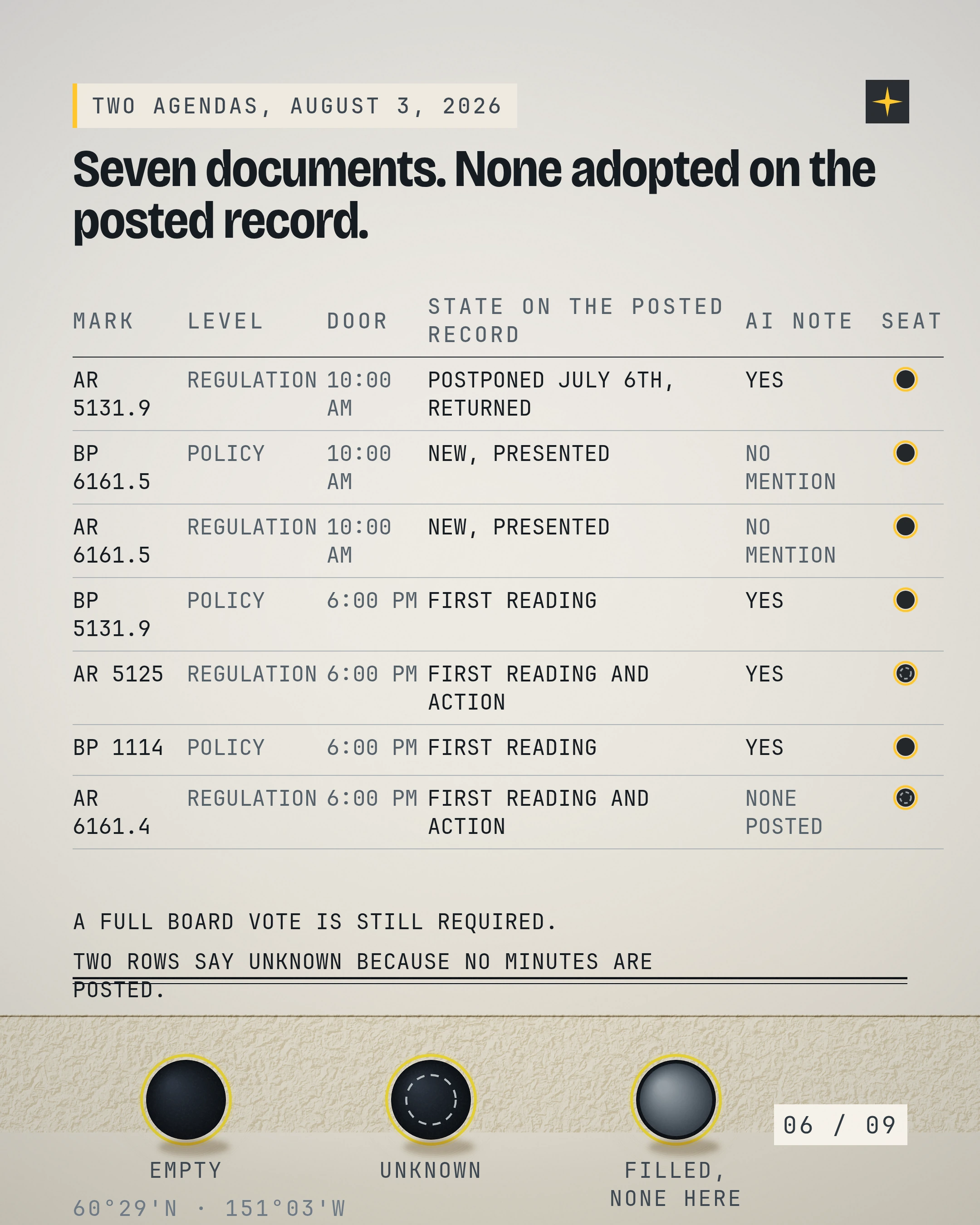
The KPBSD Policy Review Committee meeting of August 3, 2026 was scheduled to start at 10:00 AM.
The August 3rd Policy Review Committee meeting was held in the Betty J. Glick Assembly Chambers in Soldotna.
The August 3rd Policy Review Committee agenda carried eight numbered policy or exhibit documents across four review sections.
AR 5131.9 Academic Honesty appeared on the August 3rd committee agenda under the heading Policy Review-Ongoing.
The district describes AR 5131.9 Academic Honesty as a new administrative regulation brought forward in relation to the inclusion of AI.
Two competing drafts of AR 5131.9 were posted to the August 3rd agenda item, one from Administration and one from board member VanBuskirk.
The Policy Review Committee postponed AR 5131.9 at its July 6, 2026 meeting and carried it to the next committee meeting.
The Administration draft of AR 5131.9 opens by tying academic honesty directly to artificial intelligence.
The AR 5131.9 draft makes misuse of AI tools a violation of academic honesty subject to discipline under BP 5144.
The AR 5131.9 draft reserves the district's right to monitor and review student use of AI tools.
The posted drafts of AR 5131.9 appear to draw no grade line, applying the same AI rule to every student.
The VanBuskirk draft of AR 5131.9 permits AI as an instructional tool when it supports the objectives of the assignment.
The VanBuskirk draft of AR 5131.9 states that AI is meant to enhance learning and not to replace student thinking.
BP 6161.5 High-Quality Instruction and Purposeful Use of Technology came to the August 3rd committee as a brand new policy.
AR 6161.5 was presented as the administrative regulation accompanying the newly drafted BP 6161.5.
BP 6161.5 states that technology is one instructional tool among many and is not the instructional program.
BP 6161.5 says the board expects technology to support rather than replace relationships and instruction.
AR 6161.5 caps routine instructional technology use at 15 minutes a day in kindergarten and first grade.
AR 6161.5 caps routine instructional technology use at 20 minutes a day in second grade.
AR 6161.5 caps routine instructional technology use at 60 minutes a day in third grade.
AR 6161.5 caps routine instructional technology use at 90 minutes a day in fourth and fifth grade.
AR 6161.5 sets no routine daily technology limit for secondary schools.
AR 6161.5 addresses grades 6 through 12 with a qualitative standard instead of a minute figure.
AR 6161.5 says technology should not serve as the default instructional method where hands on learning offers greater educational value.
AR 6161.5 excludes assessments, distance education and intervention services from the routine use it limits.
The screen time drafts BP 6161.5 and AR 6161.5 do not mention artificial intelligence.
The full board's regular business meeting on the evening of August 3rd took a first reading of BP 5131.9 Academic Honesty on its consent agenda.
The August 3rd board consent agenda listed AR 5125 Student Records for first reading and action.
The August 3rd board consent agenda listed BP 1114 Communication Using Electronic Media for first reading.
The August 3rd board consent agenda also listed AR 6161.4 Acceptable Use Policy-Internet Safety Policy for first reading and action.
The district describes the AR 5125 Student Records revisions as recommended by Administration regarding AI-related policy shifts.
The district describes the BP 1114 revisions as recommended by Administration regarding AI-related policy shifts.
The district describes the BP 5131.9 revisions as recommended by Administration regarding AI-related policy shifts.
The KPBSD board's regular business meeting on August 3rd began at 6:00 PM, eight hours after the policy committee convened.
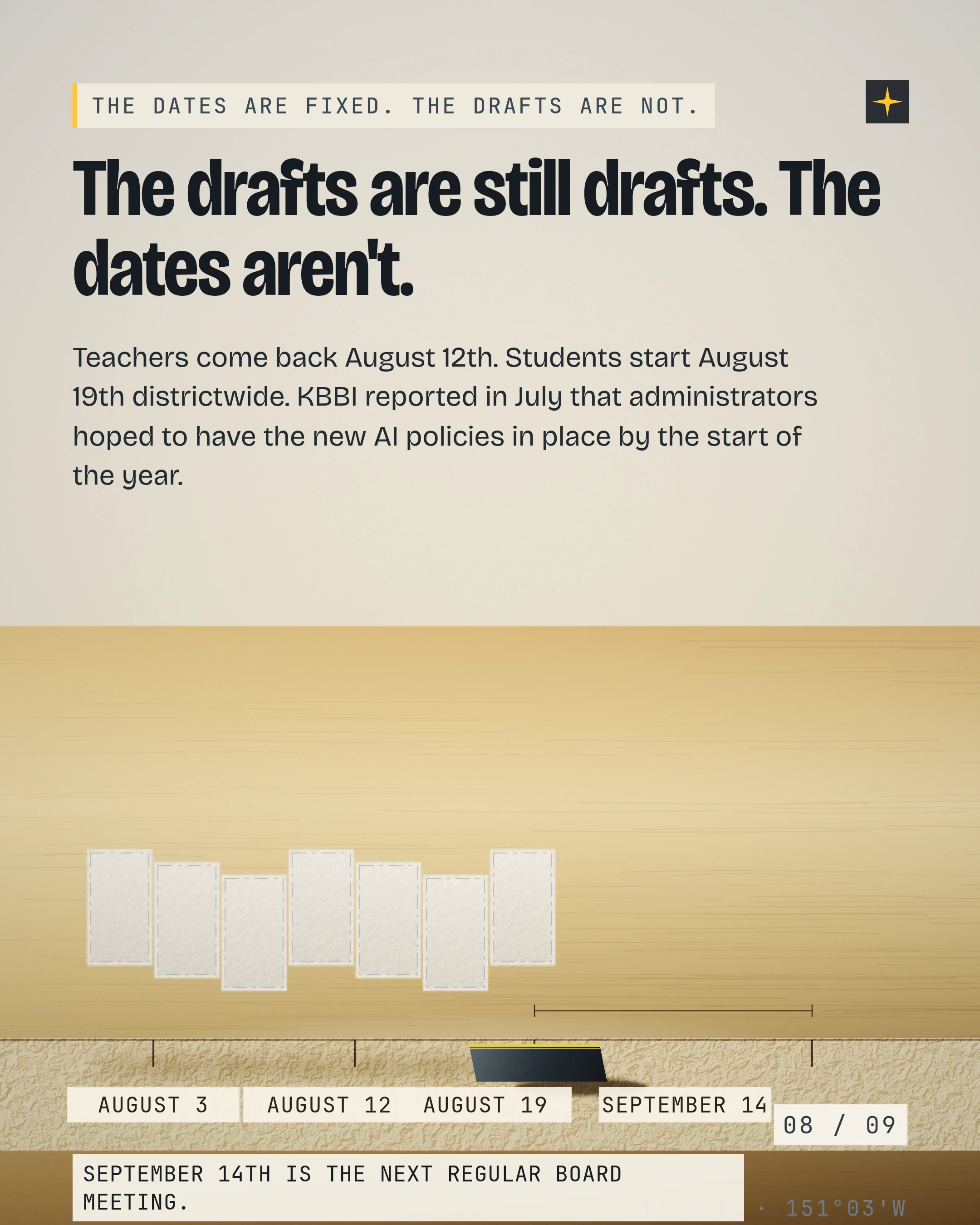
The next regular KPBSD board meeting after August 3rd is scheduled for September 14, 2026.
KPBSD reports an enrollment of about 8,300 students.
KPBSD operates 39 schools.
KPBSD covers 25,600 square miles and employs 1,214 people.
The first student day of the KPBSD 2026-27 school year is August 19, 2026 districtwide.
KPBSD teachers return on August 12, 2026, a week before students.
MagicSchool markets itself on its homepage as safe district aligned AI for schools.
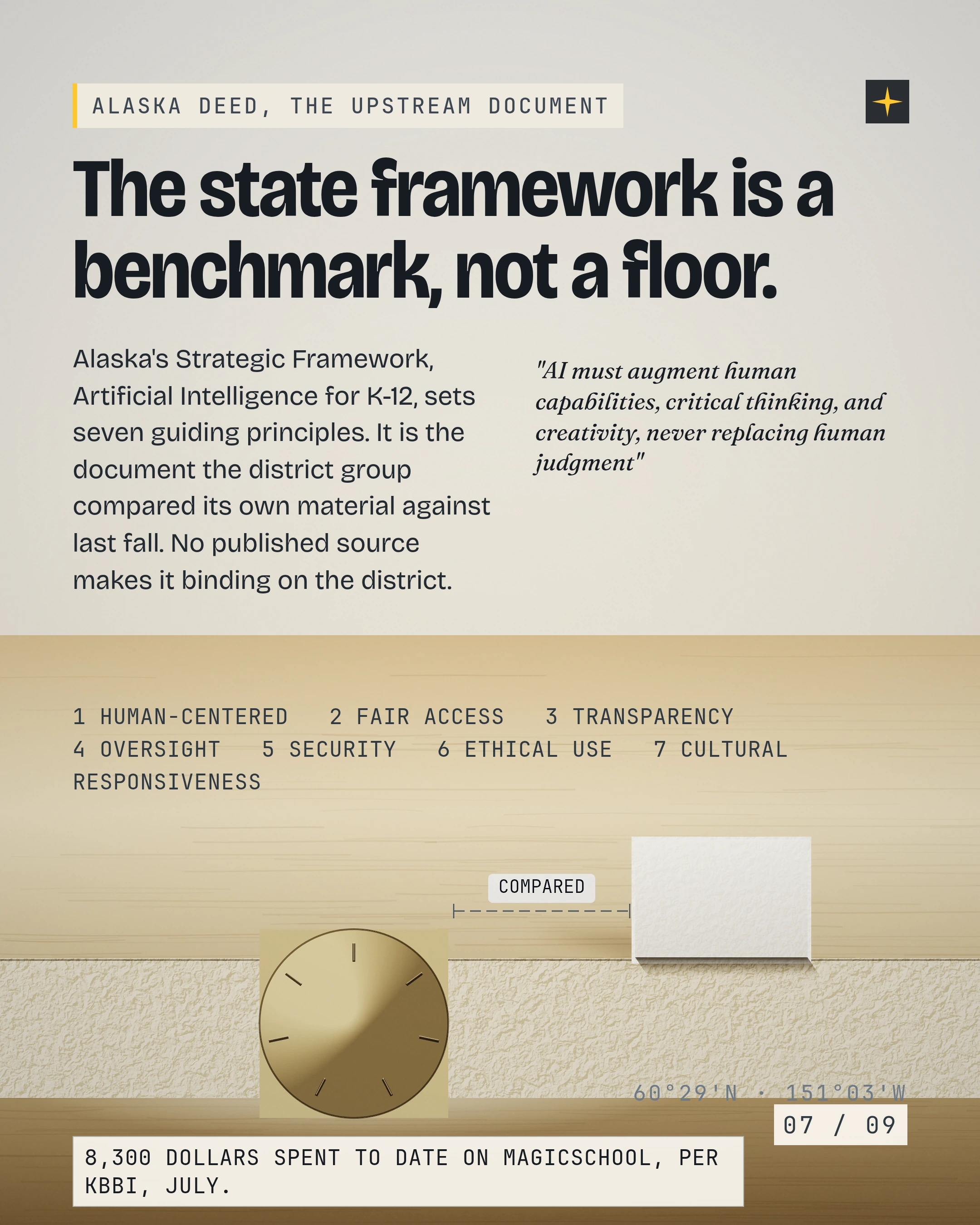
Alaska's state AI guidance for schools is titled Alaska's Strategic Framework, Artificial Intelligence for K-12, issued by the Department of Education and Early Development.
The Alaska DEED AI framework is built on seven guiding principles beginning with human-centered use.
The Alaska DEED AI framework's cultural responsiveness principle asks that AI tools affirm rather than diminish Alaska's diverse cultures.
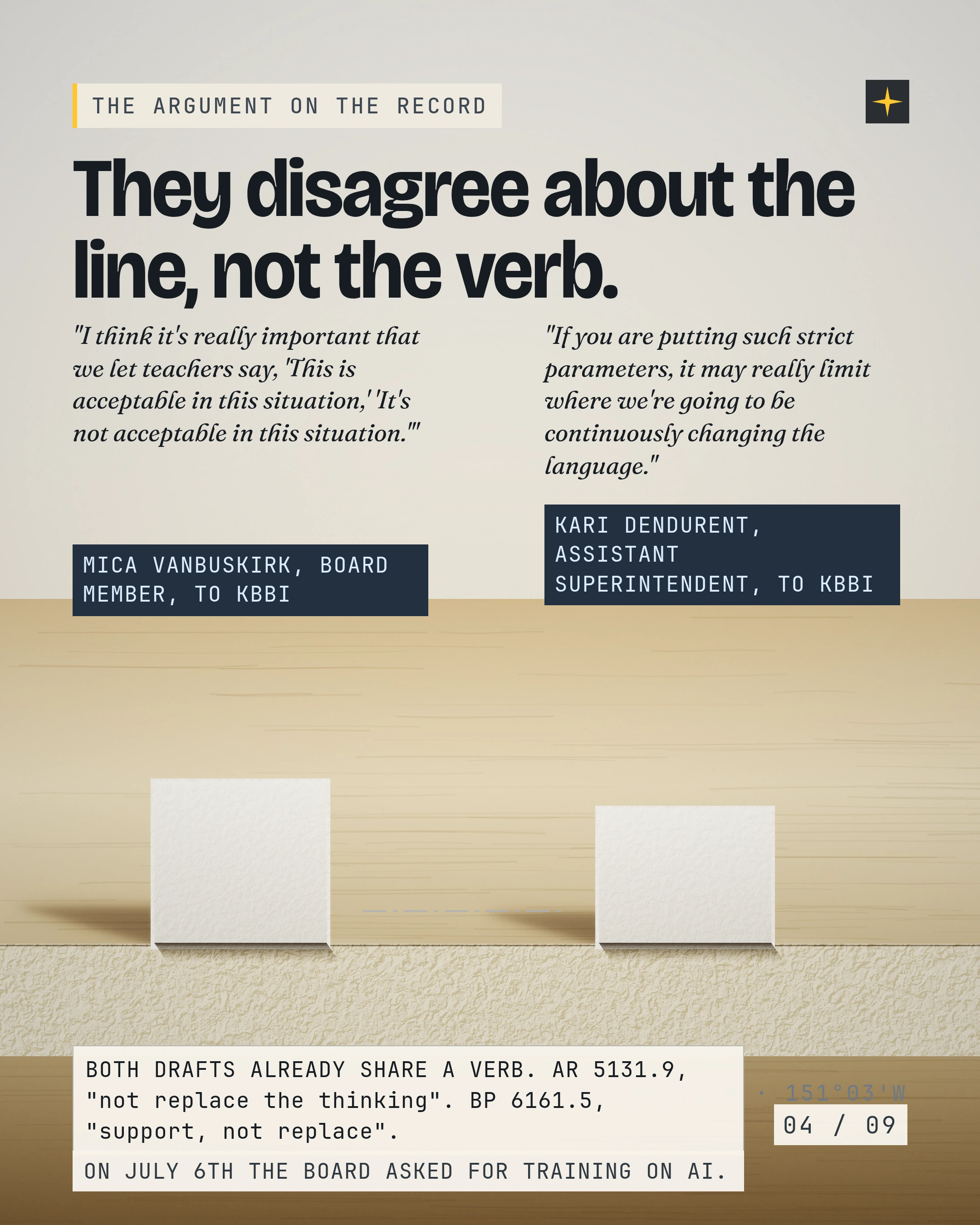
The July 6th committee record shows the board asked for a demonstration or training on AI before settling the policies.
No minutes are posted for either of the August 3rd meetings, so the outcome of that day is not on the public record.
The July 6th committee minutes are posted and are marked approved on August 3, 2026, the same day whose own minutes are not posted.
Chair Kelley Cizek called the July 6th Policy Review Committee meeting to order at 1:03 p.m. with four board members and the assistant superintendent present.
Assistant superintendent Kari Dendurent said the district has spent 8,300 dollars to date on a three year MagicSchool subscription for students and staff.
KBBI describes MagicSchool as an education specific AI platform that lets teachers and administrators monitor its use and set safeguards.
Virtual learning coordinator Amanda Adams said the district group began last fall by comparing the state AI framework with what KPBSD already had.
KDLL reported that the two technology policies presented on August 3rd need further committee review and full board approval before taking effect.
Superintendent Clayton Holland said board members have expressed a desire to put parameters on how much screen time students get in district buildings.
Board member Mica VanBuskirk said teachers should be able to say when AI use is acceptable and when it is not.
Assistant superintendent Kari Dendurent warned that strict parameters could limit the district as the language keeps changing.
KBBI reported in July that district administrators hope to implement the new AI policies by the beginning of the new school year.
Kenai High School assistant principal Will Chervenak said the technology policy defines the district's ethos and its view of high quality instruction.
KDLL reported that August 3rd was the first time board members saw the pair of screen time proposals.