Nineteen Flares Over the Kenai, and One Number
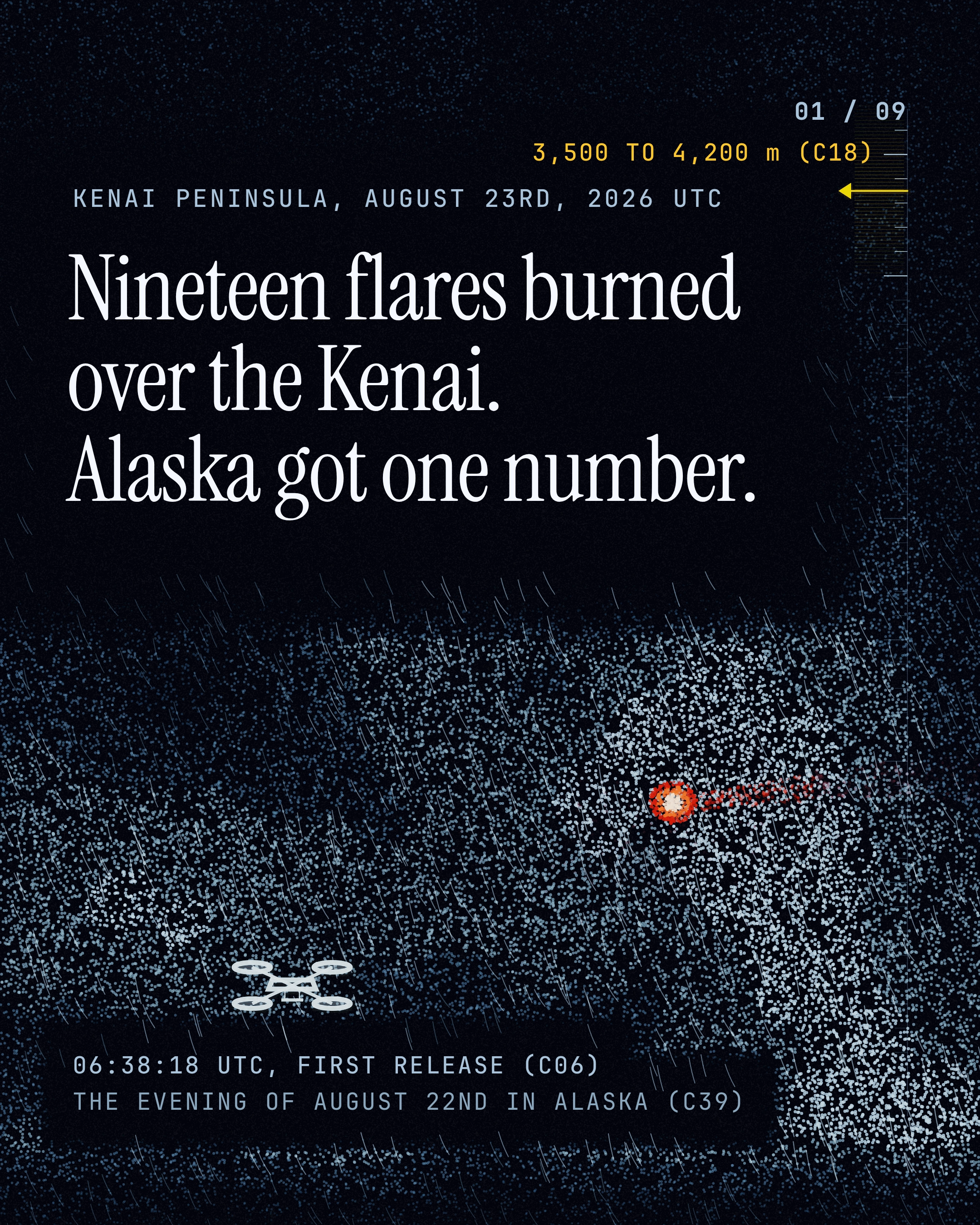
Two drones released 374.3 grams of silver iodide over the Kenai Peninsula on August 23rd, about the mass of a can of soup.
The deck
SWIPE, SCROLL OR CLICK A SLIDE TO GO FULLSCREEN · 9 SLIDES
The story
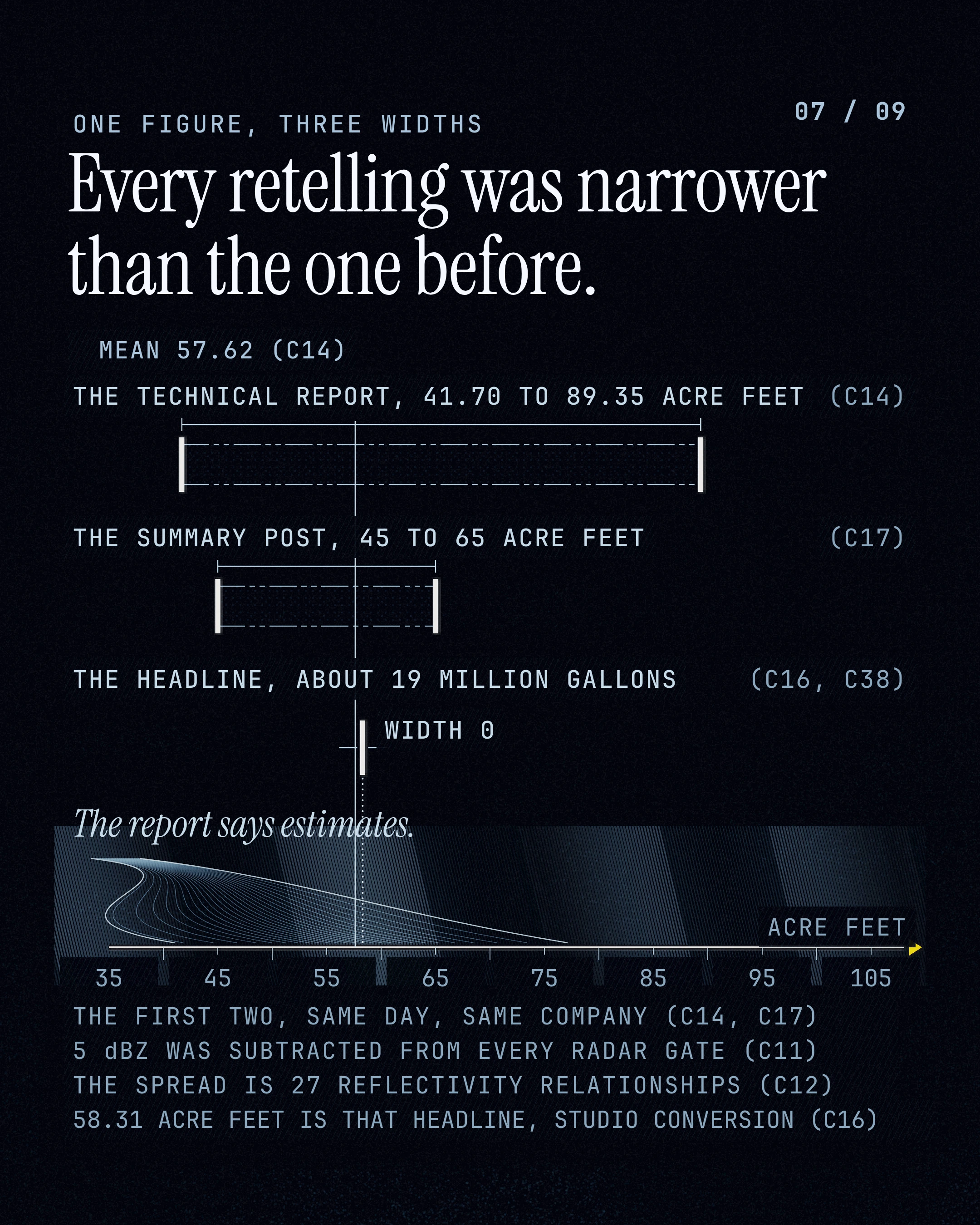
Rainmaker's report puts the precipitation attributed to seeding at a mean of 57.62 acre feet, in a 5th to 95th percentile range of 41.70 to 89.35.
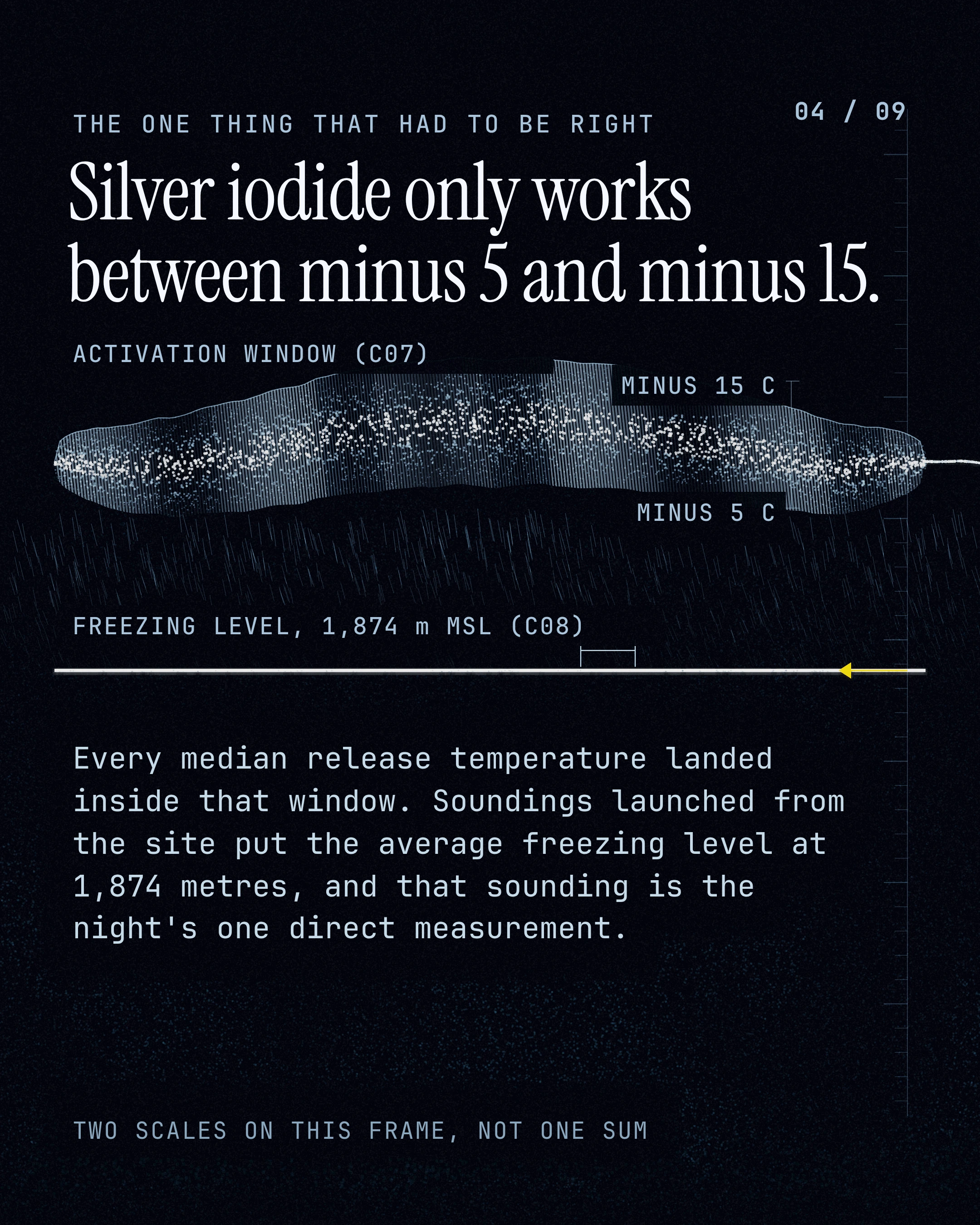
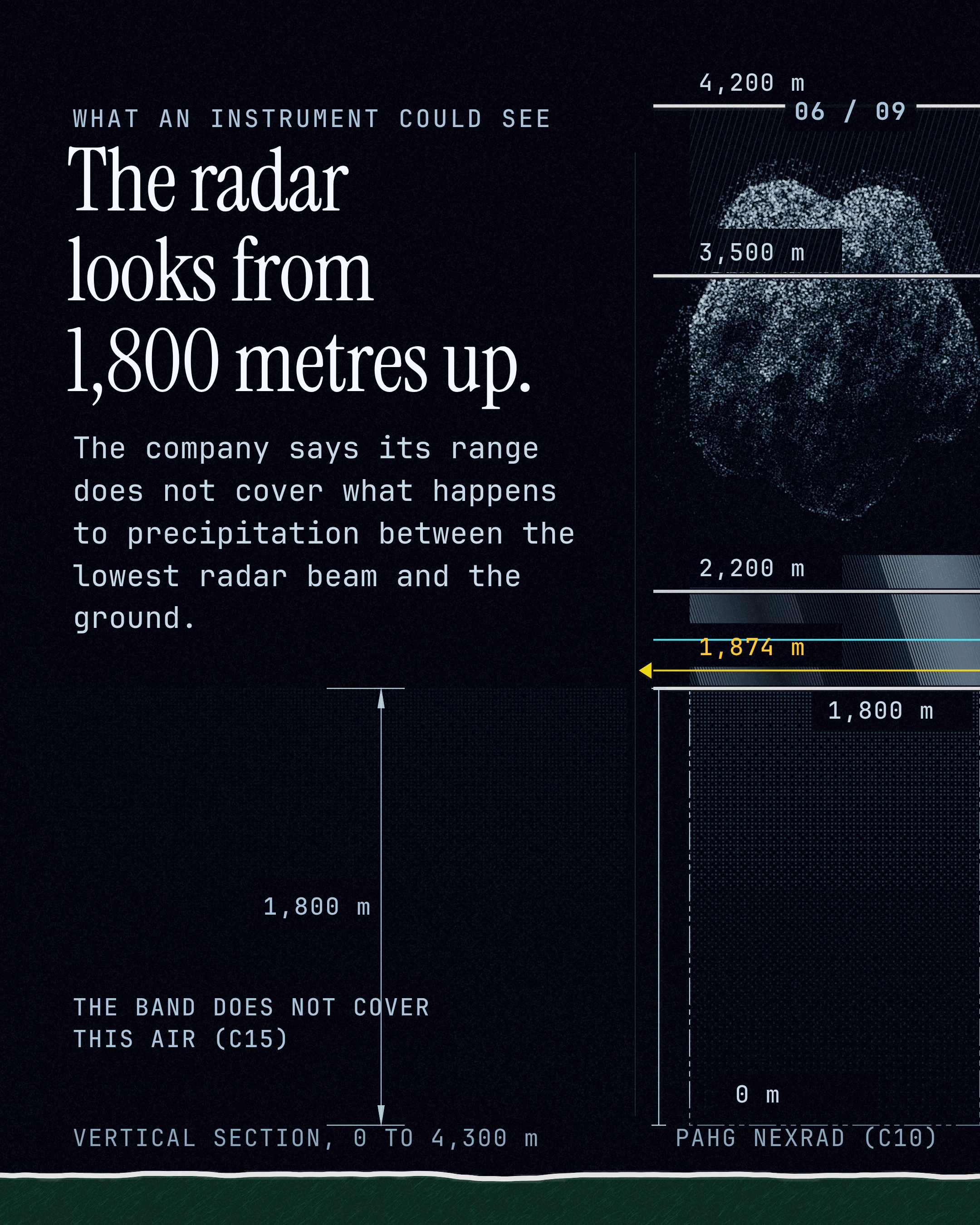
The flare releases ran between 06:38 and 09:33 UTC. Soundings put the average freezing level near 1,874 metres.
A summary post the same day says "approximately 19 million gallons".
The lowest radar beam sits near 1,800 to 2,200 metres. Rainmaker says its range doesn't cover what happens below that beam.
An operation measured to the gram produced a number that spans a factor of two.
The deck carries the operations log as published, the beam floor drawn to scale and one figure at three widths.
Same company, same day. Which of those two numbers earns the headline?
What we verified
40 CLAIMS, EACH RE-FETCHED FROM ITS SOURCE BEFORE THIS DECK SHIPPED
Rainmaker Technology Corporation says it conducted drone based glaciogenic cloud seeding in the Kenai Peninsula on August 23rd, 2026.
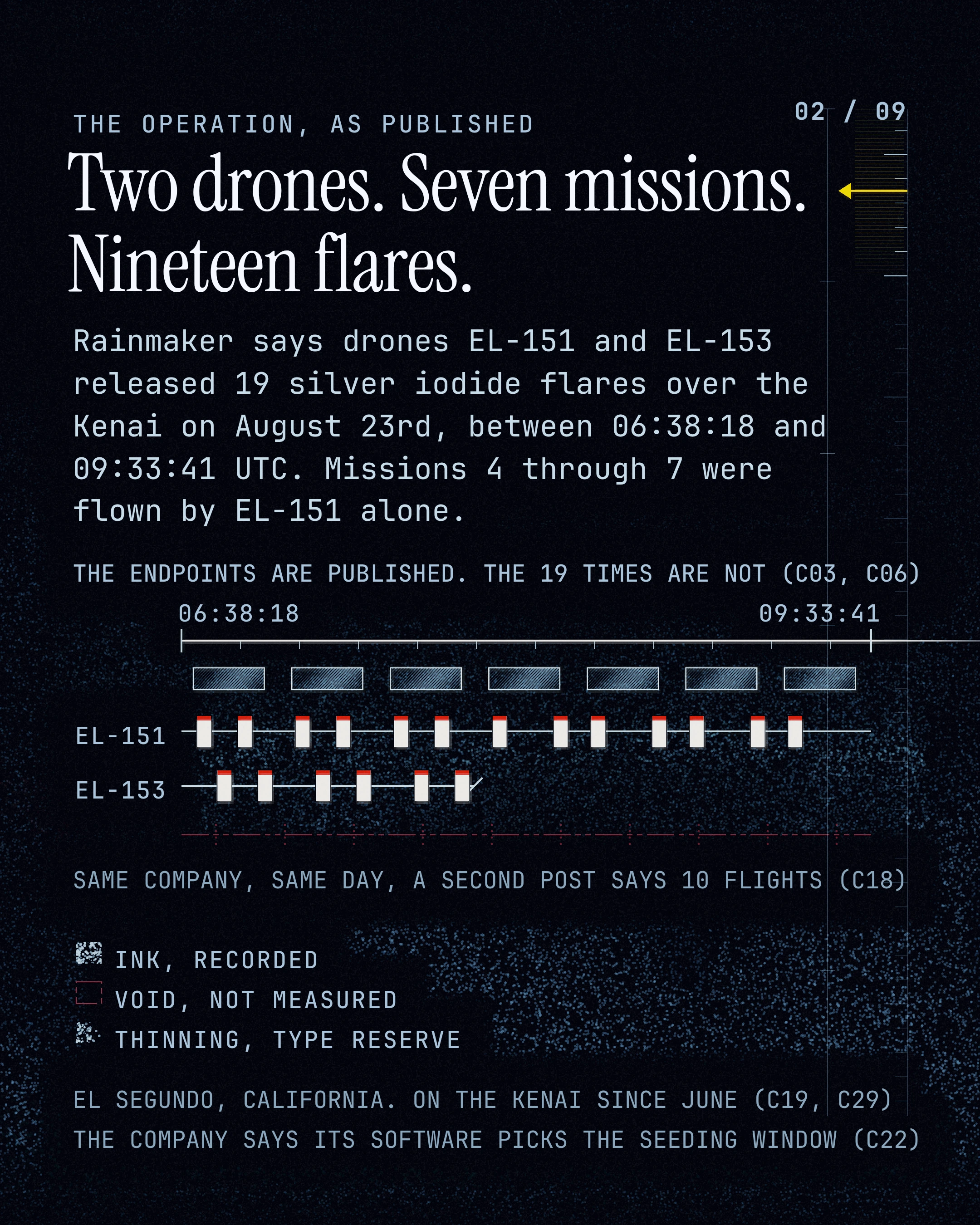
Rainmaker reports it executed seven coordinated seeding missions over a three hour period.
Rainmaker reports that 19 red silver iodide flares were released during the operation.
Rainmaker names two drones in the operation, identified as EL-151 and EL-153.
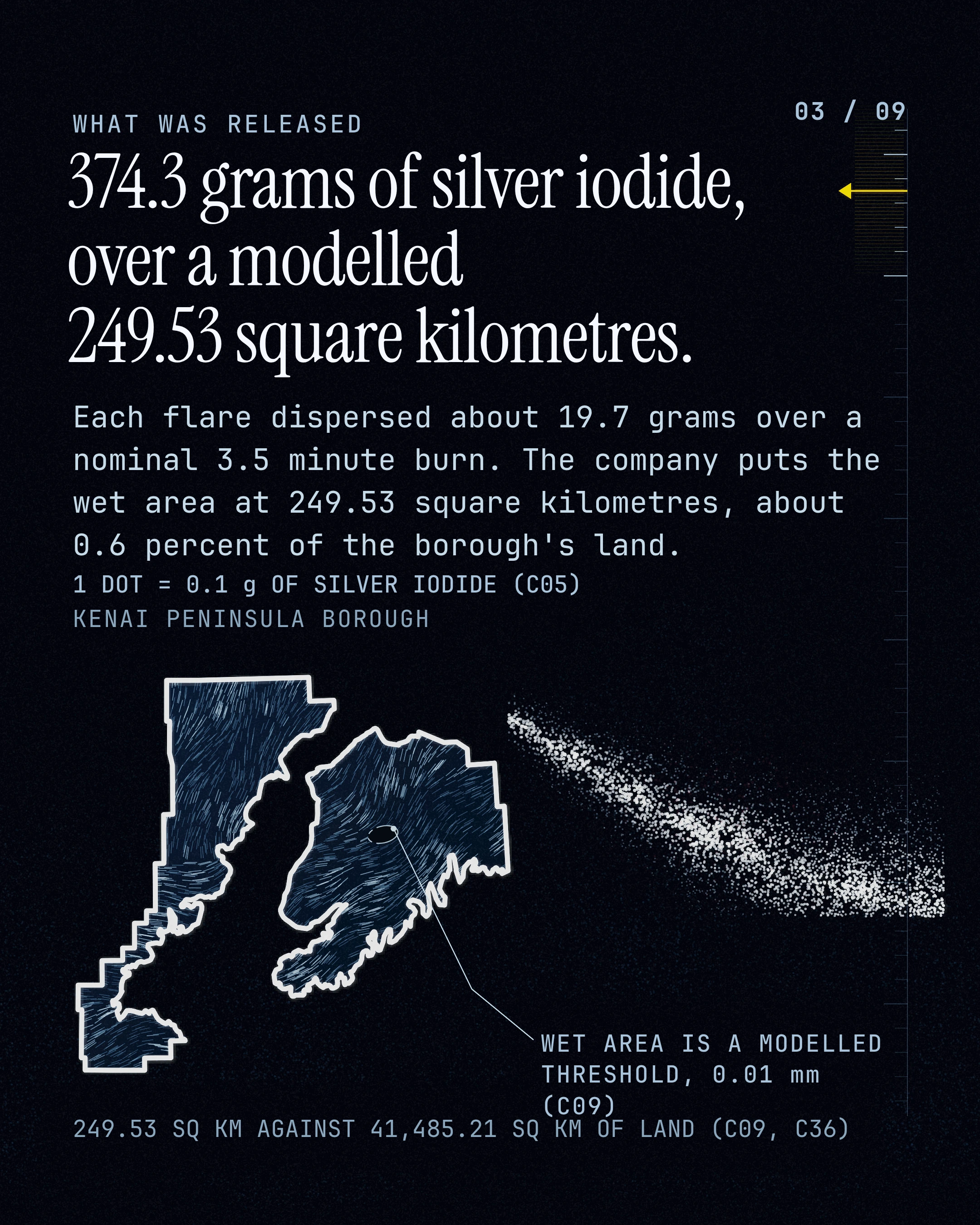
Rainmaker reports the flares dispersed approximately 374.3 grams of silver iodide in total.
Rainmaker reports the flare releases occurred between 06:38, 18 and 09:33, 41 UTC.
Rainmaker reports all median release temperatures fell within the approximate minus 5 to minus 15 degrees Celsius silver iodide activation window.
Rainmaker reports soundings launched from the seeding site placed the average freezing level near 1,874 metres above mean sea level.
Rainmaker reports the wet area attributed to seeding covered 249.53 square kilometres, defined as accumulated seeded precipitation exceeding 0.01 millimetres.
Rainmaker states the WSR-88D radar at PAHG provides the principal observational basis for the analysis.
Rainmaker estimated the natural background by subtracting 5 dBZ from all radar gates before converting reflectivity to precipitation.
Rainmaker converted radar reflectivity to precipitation using 27 separate relationships of the form Z equals a times S to the power b.
Rainmaker uses the verb estimates for the net new precipitation figure.
Rainmaker's own report gives a 5th to 95th percentile range of 41.70 to 89.35 acre feet around a mean of 57.62 acre feet.
Rainmaker states its uncertainty range does not account for what happens to precipitation between the lowest radar beam and the ground.
Rainmaker's summary post states the operation generated approximately 19 million gallons of water in a three hour period.
Rainmaker's summary post gives the figure as a mean of 57 acre feet with an interquartile range of 45 to 65 acre feet.
Rainmaker's summary post says the company made 10 seeding flights on August 23rd between 6:30am and 9:23am UTC.
Rainmaker says it has operated in the Kenai Peninsula since June 2026.
Rainmaker says it chose the region for a high incidence of summertime seeding conditions along the Chugach and Kenai coastal ranges.
Rainmaker says it followed methodology established by the National Center for Atmospheric Research in the 2017 SNOWIE campaign.
Rainmaker describes Stratus as a proprietary forecasting and nowcasting platform that ingests realtime weather data to identify optimal seeding windows.
Rainmaker's technology page advertises 20 plus data integrations and 5 day advanced awareness of seeding conditions.
Rainmaker's technology page claims 8,000 plus telemetry data variables in its validation stack.
Atmo and Rainmaker announced a strategic alliance for AI powered precision cloud seeding on July 14th, 2025.
Atmo claims its ensemble deep learning models predict weather up to 40,000 times faster and up to 100 times more precisely than conventional weather models.
The Rainmaker and Atmo announcement puts drone seeding operating cost at approximately 50 dollars per flight hour including materials.
Rainmaker chief executive Augustus Doricko said the company can combine AI meteorology with radar validated cloud seeding to deliver measurable precipitation enhancement.
Rainmaker Technology Corporation is based in El Segundo, California.
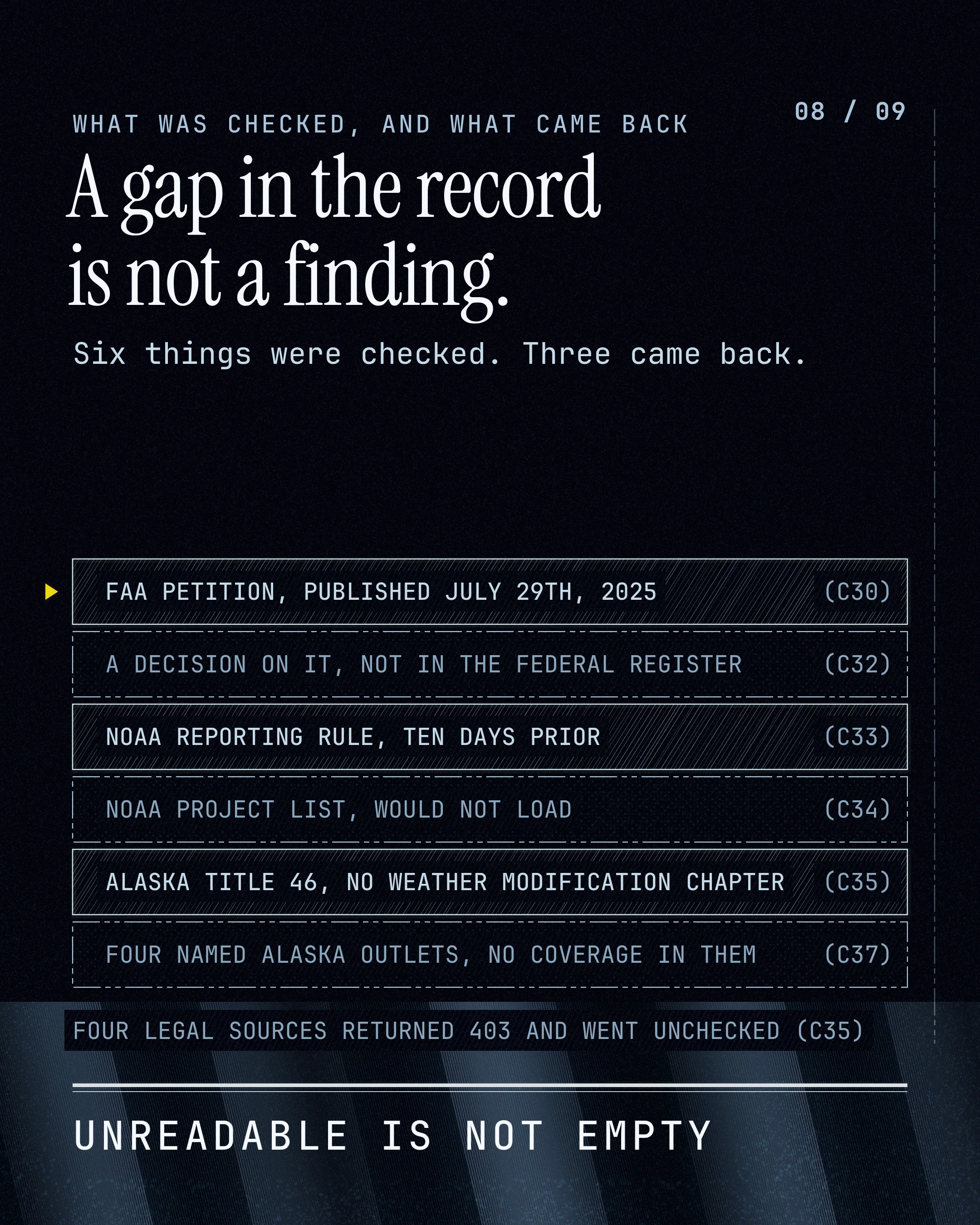
The Federal Register published a summary of Rainmaker Technology Corporation's petition for exemption from 14 CFR 107.36 on July 29th, 2025 under docket FAA-2025-1630.
Rainmaker's FAA petition seeks authorization to use burn in place and ejectable flares on its Elijah quadcopter drones for precipitation enhancement.
As of August 27th, 2026 the Federal Register contains no grant or denial of Rainmaker's exemption petition, only the July 2025 notice of the petition.
NOAA requires anyone conducting weather modification in the United States to report it at least 10 days before undertaking the activity.
NOAA's public list of weather modification project reports could not be read to confirm or refute a Rainmaker filing for the Alaska operation.
The Kenai Peninsula Borough has a land area of 16,017.53 square miles.
Rainmaker's flare releases ran from 06:38 to 09:33 UTC on August 23rd, which is the evening of August 22nd in Alaska Daylight Time.
No chapter of Alaska Statutes Title 46, which covers water, air, energy and environmental conservation, addresses weather modification or cloud seeding.
A search of named Alaska outlets on August 27th, 2026 found only the Alaska Watchman had covered the Rainmaker Kenai Peninsula operation.
The Alaska Watchman headlined a single 19 million gallon figure while its own body reported the company's range.
The Alaska Watchman reported that the Air Line Pilots Association warned Rainmaker's technology poses an extreme safety risk.
Beats
This article is on Defense and federal AI in Alaska · Alaska AI research and science. Each beat page keeps every decision and every article on that subject in one place.