Thirty Lake Beds After a Cold Alaska Winter
A browser and an internet connection are all you need to open the Permafrost Discovery Gateway, per NCEAS.
The deck
SWIPE, SCROLL OR CLICK A SLIDE TO GO FULLSCREEN · 6 SLIDES
The story
It launched an Arctic lake drainage tool on August 13th, 2026.
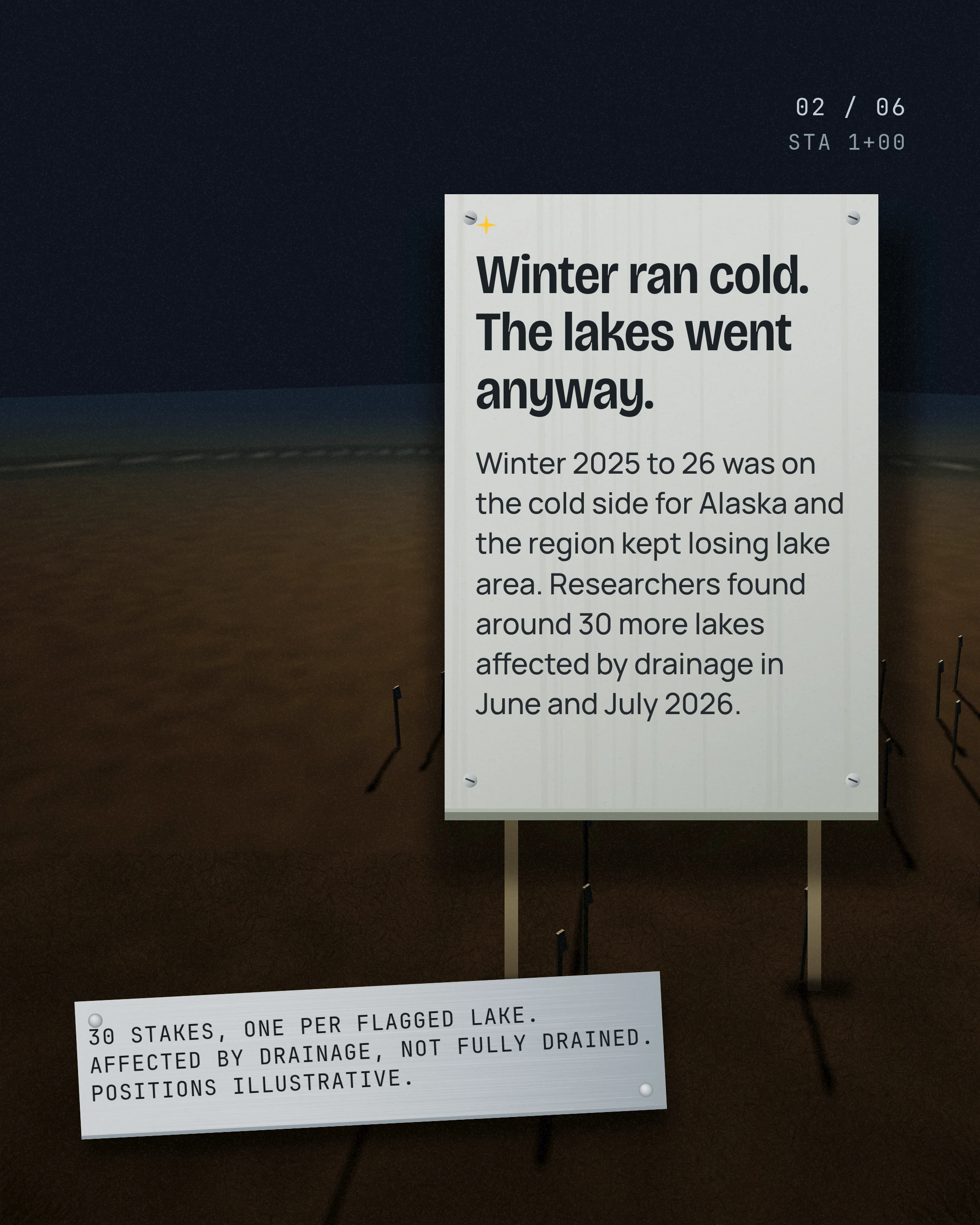
Around 30 more lakes were affected by drainage in northwestern Alaska in June and July 2026. The authors say this suggests permafrost thaw. They also say not all lake change is thaw.
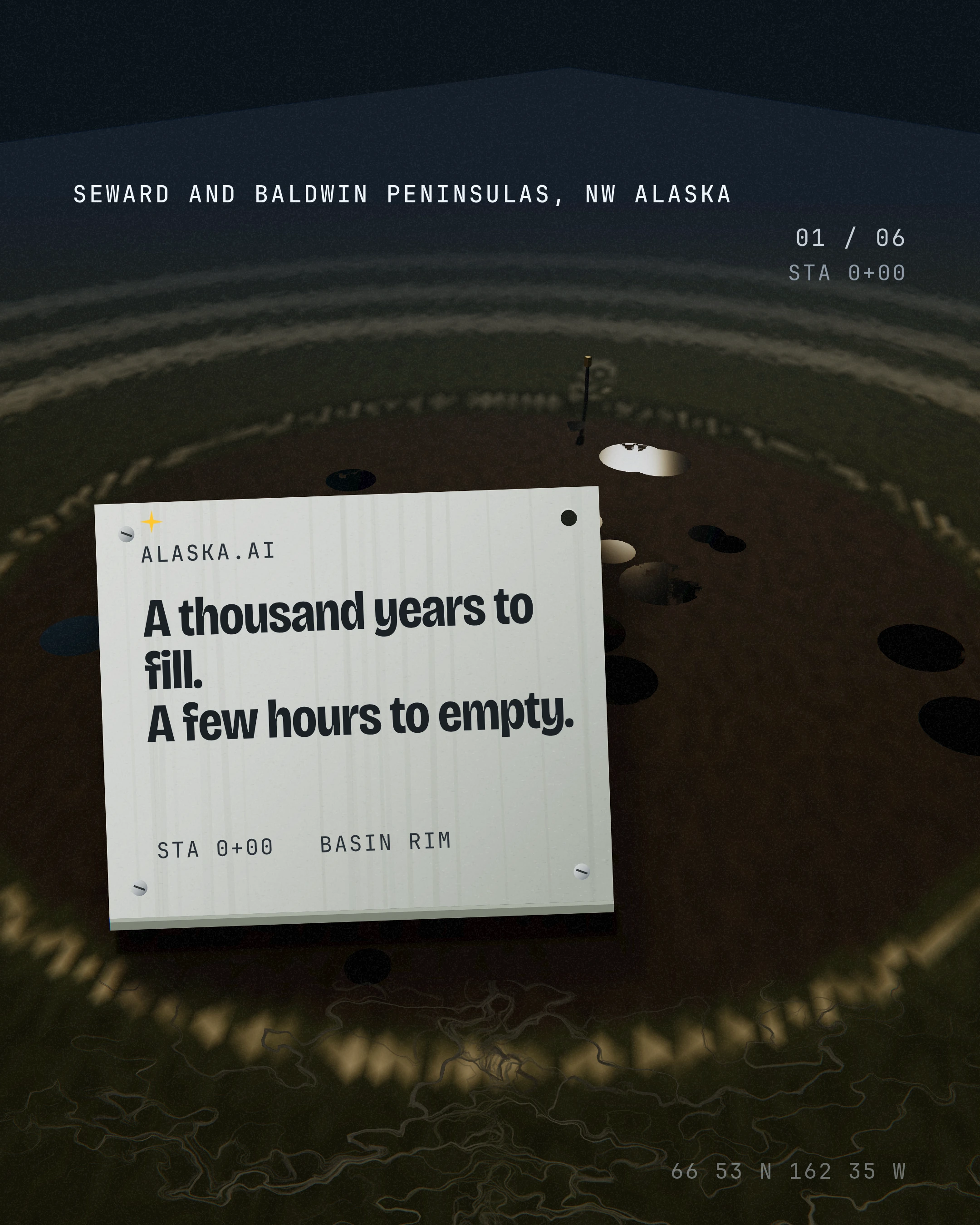
A lake several hundred meters long might take a millennium to form. Thaw from one warm summer can drain it in hours. Permafrost touches roughly 80 percent of Alaska land, and more than 140 communities build on it.
The 2026 drainage count with its hedges, the mechanism at the breach, the 2018 tally of almost 200 lakes out of about 4,600, and the two limits the authors name.
Woodwell calls the Gateway a platform in development. Which decision made off today's version would you reopen when it updates?
What we verified
32 CLAIMS, EACH RE-FETCHED FROM ITS SOURCE BEFORE THIS DECK SHIPPED
Researchers found around 30 more lakes that were affected by drainage in June and July 2026.
The Seward and Baldwin peninsulas in northwestern Alaska are described by the researchers as hot spots for lakes suddenly draining.
The researchers write that although winter 2025 to 26 was on the cold side for Alaska, the region continued to lose lake area.
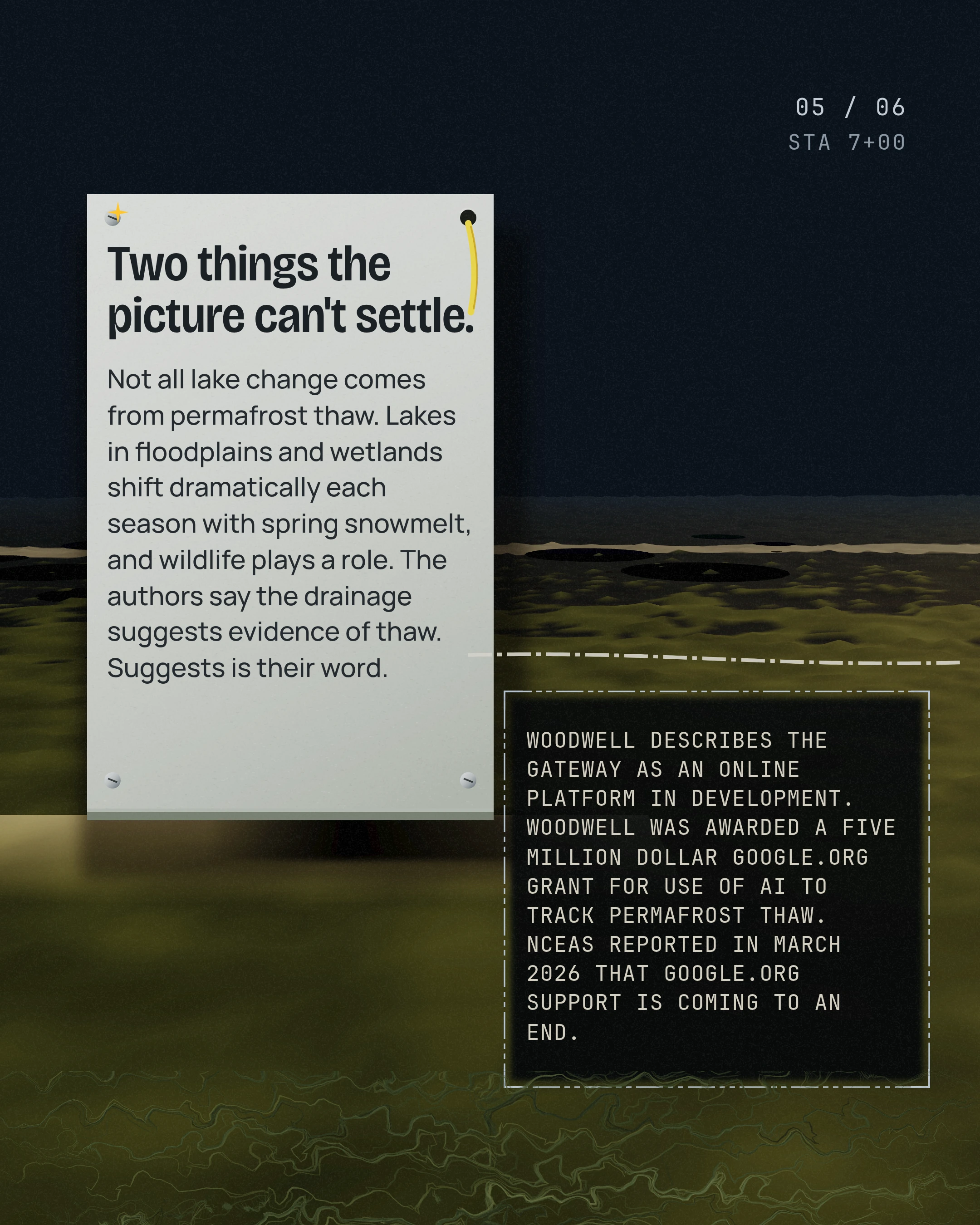
The authors say the continued loss of lake area suggests evidence of permafrost thaw.
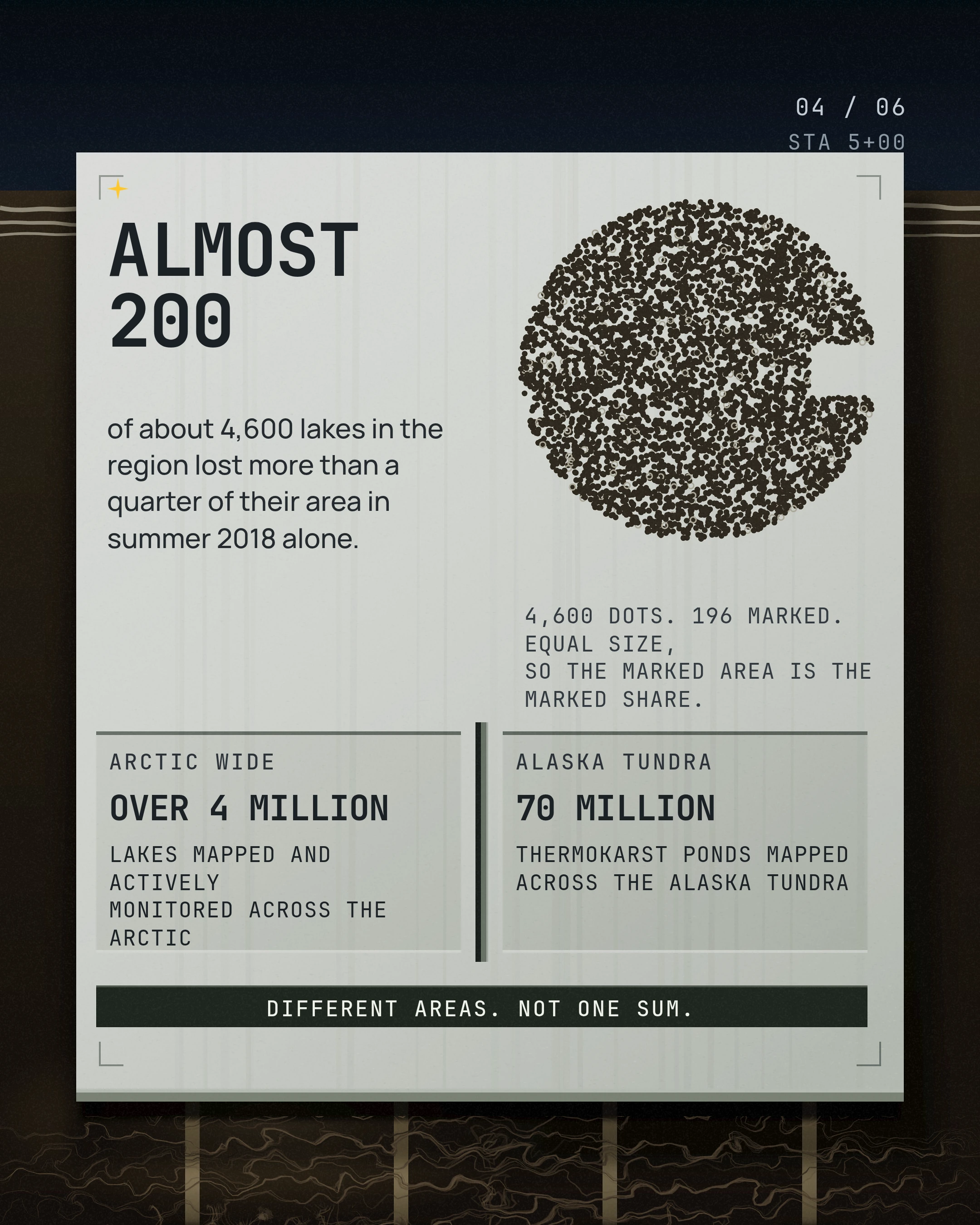
In the summer of 2018 alone almost 200 of the region's approximately 4,600 lakes lost more than a quarter of their area.
Over the past two decades the region lost many large lakes that had covered its landscape for thousands of years.
An international team working through the Permafrost Discovery Gateway has mapped and now actively monitors over 4 million lakes across the Arctic.
The same mapping covers 70 million thermokarst ponds, also known as trough ponds, across the Alaska tundra.
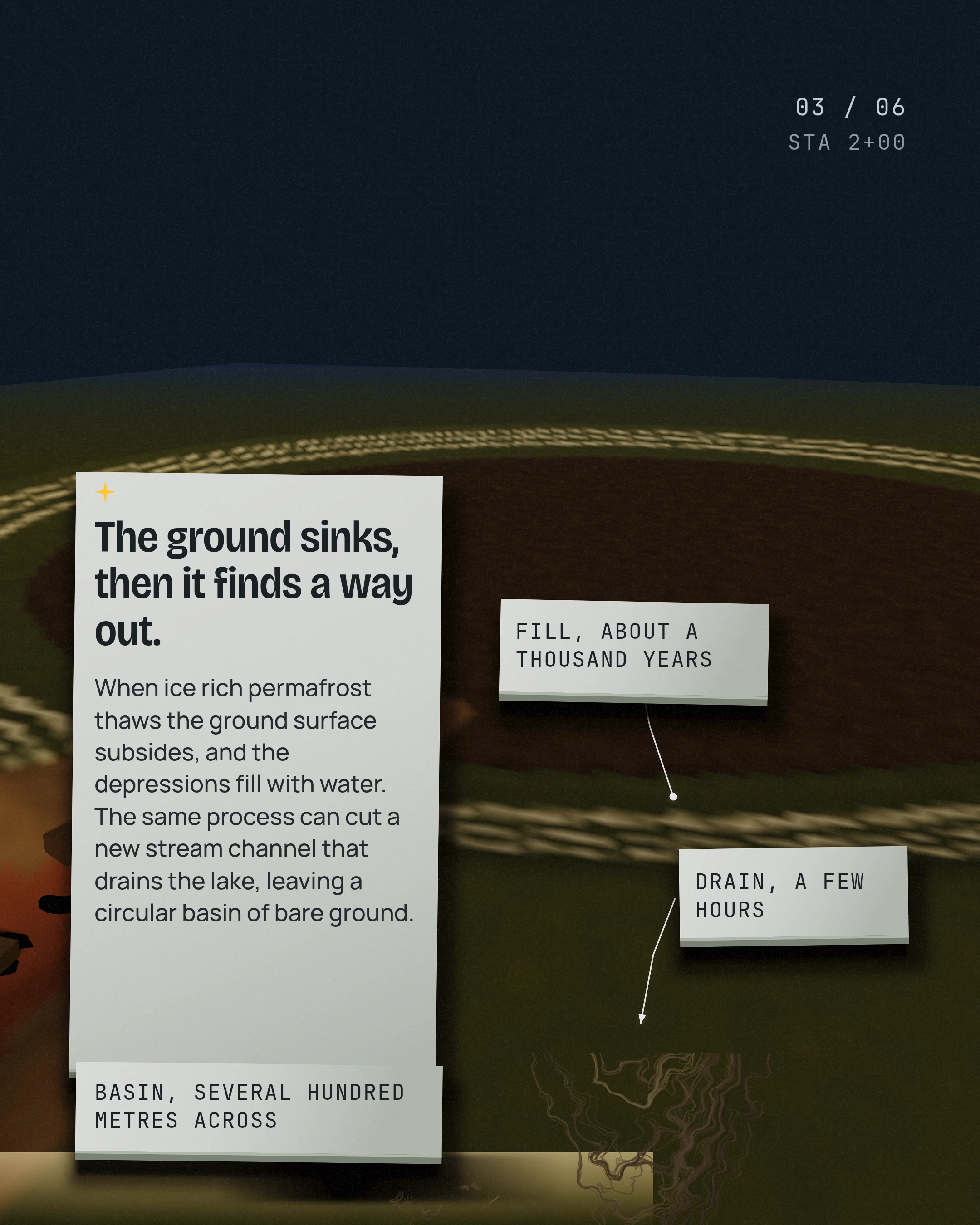
When ice rich permafrost thaws the ground surface subsides, creating thermokarst ponds, which the authors describe as depressions that fill with water.
The authors say the same process that starts the sinkhole can form new stream channels that drain the lake, leaving a circular basin of bare ground behind.
The authors write that a lake several hundred meters long might have taken a millennium to form yet permafrost thaw triggered by one unusually warm summer can completely drain it in just a few hours.
The authors state that not all lake changes are caused by permafrost thaw.
The authors note that lakes in floodplains and wetlands change dramatically across each season due to the abundance of snowmelt water in spring, and that wildlife can also play a role.
Aerial photos starting from the late 1940s and satellite imagery that became available in the 1970s have helped scientists map what the Arctic's permafrost landscapes looked like.
The authors write that Arctic temperatures rise at two to three times the global average rate.
The authors say the new maps can show where land is underlain by ice rich permafrost, meaning bad choices for building sites, and where the frozen soil has less ice, likely indicating it is safer for building.
The authors say detecting signs of permafrost thaw in those landscapes can help communities plan for changes to their environment.
On August 13th, 2026 the Permafrost Discovery Gateway launched a new tool that allows users to explore lake drainage across the Arctic.
Woodwell Climate says that for the first time ever users can track lake drainage associated with ice rich permafrost thaw in near real time and across the entire Arctic region.
Woodwell Climate describes the Permafrost Discovery Gateway as an online platform in development for creating, analyzing and visualizing big geospatial permafrost products.
Anna Liljedahl is bylined as Affiliated Professor in Arctic Hydrology at the University of Alaska Fairbanks.
Woodwell Climate Research Center lists Anna Liljedahl as an Associate Scientist.
Ingmar Nitze is bylined as a postdoctoral researcher in polar geoscience at the Alfred Wegener Institute.
Anna Liljedahl discloses funding from the Google.org Impact Challenge on Climate Innovation, the National Science Foundation under awards 1927872, 2052107 and 2234117, and Woodwell Climate Research Center.
Ingmar Nitze discloses funding from Google.org Impact Challenge on Climate Innovation, the National Science Foundation, the Schmidt Sciences Virtual Institute for the Carbon Cycle and the Alfred Wegener Institute.
Woodwell Climate was awarded a five million dollar Google.org grant for use of AI to track permafrost thaw.
The article was published on August 26th, 2026 and updated on August 27th, 2026.
NCEAS says the Permafrost Discovery Gateway is a resource where the only thing you need is a web browser and internet to get access to scientific products.
NCEAS reports that in Alaska alone roughly 80 percent of the land contains permafrost to some degree and more than 140 communities build on it.
NCEAS reported in March 2026 that the Permafrost Discovery Gateway is supported in part by Google.org but that the funding is coming to an end.
Alaska Beacon republished the article under the same headline with a feed timestamp of August 28th, 2026.
Phys.org carried the article on August 26th, 2026 under a headline that adds old photos to the title.
Beats
This article is on Alaska land and permitting for AI · Alaska AI research and science. Each beat page keeps every decision and every article on that subject in one place.