Written Before the Water
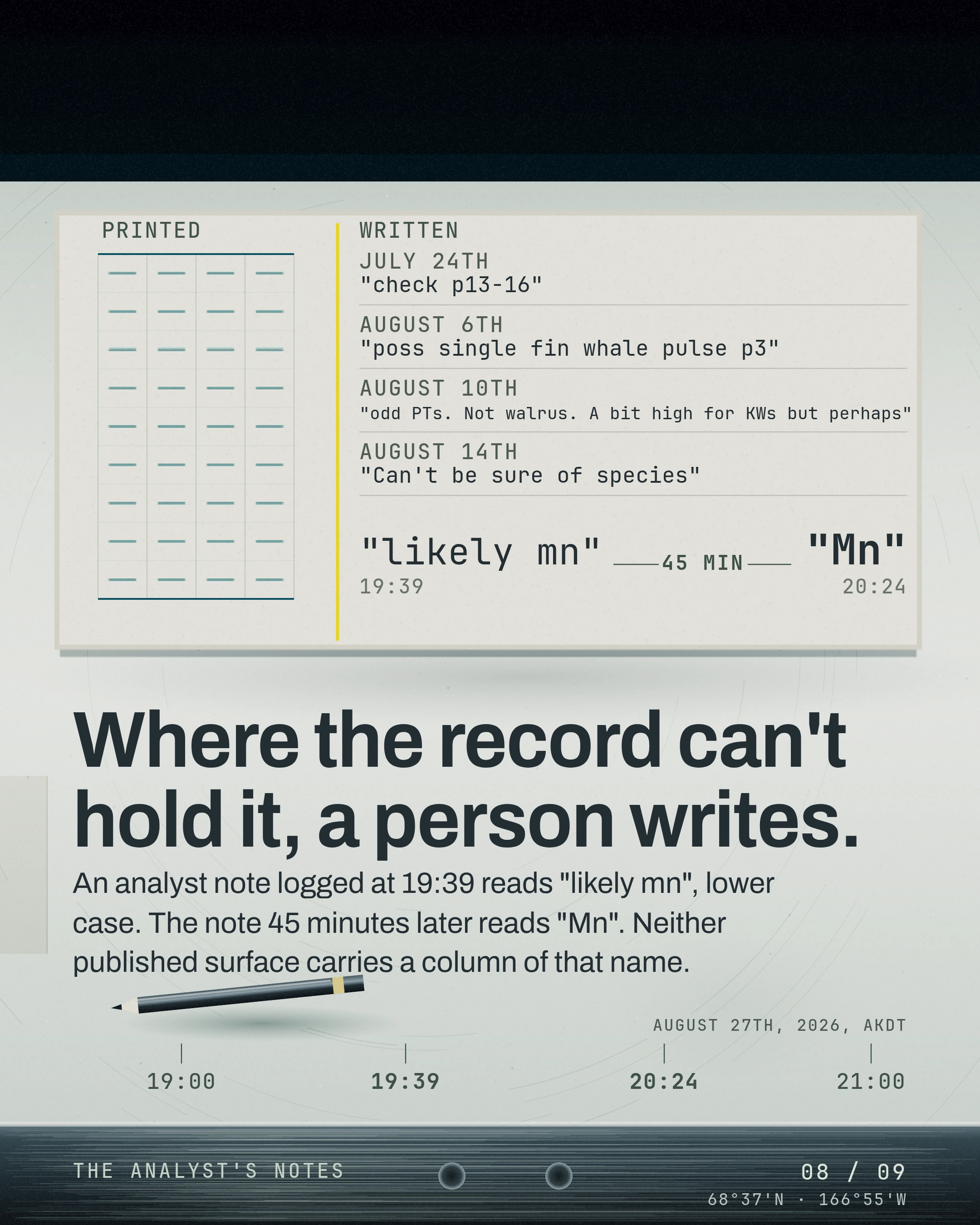
The 19:39 note on a Chukchi Sea glider's record for August 27th reads "likely mn". The 20:24 note reads "Mn".
The deck
SWIPE, SCROLL OR CLICK A SLIDE TO GO FULLSCREEN · 9 SLIDES




The story
45 minutes separate them. No published column carries that code.
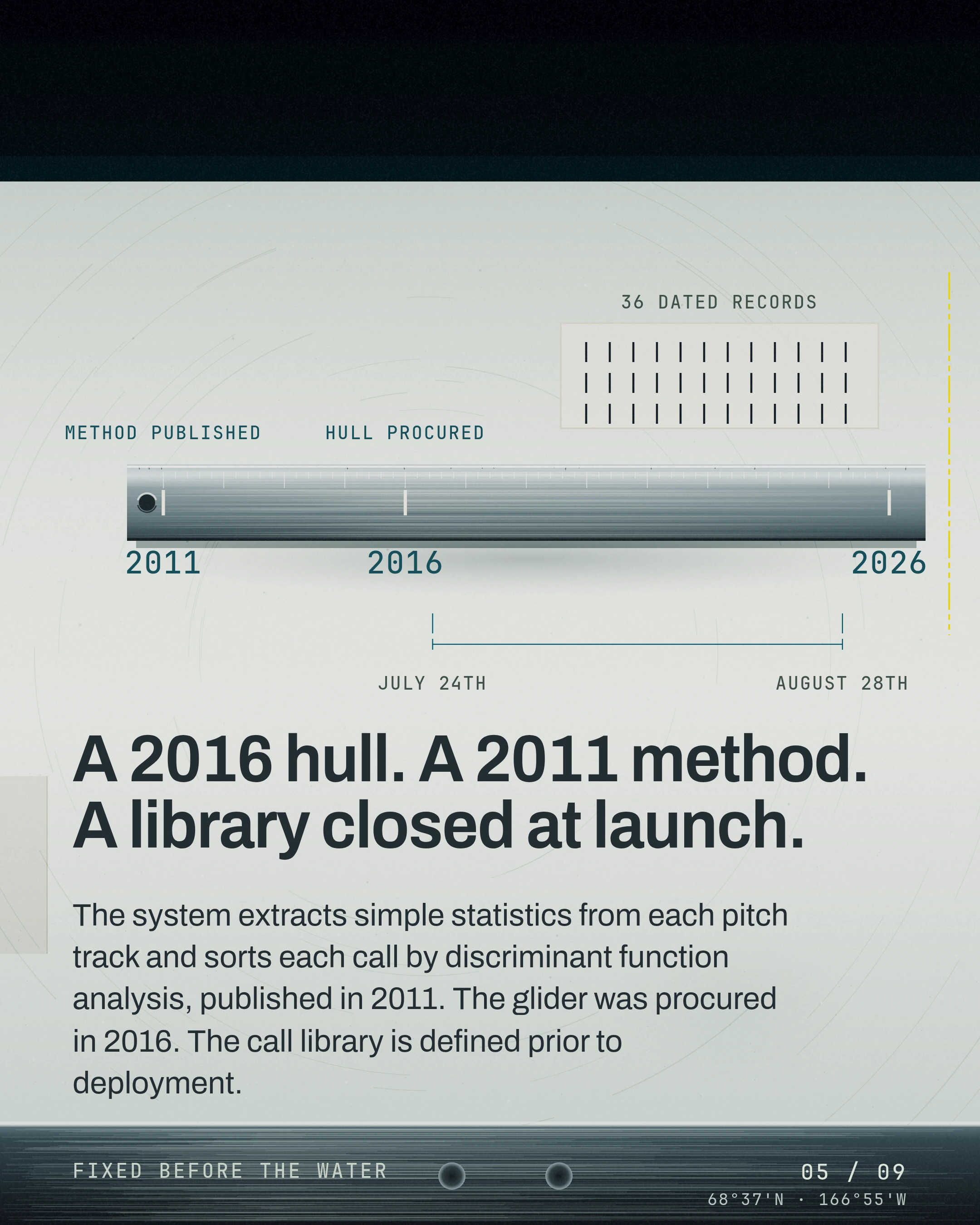
What is listening? A Slocum glider deployed off northwest Alaska on July 24th, 2026. It sorts calls by discriminant function analysis published in 2011 against a library fixed before deployment.
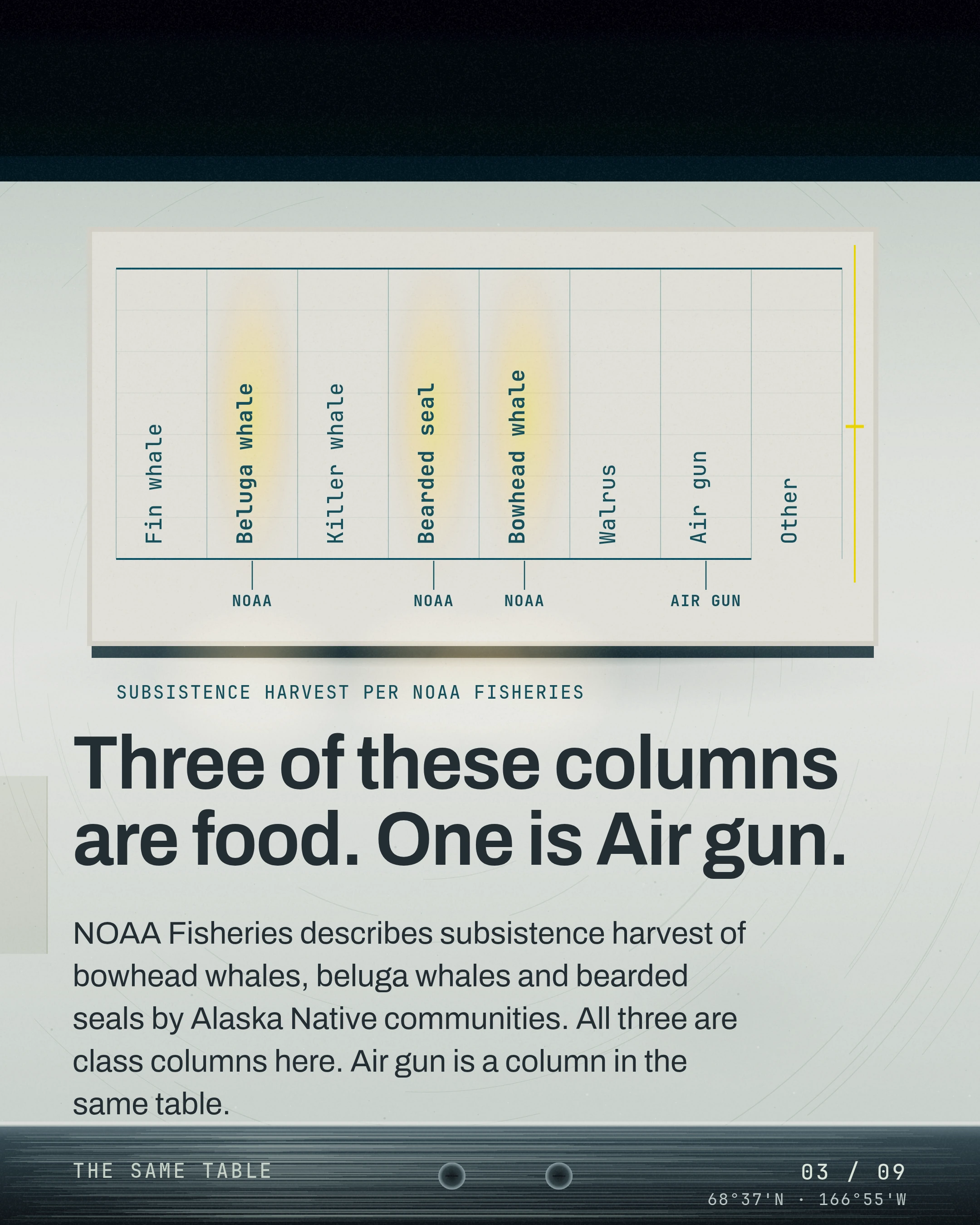
Why does Alaska care? Bowhead, beluga and bearded seal each get a column. NOAA Fisheries describes subsistence harvest of all three. Air gun is a column in the same table.
Who reviewed the results? The page names Kate Stafford.
The eight headings, the live table's seven, the thresholds a call must clear, and the notes in the margin.
Other means every sound the library never held. What has gone into it since July that no column will ever report?
What we verified
53 CLAIMS, EACH RE-FETCHED FROM ITS SOURCE BEFORE THIS DECK SHIPPED
A Slocum G2 glider was deployed in the Chukchi Sea off the northwest coast of Alaska on July 24, 2026.
The glider is listed as an active mission under the designation unit 595 on the Robots4Whales site.
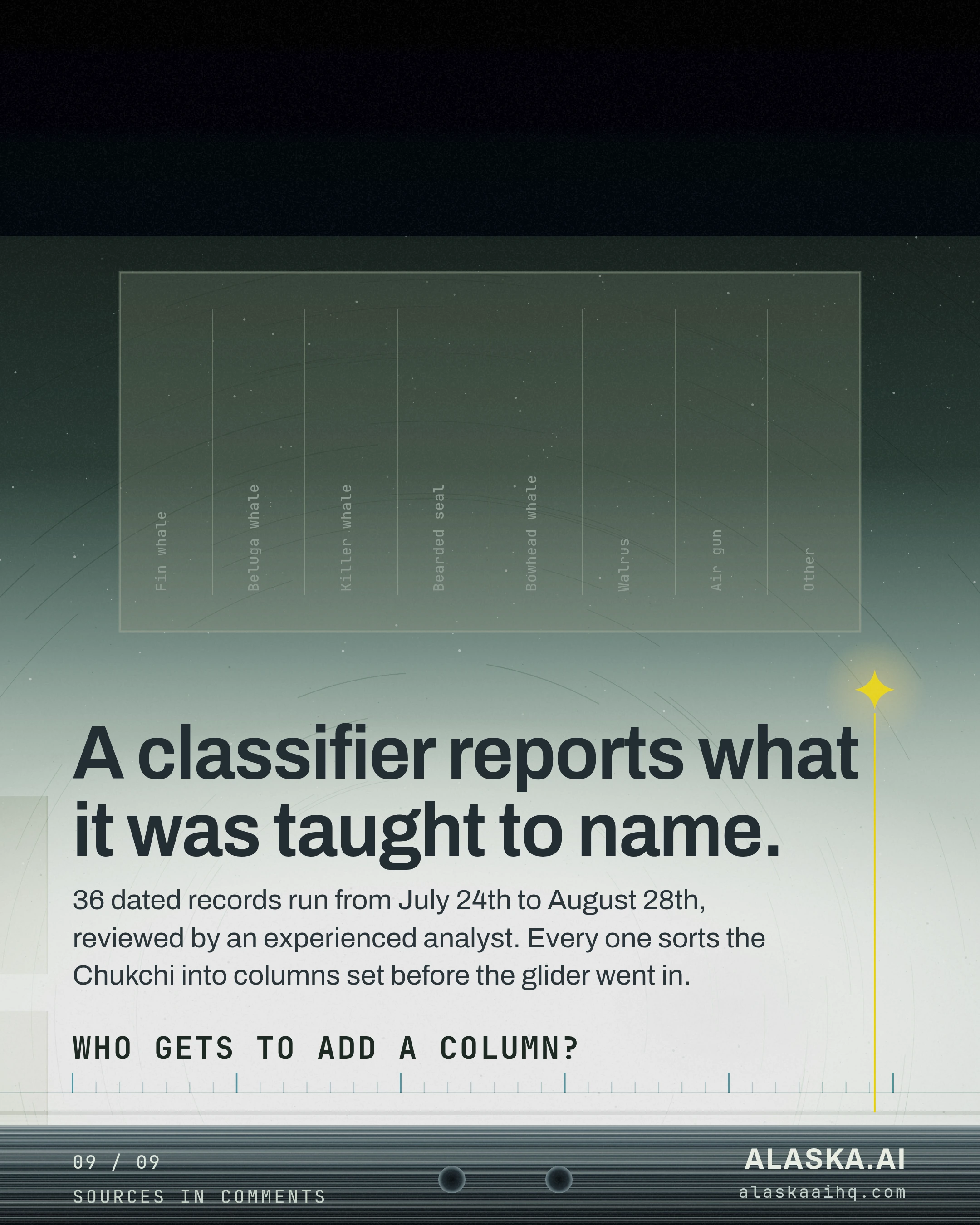
The deployment page's daily detection grid carries eight sound classes.
Killer whale is the third class named in the deployment page's detection grid.
The near real time detection table for the deployment carries seven sound class columns and has no Killer whale column.
Air gun is one of the sound classes the system tallies alongside the animal classes.
The Other class is defined as everything the call library does not contain.
Tallies of classified calls are reported by the DMON every 15 minutes.
Only calls averaging 11 dB above background or higher are tallied and reported as pitch tracks.
Only calls with a Mahalanobis distance under 3 are tallied.
Pitch tracks of individual calls are reported at a maximum rate of 8 KB per hour.
Not every call the system detects is sent back as a pitch track.
All dates and times published in the detection table are in the AKDT time zone.
The deployment page carries 36 dated daily analyst review records, the first for July 24th and the most recent for August 28th, 2026.
The most recent published daily record as of the run date is August 28, 2026, one day before this deck.
Results on the page have been reviewed by an experienced analyst, Kate Stafford.
The project is designed to examine relationships between marine mammal distribution and oceanographic conditions monitored by the glider.
The deployment is run by Oregon State University, the University of Alaska Fairbanks and Woods Hole Oceanographic Institution.
The Alaska Ocean Observing System supported development of the Arctic marine mammal call library and the preparation and operation of the glider in 2026.
The glider itself was procured in 2016 with support from the North Pacific Research Board.
DMON stands for digital acoustic monitoring instrument and is a passive acoustic instrument developed at Woods Hole Oceanographic Institution that records and processes audio in real time.
LFDCS stands for low frequency detection and classification system and runs on the DMON to identify marine mammal calls.
The classifier extracts simple statistics from each pitch track and uses discriminant function analysis to classify each call.
The classifier compares calls against a known call library defined before the instrument is deployed.
Pitch tracks are evaluated by a human analyst to decide whether whale calls are really present.
The robots detect sounds, identify the species from the characteristics of those sounds and report to researchers on shore by satellite in near real time.
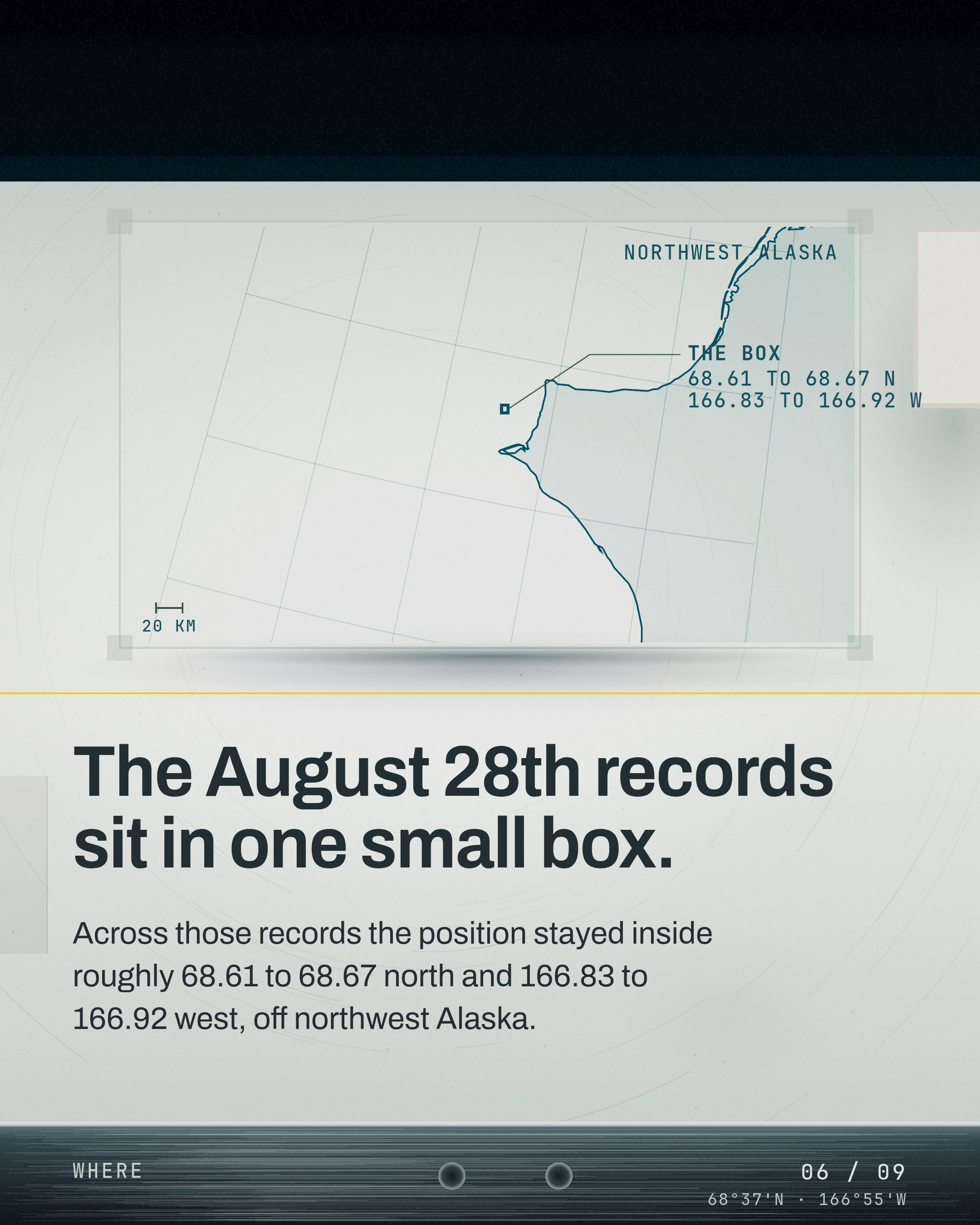
The first published record for August 28, 2026 places the glider at 68.6157 north and 166.9117 west.
Across the August 28, 2026 records the glider stayed inside roughly 68.61 to 68.67 north and 166.83 to 166.92 west.
The Air gun column logged a non zero tally on August 28, 2026.
The code Mn used in the analyst notes is not one of the standing class columns in the published tables.
An analyst note dated August 22, 2026 reads poss Mn p8.
A second analyst note dated August 22, 2026 reads poss Mn.
An analyst note dated August 27, 2026 reads likely mn in lower case.
The analyst note logged 45 minutes later on August 27, 2026 reads Mn with no hedge.
An analyst note dated August 20, 2026 reads poss Mn.
The earliest analyst note for the deployment is dated July 24, 2026 and reads check p13-16.
An analyst note dated August 14, 2026 reads Can't be sure of species.
An analyst note dated August 6, 2026 reads poss single fin whale pulse p3.
An analyst note dated August 10, 2026 reads odd PTs. Not walrus. A bit high for KWs but perhaps.
Alaska Native communities harvest bowhead whales for subsistence.
Alaska Natives hunt beluga whales for subsistence and traditional handicrafts.
Subsistence harvest of bearded seals occurs in parts of the species range and is co managed with Alaska Native organizations.
The FAA announced an expansion of its BEYOND drone program on August 27, 2026.
The FAA said it will double the BEYOND program by selecting up to eight additional state, local, tribal and territorial lead participants.
BEYOND Phase 1 participants logged more than 70,000 flights.
More than 48,000 of those Phase 1 flights were beyond visual line of sight operations.
The University of Alaska Fairbanks is one of the eight BEYOND lead participants.
BEYOND Phase 2 began in 2025 under the FAA Reauthorization Act of 2024 and the program runs to 2029.
The University of Alaska Fairbanks announced on August 19, 2026 that its university affiliated research center is renamed the Arctic and Homeland Defense Center.
A five year agreement signed the week before the announcement aligns the UAF center with the North American Aerospace Defense Command and U.S. Northern Command.
The renamed center is one of 15 university affiliated research centers nationwide.
UAF interim chancellor Larry Hinzman said the partnership is a natural extension of increasing U.S. and global interest in the Arctic.
Geophysical Institute director Robert McCoy said the change shows great confidence in the institute's ability to help with Arctic based needs.
Beats
This article is on Alaska AI research and science. Each beat page keeps every decision and every article on that subject in one place.