Out of Nenana and Back, With the Finding Pending
A 1,000 kilometre blood flight out of Nenana is documented down to five logged sensor channels. The finding is not published.
The deck
SWIPE, SCROLL OR CLICK A SLIDE TO GO FULLSCREEN · 9 SLIDES



The story
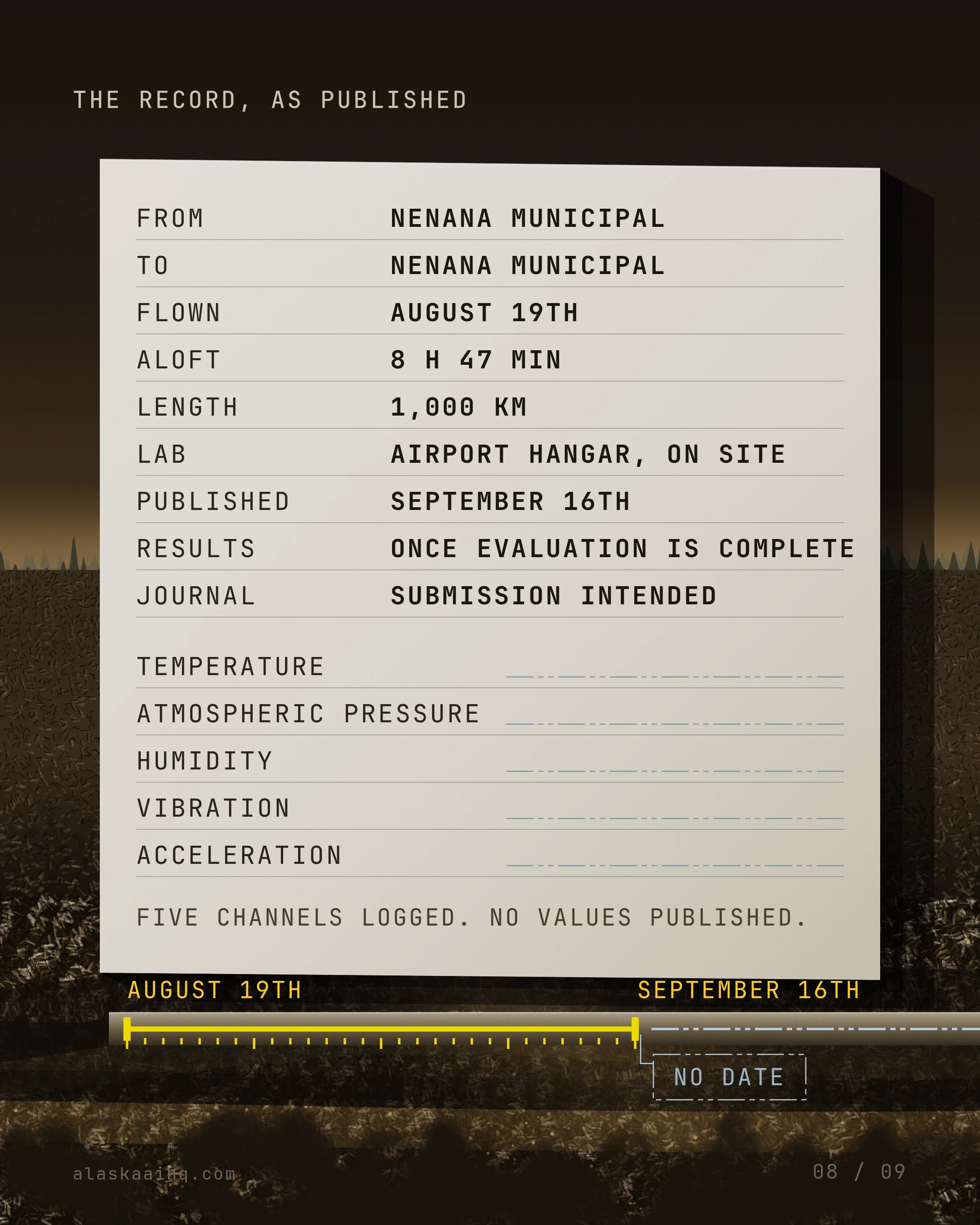
The International Testing Agency published the flight on September 16th and said the results will come once the evaluation is complete. It intends to submit them to a peer reviewed journal. No date.
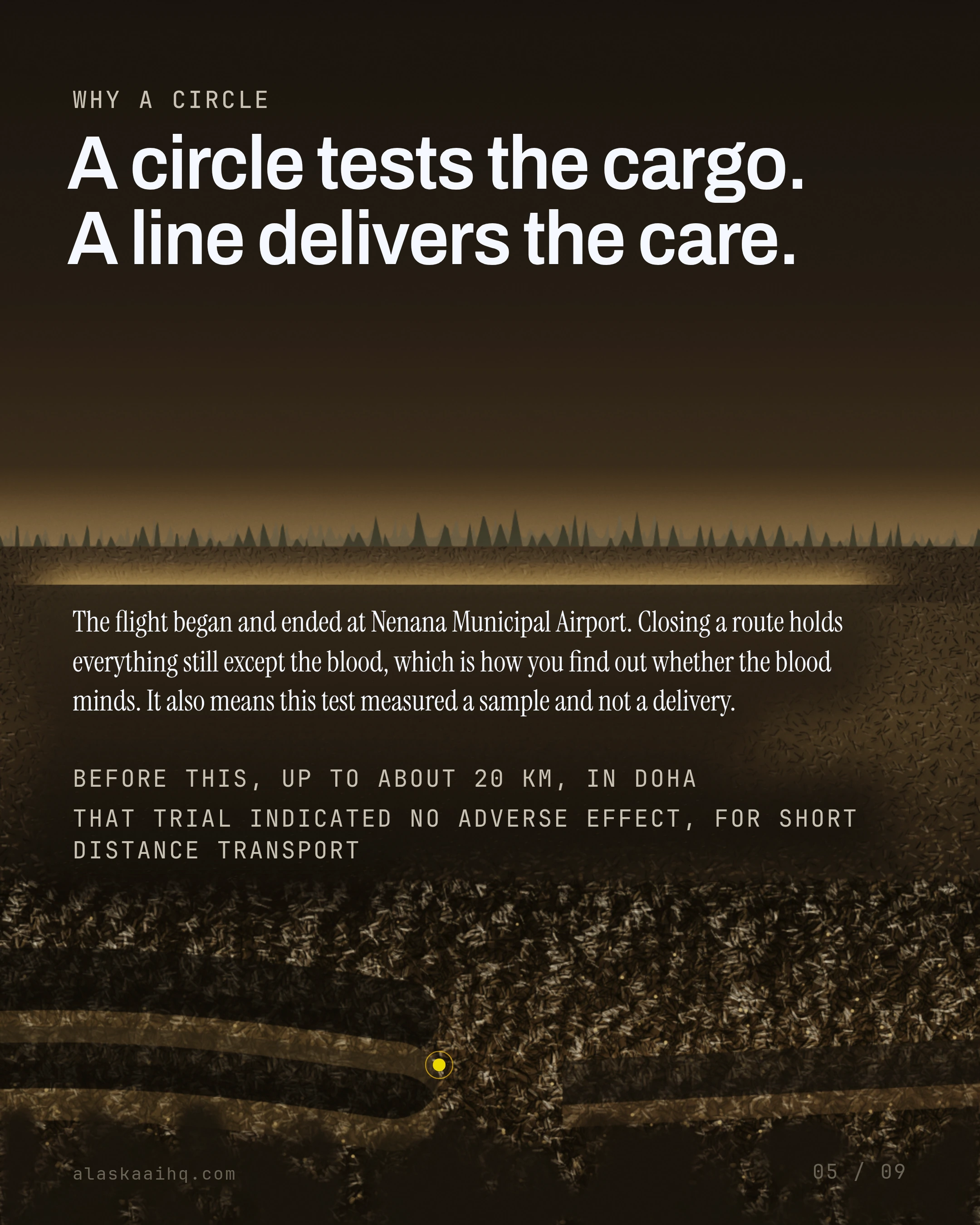
ACUASI, part of the University of Alaska Fairbanks, flew it on August 19th. The test began and ended at Nenana Municipal Airport. Closing the route is the control. That leaves the blood as the only thing that changed.
The deck holds the paired samples, the hangar laboratory at the same airport, and five logged channels as empty rows.
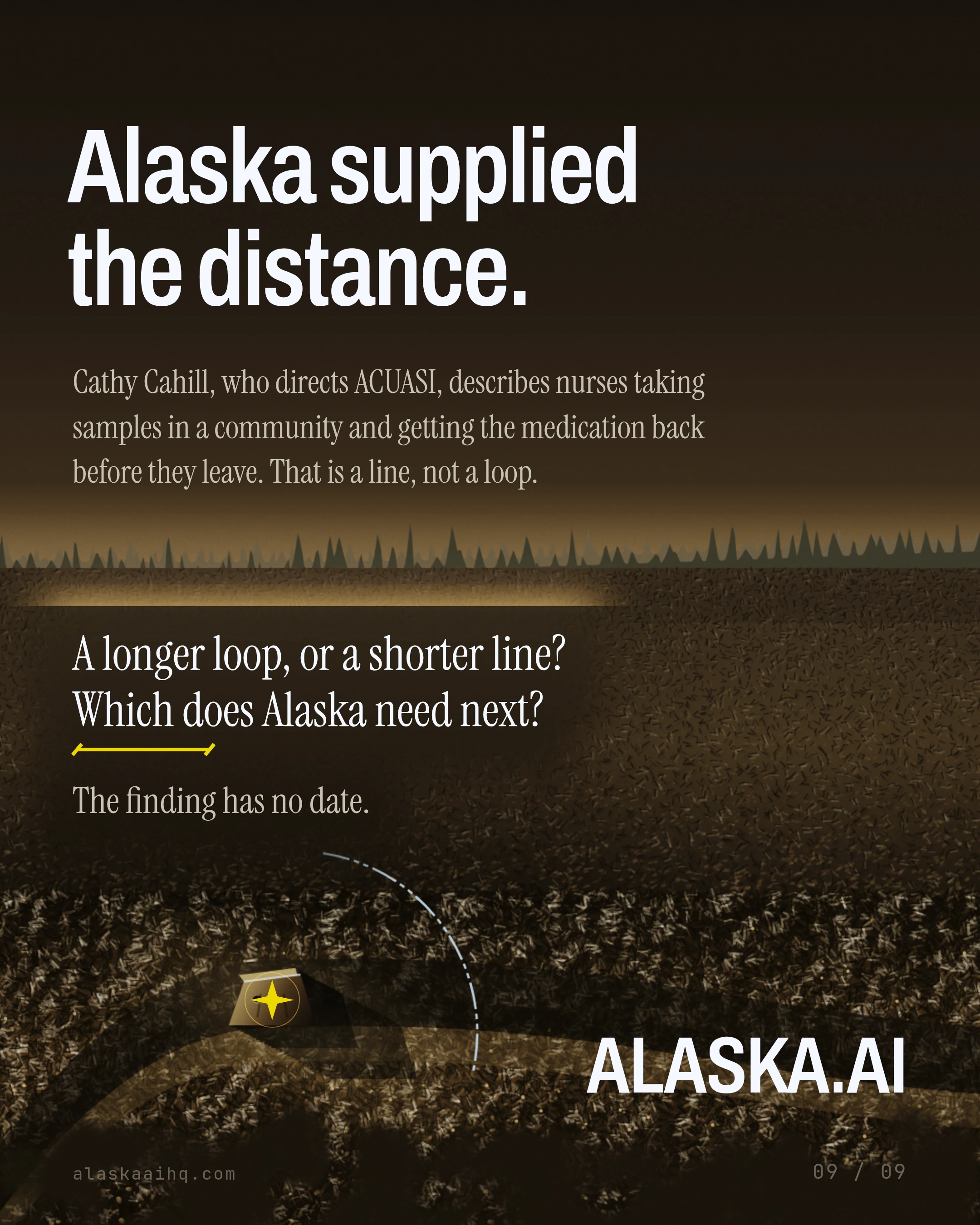
Alaska supplied the distance and the distance was the part held still. A route that isn't closed has to end somewhere. Which Alaska community should that be?
What we verified
41 CLAIMS, EACH RE-FETCHED FROM ITS SOURCE BEFORE THIS DECK SHIPPED
The International Testing Agency completed a 1,000 km drone test flight in Nenana, Alaska, to assess whether anti-doping blood samples can be transported safely over extended distances.
The flight was flown on August 19th, 2026.
The test began and ended at Nenana Municipal Airport.
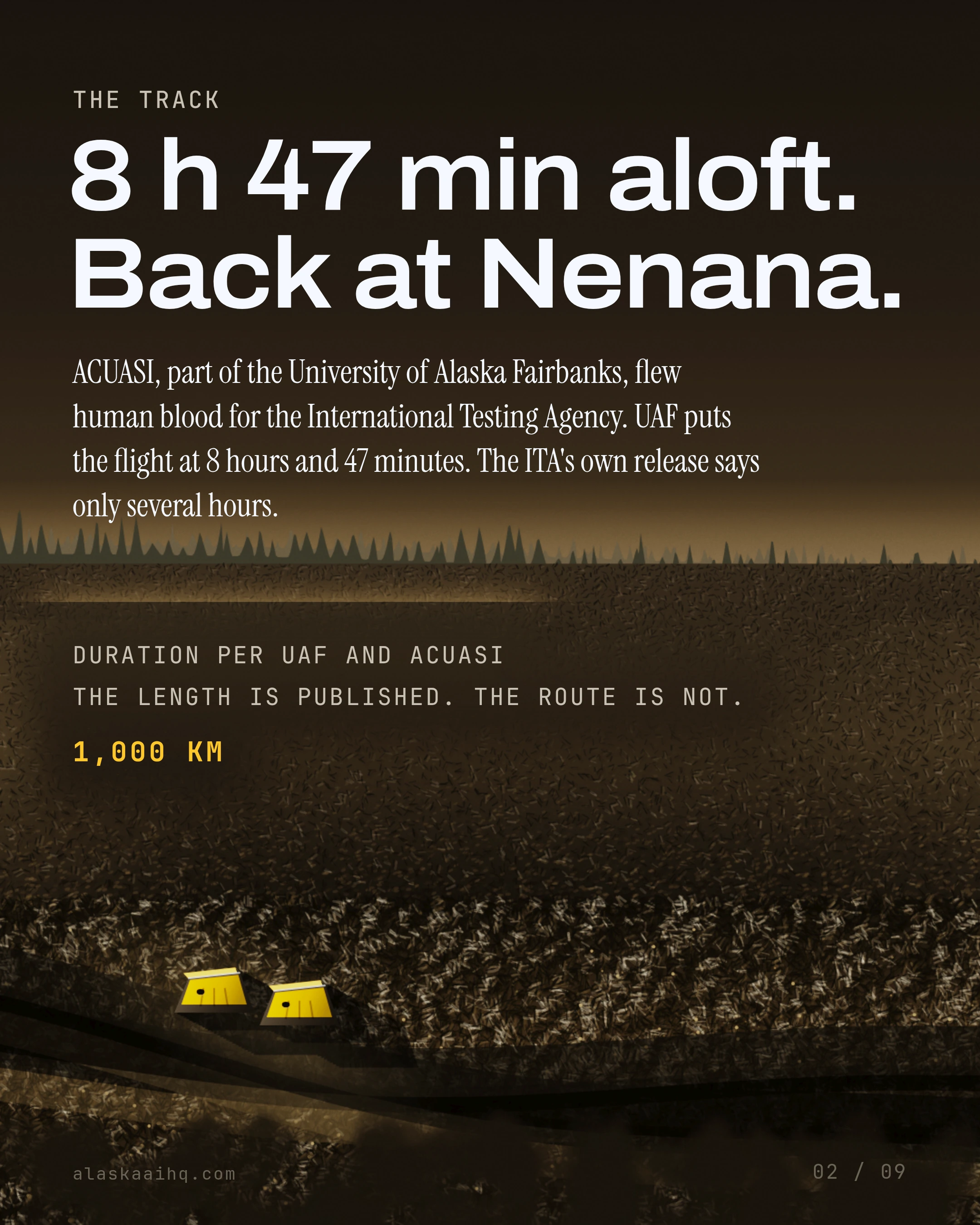
The flight lasted 8 hours and 47 minutes.
The ITA release describes the flight only as lasting several hours and prints no duration.
The ITA published its account of the flight on September 16th, 2026, twenty eight days after the flight.
UAF published its account of the flight on September 16th, 2026, written by Rod Boyce.
Sysmex America issued its own release about the flight on September 17th, 2026.
ACUASI is part of the University of Alaska Fairbanks and provided flight planning and execution for the test.
The aircraft was ACUASI's Windracers ULTRA drone, tracked from the program's Nenana hangar.
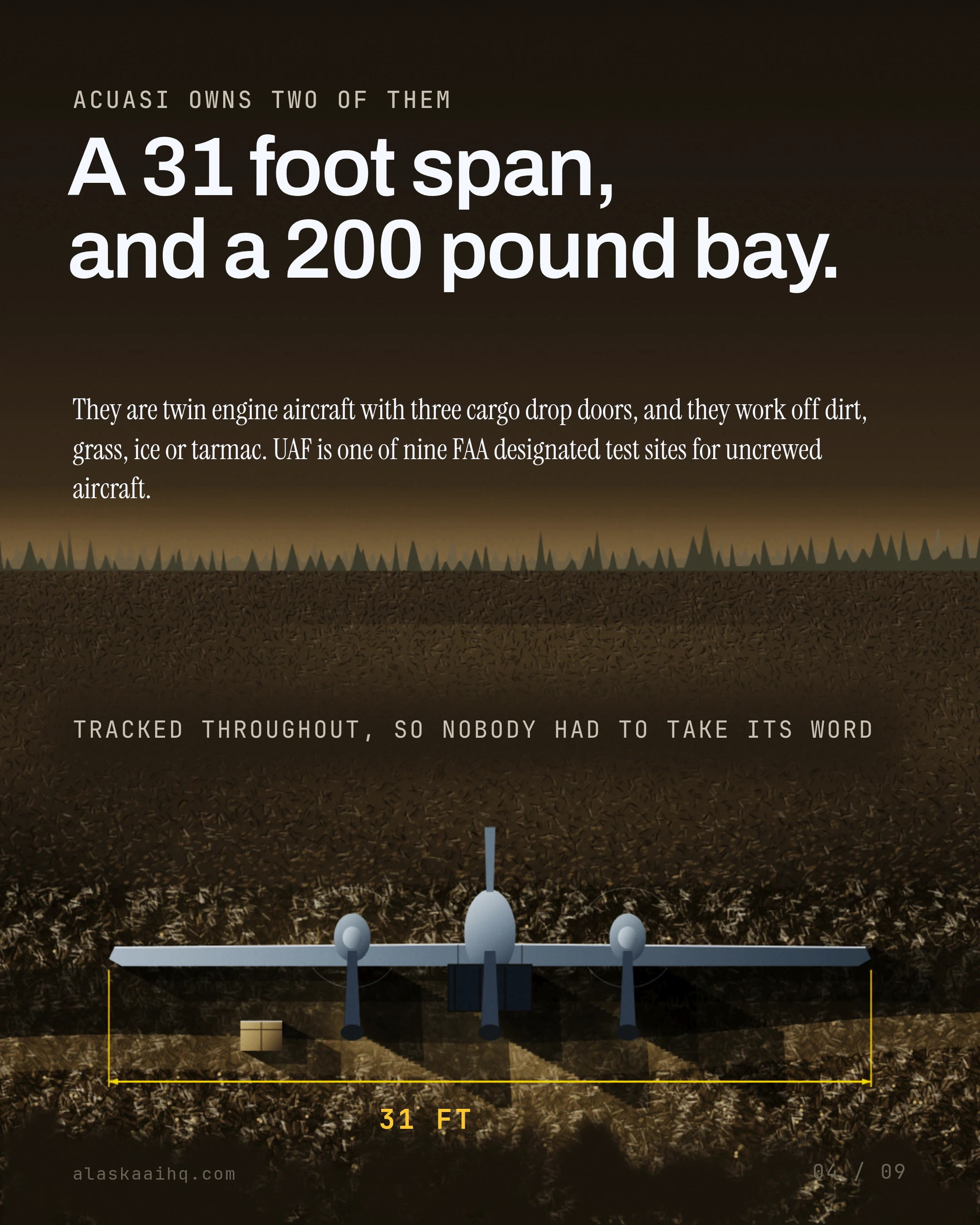
ACUASI owns two of the twin engine aircraft, which have a 31 foot wingspan, a range of about 600 miles, a 200 pound cargo capacity and three cargo drop doors.
The 1,000 kilometre flight is about 621 miles, slightly more than the roughly 600 mile range published for the aircraft.
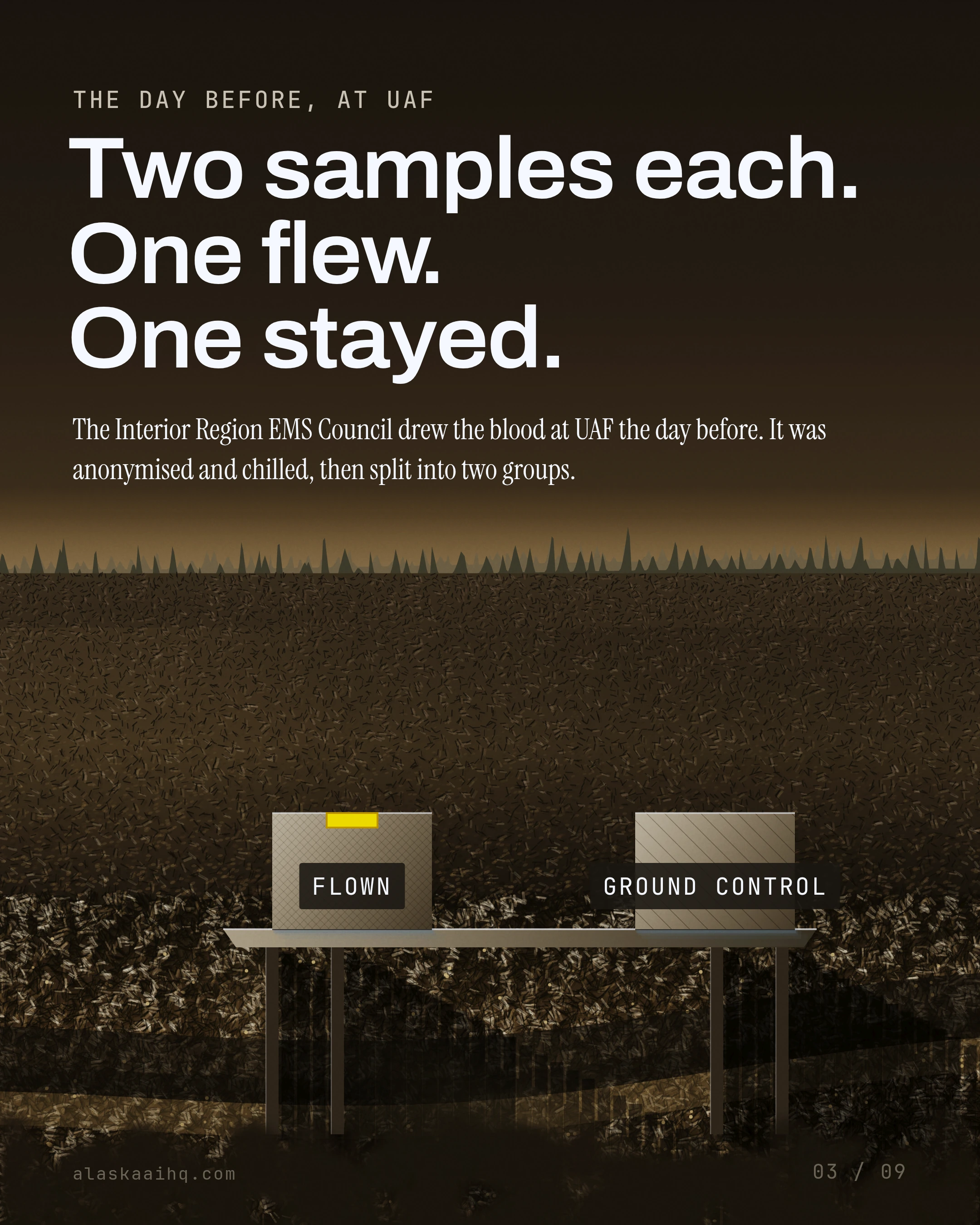
Anonymised blood samples from healthy subjects were divided into two groups, one flown on the drone and one kept on the ground as a control.
Each volunteer provided two samples so conditions before and after transport could be compared.
The blood samples carried aboard were chilled.
Neil Robinson of the ITA said samples are in sealed boxes and loaded in the drone, and that the aircraft can be tracked to demonstrate it did not land along the way.
Chain of custody for each sample had to be maintained throughout.
Sensors accompanied the samples throughout the flight to record temperature, atmospheric pressure, humidity, vibrations and acceleration.
Sysmex equipped a purpose built satellite laboratory, installed in an airport hangar, with XN-Series technology.
After the flight both groups of samples were analysed in the same on site laboratory under identical conditions.
Dr. Sven Voss, director of the WADA accredited laboratory in Dresden, Germany, operated the laboratory set up for the test.
The laboratory was equipped by Sysmex with automated haematology analysis technology and operated so that WADA's documentation for blood sample analysis was followed.
The results of the scientific analysis will be communicated once the evaluation has been completed.
The ITA intends to submit the findings for publication in a peer reviewed scientific journal.
The ITA will compare results recorded before and after the flight to determine whether the journey had any discernible impact on white and red blood cell populations and indices relevant to the Athlete Biological Passport.
In the ITA's earlier trial in Doha, urine, blood and Dried Blood Spot samples were transported on multiple drone flights covering distances of up to approximately 20 kilometres.
Post flight analysis of the earlier Doha study indicated that relevant blood biomarkers had not been adversely affected, for short distance transport.
Cathy Cahill, ACUASI director, said the competency of ACUASI pilots is truly outstanding and that an emergency is not something to trust to an amateur.
Cathy Cahill described nurses going into a community, taking samples, sending them back for analysis and getting medication back before the nurses leave.
Neil Robinson of the ITA said there are not many drones like this in the world with this cargo capacity.
Neil Robinson said the interest is to use sport as a model to ship samples, and that he is not saying we are ready today but thinks we will be ready tomorrow.
Benjamin Cohen, ITA Director General, said innovation must always be underpinned by robust science and the highest standards of sample integrity and chain of custody.
Andy Hay, Chairman of the Board of Directors of Sysmex America, said the same technology could one day bring timely diagnostics to patients in the world's most remote communities.
Sysmex enabled the long distance test flight through a financial contribution to the project.
Staff from the Interior Region EMS Council collected samples from volunteers the previous day at UAF.
UAF is one of nine FAA designated unmanned aircraft systems test sites established to develop and test drone technology.
Prof. Olivier Rabin, WADA Senior Director, Science and Medicine, said transporting samples can be an expensive and logistically difficult process.
At a joint House and Senate Resources Committee hearing on September 10th, 2026, Hilcorp Alaska senior vice president Luke Saugier testified that without another source of gas supply by winter 2029 there will not be enough gas in the system to meet all the utilities' needs.
Luke Saugier also testified that Hilcorp has never been more active in Cook Inlet and remains completely confident in its ability to deliver on all of the gas supply commitments it has made.
Luke Saugier testified that even at all time high activity levels the result is basically flat for the last three years.
Alaska Public Media reported that Senator Lisa Murkowski said she is not a proponent of data centers at JBER or at Interior installations because of an insecure energy base at this time.
Beats
This article is on Alaska AI research and science. Each beat page keeps every decision and every article on that subject in one place.