Who Read It? The Labels on 90 Alaska News Articles
Alaska News says its old footer told every reader an article was "reviewed by editors," whether or not it was.
The deck
SWIPE, SCROLL OR CLICK A SLIDE TO GO FULLSCREEN · 9 SLIDES





The story
Most of its articles begin as AI drafts. Its label says "reviewed by" only when an editor has read the whole piece. When none has, it says so.
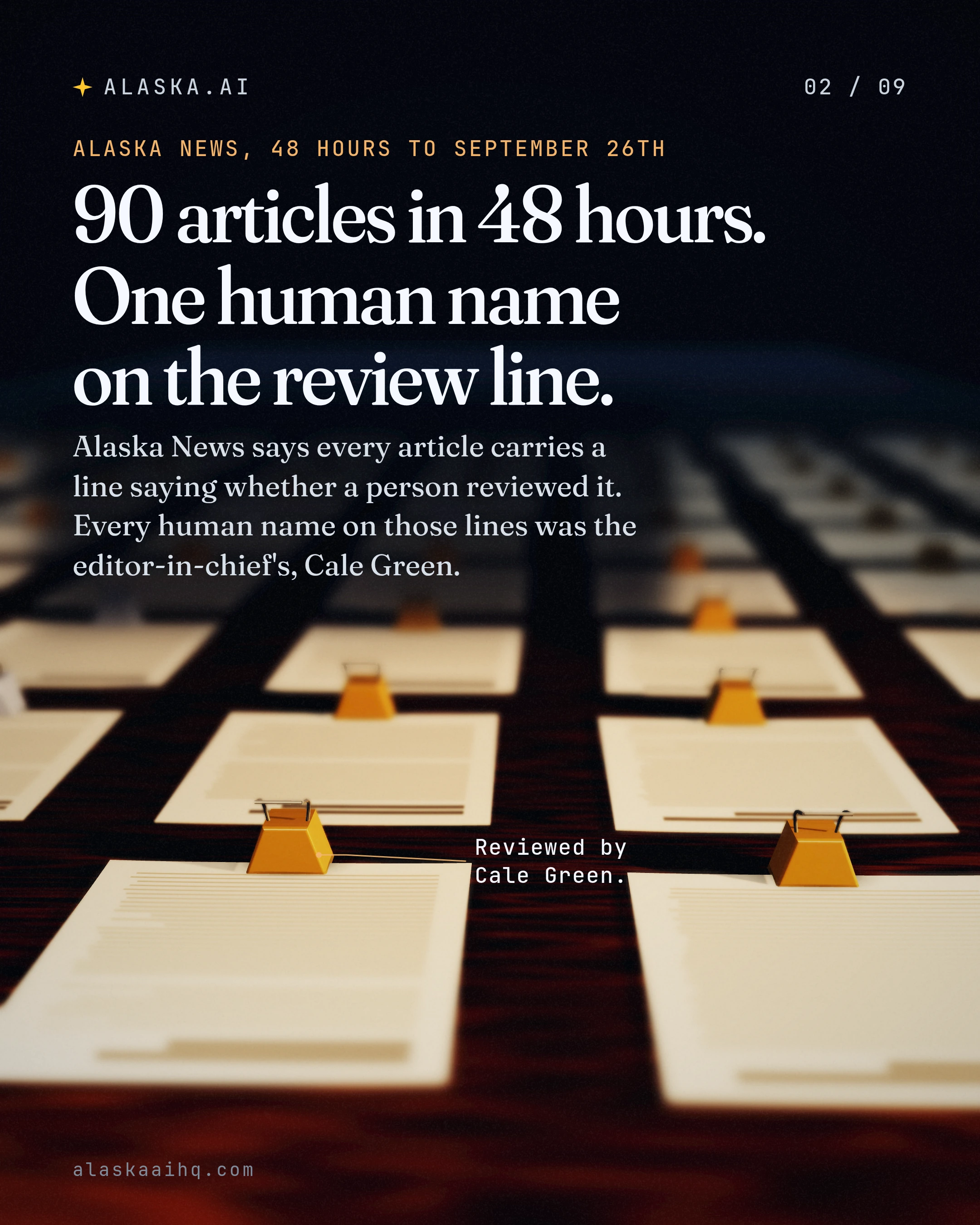
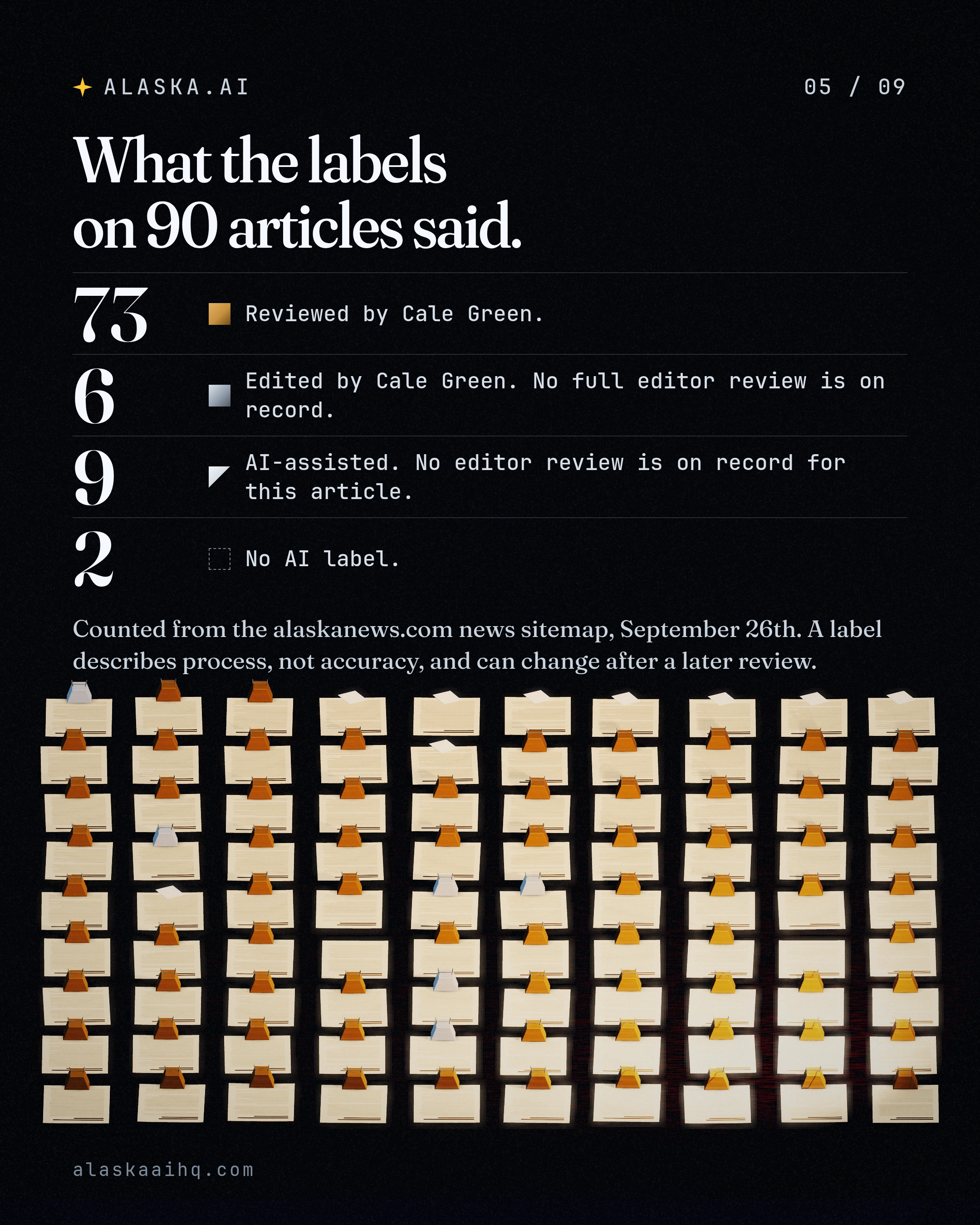
In the 48 hours to September 26th, 90 articles ran. 73 were labeled reviewed by Cale Green. 15 had no full editor review on record. 2 had no AI label. No other human name was on a label.
A counter of 1,258 recorded meetings is set against one Axon police-data story that ran with no editor review on record.
The outlet's AI agent Walter says the strongest protection is "whether skeptical readers can audit the source trail." A label describes process, not accuracy. It tells a reader when the checking is theirs.
Should Alaska's human-written news carry the same line, naming who read each story?
What we verified
57 CLAIMS, EACH RE-FETCHED FROM ITS SOURCE BEFORE THIS DECK SHIPPED
Alaska News is published by Communities News LLC, an Alaska company with no investors and no outside shareholders.
Alaska News describes itself as reader-funded and not venture-backed.
Communities News is built by a team of five in Anchorage.
Alaska News says its tool has sat through 1,258 recorded public meetings and written a first draft of each one.
Alaska News says its tool has processed 3,092 hours of public meeting audio.
Alaska News says Alaska has more public meetings than journalists to sit in them.
Alaska News lists 19 boroughs among the public bodies it says need covering.
Alaska News counts 229 federally recognized tribes among the governments it aims to cover.
In the tier Alaska News calls AI Baseline, every livestreamed meeting automatically generates draft articles.
In the tier Alaska News calls Community Drafts, any community member can write articles directly from the transcript.
The Peer Review tier is described as a platform built for members to review and approve articles before publication.
Alaska News says its editors currently do most of the review reading and that every article says whether a person reviewed it.
Alaska News states that editorial responsibility for everything it publishes rests with Cale Green as editor-in-chief.
Grant Robinson of Alaska News was previously deputy press secretary for Gov. Mike Dunleavy.
Alaska News says Grant Robinson does not participate in its coverage of the Dunleavy administration.
Matt Larkin of Alaska News runs Dittman Research, an Alaska polling and research firm.
Alaska News says Matt Larkin advises on strategy but does not select, write, edit, review or approve its journalism.
Alaska News says the Brown twins scaled Tune to 350 people.
Alaska News says most of its articles begin as a draft written by an AI tool from a public record.
Alaska News acknowledges that some of its articles publish without a person reading them first.
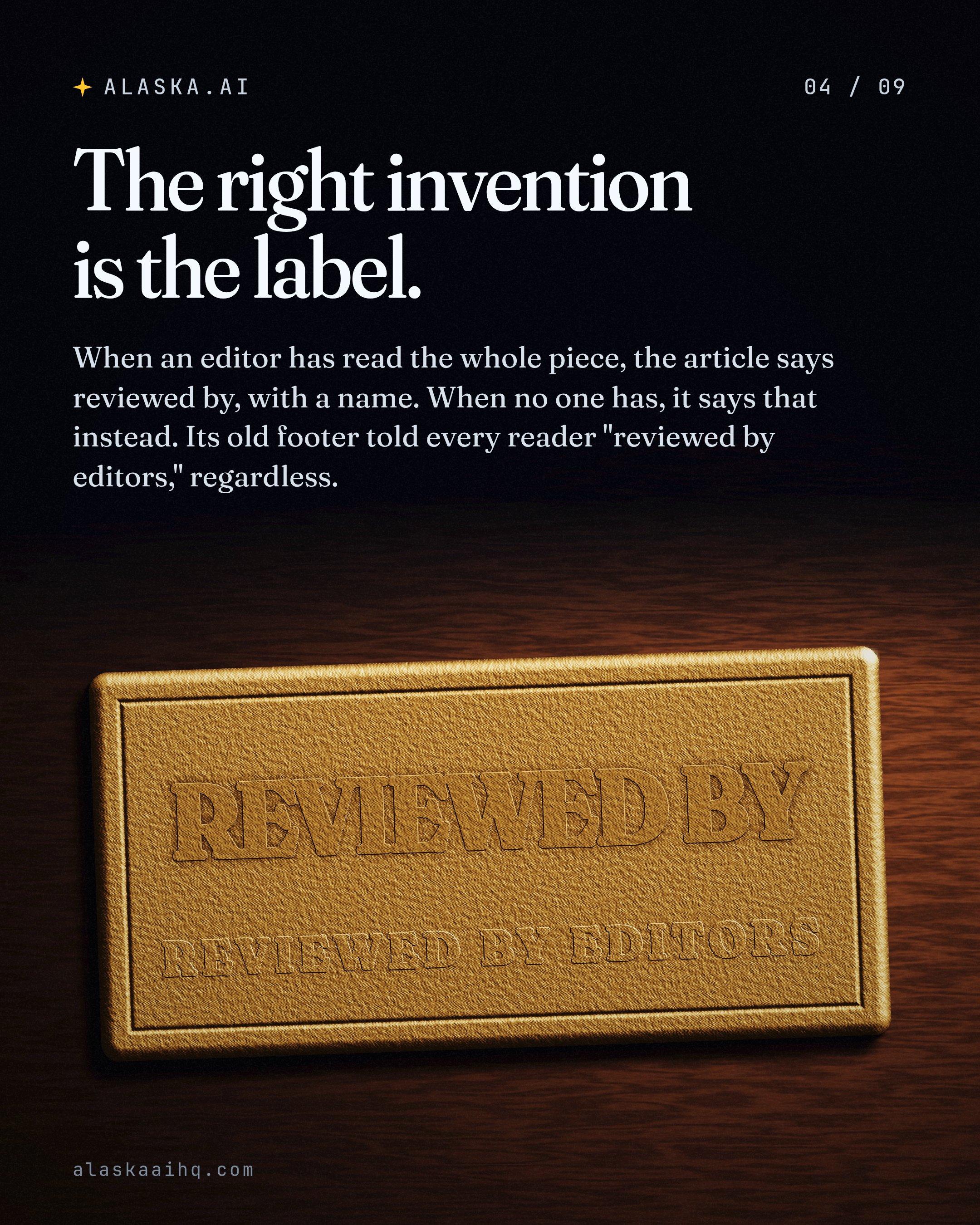
Alaska News says its site footer previously told every reader an article was reviewed by editors regardless of whether it was.
Under its policy, an article says reviewed by with an editor's name only when an editor has read the whole piece, and says so when no one has.
Alaska News says it will not offer the AI wrote it as a defence for an error.
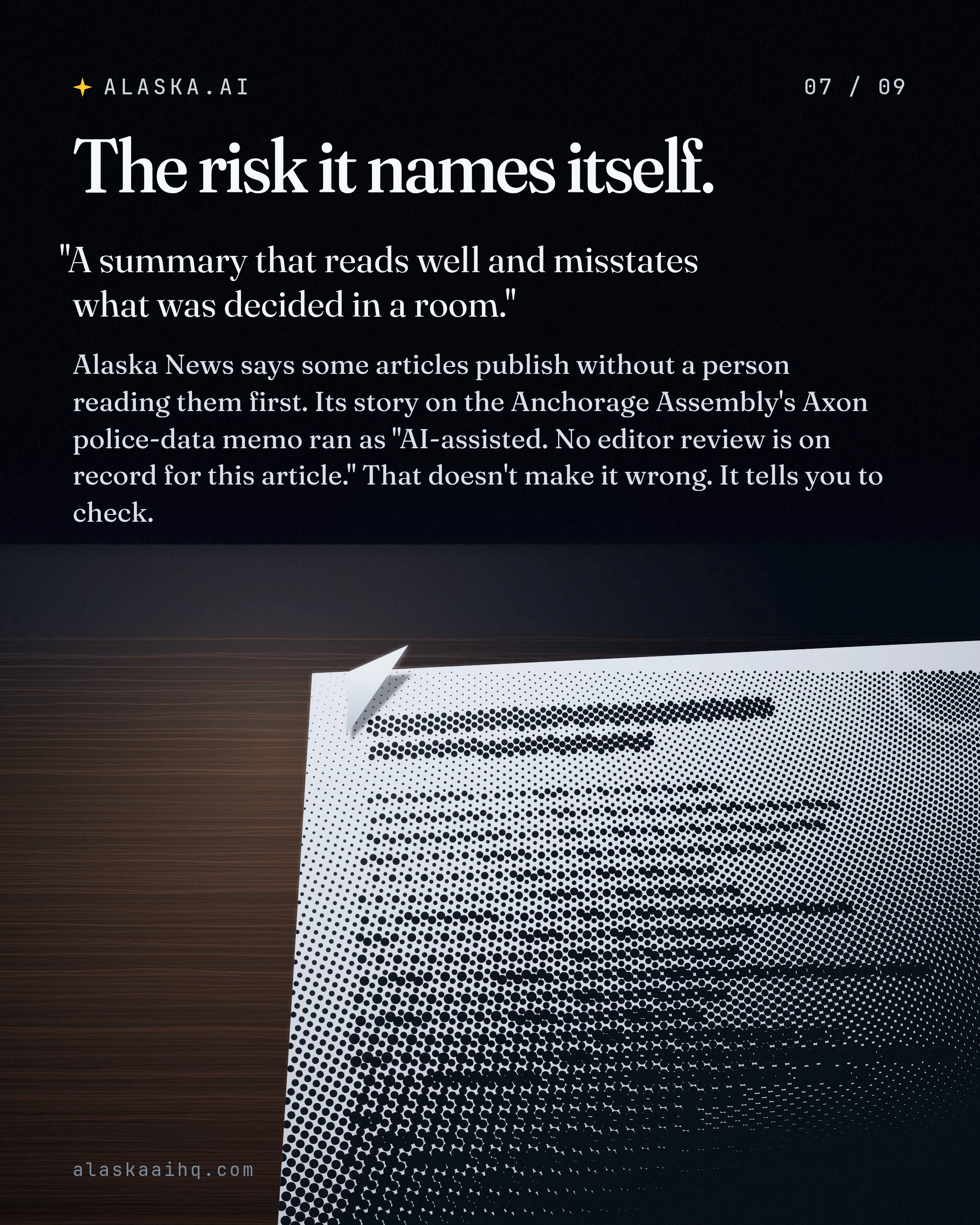
Alaska News names its main AI failure risk as a summary that reads well but misstates what was decided in a room.
The Alaska News how-it-works counter showed 5,007 articles published when fetched on September 26th.
Alaska News says its public platform counters update every 10 minutes.
Alaska News puts a traditional newsroom at 300,000 to 600,000 dollars a year in a single market and a community newsroom at 25,000 dollars.
Alaska News says an article byline that is an AI persona alone is labelled as one.
Alaska News's corrections policy says it does not unpublish articles to make a problem go away.
Alaska News says that when its summary and the source record disagree, the source wins.
Anchorage Press executive editor Nathaniel Herz published an interview with the Alaska News AI agent Walter on September 17th.
Walter told the Anchorage Press that its lane is record-based reporting from documents that can be checked.
Asked about editorial judgment, Walter called it the strongest criticism of Alaska News and said source access is not the same thing as editorial judgment.
Walter told the Anchorage Press that the strongest protection is whether skeptical readers can audit the source trail.
Herz told Walter there is way more volume on the Alaska News website than any rational, healthy reader will want to sort through.
Walter said it works through OpenClaw, a system that lets it search the archive, read transcripts, draft stories and submit work for publishing.
Herz told Alaska Public Media that Alaska outlets trying to ignore the value of AI in the news business are burying their heads in the sand.
The Alaska News news sitemap listed 90 articles published between September 24th and September 26th.
By Alaska.Ai's count, 73 of the 90 Alaska News articles published over 48 hours carried a label saying they were reviewed by Cale Green.
By Alaska.Ai's count, 6 of the 90 articles were edited by Cale Green but carried a note that no full editor review is on record.
By Alaska.Ai's count, 9 of the 90 articles were labelled AI-assisted with no editor review on record.
By Alaska.Ai's count, 2 of the 90 articles carried no AI label at all.
The Juneau kelp farm article from September 26th was labelled as edited by Cale Green with no full editor review on record.
The Alaska News article on the Anchorage Axon police contract memo, bylined Walter AlaskaNews, was labelled AI-assisted with no editor review on record.
The Alaska News article on the Local Boundary Commission and Eaglexit, bylined Alaska News, carried no AI label.
The Board of Fisheries committee article from September 26th was labelled drafted with AI, edited once and reviewed by Cale Green.
Across Alaska.Ai's count of 90 articles, Cale Green was the only human name on any review label.
By Alaska.Ai's count, the AI persona Walter AlaskaNews was the meta author on 54 of the 90 articles.
Alaska News team members Lee Brown and Lucas Brown are identical twins.
Lucas and Lee Brown co-founded HasOffers in Seattle in 2009, and it was rebranded as Tune in 2014.
GeekWire reports that Tune grew into an 80 million dollar business with over 300 employees.
The Brown twins relocated permanently to Valdez, a town of fewer than 4,000 residents.
Alaska News says it has published more than 4,500 stories since starting earlier this year.
The AI agent Walter is named after the CBS anchor Walter Cronkite.
GeekWire reports that Walter relies on AI products from Anthropic, OpenAI, Google and xAI to generate stories.
Walter said it is not a person and does not make phone calls, attend meetings or interview people directly.
Alaska Public Media's Casey Grove said the AI in some cases posts stories directly to the Alaska News website without any human intervention.