Limited or Sunset? What Alaska Adds to the E-Rate Record
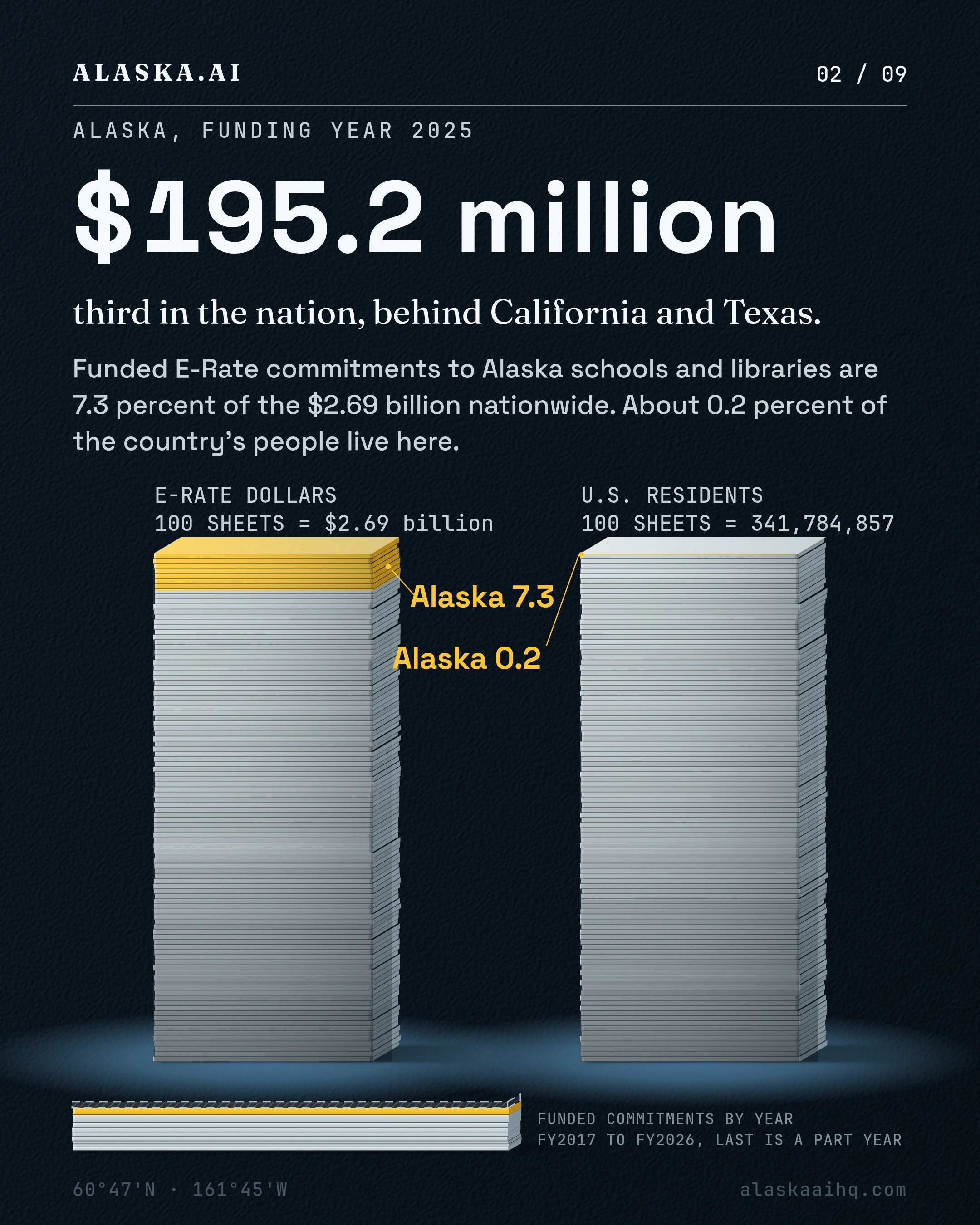
Alaska has about 0.2 percent of the country's people and about 7.3 percent of its funded E-Rate commitments.
The deck
SWIPE, SCROLL OR CLICK A SLIDE TO GO FULLSCREEN · 9 SLIDES



The story
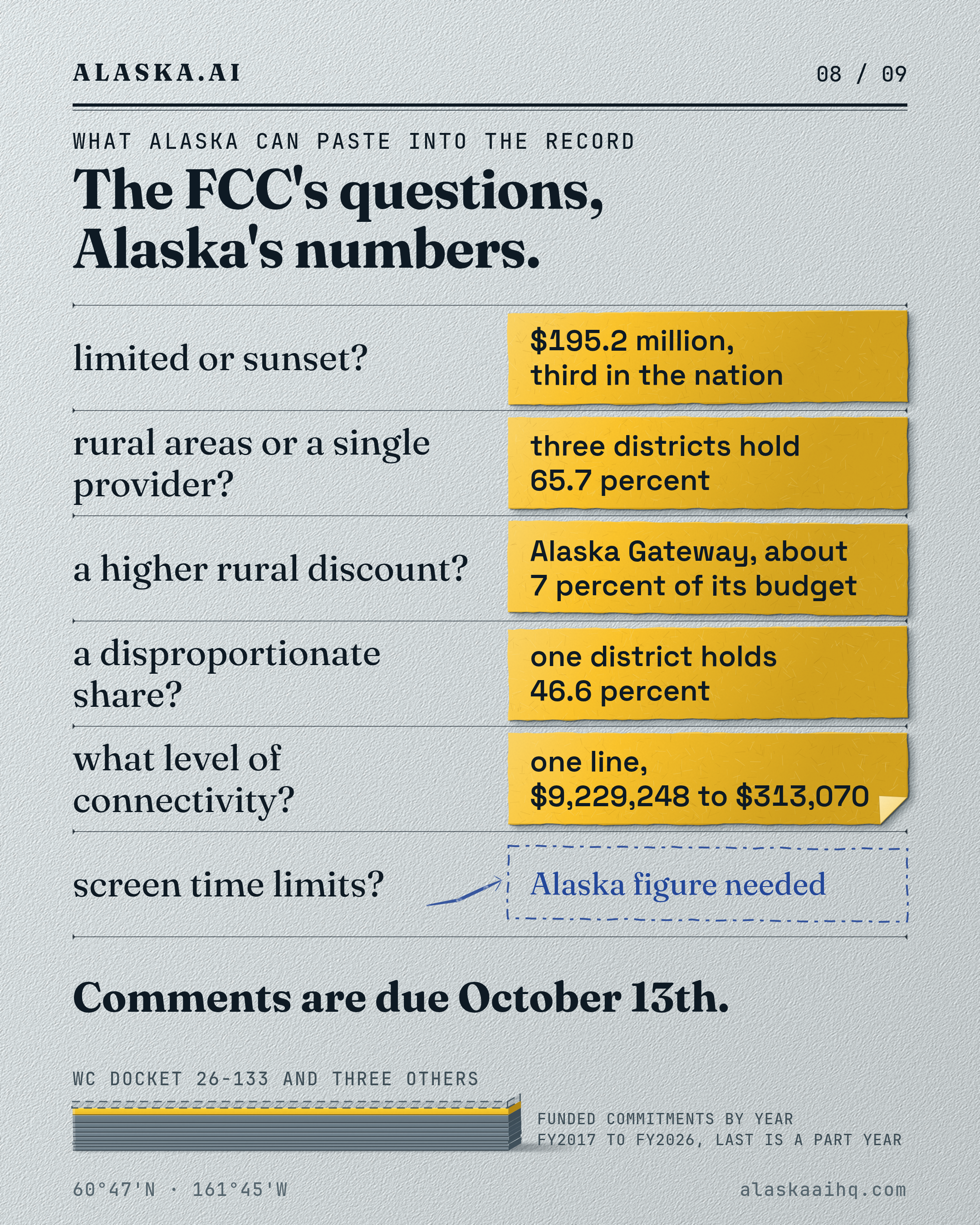
That is $195.2 million in USAC funded commitments for funding year 2025. Only California and Texas drew more. Lower Kuskokwim School District alone holds $91.0 million of it, 46.6 percent of Alaska's total.
The FCC asks whether E-Rate should be limited or sunset. It also asks what connectivity schools need to use AI-enabled tools. The full notice never uses the word Alaska. Comments are due October 13th.
The population share against the money share, ten districts ranked by dollars, one district's internet line over four years and a worksheet of FCC questions with one Alaska answer blank.
How should the FCC weigh a state where one district holds 46.6 percent of its E-Rate money?
What we verified
65 CLAIMS, EACH RE-FETCHED FROM ITS SOURCE BEFORE THIS DECK SHIPPED
The FCC's E-Rate notice in the Federal Register sets October 13th, 2026 as the deadline for comments.
Reply comments on the FCC's E-Rate notice are due November 12th, 2026.
The FCC asks in its E-Rate notice whether the E-Rate program should be limited or sunset to reflect today's extensive connectivity rates.
The notice cites an executive order on artificial intelligence whose goal is to equip educators to use AI in their classrooms to improve educational outcomes.
The FCC asks what level of connectivity schools and libraries need to use AI-enabled educational tools or other emerging technologies effectively.
The FCC asks whether the discount rate for rural schools and libraries should be higher than the discount rate for urban schools and libraries.
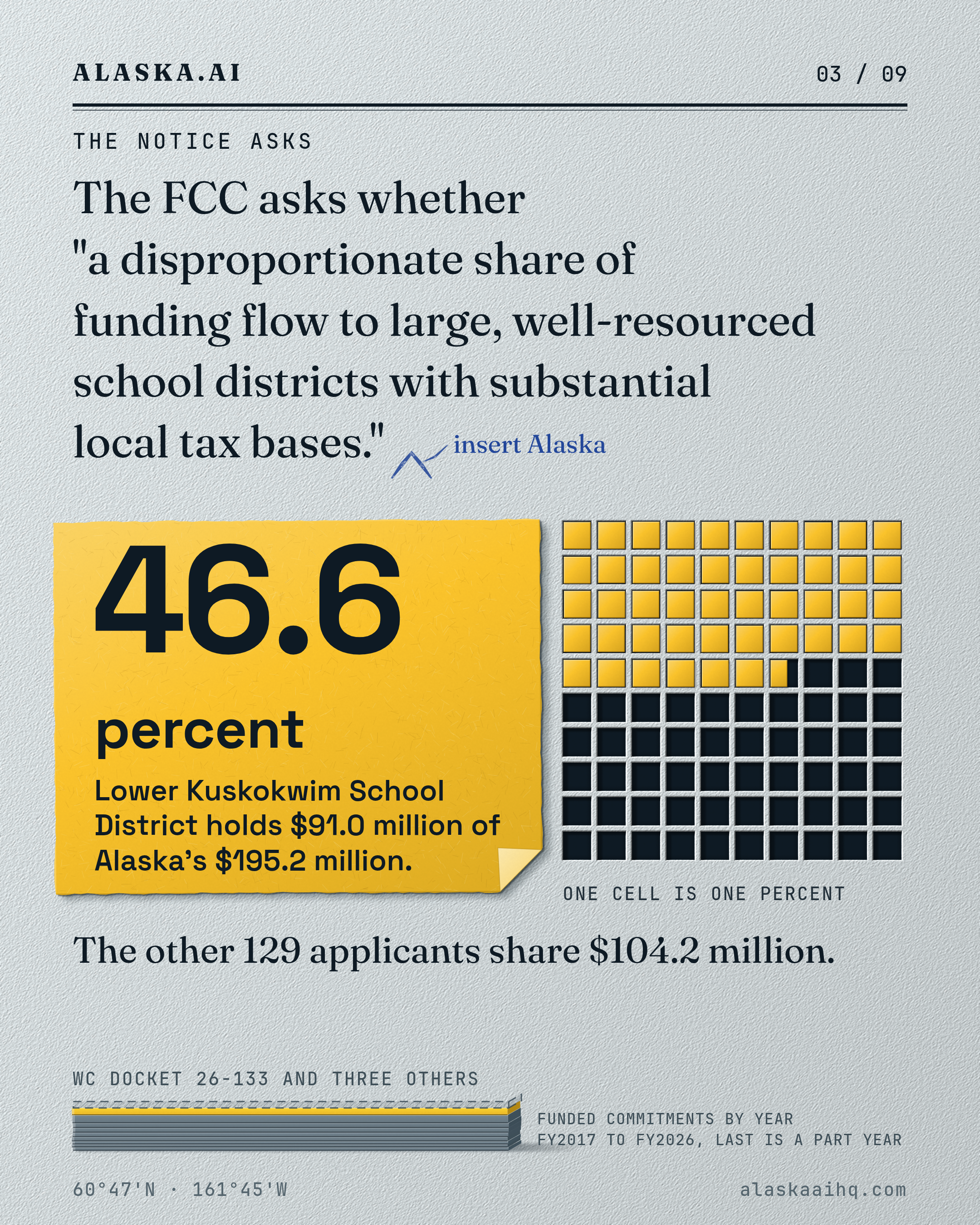
The FCC notice raises the concern of a disproportionate share of E-Rate funding flowing to large, well-resourced school districts with substantial local tax bases.
E-Rate discounts range from 20% to 90%, according to the FCC notice.
Applicants requested $1.806 billion for Category 1 services (connections to schools) in funding year 2025.
Applicants requested $1.418 billion for Category 2 services in funding year 2025.
The FCC adopted its E-Rate notice (FCC 26-41) on June 25th, 2026.
The FCC asks whether E-Rate support should be limited to rural areas or to areas served by a single provider.
The FCC asks whether E-Rate funding should be conditioned on the imposition of screen time limits in schools and libraries.
The FCC asks whether schools should be required, as a condition of E-Rate support, to give parents a meaningful opportunity to opt their children out of screen-based instruction.
An FCC Public Notice released August 17th, 2026 sets October 13th as the comment deadline and November 12th as the reply deadline.
Alaska schools and libraries had $195.2 million in funded E-Rate commitments for funding year 2025.
Alaska schools and libraries had $93.0 million in funded E-Rate commitments for funding year 2017.
Alaska ranked third among states in funded E-Rate commitments for funding year 2025, behind California and Texas.
National funded E-Rate commitments for funding year 2025 total $2.69 billion.
Alaska's funded E-Rate commitments for funding year 2025 are about 7.3 percent of the national total.
Alaska's population estimate for July 1st, 2025 is 737,270.
The United States population estimate for July 1st, 2025 is 341,784,857.
Alaska holds about 0.2 percent of the U.S. population, against about 7.3 percent of funding year 2025 funded E-Rate commitments.
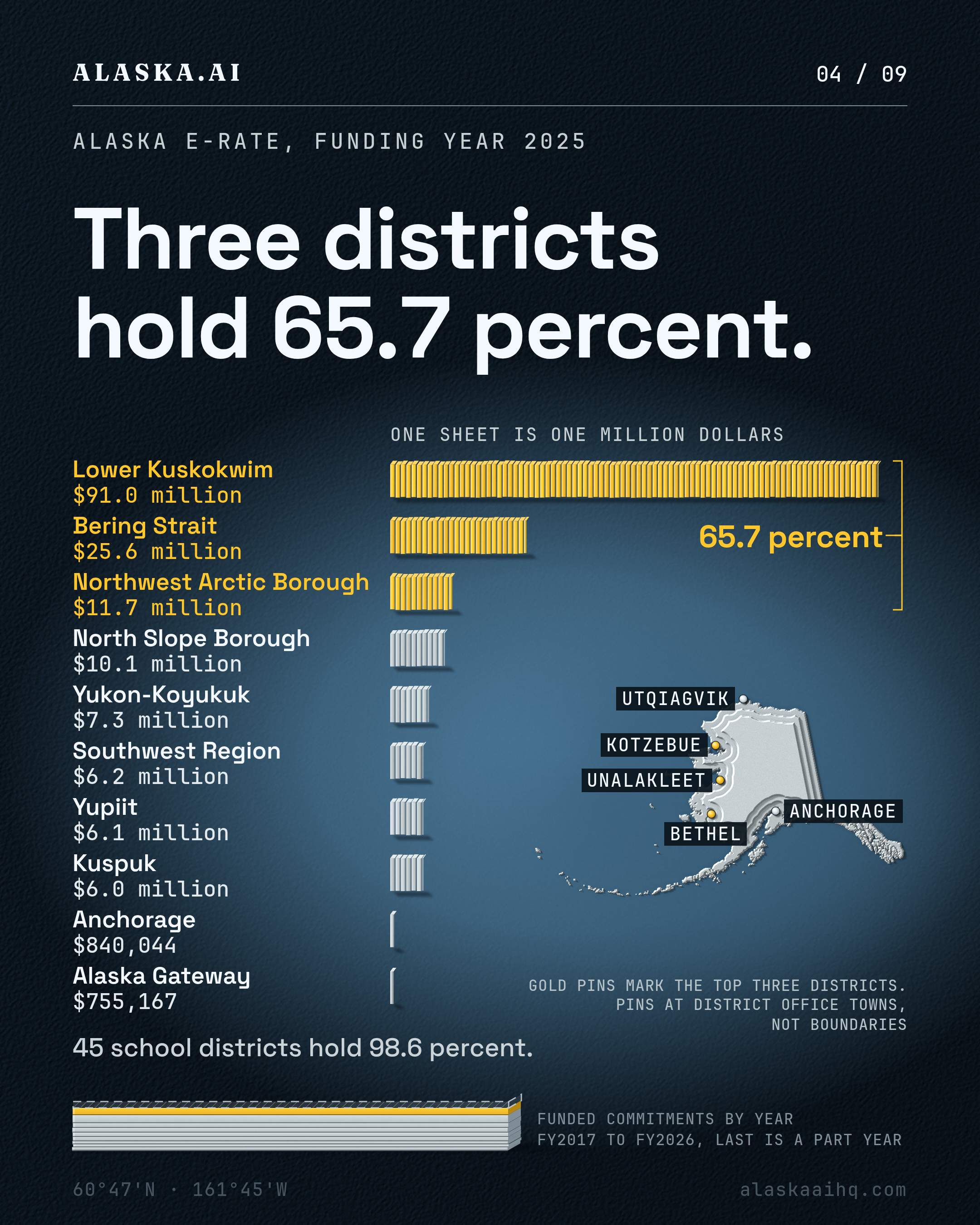
Lower Kuskokwim School District had $91.0 million in funded E-Rate commitments for funding year 2025, the most of any Alaska applicant.
Lower Kuskokwim School District accounts for about 46.6 percent of Alaska's funding year 2025 funded E-Rate commitments.
The top three Alaska applicants for funding year 2025 total about $128.3 million in funded E-Rate commitments, which is 65.7 percent of the state total.
Alaska's 45 school districts hold $192.4 million, or 98.6 percent, of the state's funding year 2025 funded E-Rate commitments.
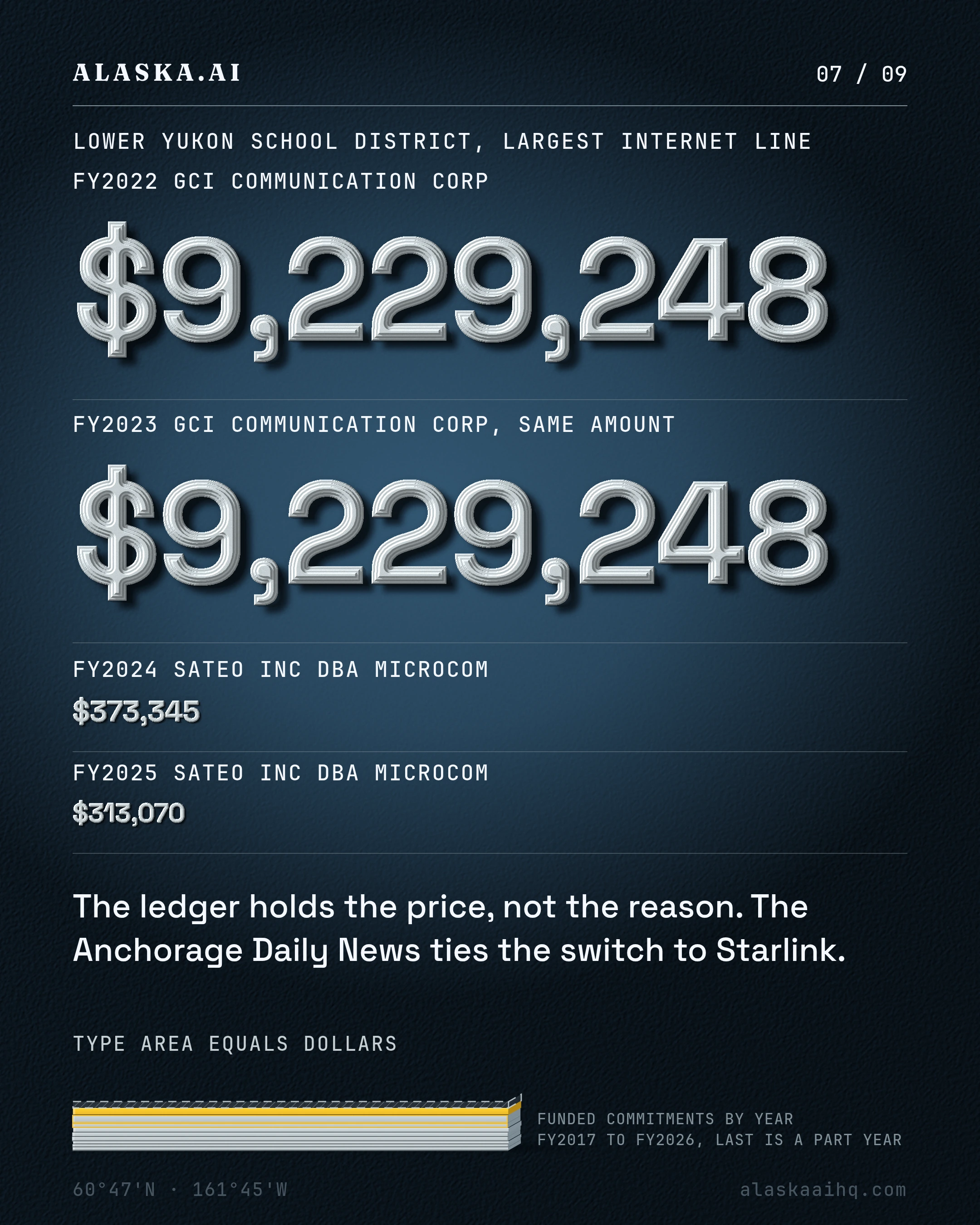
Lower Yukon School District's largest internet access line in funding year 2023 was $9,229,248 with GCI Communication Corp.
Lower Yukon School District's largest internet access line in funding year 2024 was $373,345 with Sateo Inc dba Microcom.
The full text of the Federal Register notice on the FCC's E-Rate proposal never mentions Alaska.
The FCC's E-Rate notice is filed under WC Docket Nos. 26-133, 13-184, 21-93 and 21-455, and FCC No. 26-41.
The FCC tells electronic filers to submit comments through its ECFS system at fcc.gov/ecfs.
Current E-Rate rules raise the discount rate of rural applicants with discount rates below 80% by five to ten percentage points.
Alaska schools and libraries had $81.1 million in funded E-Rate commitments for funding year 2018.
Alaska schools and libraries had $84.7 million in funded E-Rate commitments for funding year 2019.
Alaska schools and libraries had $119.0 million in funded E-Rate commitments for funding year 2020.
Alaska schools and libraries had $120.5 million in funded E-Rate commitments for funding year 2021.
Alaska schools and libraries had $129.8 million in funded E-Rate commitments for funding year 2022.
Alaska schools and libraries had $130.4 million in funded E-Rate commitments for funding year 2023.
Alaska schools and libraries had $221.4 million in funded E-Rate commitments for funding year 2024.
Alaska has $175.7 million in funded E-Rate commitments so far for funding year 2026, which is a partial year still in progress.
Bering Strait School District had $25.6 million in funded E-Rate commitments for funding year 2025.
Northwest Arctic Borough School District had $11.7 million in funded E-Rate commitments for funding year 2025.
North Slope Borough School District had $10.1 million in funded E-Rate commitments for funding year 2025.
Yukon-Koyukuk School District had $7.3 million in funded E-Rate commitments for funding year 2025.
Southwest Region School District had $6.2 million in funded E-Rate commitments for funding year 2025.
Yupiit School District had $6.1 million in funded E-Rate commitments for funding year 2025.
Kuspuk School District had $6.0 million in funded E-Rate commitments for funding year 2025.
Anchorage School District had $840,044 in funded E-Rate commitments for funding year 2025 across three requests.
Alaska Gateway School District had $755,167 in funded E-Rate commitments for funding year 2025 across six requests.
USAC lists 130 Alaska organizations with funded E-Rate commitments for funding year 2025.
The 129 Alaska applicants other than Lower Kuskokwim hold $104.2 million in funded E-Rate commitments for funding year 2025.
Lower Kuskokwim School District has its central office in Bethel.
Bering Strait School District has its central office in Unalakleet.
Northwest Arctic Borough School District has its central office in Kotzebue.
North Slope Borough School District has its central office in Utqiagvik.
The Anchorage School District administration center is in Anchorage.
Alaska Gateway School District has its central office in Tok.
Lower Yukon School District's funding year 2025 internet access line with Sateo Inc dba Microcom was $313,070.
Lower Yukon School District's funding year 2022 internet access line with GCI Communication Corp was $9,229,248.
Lower Yukon School District moved to Starlink in 2024 and its E-Rate internet subsidy dropped from about $6.25 million to about $600,000, according to the Anchorage Daily News.
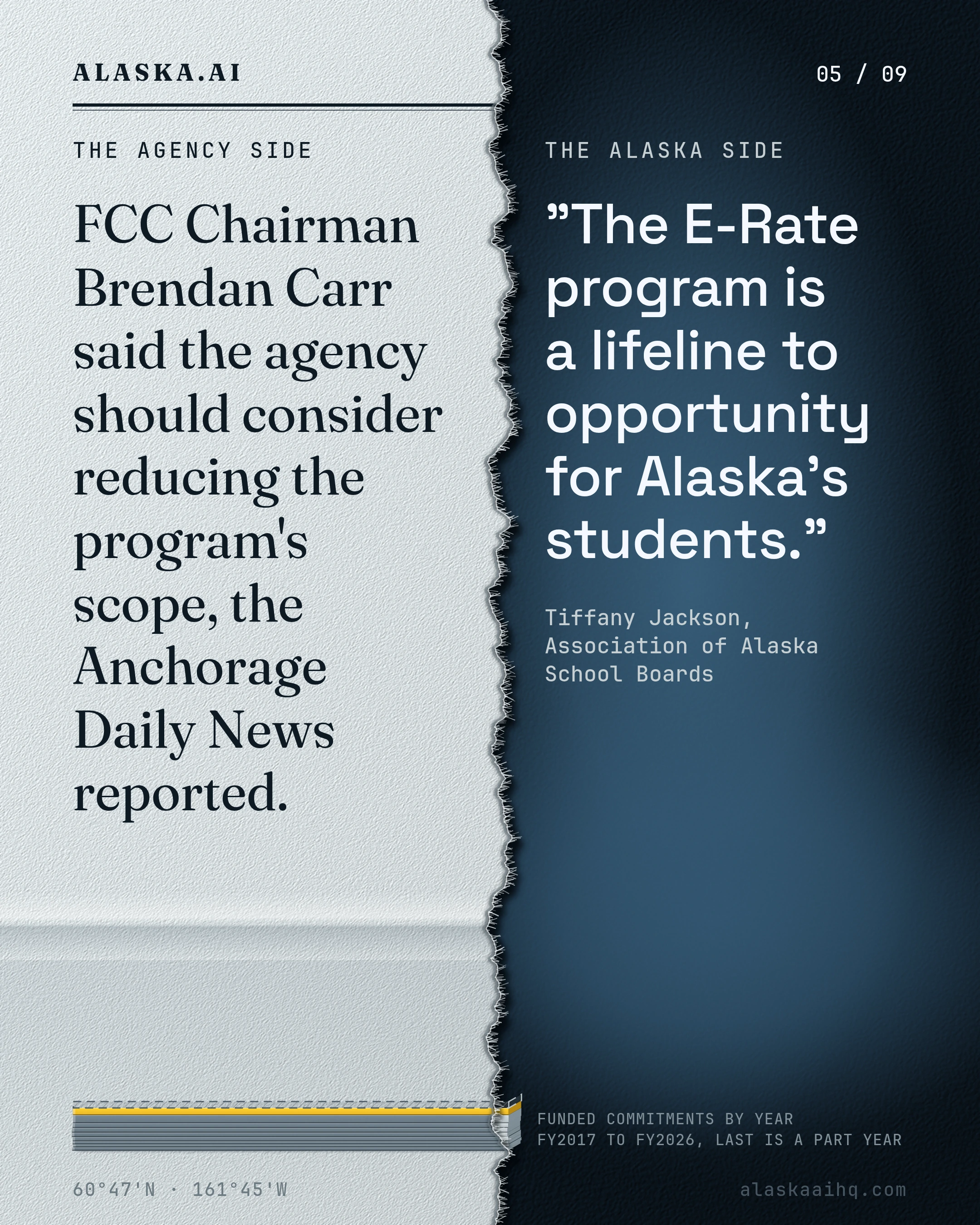
FCC Chairman Brendan Carr said the agency should consider reducing the E-Rate program's scope, according to the Anchorage Daily News.
Tiffany Jackson of the Association of Alaska School Boards said the E-Rate program is a lifeline to opportunity for Alaska's students.
Alaska Gateway School District gets more than $700,000 a year from E-Rate, about 7% of the district's budget, according to Superintendent Patrick Mayer.
The Alaska Association of School Boards wrote that districts would face an immediate absorption of full connectivity costs ranging from 20-90% if E-Rate were sunset.