Ten Minutes of Every Hour, The Count an AI Drone Must Beat
"The results have exceeded my expectations," Norm Van Vactor said in July of his Wood River AI drone pilot.
The deck
SWIPE, SCROLL OR CLICK A SLIDE TO GO FULLSCREEN · 9 SLIDES


The story
Next comes a test against Fish and Game's tower counts.
Behind it are the University of Washington's Fisheries Research Institute, Bristol Bay Regional Seafood Development Association and Bristol Bay Economic Development Corporation, not Fish and Game.
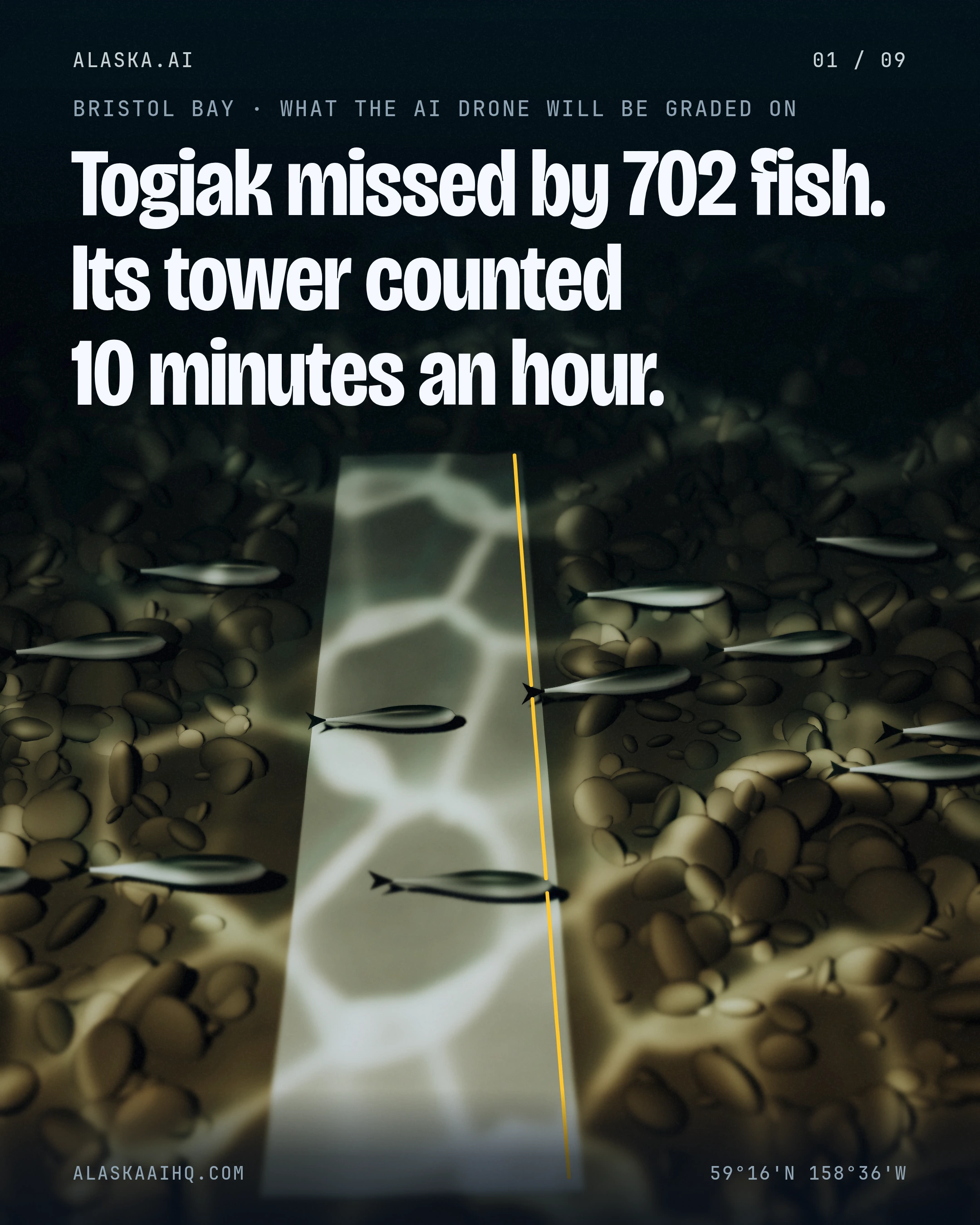
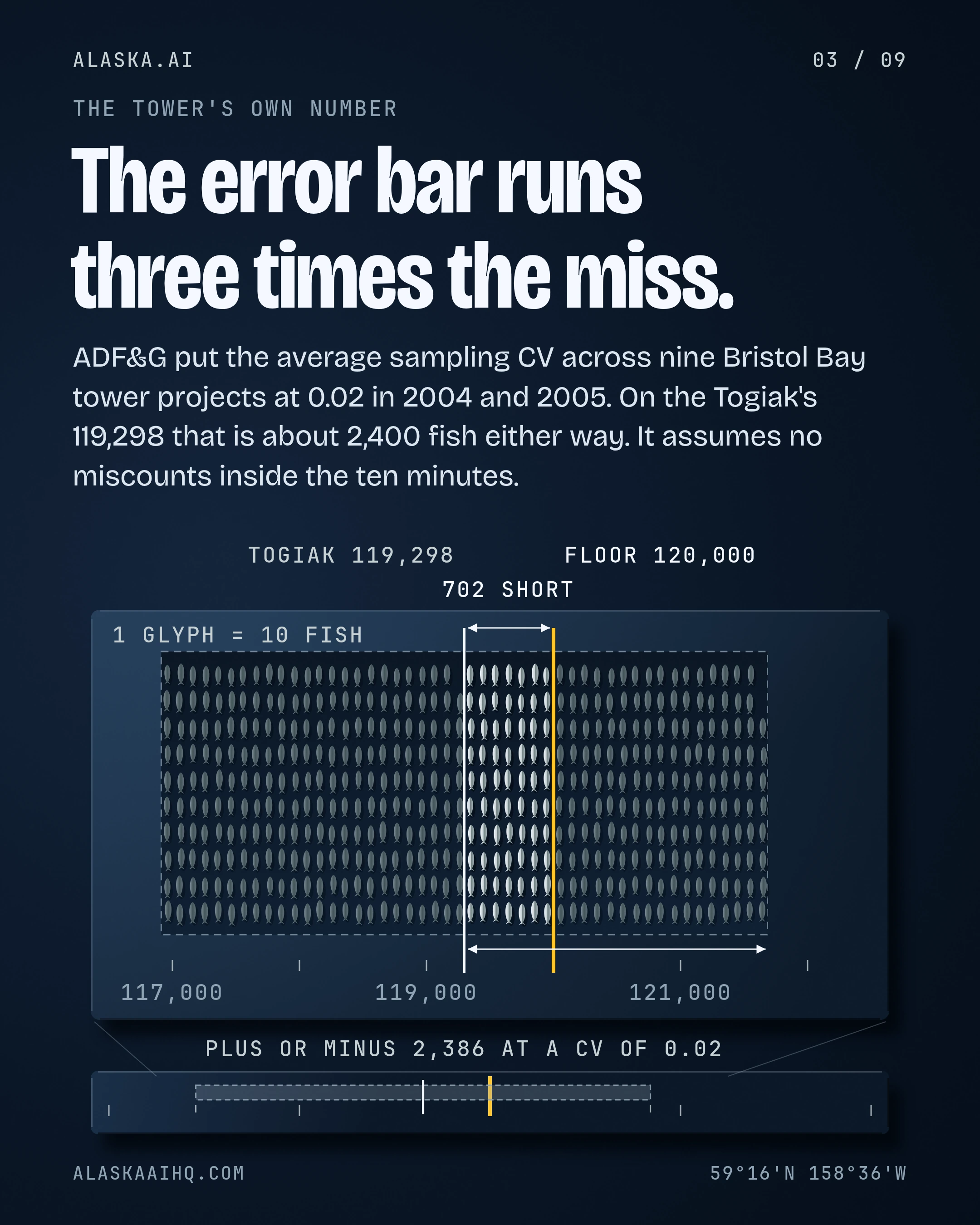
The towers count 10 minutes an hour on each bank and multiply by six. Nine Bristol Bay tower projects averaged about 2 percent sampling error in 2004 and 2005. On the Togiak's 119,298 that is about 2,400 fish, over three times its 702 miss.
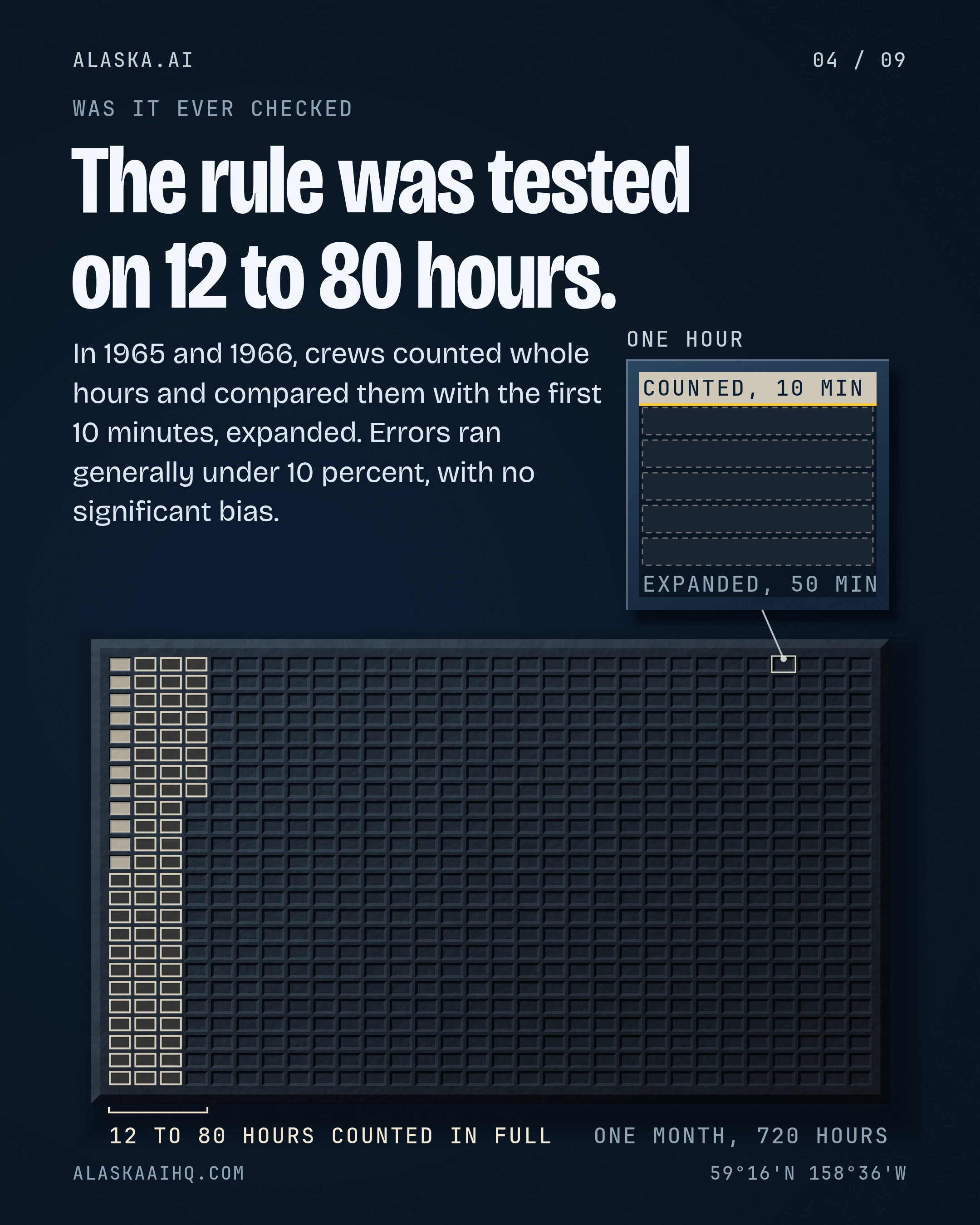
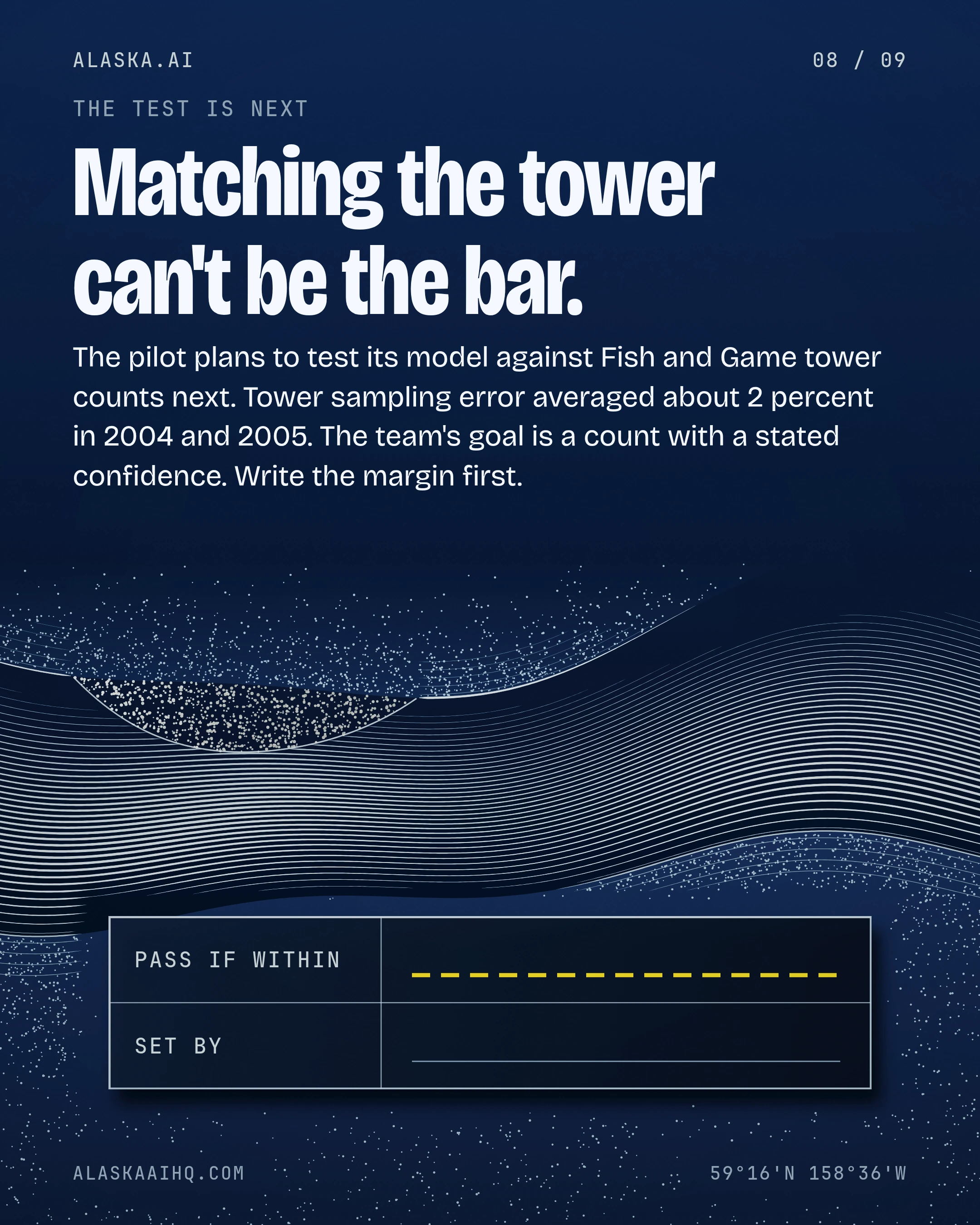
The method tested unbiased in 1965 and 1966 on only 12 to 80 hours. Matching the tower can't be the pass mark.
The Togiak's 119,298 sockeye are traced from a ten-minute window to their own error bar.
Before that test runs, who should set the passing margin?
What we verified
112 CLAIMS, EACH RE-FETCHED FROM ITS SOURCE BEFORE THIS DECK SHIPPED
ADF&G put the 2026 inshore Bristol Bay sockeye run at 45.7 million fish.
ADF&G's Table 1 gives the exact 2026 Bristol Bay sockeye total run as 45,685,308 fish.
The 2026 run was 8% below the 49.6 million fish average for the 20-year period from 2006 to 2025.
2026 was the first year since 2014 that the Bristol Bay inshore sockeye run came in under 50 million fish.
The 2026 run came in 4% above ADF&G's preseason inshore forecast of 44.1 million fish.
Baywide sockeye escapement in 2026 totaled 15.6 million fish.
ADF&G's Table 1 lists exact 2026 Bristol Bay sockeye escapement as 15,608,533 fish.
The 2026 Bristol Bay commercial sockeye harvest was 30.1 million fish.
The 2026 sockeye harvest came in 7% below the 32.3 million fish preseason harvest forecast.
ADF&G estimated the 2026 preliminary Bristol Bay exvessel value for all salmon species at $264.0 million.
ADF&G said the 2026 exvessel value was 21% above the 20-year average of $207.8 million.
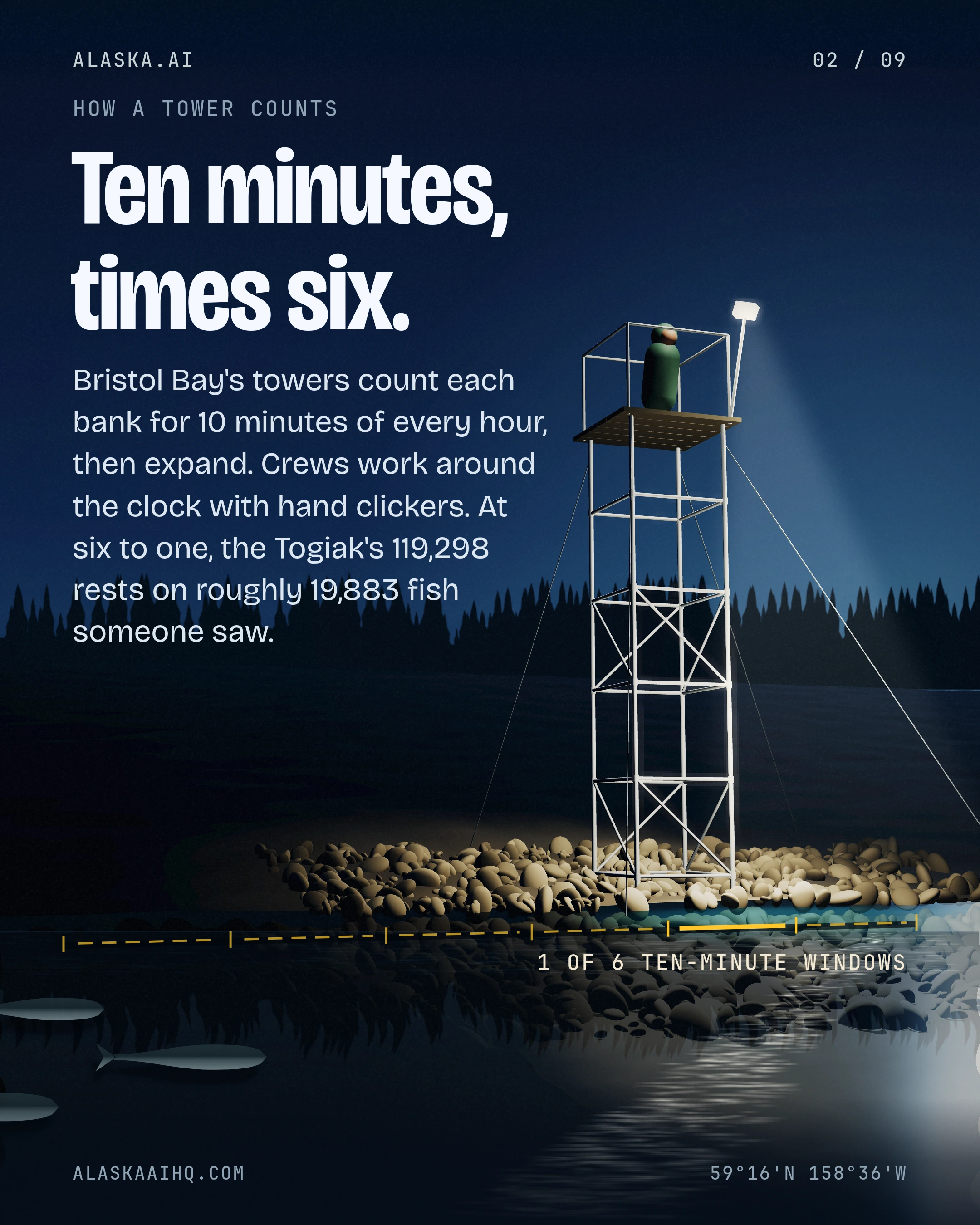
At the towers' six to one expansion, the Togiak's 2026 tower count of 119,298 corresponds to roughly 19,883 fish counted during the sampled ten minutes.
Applying ADF&G's average tower sampling CV of 0.02 to the Togiak's 119,298 gives about 2,386 fish, more than three times the 702 fish by which the count missed its floor.
Every 2026 Bristol Bay sockeye escapement goal was met or exceeded except the Togiak River's.
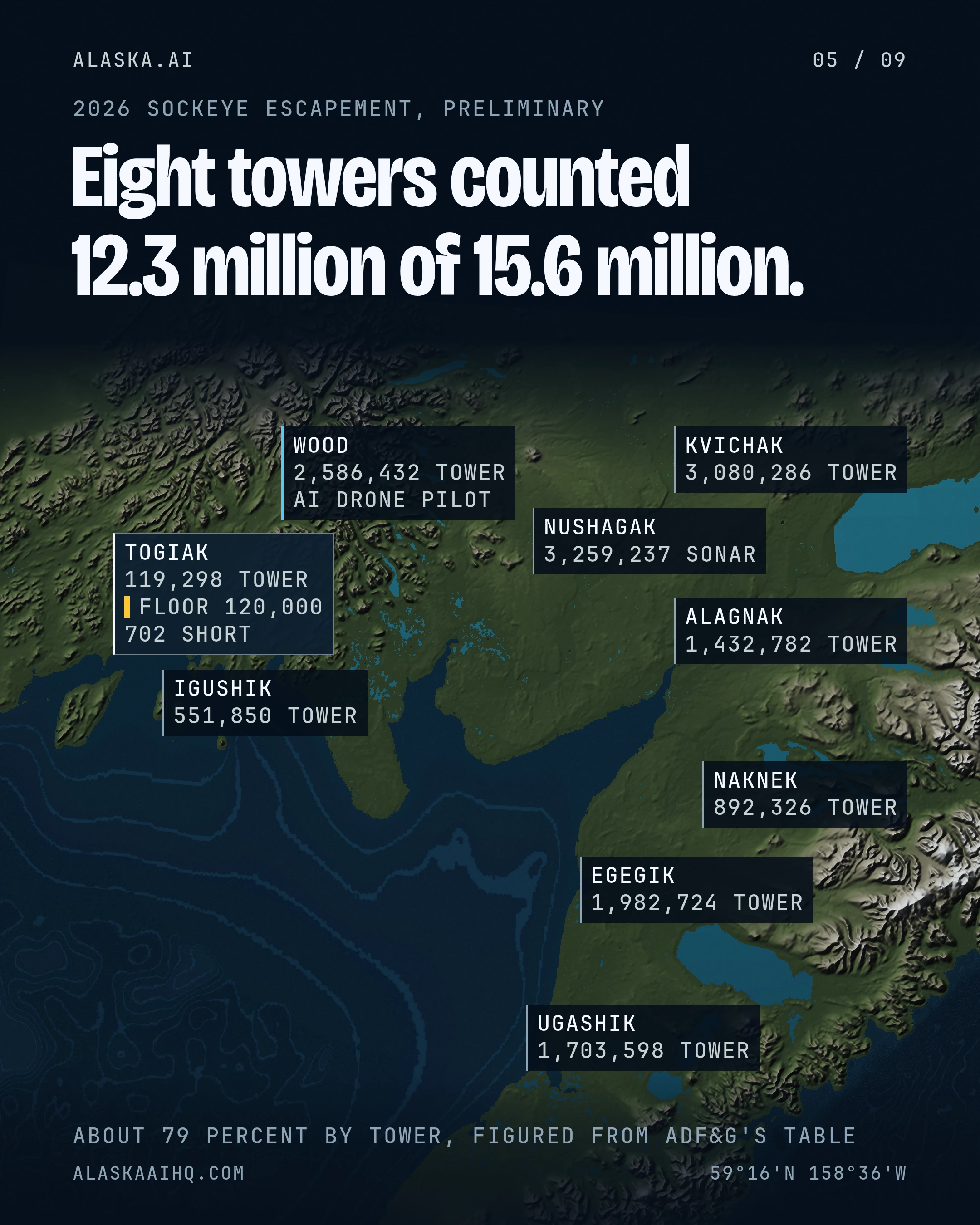
The Togiak River tower counted a 2026 sockeye escapement of 119,298 fish.
The Togiak River sockeye escapement goal range runs from 120,000 to 270,000 fish.
The 2026 Togiak escapement fell 702 fish short of the goal's 120,000 fish lower bound.
The Wood River tower counted a 2026 sockeye escapement of 2,586,432 fish.
The Wood River optimal escapement goal for sockeye is 700,000 to 2,800,000 fish.
ADF&G also lists a Wood River sustainable escapement goal of 700,000 to 1,800,000 sockeye.
The Kvichak River tower counted a 2026 sockeye escapement of 3,080,286 fish.
ADF&G's Table 1 lists the Naknek River tower escapement as 892,326 sockeye.
ADF&G's Table 3 lists the Naknek River escapement as 892,236 sockeye, which conflicts with Table 1.
The Alagnak River tower counted a 2026 sockeye escapement of 1,432,782 fish.
The Egegik River tower counted a 2026 sockeye escapement of 1,982,724 fish.
The Ugashik River tower counted a 2026 sockeye escapement of 1,703,598 fish.
The Igushik River tower counted a 2026 sockeye escapement of 551,850 fish.
The Nushagak River's 2026 sockeye escapement of 3,259,237 fish was counted by sonar, the only Bristol Bay escapement in the table not counted from a tower.
Eight tower-counted rivers supplied about 12.3 million of Bristol Bay's 15.6 million 2026 sockeye escapement, roughly 79%.
Bristol Bay sockeye averaged $1.72 per pound in 2026, per ADF&G's preliminary Table 4.
Bristol Bay sockeye averaged 5.03 pounds per fish in 2026, and the sockeye harvest alone was worth $260,236,788.
Baywide sockeye run timing in 2026 was two days early compared with the 20-year average.
ADF&G issued its 2026 Bristol Bay season summary as an advisory announcement on September 22nd and called all of its data preliminary.
ADF&G technical document 18 says towers are used to count sockeye salmon on 8 river systems in Bristol Bay.
At Bristol Bay counting towers, ADF&G counts for 10 minutes of every hour on each bank of the river and then expands the counts.
The average coefficient of variation from sampling at 9 Bristol Bay tower projects in 2004 and 2005 was 0.02.
ADF&G's 0.02 tower CV estimate assumes there are no errors in the counts made during the 10 minutes sampled.
ADF&G tested the 10-minute counting method with experiments on several tower projects in 1965 and 1966, reported by Seibel in 1967.
In the 1965 and 1966 experiments crews counted for a full hour and compared that total with the expanded count from the first 10 minutes.
The 1960s full-hour experiments found 10-minute count errors generally under 10 percent, with bias not significantly different from zero.
Only 12 to 80 hours were fully counted in each of the 1960s tower experiments, while tower projects generally run a month or longer.
CVs from the expanded 10-minute counts in the 1960s experiments averaged less than 0.02, consistent with the systematic sampling estimates.
NSF award 2433241 for the Rural AI Solutions and Engagement project at the University of Alaska Anchorage totals $380,000.
Kenrick Mock is the principal investigator on NSF award 2433241.
NSF award 2433241 runs from August 1st, 2024 to July 31st, 2027.
The NSF award includes creating an Alaska AI Solutions Consortium that will advance research through a mini-grant program.
Full proposals for UAA's 2026 RAISE mini grants are due October 7th.
UAA will announce the 2026 RAISE mini grant awards on November 2nd.
Partner statements of need for the 2026 RAISE mini grants were due September 21st.
Any Alaskan organization outside the university can partner on a RAISE mini grant, including Alaska Native organizations and K-12 education.
The University of Alaska held a statewide AI Symposium from September 25th to 27th at the ConocoPhillips Integrated Science Building in Anchorage.
Counting towers are typically built from aluminum scaffolding.
Lighter substrates or contrasting panels on the riverbed help tower counters spot salmon.
Polarized glasses are used at counting towers to reduce glare and improve visibility on cloudy days.
Floodlights over the river or near the towers make night counts possible, and the handbook calls night counts integral to good abundance estimates.
Hand tally counters appear on the handbook's equipment list for counting towers, and at high densities one click can stand for tens, hundreds or rarely thousands of salmon.
The handbook lists the Wood River sockeye counting tower as operating from 1956.
The handbook lists the Kvichak River sockeye counting tower as operating from 1955, the earliest Bristol Bay entry in its table.
The handbook says its tower count methods give reasonable estimates of salmon population size, within plus or minus 6 to 10 percent, in clear rivers.
The handbook says counting tower data have been found consistent with digital video counts, citing Edwards in 2005.
Seibel's 1967 reevaluation across eight Alaska rivers found a mean relative error of 0.9 percent for systematic tower counts, not significant at the 95 percent confidence level.
The handbook states plainly that counting towers do not provide error-free estimates of escapement.
A drone in a self-contained box on the Wood River opens and launches at half past eight each morning, according to KDLG.
Project lead Norm Van Vactor called the drone's box a completely self-contained unit.
Norm Van Vactor is a project lead on the Wood River drone counting pilot.
Norm Van Vactor said the project rides an amazing convergence of technology.
Norm Van Vactor said tools like the drone could significantly enhance the quality of the data used to manage the fishery.
Ian Chiu, who develops the project's machine learning remotely, said the end product is a computer vision model trained to pick out salmon in video.
Wood River tower counters multiply their 10-minute counts by six to estimate the fish passing in an hour, KDLG reported in 2023.
A three-person Wood River tower crew working eight-hour shifts counts salmon for 20 minutes of every hour, every day, KDLG reported in 2023.
KDLG reported in 2023 that the Wood River counting tower is one of nine tower sites across Bristol Bay.
ADF&G tower crews rotate through round-the-clock shifts, counting salmon with hand-clickers in 10 minute intervals, according to KDLG.
ADF&G has tracked Bristol Bay salmon escapement with counting towers since 1955, according to KDLG.
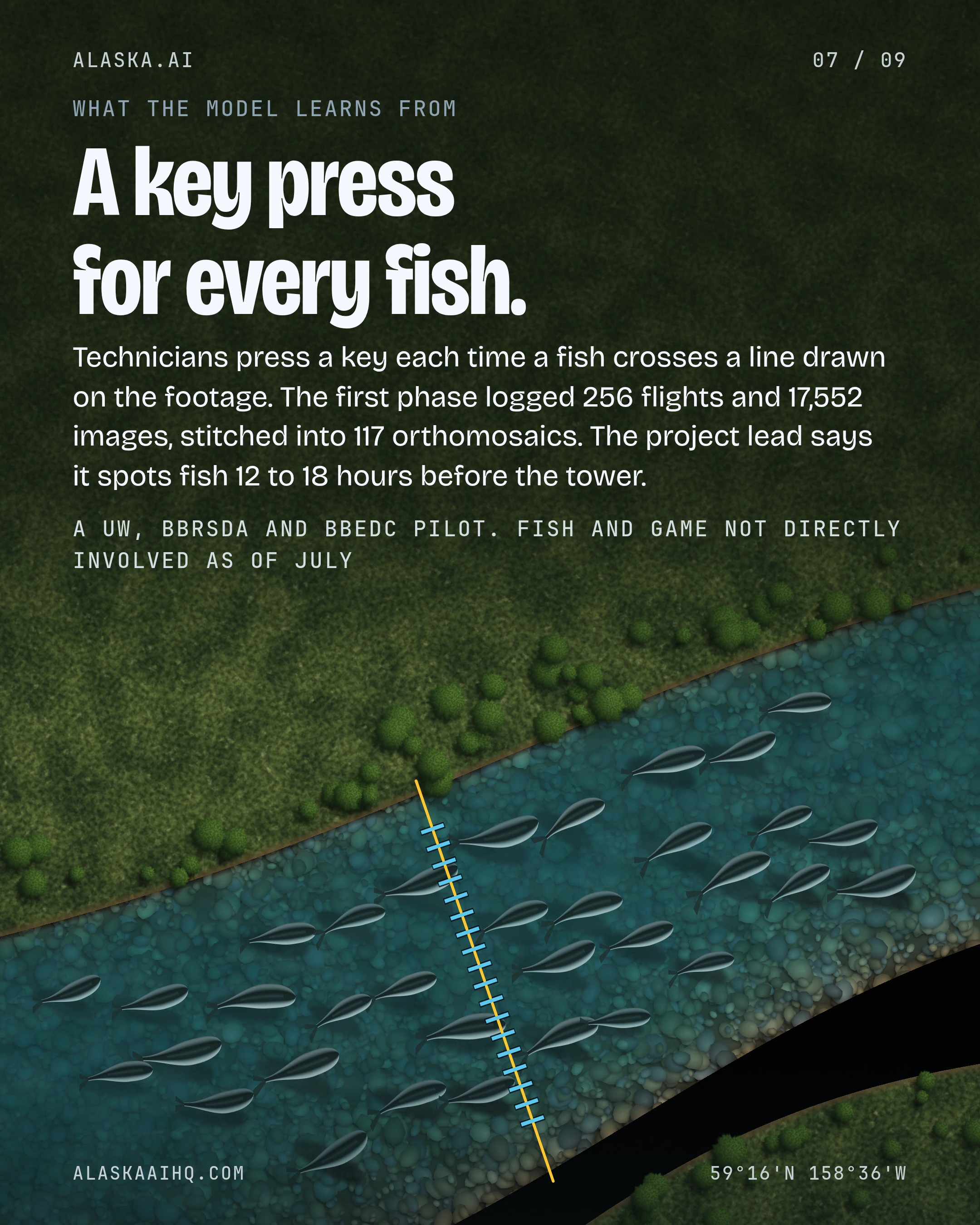
The drone pilot's partners are the University of Washington's Fisheries Research Institute, the Bristol Bay Regional Seafood Development Association and the Bristol Bay Economic Development Corporation.
As of July, Fish and Game was not directly involved in the drone counting project.
Technicians train the AI model by pressing a key each time a fish crosses a line drawn across the drone footage.
The drone crew planned to test its models against Fish and Game tower counting data in the project's next phase.
Norm Van Vactor said of the technology, I really think it's our future.
Seafoodsource reported that a $70,000 ACME Climate Grant helped fund the Wood River drone pilot.
Seafoodsource reported a $120,000 grant from the Bristol Bay Economic Development Corporation for the pilot.
The grants let the team buy two solar-powered drones for the Wood River pilot, according to SeafoodSource.
The pilot's first phase involved 256 drone flights that captured 17,552 images of swimming salmon, according to SeafoodSource.
Interns turned the drone images into 117 orthomosaics, stitched composite images, according to SeafoodSource.
Van Vactor said the drone camera's position let the team spot fish 12 to 18 hours before they would reach the counting tower.
Van Vactor described the drone counting effort as probably a two-year project, with this year as year one.
Van Vactor said the aim is a process that can state a fish count with a stated confidence level, using a hypothetical example of 256,755 fish at 90 percent confidence.
Van Vactor told SeafoodSource that the pilot's results had exceeded his expectations.
ADF&G biologist Stacy Vega said of the 2026 Bristol Bay sockeye return that it was by no means a small run.
Bristol Bay's record sockeye run was 79 million fish in 2022, according to Stacy Vega.
Alaska Beacon reported on October 2nd that this year's Bristol Bay sockeye run was the first under 50 million since 2014.
A draft University of Alaska AI policy would require all three campuses to have an AI plan for students, faculty and staff.
University of Alaska leadership plans to bring a finalized draft AI policy to the regents for approval at their November meeting.
In 1951 biologist Charles Walker reported that he could count migrating sockeye from a high riverbank at the outlet of Lake Aleknagik on the Wood River.
W. F. Thompson, then a director of fisheries research in Bristol Bay, proposed the tower counting technique in 1953 and ran a pilot study counting fish from high towers.
Sockeye closely followed the contour of each riverbank in water about three to six feet deep and rarely more than thirty feet from shore, as Rietze described in 1957.
Rietze reported that migrating sockeye traveled in a narrow band of about four to ten fish swimming abreast.
The most common counting tower design in Alaska is nonreplicated systematic sampling of 10 minutes per hour.
Before the season a random number from 1 to 6 is drawn to pick which 10-minute interval of each hour gets counted for the rest of the season.
In the handbook's example a counter who draws interval 2 counts at ten minutes past each hour, starting at ten past noon and repeating every hour.
The standard 10-minute-per-hour tower design does not allow unbiased estimation of the variance of the total escapement estimate.
Each paired-observer test pairing an inexperienced and an experienced counter consisted of eighteen 10-minute counts split across daylight, dusk and night.
The paired-observer tests produced a combined total error of plus 0.4 percent, a 117 fish difference out of 29,000 fish.
Becker in 1962 tested observer error with a series of 32 paired 5-minute counts.
In Becker's paired counts the difference between observers ranged from minus 5.3 percent to plus 3.5 percent.
In Becker's 1962 test the two observers' total counts differed by 1 percent, implying observer error was unbiased and tended to cancel out.
In 1980 a fishermen's strike led to a Kvichak River sockeye escapement of 22.5 million fish.
During the 1980 Kvichak run an estimated 0 to 150,000 fish passed the counting towers in every 10-minute counting interval.
In the 1980 Kvichak run observers visually divided migrating bands of salmon into tens, hundreds and even thousands to tally them.
The handbook says the impact of counting error during such dense migrations has not been studied.
Becker found greater variation in observer bias when migrants equaled or exceeded 700 fish per 10-minute interval.
Glare, overcast skies, high winds, rain and turbidity all reduce visibility and affect tower count accuracy.
The handbook says the error from weather and visibility at counting towers has not been quantified.
Beats
This article is on Alaska AI research and science. Each beat page keeps every decision and every article on that subject in one place.