Of 150 Cited, 119 Used AI. The Rule Says Devices.
AI cases are now most of UAA's conduct caseload by its own report. The rule behind them says "devices" and never names AI.
The deck
SWIPE, SCROLL OR CLICK A SLIDE TO GO FULLSCREEN · 8 SLIDES
The story
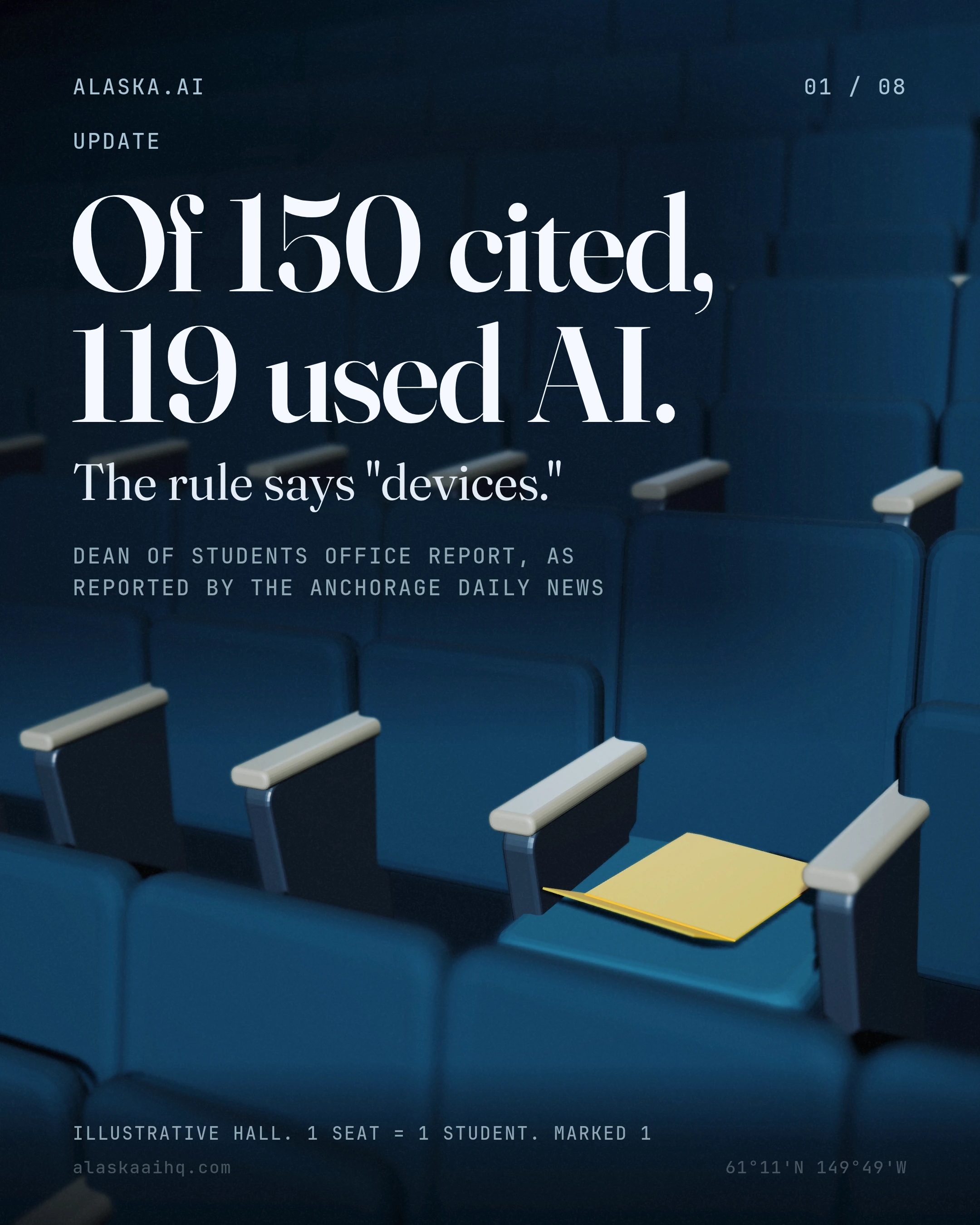
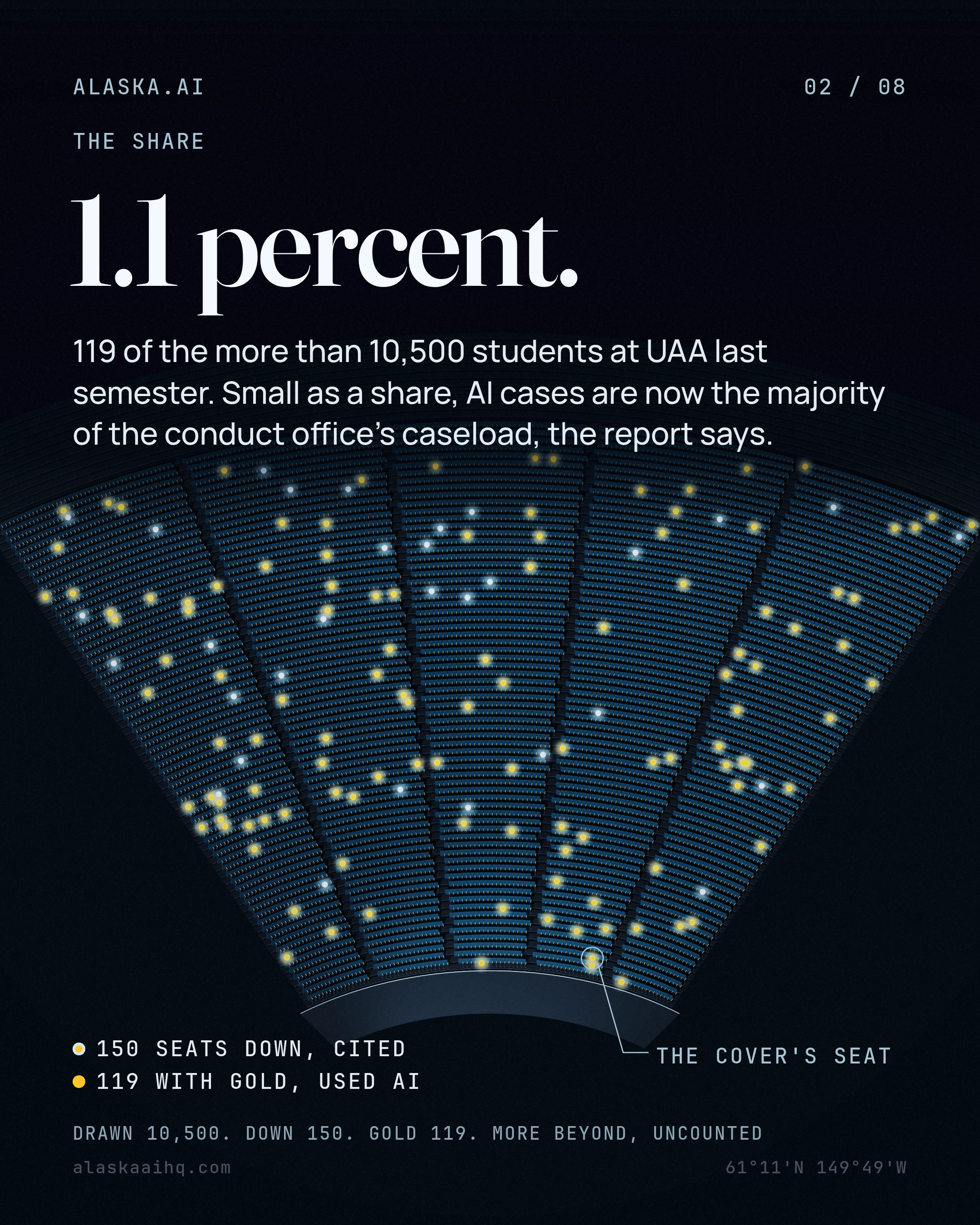
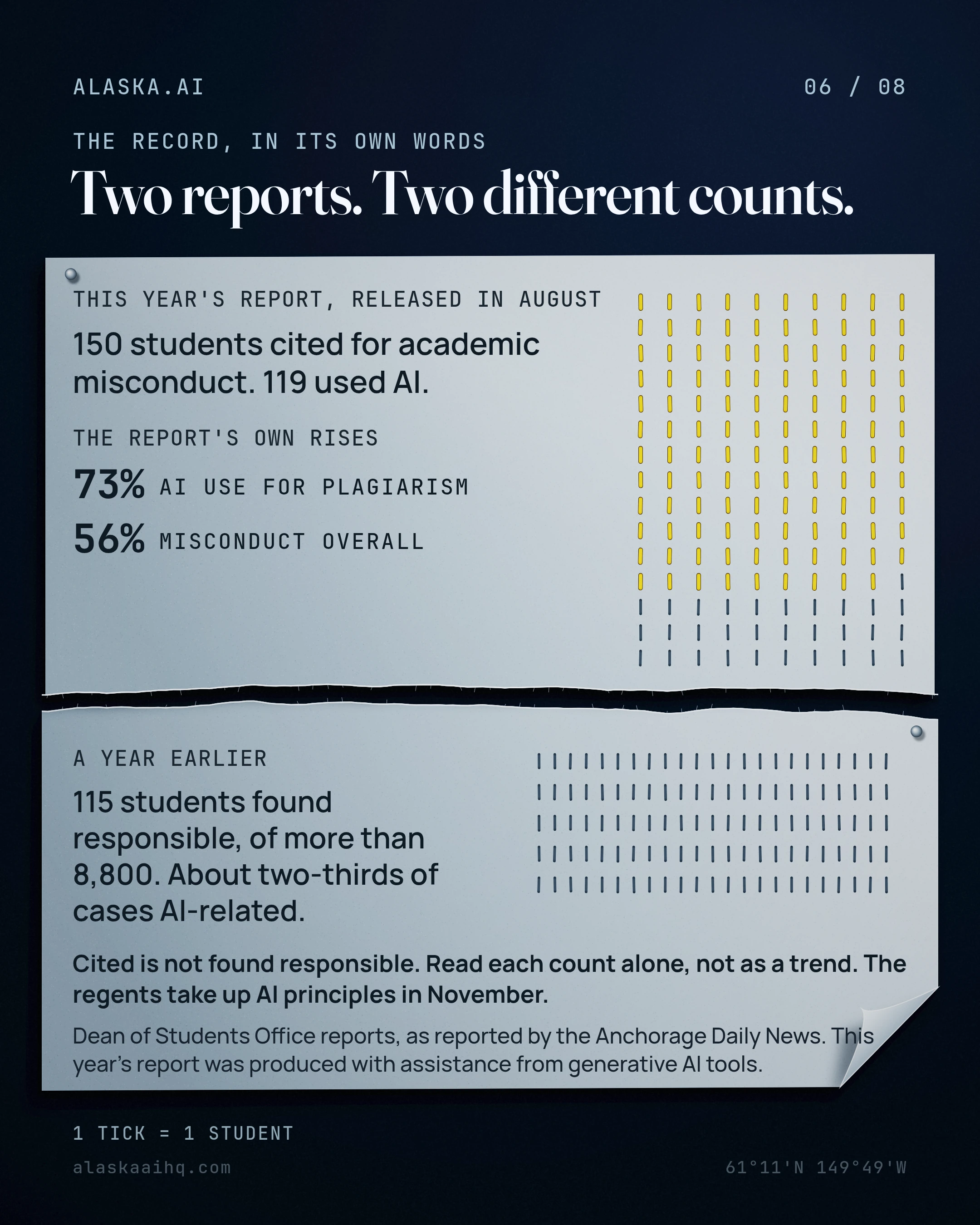
The Dean of Students Office report counted 150 students cited for academic misconduct. 119 used AI, 1.1 percent of the more than 10,500 who attended last semester.
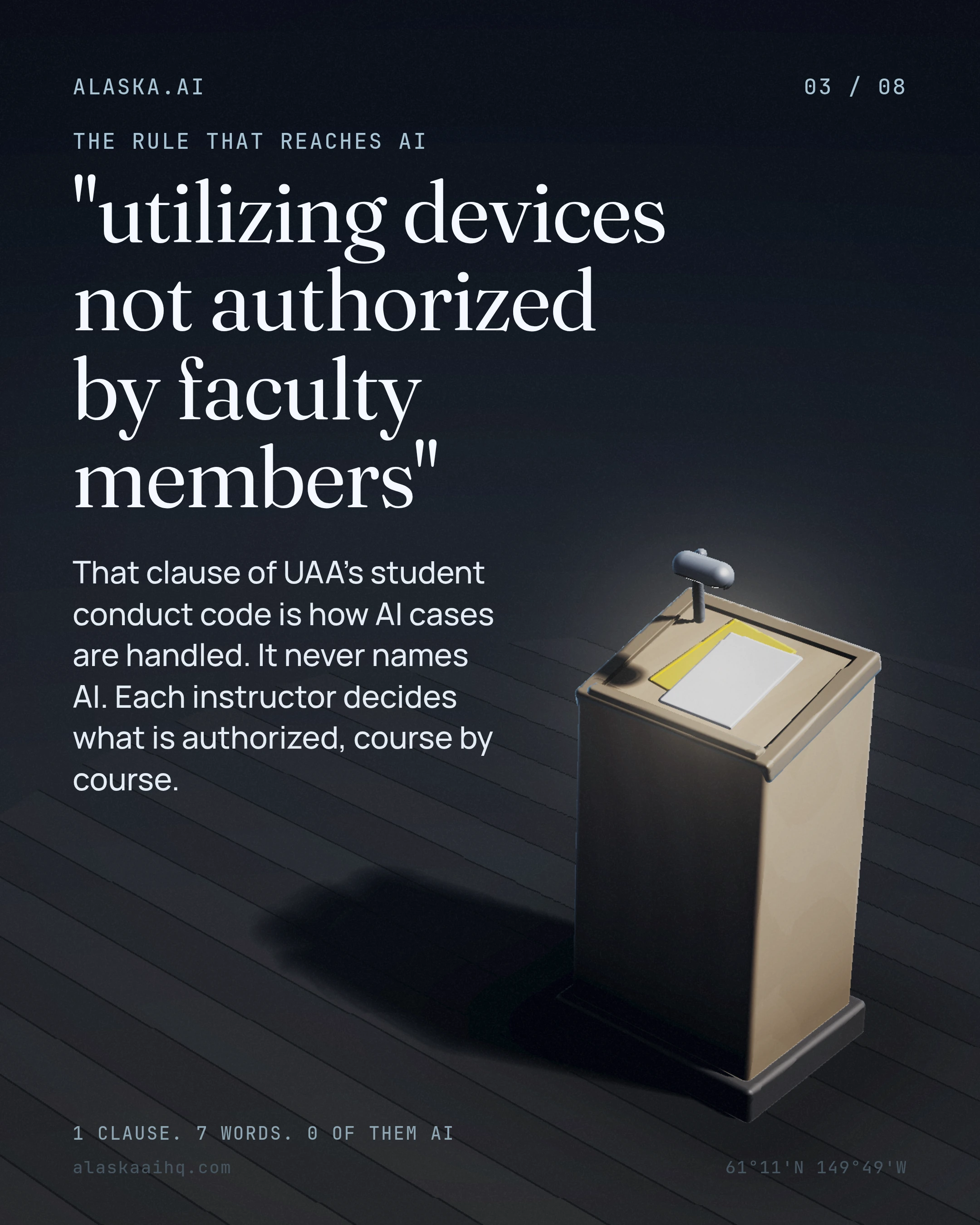
The clause prohibits "utilizing devices not authorized by faculty members."
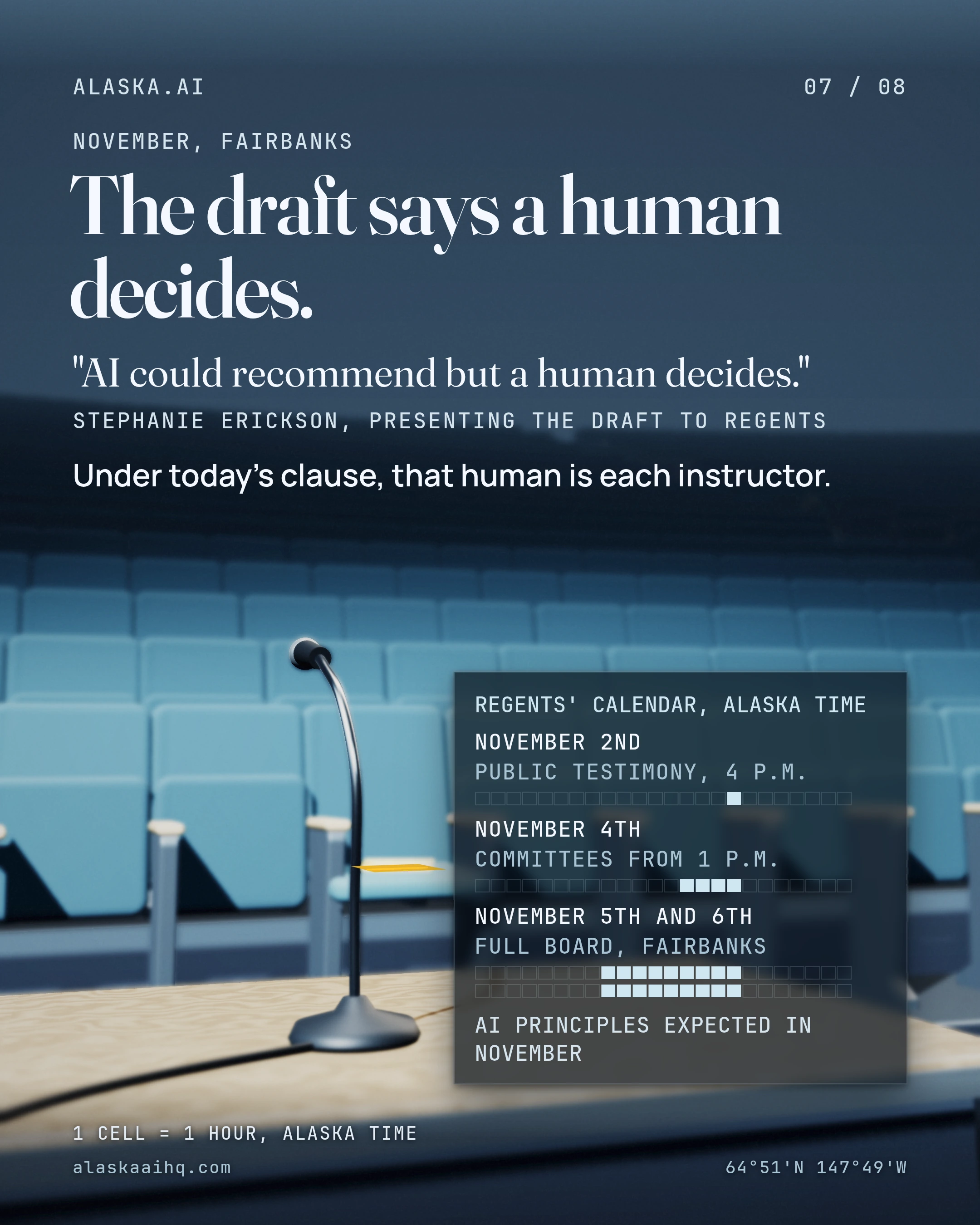
November 2nd at 4 p.m. Public testimony before the regents. November 5th and 6th. The board meets in Fairbanks, with AI principles scheduled for November.
Stephanie Erickson said "AI could recommend but a human decides." The clause makes each instructor that human.
A drawn hall of 10,500 seats shows 150 cited and 119 for AI. Then come the clause, two years of reports kept apart and the November calendar.
After November, will UAA's next AI case still be judged under "devices"?
What we verified
51 CLAIMS, EACH RE-FETCHED FROM ITS SOURCE BEFORE THIS DECK SHIPPED
The UA Board of Regents calendar lists BOR Committee Meetings beginning at 1 p.m. Alaska time on November 4th.
The regents calendar lists a Committee and Full Board Meeting in Fairbanks on November 5th.
The regents calendar lists the Board of Regents' Meeting in Fairbanks on November 6th.
The regents calendar lists a Public Testimony session from 4 p.m. to 5 p.m. Alaska time on Monday, November 2nd.
The UA Statewide AI Symposium ran September 25th to 27th at the ConocoPhillips Integrated Science Building in Anchorage.
The symposium closed with a strategy session for the UA statewide AI advisory council.
UA's Systemwide AI in Communications Guidelines were developed over five months.
The communications guidelines don't address classroom, instructional or research uses of AI.
UA's Generative AI Security Standard took effect in January 2025 and governs data and tool procurement rather than academic integrity.
DNR noticed Hilcorp's application for a Beluga River gas storage lease covering approximately 6,100 acres of state-owned subsurface reservoir.
UAA's Dean of Students Office report counted 150 students cited for academic misconduct.
Of the students cited for academic misconduct at UAA, 119 used AI.
The 119 AI cases equal 1.1% of the more than 10,500 students who attended UAA last semester.
The report shows a 73% increase in AI use for plagiarism last year.
The report shows a 56% increase in academic misconduct overall.
The UAA report on generative AI use among students was produced with assistance from generative AI tools.
The Dean of Students Office released the report in August.
The report states that cases involving AI use now make up the majority of cases handled by the UAA conduct office.
The UA system has no single policy governing AI use across more than a dozen campuses.
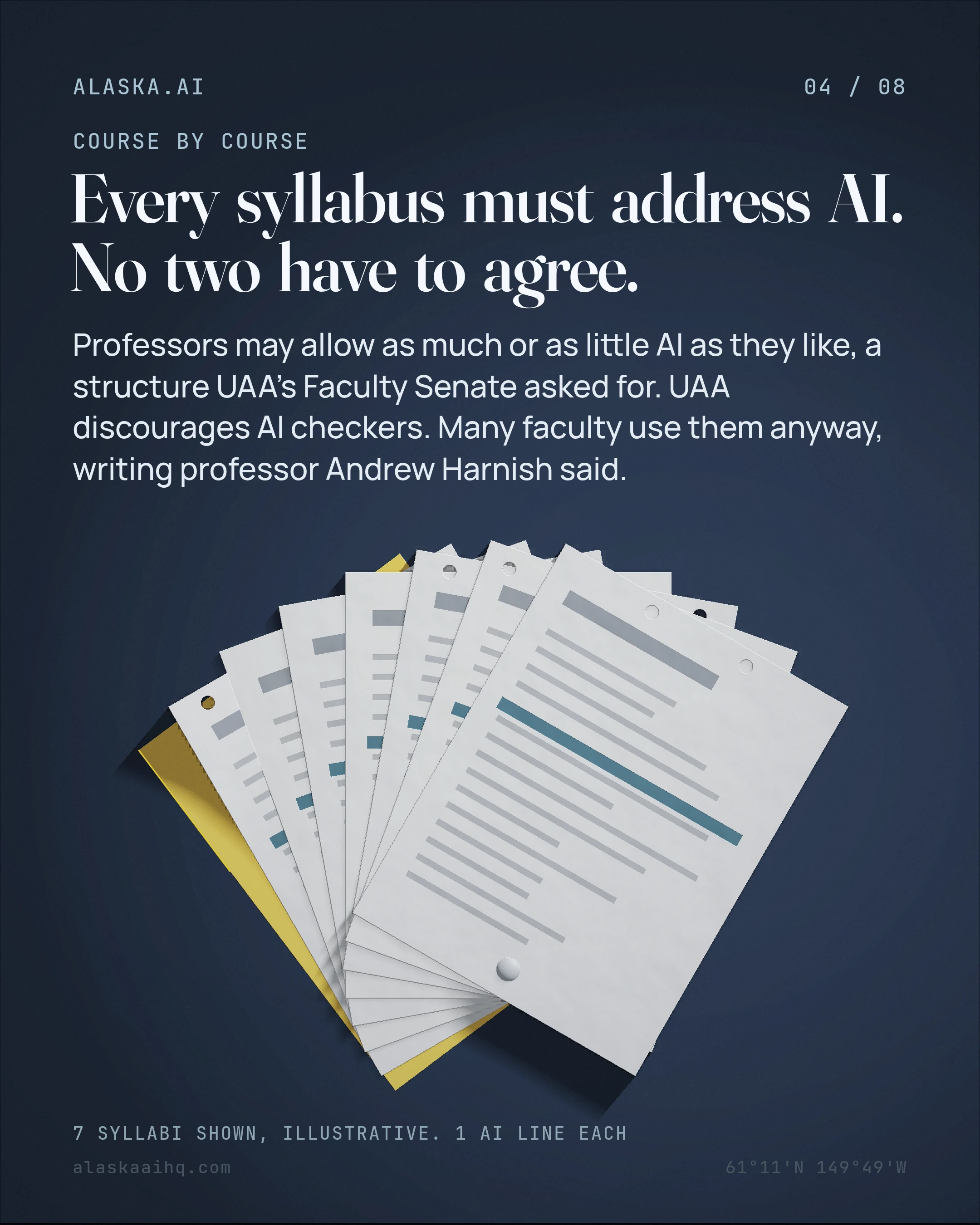
Current UAA guidance lets professors tailor their syllabi to allow as much or as little AI use as they like.
The UAA Faculty Senate specifically requested the current faculty-by-faculty structure.
UAA spokesperson Catalina Myers said letting faculty decide AI use preserved the integrity of academic freedom.
The report said UAA requires all faculty to address AI use in their syllabus.
UAA discourages the use of AI checkers, according to the report.
UAA associate professor Andrew Harnish said many faculty use AI checkers in practice.
UA regents are scheduled to consider guiding principles for integrating AI throughout the UA system in November.
Special projects lead Stephanie Erickson presented the draft language to regents in September alongside Chief Information Technology Officer Ben Shier.
Erickson told regents the university needs to be deliberate about engaging with AI instead of letting it just happen.
The draft document calls for "appropriate AI in every discipline" and says humans must remain "in the loop."
Erickson said being in the loop means AI could recommend but a human decides.
Erickson also said AI can't act alone.
Shier drafted the AI intent language over the summer at the request of regents.
Feedback from staff and students on the draft was included but limited, according to Shier.
Shier called AI one of the most profound technology shifts the university has ever seen.
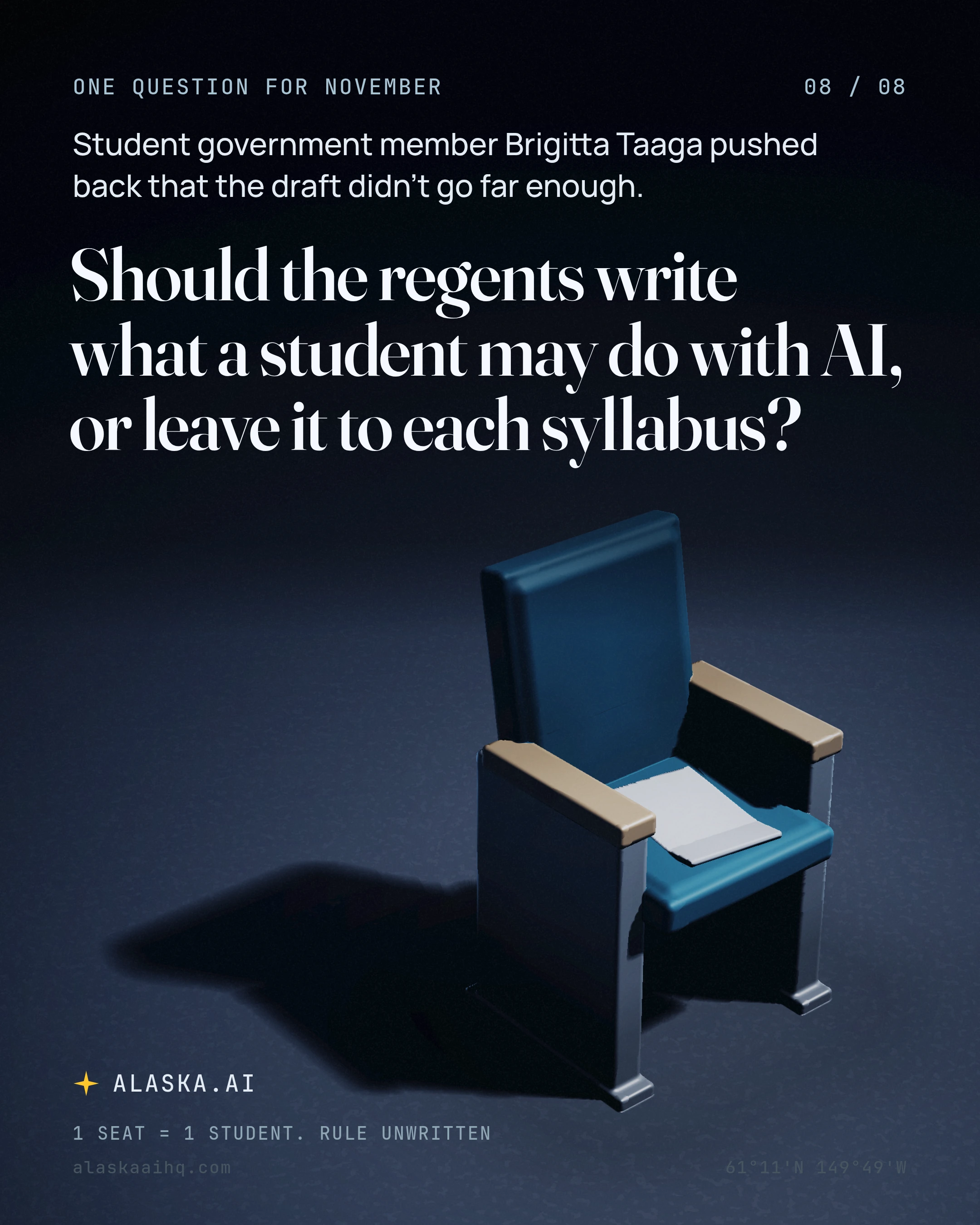
UAA sophomore and student government member Brigitta Taaga pushed back on the draft language as not going far enough.
Taaga said most of the younger generations are really against AI.
Non-traditional UAA student Michael Feign said the draft offers overarching ideas rather than nitty-gritty policy.
Feign said he would prefer the university build its own large language model hosted on local servers.
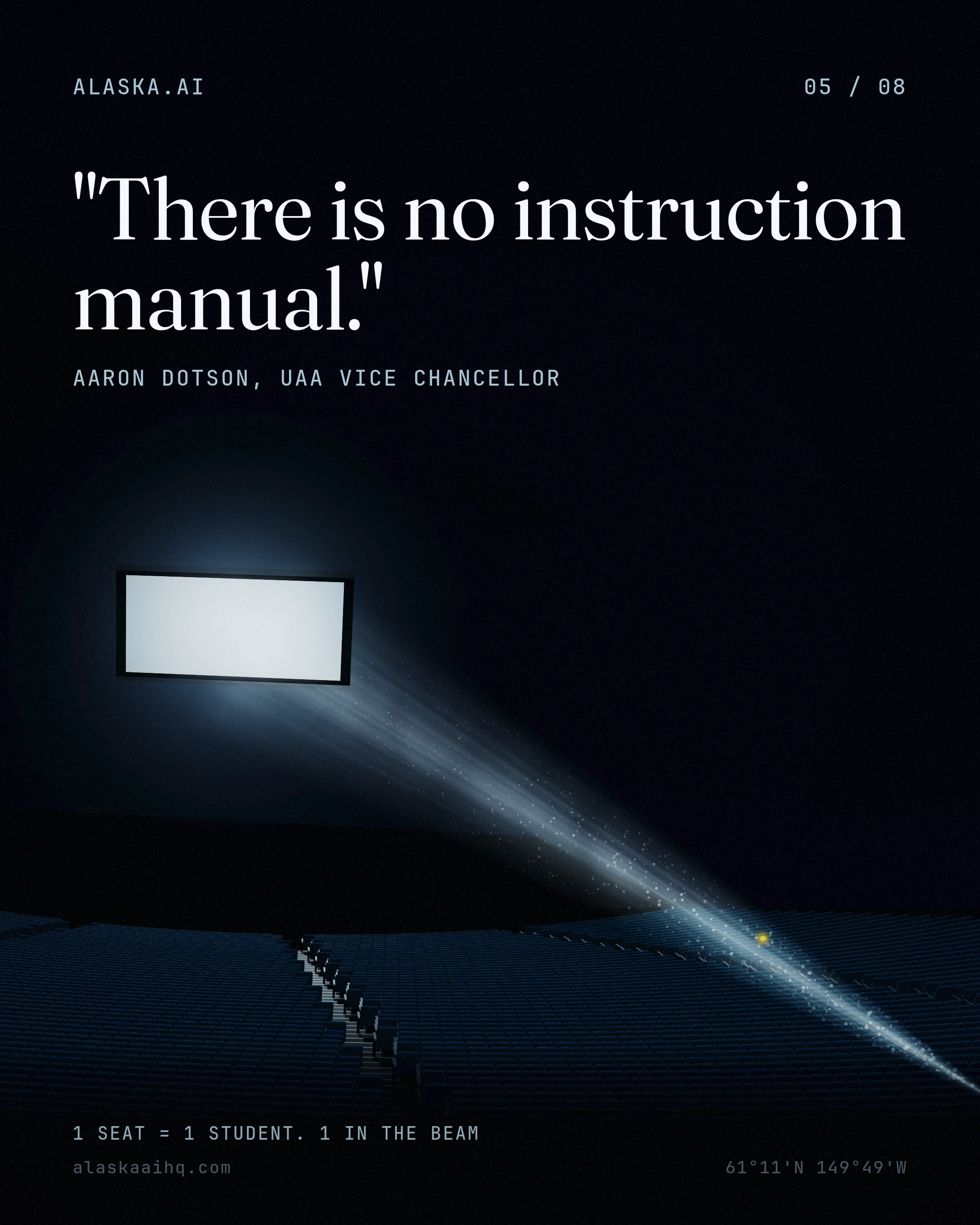
UAA vice chancellor Aaron Dotson said there is no instruction manual.
A year earlier, a Dean of Students Office report showed 115 UAA students were found responsible for academic misconduct.
About two-thirds of those 115 cases were AI-related.
UAA's conduct code addresses AI use through the section prohibiting "utilizing devices not authorized by faculty members."
A UAA professor hid a nearly invisible prompt in an assignment, and AI chatbots that six students pasted the problem into saw it.
UAA issues suspensions for academic dishonesty only about once every two years.
KTOO reported that the draft AI policy would require all three UA universities to have a plan to address AI.
University leadership plans to submit a finalized draft for approval at the November regents meeting.
About 85% of college students use generative AI in their coursework, according to a 2025 Inside Higher Ed survey cited by KTOO.
The Army Corps of Engineers Alaska District issued a September 29th public notice processing a Hilcorp Beluga gas storage permit on an emergency basis.
Comments on the Corps notice are due by October 30th, according to Petroleum News.
The proposed Beluga gas storage pad would cover some 7.38 acres.
The pad would directly fill some 2.35 acres of palustrine wetlands.
Beats
This article is on Defense and federal AI in Alaska · Alaska AI research and science. Each beat page keeps every decision and every article on that subject in one place.