829 Acres, 20 Years, and a Notice That Named No Tenant
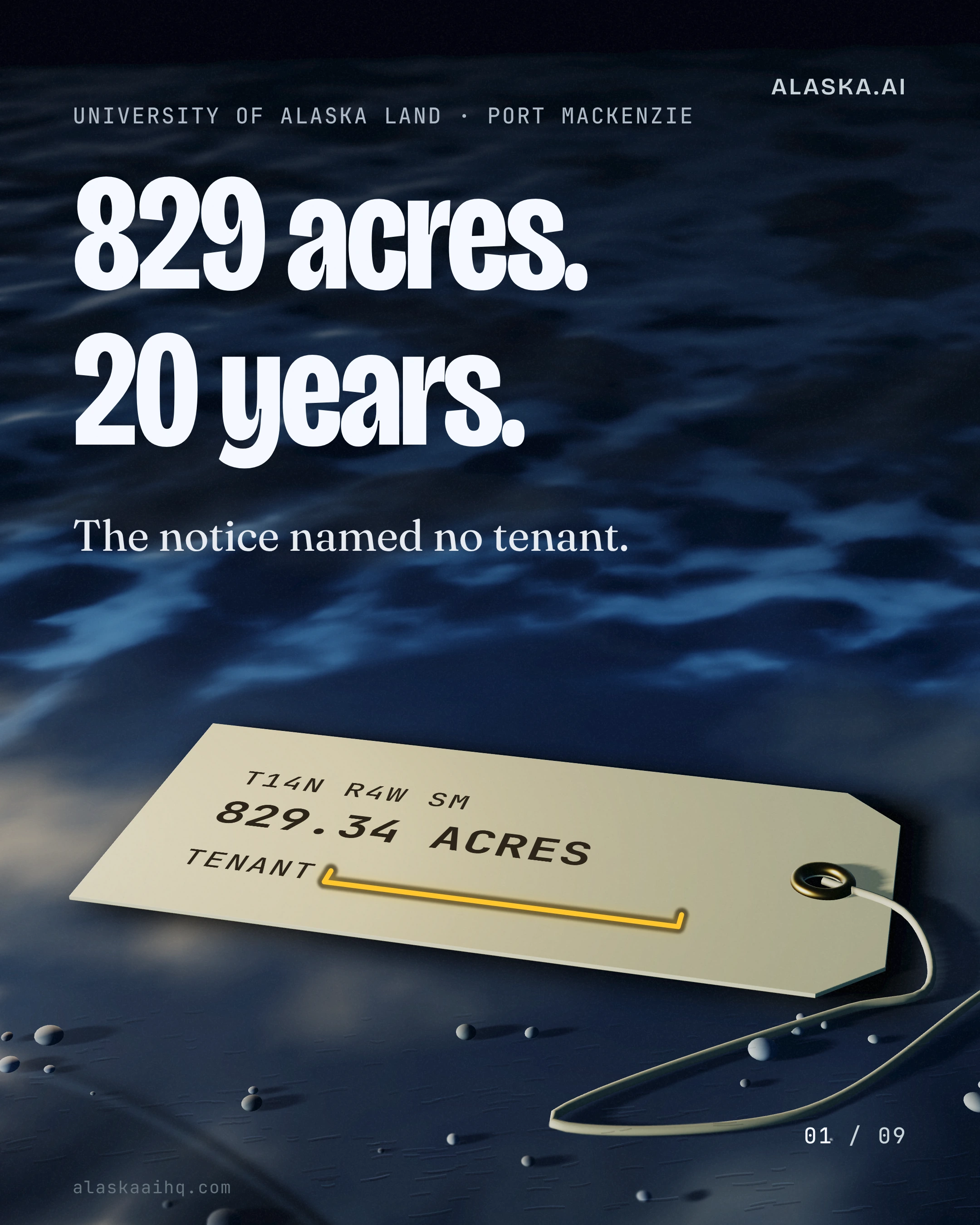
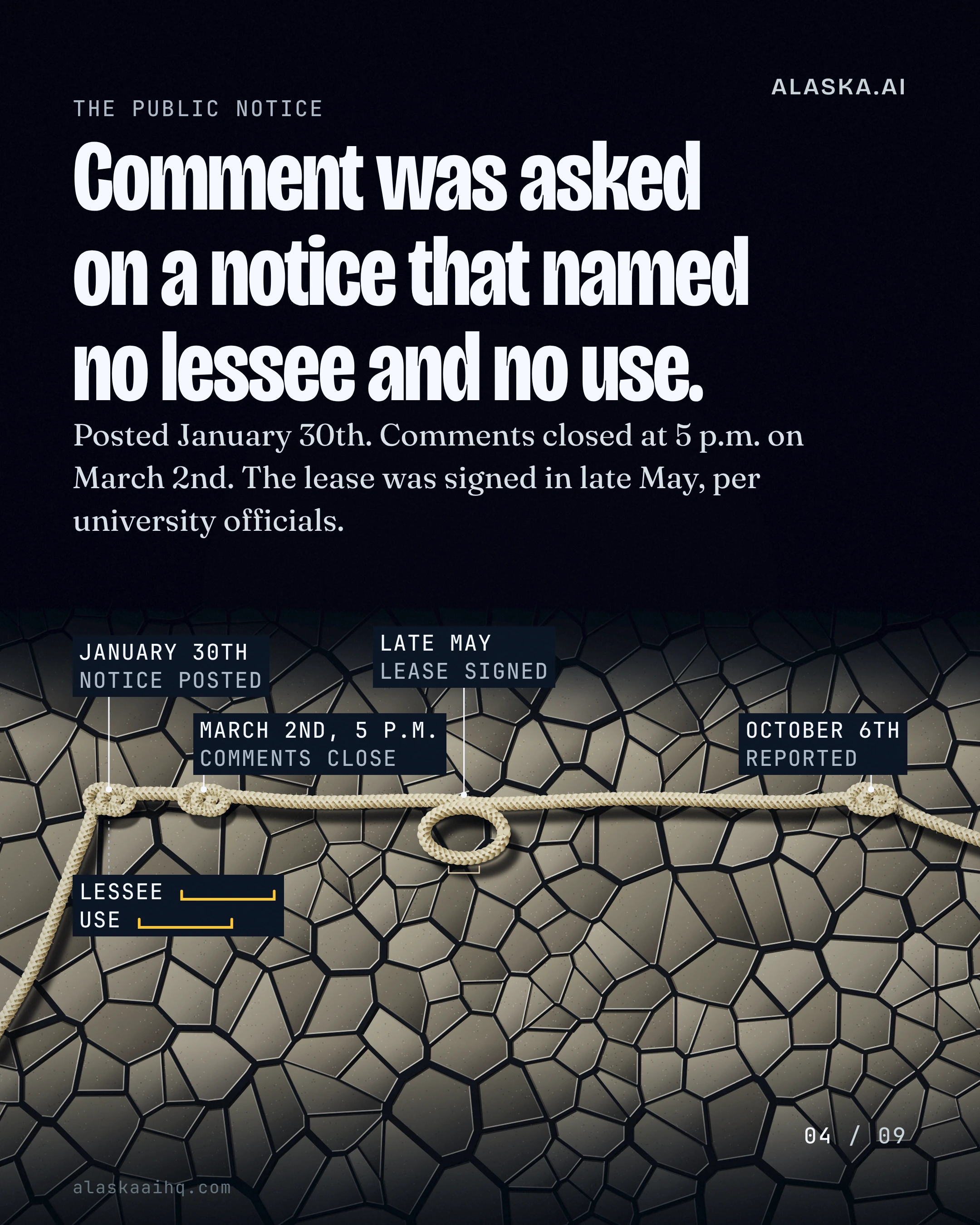
On January 30th the University of Alaska put 829 acres at Port MacKenzie up for lease on a notice that named no tenant.
The deck
SWIPE, SCROLL OR CLICK A SLIDE TO GO FULLSCREEN · 9 SLIDES


The story
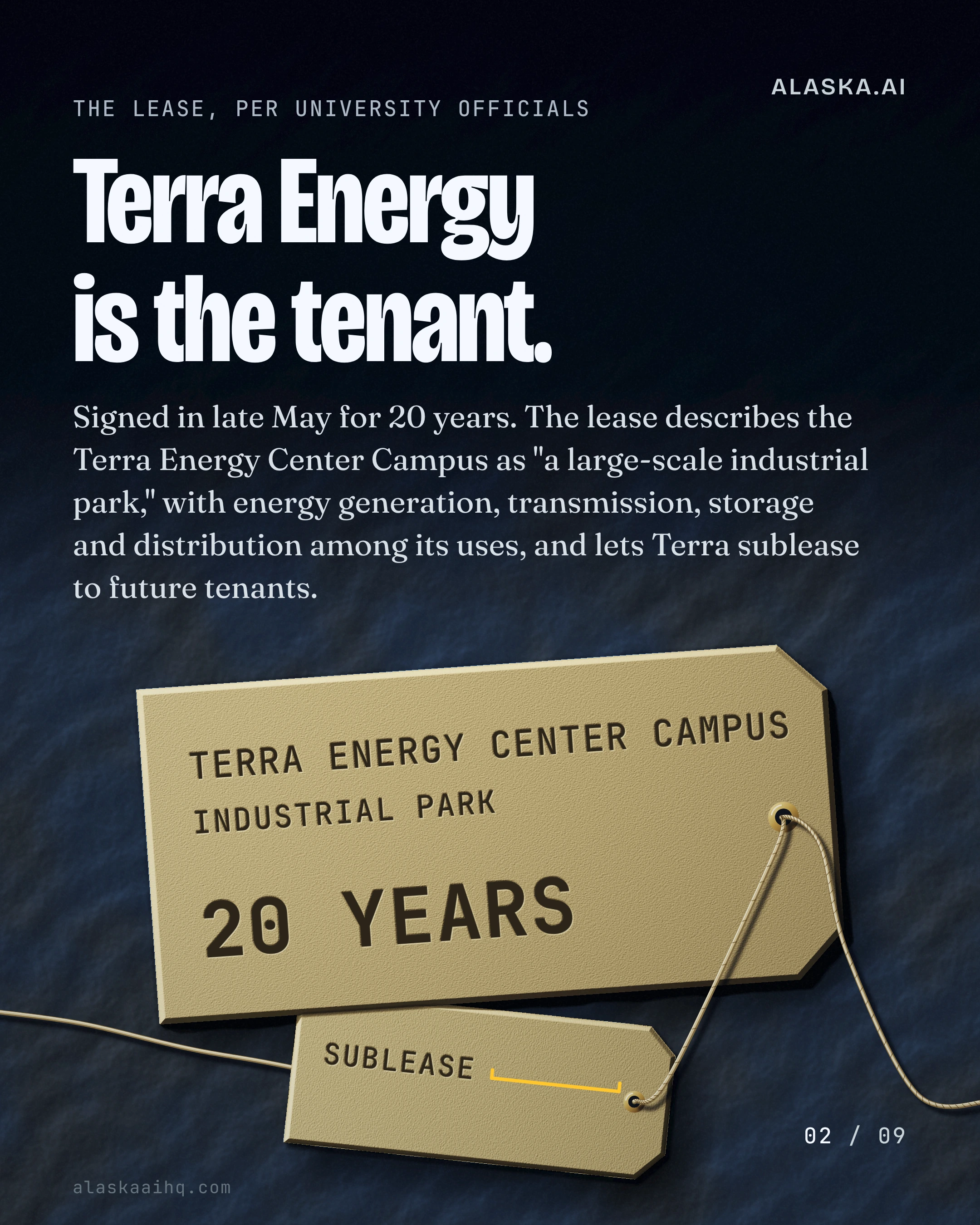
Terra Energy signed a 20-year lease in late May for a campus the lease calls "a large-scale industrial park," UA's land director Adrienne Stolpe told the Mat-Su Sentinel.
The Mat-Su Assembly overrode a veto 6-1 in March to market borough land jointly with Terra to big power users like data centers. Yet the university signed without telling borough officials. To port manager Dave Griffin, that "blows my mind."
Per the Mat-Su Sentinel, major state land actions need a best interest finding that weighs public comment, and university land is exempt.
Four parcels to scale and the notice's dates, the rent by year, the affiliate's coal plan and the 6-1 vote.
Should a 20-year university lease stay exempt from the best interest finding?
What we verified
55 CLAIMS, EACH RE-FETCHED FROM ITS SOURCE BEFORE THIS DECK SHIPPED
The University of Alaska's land notice for the four Point MacKenzie parcels was posted January 30th.
Public comments on the university's intent to lease were due by 5 p.m. on March 2nd.
The university's notice says the parcels will be leased at or above fair market value.
The university's public notice and disposal plan name no lessee and no proposed use for the land.
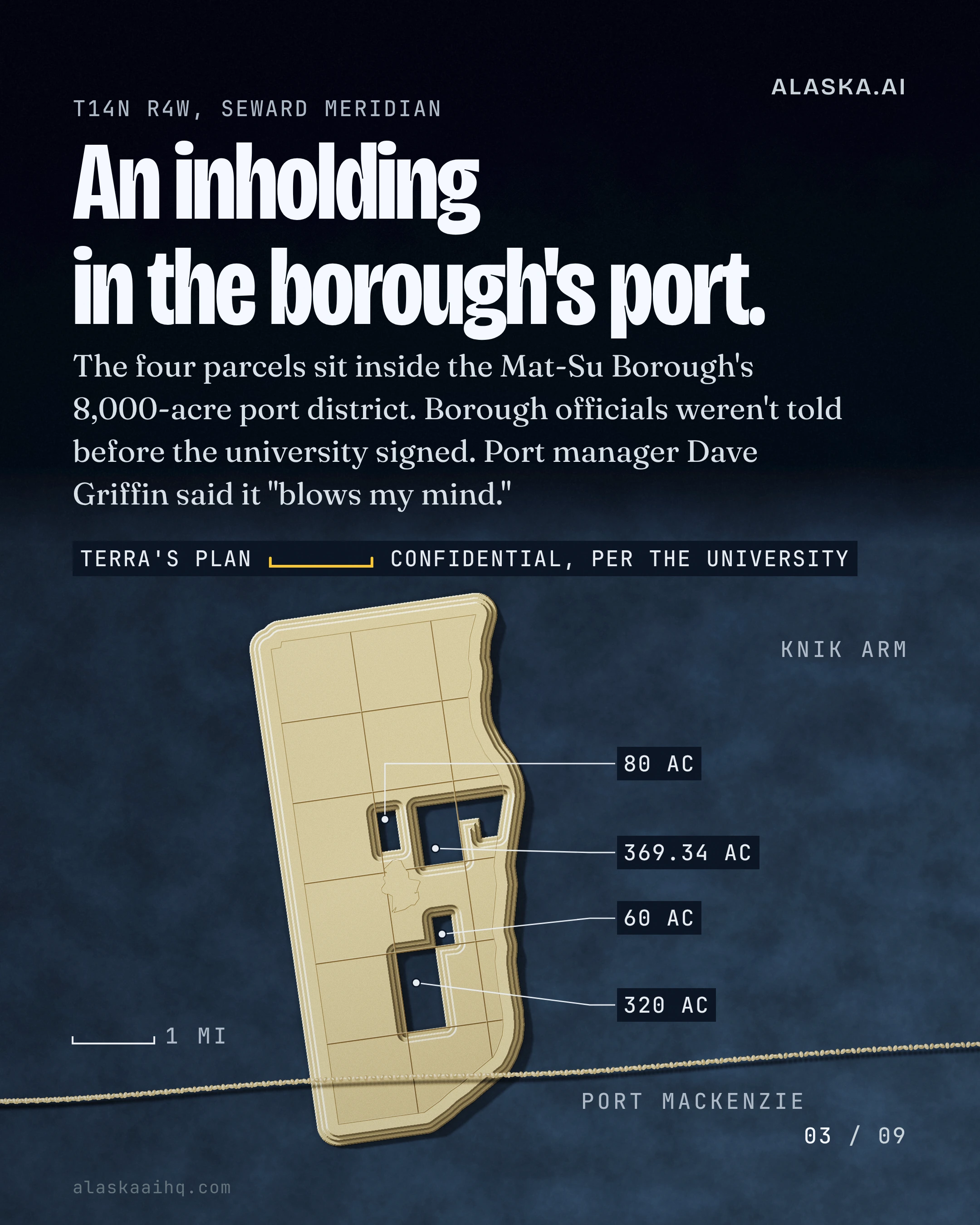
Parcel MS.PM.0001 is listed in the notice at 369.34 acres.
Parcel MS.PM.0002 is listed in the notice at 80 acres.
Parcel MS.PM.0003 is listed in the notice at 60 acres in Section 23.
Parcel MS.PM.0004 is the west half of Section 26, listed at 320 acres, west of Port MacKenzie.
All four parcels lie in Township 14 North, Range 4 West, Seward Meridian, near Point MacKenzie.
The four parcel acreages in the university's notice add up to 829.34 acres, matching the 829 acres reported as leased.
UA Land Management's Port MacKenzie page, last updated September 8th, totals the four parcels at 828.740 acres.
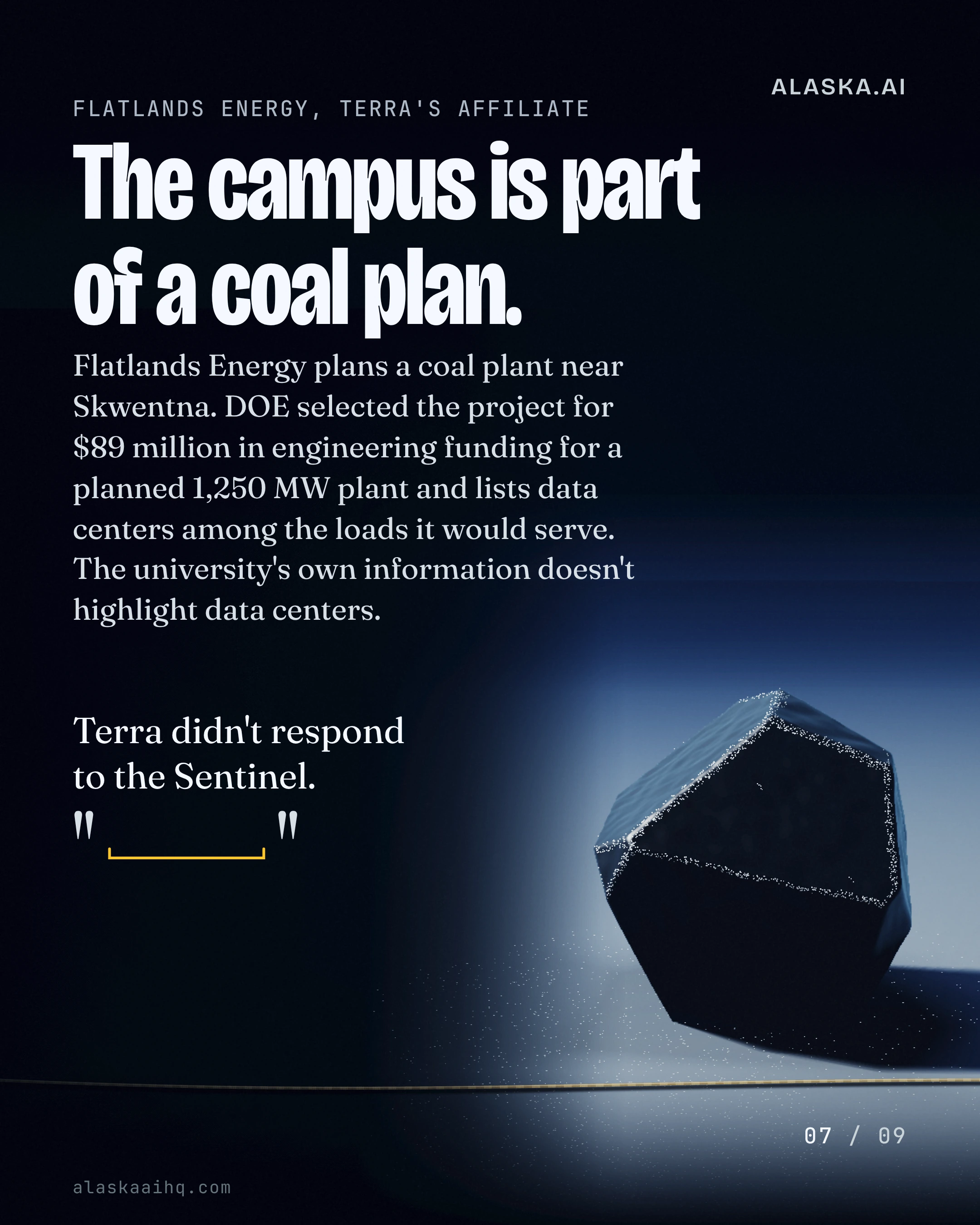
The Department of Energy lists Terra Energy Center Corporation of Anchorage for $89,000,000 in DOE funding under its coal recommissioning and modernization announcement.
DOE puts the Terra project's total value at $190,375,155, including $101,375,155 in non-DOE funding.
DOE describes the project as engineering and design of a 1,250 MW coal-fired baseload power facility with carbon capture in the Mat-Su Borough.
DOE says the plant's carbon capture system would capture more than 90 percent of its CO2, an estimated 8.26 million tonnes a year.
The DOE-funded project aims to complete FEL-3 Class 3 engineering in 2027.
The project description on DOE's page says it is positioned to provide baseload generation by 2031.
DOE's description names data centers among the loads the coal plant would serve, alongside utilities, military installations and critical mineral operations.
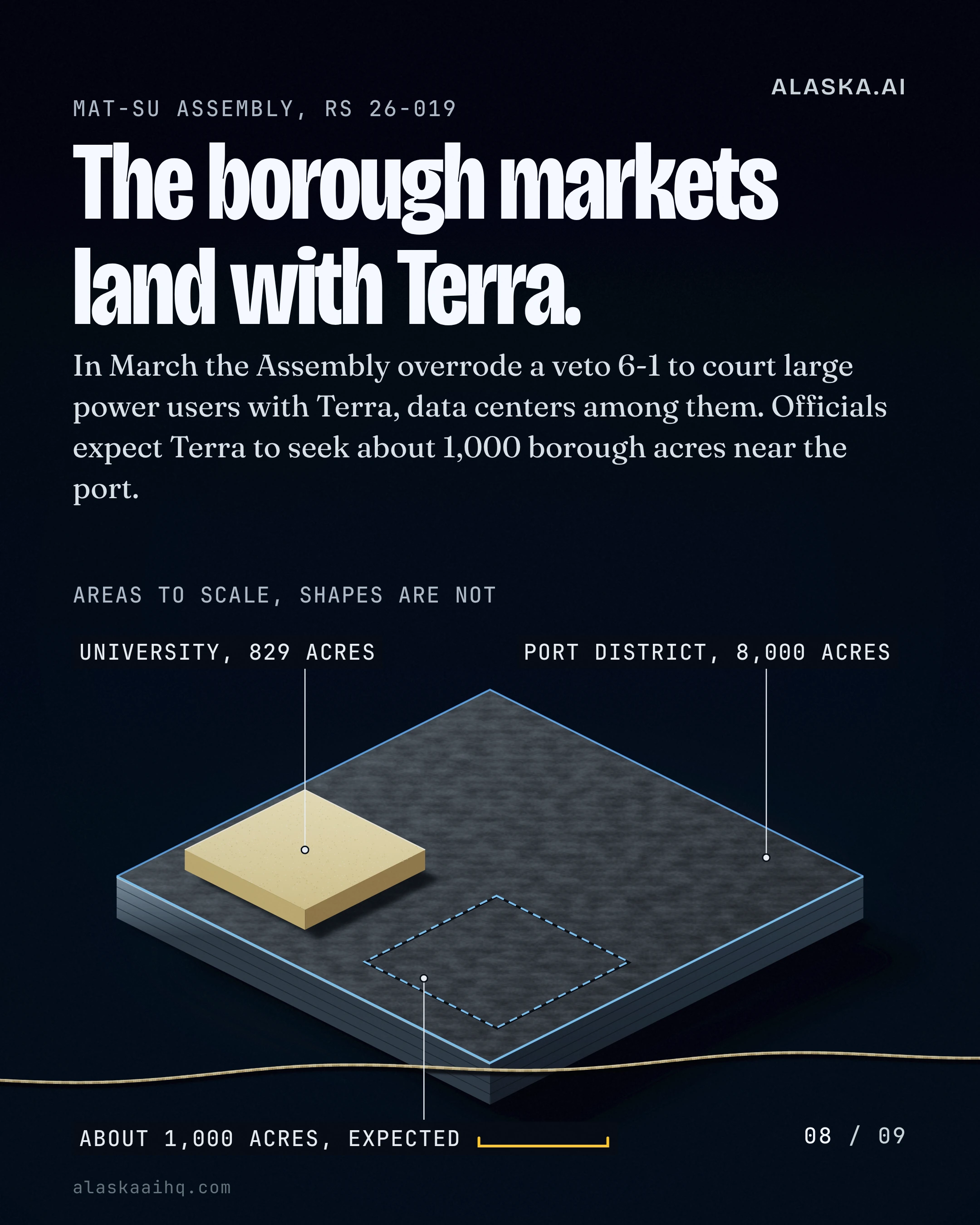
The Mat-Su Borough Assembly passed Resolution RS 26-019, supporting a joint marketing effort with Terra Energy Center Corporation to solicit interest from large power consumers including data centers.
The Assembly overrode the mayor's veto of the Terra resolution on March 17th.
A $6 million National Science Foundation project joins UAF, UAA, Montana Technological University and the University of Wyoming.
The project studies how microorganisms and AI-based methods can recover rare earth elements from coal refuse and ash.
NSF's award record says the initiative is led by the University of Alaska Anchorage in partnership with UAF, Montana Tech and the University of Wyoming.
UAA's component of the collaborative award is $3,824,575.
UAF's portion of the work is supported by nearly $913,000 of the total award.
NSF's abstract says the project applies reinforcement-learning controllers within a bioprocess digital twin linked to microgrid simulators.
UAF says the project is one of eight NSF EPSCoR projects sharing $39.9 million across 16 jurisdictions.
Srijan Aggarwal said the team is connecting environmental engineering, microbiology, mineral processing and AI to recover valuable elements from waste.
Terra Energy signed a 20-year lease with the University of Alaska for land near Port MacKenzie.
The lease was signed in late May, according to university officials quoted by the Mat-Su Sentinel.
The university land leased to Terra Energy totals 829 acres.
UA Land Management director Adrienne Stolpe said the lease authorizes the Terra Energy Center Campus, which the lease describes as a large-scale industrial park.
Permitted uses under the lease include facilities for industrial and commercial tenants and for energy generation, transmission, storage and distribution.
The lease authorizes Terra Energy to sublease to future tenants consistent with the permitted uses.
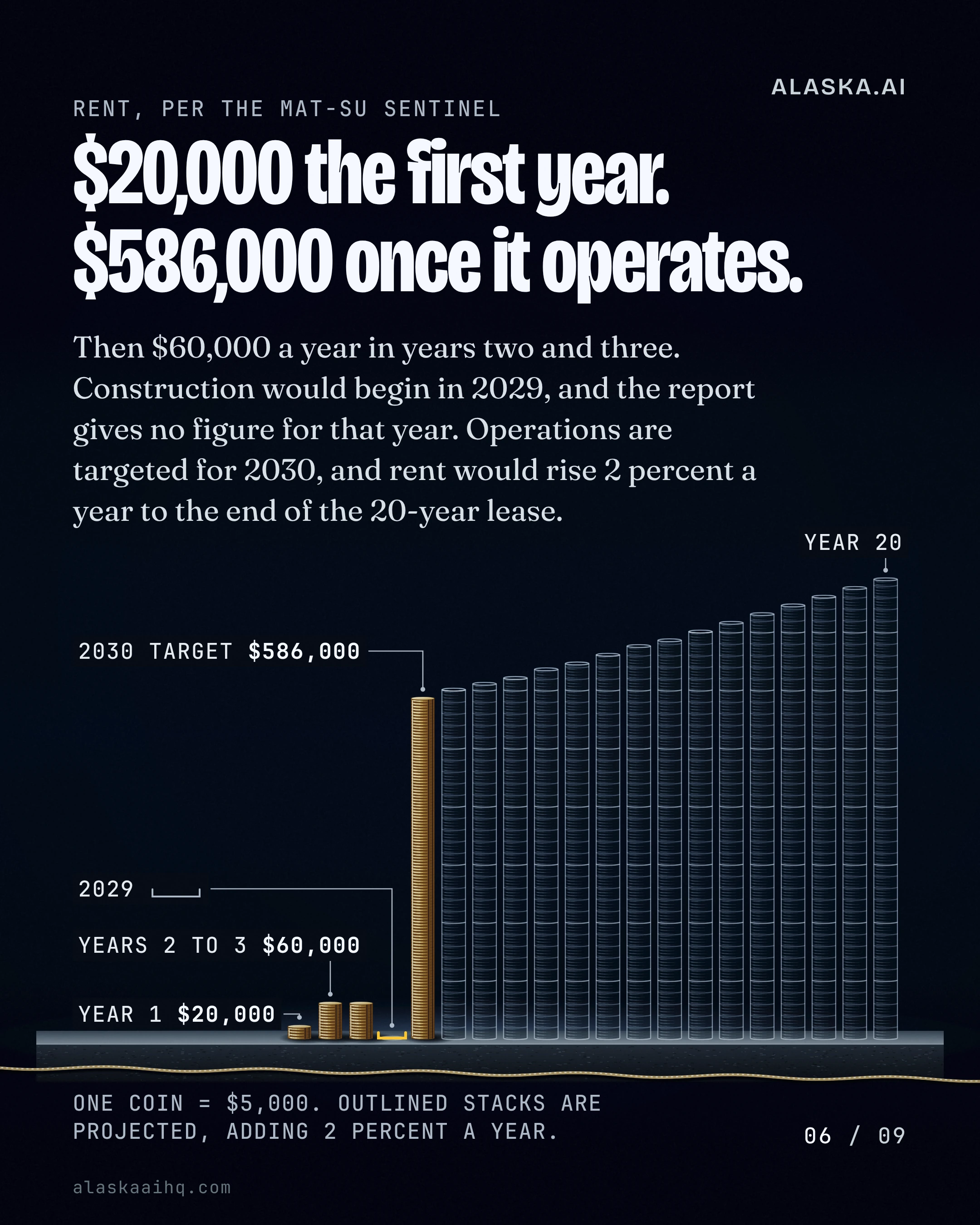
The lease pays the university $20,000 in its first year.
The lease payment rises to $60,000 a year in the second and third years.
When operations begin the lease payment would rise to $586,000 a year.
The $586,000 payment carries a 2 percent annual inflation adjustment through the end of the 20-year lease.
Site development and construction would begin in 2029, the fourth year of the lease.
Operations on the leased land are targeted for 2030.
Projects on university land are exempt from the best interest finding the state requires for major actions on state land.
Terra's full preliminary development plan provided to the university is confidential, according to Stolpe.
Terra Energy officials did not respond to the Mat-Su Sentinel's request for comment.
Information the university released about the deal does not highlight data centers.
Mat-Su Borough officials were not informed before the university leased the land, an inholding within the borough's 8,000-acre port district.
Borough officials expect Terra to keep pursuing a lease of about 1,000 acres of borough land near the port for similar projects.
If Terra requests and wins the borough lease, it would hold leases on about a quarter of the land in the port district.
Mat-Su Borough Port Manager Dave Griffin said the university leasing the land without any conversation with the borough "blows my mind".
Terra's port projects are part of affiliate company Flatlands Energy's plan for a new coal-fired power plant near Skwentna.
The coal plant plan calls for piping carbon emissions more than 60 miles to Cook Inlet for underground storage.
The veto override passed 6-1, with Assembly member Stephanie Nowers voting no.
The resolution sets up a two-year partnership with Terra and does not require the borough to sell or lease land or commit to a data center.
On September 15th the Mat-Su Assembly unanimously passed a resolution saying large-scale industrial and energy development belongs at Point MacKenzie or West Susitna rather than on state land near Houston.
The Mat-Su Sentinel's report states rent for the first year, for the second and third years and from the start of operations, and gives no rent figure for 2029, the fourth year, when construction would begin.
The Mat-Su Sentinel published its report on the lease on October 6th.
Beats
This article is on Alaska data centers · Alaska land and permitting for AI · Alaska AI research and science. Each beat page keeps every decision and every article on that subject in one place.