Software Can Read the Tape. The Camera Is the Cost.
"Should not have to carry one less crew member," the North Pacific Council's Advisory Panel said of boats sent from cameras to observers.
The deck
SWIPE, SCROLL OR CLICK A SLIDE TO GO FULLSCREEN · 9 SLIDES

The story
On October 9th the Council backed a yearly test. A boat averaging under 3 trips a year over 3 years goes to observers from 2028 in NMFS's draft.
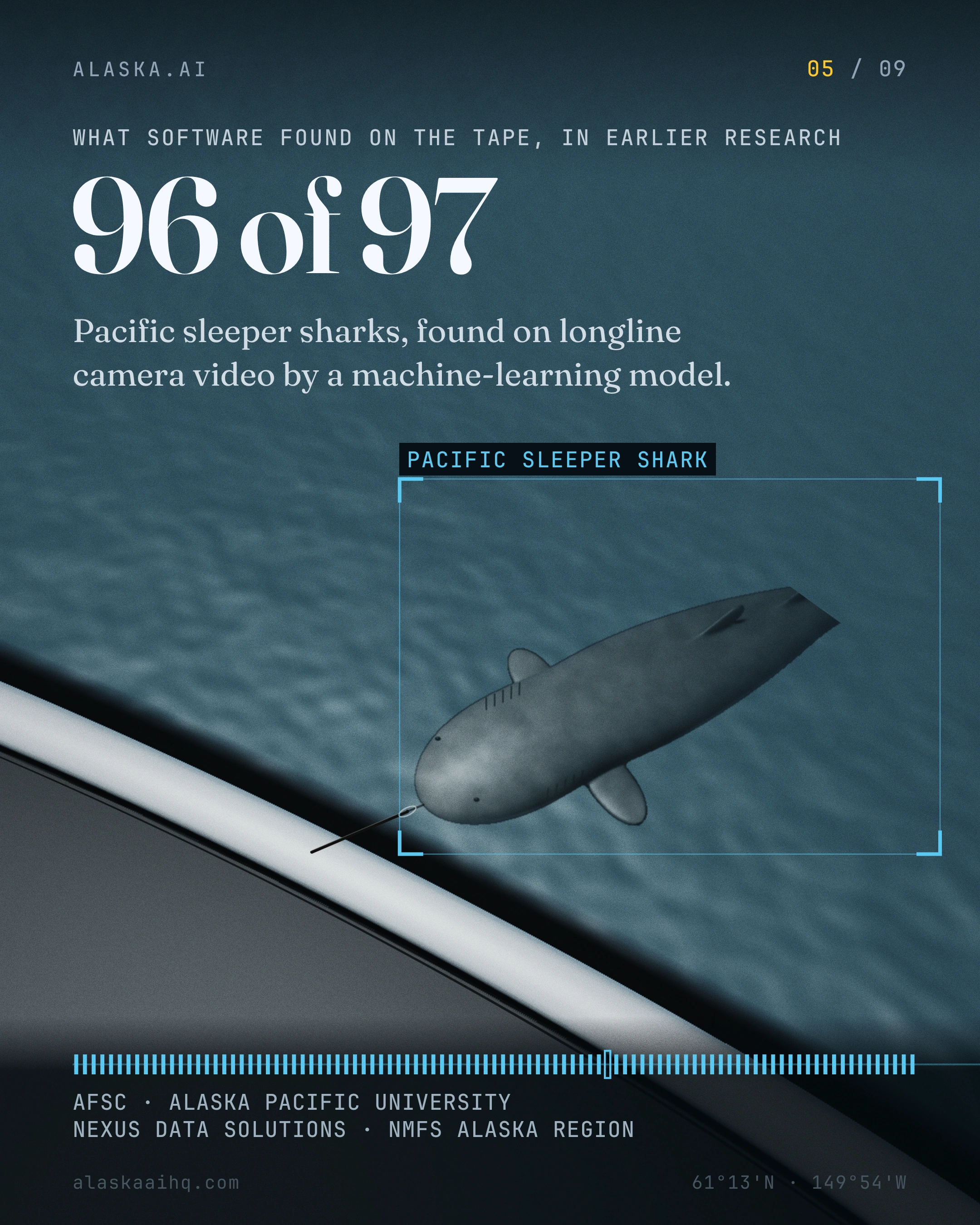
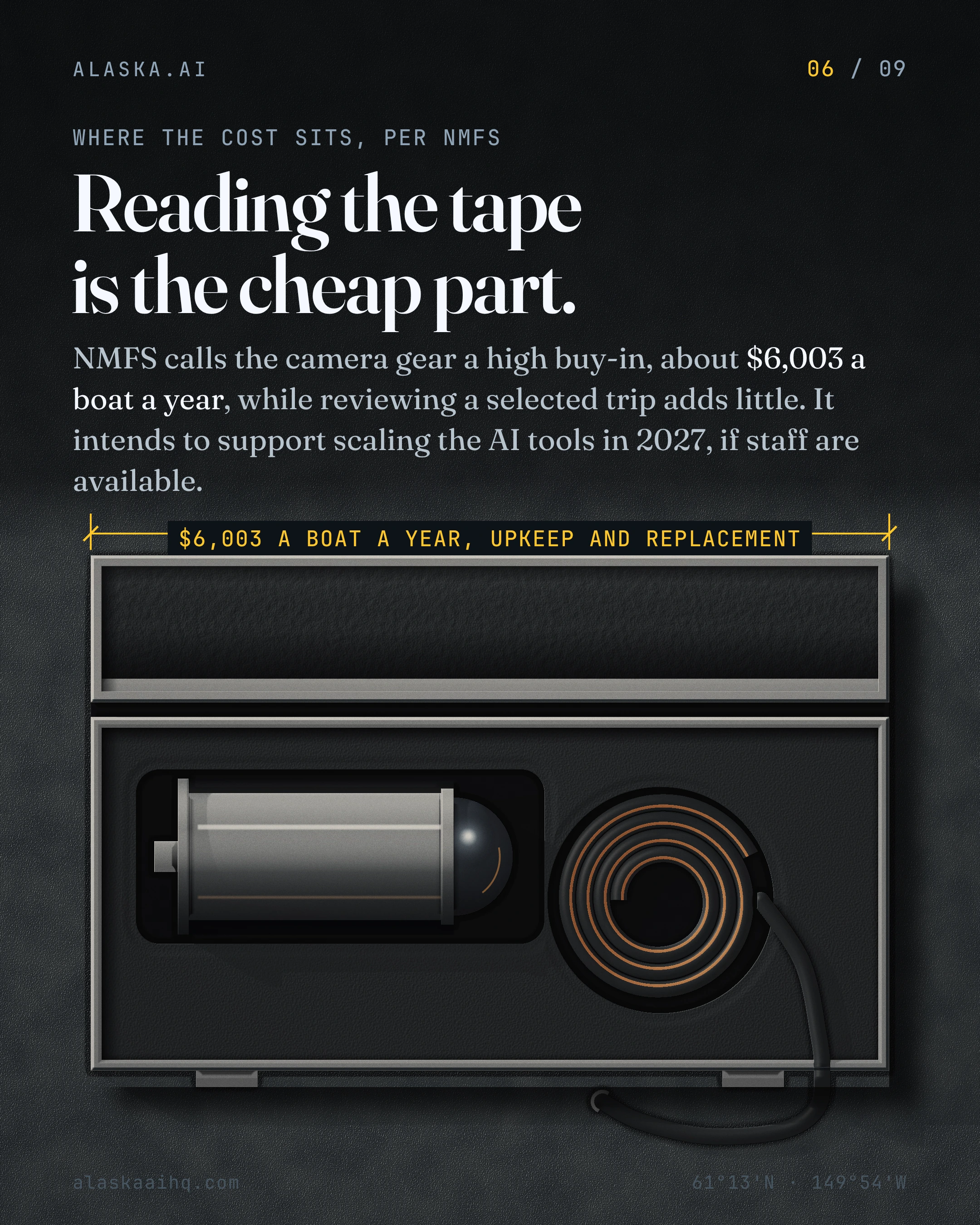
Software from Cindy Tribuzio's AFSC team found 96 of 97 sleeper sharks on camera video in earlier research. NMFS says review adds little per trip and the gear is the buy-in. Most fixed-gear camera trips fish the Gulf. NMFS expects to monitor 14.25 percent of that catch.
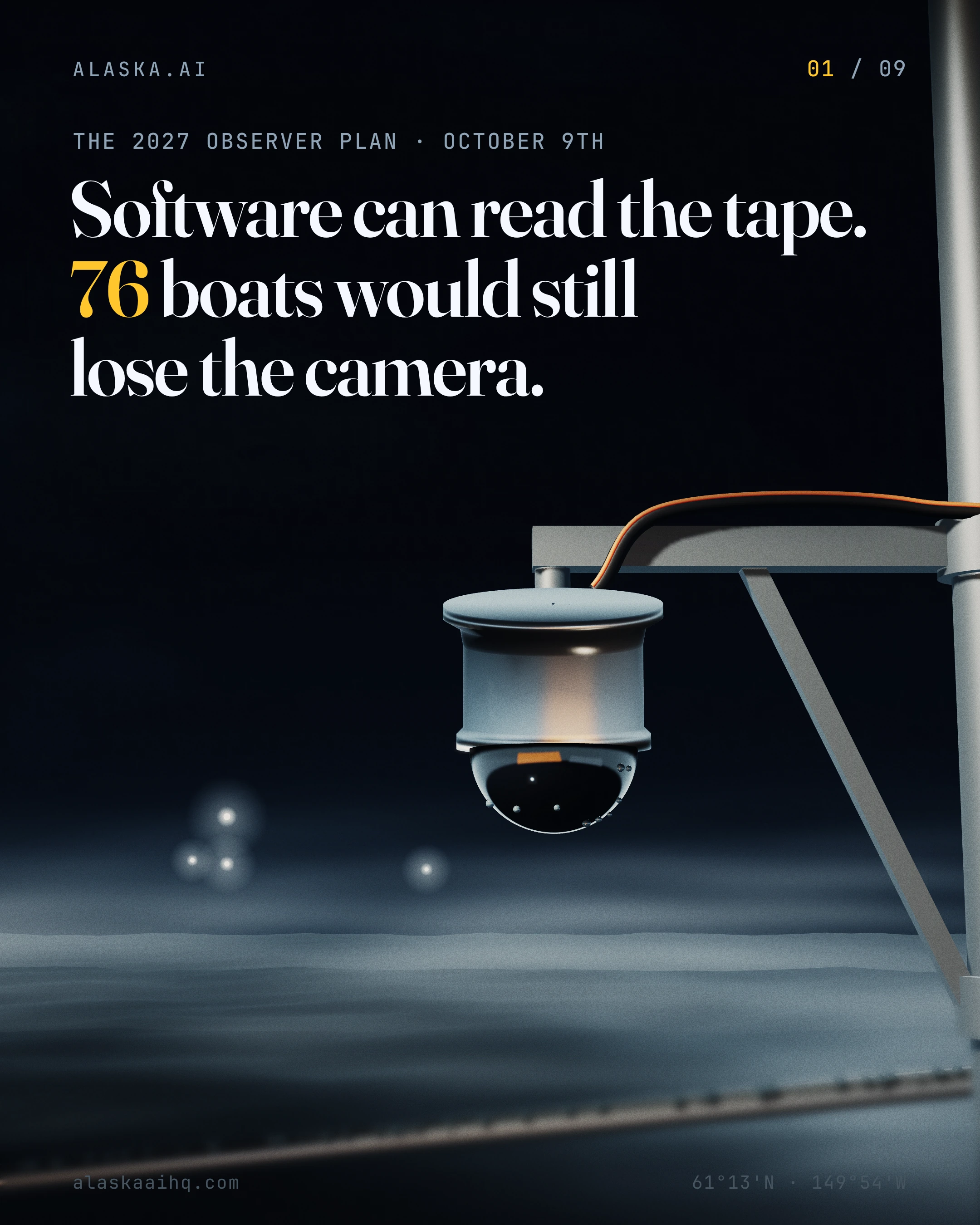
From the camera on its mast to the same camera on a hatch, the deck shows 76 of 172 boats that would move, a 3-trip tally, cheaper trips, 96 of 97 sharks, a $6,003 gear case, the Gulf's 14.25 percent and an empty berth.
What is a deckhand's bunk worth on a boat that fishes twice a year?
What we verified
86 CLAIMS, EACH RE-FETCHED FROM ITS SOURCE BEFORE THIS DECK SHIPPED
In a motion dated October 9th, the North Pacific Fishery Management Council said it supports the draft 2027 Annual Deployment Plan for partial coverage fisheries.
The Council motion says observer coverage rates and the final budget are expected in the final 2027 ADP in December.
The Council motion says regulations requiring 100% and 200% observer coverage are unchanged.
The Council supports removing vessels from the fixed gear EM pool in 2027 if they have not complied with requirements to update and submit EM Vessel Monitoring Plans for the past 3 years.
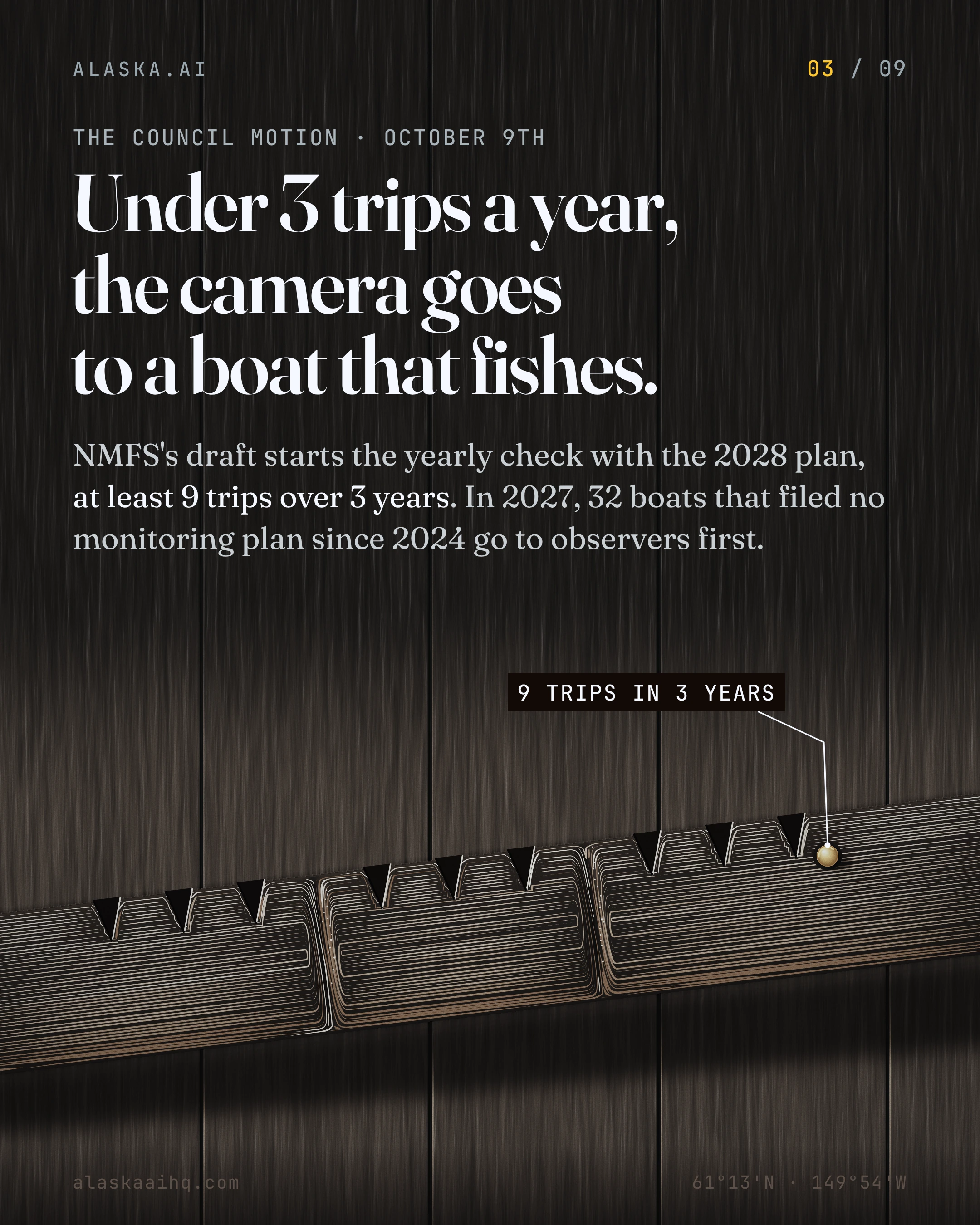
NMFS identified 32 fixed-gear EM vessels that had not submitted a Vessel Monitoring Plan in 2024, 2025 or 2026, and said they will be placed in the observer pool for the 2027 fishing year.
The Council supports a yearly NMFS evaluation that moves fixed gear EM vessels averaging fewer than 3 trips a year over the prior 3 years into the at-sea observer pool and returns their EM equipment for use on active vessels.
The draft 2027 ADP says the minimum fishing effort requirements to stay in the fixed-gear EM pool take effect starting in 2028.
Under the draft ADP, vessels with at least 3 years in the fixed-gear EM pool must complete at least 9 trips over the most recent three years to remain in it in 2028.
Under the Council motion, vessels asking to rejoin the fixed gear EM pool need at least 5 trips a year over the prior 3 years.
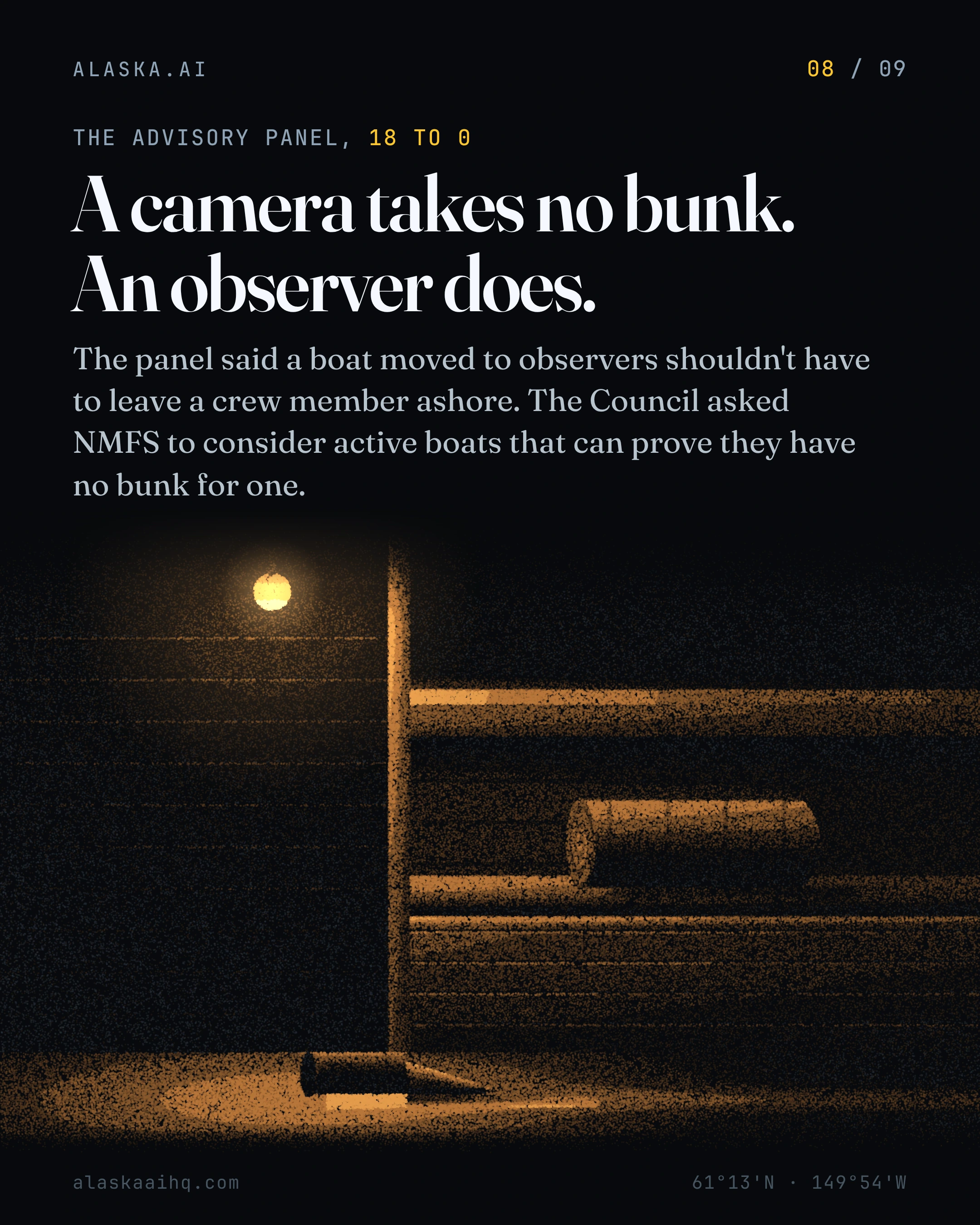
The Council asked NMFS to consider active vessels proposed for removal from the fixed gear EM pool, with more than 0 and fewer than 3 trips, if they can prove they lack bunk space for an observer.
The Council asked NMFS to continue exploring criteria for vessels joining the fixed gear EM pool for the first time.
The draft ADP says new vessels seeking entry to the fixed-gear EM pool for 2027 must have completed at least 15 trips in the prior three years.
The Council recognized NMFS's conclusion that moving low-trip fixed gear vessels to the zero selection pool produced no cost efficiency or monitoring gains.
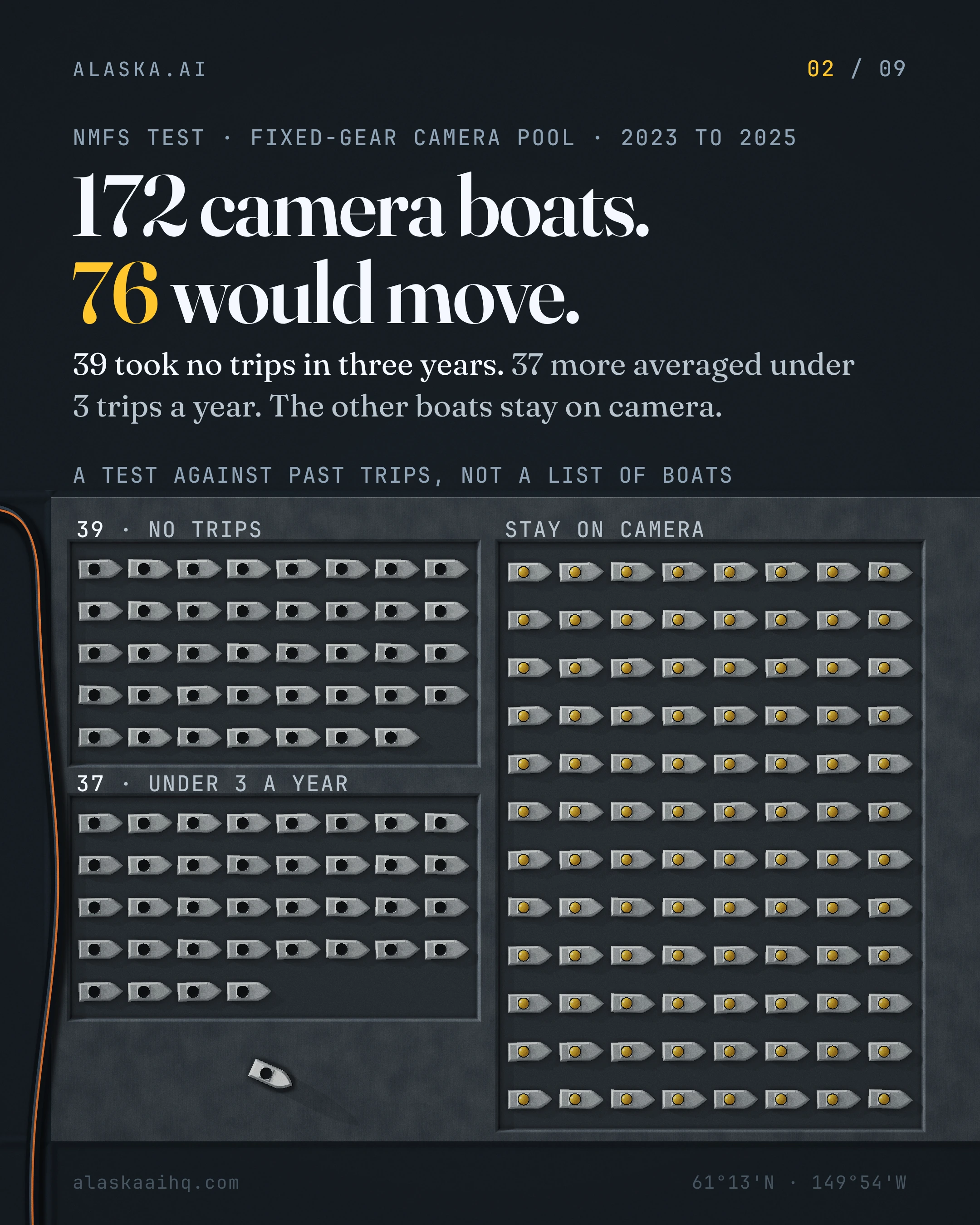
NMFS analyzed 172 fixed-gear EM vessels that had a full three-year fishing history for 2023 through 2025.
Of those 172 vessels, 39 took no trips over 2023 through 2025 and 133 were active.
NMFS found that 37 active fixed-gear EM vessels fishing fewer than 3 trips a year were generally not cost-effective.
NMFS calculated that applying the under-3-trips threshold moves 39 inactive and 37 active vessels, 76 vessels and 77 trips in all, from fixed-gear EM to observers.
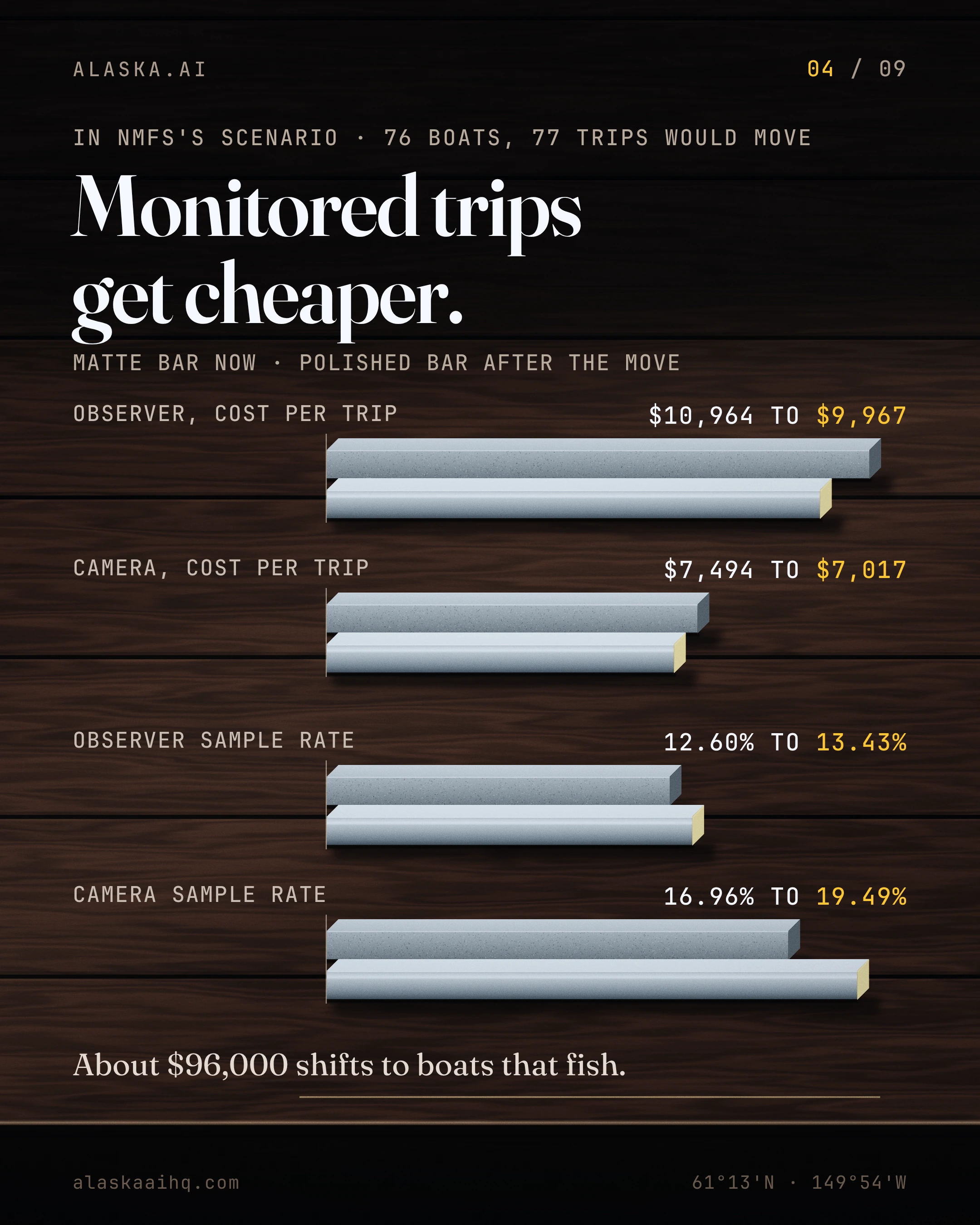
NMFS put the total cost difference from applying the under-3-trips threshold at $96,000.
In the NMFS scenario, observer cost per trip falls from $10,964 to $9,967, a 9.1% drop.
In the same scenario, fixed-gear EM cost per trip falls from $7,494 to $7,017, a 6.4% drop.
In the same scenario, the at-sea observer sample rate rises from 12.60% to 13.43%.
In the same scenario, the fixed-gear EM sample rate rises from 16.96% to 19.49%.
NMFS told the Council that fixed-gear EM vessels that do not fish enough trips to overcome equipment-related costs are less cost-efficient.
NMFS estimated fixed-gear EM equipment maintenance and annualized system replacement at $6,003 per vessel per year.
NMFS put 2025 at-sea observer costs at $2,937,000 for 1,299 observer days, or $2,260.97 per day.
NMFS set a preliminary budget of $5.45 million for 2027 monitoring of the partial coverage fisheries.
The draft ADP describes the 2027 budget as a 14.7% increase from the $4.75 million set in the 2026 ADP.
The draft ADP allocates $3,227,000 of the preliminary 2027 partial coverage budget to at-sea observers.
The draft ADP allocates $1,479,000 of the preliminary 2027 partial coverage budget to fixed-gear EM.
The draft ADP allocates $732,000 of the preliminary 2027 partial coverage budget to trawl EM in the Gulf of Alaska.
The three allocations in the draft ADP's Table B-1 total $5,438,000.
The draft ADP says Congressional Directed Spending funds for EM installations and replacements are expected to run out by the end of 2026, so those costs are now in the 2027 budget.
The Council's monitoring committee reported that fee revenue makes up $3.55 million of the estimated $5.45 million 2027 partial coverage budget.
NMFS told the Council that as of October 1st, $3.19 million in observer fees had been assessed out of a projected $3.55 million.
NMFS expects to monitor 2,742 trips and an estimated 16,374 days in the full coverage component in 2027.
NMFS expects to monitor 1,404 trips and 4,408 days in the partial coverage component in 2027.
For 2026, NMFS's final plan expected to monitor 4,341 trips and 22,110 days in total.
For 2026, the partial coverage component was expected to monitor 1,473 trips and 4,649 days.
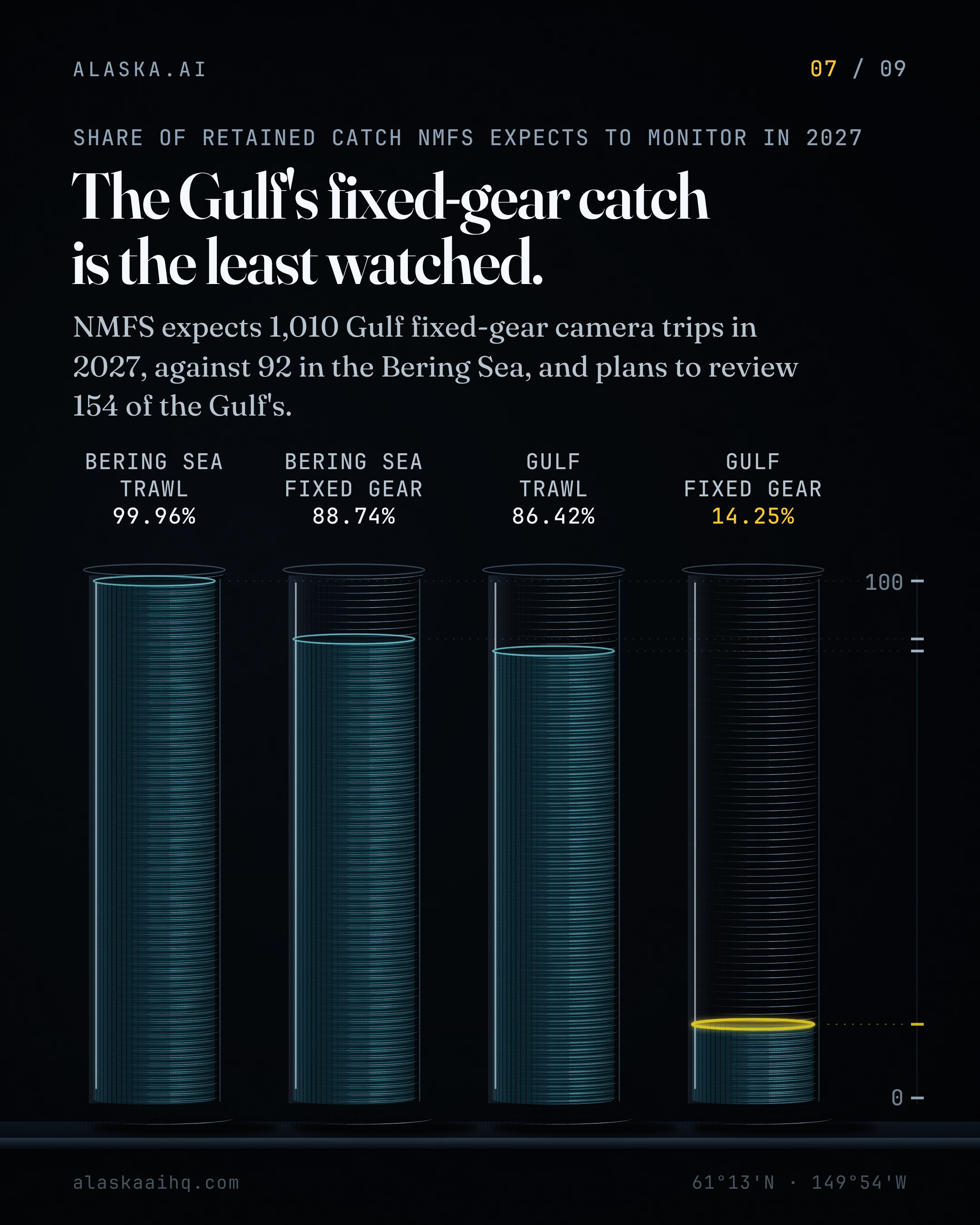
NMFS expects 99.96% of retained catch in Bering Sea and Aleutian Islands trawl fisheries to be monitored in 2027, counting full and partial coverage.
NMFS expects 88.74% of retained catch in Bering Sea and Aleutian Islands fixed-gear fisheries to be monitored in 2027.
NMFS expects 86.42% of retained catch in Gulf of Alaska trawl fisheries to be monitored in 2027.
NMFS expects only 14.25% of retained catch in Gulf of Alaska fixed-gear fisheries to be monitored in 2027.
The preliminary 2027 observer selection rate for Gulf of Alaska fixed-gear trips is 9.31% of 1,868 expected trips, or 174 observed trips.
The preliminary 2027 observer selection rate for Bering Sea and Aleutian Islands fixed-gear trips is 31.35%.
The preliminary 2027 EM selection rate for Gulf of Alaska fixed-gear trips is 15.24% of 1,010 expected trips, or 154 monitored trips.
The preliminary 2027 EM selection rate for Bering Sea and Aleutian Islands fixed-gear trips is 42.99%.
All 894 expected Gulf of Alaska pelagic trawl EM trips are to be monitored at a 100% rate in 2027.
An expected 1,427 trips in 2027 fall in the no-selection pool, which has a 0% chance of monitoring.
More than 90% of Alaska's federal fisheries by tonnage are in the full coverage program, leaving under 10% in partial coverage.
The North Pacific Observer Program is responsible for monitoring a fleet of nearly a thousand vessels.
That fleet fishes across an Alaska Exclusive Economic Zone of roughly 3.77 million square kilometers.
Since the regulated fixed-gear EM program began in 2018, the pool has grown to a current count of 178 vessels.
NMFS's final 2026 plan said the fixed-gear EM group included 181 vessels.
Requests to join or leave the fixed-gear EM selection pool for 2027 must be received in NMFS's ODDS system by November 1st.
Pollock catcher vessels using pelagic trawl gear must opt in to trawl EM annually by November 1st.
The draft ADP says an EM reviewer may log a problem with a vessel's video a month or more after the trip.
The Council's Advisory Panel voted 18-0 to support all of the monitoring committee's recommendations on the draft 2027 ADP.
The Advisory Panel said a vessel moved to the observer pool should not have to carry one less crew member to take an observer.
NMFS told the Council that the independent CIE peer review recommended no changes for the 2027 ADP.
The draft ADP lists a project titled Advancing Fisheries Monitoring, on scaling AI tools for electronic monitoring video, among EM projects NMFS intends to support in 2027 pending staff resources.
A machine learning model run on longline EM video identified 96 of 97 Pacific sleeper sharks.
The team's sleeper shark length-estimation model performed differently from vessel to vessel.
The Advancing Fisheries Monitoring presentation lists Cindy Tribuzio of AFSC, Ben Wilkins, Brad Harris and Sarah Williamson of APU, Jared Fuller of Nexus Data Solutions, and Jason Gasper and Joel Kraski of the NMFS Alaska Region as authors.
The project team plans to scale up machine learning detection, improve fish length estimation and expand into other fisheries, including Alaska trawl EM.
Sarah Williamson's project is master's research at Alaska Pacific University's FAST Lab and is supported by the National Fish and Wildlife Foundation.
The project uses machine learning and EM video to improve fish length estimation and species identification.
One application discussed for the tool was estimating small sablefish discards.
Eric Torgerson of Chordata LLC outlined an upcoming NFWF proposal to collect real-time gear deployment and retrieval data for the shoreside AFA pollock fleet, using machine learning to identify those events.
The Chordata proposal would send real-time sensor data and still images at one to five minute intervals via Starlink from vessels with Saltwater EM systems.
At the monitoring committee's September 15th meeting, public input was invited throughout but no formal comments were given.
Nicole Kimball chairs the Partial Coverage Fishery Monitoring Advisory Committee.
The Council's 280th meeting was held at the Egan Center in Anchorage in October.
The Council session of the 280th meeting ran October 8th to 13th, with the Advisory Panel meeting October 7th to 9th.
Agenda item C1 at the meeting covered the Observer 2027 Annual Deployment Plan, the CIE review of the plan and a committee report.
Golden Valley Electric Association issued its first energy emergency alert on Monday, October 12th.
GVEA's first alert was a Level 2 alert.
GVEA had about 15 megawatts of reserve generating capacity when it issued the alert, according to KUAC.
Under GVEA's new system, a Level 1 alert is triggered when available reserves fall below 38 megawatts.
A Level 2 alert means GVEA's reserves are below 15 megawatts.
A Level 3 alert warns of imminent rotating blackouts across GVEA's 12 zones.
GVEA asks members to be prepared for their zone to lose power for 30 to 60 minute intervals during a Level 3 event.
The alert followed one GVEA generation unit going offline while two others were in scheduled maintenance.
GVEA's alert was set to remain in effect through Wednesday, October 14th.
GVEA spokesperson Ashley Bradish told KUAC the alert is probably not going to be a one-off.
Interior Secretary Doug Burgum visited Fairbanks on Wednesday, October 14th, pitching the Interior as a location for large-scale AI data centers.
Alaska's News Source reported that Burgum's data center pitch came as GVEA's Level 2 power emergency raised questions about whether the grid is ready for more demand.
Beats
This article is on Defense and federal AI in Alaska · Alaska AI research and science. Each beat page keeps every decision and every article on that subject in one place.