Played Bethel's Yup'ik, the Model Answered Across the Sea
Meta's model card says "This model supports 4017 languages." "Supports" for Yup'ik means one label in 4,017.
The deck
SWIPE, SCROLL OR CLICK A SLIDE TO GO FULLSCREEN · 9 SLIDES



The story
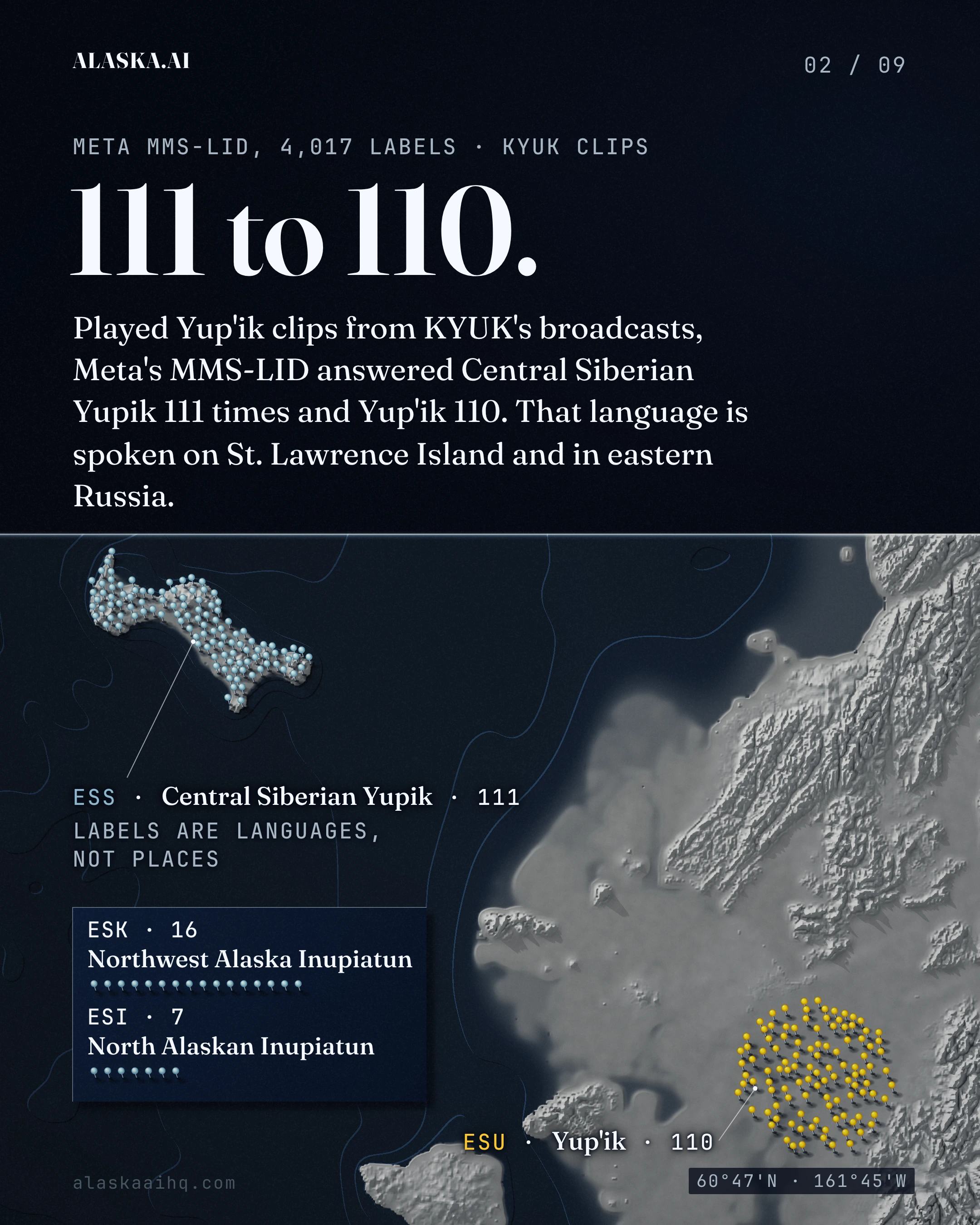
The model named KYUK's Yup'ik clips Central Siberian Yupik 111 times and Yup'ik 110.
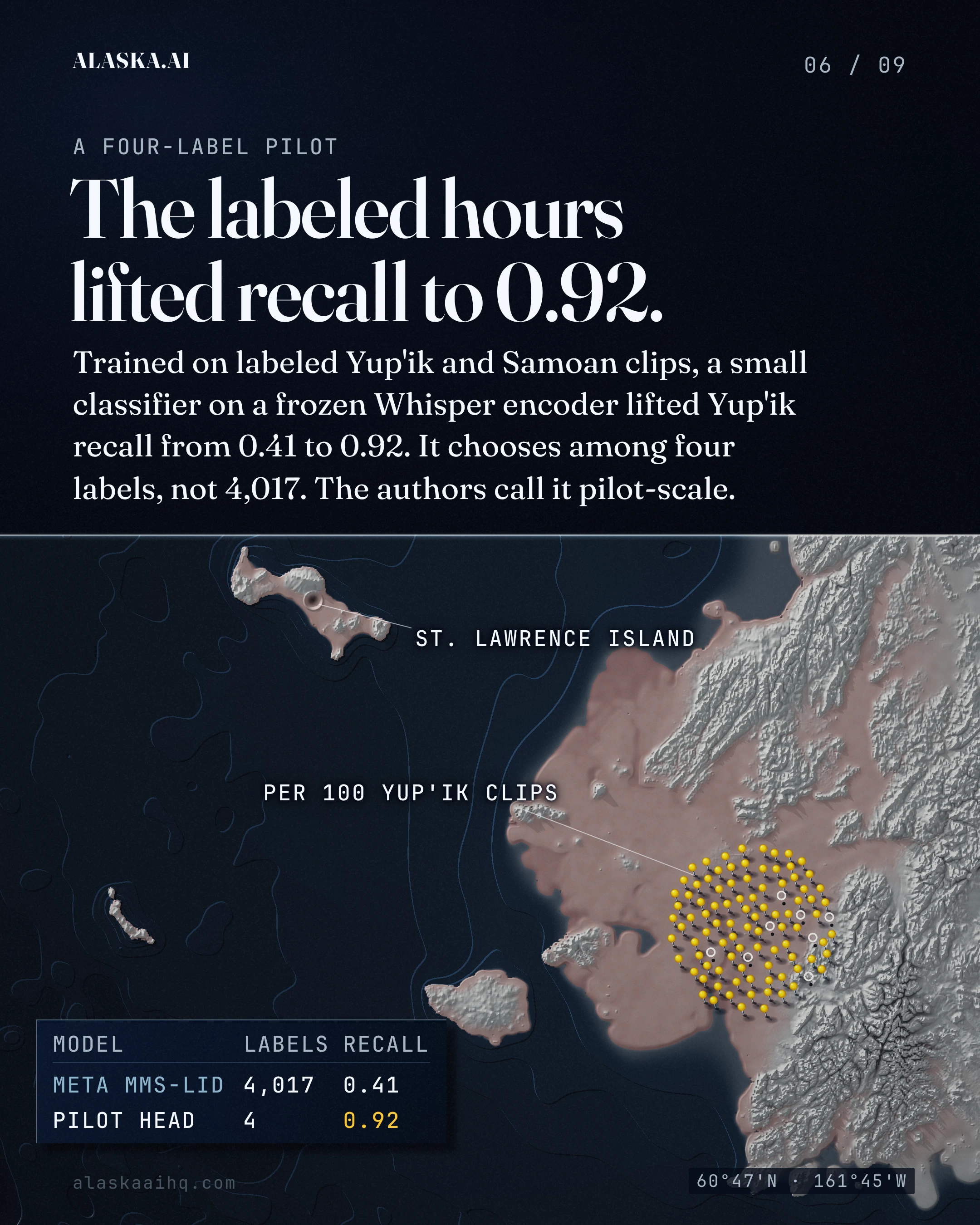
A four-label pilot trained on about 1,600 labeled clips across Yup'ik and Samoan lifted Yup'ik recall from 0.41 to 0.92.
Bethel's gold pin threads the slides past 111 pins on St. Lawrence Island, the label lists, KYUK's archive, the pilot, the speakers who label next and resolution 26-20.
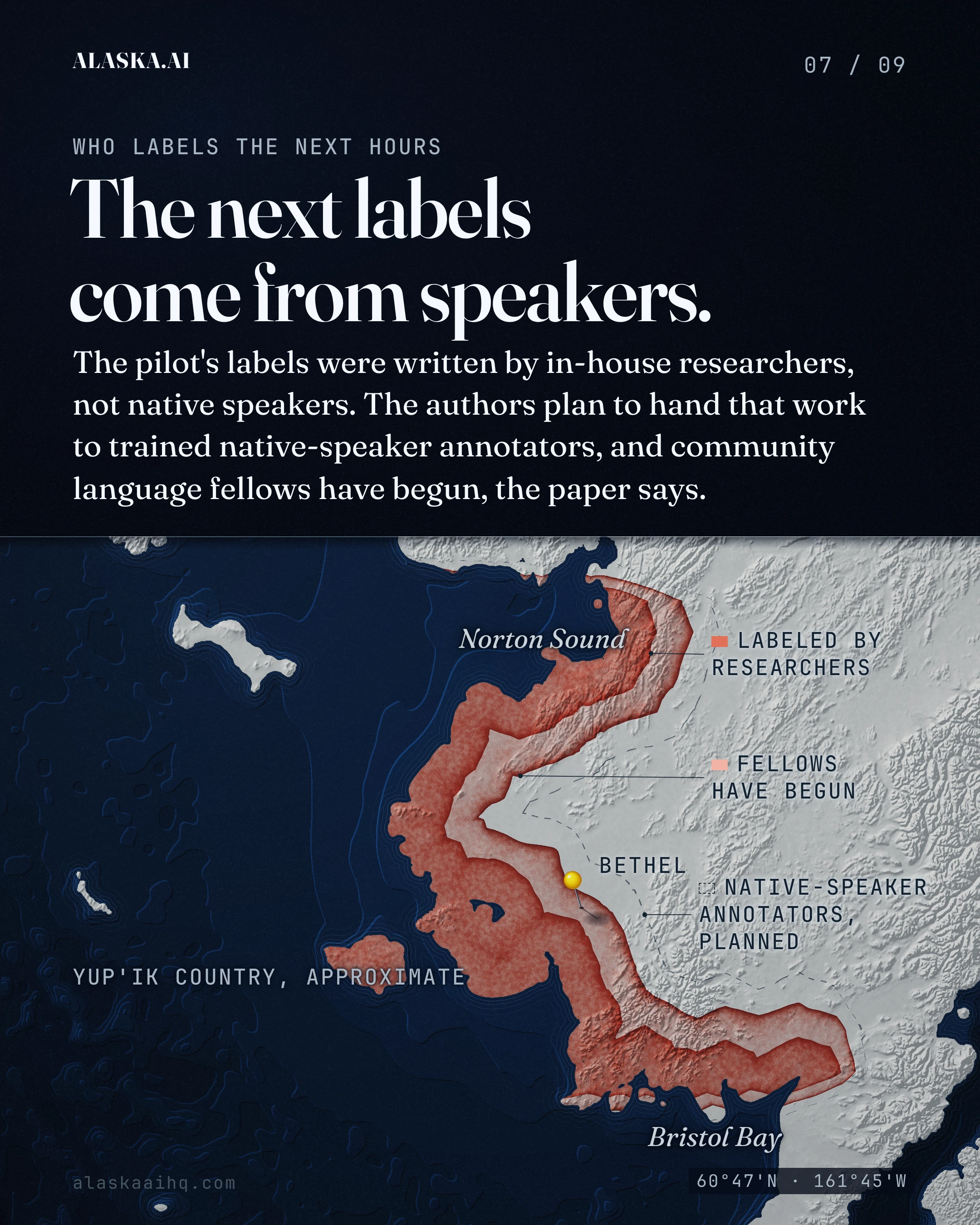
In-house researchers wrote the pilot's labels. Community language fellows have begun labeling. Native-speaker annotators are planned.
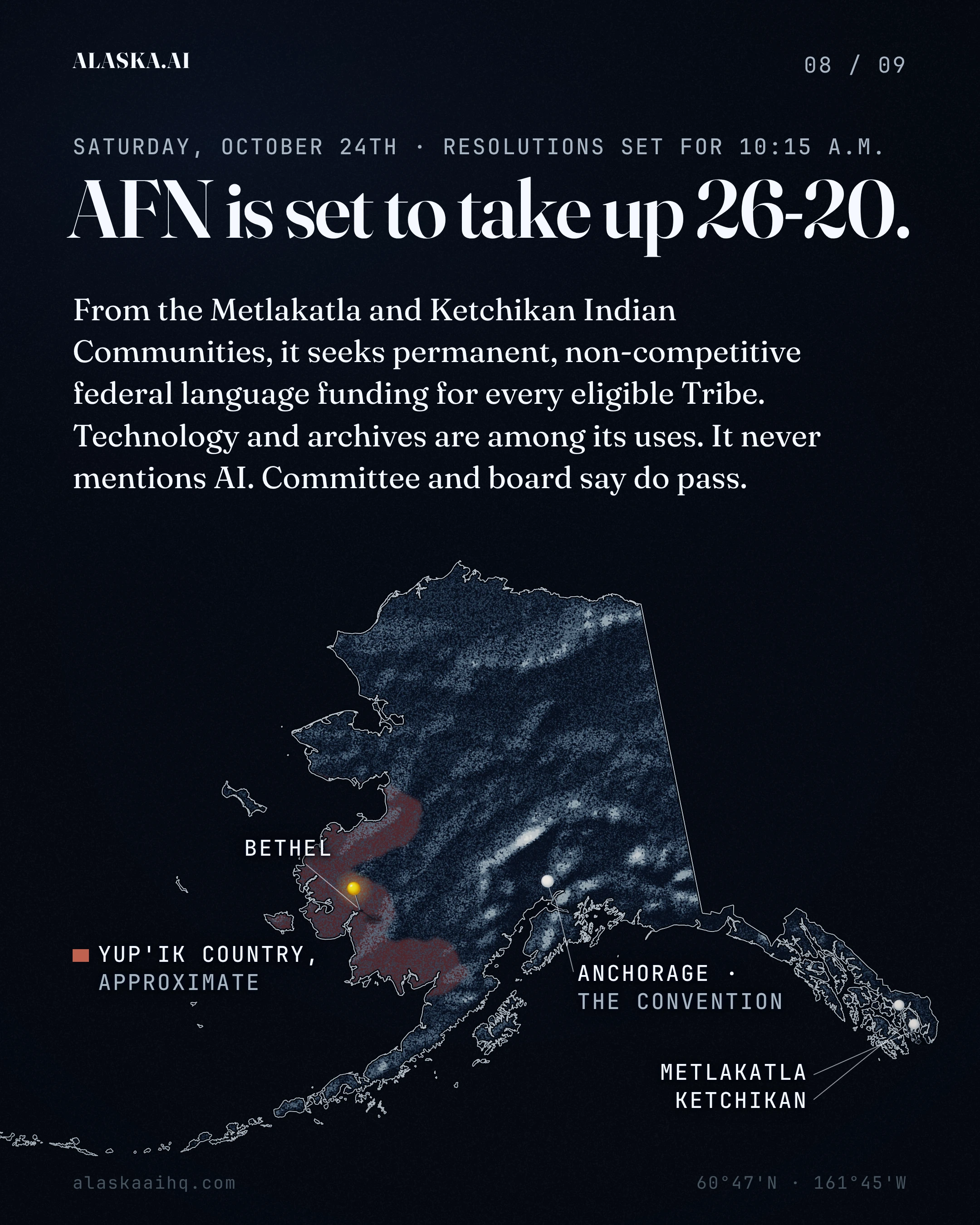
AFN is set to take up 26-20 Saturday, October 24th. It seeks permanent and non-competitive federal language funding for Tribes, technology included. It never mentions AI.
What does a model builder owe the speakers who write the next labels?
What we verified
79 CLAIMS, EACH RE-FETCHED FROM ITS SOURCE BEFORE THIS DECK SHIPPED
A Brandeis University survey found no spoken language identification system on HuggingFace that covers Central Alaskan Yup'ik except the largest variant of Meta's MMS-LID family.
Whisper, VoxLingua107-based models and ESPnet OWSM include Hawaiian and Maori but neither Samoan nor any Yupik variety.
The paper's Table 1 lists Whisper large-v3 as covering 99 languages.
The paper's Table 1 lists VoxLingua107 as covering 107 languages.
The paper's Table 1 lists ESPnet OWSM v4 as covering about 150 languages.
Meta's MMS-LID family covers Yup'ik only at its largest variant, which has 4,017 labels.
At 4,017 labels the per-class prior is about 2.5 x 10^-4, which the authors say makes zero-shot results on under-represented languages poor.
Zero-shot on the Yup'ik test clips, mms-lid-4017 reached a precision of 0.85 on the Yup'ik label.
Zero-shot on the Yup'ik test clips, mms-lid-4017 reached a recall of 0.41 on the Yup'ik label.
Zero-shot on the Yup'ik test clips, mms-lid-4017 reached an F1 score of 0.55 on the Yup'ik label.
For gold Yup'ik clips, the most frequent label mms-lid-4017 predicted was ess, Central Siberian Yupik, with 111 clips.
For gold Yup'ik clips, mms-lid-4017 predicted the correct label esu for 110 clips.
For gold Yup'ik clips, mms-lid-4017 predicted esk, Northwest Alaska Inupiatun, for 16 clips.
For gold Yup'ik clips, mms-lid-4017 predicted esi, North Alaskan Inupiatun, for 7 clips.
ISO 639-3 code ess denotes Central Siberian Yupik, a living individual language.
ISO 639-3 code esk denotes Northwest Alaska Inupiatun, part of the Inupiaq macrolanguage.
ISO 639-3 code esi denotes North Alaskan Inupiatun, part of the Inupiaq macrolanguage.
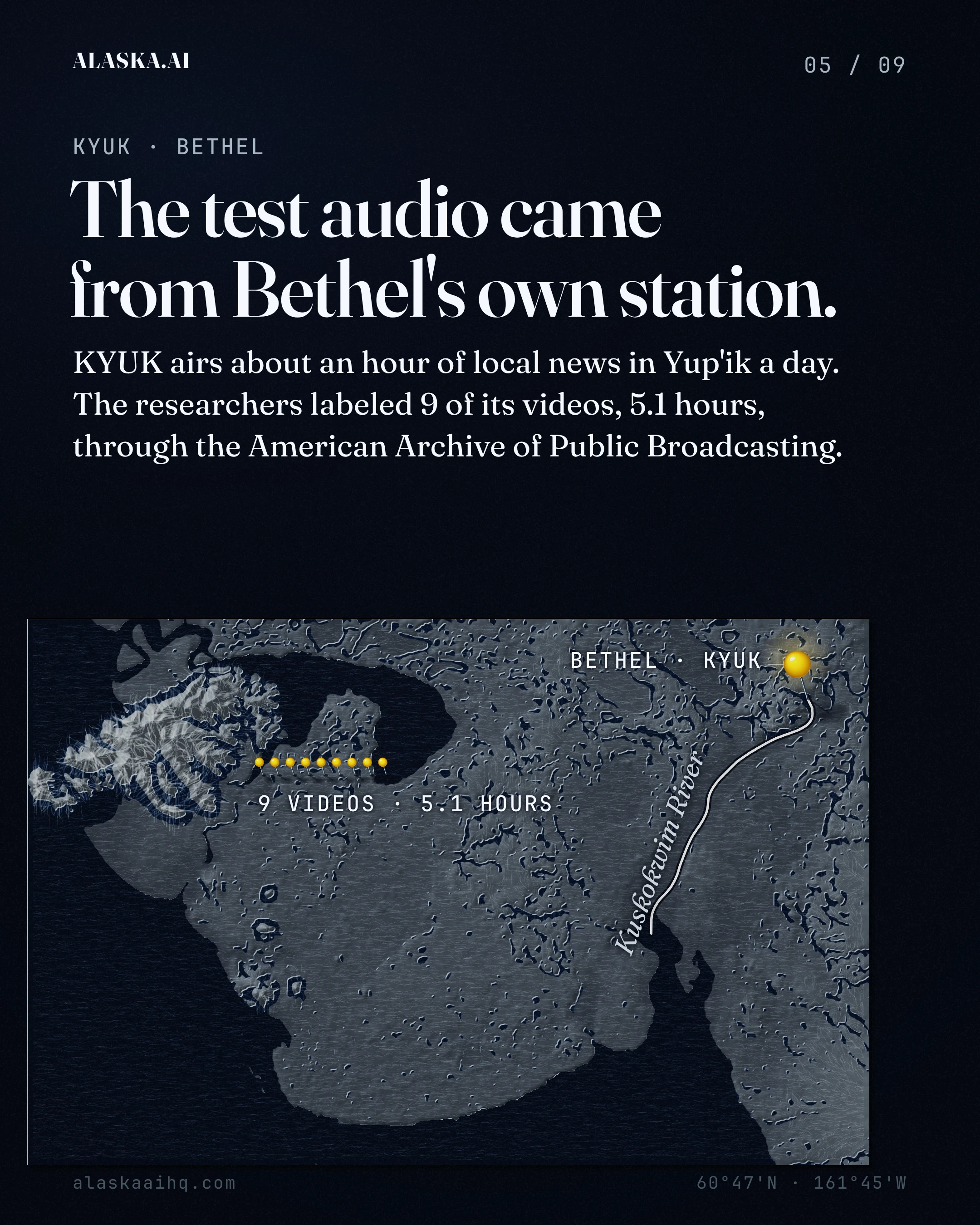
The study's Yup'ik audio comes from KYUK, a public broadcaster in western Alaska that has produced Yup'ik television news and programming since the 1970s.
The researchers took their audio from the American Archive of Public Broadcasting Online Reading Room, a collaboration between GBH and the Library of Congress.
The annotated Yup'ik set covers 9 videos.
The annotated Yup'ik set runs 5.1 hours.
The annotated Yup'ik set contains 589 segments.
283 of the Yup'ik set's segments are labeled as Yup'ik speech, esu.
A small classifier head trained on a frozen Whisper-medium encoder raised Yup'ik recall to 0.92.
With the frozen Whisper-medium encoder the Yup'ik F1 score reached 0.94.
The same classifier head on a frozen XLS-R-300M encoder raised Yup'ik recall to 0.85.
With the frozen XLS-R-300M encoder the Yup'ik F1 score reached 0.82.
The prototype is a two-layer MLP trained on fixed features from a frozen pretrained speech encoder.
The prototype was trained on about 1,600 labeled clips across both Yup'ik and Samoan, in four coarse classes.
The authors say their prototype results should be treated as pilot-scale evidence.
The authors' next step is to move primary annotation to trained native-speaker annotators.
Since the paper's first submission, community language fellows have begun annotating Yup'ik and Samoan broadcast material.
The current annotated set was labeled by in-house researchers rather than native speakers.
The paper describes Yup'ik as having a four-vowel system with contrastive vowel length.
The paper's Table 2 puts the Yup'ik consonant inventory at about 25.
The paper says Yup'ik has acoustically distinctive sounds rare across languages, including velar and uvular consonants and voiceless nasals.
The paper by Yangyang Chen, Kyeongmin Rim and James Pustejovsky of Brandeis University appeared in the AmericasNLP 2026 workshop proceedings on July 3rd.
The research was supported in part by the Andrew W. Mellon Foundation.
Meta's Massively Multilingual Speech paper describes a language identification model for 4,017 languages.
Meta's mms-lid-4017 model card on HuggingFace says the model supports 4017 languages.
KYUK's licensee operates public radio and television stations in Bethel, Alaska.
KYUK radio has been on the air since 1971.
KYUK television began broadcasting in 1972.
KYUK broadcasts about one hour a day of local news in Yup'ik.
KYUK describes itself as a bilingual station broadcasting in English and Yugtun.
KYUK radio serves about 22,000 mostly Yup'ik and Cup'ik residents of the Yukon-Kuskokwim Delta.
KYUK says it is digitizing more than 2,000 videos to make them public.
AFN draft resolution 26-20 is titled a resolution supporting national Indigenous language revitalization, Tribal self-governance and permanent federal funding.
Resolution 26-20 calls on Congress and the Administration to establish permanent, non-competitive federal funding for all eligible Tribal Nations to revitalize their languages.
Resolution 26-20 lists technology among the uses Tribes could fund, alongside immersion schools, master-apprentice programs, curriculum, archives and community-based transmission.
Resolution 26-20 states that competitive, short-term grant funding has proven inadequate and inconsistent with Tribal self-determination.
The full text of resolution 26-20 names technology as a fundable use but never mentions artificial intelligence.
Resolution 26-20 was submitted by the Metlakatla Indian Community and the Ketchikan Indian Community.
AFN's resolutions committee recommended do pass on resolution 26-20.
AFN's board recommended do pass on resolution 26-20.
In the September 27th draft packet the convention action line for resolution 26-20 is blank, so delegates had not yet voted.
AFN's resolutions state that its membership includes 192 federally recognized tribes.
AFN's resolutions state that its membership includes 152 village corporations.
AFN's resolutions state that its membership includes 11 regional corporations.
AFN's resolutions state that its membership includes 11 regional nonprofit and tribal consortiums.
The 2026 AFN Annual Convention runs October 22nd through October 24th.
The 2026 AFN Annual Convention is in Anchorage.
AFN delegates are scheduled to take up the 2026 convention resolutions on Saturday, October 24th, in a session set to start at a quarter past ten in the morning.
The resolutions session is moderated by Jodi Mitchell, chair of AFN's Resolutions Committee.
AFN's 2026 draft resolution packet contains 48 resolutions.
None of the 48 resolution titles in AFN's 2026 draft packet names artificial intelligence, AI or data centers.
Resolution 26-21 asks the University of Alaska system to create academic credit and credential pathways for tribal training programs.
Resolution 26-21 was submitted by Tanana Chiefs Conference.
Resolution 26-47 urges Congress to appropriate 14.9 million dollars a year to the Bureau of Indian Affairs to sustain 36 Native radio stations and one Tribally licensed television station.
Resolution 26-47 was submitted by Cook Inlet Region, Inc.
Resolution 26-47 states that Alaska public media lost annual state funding in August 2019 and annual Corporation for Public Broadcasting funding in October 2025.
Yup'ik has the largest body of speakers of any Alaska Native language, according to the Alaska Native Languages site.
The Alaska Native Languages site puts the number of native Yup'ik speakers at 10,400.
Central Alaskan Yup'ik is spoken in Southwest Alaska from Bristol Bay to Norton Sound.
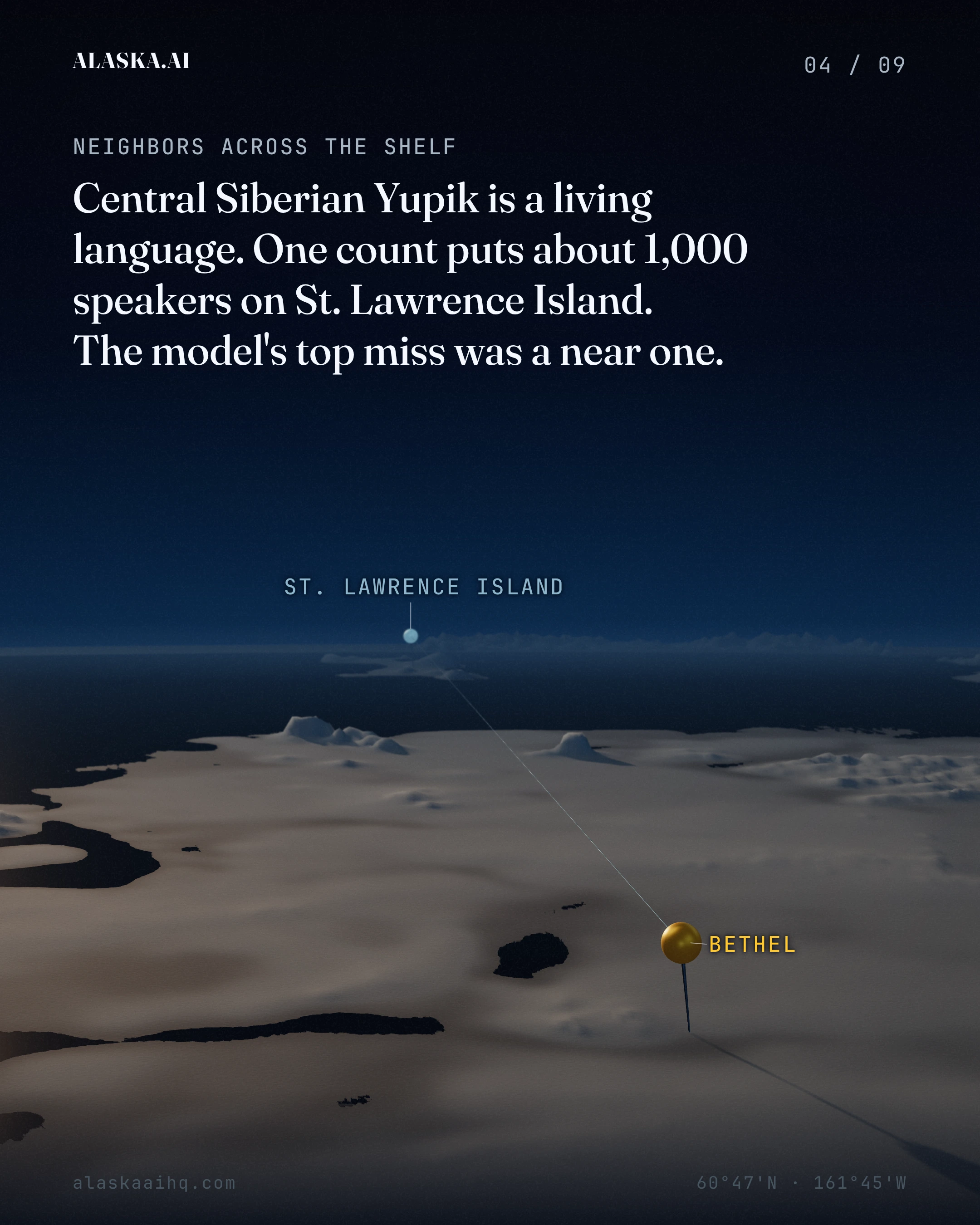
St. Lawrence Island Yupik is spoken by about 1,000 people on St. Lawrence Island, according to the Alaska Native Languages site.
The same Yupik language is also spoken in eastern Russia.
Glottolog lists St. Lawrence Island Yupik as an alternative name for Central Siberian Yupik and records it in Russia and the United States.
The convention is being held at Anchorage's Dena'ina Civic and Convention Center.
This year's AFN convention marks the organization's 60th anniversary.
Beats
This article is on Defense and federal AI in Alaska · Alaska AI research and science · Alaska data sovereignty and AI. Each beat page keeps every decision and every article on that subject in one place.