One Line of Code in a Polar Bear Rule
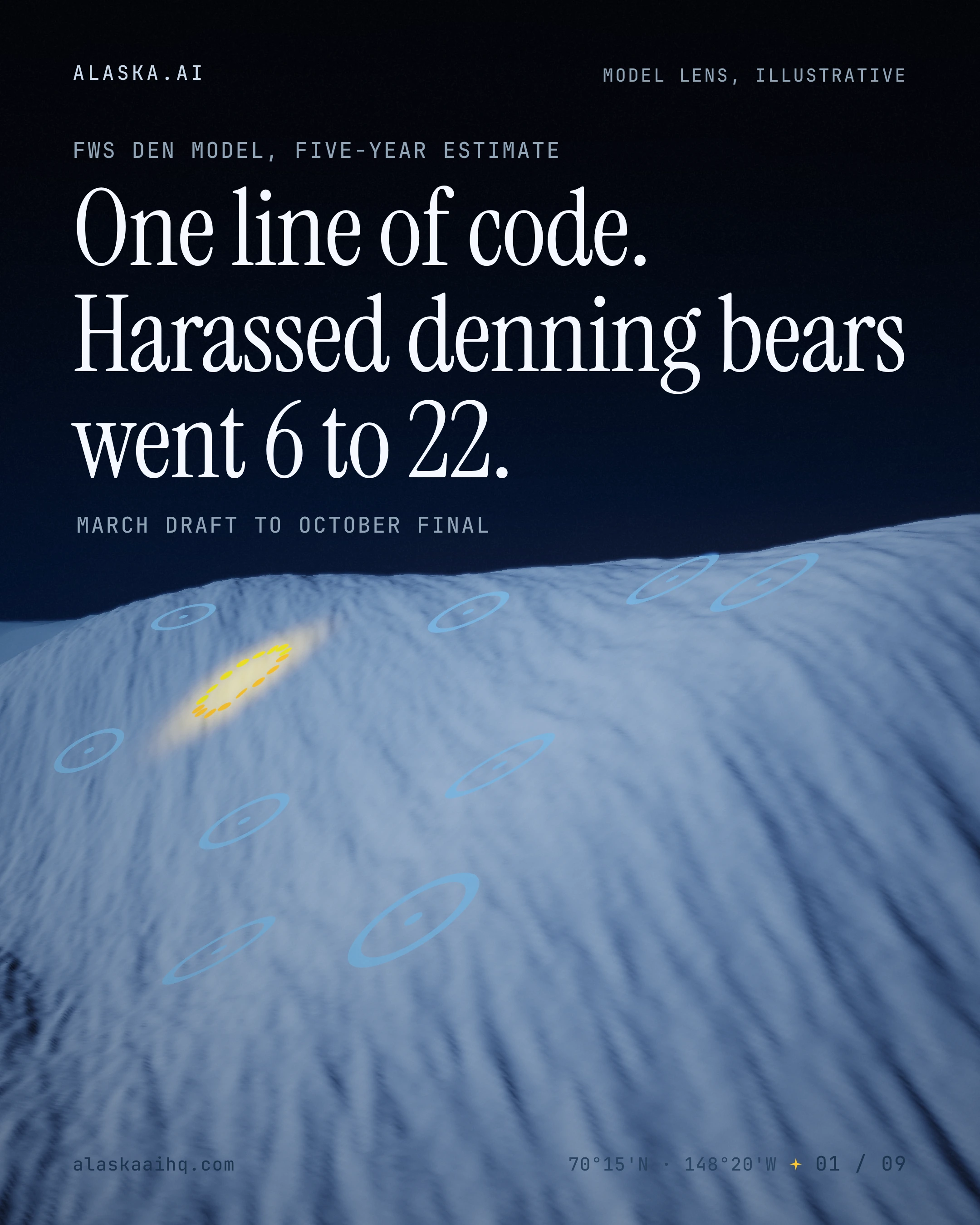
6 to 22. Fixing one line of code moved a Fish and Wildlife Service estimate of harassed denning polar bears that far.
The deck
SWIPE, SCROLL OR CLICK A SLIDE TO GO FULLSCREEN · 9 SLIDES


The story
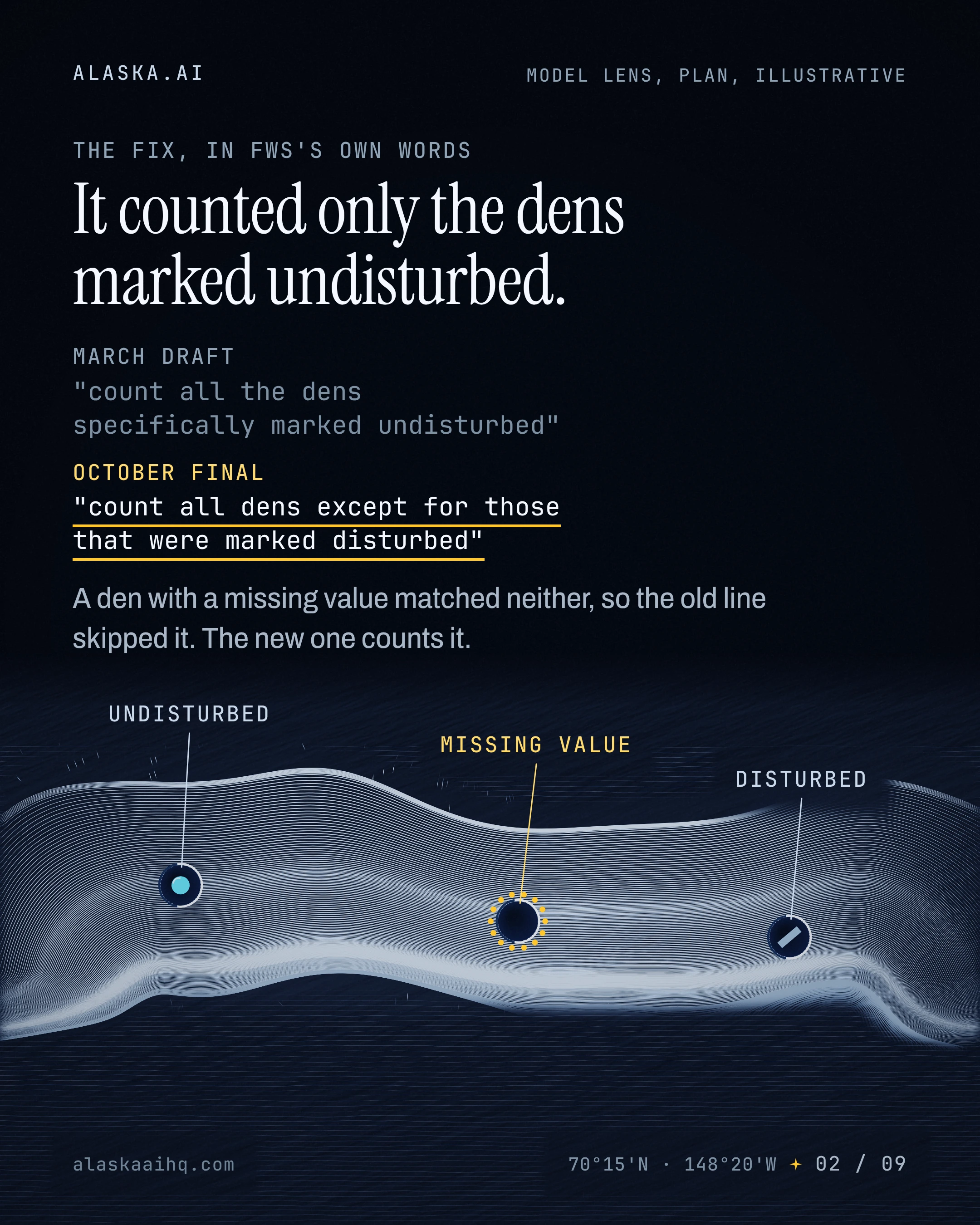
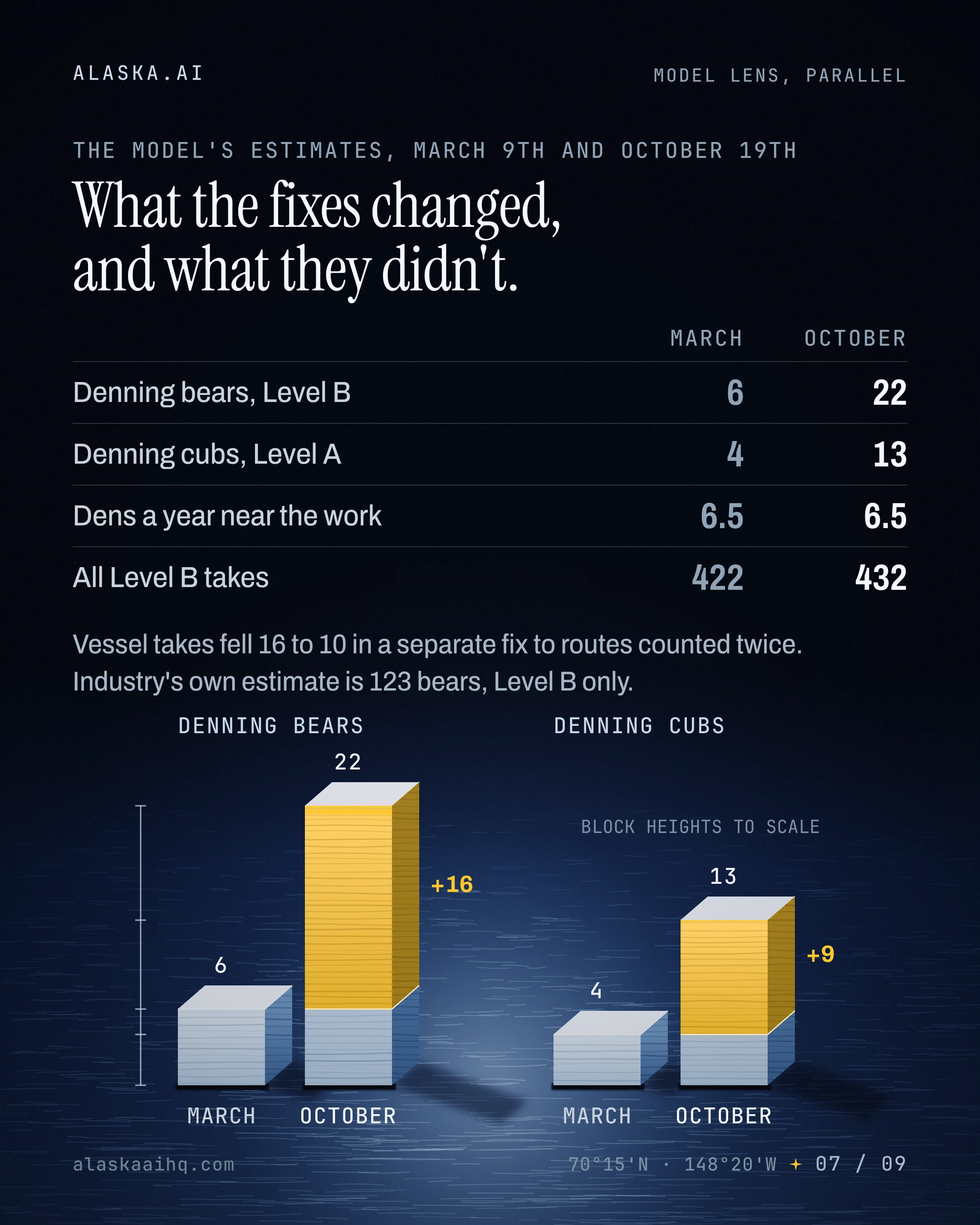
The line sits in the den simulation behind the October 19th rule for North Slope oil and gas. The old code counted only dens "specifically marked undisturbed" and skipped any den with a missing value. The line and another code fix together took cubs from 4 to 13.
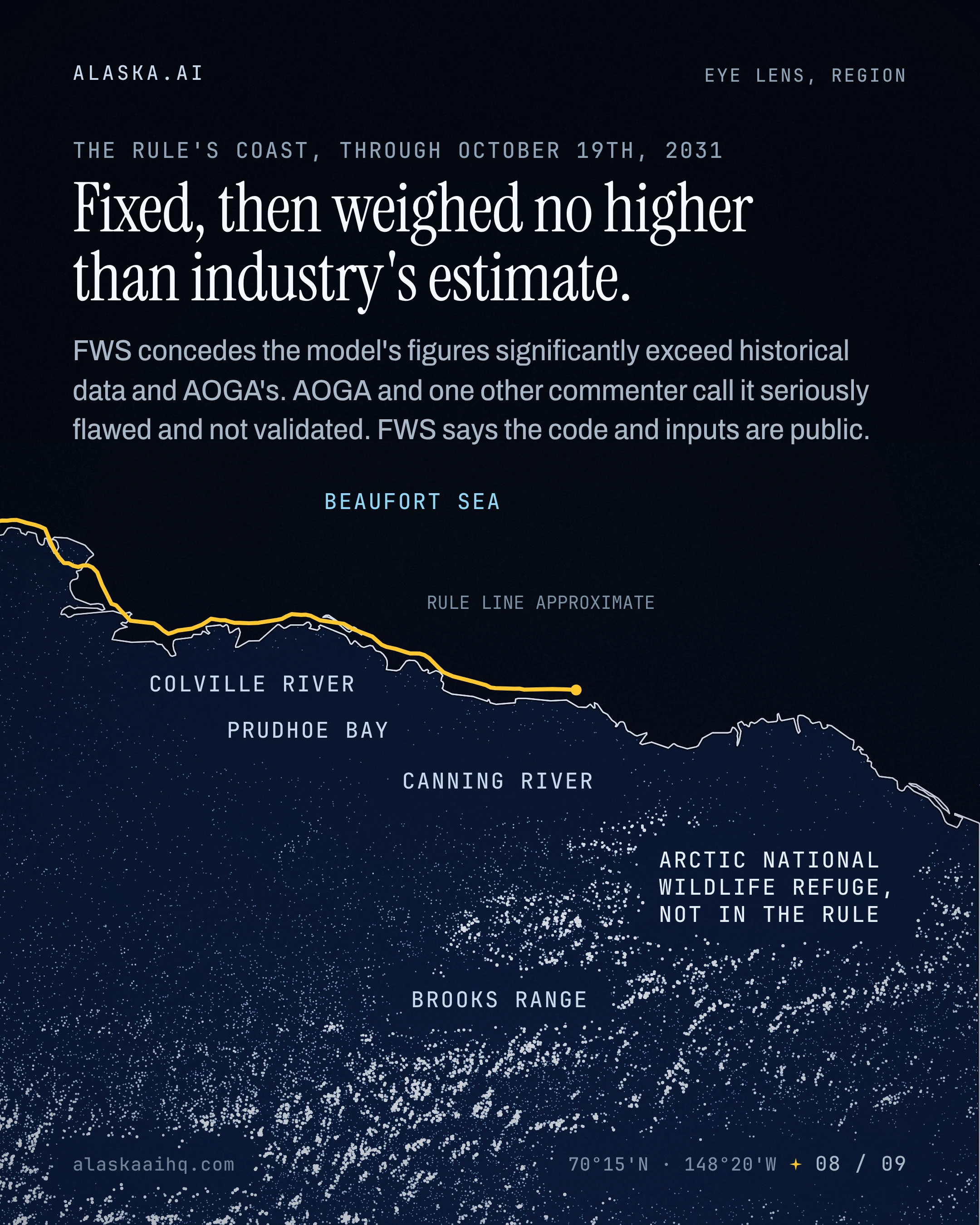
FWS concedes the model's figures significantly exceed historical data and industry's. So the rule weighs the model no higher than industry's estimate.
Code that moves a count this far is part of the rule.
Both versions of the line, the dens it skipped, the infrared survey and the March and October numbers.
FWS says the code is public. The model says 22 denning bears. Industry's request says 3. What's the honest den number for a rule that runs to October 19th, 2031?
What we verified
80 CLAIMS, EACH RE-FETCHED FROM ITS SOURCE BEFORE THIS DECK SHIPPED
The U.S. Fish and Wildlife Service finalized incidental take regulations for polar bears in response to a request from the Alaska Oil and Gas Association.
The final rule covers polar bears and Pacific walruses during year-round oil and gas industry activities in the Beaufort Sea and the adjacent northern coast of Alaska.
The final regulations apply for a 5-year period.
No lands or waters inside the Arctic National Wildlife Refuge are included in the region the rule covers.
The final rule was published in the Federal Register on October 19th, 2026 at 91 FR 66204.
The rule took effect October 19th, 2026 and remains in effect through October 19th, 2031.
FWS invoked good cause to make the rule effective less than 30 days after publication.
The previous 5-year Beaufort Sea incidental take regulations ran through August 5th, 2026.
FWS received AOGA's request on September 30th, 2025, on behalf of AOGA members and 8 Star Alaska LLC.
Companies represented in AOGA's request include Alyeska Pipeline Service Company, Chevron, ConocoPhillips Alaska and ExxonMobil Alaska Production.
Hilcorp, Repsol and Santos are also among the companies named in AOGA's request.
While further streamlining the code for its predictive denning model, FWS discovered two errors that caused inaccurate model outputs.
In the first error, simulated dens with zero cubs that were simulated to receive lethal or Level A harassment were still being counted.
A den having zero cubs naturally is a roughly 7 percent chance in the model.
The second error was a line of code that miscounted a single category of disturbance events.
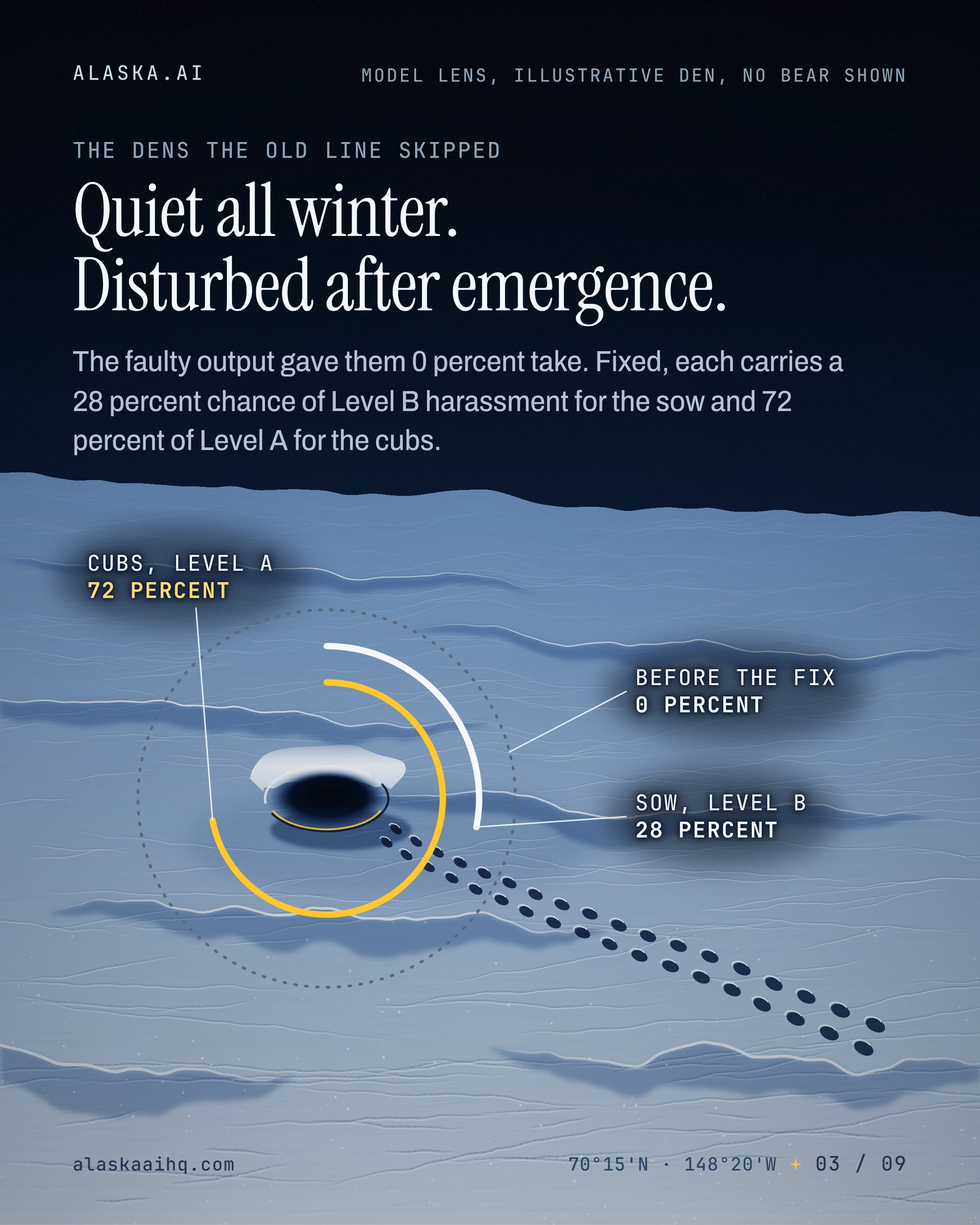
The dens left out by that line of code were undisturbed in early and late denning but disturbed in the post-emergence period.
FWS changed the code from counting all dens specifically marked undisturbed to counting all dens except those marked disturbed.
The new code also selects dens with a missing value, which the old code skipped.
FWS says it fixed the faulty line of code and reviewed the remaining code for similar issues.
FWS wrote a series of auto-check functions to keep a similar issue from appearing in future code updates.
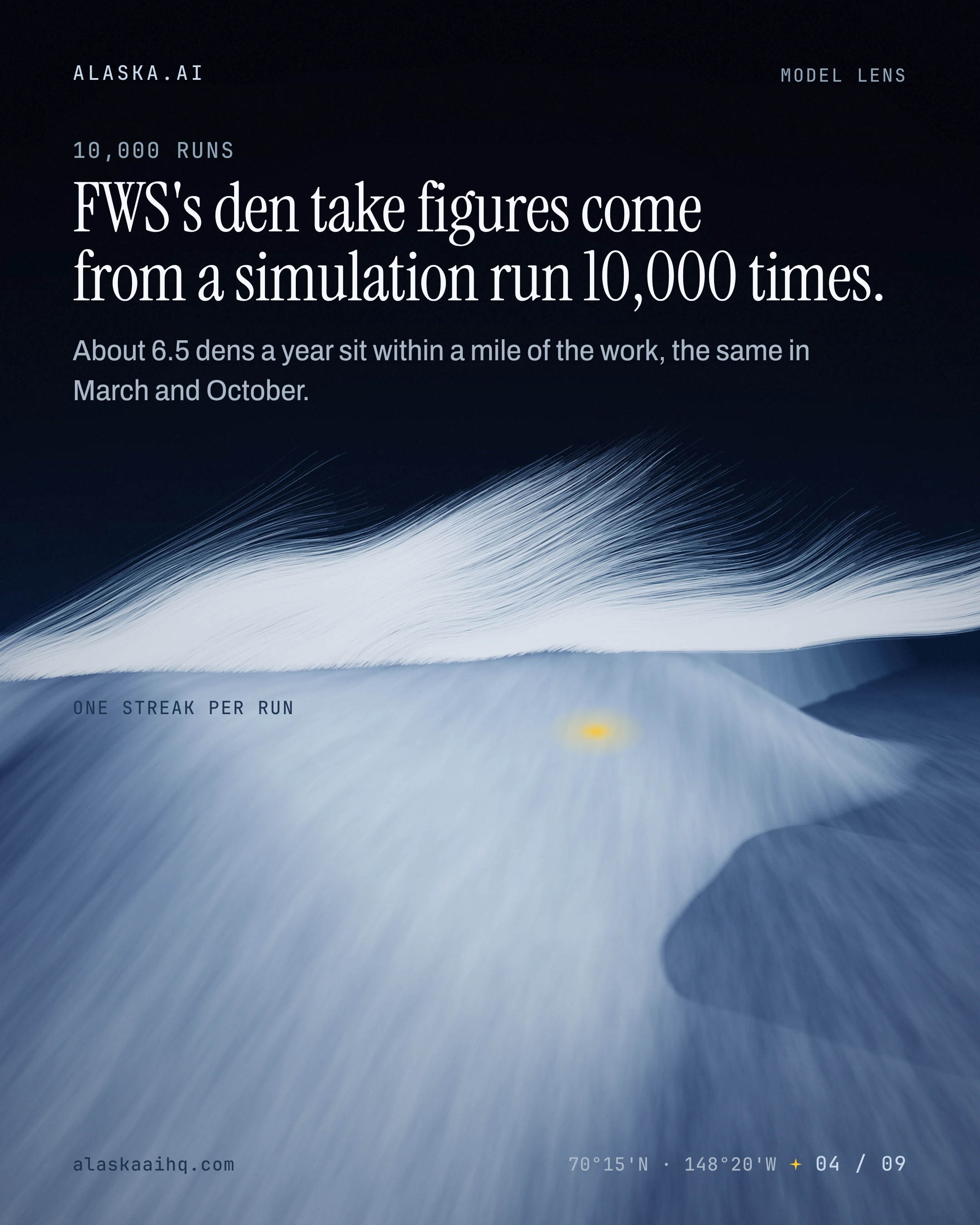
The denning model runs 10,000 iterations of simulated dens exposed to the specified activities.
After the repair, those previously uncounted dens carry a 28 percent probability of Level B harassment of the sow and a 72 percent probability of Level A harassment of cubs.
The faulty output had counted no take at all for those dens.
After the code repairs, the estimated probability of lethal take decreased slightly.
After the code repairs, the Level A and Level B harassment estimates increased.
FWS also corrected vessel routes that had been counted in both its vessel analysis and its surface analysis.
FWS estimated 6.5 land-based dens a year within the activity area and a 1-mile buffer, with a median of 6 and a 95 percent credible interval of 1 to 14.
FWS's model puts the probability of one or more lethal takes in any year at 0.12.
FWS's model puts the probability of one or more lethal takes over the 5-year period at 0.43.
The final model estimated 94 takes by Level B harassment of 46 individual polar bears a year.
Of the final model's annual estimate, 5 takes of 5 polar bears come from denning.
Over the 5-year period the final model estimated 432 takes by Level B harassment of 209 polar bears.
Of the final 5-year estimate, 395 takes of 172 polar bears come from surface interactions.
Of the final 5-year estimate, 10 takes of 10 polar bears come from vessel activities.
Of the final 5-year estimate, 22 takes of 22 polar bears come from denning.
Over the 5-year period the final model estimated 13 takes by Level A harassment of 13 denning cubs.
AOGA's request estimated Level B harassment of 123 polar bears over the period, 120 on the surface and 3 denning, and no other forms of take.
AOGA's evidence included 2,646 records of 2,830 polar bear sightings reported by the oil and gas industry in the petition area from 2014 to 2024.
Two operators reported 43 Level B takes in the region for calendar year 2025.
FWS says it does not give its predictive models more weight than other sources of information.
FWS acknowledges that its model's take estimates significantly exceed historical data and AOGA's estimates.
FWS says it considered all inputs in line with Executive Order 14303, Restoring Gold Standard Science.
FWS acknowledges the final rule shifts its approach to what counts as best available scientific evidence compared with the 2021 to 2026 rule and the proposed rule.
FWS says the model code and most recent data inputs are published on regulations.gov under docket FWS-R7-ES-2025-1628.
According to the final rule, AOGA and one other commenter criticized the denning model as inaccurate and seriously flawed.
AOGA and that commenter also said the denning model has not been validated.
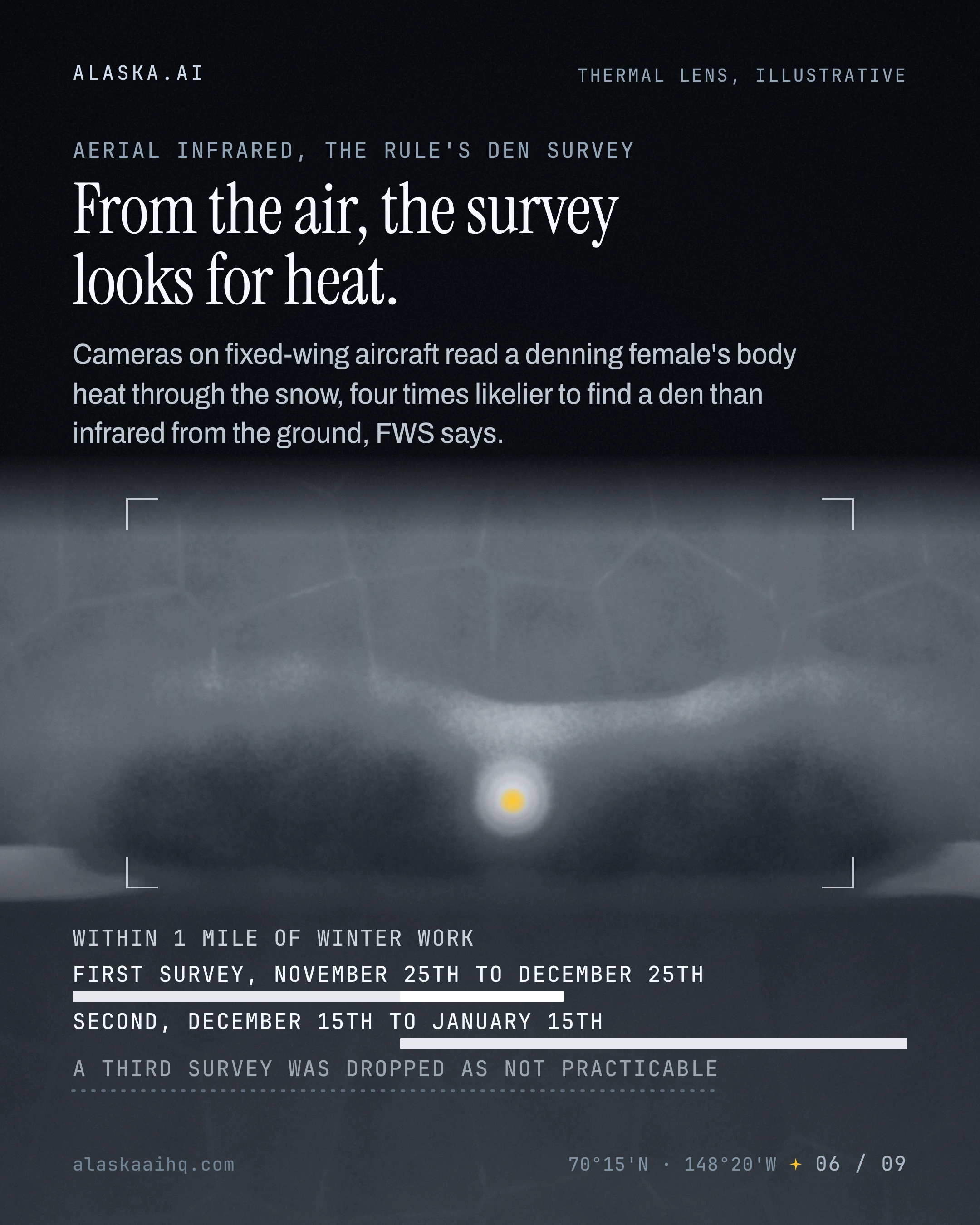
Aerial infrared surveys use cameras on fixed-wing aircraft to detect body heat from denning female polar bears coming through the snow.
FWS says aerial infrared surveys are four times more likely to detect polar bear dens than ground-based forward-looking infrared, because of blowing snow.
Operators working onshore in the denning season must survey all denning habitat within 1 mile of their activities using aerial infrared imagery.
The rule requires at least two aerial infrared surveys in high and medium density denning zones and at least one elsewhere onshore.
The first required aerial infrared survey must take place between November 25th and December 25th.
The second required aerial infrared survey must take place between December 15th and January 15th.
FWS concluded a third aerial infrared survey is not practicable and removed it from the final rule.
AOGA told FWS a required third aerial infrared survey was not practicable for logistical, human safety and economic reasons.
FWS says third aerial infrared surveys flown under the 2021 to 2026 rule detected no additional dens.
Under AOGA's measures, a suspected den found by aerial infrared survey gets a mitigation zone for the rest of the denning season, which runs November to April.
Operators must keep a 1-mile operational mitigation zone around all known or suspected polar bear dens during the denning season.
FWS estimates no more than 20 Pacific walruses a year will be taken by Level B harassment.
FWS puts the Pacific walrus population at approximately 257,193 animals.
FWS calculates 20 walruses a year as 0.008 percent of the population.
FWS received 85,589 comments on the proposed rule.
Of those comments, 77,468 came through mass mailing campaigns.
FWS used a tool called DocketScope to aggregate the public comments.
FWS published the proposed rule in the Federal Register on March 9th, 2026 at 91 FR 11240.
The proposed and final rules share docket number FWS-R7-ES-2026-0694.
The proposed rule's model estimated 422 takes by Level B harassment of 199 polar bears over 5 years.
The proposed rule's model estimated 91 takes by Level B harassment of 43 polar bears a year, including 1 take of 1 denning bear.
The proposed rule's 5-year estimate included 395 takes of 172 polar bears from surface interactions.
The proposed rule's 5-year estimate included 6 takes of 6 polar bears from denning.
The proposed rule's model estimated four takes by Level A harassment of four denning cubs over 5 years.
The proposed rule had added a third aerial infrared survey of polar bear denning habitat as an extra mitigation measure.
The proposed rule also estimated 6.5 land-based dens, the same figure as the final rule.
FWS estimates that at most 49 polar bears would be taken by Level A or Level B harassment in any single year.
FWS says 49 polar bears would be 5.4 percent of the current Southern Beaufort Sea stock estimate of 907 animals.
FWS says 49 polar bears would be 6.0 percent of a Southern Beaufort Sea stock of 819 animals.
A January 2nd, 2025 draft stock assessment put the Southern Beaufort Sea polar bear stock at 819 bears, mainly because of a shifted stock boundary.
Commenters argued, as the final rule summarizes them, that killing four cubs or one maternal bear and harassing up to 5.7 percent of the population in a single year is not a small number for a threatened, declining population.
FWS expects updated abundance results for the Southern Beaufort Sea polar bear stock by the end of 2026.
One commenter urged FWS to commission new population surveys before finalizing the rule, calling the most recent population data nearly a decade old.
FWS says the most recent Southern Beaufort Sea polar bear population estimate used data through 2015.
Beats
This article is on Alaska land and permitting for AI · Defense and federal AI in Alaska · Alaska AI research and science. Each beat page keeps every decision and every article on that subject in one place.