Weight, Cold, Mountains. The Army's Alaska Drone Taken Apart
"Soldiers across the 11th Airborne Division continue to demonstrate that many of the best ideas come from the bottom up."
The deck
SWIPE, SCROLL OR CLICK A SLIDE TO GO FULLSCREEN · 9 SLIDES




The story
Col. Matthew Adamczyk is right.
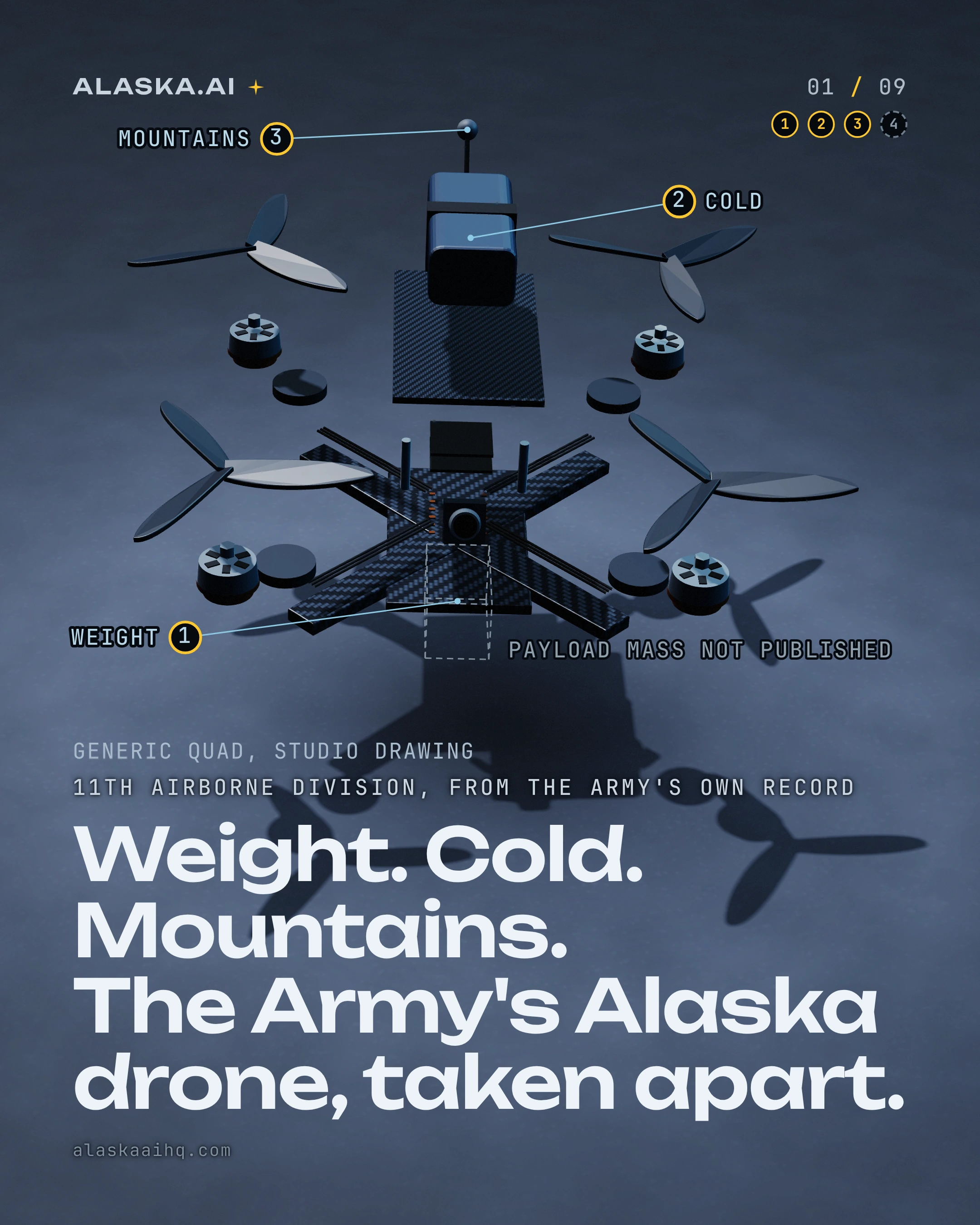
Weight. Sgt. 1st Class Devin McNamara enabled unarmed payload flights before the live strikes. Cold. Pfc. Michael Pereira hand-sewed a body-heat battery vault. Mountains. Spc. Leighton Keilen won Angel Ascent with a Skydio drone relay. Snow. Capt. Daniel Woodard's team designed a metal hatch cover other units can copy for about $300 in materials.
Soldiers get names. The drone's model, payload mass, endurance, engagement range and measured accuracy don't.
Inside, the first kinetic drone strike within the Richardson Training Area, four soldier fixes and five drone specs left blank.
A $300 hatch got its price printed. Should an armed drone's measured accuracy be that public?
What we verified
43 CLAIMS, EACH RE-FETCHED FROM ITS SOURCE BEFORE THIS DECK SHIPPED
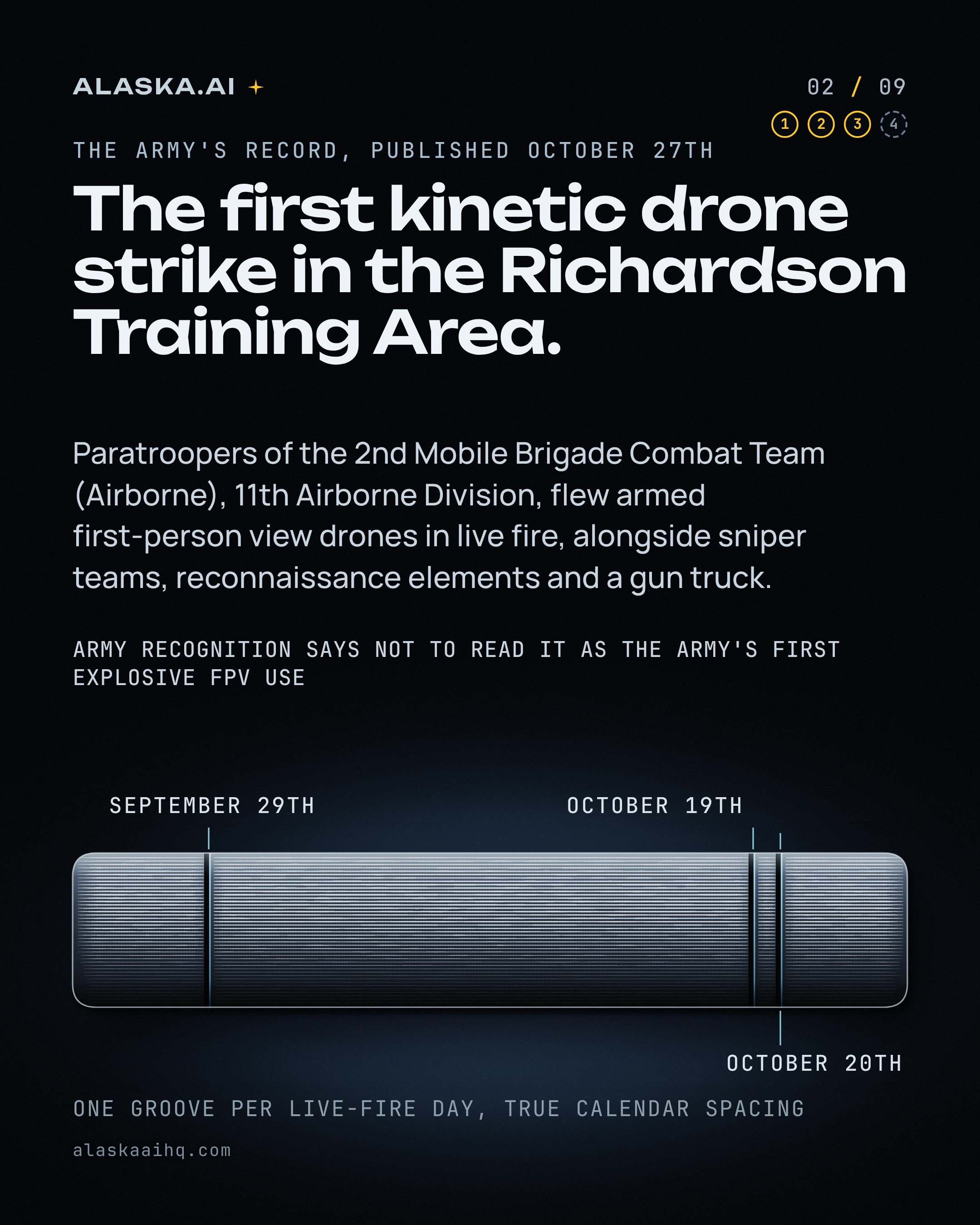
Paratroopers of the 2nd Mobile Brigade Combat Team (Airborne), 11th Airborne Division, conducted multi-purpose company live-fire exercises in Alaska.
The live-fire exercises took place on September 29th and October 19th to 20th.
The exercises were held at the Multi-Purpose Training Range in the Richardson Training Area.
The exercises included the first kinetic drone strike conducted within the Richardson Training Area.
The strike used armed first-person view drones.
The exercises integrated armed small unmanned aircraft systems, sniper teams, reconnaissance elements and a gun truck.
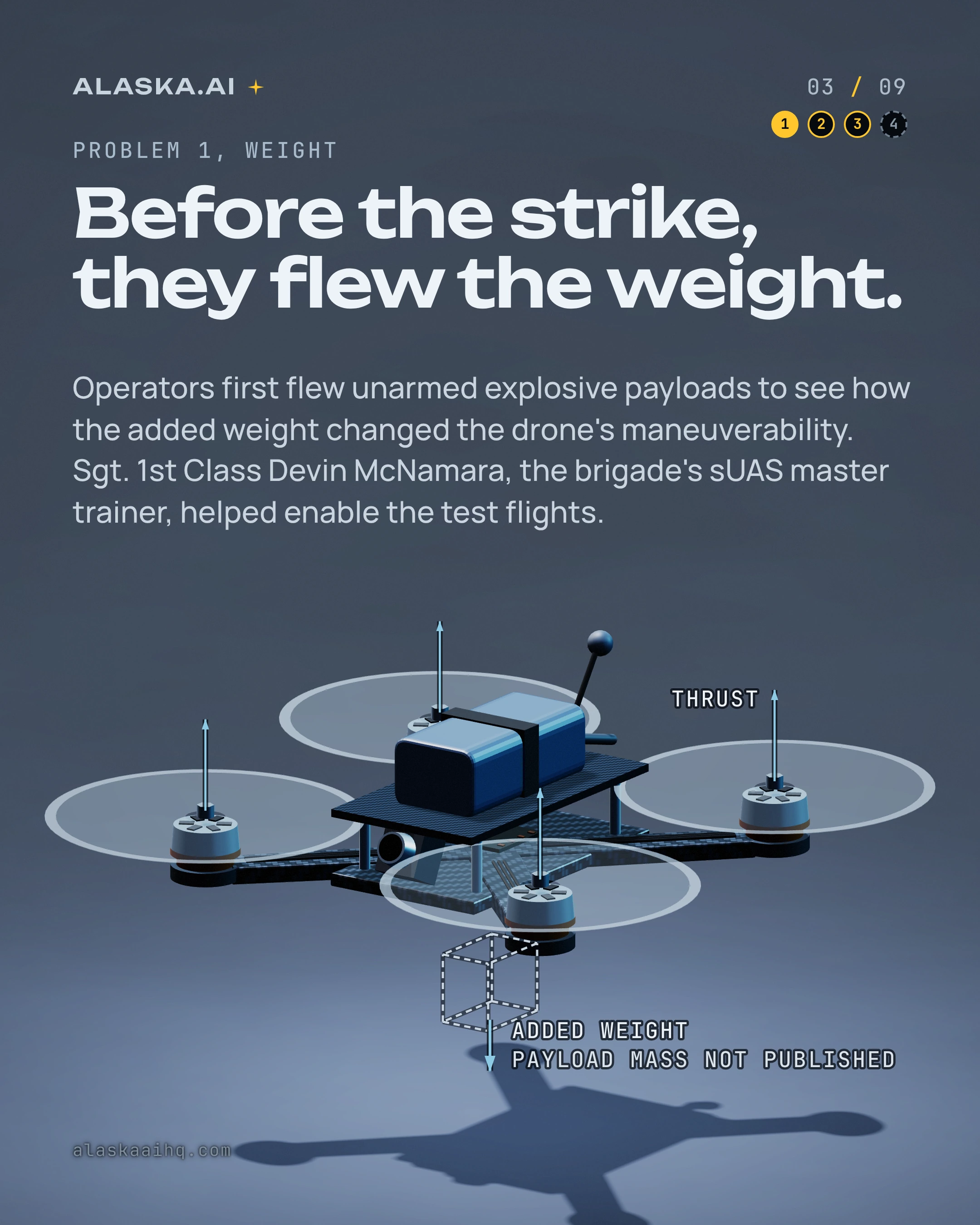
Before the live strikes, operators flew test flights with unarmed explosive payloads to see how the added weight affected maneuverability.
Sgt. 1st Class Devin McNamara, the brigade's sUAS master trainer, helped enable the test flights.
The brigade's Multi-Functional Reconnaissance Company, commanded by Capt. Pat Robinson, coordinated the initial effort and flew the first live strike.
Capt. Raymond Bartoli, a brigade planner and officer in charge of the live-fire range, said "The Kinetic Drone Strike completed on MPTR was the first of its kind in the Richardson Training Area (RTA)."
The Army article says these drone capabilities are particularly relevant to the Spartan Brigade in Arctic and mountainous environments.
The 11th Airborne Division held its Angel Ascent innovation competition on October 28th at the division theater.
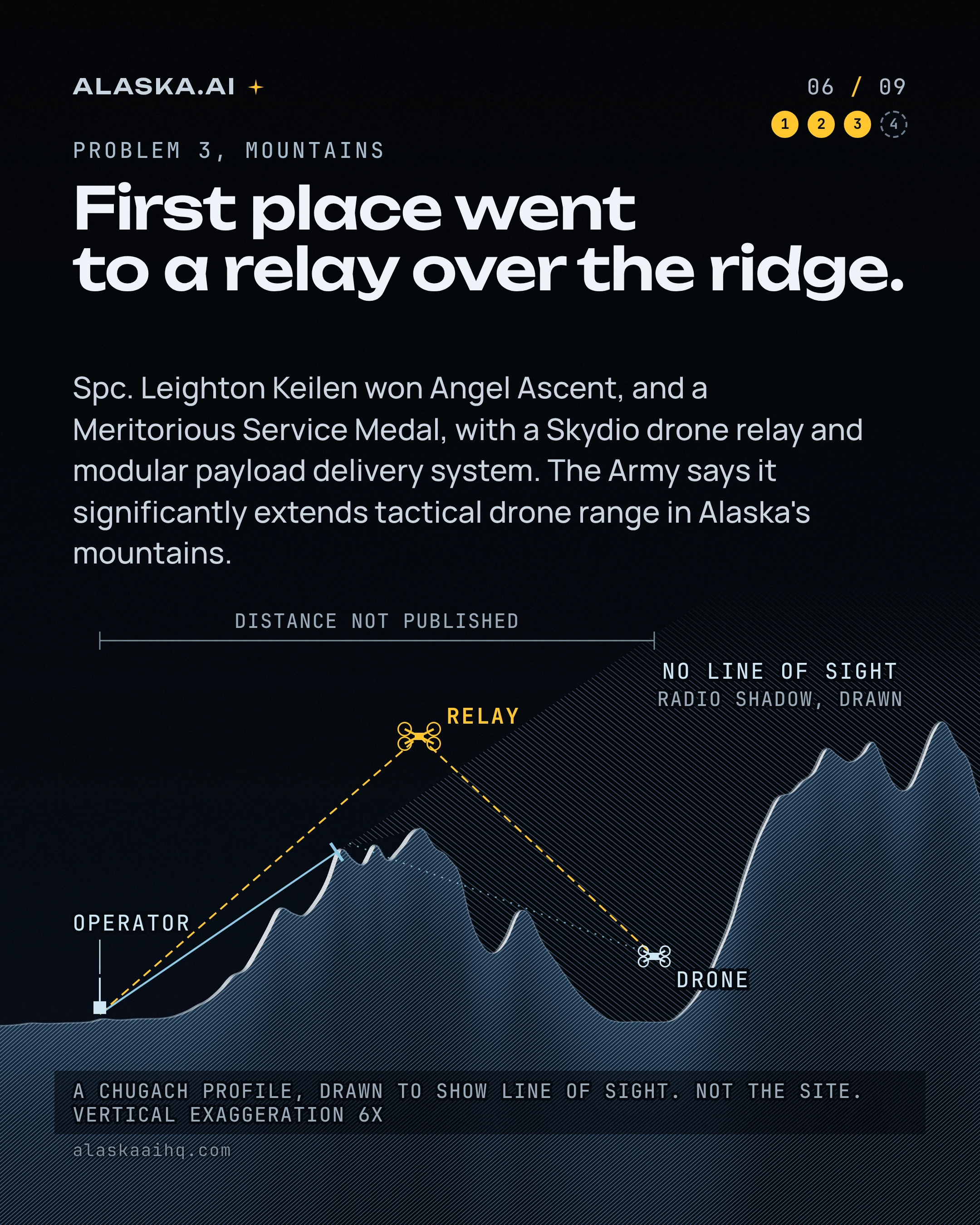
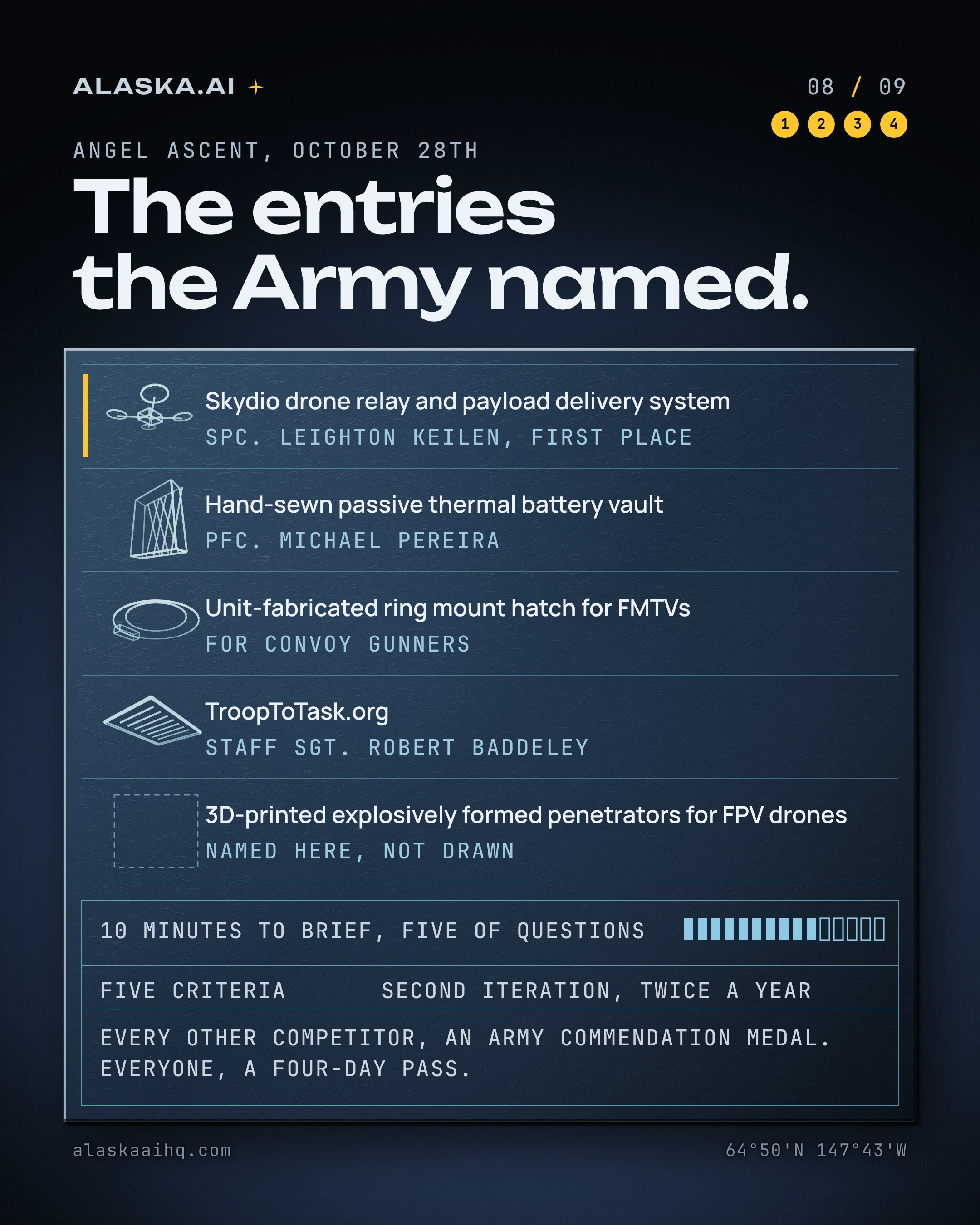
Spc. Leighton Keilen of 1st Battalion, 24th Infantry Regiment, 1st Infantry Brigade Combat Team, won first place at Angel Ascent.
Keilen's winning entry was a Skydio drone relay and modular payload delivery system.
The Army says Keilen's system significantly extends tactical drone range and utility in Alaska's rugged, mountainous terrain.
Col. Matthew Adamczyk presented Keilen with a Meritorious Service Medal.
Every other Angel Ascent competitor received an Army Commendation Medal, and every participant got a four-day pass.
Each innovator had 10 minutes to brief a project, followed by five minutes of questions from the judges.
Judges scored entries on problem identification, solution quality, operational value, resource requirements and presentation.
Pfc. Michael Pereira hand-sewed a prototype passive thermal battery vault to keep drone batteries working in sub-zero temperatures using only body heat and radiant barriers.
Other Angel Ascent entries included 3D-printed explosively formed penetrators for FPV drones.
Another entry was a unit-fabricated ring mount hatch for FMTVs that protects convoy gunners in Arctic conditions.
Col. Matthew Adamczyk said "Soldiers across the 11th Airborne Division continue to demonstrate that many of the best ideas come from the bottom up."
Staff Sgt. Robert Baddeley developed TroopToTask.org, a platform that combines personnel, training and duty data for leaders.
Angel Ascent is the 11th Airborne Division's twice-yearly innovation competition, sponsored by the division's Innovations Lab.
The October 28th competition was the second iteration of Angel Ascent.
A team from the 725th Light Support Battalion, 2nd Mobile Brigade Combat Team (Airborne), designed a metal replacement for the soft cloth gunner hatch covers on Light Medium Tactical Vehicles, which let snow leak into the cab.
Other units can reproduce the metal hatch cover for roughly $300 in materials.
Capt. Daniel Woodard said "We put together a metal version that can sustain the weight of snow, and can also be popped open easily."
Capt. Eleanor Manning, deputy of innovations at the 11th Airborne Division Innovations Lab, said "The overall intent is not to just select one winner."
MEA, Enstar and Hilcorp signed a gas exchange agreement covering 1.2 billion cubic feet of natural gas.
Enstar is to return equivalent gas volumes to MEA no later than March 31st, 2028.
MEA estimates the exchange will save its members about $2 million, subject to regulatory approval.
MEA CEO Tony Izzo said "This agreement demonstrates how utilities can work together to address regional energy challenges."
Army Recognition reported that the Army did not identify the drone model, payload mass, flight endurance, engagement range or measured accuracy.
Army Recognition cautioned that the Richardson strike should not be read as the Army's first use of an explosive FPV drone.
Enstar Natural Gas applied to the Regulatory Commission of Alaska to approve a proposed gas exchange with Matanuska Electric Association.
Enstar asked the RCA for an expedited decision on the exchange.
With 98 percent of precincts reporting on election night, Democrat Jonathan Kreiss-Tomkins led the governor's race with 49 percent of the vote.
Republican Bernadette Wilson was second with about 29 percent of first-choice votes.
Ranked-choice ballots in the governor's race are to be tabulated on November 18th.
Kreiss-Tomkins told the Alaska Beacon he supports a moratorium on data center development in Alaska until the Legislature passes a regulatory framework.
Wilson said she would never allow Alaska to be littered with hyperscale data centers.
Beats
This article is on Defense and federal AI in Alaska. Each beat page keeps every decision and every article on that subject in one place.