Who watches Alaska's fishing boats in 2027
In 2027 camera hardware moves into Alaska's fisheries monitoring budget while the AI that could review the video waits on staff.
The deck
SWIPE, SCROLL OR CLICK A SLIDE TO GO FULLSCREEN · 9 SLIDES
The story
Who pays for the camera? Congress has, since 2023. That money is expected to run out this year. The draft puts hardware at $6,002.96 a year per fixed-gear camera boat, inside a preliminary $5.45M budget.
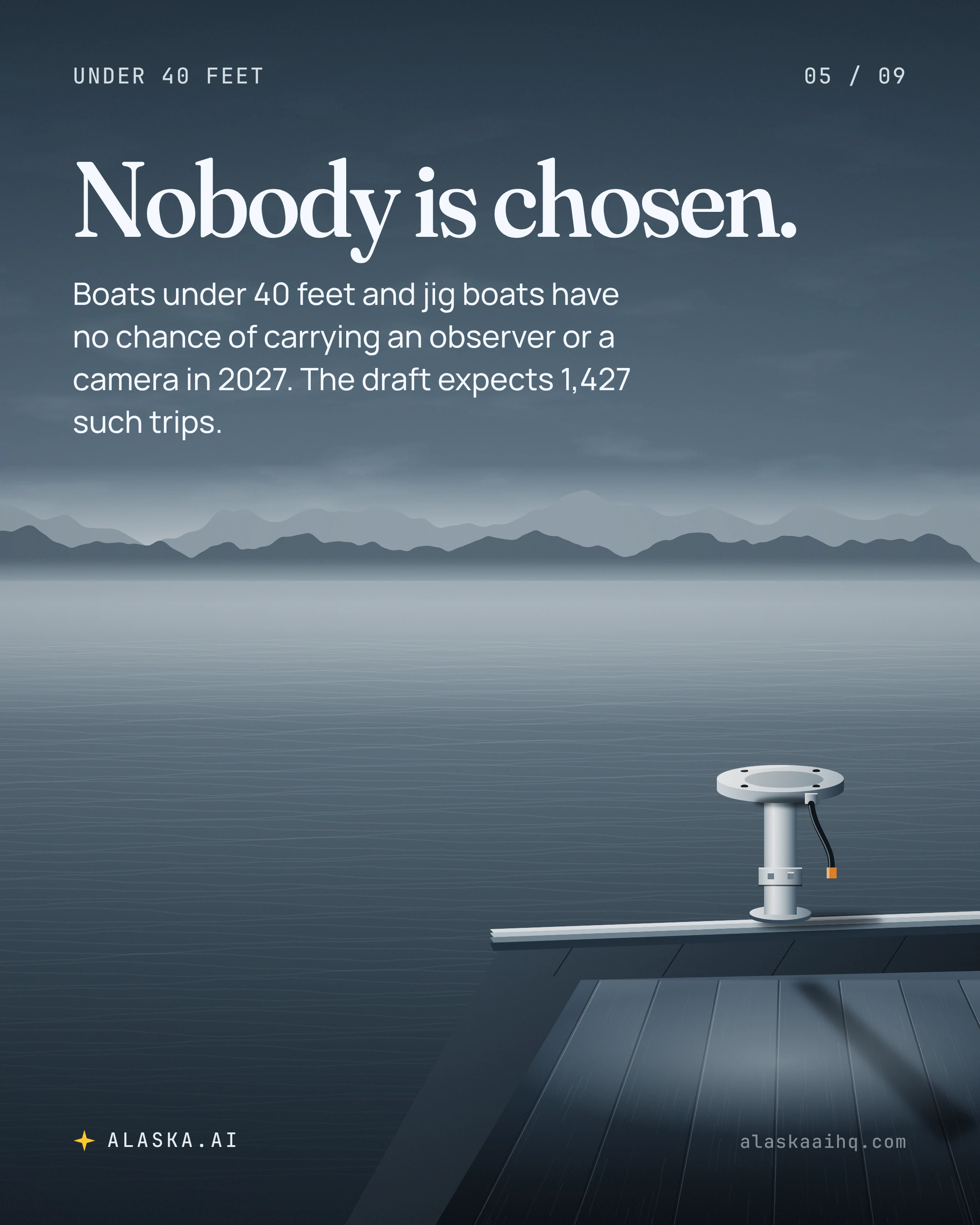
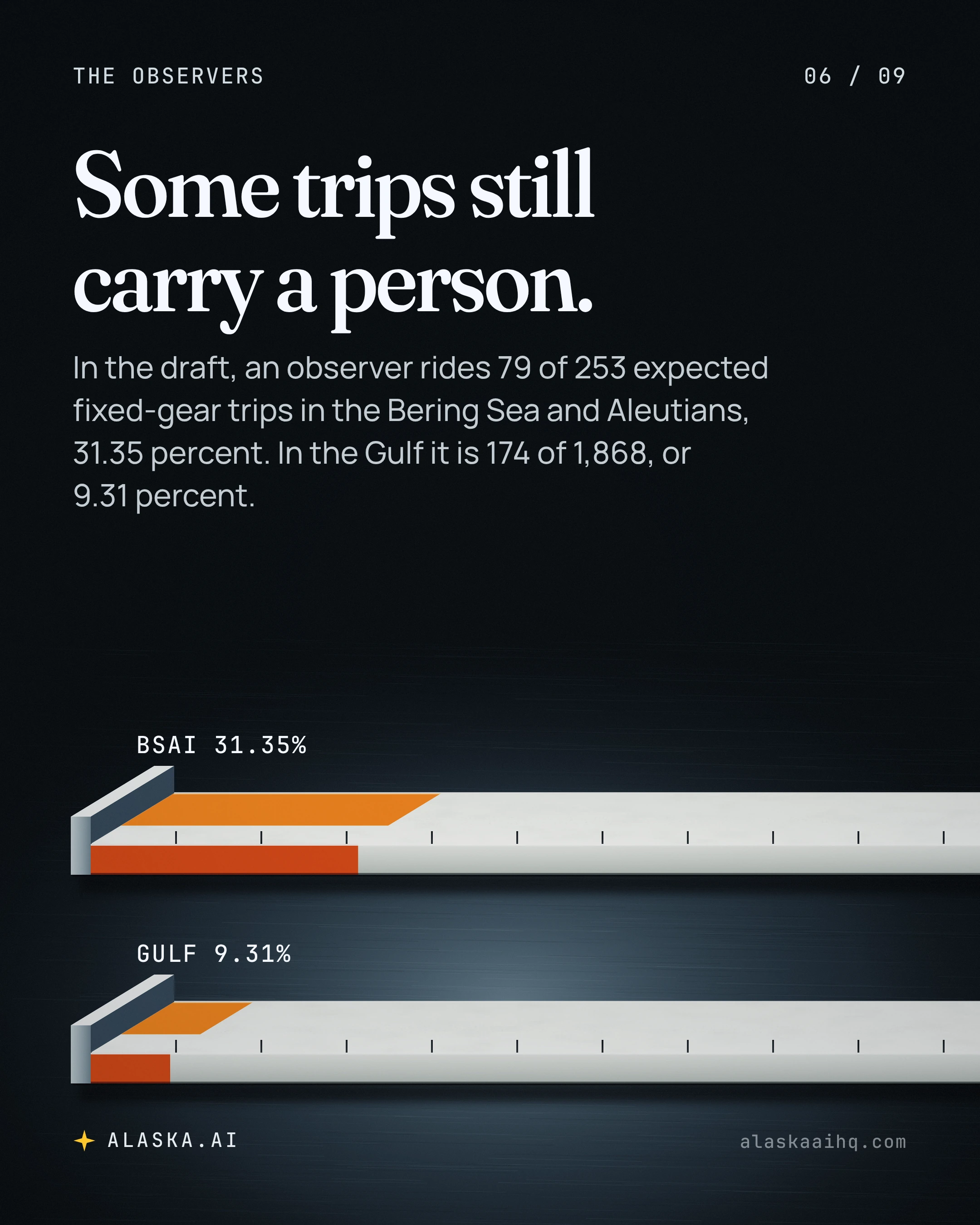
Will your trip get picked? In the draft an observer rides 31.35 percent of Bering Sea and Aleutian fixed-gear trips and 9.31 percent in the Gulf. Under 40 feet, nobody is chosen.
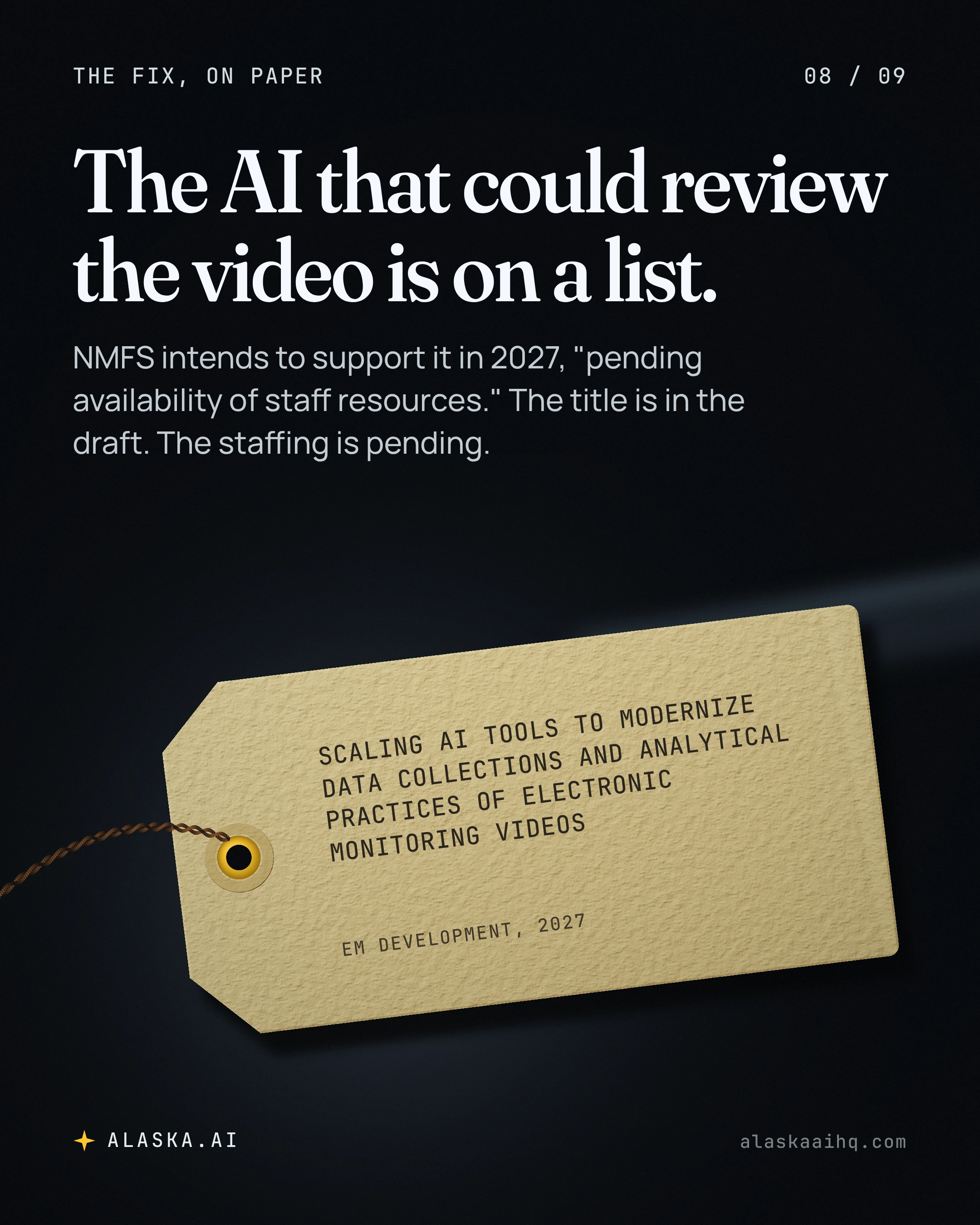
Who watches your footage? A review provider, priced per hard drive reviewed. NMFS lists the AI project for 2027 "pending availability of staff resources."
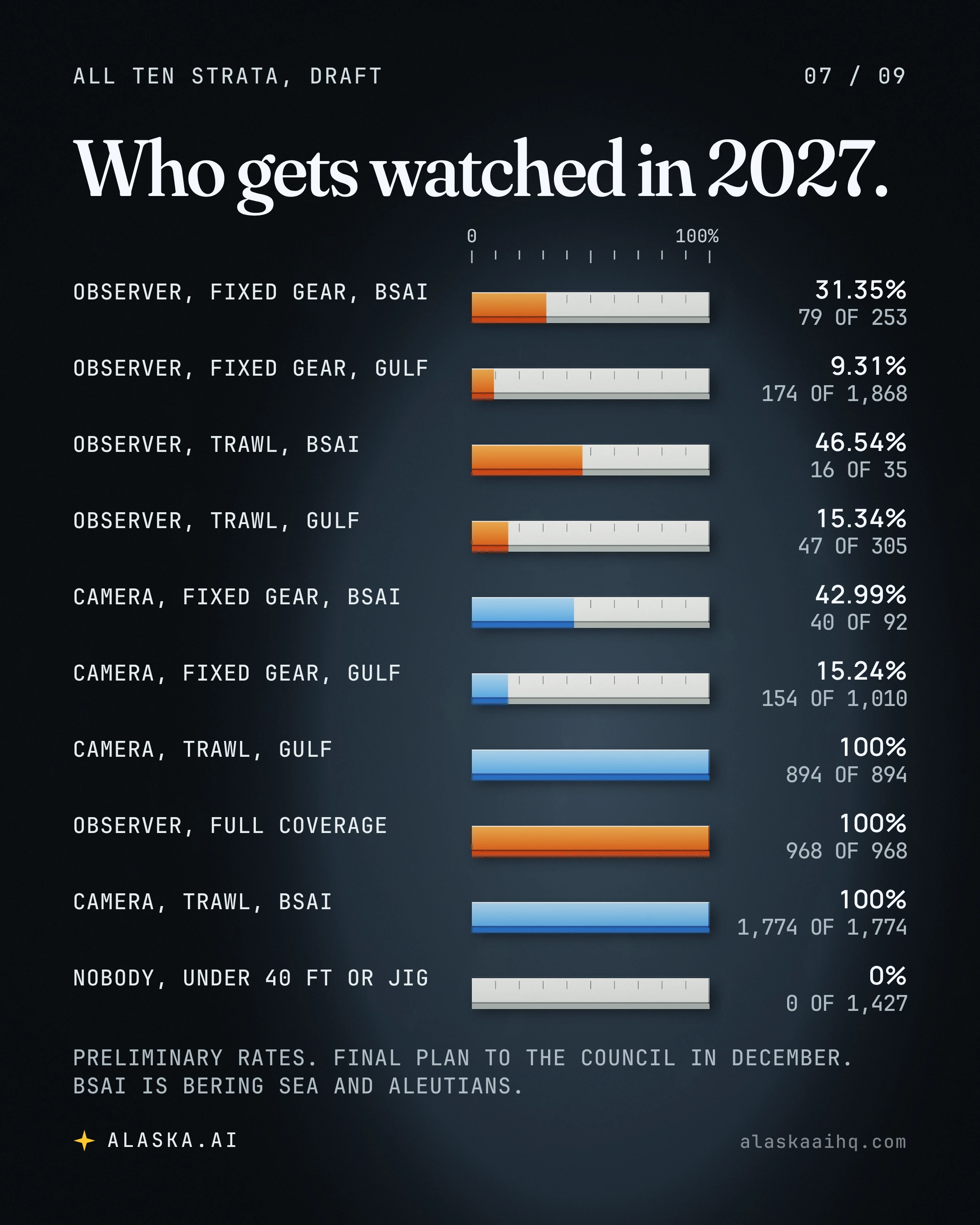
The slides show the budget, draft odds for all ten strata and the AI line as printed.
How much of that $5.45M should reach the AI review line before more cameras go aboard?
What we verified
48 CLAIMS, EACH RE-FETCHED FROM ITS SOURCE BEFORE THIS DECK SHIPPED
NOAA Fisheries posted the Draft 2027 Annual Deployment Plan resource page on November 6th.
The PDF cover of the draft plan is dated September 2026.
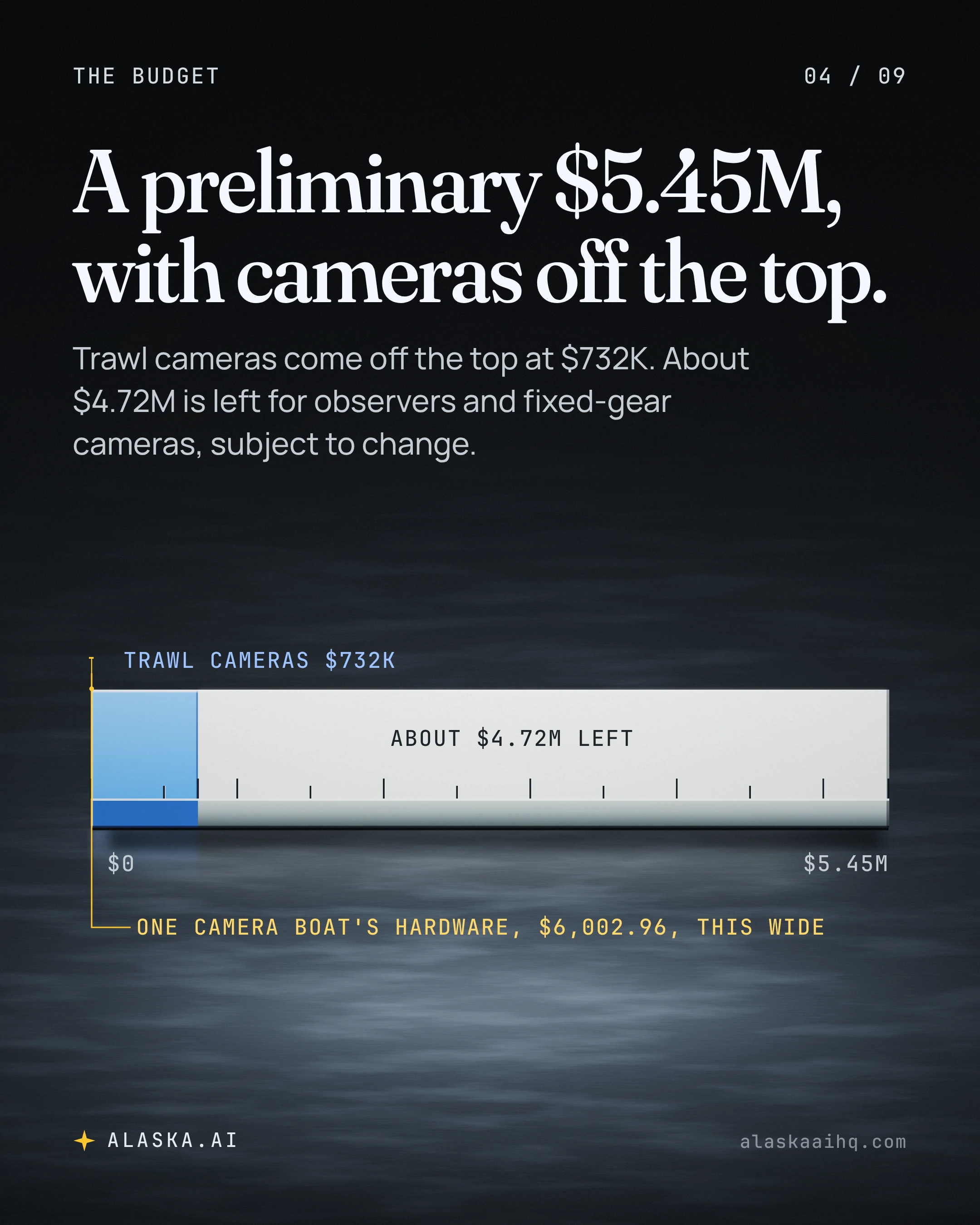
NMFS set a preliminary budget of $5.45M for monitoring the partial coverage fisheries in 2027.
The preliminary budget includes 2025 ex-vessel fee revenue, estimated 2026 ex-vessel fees and any federal funds secured for monitoring.
NMFS estimated trawl EM would cost $732K and deducted it from the $5.45M budget first.
About $4.72M remains to deploy at-sea observers and fixed-gear EM after the trawl EM deduction.
NMFS lists a sharp increase in travel costs and other inflationary pressures in 2026 as a source of budget uncertainty.
Since 2023 Congressional Directed Spending funds went directly to the Pacific States Marine Fisheries Commission for new EM installations and equipment replacements.
The Congressional Directed Spending funds are expected to run out by the end of 2026, so EM equipment installation and replacement costs now sit in the 2027 ADP budget.
The North Pacific Observer Program monitors a fleet of nearly a thousand vessels.
The fleet fishes across an Alaska Exclusive Economic Zone of roughly 3.77 million square kilometers.
NMFS expects to monitor 2,742 trips in the full coverage component in 2027.
The full coverage component is estimated at 16,374 monitored days in 2027.
NMFS expects to monitor 1,404 trips in the partial coverage component in 2027.
The partial coverage component is estimated at 4,408 monitored days in 2027.
The at-sea observer fixed-gear BSAI stratum has a draft selection rate of 31.35 percent, with 79 of an expected 253 trips monitored.
The at-sea observer fixed-gear GOA stratum has a draft selection rate of 9.31 percent, with 174 of an expected 1,868 trips monitored.
The at-sea observer trawl BSAI stratum has a draft selection rate of 46.54 percent, with 16 of an expected 35 trips monitored.
The at-sea observer trawl GOA stratum has a draft selection rate of 15.34 percent, with 47 of an expected 305 trips monitored.
The EM fixed-gear BSAI stratum has a draft selection rate of 42.99 percent, with 40 of an expected 92 trips monitored.
The EM fixed-gear GOA stratum has a draft selection rate of 15.24 percent, with 154 of an expected 1,010 trips monitored.
All 894 expected EM trawl GOA trips get at-sea EM compliance monitoring, and about 298 deliveries get dockside biological sampling at a one in three rate.
The full coverage observer stratum expects 968 trips in 2027, all monitored.
The full coverage EM trawl BSAI stratum expects 1,774 trips in 2027, all monitored.
The no-selection stratum expects 1,427 trips in 2027 with a zero percent selection rate.
The no-selection pool covers vessels under 40 feet length overall and vessels fishing jig gear, which have no chance of carrying an observer or EM system in 2027.
NMFS will run 6 selection pools and 10 sampling strata in 2027.
Starting in 2028, fixed-gear EM vessels with at least three years in the pool must complete at least nine trips over the latest three years to stay in it.
Vessels that miss the minimum effort rule are automatically moved into the at-sea observer pool.
For 2027 a vessel re-enters the EM pool after logging 15 trips in the last 3 years in the at-sea observer pool.
Of 172 vessels in the fixed-gear EM pool for all three years from 2023 to 2025, 39 completed no trips.
The draft lists an AI project titled Scaling AI tools to Modernize Data Collections and Analytical Practices of Electronic Monitoring Videos among EM development projects for 2027.
NMFS says it intends to support the listed EM development projects in 2027 pending availability of staff resources.
The Council recommended keeping the fixed-gear EM selection pool at up to 181 vessels for the 2027 ADP.
NMFS estimated the recurring annual equipment cost per fixed-gear EM vessel at $6,002.96.
NMFS calculates average EM video review cost by dividing a full year's video review spending by the number of hard drives reviewed.
NMFS will present the final 2027 ADP to the North Pacific Fishery Management Council in December 2026.
The North Pacific Fishery Management Council meets November 30th through December 9th in Anchorage.
The final 2026 ADP set a partial coverage budget of $4.75M for EM and observer deployment.
An independent expert panel reviewed the ADP design in 2026 and made no recommendations to change the core ADP for 2027.
The full coverage fleet is served by three NMFS-permitted observer providers, two EM hardware providers and one EM review provider.
The EM trawl BSAI stratum has been planned at 100 percent at-sea EM compliance every year from 2023 through 2027.
KTUU reported in August 2025 that the Alaska Longline Fishermen's Association received a $485,000 National Fish and Wildlife Foundation grant to develop AI for electronic monitoring.
ALFA policy coordinator Lauren Howard told KTUU that 'We have a 3% cap on our cost recovery.'
The News-Miner reported that the Fairbanks North Star Borough Planning Commission unanimously recommended a data center moratorium.
The News-Miner reported that the commission lengthened the recommended moratorium to 18 months from the 12 months the borough administration requested.
The News-Miner reported that GU-1 general use zoning covers about 97 percent of the borough.
Planning Commissioner Eric Muehling said 'I'm hearing anxiety from people over AI in general.'
Beats
This article is on Defense and federal AI in Alaska · Alaska AI research and science. Each beat page keeps every decision and every article on that subject in one place.