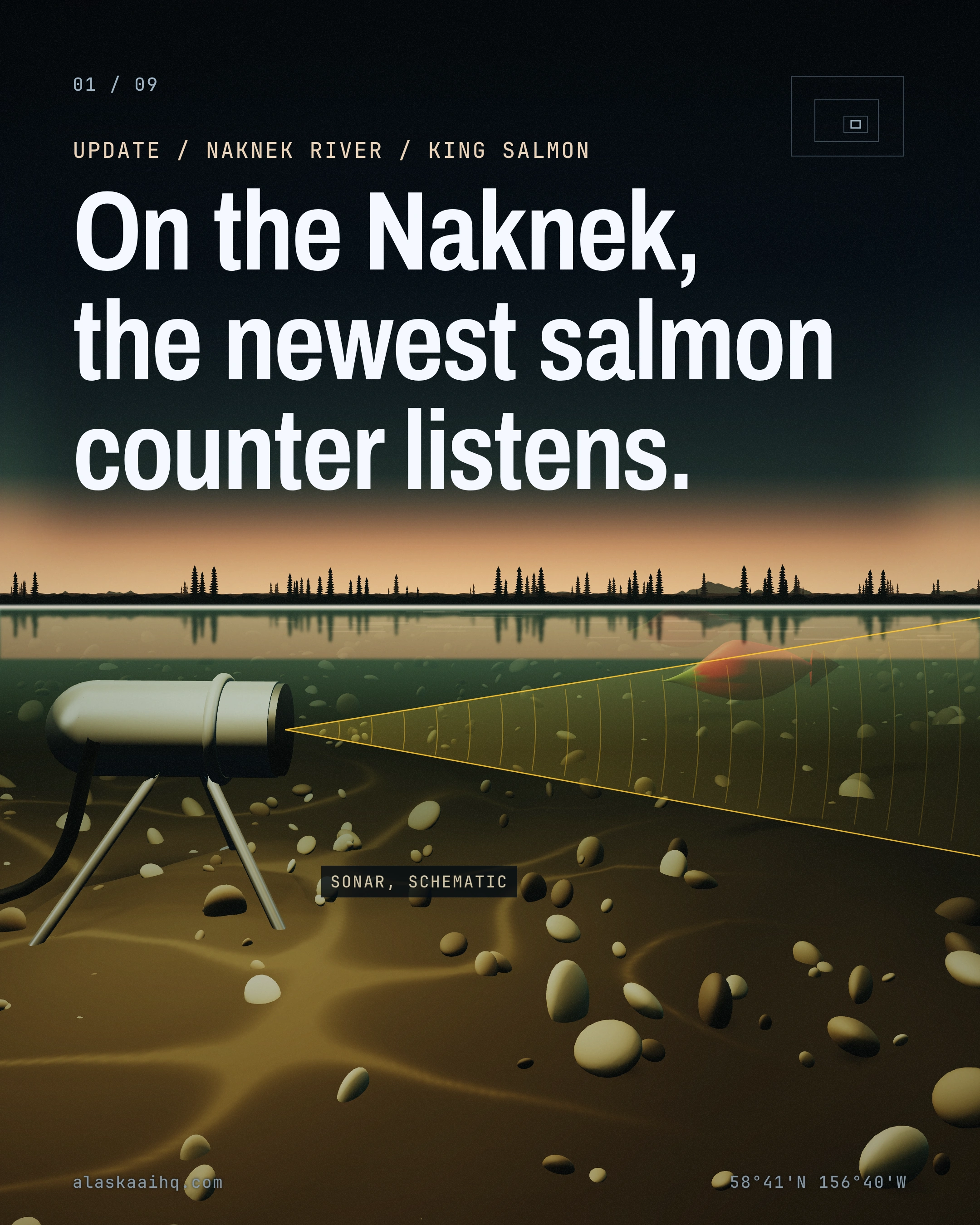
UPDATE. Bristol Bay's newest salmon counter listens
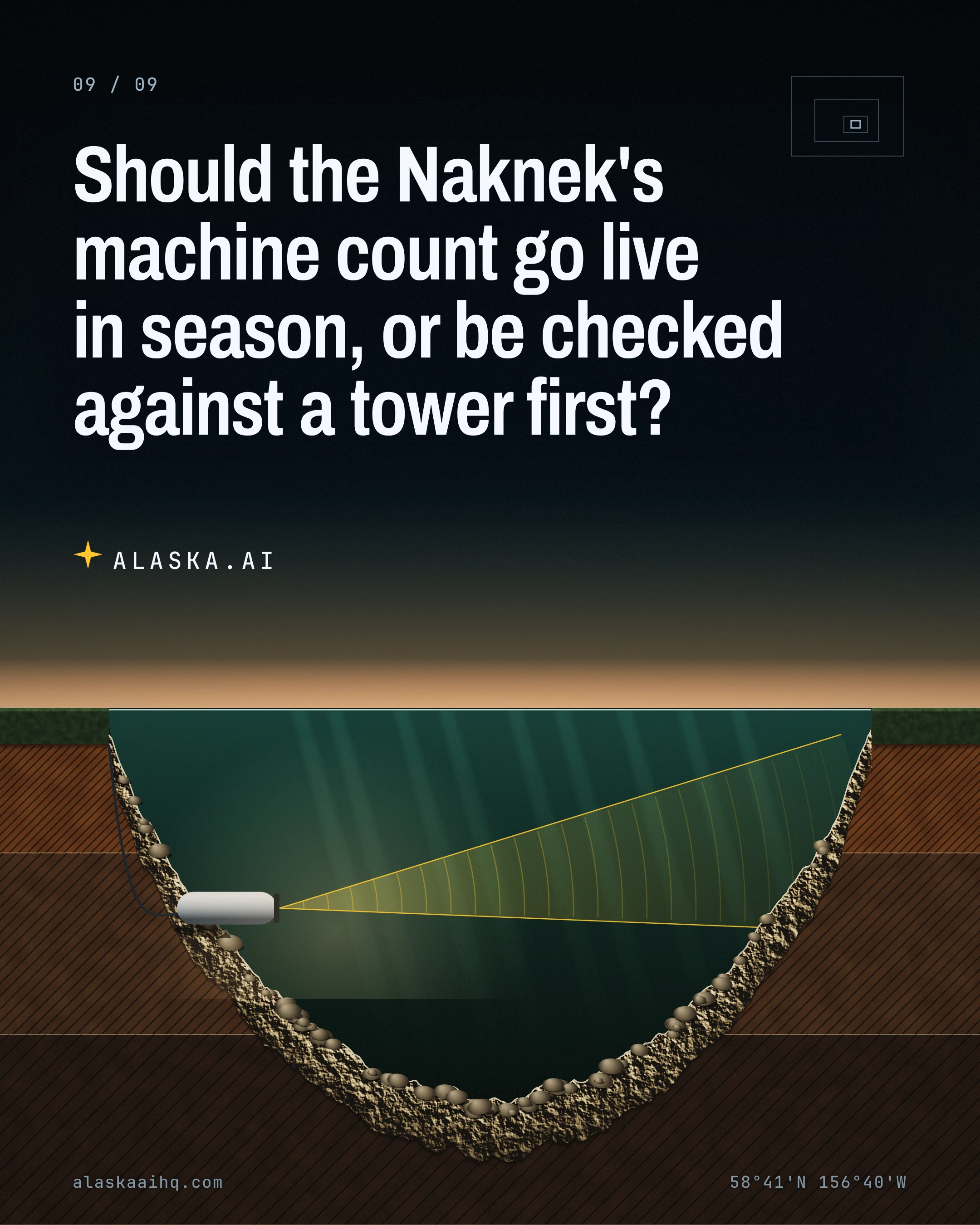
On the Wood River a person on a tower clicks each passing salmon by hand, and on the Naknek near King Salmon a sonar will listen.
The deck
SWIPE, SCROLL OR CLICK A SLIDE TO GO FULLSCREEN · 9 SLIDES
The story
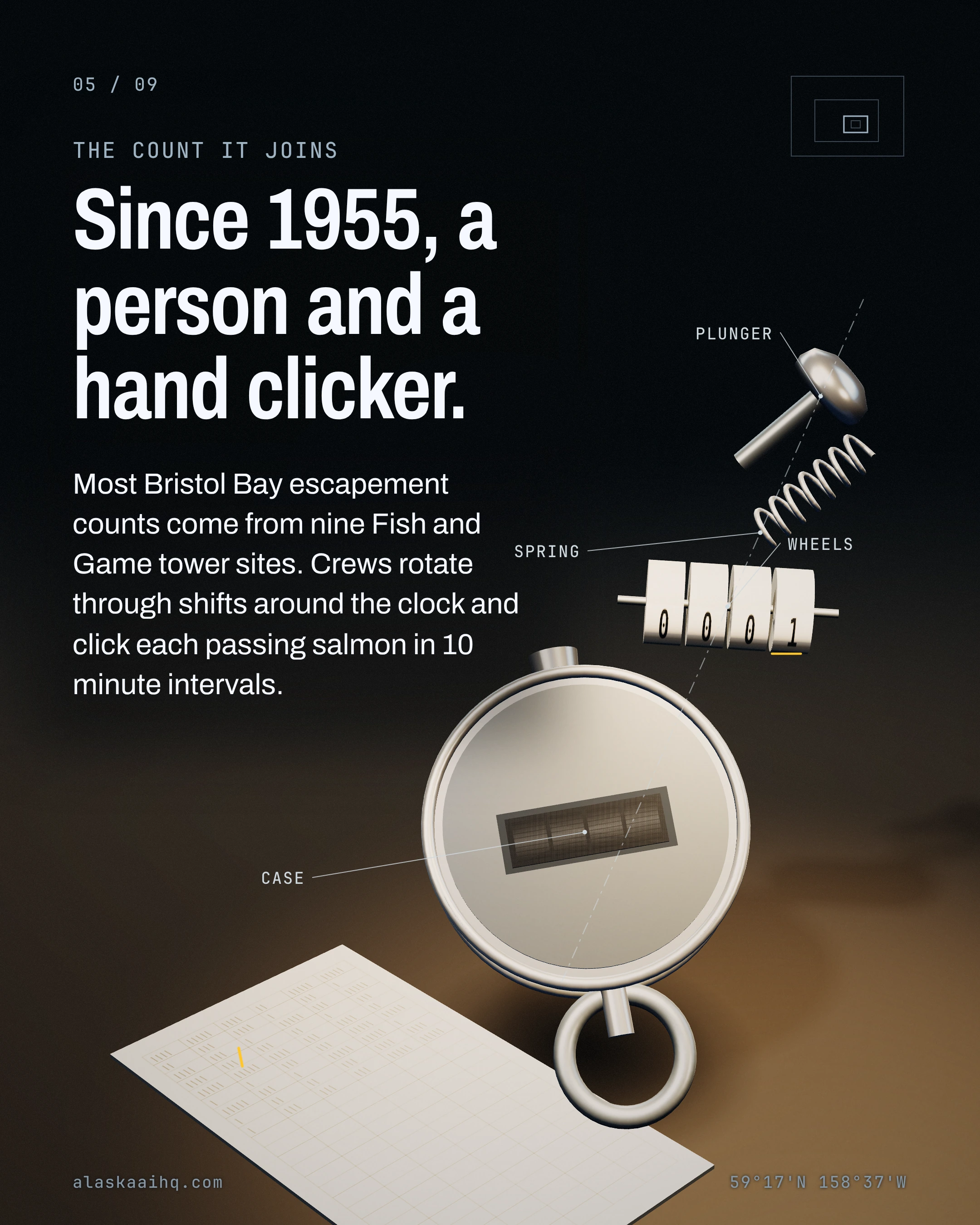
The tower count goes back to 1955. Crews at nine Fish and Game sites click in 10 minute intervals around the clock.
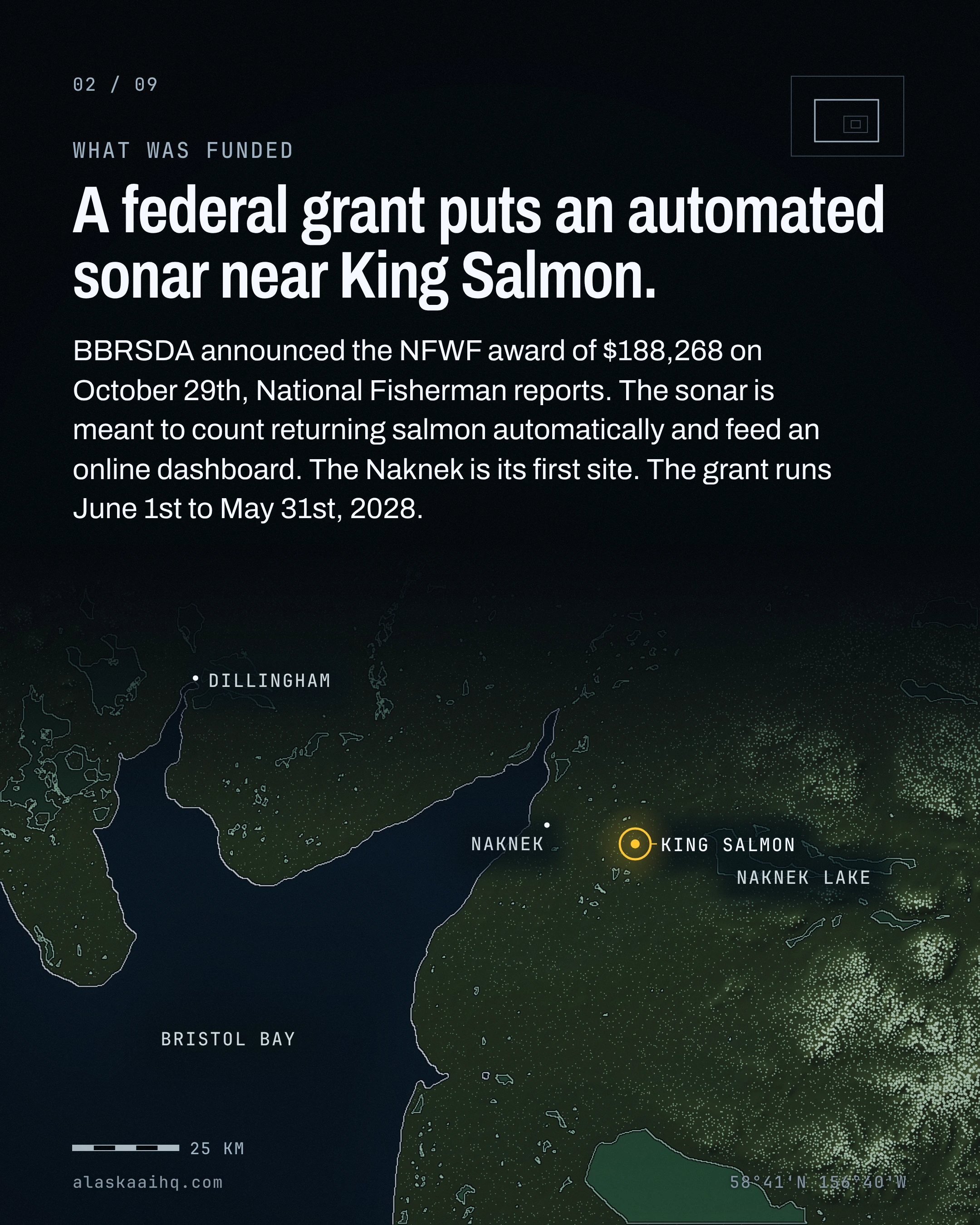
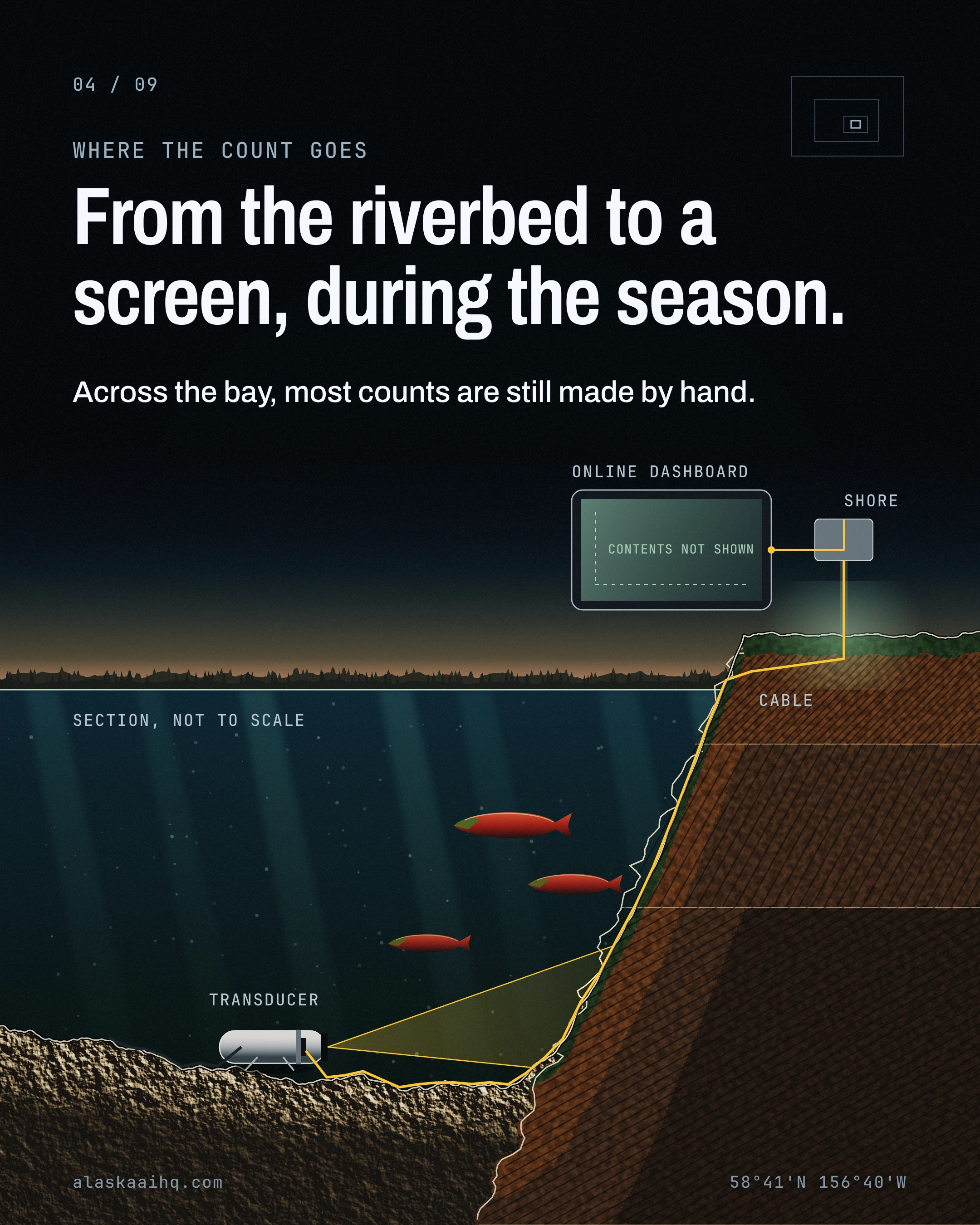
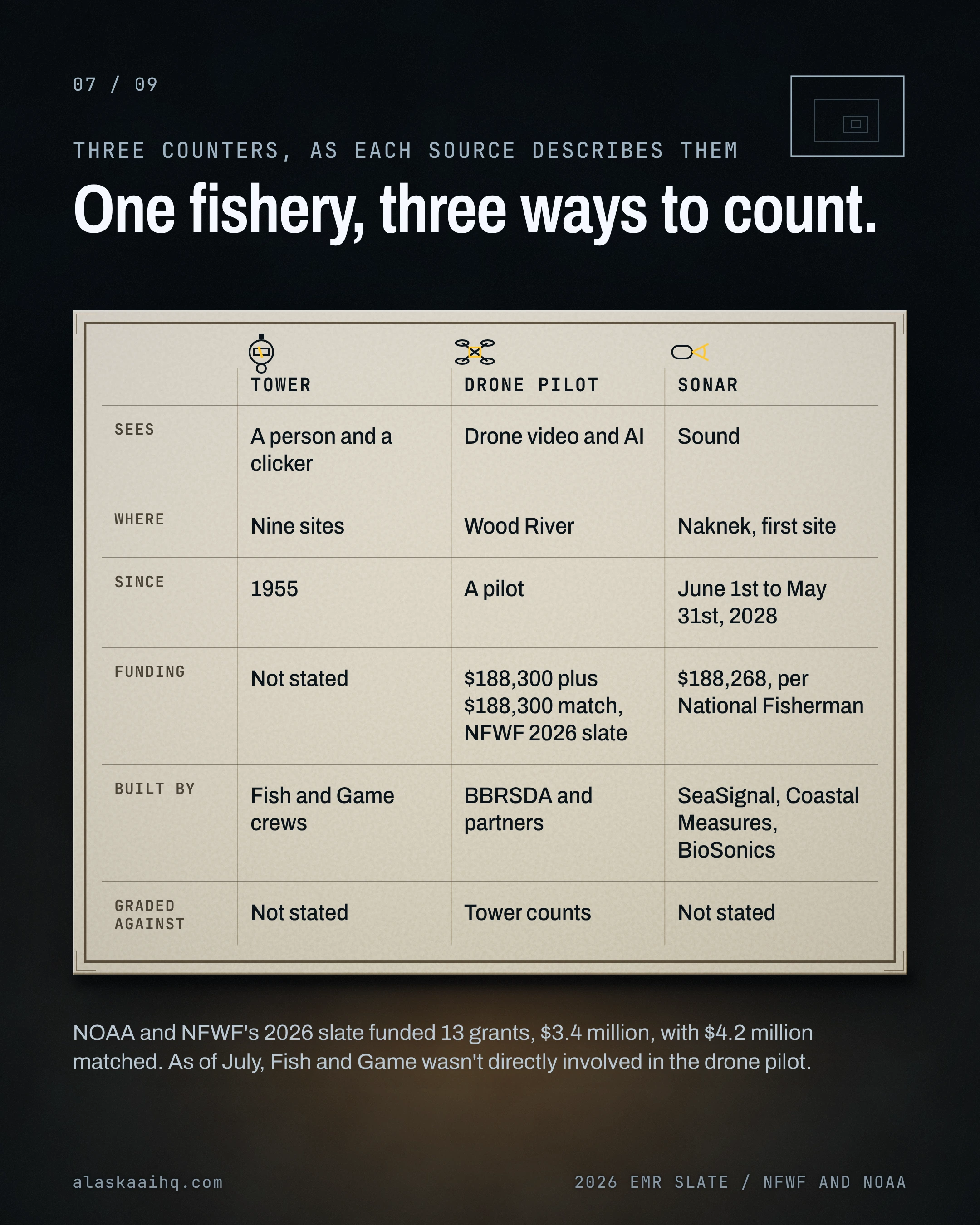
The sonar is new. BBRSDA announced a $188,268 NFWF award on October 29th, National Fisherman reports. It is meant to count returning salmon automatically and feed an online dashboard.
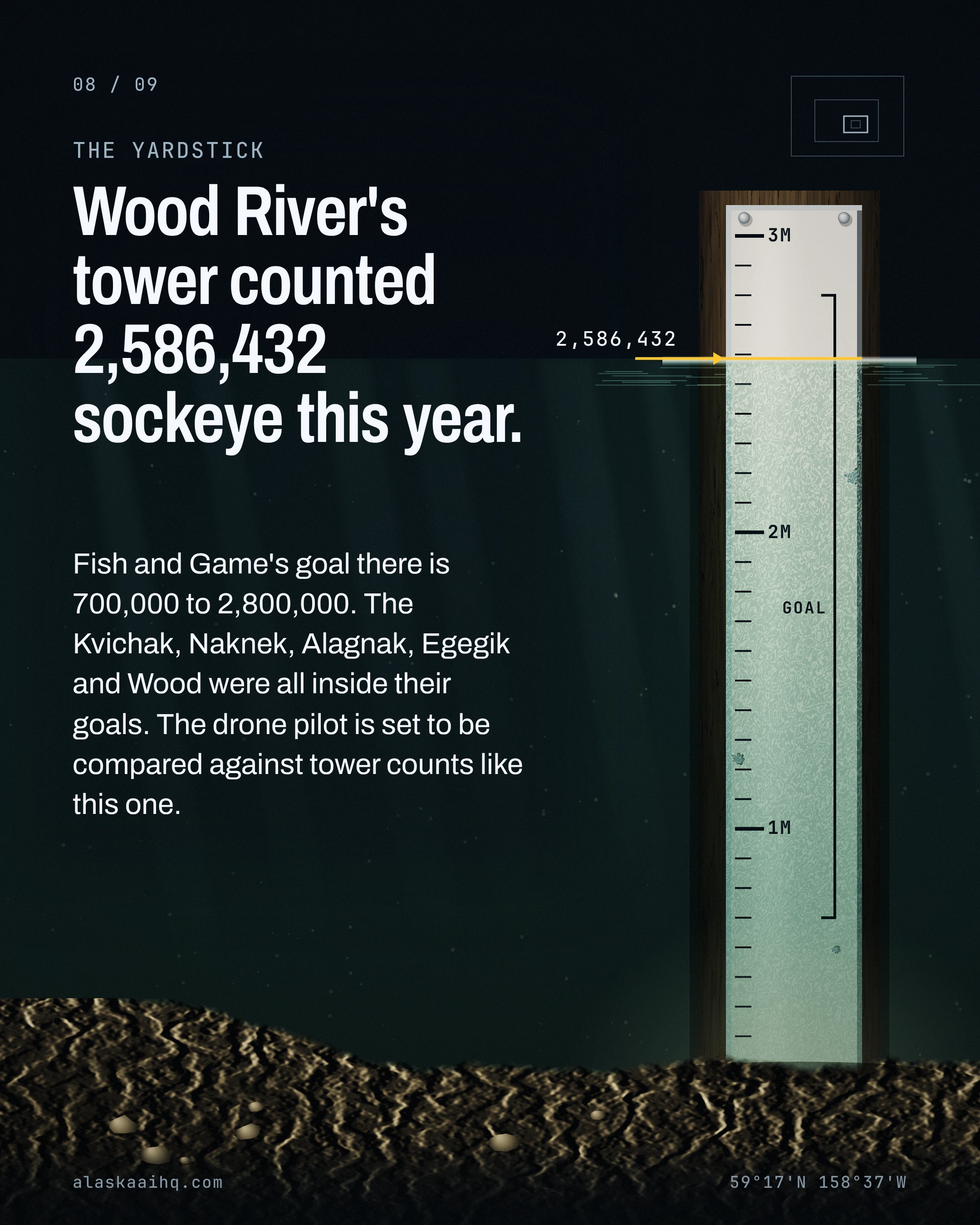
The Wood tower's 2,586,432 sockeye this year sat inside the river's goal.
What the grant funds and where. How the sonar listens across the river and the clicker count it joins. The 2026 run drawn as marks, the three counters side by side and the Wood River tower count against its goal.
If you fish or buy fish on the Naknek, would you trust an in-season machine count before anyone grades it against a tower?
What we verified
53 CLAIMS, EACH RE-FETCHED FROM ITS SOURCE BEFORE THIS DECK SHIPPED
NOAA and NFWF awarded thirteen new Electronic Monitoring and Reporting grants in the 2026 slate.
The 2026 EMR grants totaled $3.4 million.
The 2026 EMR awards leveraged $4.2 million in matching contributions from grantees.
The 2026 EMR slate has a total conservation impact of $7.6 million.
The 2026 EMR slate lists a $188,300 grant to the Bristol Bay Regional Seafood Development Association.
The BBRSDA drone project lists $188,300 in matching funds.
The BBRSDA drone project's total amount is $376,600.
The NFWF project is titled Using Unmanned Aerial Vehicles with AI Video Processing to Improve Salmon Counts in Bristol Bay.
The NFWF-funded pilot uses drone video and AI video processing to improve sockeye escapement counts in the Wood River system.
The drone project will compare its results against traditional methods such as visual tower counts.
The 2026 EMR slate also funds the Alaska Department of Fish and Game with $294,900 for a charter electronic logbook app.
The 2026 EMR slate funds the Alaska Sustainable Fisheries Trust with $293,600 for electronic logbooks in the Southeast Alaska troll fishery.
NFWF announced the $3.4 million in EMR grants on April 9th.
The EMR grant program is a partnership between NFWF and NOAA Fisheries.
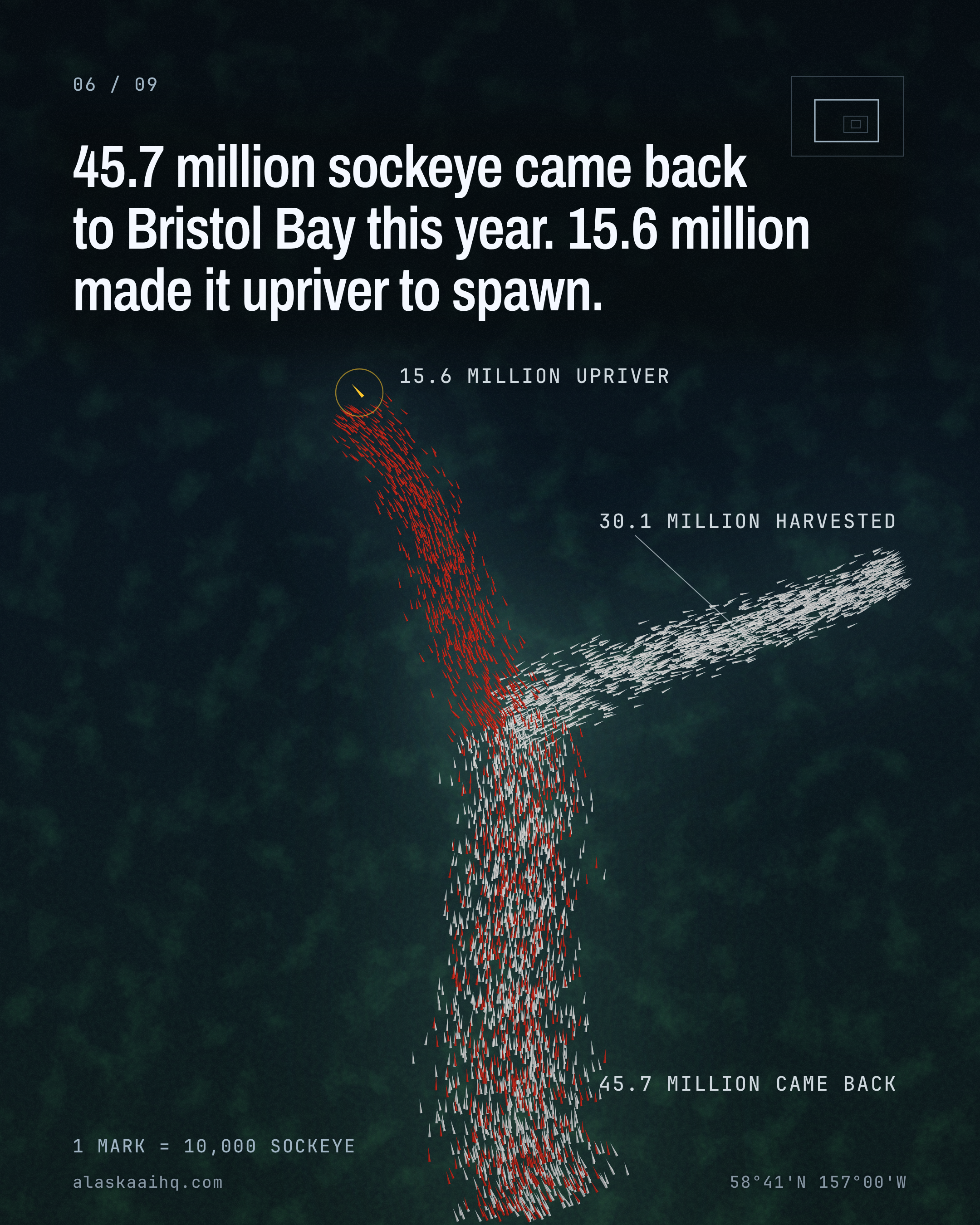
The 2026 inshore Bristol Bay sockeye run was 45.7 million fish.
The 2026 inshore run was 8% below the 49.6 million average of the latest 20 years.
2026 was the first year since 2014 that the Bristol Bay inshore run was under 50 million fish.
Baywide sockeye escapement totaled 15.6 million fish in 2026.
The Wood River sockeye escapement was 2,586,432 fish in 2026.
ADF&G lists the Wood River optimal escapement goal for 2026 as 700,000 to 2,800,000 sockeye.
ADF&G says the Kvichak, Naknek, Alagnak, Egegik and Wood rivers were within their escapement goal ranges in 2026.
The 2026 Bristol Bay commercial sockeye harvest was 30.1 million fish.
The preliminary 2026 exvessel value of all Bristol Bay salmon was $264.0 million.
BBRSDA announced a second grant award from NFWF on October 29th, according to National Fisherman.
National Fisherman reports BBRSDA's NFWF Electronic Monitoring and Reporting grant as $188,268.
The Naknek project will deploy a hydroacoustic sonar system on the Naknek River near King Salmon, according to National Fisherman.
The sonar system is meant to count returning salmon automatically.
The sonar system will feed counts directly into an online dashboard.
The Naknek River will be the sonar system's first deployment site.
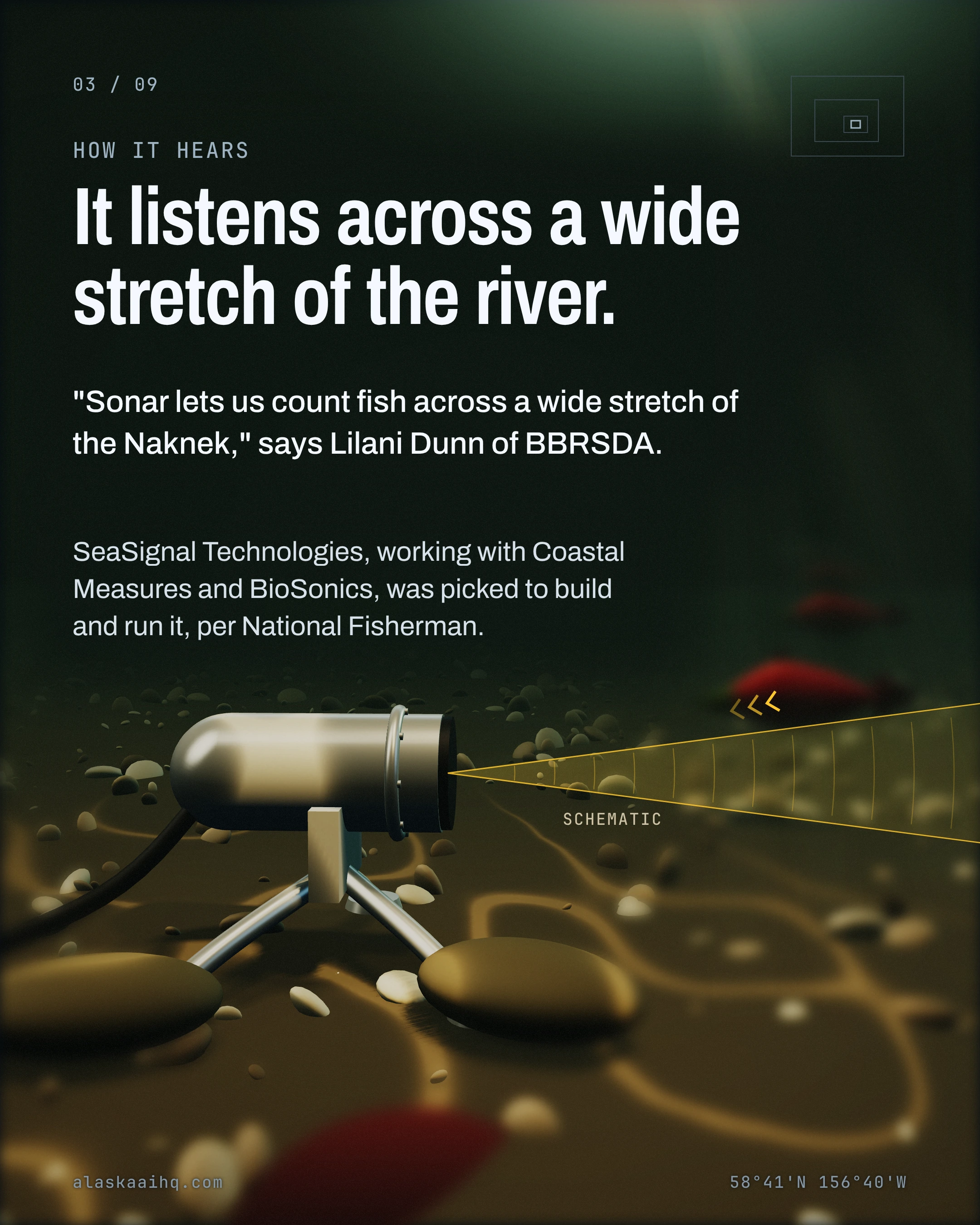
SeaSignal Technologies, working with Coastal Measures and BioSonics, was selected through a competitive process to develop and operate the sonar system.
The NFWF sonar grant period runs from June 1st, 2026 through May 31st, 2028.
BBRSDA also received $499,400 through NOAA Fisheries' Saltonstall-Kennedy grant program.
The Saltonstall-Kennedy project aims to increase demand for wild Alaska sockeye across the U.S. food service industry.
The two BBRSDA grants together total $687,668 in federal investment, according to National Fisherman.
BBRSDA executive director Lilani Dunn said better information during the season means better decisions for everyone who depends on the fishery.
Dunn said sonar lets BBRSDA count fish across a wide stretch of the Naknek.
ADF&G has used counting towers in Bristol Bay for over 70 years.
The department has tracked Bristol Bay salmon escapement with towers since 1955.
Most Bristol Bay escapement counts come from nine Fish and Game counting tower sites.
Fish and Game tower crews rotate through continuous shifts over 24 hours.
Tower crews count each passing salmon with a hand clicker in 10 minute intervals.
Fish and Game was not directly involved in the drone project as of July.
The project's drones fly just downstream of the Wood River towers.
Project lead Norm Van Vactor said of the technology that it is the future.
Team member Ian Chiu said the project will have a computer vision model trained to pick out salmon.
The team will likely need several thousand drone images for the model to reliably identify a fish, KDLG reported.
BBRSDA and the Bristol Bay Economic Development Corporation are named among the partners supporting the drone research.
The crew planned to test its models against Fish and Game tower counting data in the project's next phase.
The Fairbanks North Star Borough Planning Commission approved Mayor Grier Hopkins' proposed moratorium on permits for large-scale data centers.
The commission extended the mayor's proposed 12-month moratorium to 18 months.
The commission extended the administration's research and recommendation deadline from six months to 10.
Hopkins said the assembly vote will likely take place on January 14th.
Hopkins said the borough is researching how to turn the gray area of a data center on Eielson Air Force Base black and white.
Beats
This article is on Alaska AI research and science. Each beat page keeps every decision and every article on that subject in one place.