261 Minutes When No Flight Left Alaska
Flights within Alaska kept flying on November 13th while every flight leaving the state was grounded.
The deck
SWIPE, SCROLL OR CLICK A SLIDE TO GO FULLSCREEN · 9 SLIDES





The story
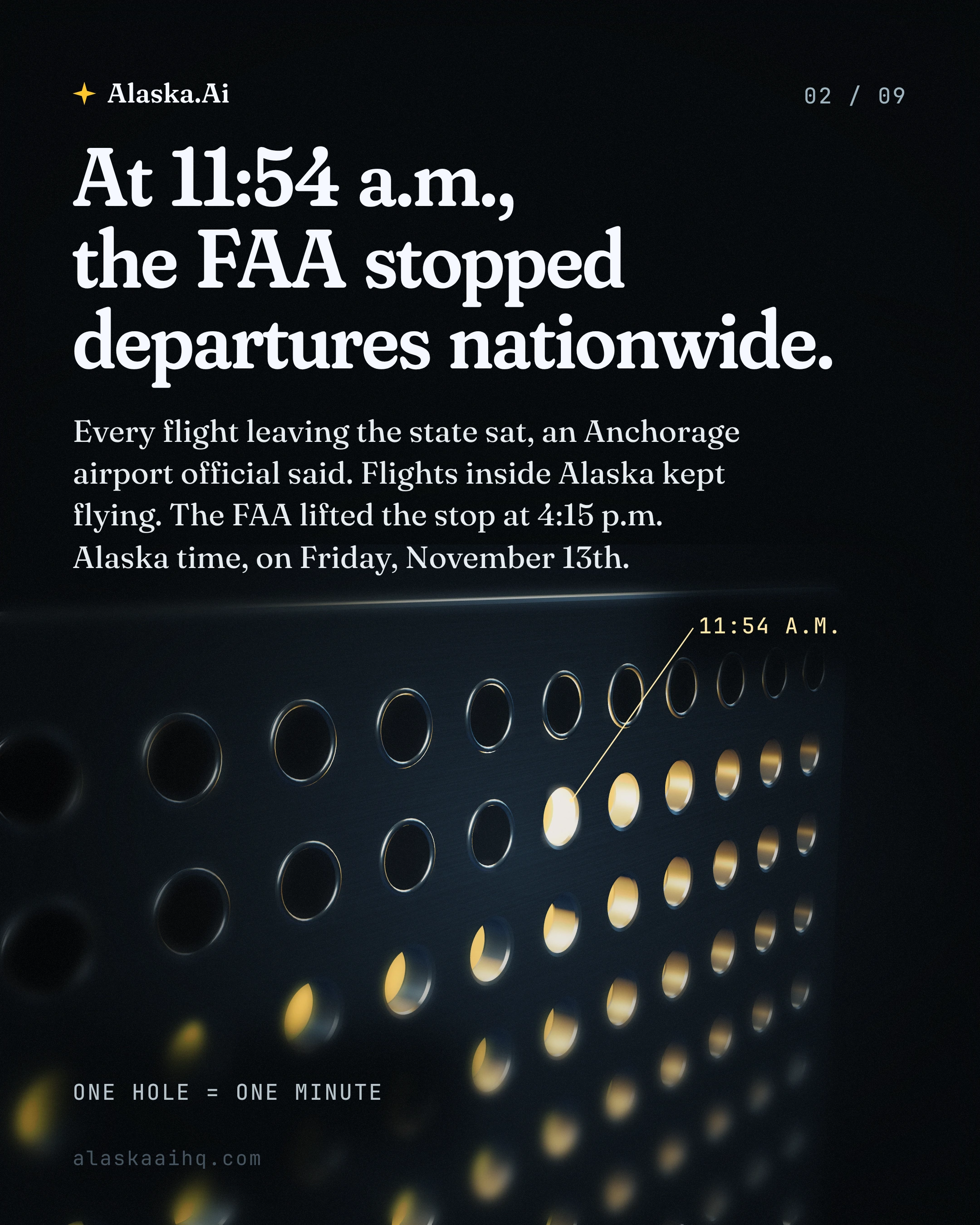
So said an Anchorage airport official. The FAA's nationwide stop ran 11:54 a.m. to 4:15 p.m. Alaska time.
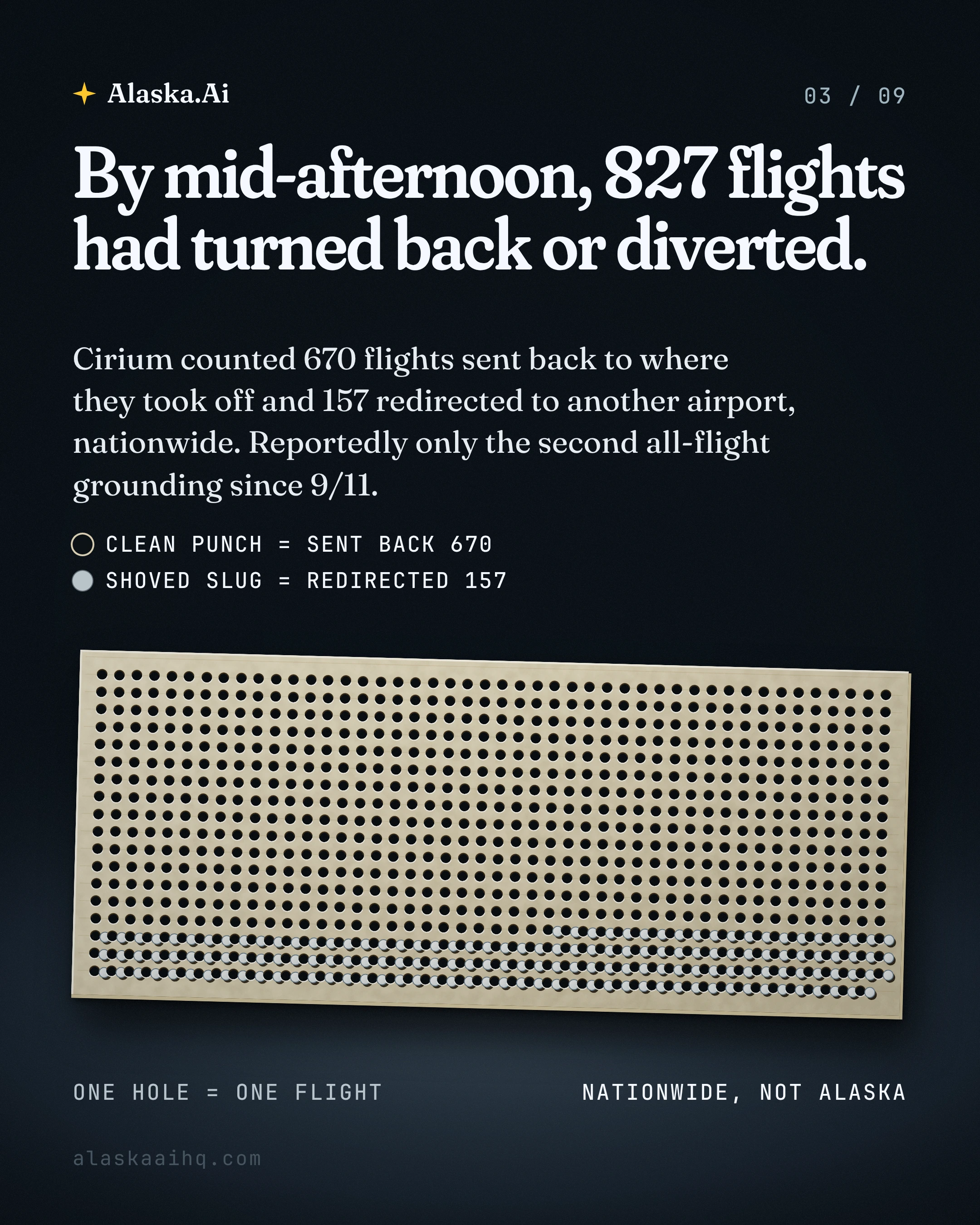
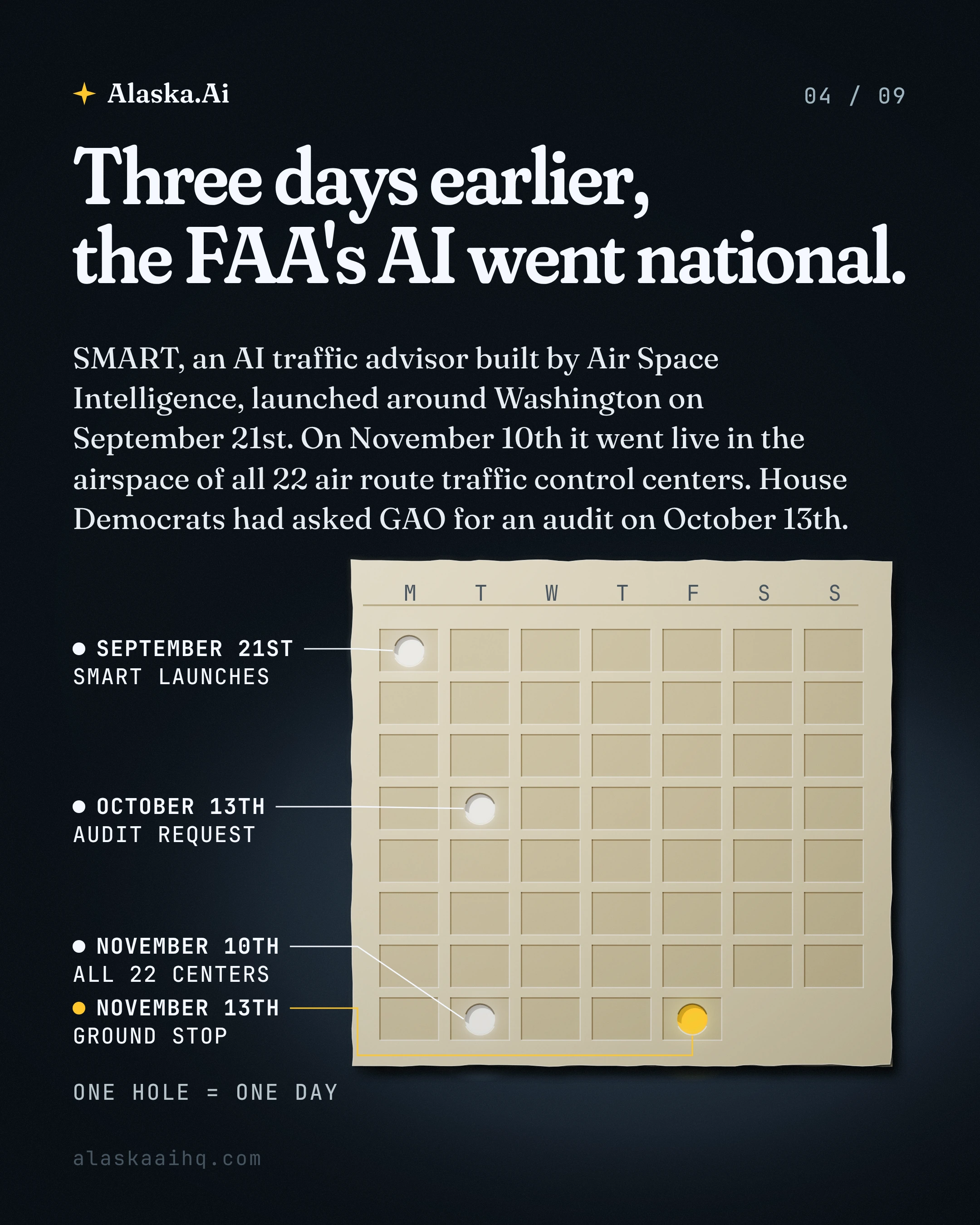
By mid-afternoon Cirium counted 670 flights sent back and 157 redirected nationwide. Three days earlier SMART, the FAA's AI traffic advisor, went national. The FAA blamed a router overloading older equipment. SMART's maker says the stop wasn't a result of its system.
The carousel shows the stop minute by minute, the national toll, SMART's rollout, the stated cause and Anchorage Center's airspace.
Should the next federal dollar go to the AI the FAA credits with 10 minutes per reroute or to the older equipment a router overloaded?
What we verified
35 CLAIMS, EACH RE-FETCHED FROM ITS SOURCE BEFORE THIS DECK SHIPPED
Alaska Airlines was the first airline worldwide to adopt Air Space Intelligence's Flyways technology, announced in May 2021.
Alaska Airlines said Flyways enabled it to save 480,000 gallons of fuel during its trial.
In the trial, Flyways found an opportunity to reduce miles and fuel use for 64 percent of Alaska's mainline flights.
Alaska Airlines dispatchers evaluated and accepted 32 percent of Flyways recommendations in the trial.
The FAA says there are twenty-one air route traffic control centers in the continental United States.
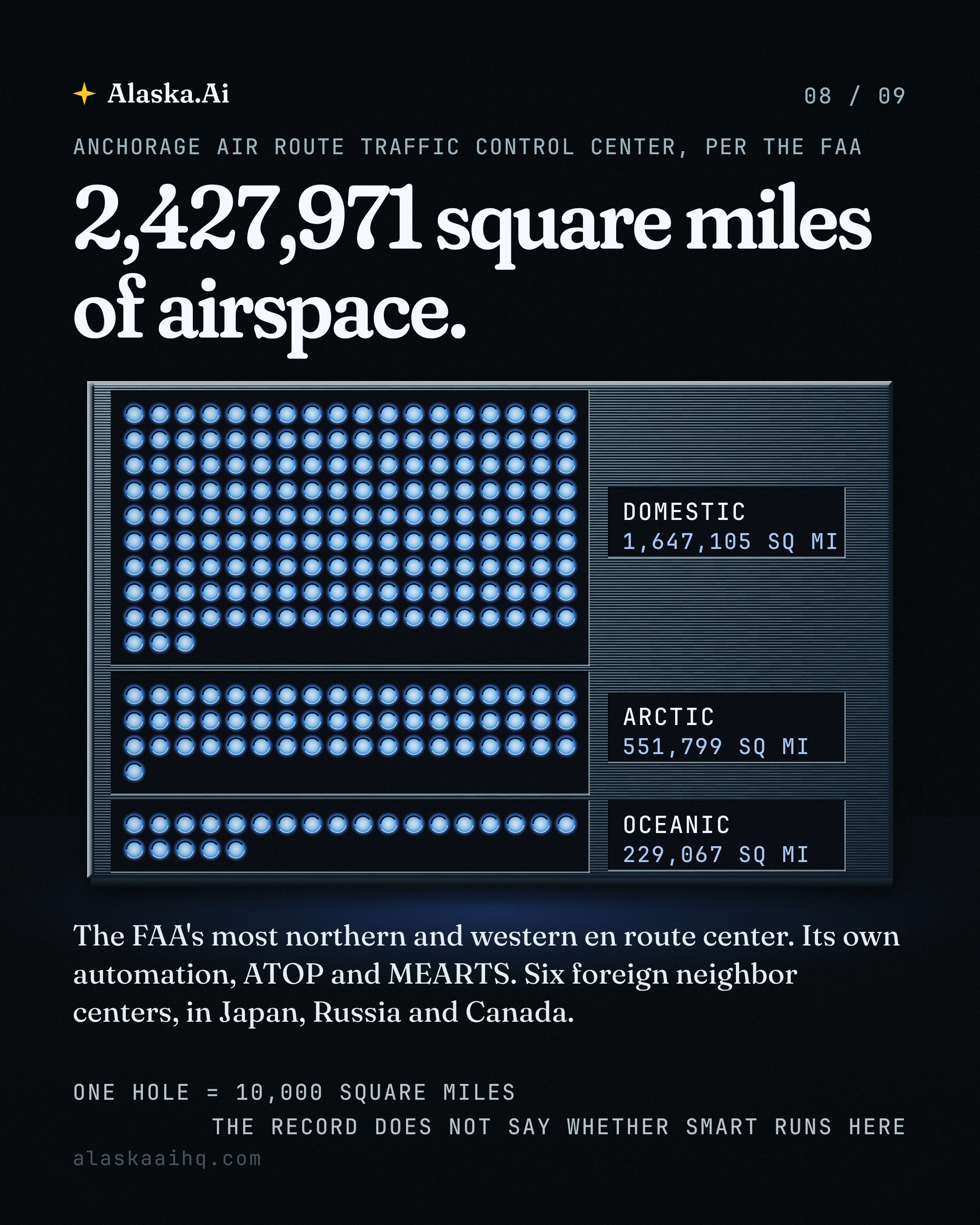
Anchorage ARTCC is the FAA's most northern and western en-route center and one of three FAA-designated Oceanic centers.
Anchorage ARTCC's airspace spans three flight information regions totalling 2,427,971 square miles.
The Anchorage Domestic flight information region covers 1,647,105 square miles.
The Anchorage Oceanic flight information region covers 229,067 square miles.
The Anchorage Arctic flight information region covers 551,799 square miles.
Anchorage ARTCC operates two separate automation platforms, ATOP and MEARTS/FDP.
Anchorage ARTCC's airspace includes more military airspace than any other ARTCC.
Anchorage ARTCC works with six international area control centers, in Japan, Russia and Canada.
The FAA's SMART AI system is now active in the airspace of all of the nation's air route traffic control centers, 22 in all.
SMART was expanded nationwide on November 10th for the airspace of all 22 air traffic control centers.
The startup Air Space Intelligence designed the SMART system.
SMART was developed under a broader $875 million contract awarded to Air Space Intelligence in June.
The Air Space Intelligence contract behind SMART runs 12 years, according to AVweb.
SMART launched on September 21st in the airspace around Reagan National, Washington Dulles and Baltimore/Washington International airports.
The FAA says SMART has helped reroute 180 flights.
According to the FAA, rerouted flights saved an average of 10 minutes each.
According to the FAA, rerouted flights saved nearly 80 gallons of fuel each on average.
SMART centralizes 200 data streams, including weather patterns, flight paths and traffic flow.
House Democrats sent the Government Accountability Office a letter dated October 13th requesting an audit of the SMART software.
Homeland Security Secretary Markwayne Mullin said there was no indication the communications issues behind the ground stop were linked to the new computer system.
The FAA's nationwide ground stop order came out at 11:54 a.m. Alaska time on November 13th.
An official with Ted Stevens Anchorage International Airport said all flights going outside the state were grounded.
Flights traveling within Alaska were not affected by the ground stop, according to an Anchorage airport official.
Cirium reported 670 flights sent back to the airports they took off from, as of mid-afternoon Alaska time.
Cirium reported 157 flights redirected to a different airport during the ground stop.
The November 13th stoppage was reportedly only the second time since 9/11 that all flights nationwide were grounded.
The FAA issued the nationwide ground stop at 3:54 p.m. Eastern time.
The FAA lifted the ground stop at 8:15 p.m. Eastern time.
The FAA said a router sent too much data, overloading older air traffic control equipment.
Air Space Intelligence said the ground stop was not based on or a result of the SMART system.
Beats
This article is on Defense and federal AI in Alaska. Each beat page keeps every decision and every article on that subject in one place.