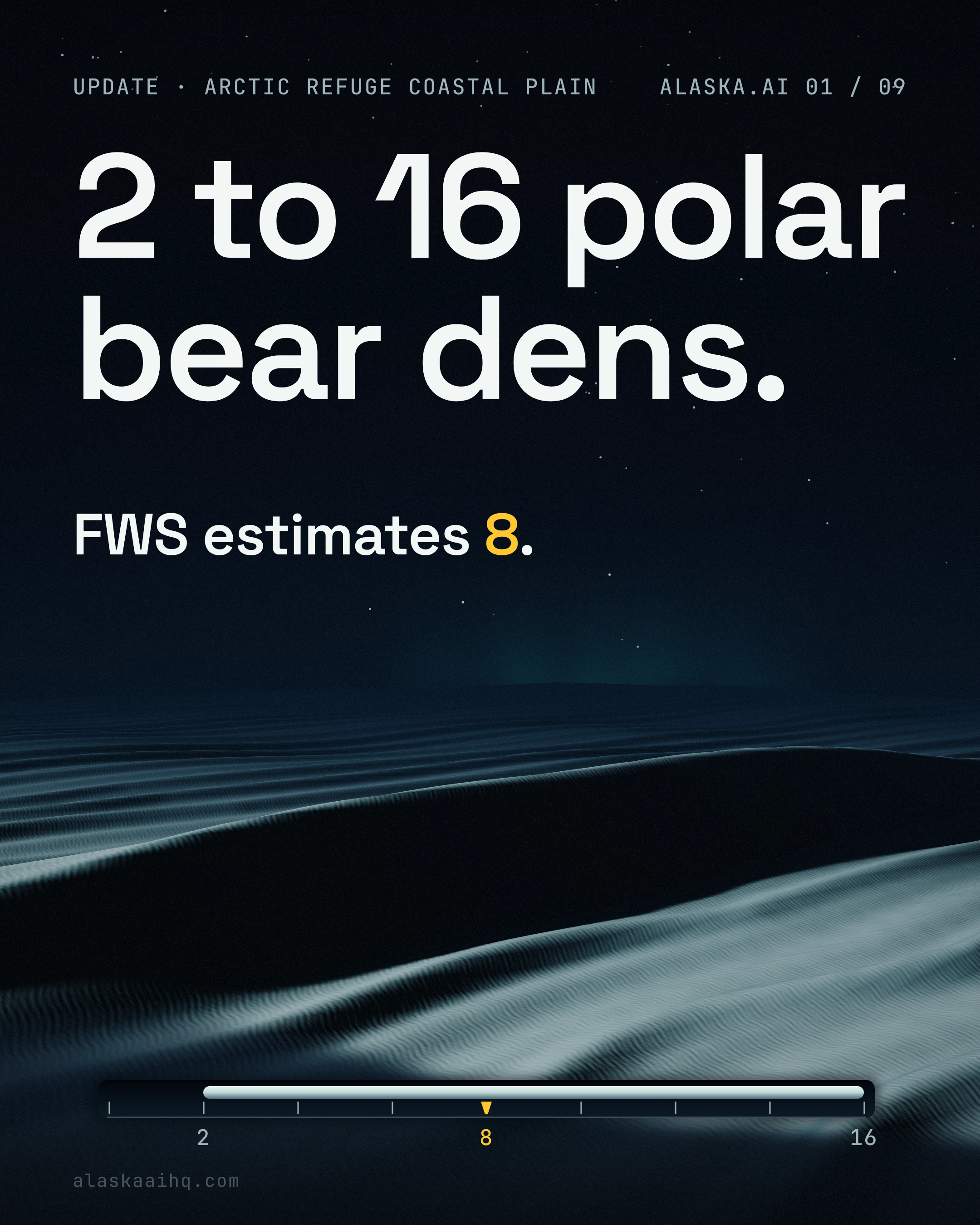
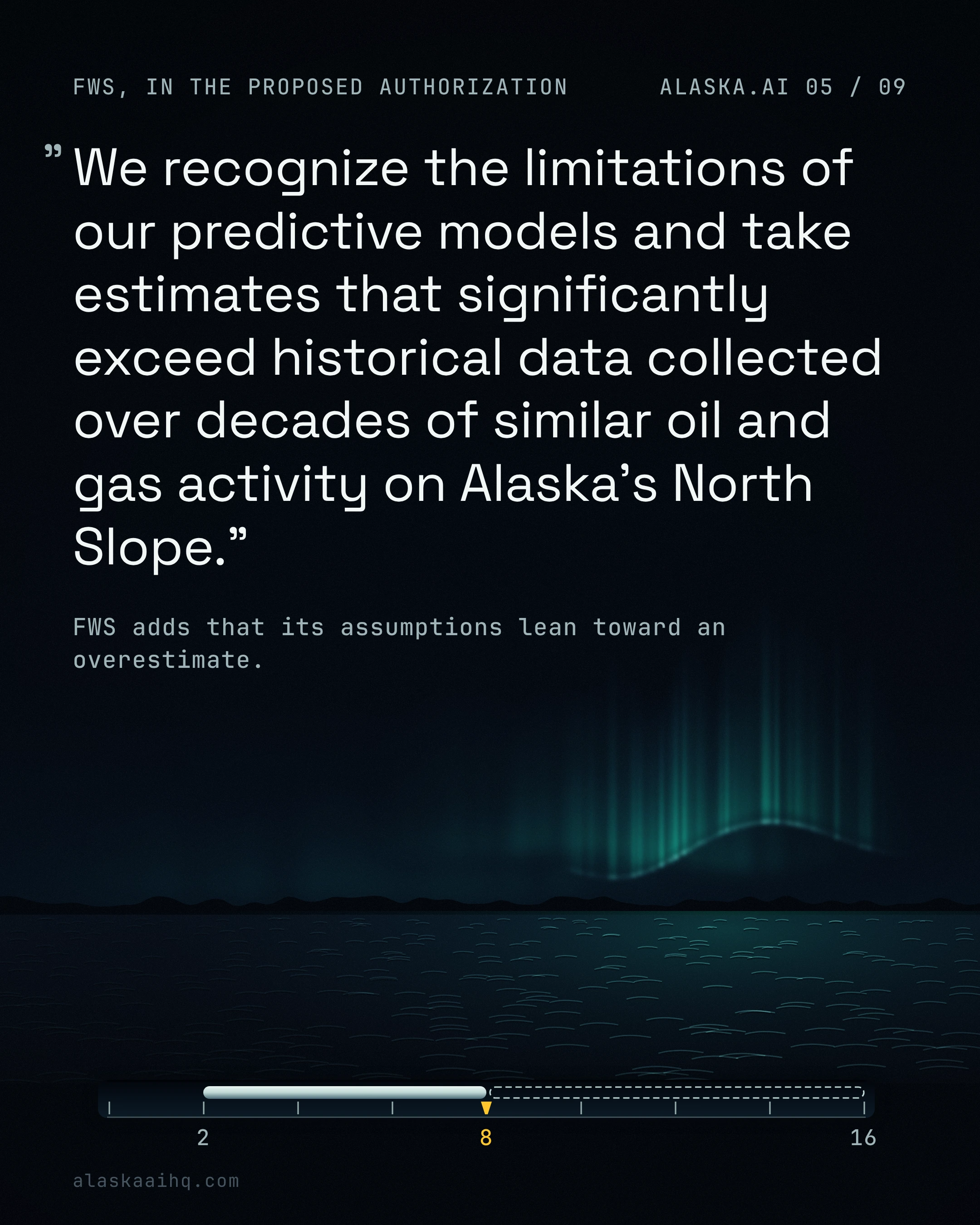
2 to 16 polar bear dens, and FWS estimates 8
The proposed terms for infrared polar bear den flights over the Arctic Refuge list last winter's dates.
The deck
SWIPE, SCROLL OR CLICK A SLIDE TO GO FULLSCREEN · 9 SLIDES

The story
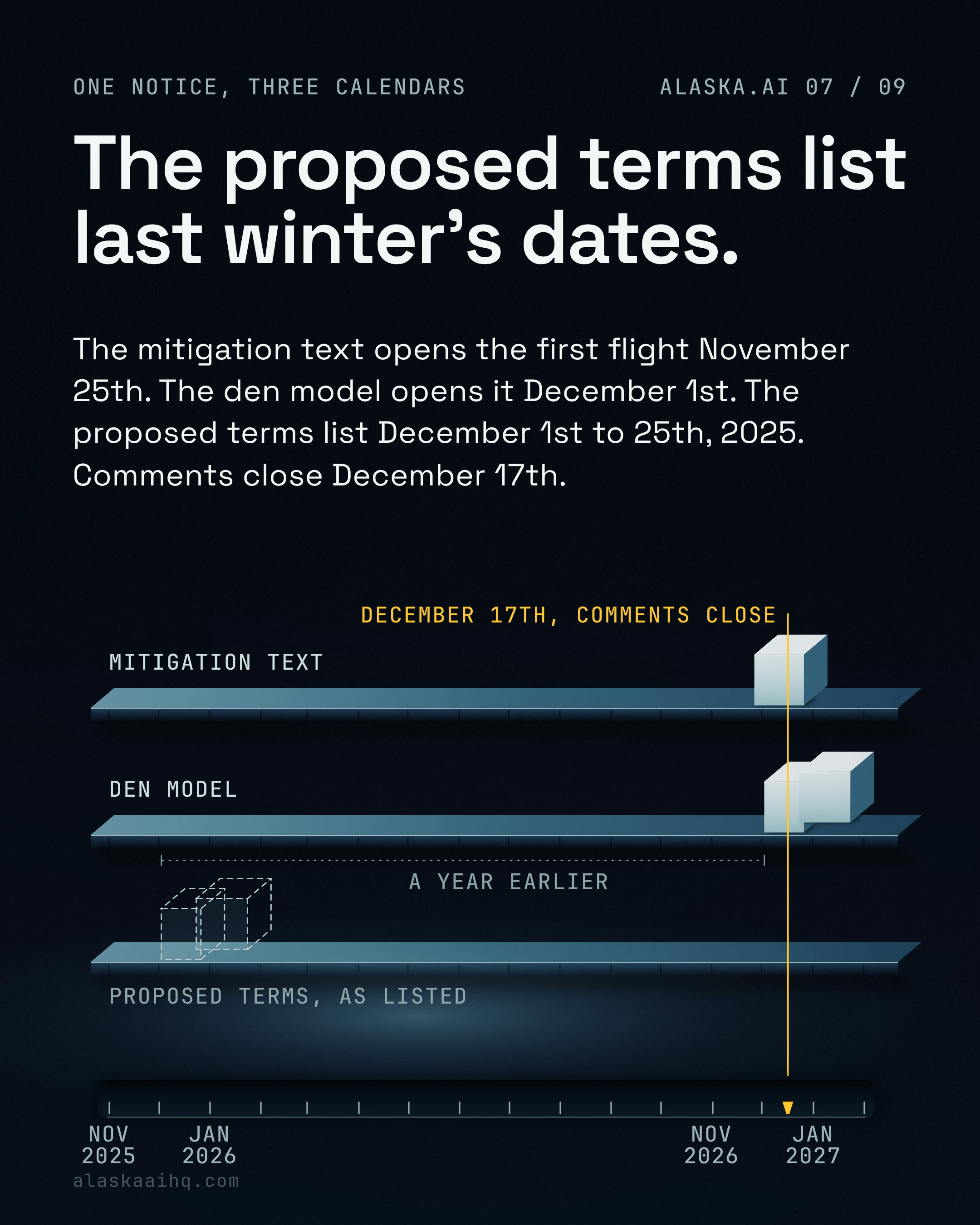
The first window runs December 1st to 25th, 2025. The den model in the same notice sets them this winter.
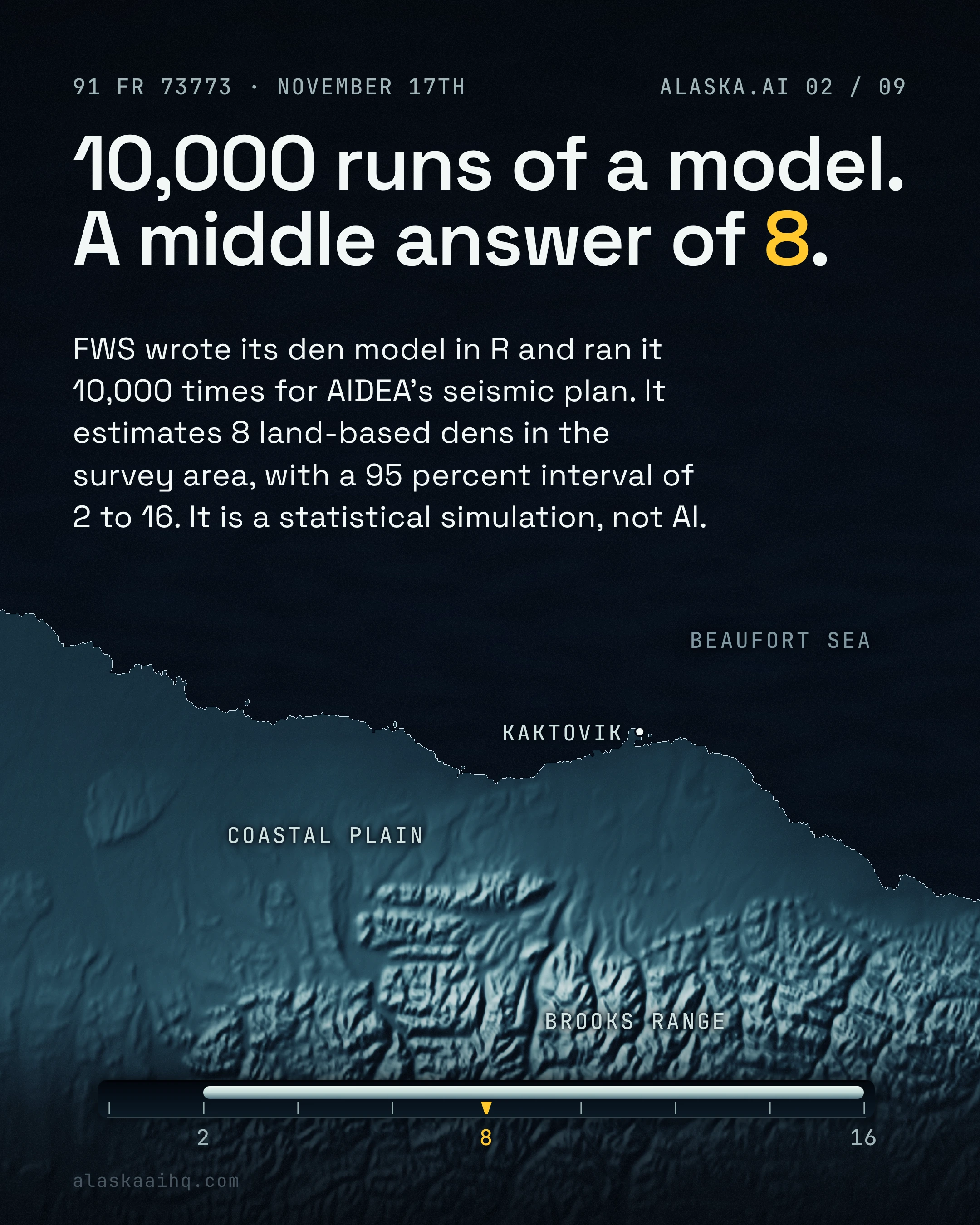
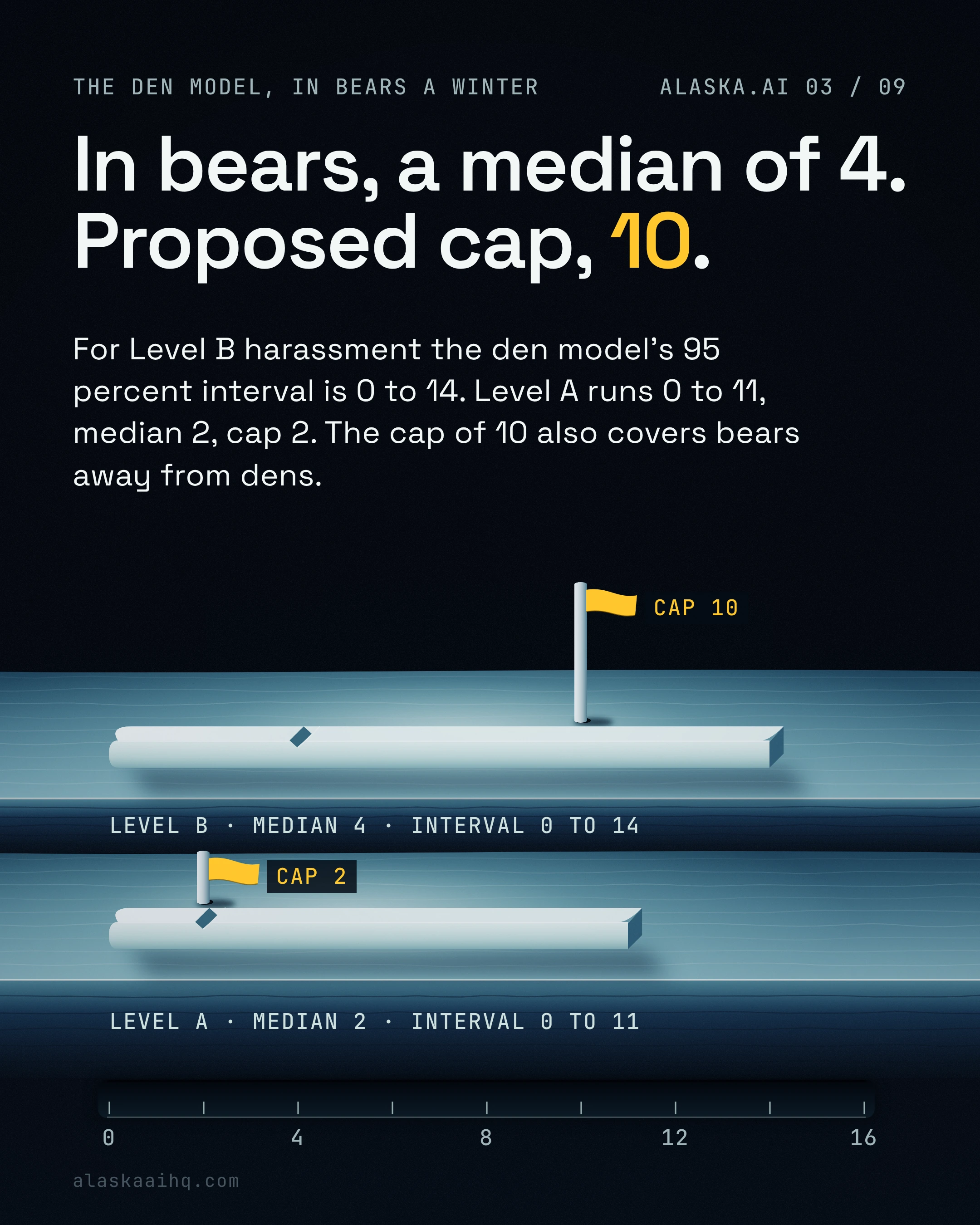
FWS wrote it in R and ran it 10,000 times for AIDEA's seismic survey. It estimates 8 dens, with a 95 percent interval of 2 to 16. Its median takes are 4 Level B and 2 Level A against caps of 10 and 2. The 10 also covers bears away from dens. FWS says its estimates significantly exceed decades of North Slope data and lean toward an overestimate. Comments close December 17th.
A coastal plain map leads, then the take medians against the caps, 12 bears of 907, FWS on its own numbers, three flight calendars and the vehicles.
Should the final terms plan for the top of the model's range or for what decades of North Slope work recorded?
What we verified
41 CLAIMS, EACH RE-FETCHED FROM ITS SOURCE BEFORE THIS DECK SHIPPED
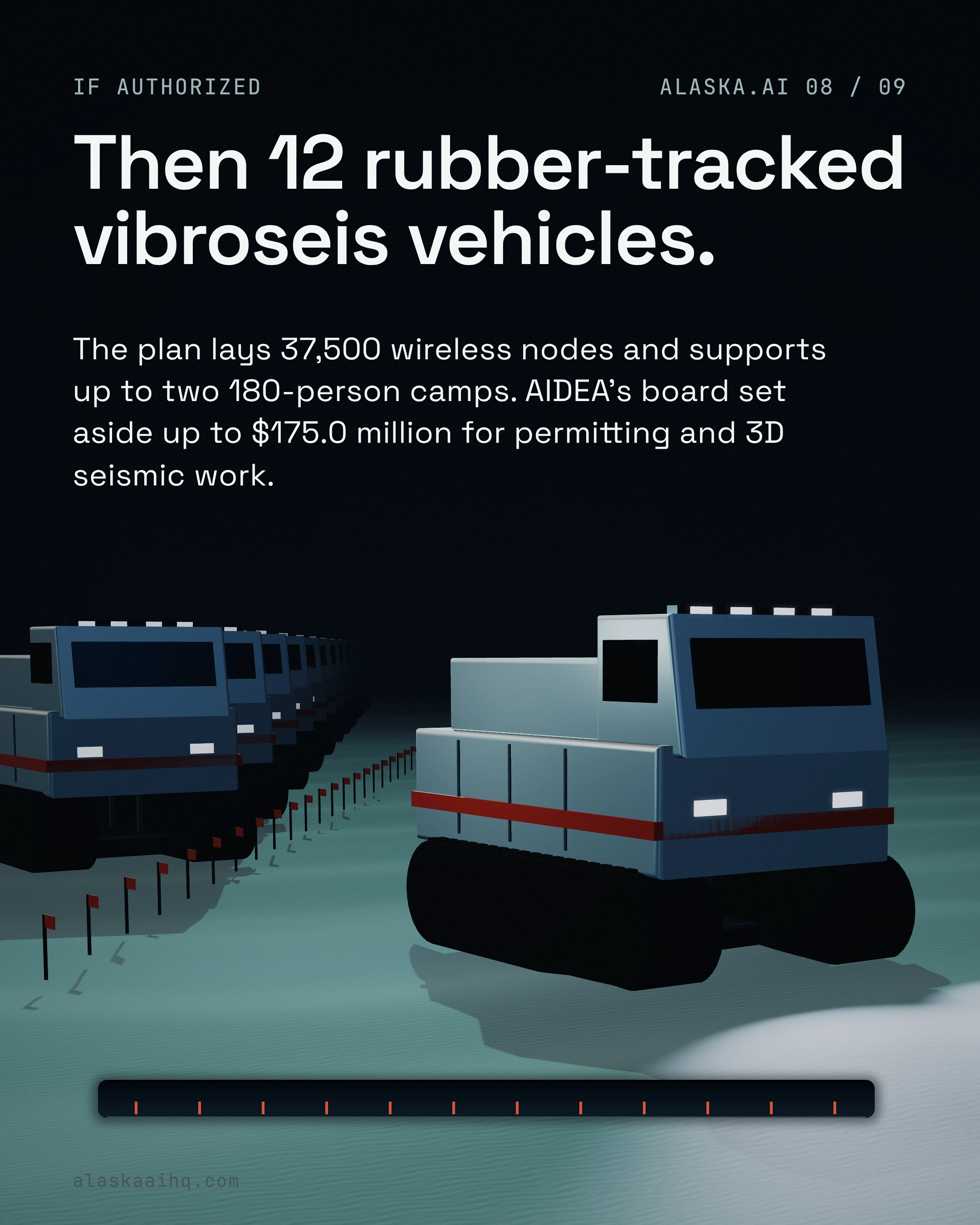
AIDEA's board resolution authorizes up to $175.0 million for 1002 Area permitting and 3D seismic work.
The same resolution authorizes up to $15.0 million for bids and rentals in the June 2026 Coastal Plain lease sale.
The applicant for the proposed authorization is the Alaska Industrial Development and Export Authority (AIDEA).
The activity area is the Coastal Plain 1002 Area of the Arctic National Wildlife Refuge.
The seismic survey would begin during the winter of 2026-2027.
The seismic program would use 12 rubber-tracked vibroseis vehicles.
The program would deploy 37,500 wireless autonomous recording devices called nodes.
Up to two 180-person camp seismic crews may be supported.
The advance crew will mobilize no earlier than January 10th.
FWS wrote the code for its den disturbance model in the program R.
FWS ran 10,000 iterations of the den model as a Monte Carlo simulation.
The model's inputs include the estimated number of dens in four regions of northern Alaska.
FWS estimated 8.0 land-based dens in the area of specified activity, with a median of 8 and a 95 percent interval of 2 to 16.
The den disturbance model gives a median of 4 Level B takes per winter, with a 95 percent interval of 0 to 14.
The den disturbance model gives a median of 2 Level A takes per winter, with a 95 percent interval of 0 to 11.
The den disturbance model puts the probability of at least one lethal take at 0.15, with a median lethal take of 0.
FWS proposes to authorize take of no more than 10 polar bears by Level B harassment.
FWS proposes to authorize take of no more than 2 polar bears by Level A harassment.
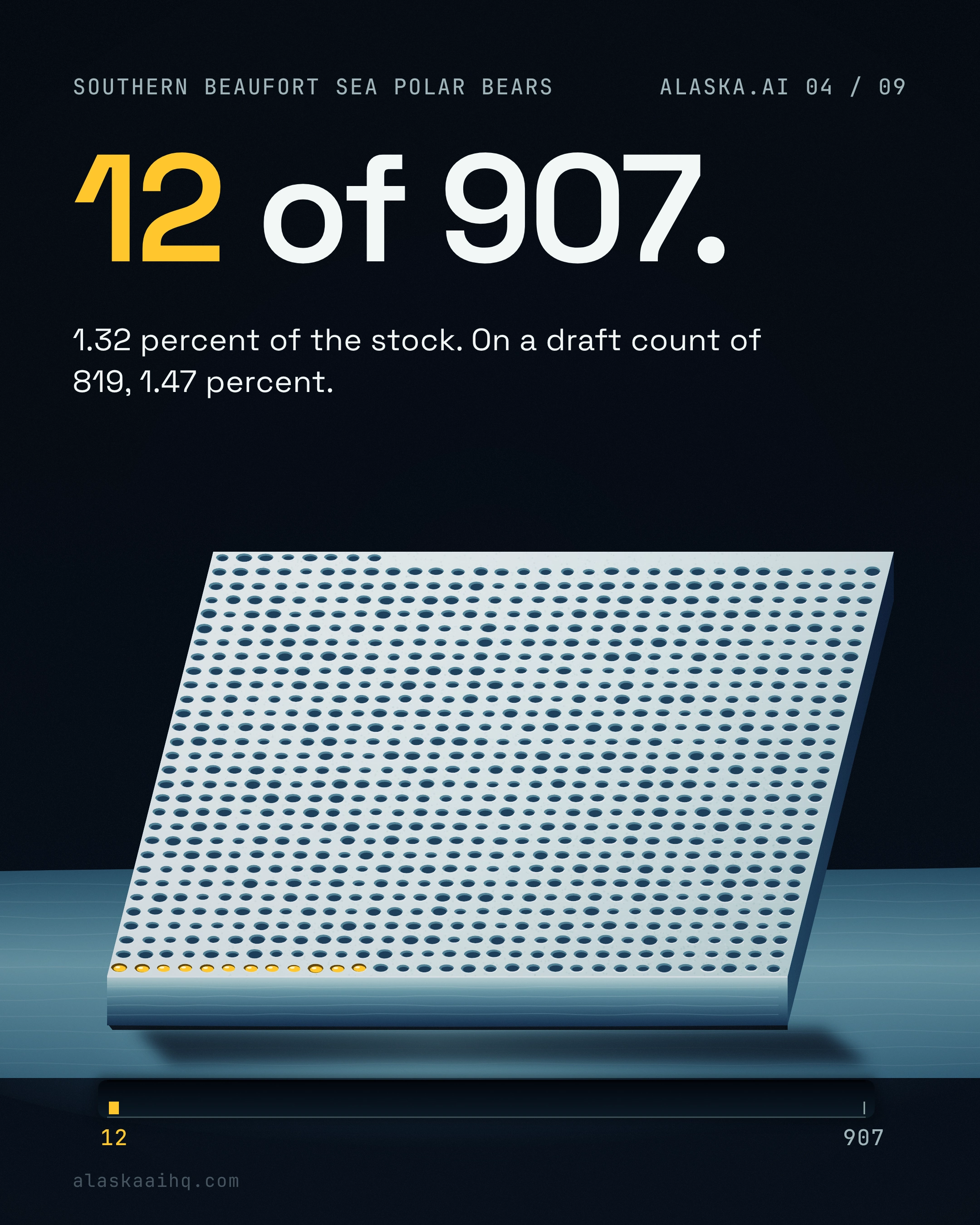
Take of 12 bears is 1.32 percent of the Southern Beaufort Sea stock estimate of 907 animals.
Under a draft stock estimate of 819 bears, 12 bears would be 1.47 percent of the stock.
In the mitigation description, the first aerial infrared den survey would be flown between November 25th and December 25th.
In the denning model, the first aerial infrared survey was set between December 1st and December 25th and the second between December 15th and January 15th, 2027.
The proposed authorization's mitigation terms list aerial infrared survey dates in December 2025 and January 2026, a year earlier than the windows in the den model.
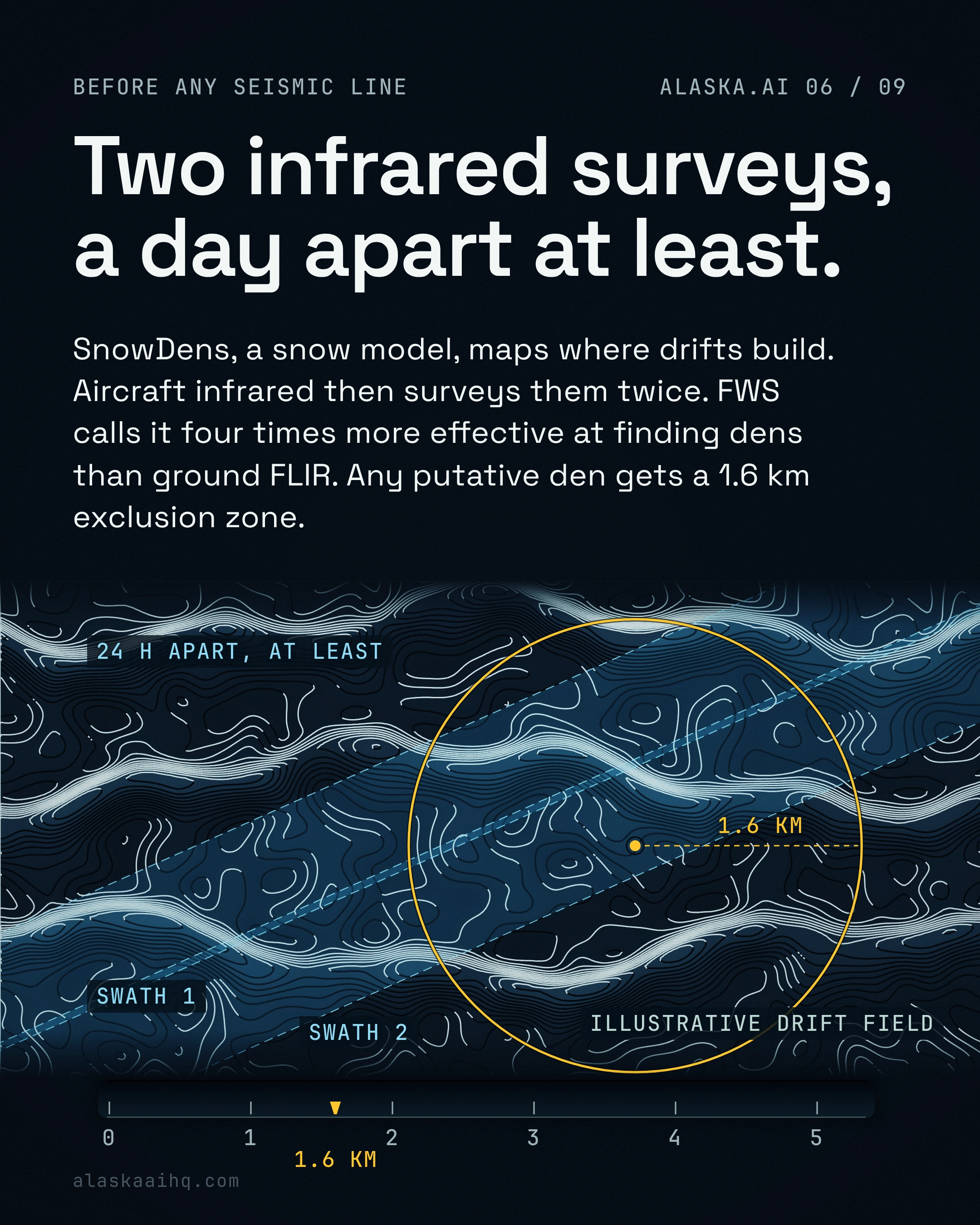
The model requires a minimum of 24 hours between the two aerial infrared surveys.
FWS says aerial infrared has been found to be four times more effective at detecting dens than ground-based FLIR.
AIDEA will create a 1.6 km (1 mi) exclusion zone around any putative dens it locates.
The notice gives no numeric den detection probabilities and refers to the 2026-2031 Beaufort Sea ITR for them.
AIDEA will use a modeling framework called SnowDens to simulate snow accumulation before starting aerial infrared surveys.
FWS says its modeling assumptions are more likely to contribute to an overestimate than an underestimate of take.
FWS acknowledges its take estimates significantly exceed historical data collected over decades of similar oil and gas activity on the North Slope.
Comments on the proposed authorization must be received by December 17th.
The docket number for the proposed authorization is FWS-R7-ES-2026-4357.
The notice was published in the Federal Register at 91 FR 73773 on November 17th.
FWS proposes a one-year authorization for nonlethal incidental harassment of small numbers of Southern Beaufort Sea polar bears.
The notice does not use the terms artificial intelligence, machine learning or drone.
The final Beaufort Sea incidental take regulations are effective through October 19th, 2031.
The final Beaufort Sea rule estimates 22 takes of polar bears during denning over its five years.
The final Beaufort Sea rule's model also estimates 13 takes by Level A harassment of denning cubs.
Alaska Beacon reported that a decision on AIDEA's seismic application is not expected until mid-January 2027.
AIDEA said it would incur significant financial impact if forced to end its seismic program after November 29th.
Alaska Beacon reported that staging and preliminary work outside the refuge had begun and would ramp up further at the end of November.
Beats
This article is on Alaska land and permitting for AI · Alaska AI research and science. Each beat page keeps every decision and every article on that subject in one place.