The Machine Makes Time. Who Owns the Clock?
On a Cook Inlet salmon boat this month, a sockeye enters a steel box on deck and leaves it iced.
The deck
SWIPE, SCROLL OR CLICK A SLIDE TO GO FULLSCREEN · 9 SLIDES
The story
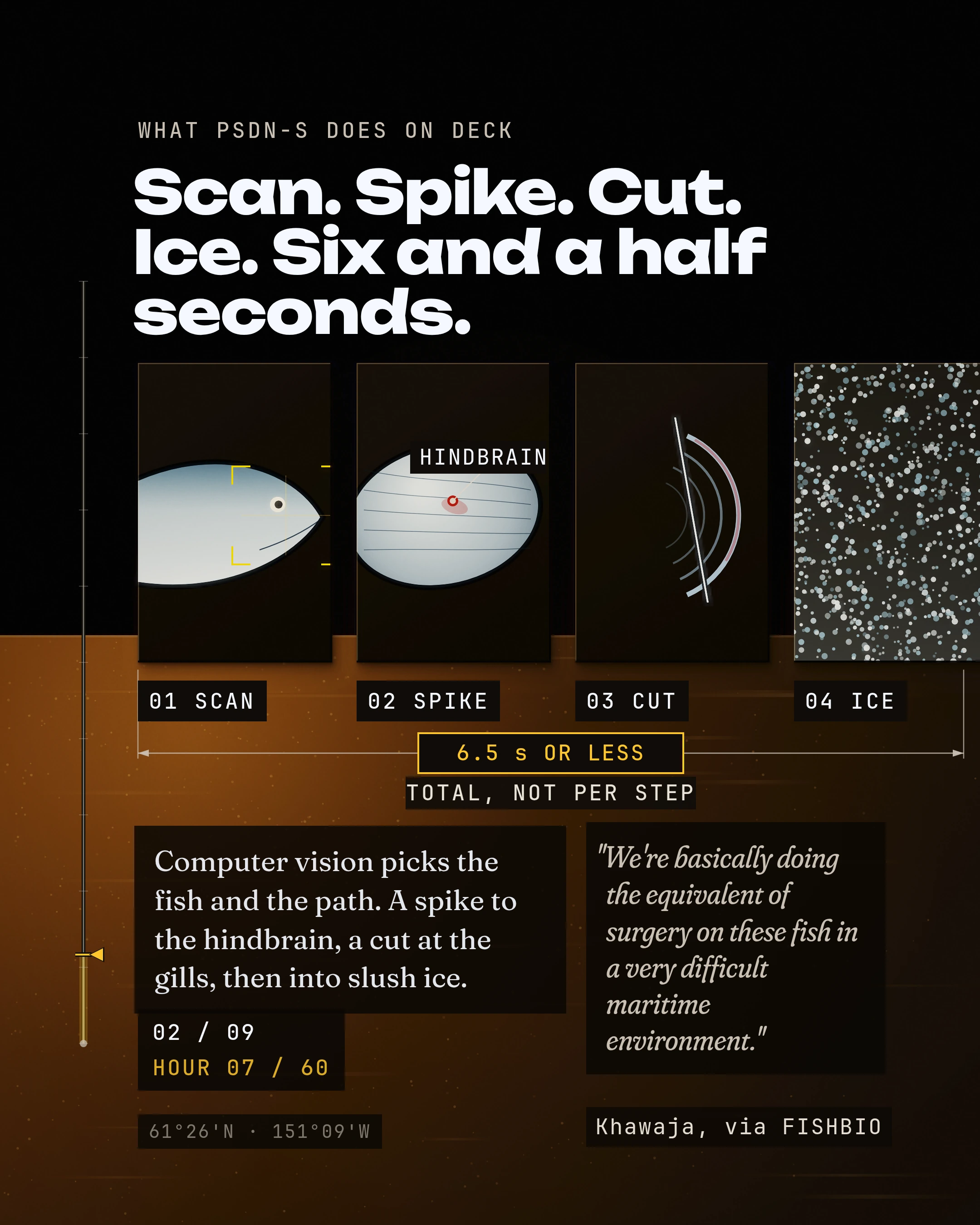
Computer vision picks the fish and the path. Brain spiked, gills cut, iced, 6.5 seconds or less by Shinkei's count.
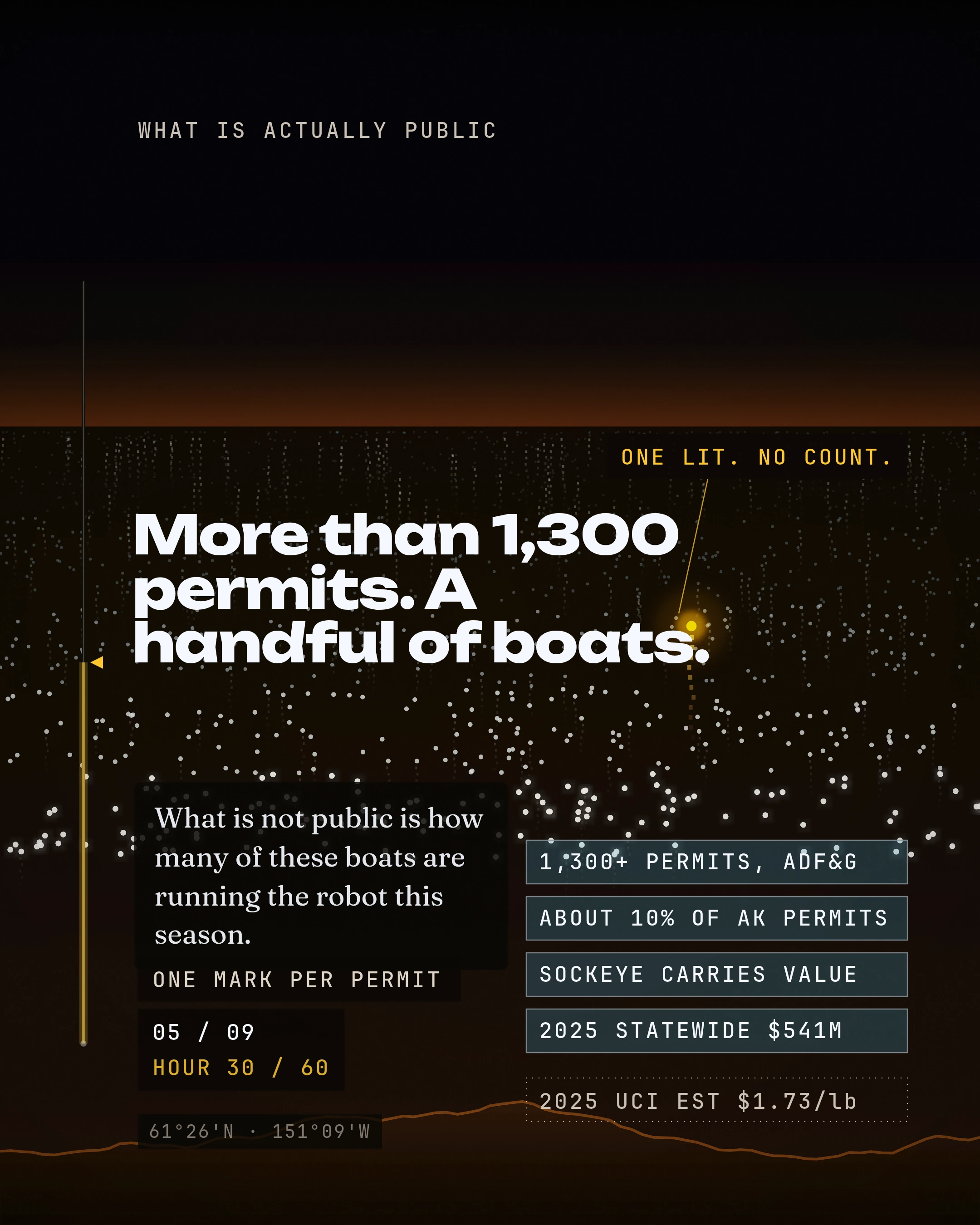
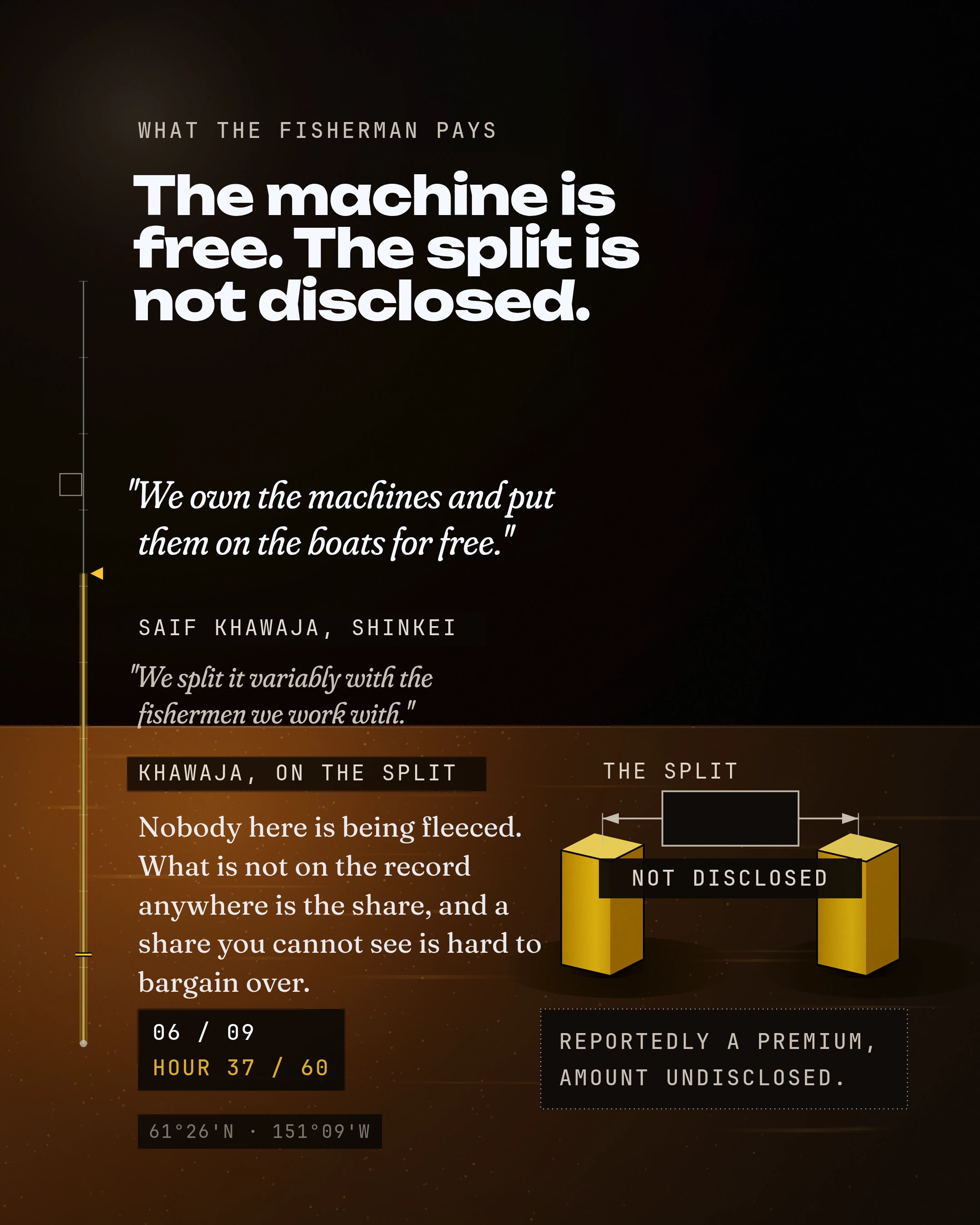
Upper Cook Inlet holds more than 1,300 drift and set gillnet permits, and sockeye carries the value there. Boats in that fleet now carry the machine. It goes aboard free. The catch reportedly sells at a premium. That deal is fair.
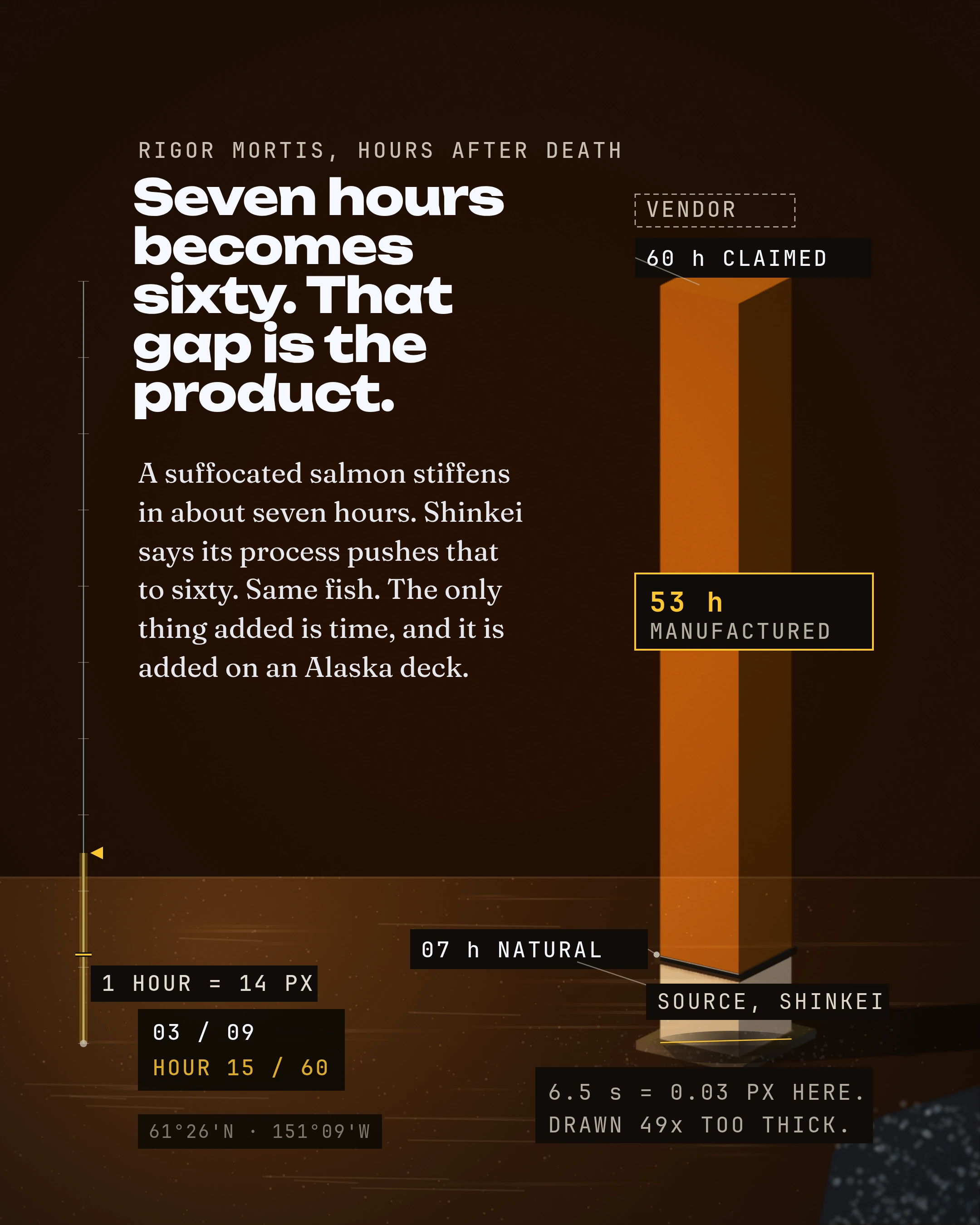
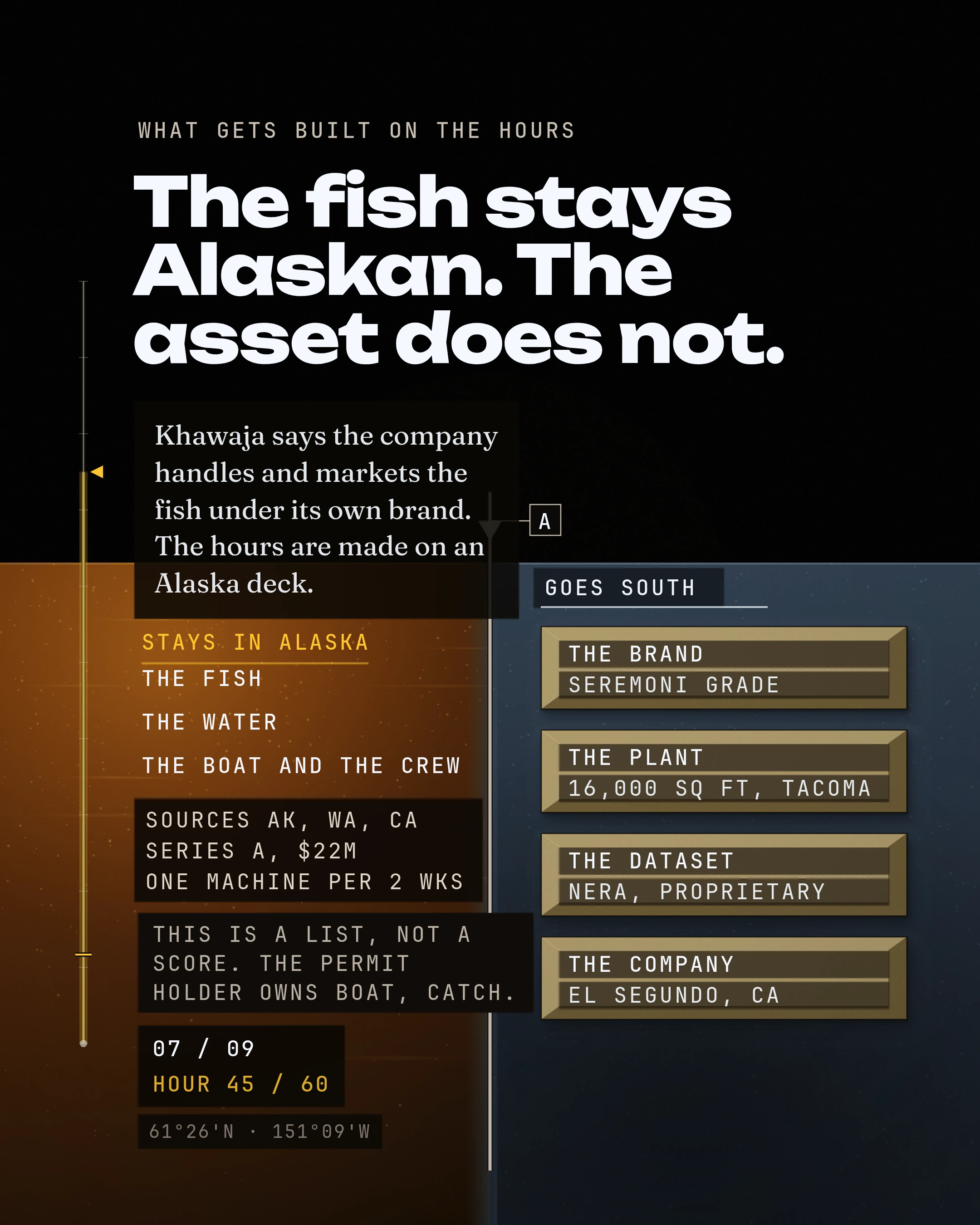
A suffocated salmon stiffens in about 7 hours. Shinkei says its process stretches that to 60. Those hours become a brand, Seremoni Grade, a 16,000 square foot plant in Tacoma, and NERA, the firm's own system rating how many days a fish can be sold. Headquarters is El Segundo.
Alaska holds the fish, the water and the crews. Who gets to decide where the clock is owned?
What we verified
30 CLAIMS, EACH RE-FETCHED FROM ITS SOURCE BEFORE THIS DECK SHIPPED
Shinkei Systems announced PSDN-S as its newest harvesting robot created to bring Seremoni Grade handling to Alaska's wild salmon industry.
Shinkei says PSDN-S was built to make its harvesting technology more practical for the smaller boats used throughout Alaska's salmon fisheries.
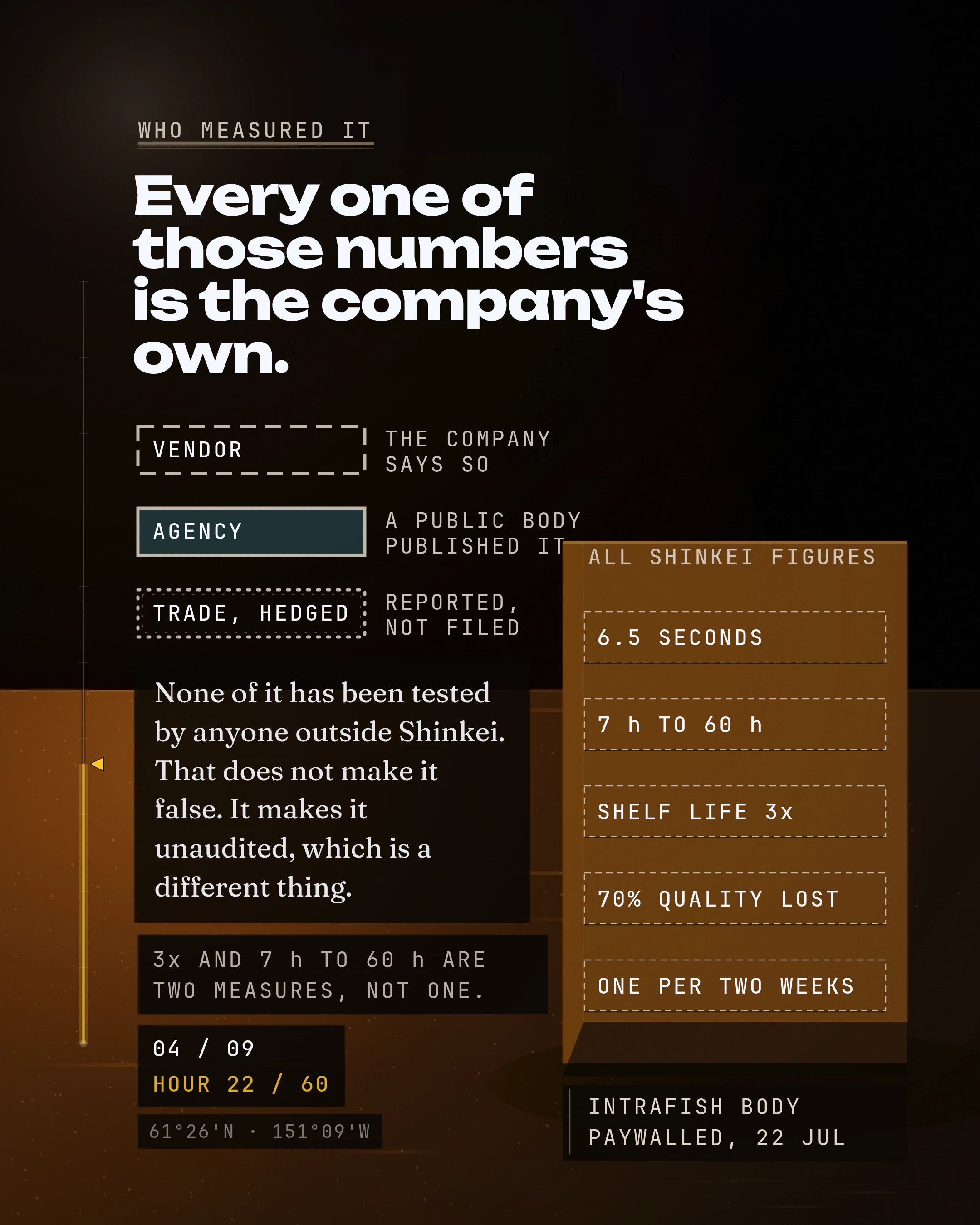
Shinkei's website says PSDN extends shelf life 3x.
The Alaska Department of Fish and Game says more than 1,300 drift and set gillnet limited entry permits exist for the Upper Cook Inlet area.
The Alaska Department of Fish and Game says sockeye salmon are the most important species by economic value in Upper Cook Inlet.
NOAA Fisheries says the 2026 commercial fishing season for the Cook Inlet EEZ Area opens on June 22 and closes on or before August 15.
The Alaska Department of Fish and Game reported the 2025 statewide commercial salmon harvest at 194.8 million fish worth approximately 541 million dollars.
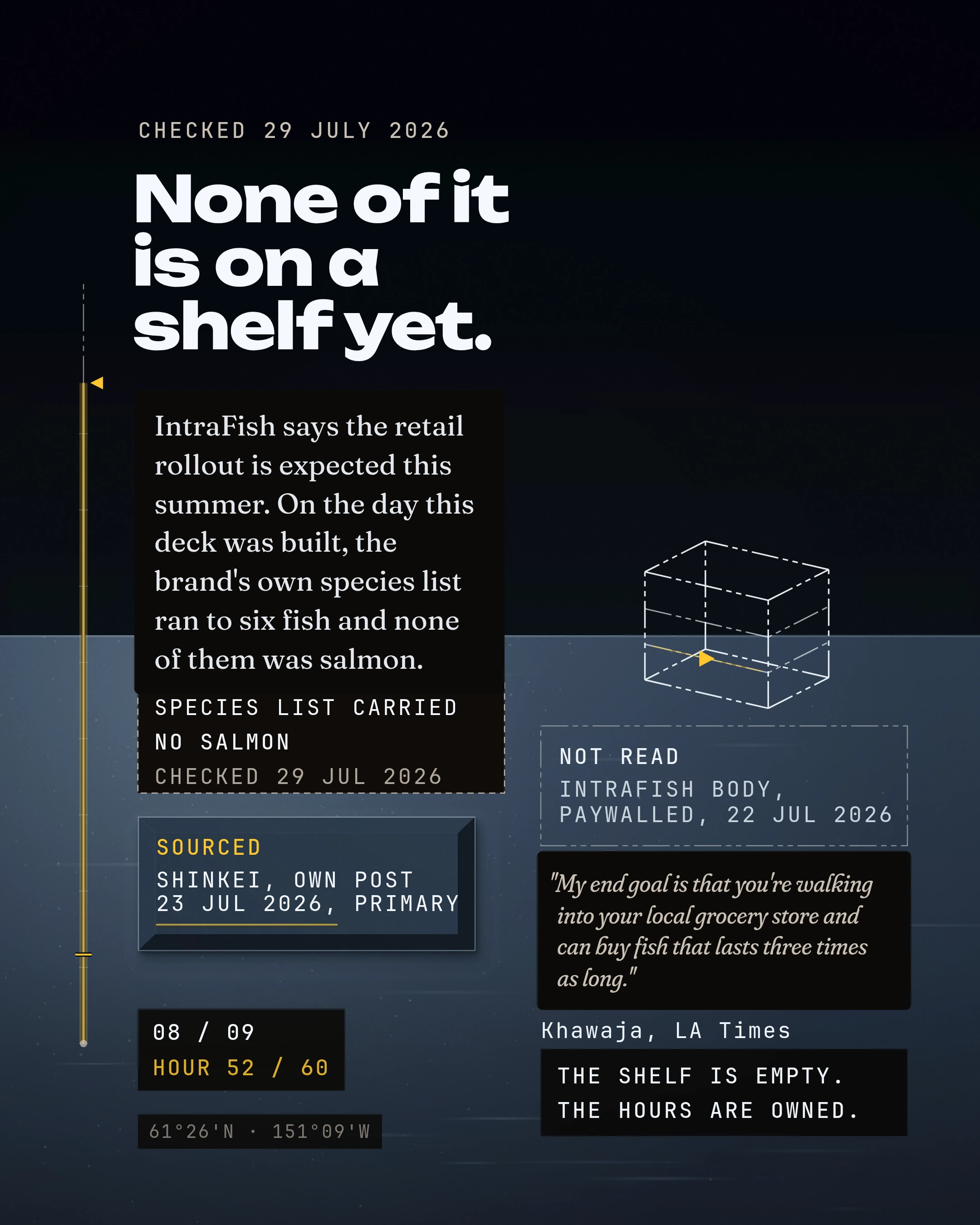
IntraFish published an article headlined 'Shinkei rolls out robot-harvested Alaska salmon' on 22 July 2026.
IntraFish's subhead says Shinkei expects to roll out its Seremoni Grade salmon to select retail and restaurant partners this summer.
IntraFish's photo caption places Shinkei Systems working with fishermen in Alaska's Cook Inlet in 2026.
Shinkei chief executive Saif Khawaja said the company owns the machines and puts them on the boats for free.
Khawaja said Shinkei splits the proceeds variably with the fishermen it works with.
Khawaja said Shinkei handles and markets the fish under its own brand Seremoni Grade.
Shinkei's lead mechanical engineer Waiman Meinhold described the deck machine as about the size of a refrigerator.
Shinkei says the machine scans a fish, spikes the brain, cuts the gills and puts it into slush ice in 6.5 seconds or less.
Khawaja said Shinkei can build a machine every two weeks.
The Spoon reported that each fish is processed in about six seconds.
The Spoon reported that Shinkei uses computer vision AI to scan the fish and determine the fastest and least stressful path forward.
The Spoon reported that a traditionally suffocated fish enters rigor mortis in about 7 hours while Shinkei's process expands that up to 60 hours.
The Spoon reported that Shinkei recently raised 22 million dollars in a Series A co-led by Founders Fund and Interlagos.
The Spoon reported that Shinkei works with eight boats sourcing black cod, rockfish and red snapper.
Shinkei acquired a 16,000 square foot fish processing facility in Tacoma, Washington from FATHOM Seafood.
The Tacoma plant was reported to open in spring 2026 with a core workforce of more than 50 employees plus seasonal hires.
Shinkei said the Tacoma plant would source fish from fishermen in Alaska, Washington and California.
Khawaja said NERA uses Shinkei's proprietary datasets to show how fresh each fish is and how many days it can be sold.
Khawaja told the Los Angeles Times his end goal is grocery shoppers buying fish that lasts three times as long, tastes better and is handled humanely.
Deckboss reported that the 2025 Upper Cook Inlet sockeye harvest was worth 35.8 million dollars at an estimated average price of 1.73 dollars per pound.
KFSK reported that Silver Bay Seafoods announced a Bristol Bay sockeye base price of 1.60 dollars per pound for the 2026 season.
Trade coverage of the Alaska rollout says Shinkei provides its robots to Alaskan fishermen at no cost while purchasing their catch at premium prices.
FISHBIO reported Khawaja saying the company is doing the equivalent of surgery on the fish in a very difficult maritime environment.
Beats
This article is on Alaska power and the grid · Alaska land and permitting for AI · Alaska AI research and science. Each beat page keeps every decision and every article on that subject in one place.