A Poll Is Not a Ballot
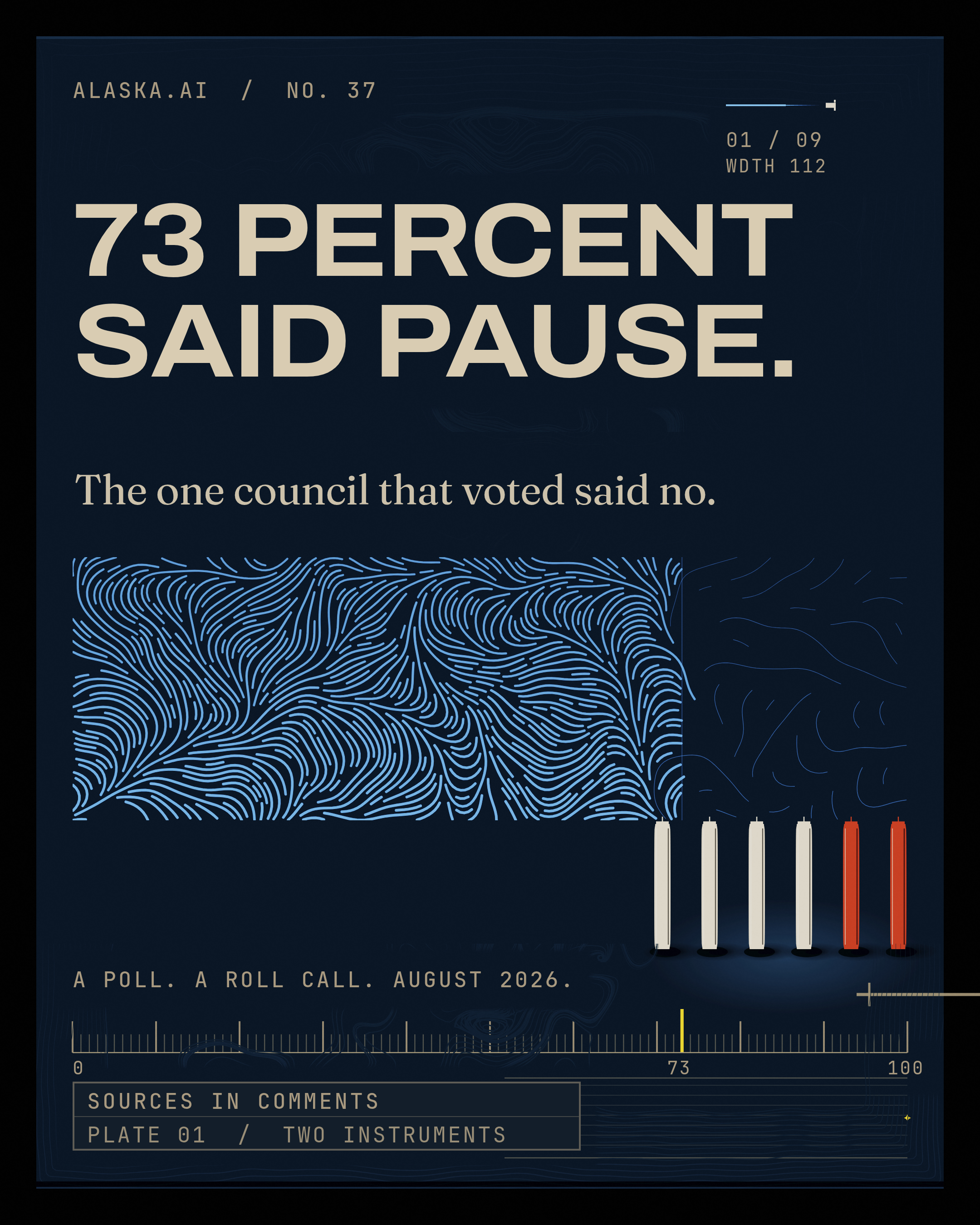
73 percent of Alaska likely voters back pausing new data centers until the state passes a law. Houston in the Mat-Su voted a ban down.
The deck
SWIPE, SCROLL OR CLICK A SLIDE TO GO FULLSCREEN · 9 SLIDES
The story
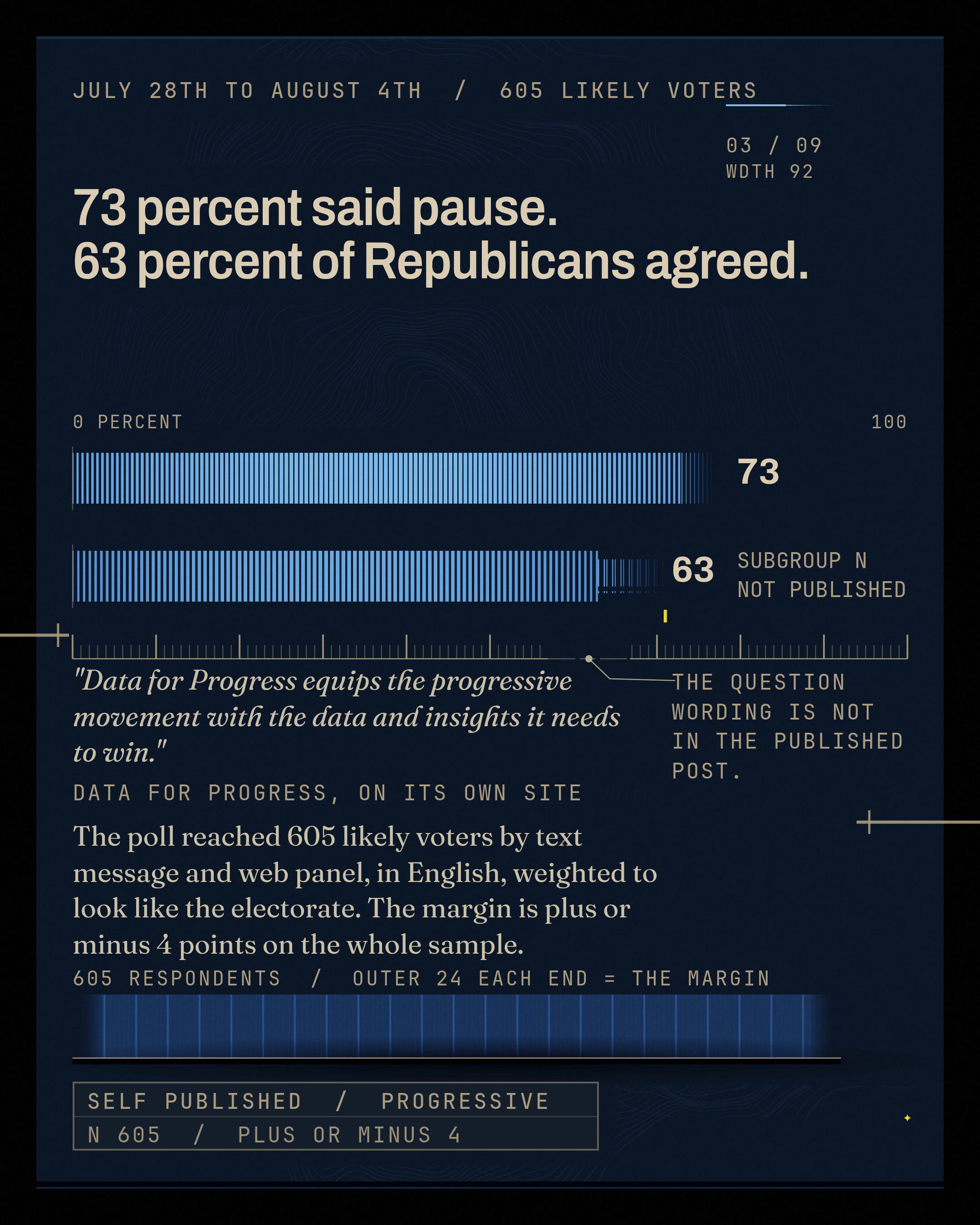
Data for Progress polled 605 likely voters from July 28th to August 4th. 63 percent of Republicans said pause too.
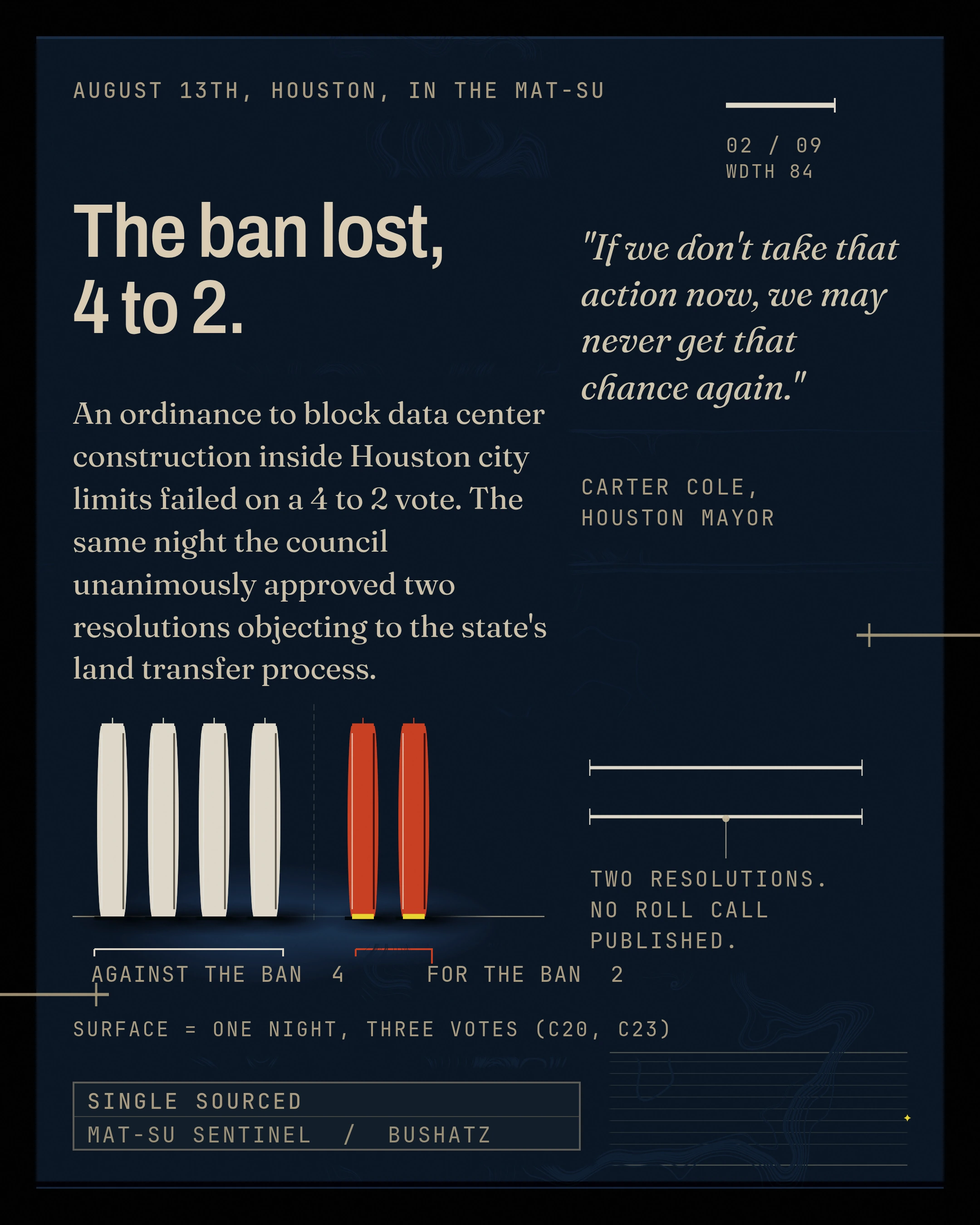
On August 13th the ban failed 4 to 2, per the Mat-Su Sentinel. The same council unanimously passed two objections to the state's land transfer process.
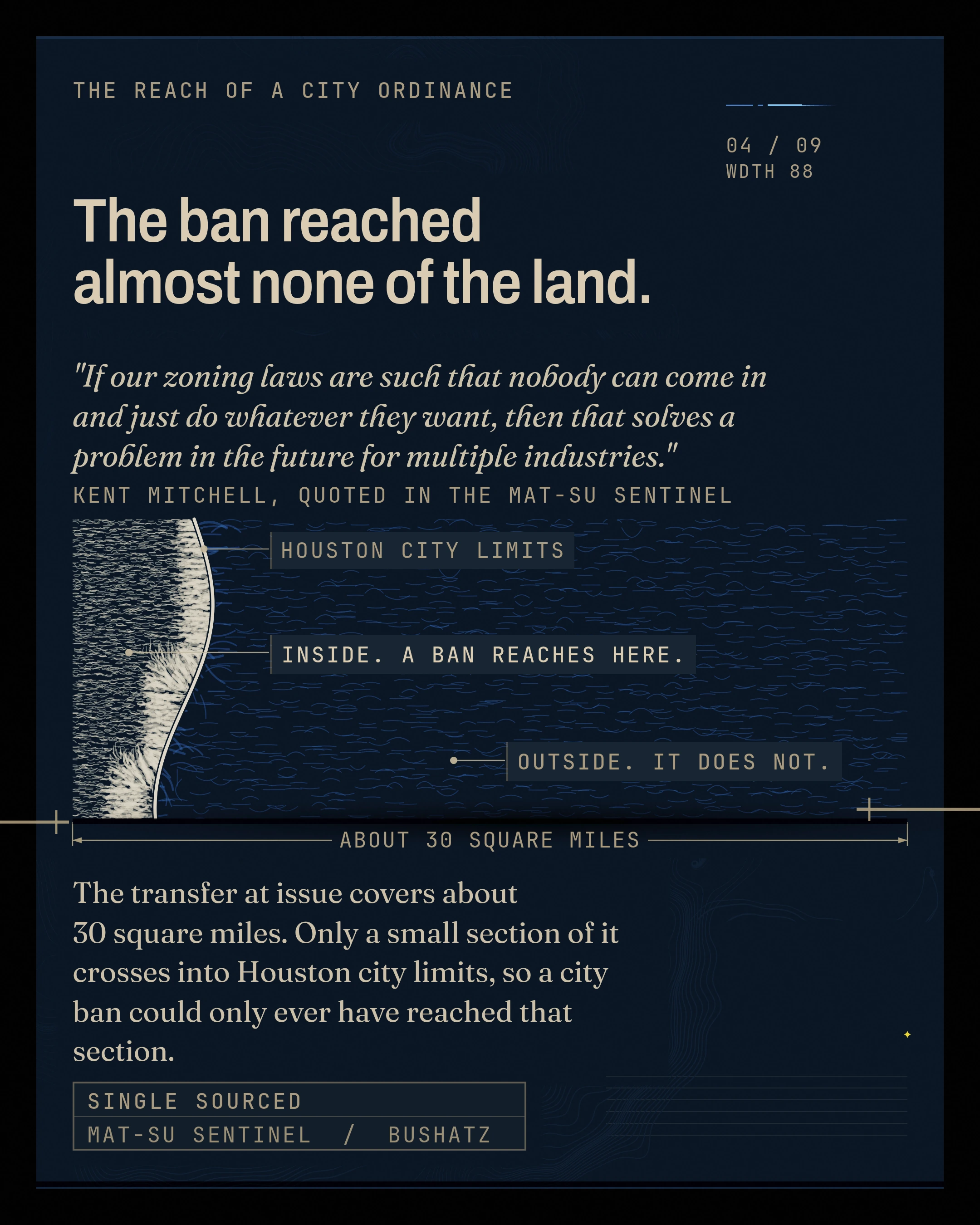
A poll covers a whole state. The ban covered one city, and only a small section of the land in question sits inside it. Anchorage adopted a permitting framework instead, a conditional use permit that regulates how and not whether.
The poll's methods and missing question wording, the Houston roll call, and what Anchorage adopted instead.
Which instrument should a 73 percent preference get, a city ban, a permit with conditions, or a state law?
What we verified
45 CLAIMS, EACH RE-FETCHED FROM ITS SOURCE BEFORE THIS DECK SHIPPED
A Data for Progress survey found 73 percent of Alaska likely voters support pausing new data center development until the state passes a law regulating it.
The same survey found 63 percent of Alaska Republicans support pausing new data center development until the state passes a law regulating it.
The Data for Progress Alaska survey sampled 605 likely voters.
The Data for Progress Alaska survey was fielded from July 28th to August 4th, 2026.
The Data for Progress Alaska survey carries a margin of error of plus or minus 4 percentage points.
The survey used SMS and web panel respondents and was weighted by age, gender, education, race, geography, and recalled vote.
The Data for Progress Alaska survey was conducted in English only.
Data for Progress describes itself as equipping the progressive movement with the data and insights it needs to win.
Data for Progress did not publish the exact wording of the data center question in the post announcing the result.
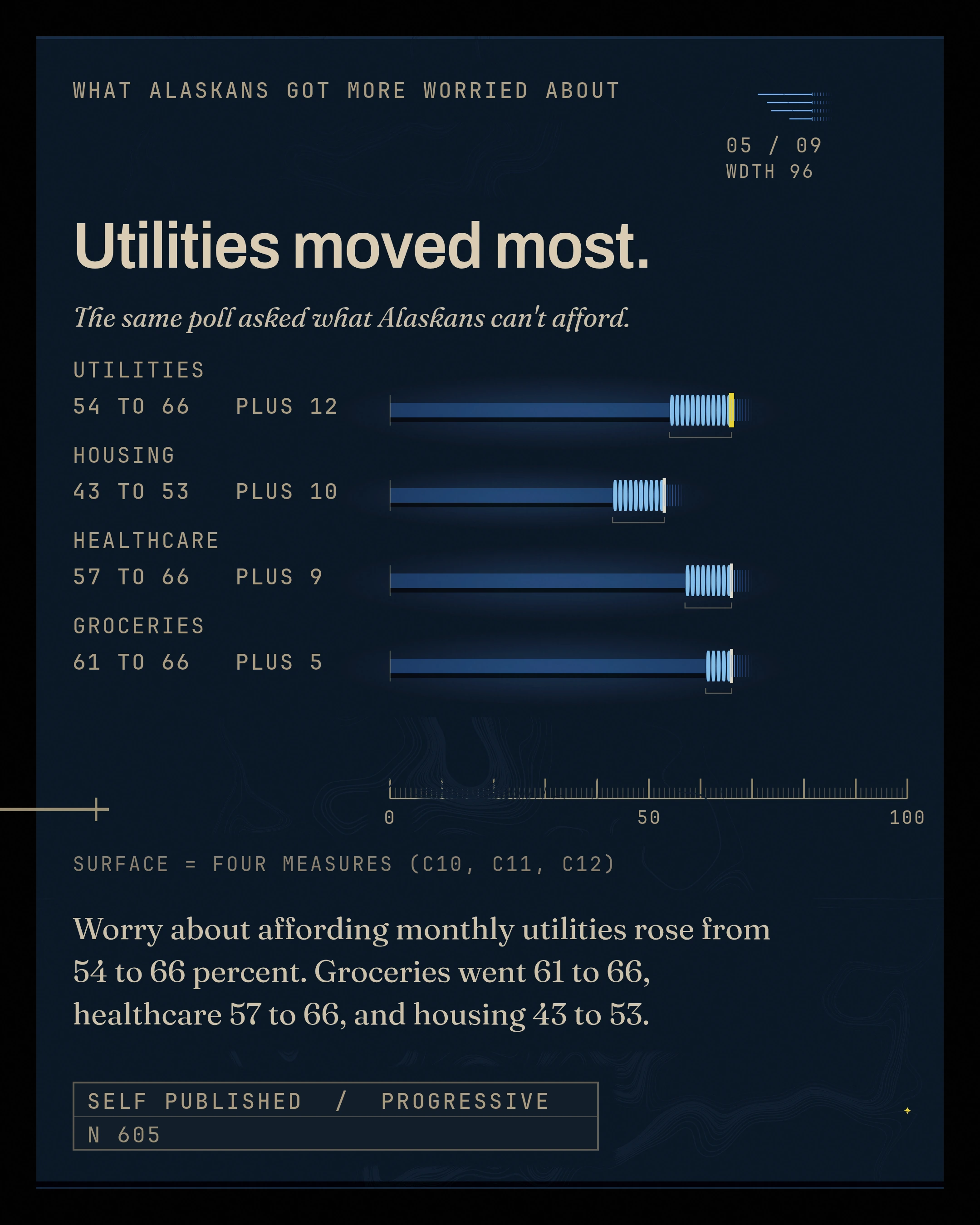
The share of Alaska voters worried about affording monthly utilities such as electricity or heat rose from 54 percent to 66 percent.
Worry about affording groceries and food rose from 61 percent to 66 percent in the same survey comparison.
Worry about affording healthcare services rose from 57 percent to 66 percent and housing from 43 percent to 53 percent.
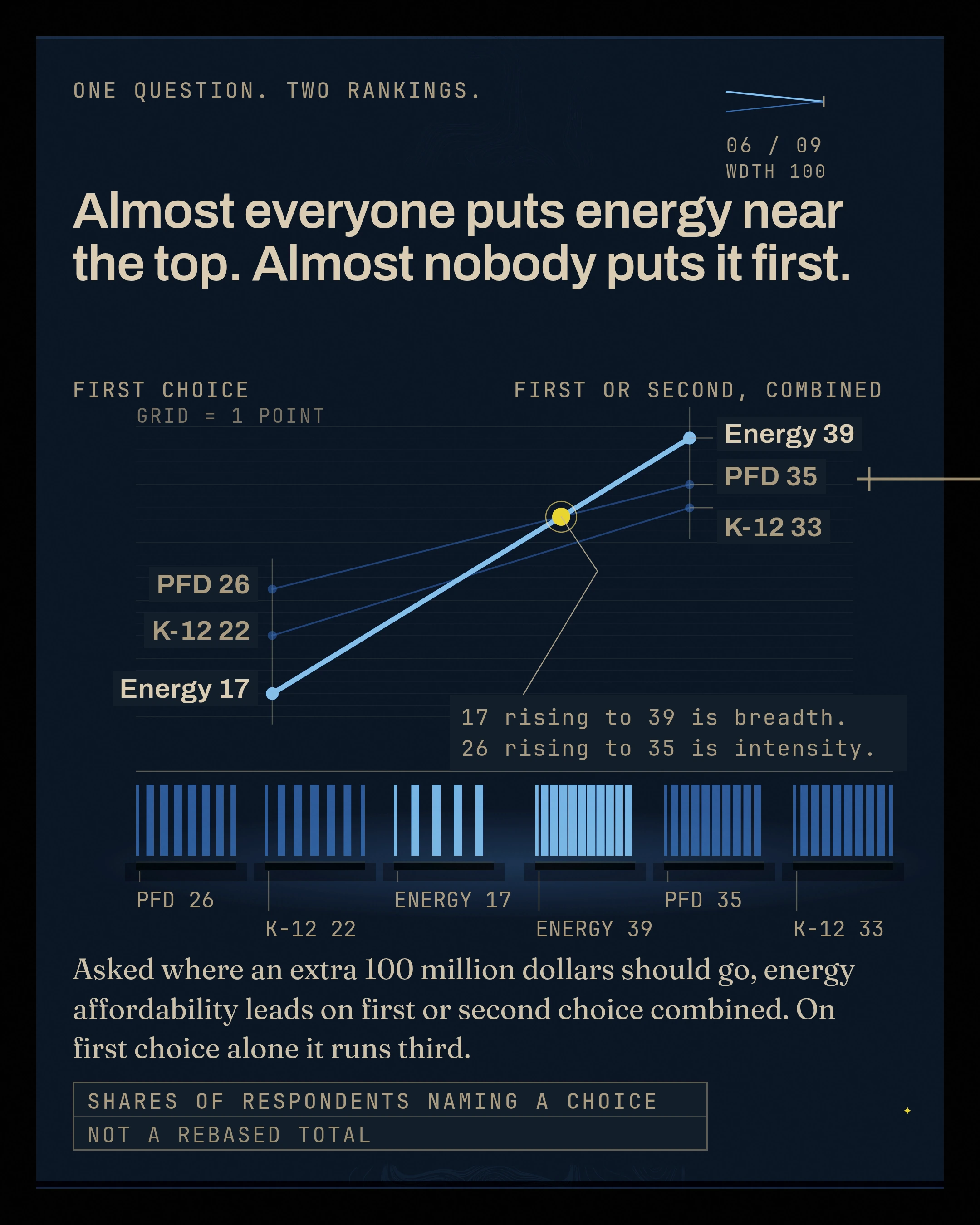
Asked where an extra 100 million dollars of state spending should go, 39 percent of Alaska voters named making electricity and heating more affordable as a first or second choice, against 35 percent for the Permanent Fund Dividend and 33 percent for K-12 education.
On first choice alone, Alaska voters most commonly named the Permanent Fund Dividend at 26 percent, then K-12 public education at 22 percent, with making electricity and heating more affordable third at 17 percent.
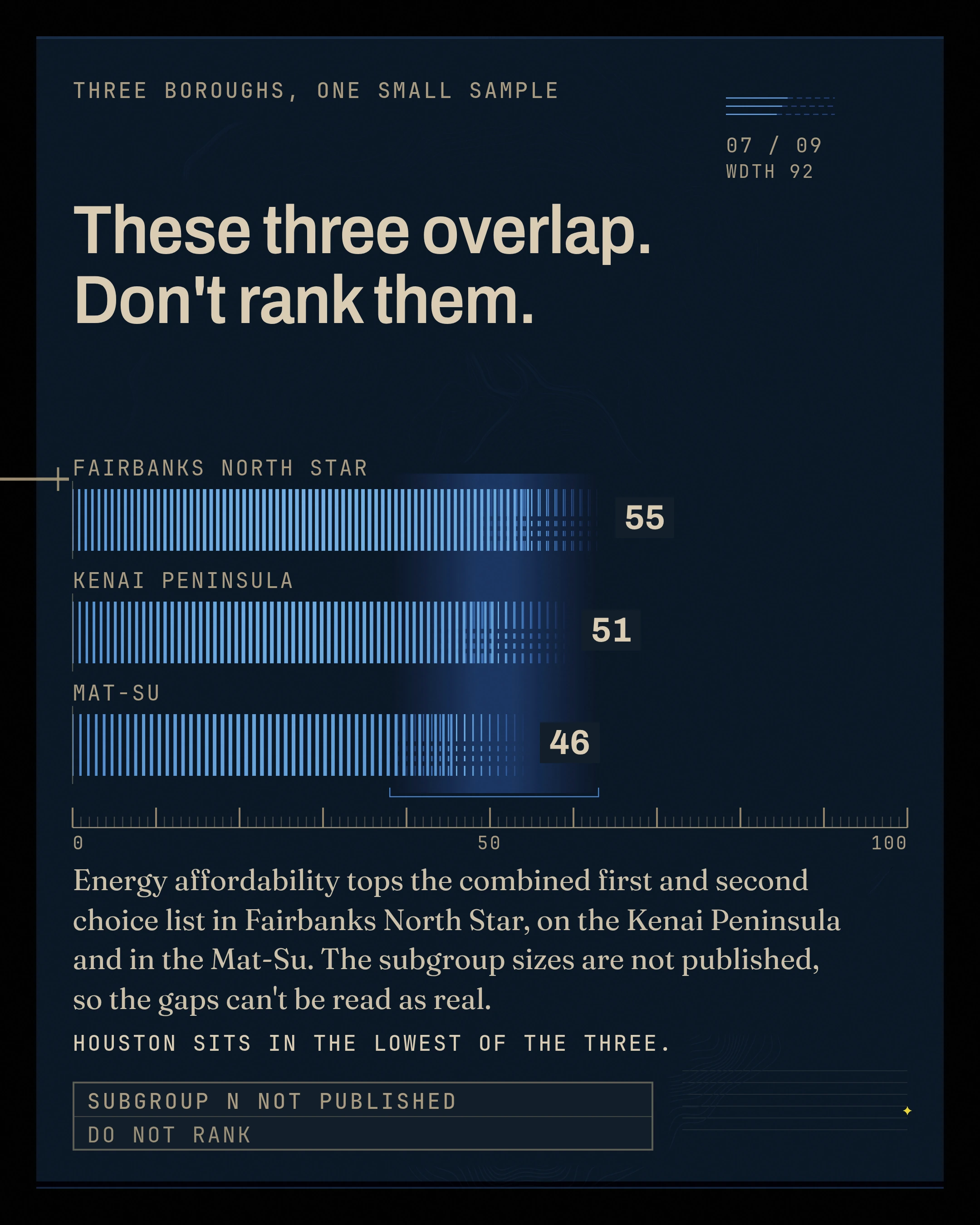
Energy affordability topped the combined first and second choice list in the Fairbanks North Star Borough at 55 percent.
Energy affordability topped the combined first and second choice list on the Kenai Peninsula at 51 percent.
Energy affordability topped the combined first and second choice list in the Mat-Su at 46 percent.
60 percent of Alaska voters say their local electric utility should build a project that could raise bills for a few years but lower them over the following two decades, while 25 percent say it should not.
52 percent of Alaska voters say a utility that rejects such a project should be required to open its finances to an independent audit.
Jonathan Kreiss-Tomkins wrote that he is the first and he believes still the only candidate in the governor's race to call for a moratorium on data center development in Alaska until the state can pass comprehensive regulation.
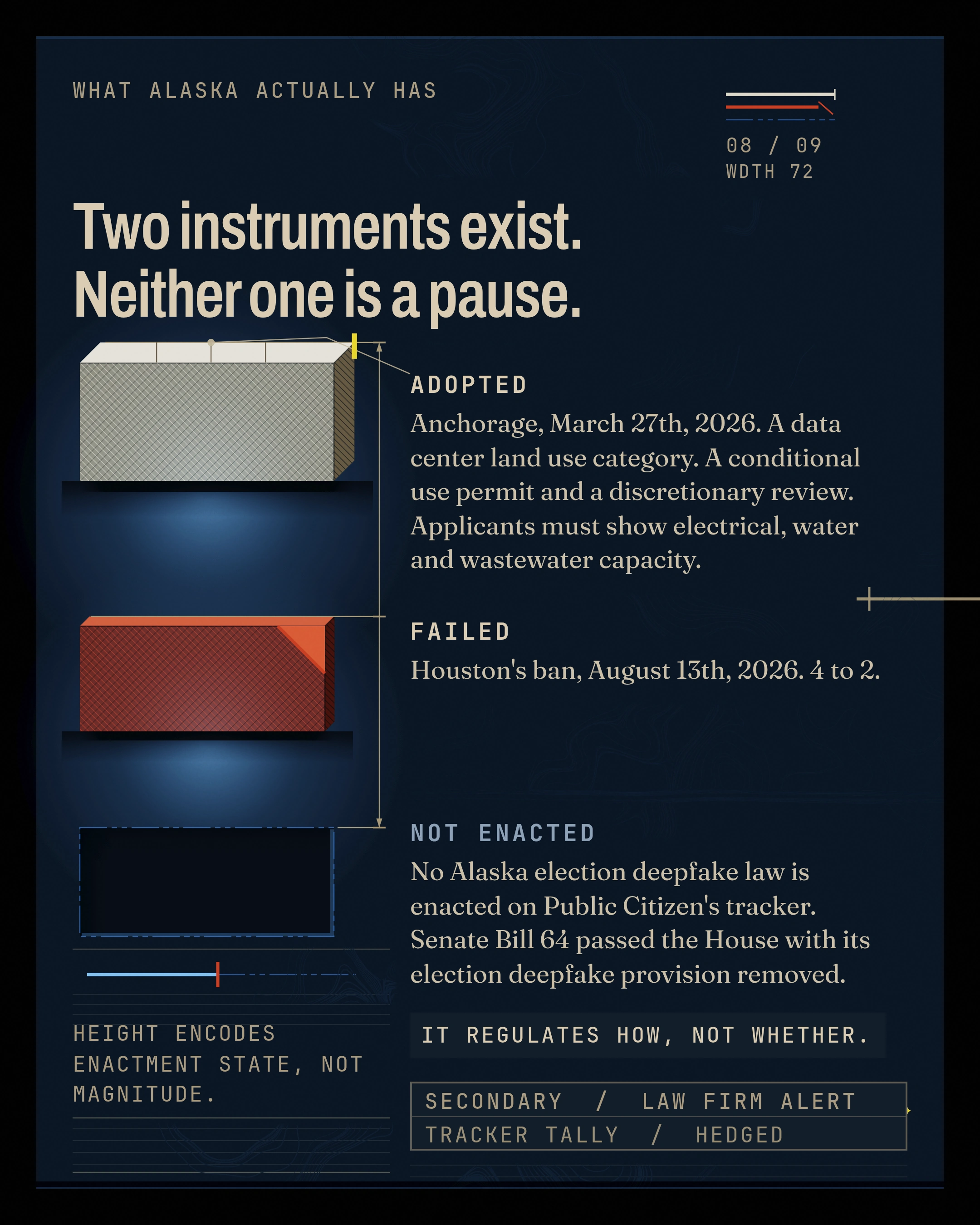
An ordinance to block data center construction within Houston city limits failed on a 4 to 2 vote.
The Houston city council vote on the data center ordinance took place on August 13th, 2026.
Houston council members Callie Courtney and Lisa Johansen voted in favor of the data center ban ordinance.
The Houston city council unanimously approved two resolutions opposing the state Department of Natural Resources land transfer process on the same night the ban failed.
Houston council member Jeffrey Brasel said of the state land transfer process that there was zero transparency and that preliminary decisions were made before the city had a decision to make.
Houston Mayor Carter Cole said that if a good reason were found for a data center in Houston it could probably end up in Houston and that without action now the city may never get that chance again.
Houston official Kent Mitchell said that zoning laws preventing anyone from coming in and doing whatever they want would solve a future problem for multiple industries.
State Representative Kevin McCabe said what he supports is finding ways to get the city of Houston more revenue and the state more revenue.
A Department of Natural Resources spokesperson said the city's resolutions will be reviewed as part of the proposal process if they are officially submitted as comments.
The proposed transfer would move 30 square miles of rural land from the Alaska Department of Natural Resources to the Alaska Industrial Development and Export Authority.
The proposed parcels border Willow, Meadow Lakes and Houston, with a small section crossing into Houston city limits.
Public Citizen's tracker of election deepfake legislation lists no enacted Alaska law, showing every Alaska bill as failed or with its election deepfake provision removed.
Alaska Senate Bill 64 passed the House in 2026 with its election deepfake provision removed.
At least 27 states are listed as having enacted election deepfake laws on Public Citizen's tracker as of its August 3rd, 2026 update.
The Anchorage Assembly adopted Ordinance AO 2026-27 on March 27th, 2026.
Ordinance AO 2026-27 amends Title 21 of the Anchorage Municipal Code by creating a new land use category for data centers.
Under the Anchorage ordinance data centers must obtain a conditional use permit, which triggers a discretionary review process.
The Anchorage ordinance requires applicants to demonstrate that sufficient electrical, water and wastewater capacity exists to support the proposed facility.
The Anchorage ordinance is described as a land use and permitting framework for data centers and not as a moratorium.
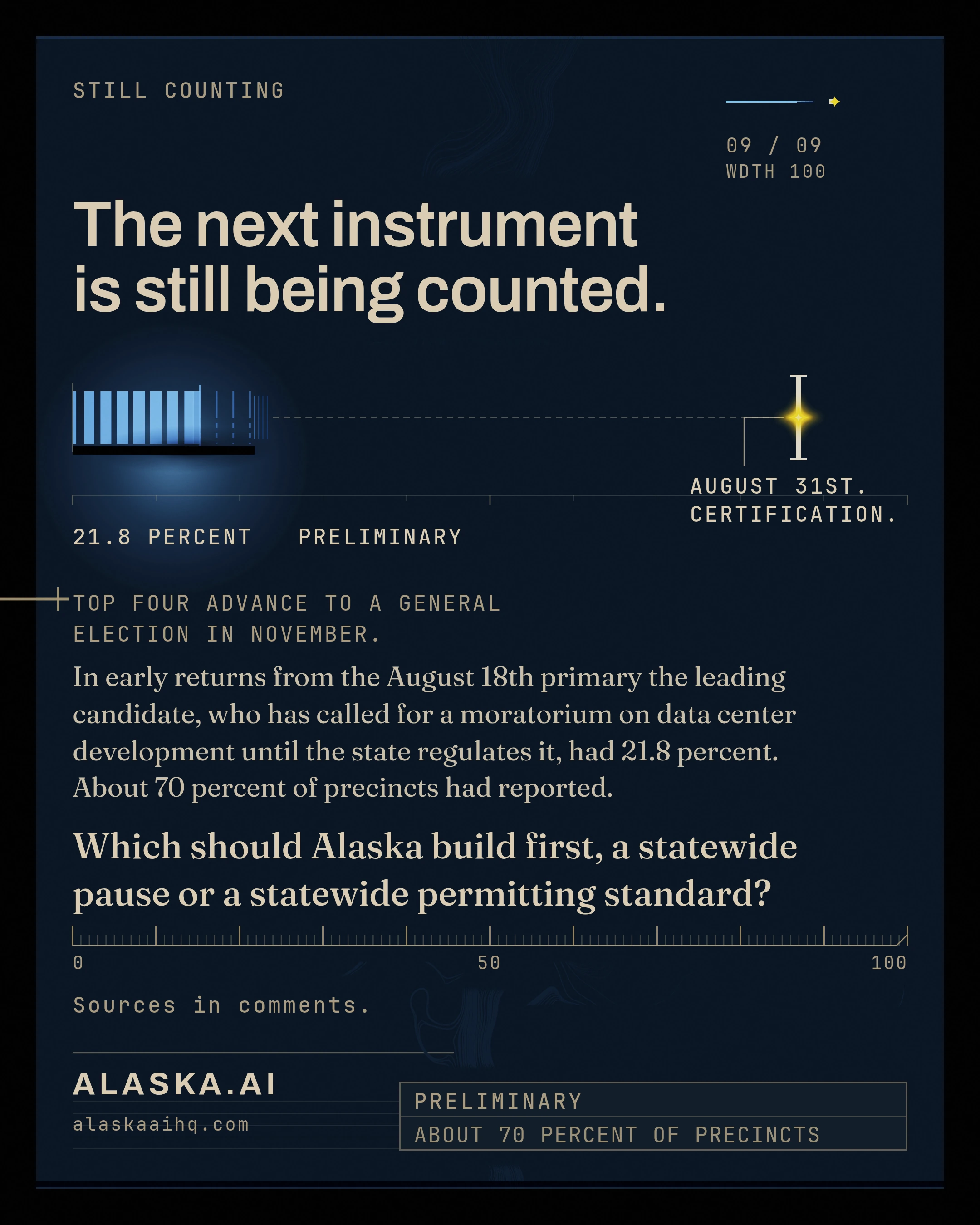
In early and preliminary counting from Alaska's August 18th, 2026 primary, Jonathan Kreiss-Tomkins led the governor's race with 21.8 percent and Tom Begich followed with 19.7 percent.
In the same preliminary count Bernadette Wilson had 10.7 percent and Dave Bronson 8.5 percent.
The Alaska governor primary field included 17 candidates made up of 12 Republicans, three independents and two Democrats.
Under Alaska's election laws the top four vote getters in the primary advance to the general election regardless of party.
Alaska election officials plan to certify the primary results on August 31st, 2026.
Over two dozen demonstrators affiliated with the group PauseAI took to the streets of Anchorage on a Monday afternoon warning drivers about the under regulation of AI.
Beats
This article is on Alaska data centers · Alaska land and permitting for AI · Defense and federal AI in Alaska · Alaska AI policy and legislation. Each beat page keeps every decision and every article on that subject in one place.