Alaska AI policy and legislation
Bills, the governor's desk, the regulatory commission and everything that decides the rules before the concrete pours.
Where this beat stands
Alaska AI tracks 8 decisions on this beat, each one with the documents it was verified against. 1 is open for public comment right now. The nearest date is Nov 2 on DeepGreen's underwater data center in Cook Inlet. The bodies deciding on this beat include Alaska Legislature, third special session, Regulatory Commission of Alaska (prudency); Alaska DNR (storage lease and technical determination) and Alaska Legislature (House Energy Committee).
Decisions on this beat
Closed · Alaska Legislature, third special session
A conference committee compromise unveiled July 2nd would swap the state property tax on the Glenfarne-led Alaska LNG project for a volumetric tax after five years of operation or 500 MMcf per day, and extend the completion deadline to the end of 2034. The House deadlocked 19 to 19 on July 16th over an expanded S corporation income tax, the governor rejected that provision, and a third special session convened July 27th with no bill from the governor and almost no legislators in the room.
15 sources on file · the full record
Enstar's Cook Inlet gas storage plan (Kenai Loop Pool)
Pending decision · Regulatory Commission of Alaska (prudency); Alaska DNR (storage lease and technical determination)
On July 10th, 2026 the Anchorage Daily News reported the RCA issued a 17-page order denying Enstar's request for an advance determination that its proposed Cook Inlet gas storage project was prudent, saying the utility lacked basic information. The $240 million project would have bought the depleted Kenai Loop Pool reservoir from AIX Energy to hold 25 billion cubic feet of gas, close to half Enstar's annual demand, adding up to $12 a month to the average bill. Enstar and Hilcorp have competing DNR lease applications for the same pool, and DNR has not confirmed it is technically capable of storing gas. Without approval, Enstar president John Sims said the company suspended the project. Enstar reopened the question on July 23rd, 2026 with a 31-page petition for reconsideration, arguing the order was erroneous and suffers from a lack of true understanding of the nature of the problem, and calling the Kenai Loop Pool the only viable commercial storage option in Cook Inlet. Alaska Public Media reports the commission has thirty days to respond and that inaction is an automatic denial.
7 sources on file · the full record
HB 259, state utility standards for large data centers
Closed · Alaska Legislature (House Energy Committee)
HB 259, introduced by Rep. Donna Mears in January 2026, would have set utility rate-setting guidelines and community benefit agreement standards for large energy use facilities such as data centers, and given the Regulatory Commission of Alaska new duties over them. The House Energy Committee heard it twice, on January 29th and February 3rd, 2026, taking testimony from Greensparc, GCI, the Alaska Municipal League and former Rep. Paul Seaton. It never advanced out of that committee, and it carried a second referral to House Community and Regional Affairs it never reached. The bill died with the 34th Legislature at sine die on May 20th, 2026. Alaska still has no statewide cost-allocation rule governing how a large data-center load is billed against other ratepayers, which leaves that question with the Regulatory Commission of Alaska and with individual utility boards.
3 sources on file · the full record
The AI ratepayer pledge, and which Alaska utilities have signed it
Watching · Each Alaska electric utility board, including the Railbelt cooperatives
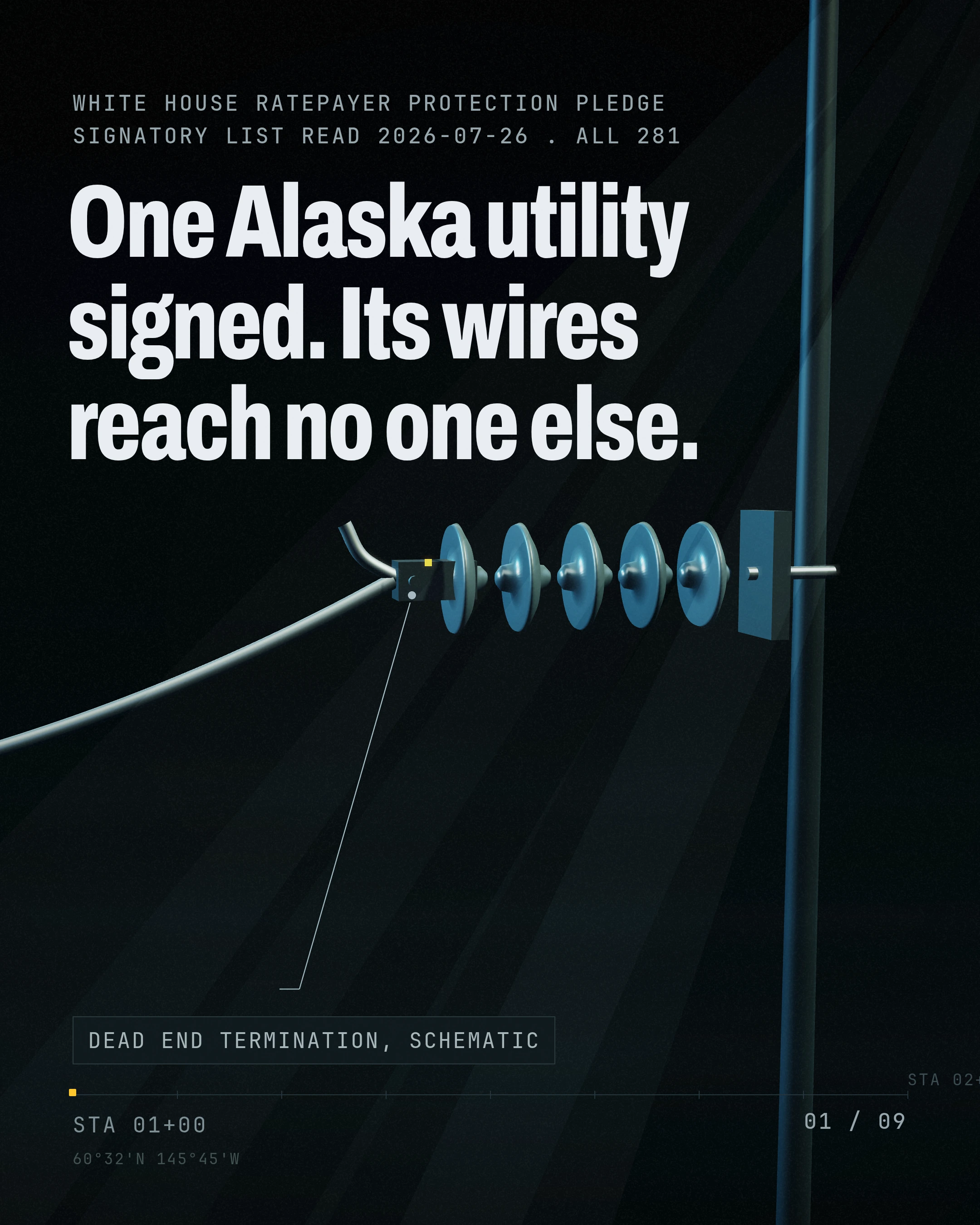
The White House Ratepayer Protection Pledge asks AI companies, utilities and data center developers to commit that new data center load pays for its own generation and delivery instead of shifting the cost onto households. USA TODAY and POWER both describe it as voluntary and non binding. Gov. Mike Dunleavy signed the governors addendum on July 23rd, 2026, one of 23 governors. The signatory list has grown from 281 when it was first read here on July 26th, 2026 to 317 on September 11th, 2026, and across that growth exactly one Alaska entity appears on it, Cordova Electric Cooperative, a 1,566 customer cooperative that is not connected by transmission line to any other community. No Railbelt utility has signed.
5 sources on file · the full record
The Dixon Glacier diversion into Bradley Lake
Pending decision · Federal Energy Regulatory Commission
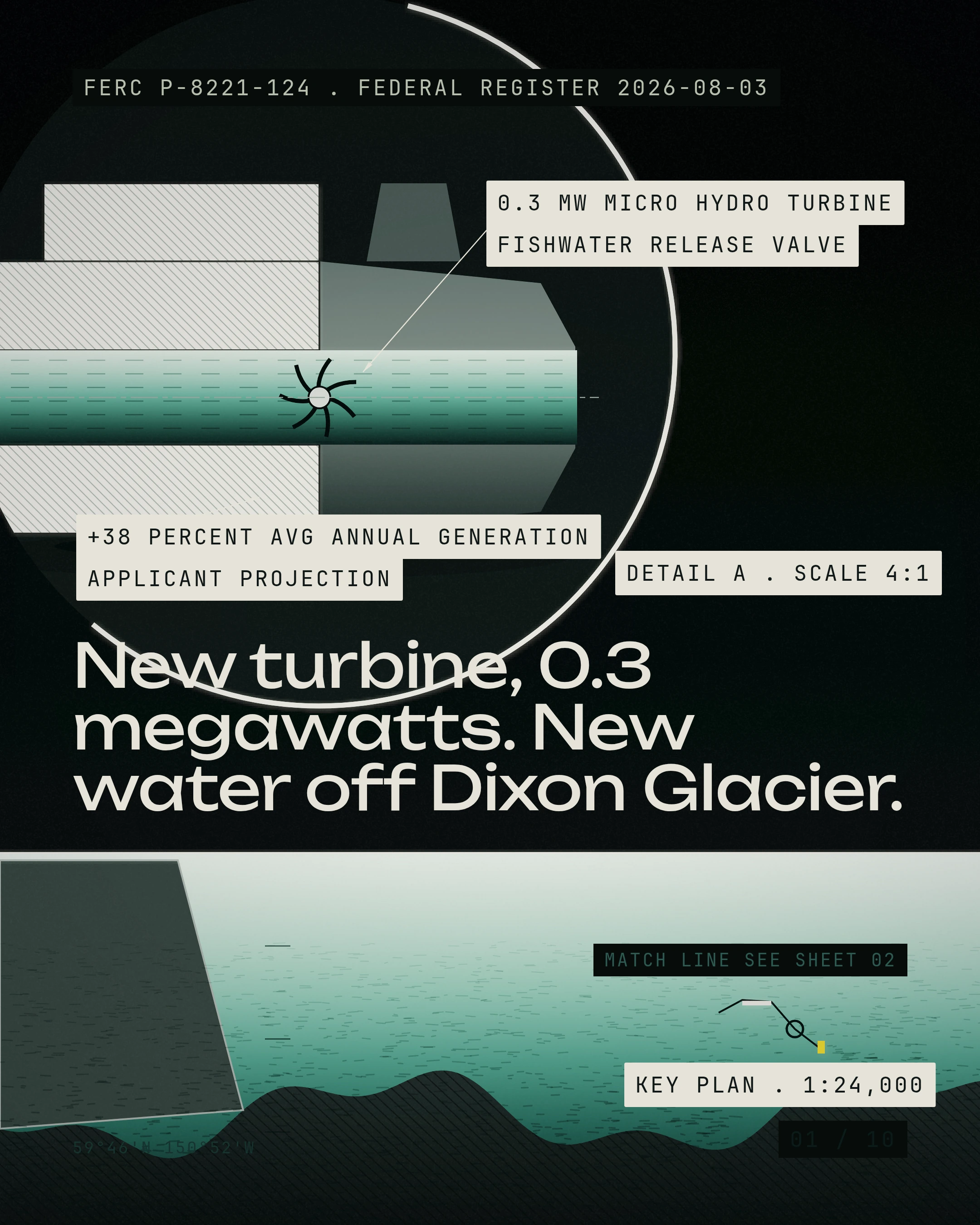
The Alaska Energy Authority has asked FERC to amend the license for the Bradley Lake Hydroelectric Project, the largest in Alaska, so it can build a new dam diverting meltwater and surface runoff from the Dixon Glacier into Bradley Lake, raise the lake's normal maximum operating pool by about 16 feet, and install a 0.3 megawatt micro-hydro turbine in one of the dam's fishwater release valves. The application projects about 38 percent more average annual generation while installed capacity rises from 119.7 to 120.0 megawatts, because the gain comes from water rather than from turbines. AEA estimates construction at about $400 million and about three years of study and permitting followed by three years of construction. FERC accepting the application for filing is a procedural step and not an approval.
4 sources on file · the full record
The Air Force nuclear microreactor at Eielson
Pending decision · Department of the Air Force with Defense Logistics Agency Energy, and the Nuclear Regulatory Commission for the license
The Air Force intends to award Oklo a 30 year fixed price power purchase agreement for a microreactor delivering up to 5 megawatts to Eielson Air Force Base outside Fairbanks. Oklo would build, own and operate it, and the contract is signed only after Oklo obtains a license from the Nuclear Regulatory Commission.
4 sources on file · the full record
Alaska's bid to run its own carbon storage permits
Pending decision · Alaska Oil and Gas Conservation Commission applies; the U.S. Environmental Protection Agency decides
The Alaska Oil and Gas Conservation Commission is applying to the Environmental Protection Agency for primary enforcement authority over Class VI wells, the wells used to inject carbon dioxide for permanent underground storage. If the application succeeds the state, not the federal government, would permit and police every carbon storage well in Alaska.
3 sources on file · the full record
DeepGreen's underwater data center in Cook Inlet
Open for comment · Federal Energy Regulatory Commission · Nov 2
DeepGreen Cook Inlet SPV LLC, a Delaware company whose parent formed in January 2026, applied to FERC in February for a preliminary permit over an initial operational envelope of 1,650 acres of Cook Inlet seabed west of Nikiski, proposing a 100 megawatt data center of 66 hives of AI servers powered and cooled by approximately 330 to 350 tidal turbines in water 45 to 166 feet deep. A preliminary permit authorizes study rather than construction, for up to four years, and FERC's Northwest branch found the application incomplete in a June 18th letter.
7 sources on file · the full record
Every one of these is also in the full Alaska AI Docket, published as open data at /data/ under CC BY 4.0.
Articles on this beat














Every beat
Data centers · Power and the grid · Land and permitting · Defense and federal · Research and science · Data sovereignty · State policy