1,650 Acres of Priority to Study
DeepGreen's filing names a Universal Docking Cradle. FERC's June letter said much of the underwater hardware lacked dimensions.
The deck
SWIPE, SCROLL OR CLICK A SLIDE TO GO FULLSCREEN · 9 SLIDES

The story
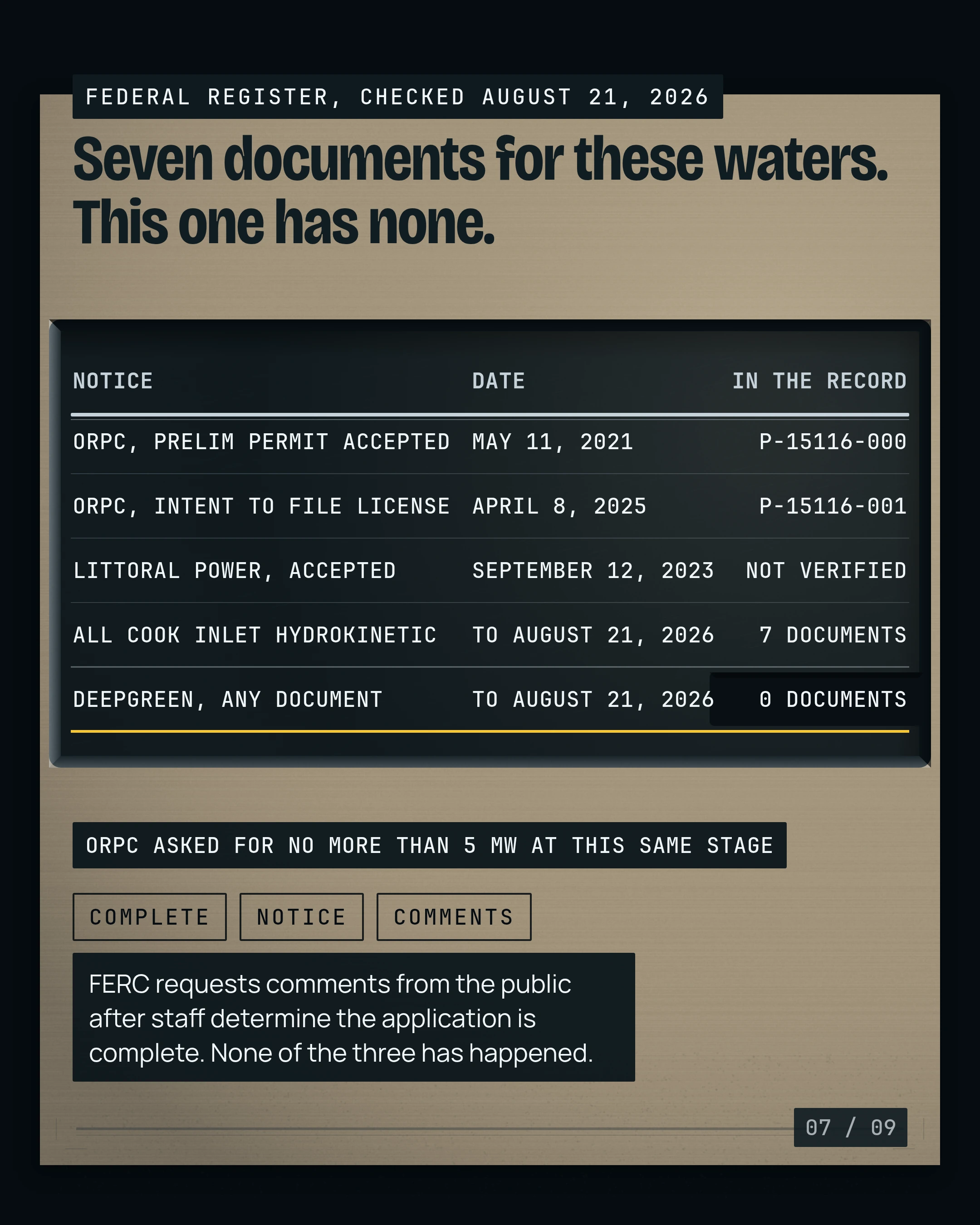
Checked August 21st, the Federal Register holds zero DeepGreen documents and seven for Cook Inlet hydrokinetic. FERC says comment comes after staff find a file complete.
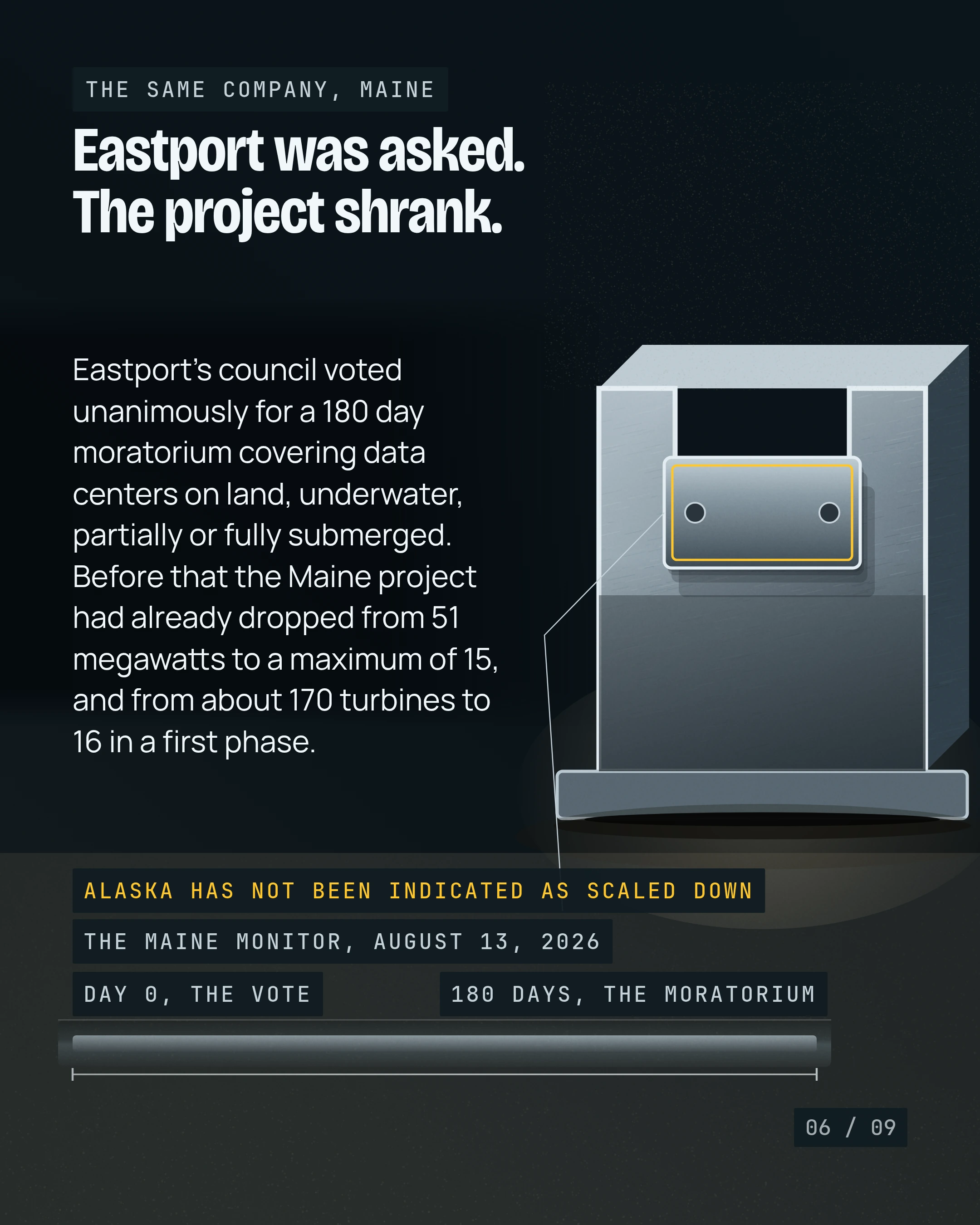
This month Eastport, Maine voted unanimously for a 180 day moratorium on the same company's proposed underwater AI data center. It had already dropped from 51 megawatts to a maximum of 15.
February's filing asked for 1,650 acres of Cook Inlet seabed and up to four years of priority to study it. Its parent had formed in January.
The deck sets 1,650 acres against Maine's 400, the empty Federal Register row, and Curtis Thayer of the Alaska Energy Authority saying nobody called.
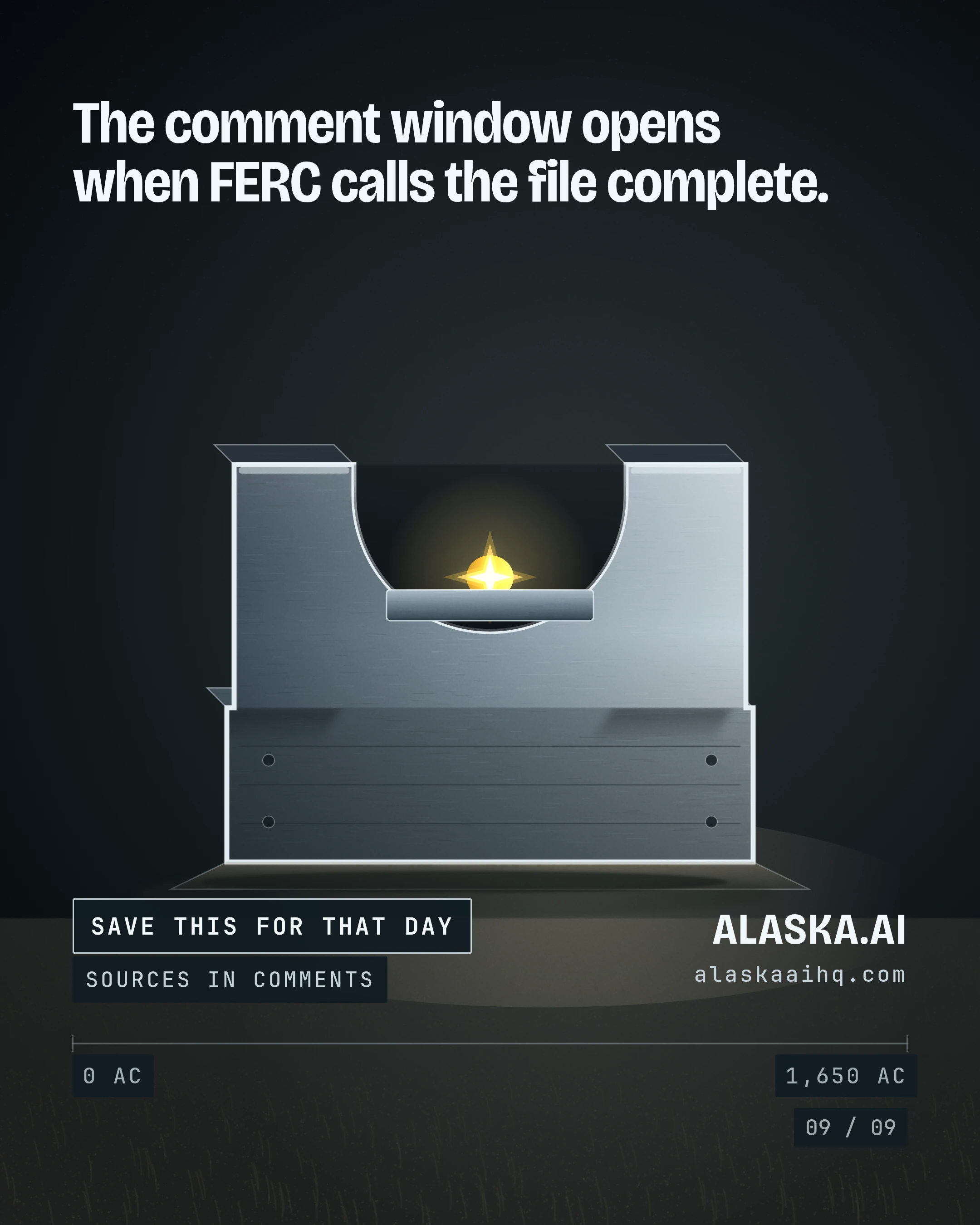
When the comment window opens on Cook Inlet, what would you want measured first?
What we verified
47 CLAIMS, EACH RE-FETCHED FROM ITS SOURCE BEFORE THIS DECK SHIPPED
A Federal Register full text search for DeepGreen returned zero documents when checked on August 21st, 2026, so FERC has published no notice accepting the Cook Inlet application for filing.
The same Federal Register search returns seven documents for the term Cook Inlet hydrokinetic, so the zero result for DeepGreen is not a failure of the search.
FERC published a notice accepting Ocean Renewable Power Company's Cook Inlet preliminary permit application for filing and soliciting comments on May 11, 2021, under Project No. 15116-000.
FERC published an Ocean Renewable Power Company Notice of Intent to File License Application soliciting comments on April 8, 2025, under Project No. 15116-001.
FERC published a Littoral Power Systems notice of preliminary permit application accepted for filing on September 12, 2023.
Ocean Renewable Power Company's East Foreland Tidal Energy Project is sited in Cook Inlet near Nikiski and adjacent lands of the Kenai Peninsula Borough.
ORPC's East Foreland pilot as described to FERC consists of a 1.75 megawatt Proteus Marine Renewables AR1750 tidal device and a 0.23 megawatt ORPC TidGen80 device.
ORPC's 2021 Cook Inlet preliminary permit application described turbine generator units with a combined capacity of no more than 5 megawatts.
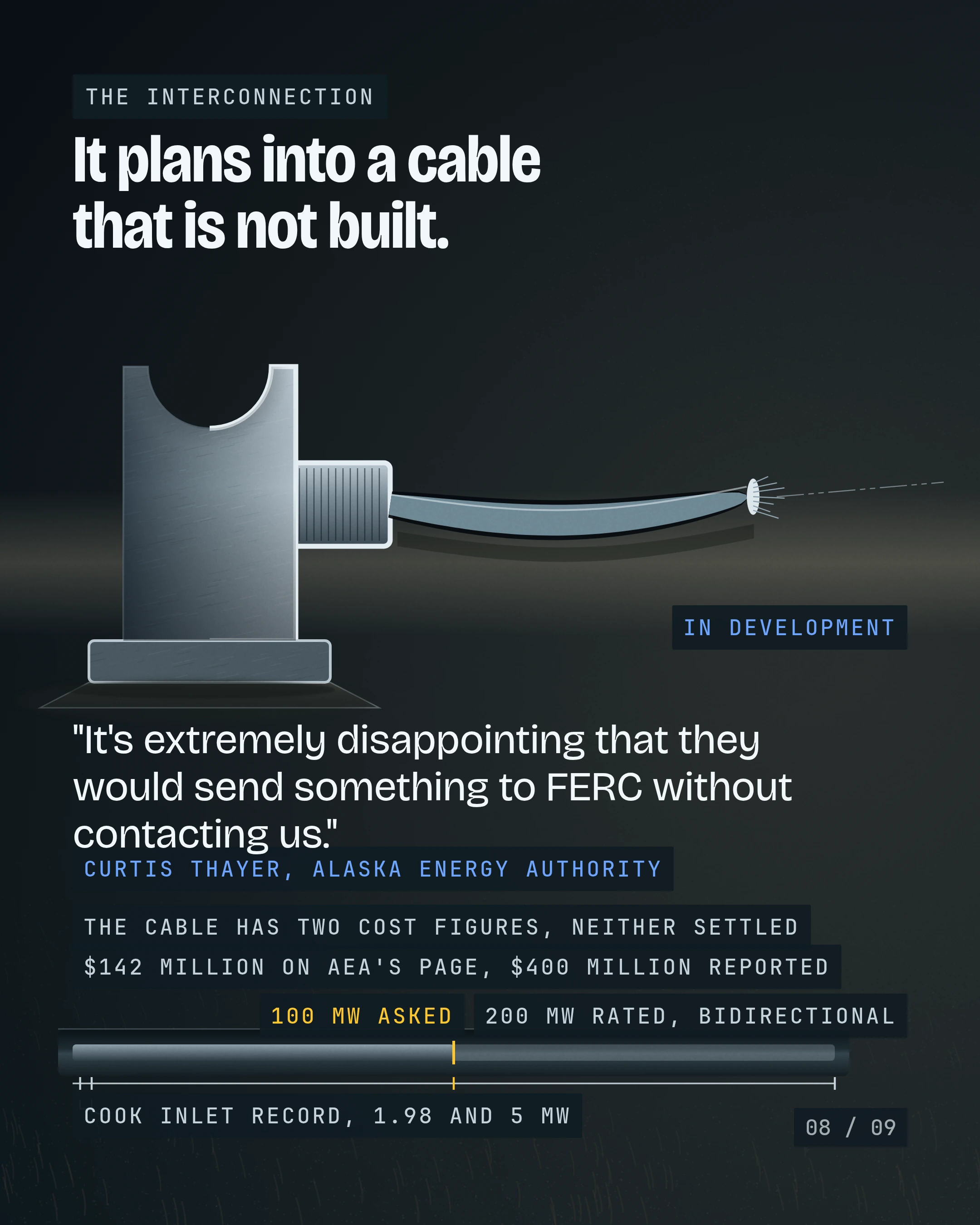
The Alaska Energy Authority's own project page states the total Cook Inlet PowerLink project cost is 142 million dollars.
The Alaska Energy Authority describes Cook Inlet PowerLink as a 38 mile subsea cable delivering up to 200 megawatts of bidirectional power transfer.
The Alaska Energy Authority lists the Cook Inlet PowerLink project status as In Development and funded for 8 years.
The East Foreland tidal project's total capacity is 1.98 megawatts.
DeepGreen Cook Inlet SPV LLC has proposed a 100 megawatt underwater data center project off the shore of Nikiski.
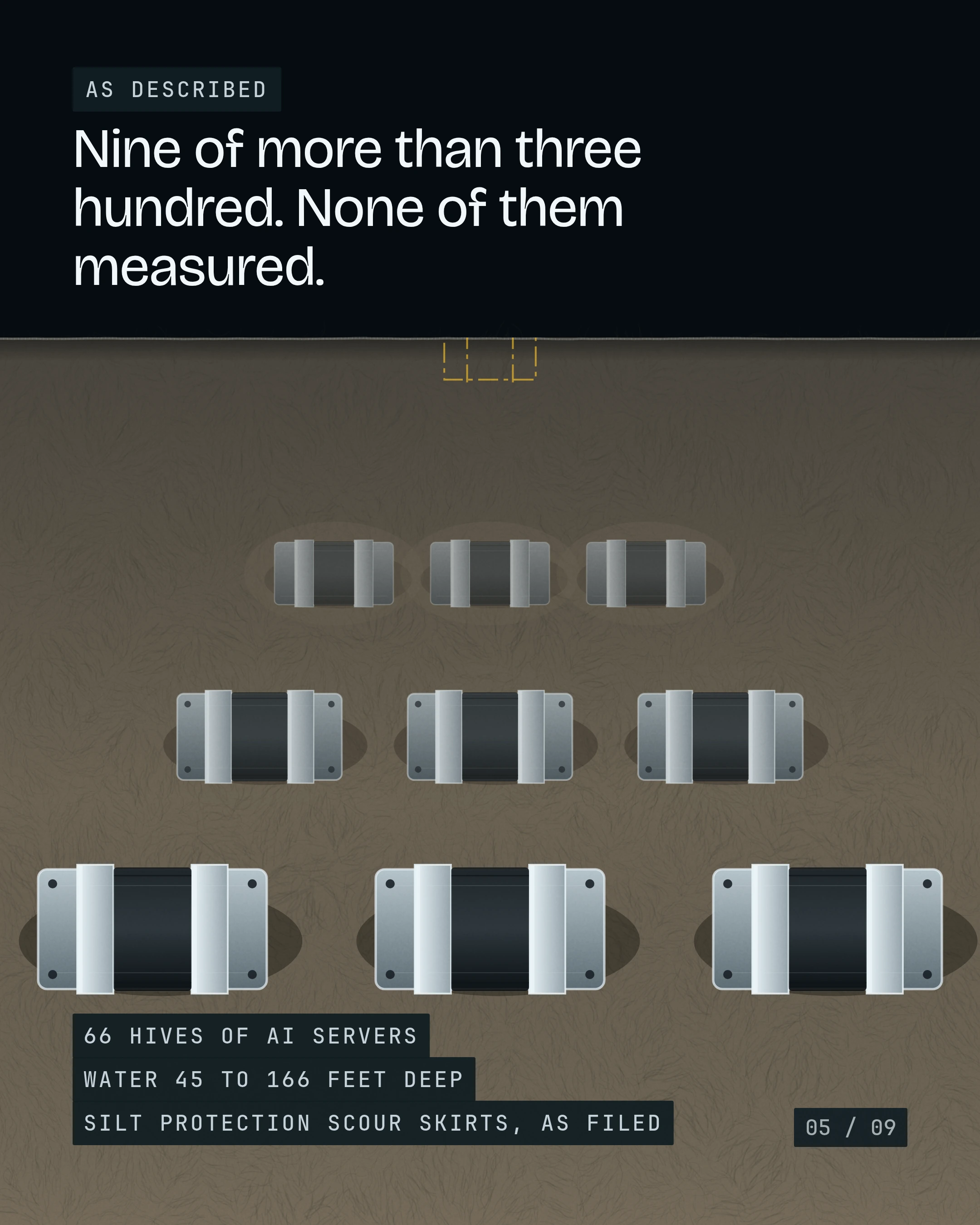
The proposal includes 66 hives housing AI servers, both powered and cooled by the water of Cook Inlet.
The February filing for the Cook Inlet project proposed approximately 330 to 350 marine hydrokinetic turbines using the company's proprietary Universal Docking Cradle system.
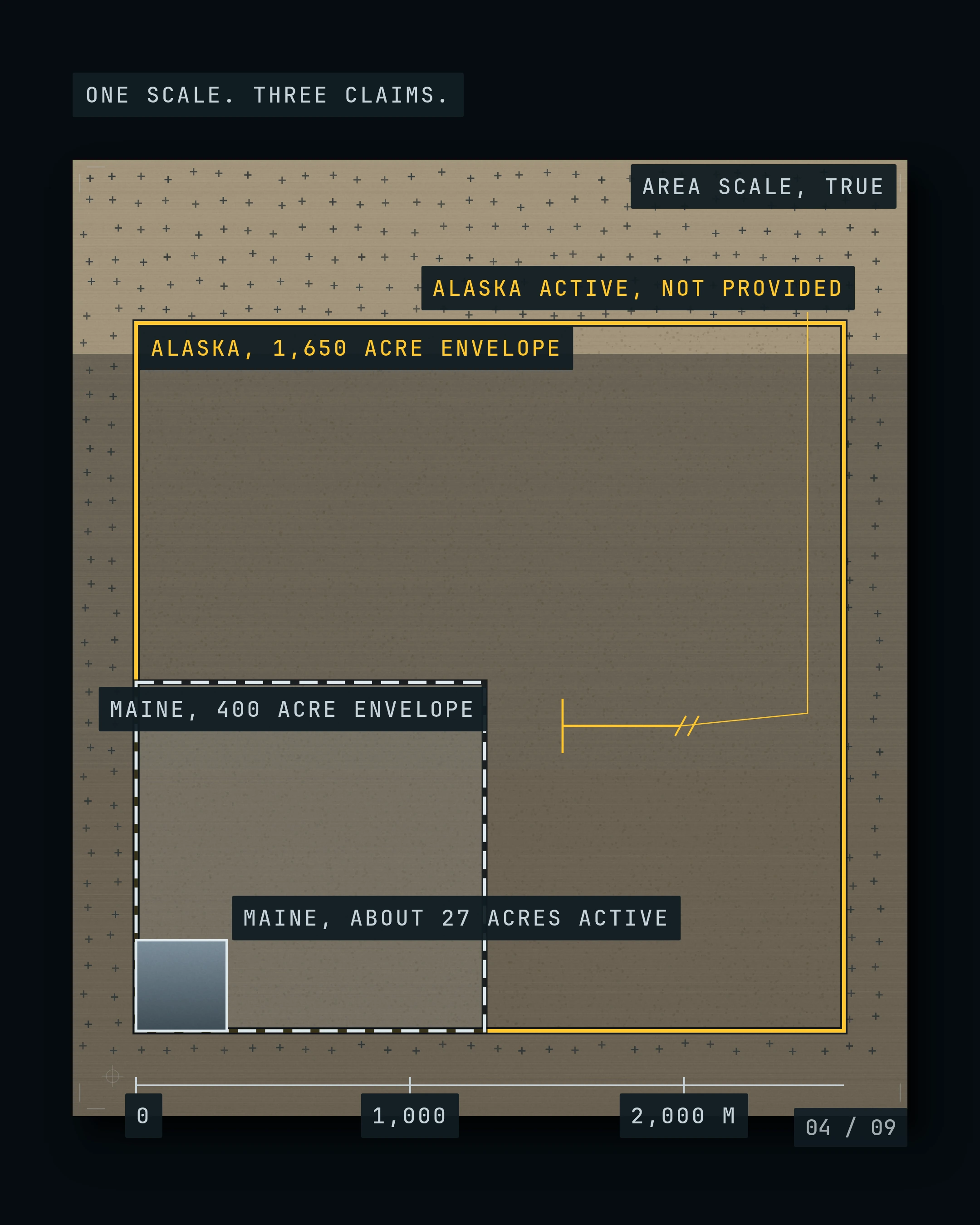
The February filing proposed an initial operational envelope of 1,650 acres in Cook Inlet.
The Cook Inlet project corridor lies west of the Nikiski shoreline in water 45 feet to 166 feet deep.
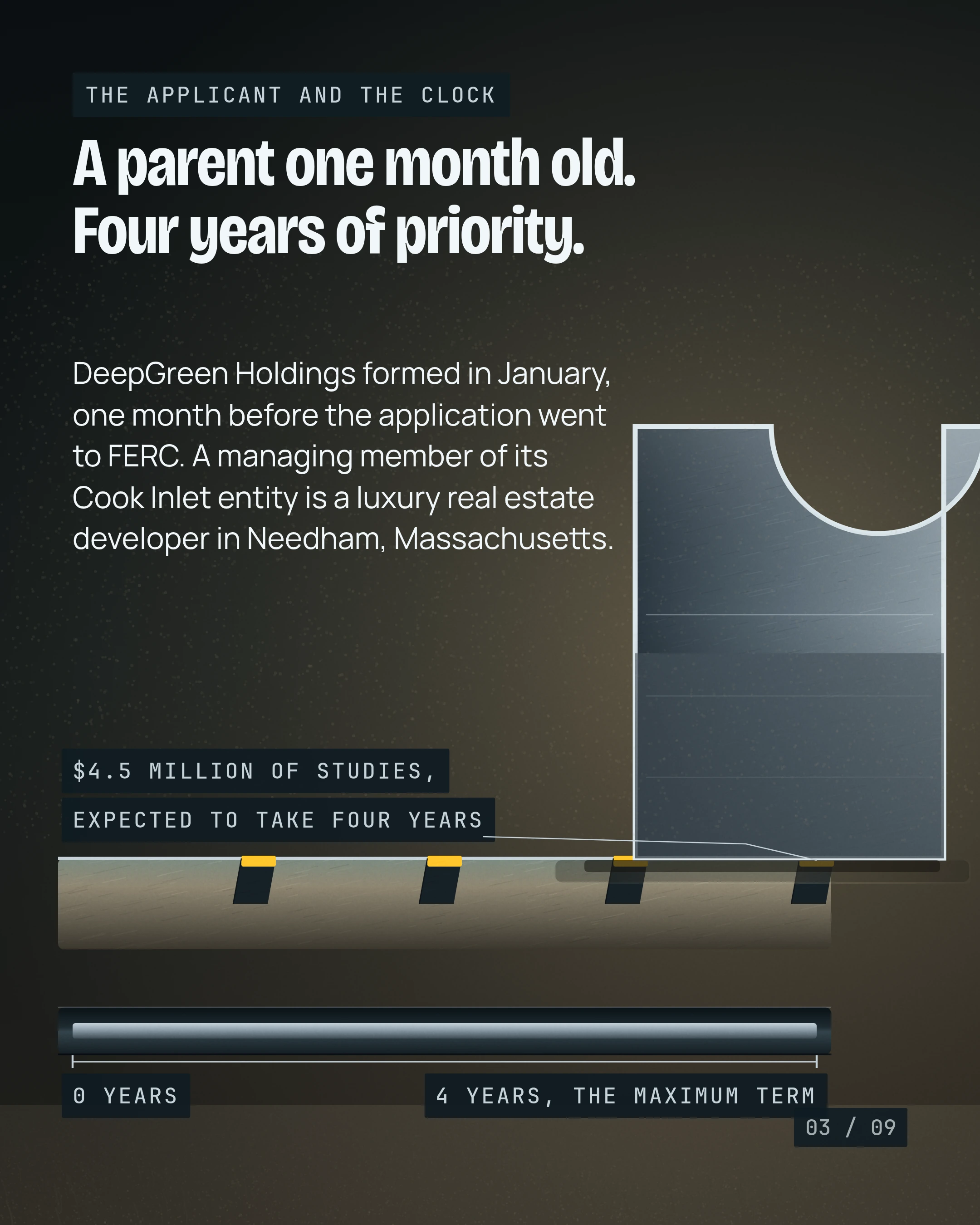
DeepGreen estimated the preliminary engineering studies at 4.5 million dollars and expects them to take four years.
The applicant is DeepGreen Cook Inlet SPV LLC, a Delaware based entity, and its parent DeepGreen Holdings LLC formed in January, one month before the FERC application was sent.
Louis Wolfson, a managing member for DeepGreen Cook Inlet, is a luxury real estate developer based in Needham, Massachusetts.
Wolfson said land based data centers face major constraints because they take up large plots of real estate, strain local power grids, and consume millions of gallons of fresh water daily for cooling.
The proposal describes silt protection scour skirts engineered to protect the infrastructure from the harsh tides.
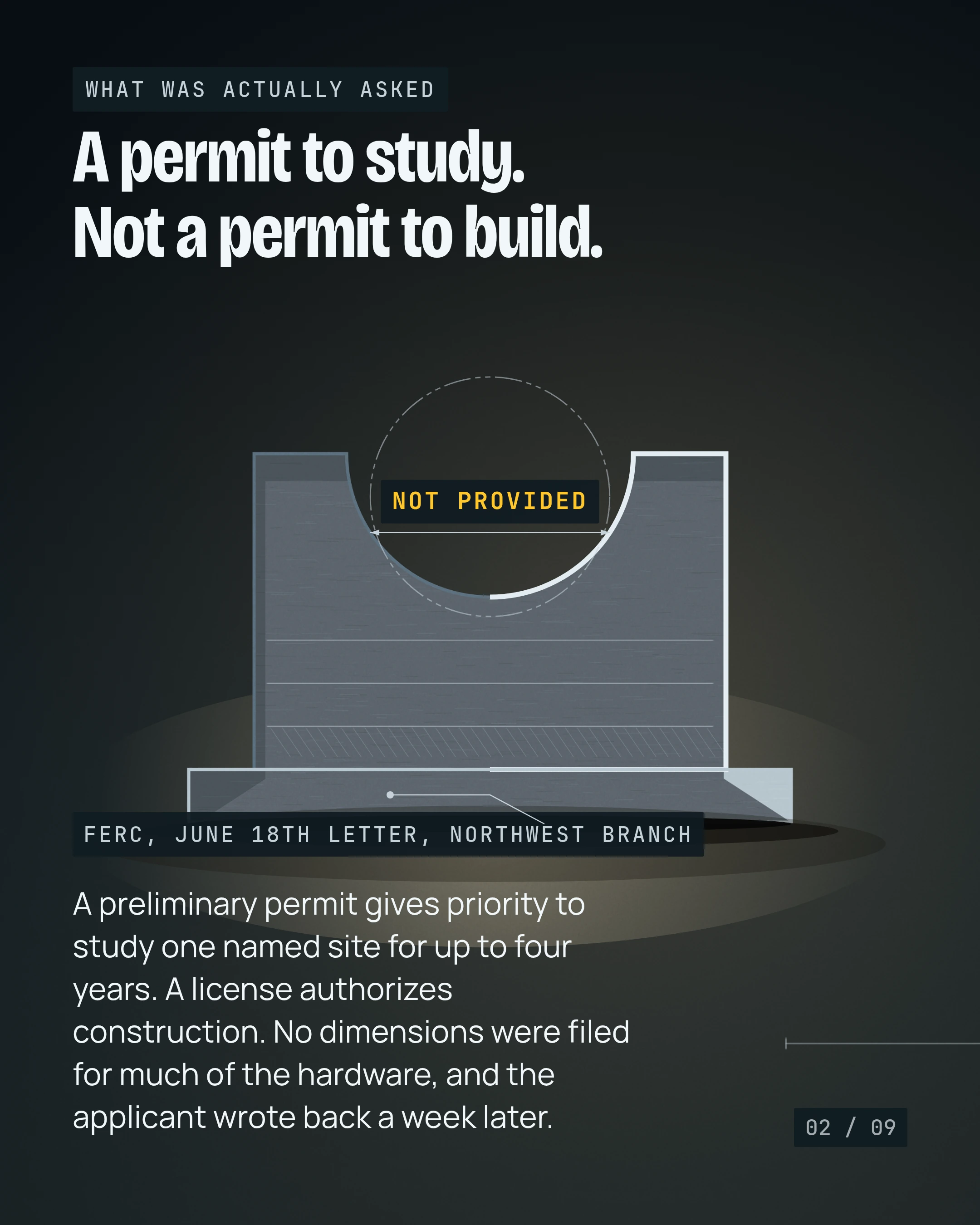
A June 18th letter from FERC's Northwest Branch Division of Hydropower Licensing found DeepGreen failed to provide the dimensions and physical composition of many of the data center's underwater infrastructure components.
FERC also found that DeepGreen did not notify the City of Kenai and failed to identify all tribes and Alaska Native corporations that may have interest in or be affected by the project.
DeepGreen corrected its mistakes in a letter sent a week later.
FERC spokesperson Celeste Miller said that after staff determine the application is complete, the commission will request comments from the public.
Alaska Energy Authority CEO Curtis Thayer said the organization had never heard of DeepGreen nor received any contact from the company.
Thayer said it is extremely disappointing that they would send something to FERC without contacting us.
Thayer said DeepGreen's letter to FERC has some of the project's facts dead wrong.
Kenai City Manager Terry Eubank said he does not know that it would be any more substantial than the oil and gas production out there, but he thinks it always has to be examined and looked at.
DeepGreen told FERC its project is designed to tie in with the Alaska Energy Authority's Cook Inlet PowerLink project, a 38 mile submarine transmission line planned between Nikiski and Beluga.
DeepGreen Western Passage SPV LLC submitted its Maine preliminary permit application to FERC on February 11th, seeking a 48 month permit.
The Maine project as originally filed was a 51 megawatt tidal energy and subsea data center with 170 turbines, estimated to cost 415 million dollars.
The original Maine filing sought 400 acres while its active infrastructure would occupy about 27 acres, roughly 7 percent of the space.
DeepGreen told FERC the Maine project's total proposed operational capacity has been scaled down to a maximum of 15 megawatts, against an earlier proposal that envisioned up to 51 megawatts.
In the revised Maine Phase I DeepGreen projects installing 16 marine hydrokinetic turbines, increasing to 34 in Phase II, against approximately 170 in the original application.
In July DeepGreen amended its Maine proposal, scaling back Phase I from 15 megawatts to 1 to 5 megawatts.
In a July 15th letter FERC requested more information from DeepGreen after finding four deficiencies in its Maine preliminary permit application.
Emily Carter, chief of FERC's New England branch in the Division of Hydropower Licensing, gave DeepGreen 45 days to respond.
One of the four Maine deficiencies was the lack of a detailed technical explanation for requesting a 400 acre operational envelope when the active infrastructure footprint is significantly smaller.
The Eastport City Council voted unanimously to enact a 180 day moratorium that halts all progress on a proposed underwater artificial intelligence data center planned for waters off Eastport.
Councilor Karen Raye moved to adopt a moratorium temporarily prohibiting any application, permit, license or approval related to the establishment, construction, expansion or operation of a commercial or industrial data center or artificial intelligence computing facility.
The Eastport moratorium specifies that facilities on land, underwater, partially or fully submerged, and any co occurring infrastructure are included in the ban.
The Maine Monitor reported that the permit application for the Alaska project received a similar letter of deficiencies from FERC but that the company has not indicated the Alaska proposal is being scaled down.
A FERC preliminary permit is issued for up to four years for projects in state waters and gives the developer priority to study a project at the specified site for the duration of the permit.
A FERC license, unlike a preliminary permit, is granted to construct and operate a hydrokinetic electric generation facility.
As of July 15th, 2026 the Northeast Ocean Data Portal counted one licensed marine hydrokinetic project in the Northeast region against five active preliminary permits and two pending applications.
Beats
This article is on Alaska data centers · Alaska power and the grid · Alaska land and permitting for AI · Defense and federal AI in Alaska. Each beat page keeps every decision and every article on that subject in one place.