Five Surfaces
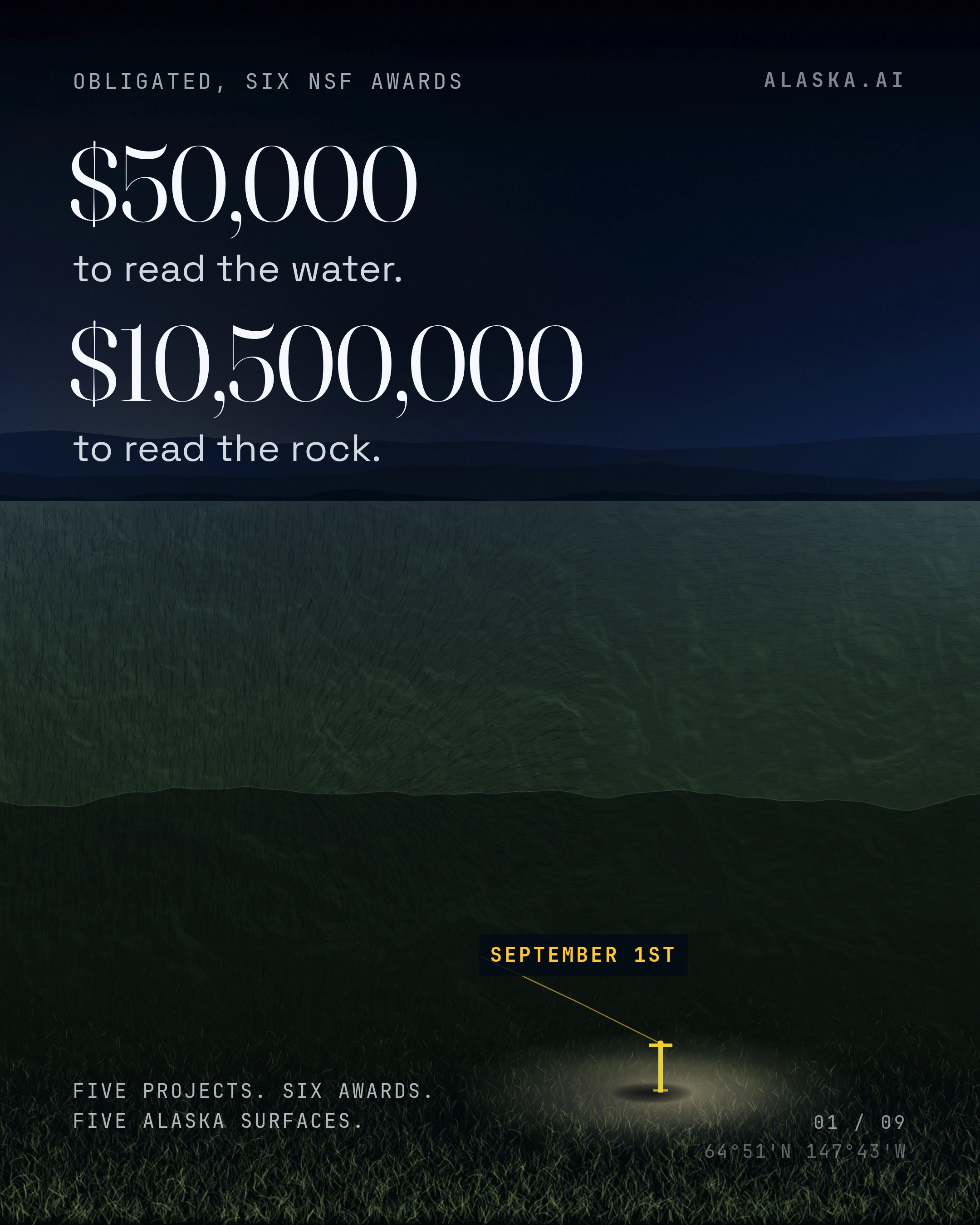
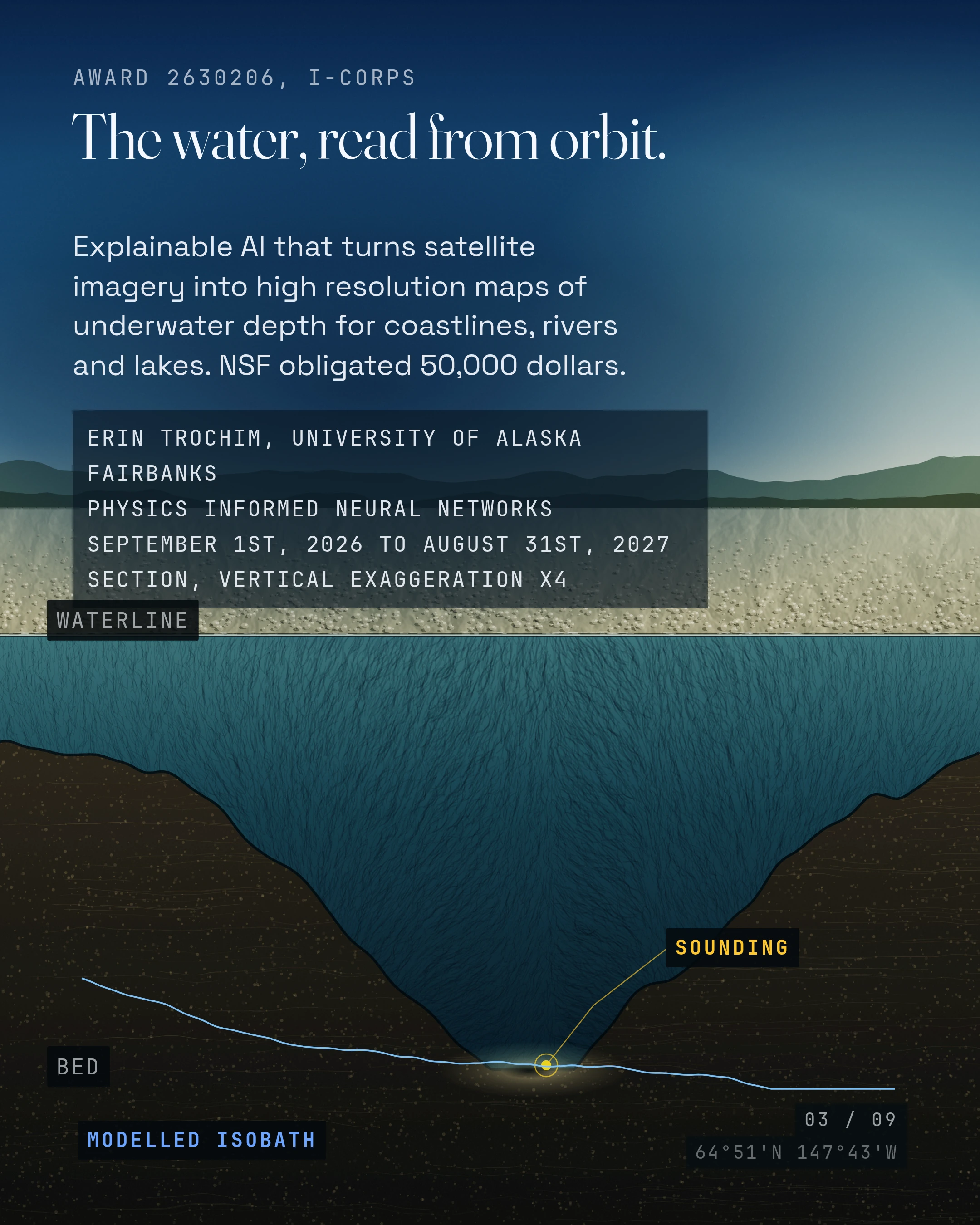
Alaska's coastlines, rivers and lakes get their depth read out of satellite imagery starting September 1st.
The deck
SWIPE, SCROLL OR CLICK A SLIDE TO GO FULLSCREEN · 9 SLIDES
The story
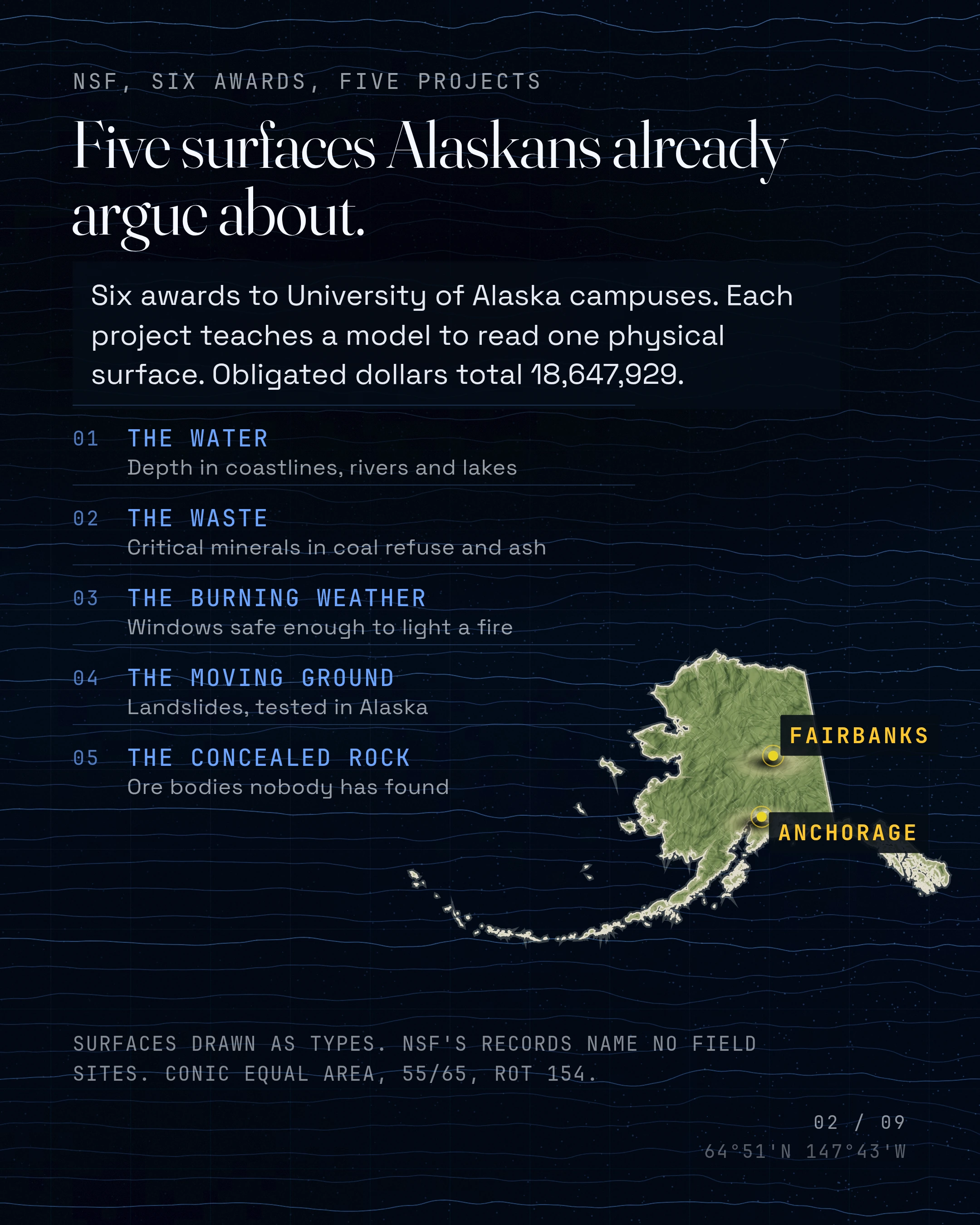
The air above them gets a model for the weather windows safe enough for a prescribed burn. The ground under them gets one that forecasts landslides. Coal refuse and ash get read for critical minerals. Concealed rock gets searched for ore nobody has found.
Six National Science Foundation awards to University of Alaska campuses obligate $18,647,929 down that column.
Each award's obligated dollars beside its end date, what the five models read, and the fifteen UAF headlines from August 9th to August 21st that name none of the six.
Erin Trochim's water award ends August 31st, 2027. The rock award runs to July 31st, 2036. Who pays to keep a model running after its award ends?
What we verified
48 CLAIMS, EACH RE-FETCHED FROM ITS SOURCE BEFORE THIS DECK SHIPPED
NSF award 2630206 is titled I-Corps Translation Potential of Explainable Artificial Intelligence (AI) for Satellite-Derived Nearshore Bathymetry and River Profiles.
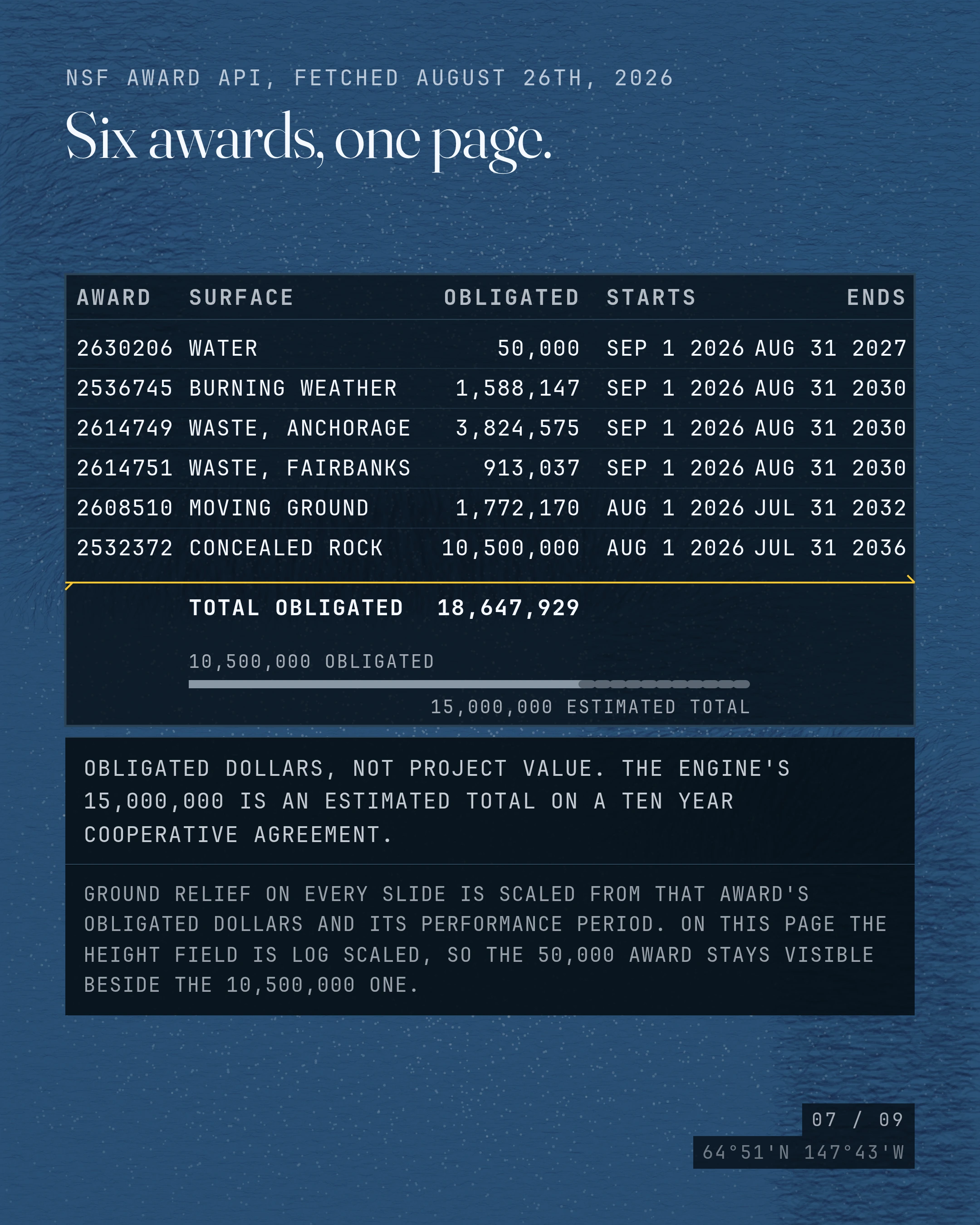
NSF obligated 50,000 dollars to award 2630206 in fiscal year 2026.
NSF dated award 2630206 August 19, 2026.
Award 2630206 has a performance period running September 1, 2026 to August 31, 2027.
Erin Trochim of the University of Alaska Fairbanks is the principal investigator on award 2630206.
The abstract for award 2630206 says the project develops explainable artificial intelligence that converts satellite imagery into high resolution maps of underwater depth for coastlines, rivers and lakes.
The abstract for award 2630206 says the framework combines physics informed neural networks with interpretable architectures.
NSF filed award 2630206 under the program element ARTIFICIAL INTELL and COGNIT SCI.
NSF obligated 3,824,575 dollars to the University of Alaska Anchorage under award 2614749.
NSF obligated 913,037 dollars to the University of Alaska Fairbanks under award 2614751.
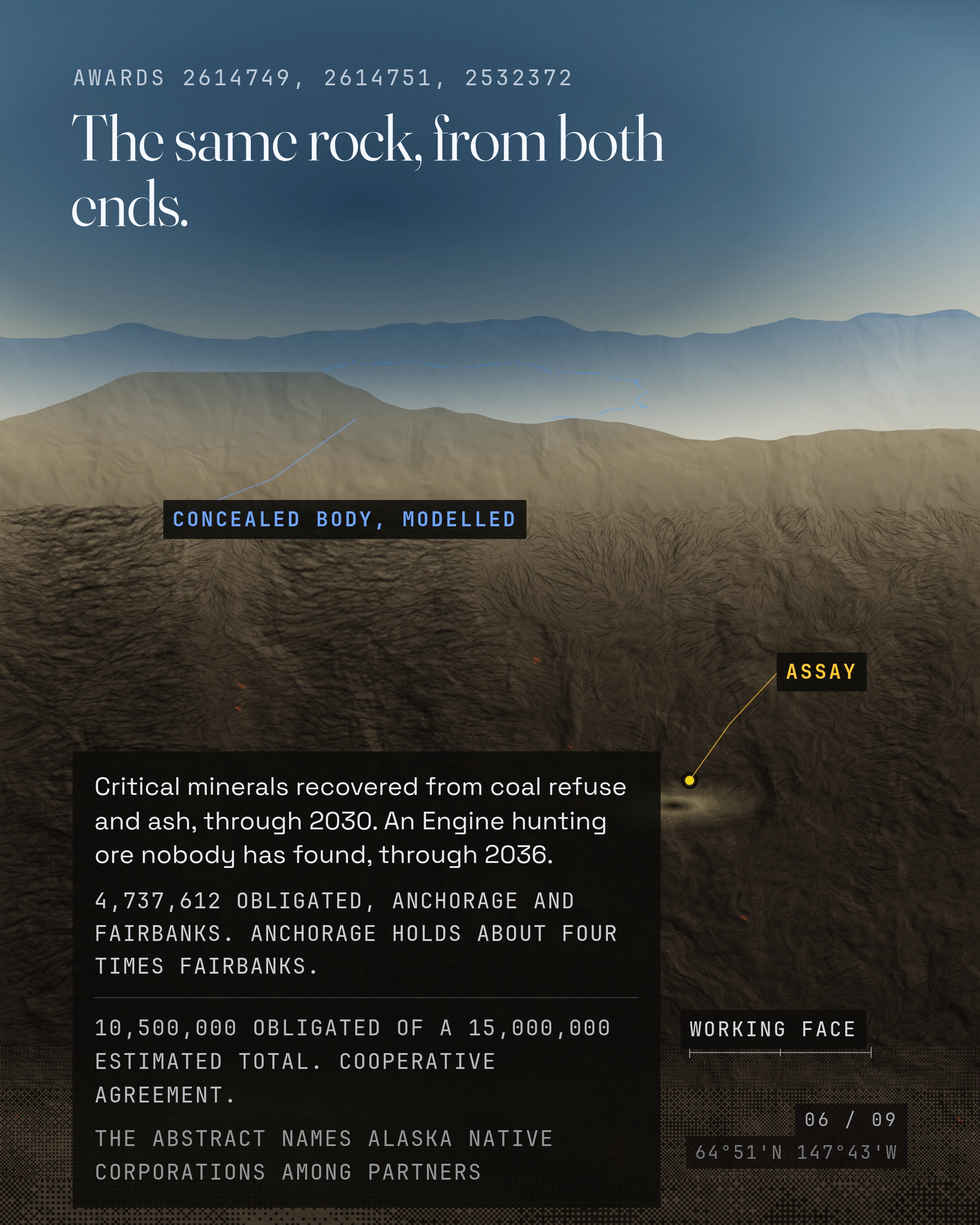
Awards 2614749 and 2614751 carry the identical project title, Collaborative Research FEC Transformative Bioprocessing and AI-Driven Frameworks for Sustainable Critical Mineral Recovery.
The two critical mineral awards together obligate 4,737,612 dollars.
Anchorage holds the larger of the two critical mineral awards, taking about four times what Fairbanks takes.
The critical mineral abstract says the initiative is led by the University of Alaska Anchorage in partnership with the University of Alaska Fairbanks, Montana Technological University and the University of Wyoming.
NSF dated both critical mineral awards August 5, 2026.
Both critical mineral awards run September 1, 2026 to August 31, 2030.
Brandon Briggs is the principal investigator on the Anchorage critical mineral award.
Srijan Aggarwal is the principal investigator on the Fairbanks critical mineral award.
The critical mineral abstract says the project applies reinforcement learning controllers within a bioprocess digital twin integrated with microgrid simulators.
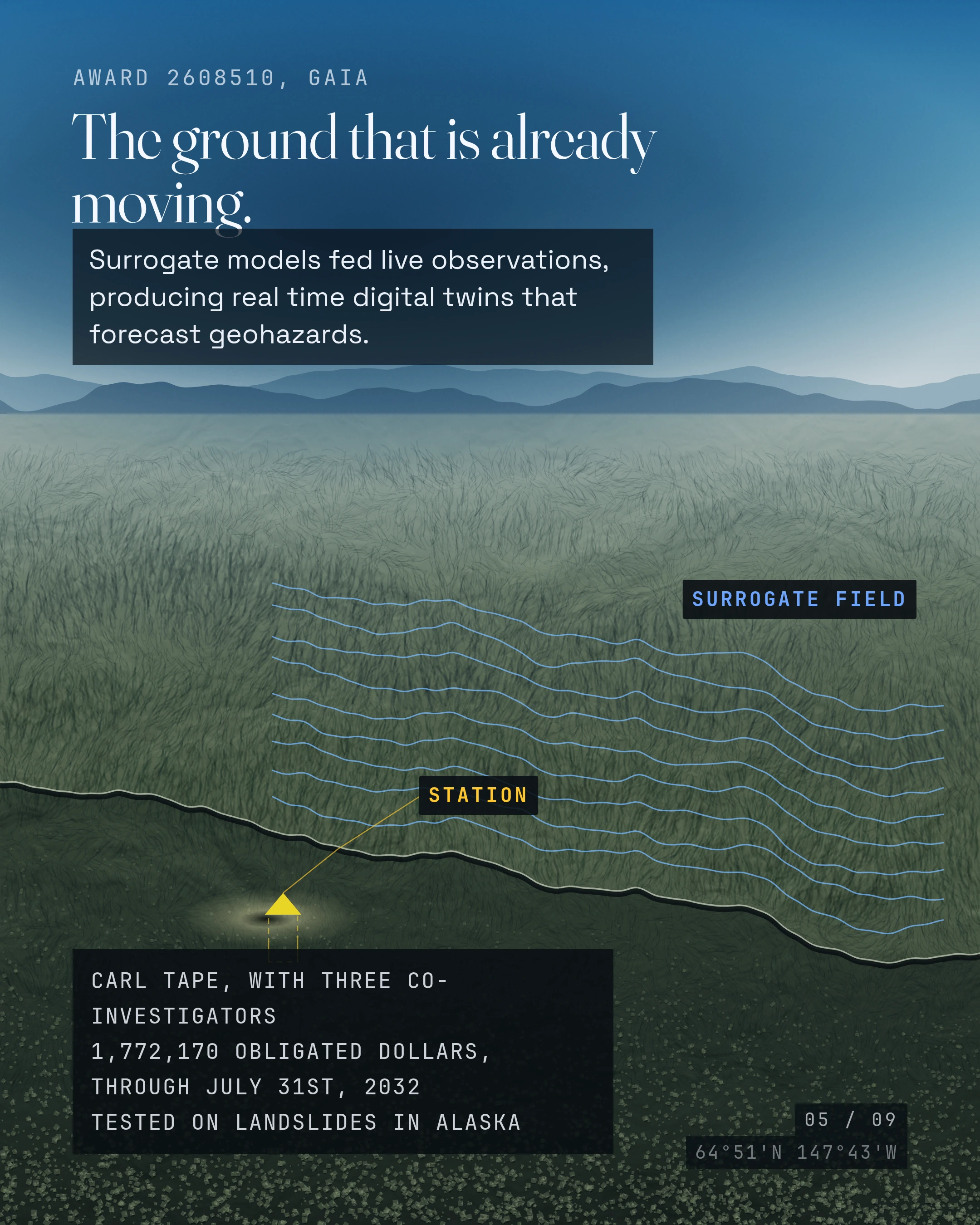
NSF award 2608510 is titled Collaborative Research Frameworks Geophysical AI-driven Integration and Assimilation GAIA.
NSF obligated 1,772,170 dollars to the University of Alaska Fairbanks for GAIA.
NSF dated the GAIA award July 10, 2026 and it runs August 1, 2026 to July 31, 2032.
Carl Tape is the principal investigator on GAIA.
GAIA lists three co-principal investigators, Michael West, Franz Meyer and Ronni Grapenthin, all at alaska.edu addresses.
The GAIA abstract says the team trains fast surrogate models coupled to incoming observations to produce real time digital twins that forecast geohazards.
The GAIA abstract says the investigators test the full system on landslides in Alaska and the Pacific Northwest.
NSF award 2532372 is titled NSF Critical Mineral Accelerator Engine in Alaska and is held by the University of Alaska Fairbanks.
The Engine award carries an estimated total amount of 15,000,000 dollars.
NSF has obligated 10,500,000 dollars of the Engine award in fiscal year 2026.
The Engine award runs August 1, 2026 to July 31, 2036, a ten year period.
The Engine is a cooperative agreement rather than a standard grant.
Lee Munk is the principal investigator on the Engine award.
The Engine abstract says the project intends to integrate geological, geochemical, geophysical, remote sensing and legacy data into AI based systems to identify concealed mineral deposits.
The Engine abstract says methods will combine data integration, machine learning and uncertainty analysis with laboratory experiments and field validation.
A co-principal investigator on the Engine award is listed at a nana.com email address.
The Engine abstract says coordinated partnerships among academia, Alaska Native Corporations, industry, tech start ups, national laboratories, state and federal agencies and nonprofits will align research with operational needs.
The six awards obligate 18,647,929 dollars in total.
Every one of the six awards has a performance start date of either August 1, 2026 or September 1, 2026.
The five projects expire on four different dates spanning August 31, 2027 to July 31, 2036.
An NSF award API query for Alaska awardees with award dates from August 16, 2026 to August 26, 2026 returns exactly two records.
One of the two Alaska awards in that ten day window is the AI bathymetry award and the other is a mathematical biology award on phylogenetic networks.
The other Alaska award in that window obligates 289,888 dollars to the University of Alaska Fairbanks.
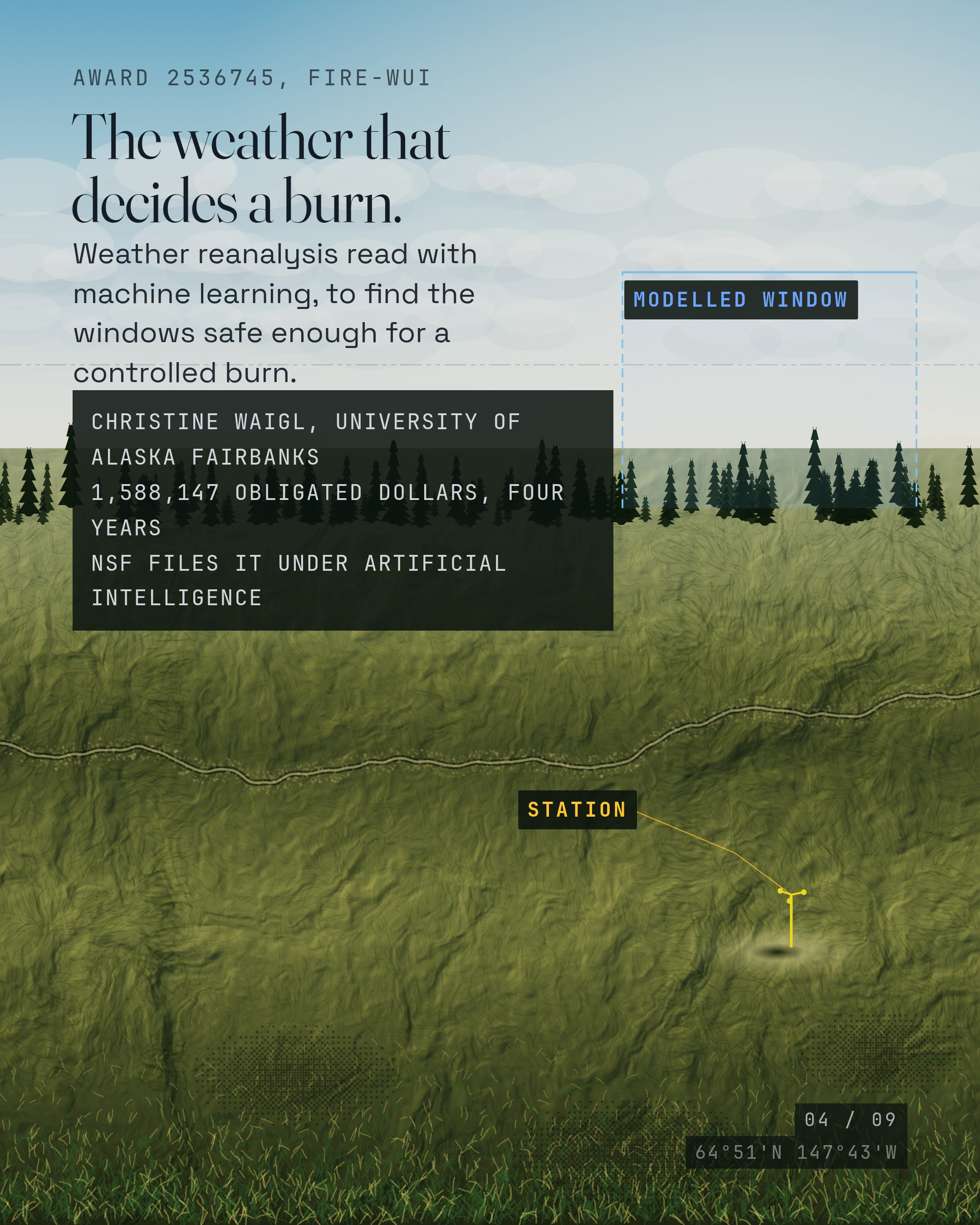
The abstract for NSF award 2536745 says the research team will use statistical and machine learning techniques to characterize the geographic and seasonal patterns of hazardous fire weather across Alaska.
NSF classifies the Alaska fire weather toolkit award under the program Artificial Intelligence (AI).
NSF obligated 1,588,147 dollars to the University of Alaska Fairbanks for the fire weather toolkit award, which runs September 1, 2026 to August 31, 2030.
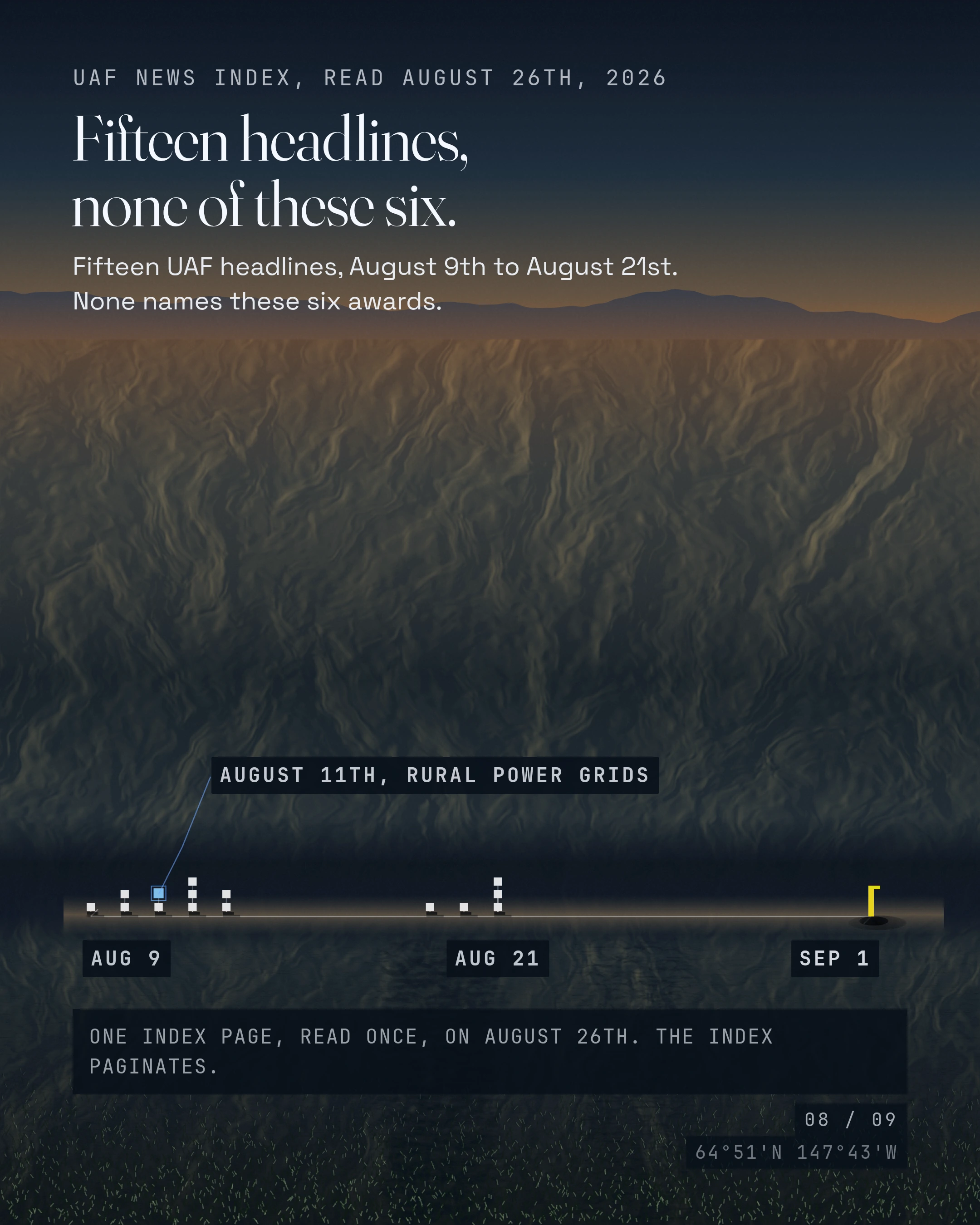
The UAF news index for August 9, 2026 to August 21, 2026 carries fifteen headlines and none of them names any of these six awards. The fifteen, newest first, are, Veteran journalist and author joins UAF as Snedden chair, 2026-08-21; Alaska Defense Forum 2026 focuses on community-military ties, 2026-08-21; Uncorking the secrets of a tiny bottle of volcanic ash, 2026-08-21; Shapes of Western Alaska bays influence local flood danger, 2026-08-20; Expanded UAF, military partnership looks north, 2026-08-19; Faudree, Sikes, Shallcross named 2026 Usibelli Award winners, 2026-08-13; Time capsule, Looking for a few good wood frogs, 2026-08-13; Accelerated rates of warming in the Arctic continue, 2026-08-12; 100,000 dollar planetarium gift celebrates alumni association centennial, 2026-08-12; Festival will satisfy currant curiosity, 2026-08-12; UAF leads AI project to strengthen Alaska's rural power grids, 2026-08-11; How do Alaska animals sleep in the summer?, 2026-08-11; New instrument will aid environmental science and industry, 2026-08-10; Tickets available for UAF Business Leader of the Year event, 2026-08-10; Week's events, Robert Hannon, sleep, Alaska Native language archive, string band, 2026-08-09.
The same UAF news index carries a separate artificial intelligence headline dated August 11, 2026 about rural power grids.
Alaska's 2026 wildfire season formally ends August 31st, the day before the fire weather award's performance period begins.
Beats
This article is on Alaska power and the grid · Alaska AI research and science. Each beat page keeps every decision and every article on that subject in one place.