One Race Late. The limit and the money it missed.
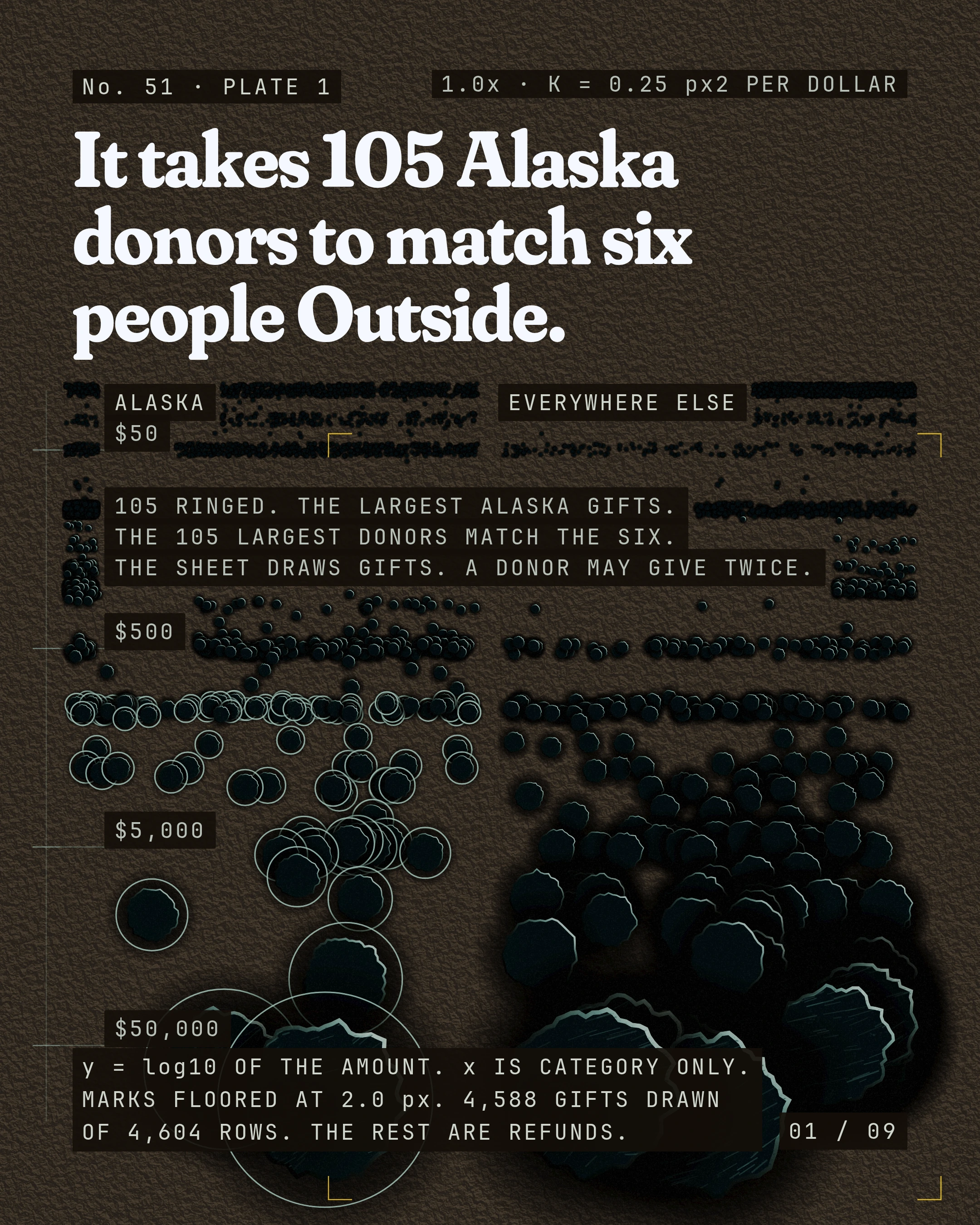
105 top Alaska donors match what six Bay Area donors gave governor candidate Jonathan Kreiss-Tomkins.
The deck
SWIPE, SCROLL OR CLICK A SLIDE TO GO FULLSCREEN · 9 SLIDES
The story
A disclosure. This deck was produced by an automated studio running on Claude, a model made by Anthropic, and it reports on donations by six people who list Anthropic as their employer. The company gave nothing and no company statement about the donations is reported. Every figure here is arithmetic over the State of Alaska's own disclosure rows, recomputed twice by separate code, and an adversarial fact-check dropped twelve claims before publication.
Six people who list Anthropic as their employer gave $372,000 between February 3rd and May 7th. The company gave nothing. The median Alaska gift in that record is $50. All of it was lawful. Alaska has had no individual contribution limit since a federal appeals court ruling in 2021. The money went to the candidate proposing a data center moratorium. On August 18th Alaskans voted 117,962 to 45,418 to restore limits. Alaska Public Media reported the measure would take effect after the November general election.
One sheet holds every gift in the 2026 record, photographed nine times, down to the inside of a single deposit.
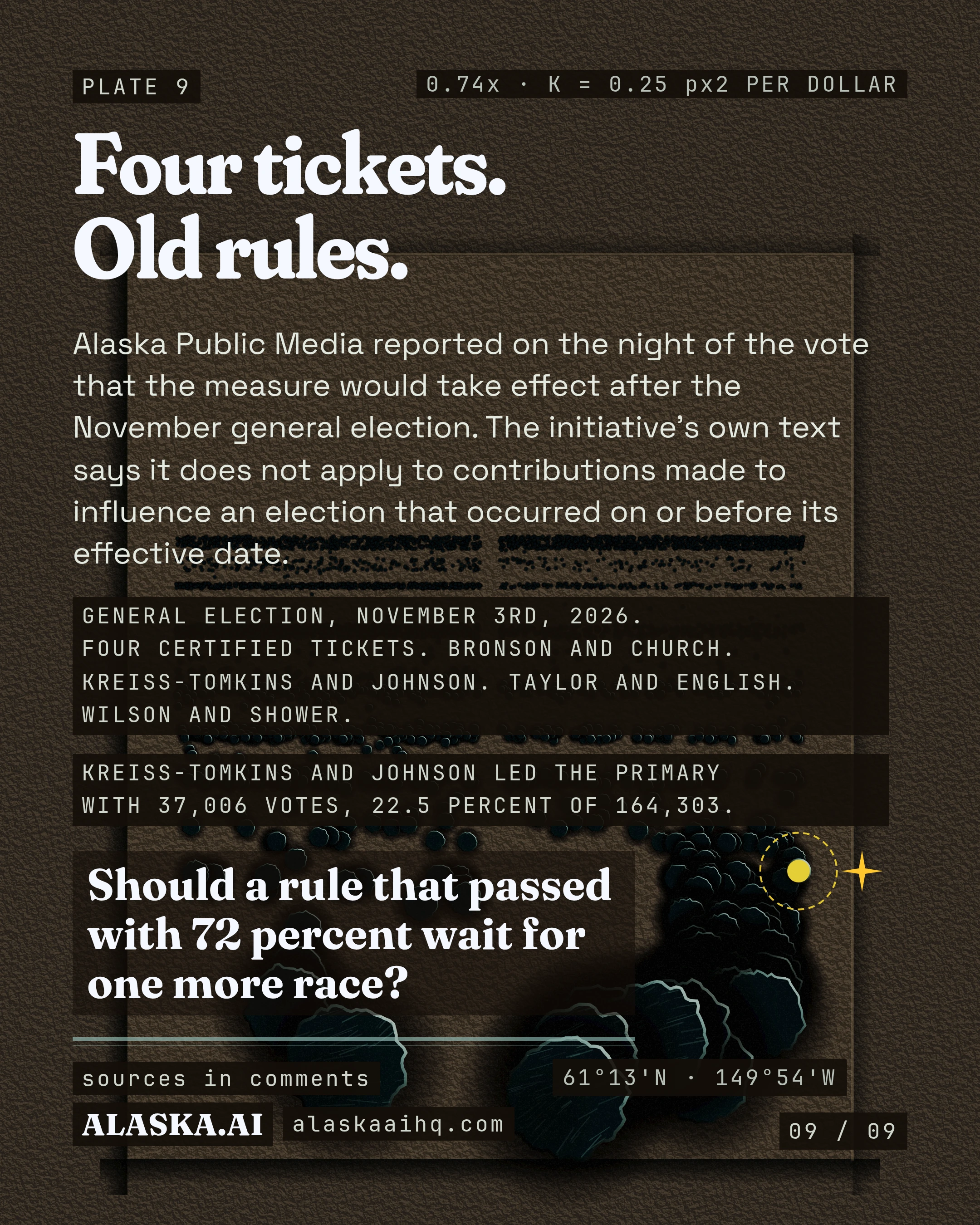
Should a rule that passed with 72 percent wait for one more race?
What we verified
46 CLAIMS, EACH RE-FETCHED FROM ITS SOURCE BEFORE THIS DECK SHIPPED
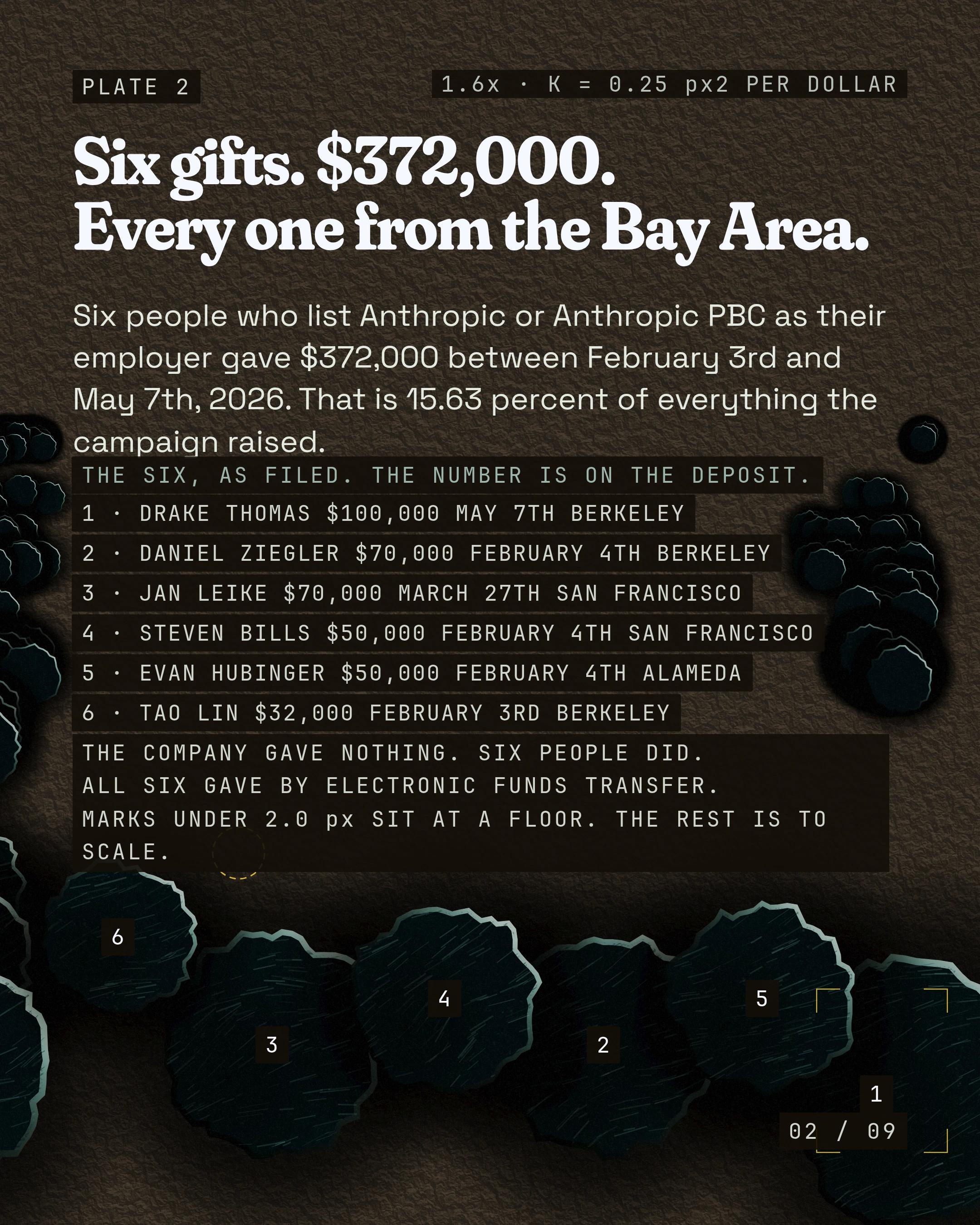
Drake Thomas of Berkeley, California, who lists Anthropic as his employer and Member of Technical Staff as his occupation, gave the Kreiss-Tomkins campaign $100,000 on May 7th, 2026 by electronic funds transfer.
Daniel Ziegler of Berkeley, California, who lists Anthropic PBC as his employer and Machine Learning Researcher as his occupation, gave $70,000 on February 4th, 2026.
Jan Leike of San Francisco, California, who lists Anthropic as his employer and Technical Staff as his occupation, gave $70,000 on March 27th, 2026.
Steven Bills of San Francisco, California, who lists Anthropic as his employer and AI Researcher as his occupation, gave $50,000 on February 4th, 2026.
Evan Hubinger of Alameda, California, who lists Anthropic as his employer and Research Scientist as his occupation, gave $50,000 on February 4th, 2026.
Tao Lin of Berkeley, California, who lists Anthropic as his employer and Technical Staff Member as his occupation, gave $32,000 on February 3rd, 2026.
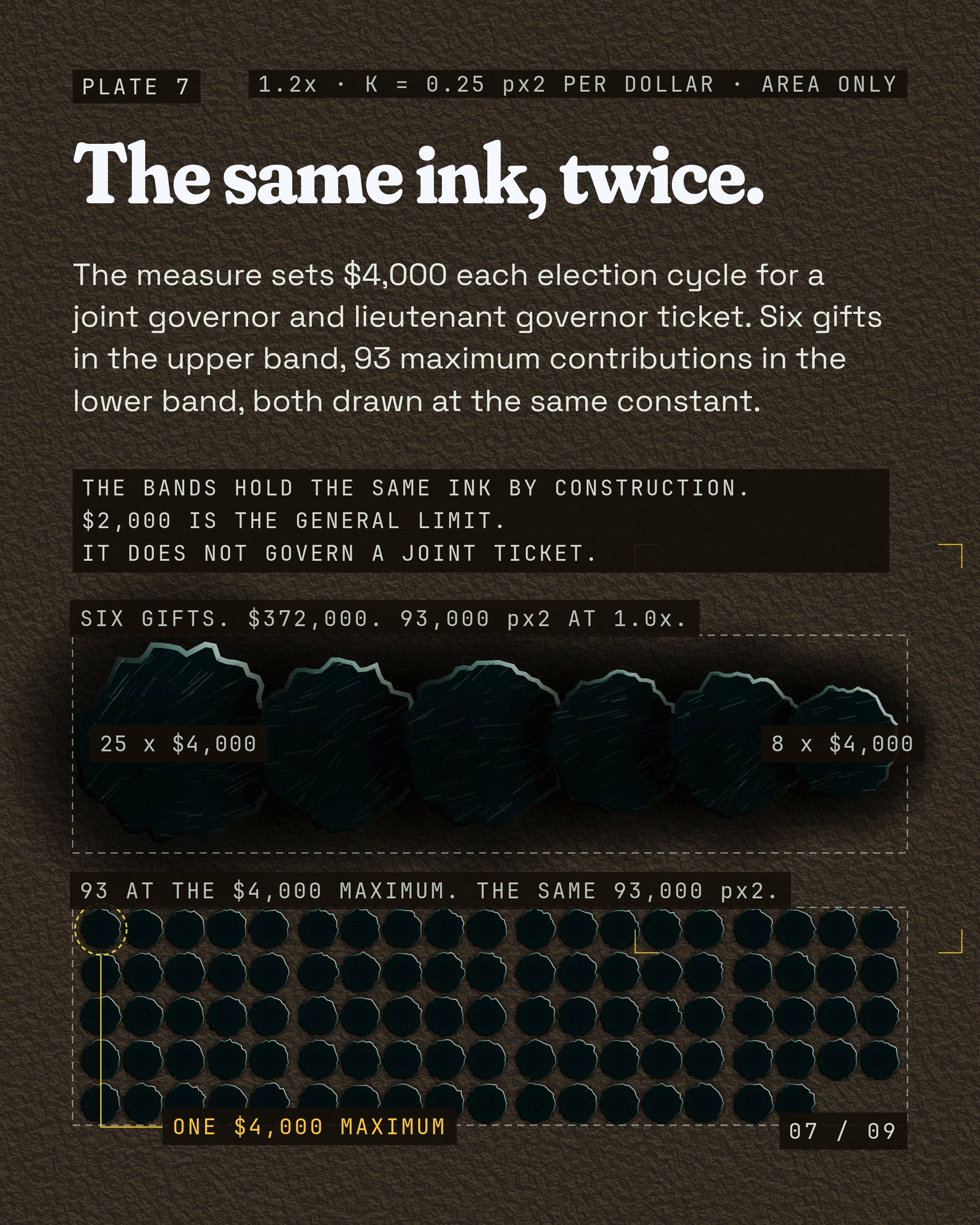
The six gifts from people who list Anthropic or Anthropic PBC as their employer total $372,000.
All six of those gifts arrived by electronic funds transfer.
All six donors list San Francisco Bay Area addresses, three in Berkeley, two in San Francisco and one in Alameda.
The six gifts were made between February 3rd and May 7th, 2026, every one of them before the August 18th primary.
The campaign's 2026 disclosure record holds 4,604 transactions totalling $2,379,290.20, which makes the six gifts 15.63 percent of everything it raised.
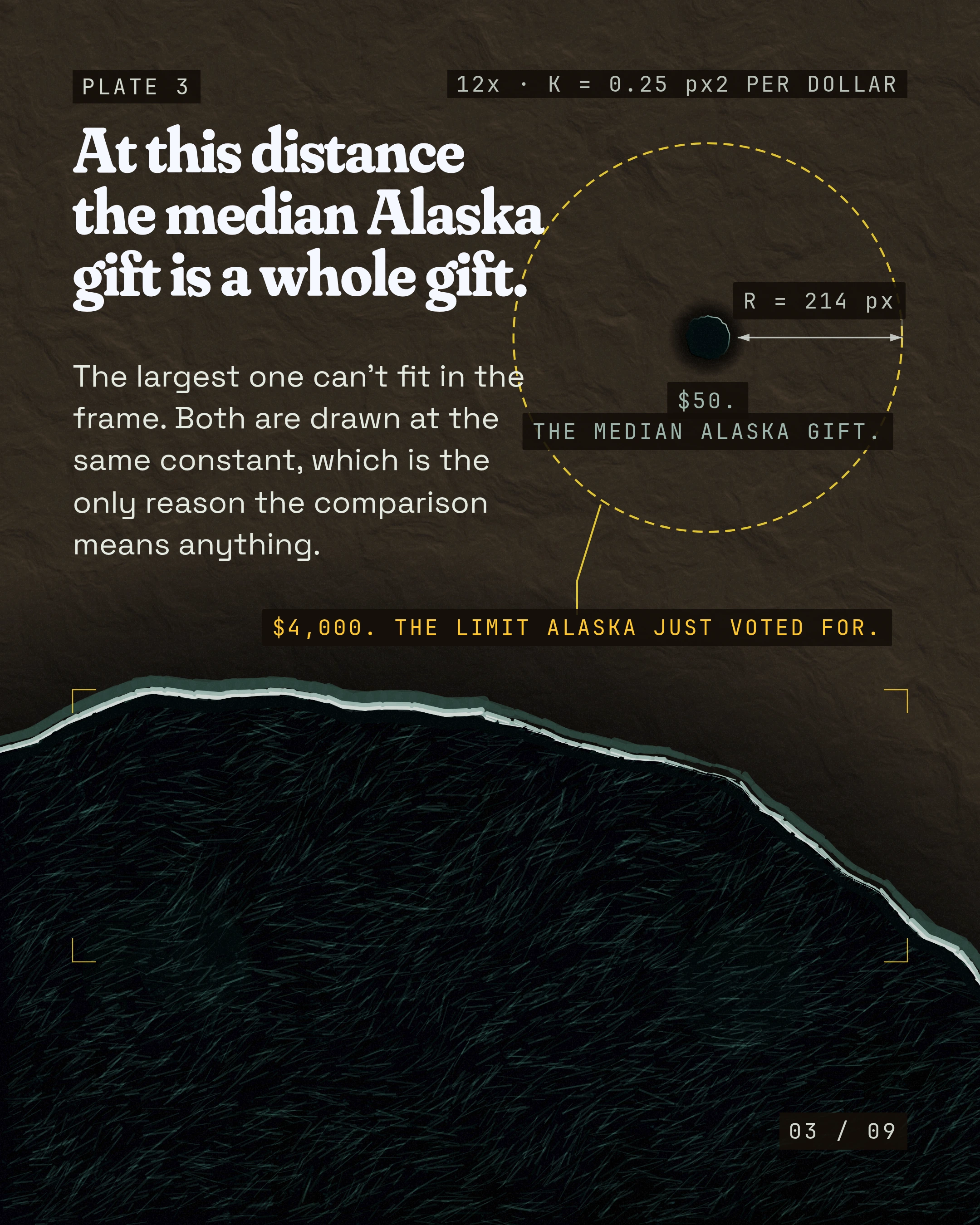
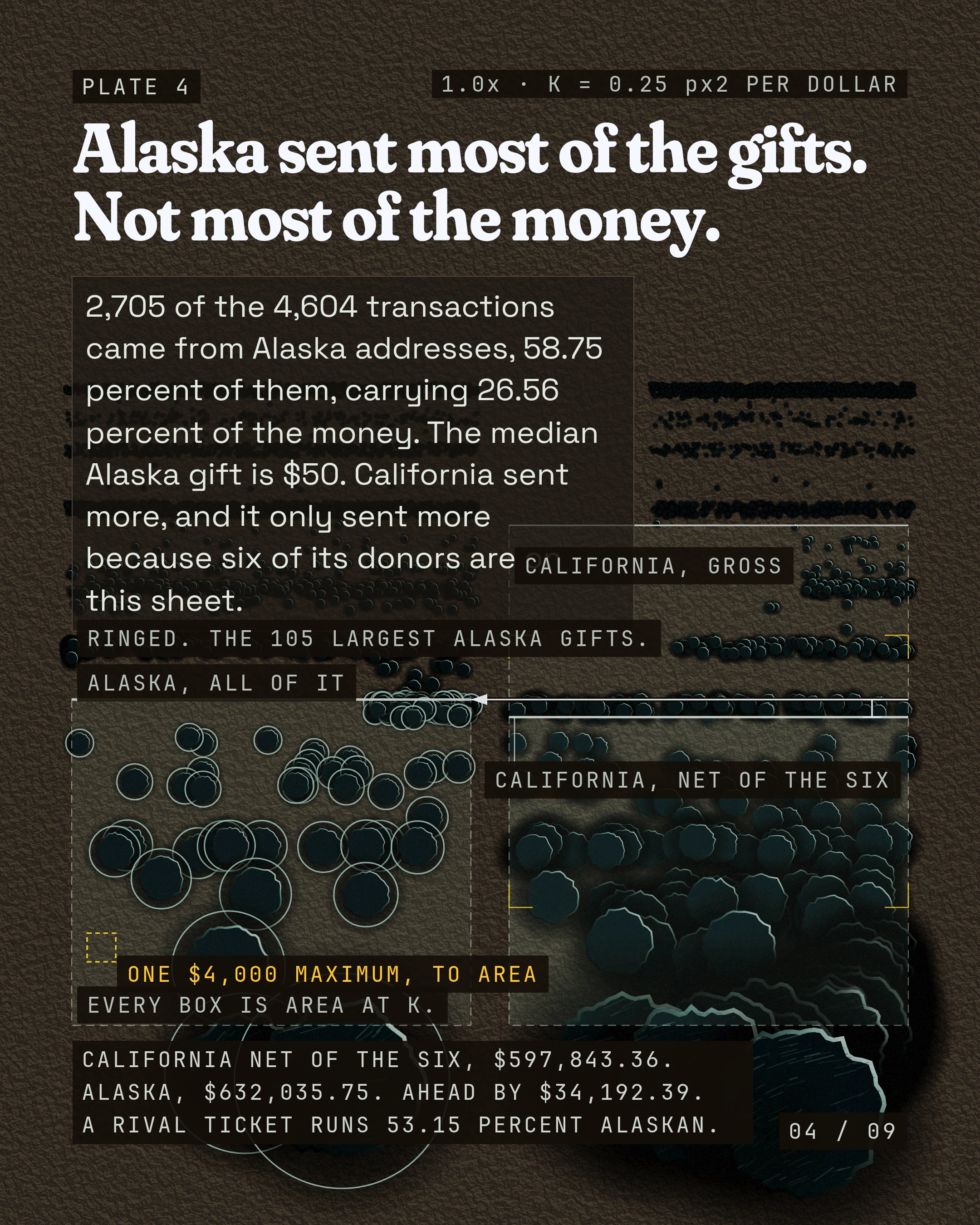
Alaska addresses supplied 2,705 of the 4,604 gifts, 58.75 percent of the count, and $632,035.75, 26.56 percent of the money. The median Alaska gift is $50.
California addresses supplied $969,843.36, more than Alaska's $632,035.75, and that gap exists because of the six gifts. Net of them California supplied $597,843.36, which is less than Alaska.
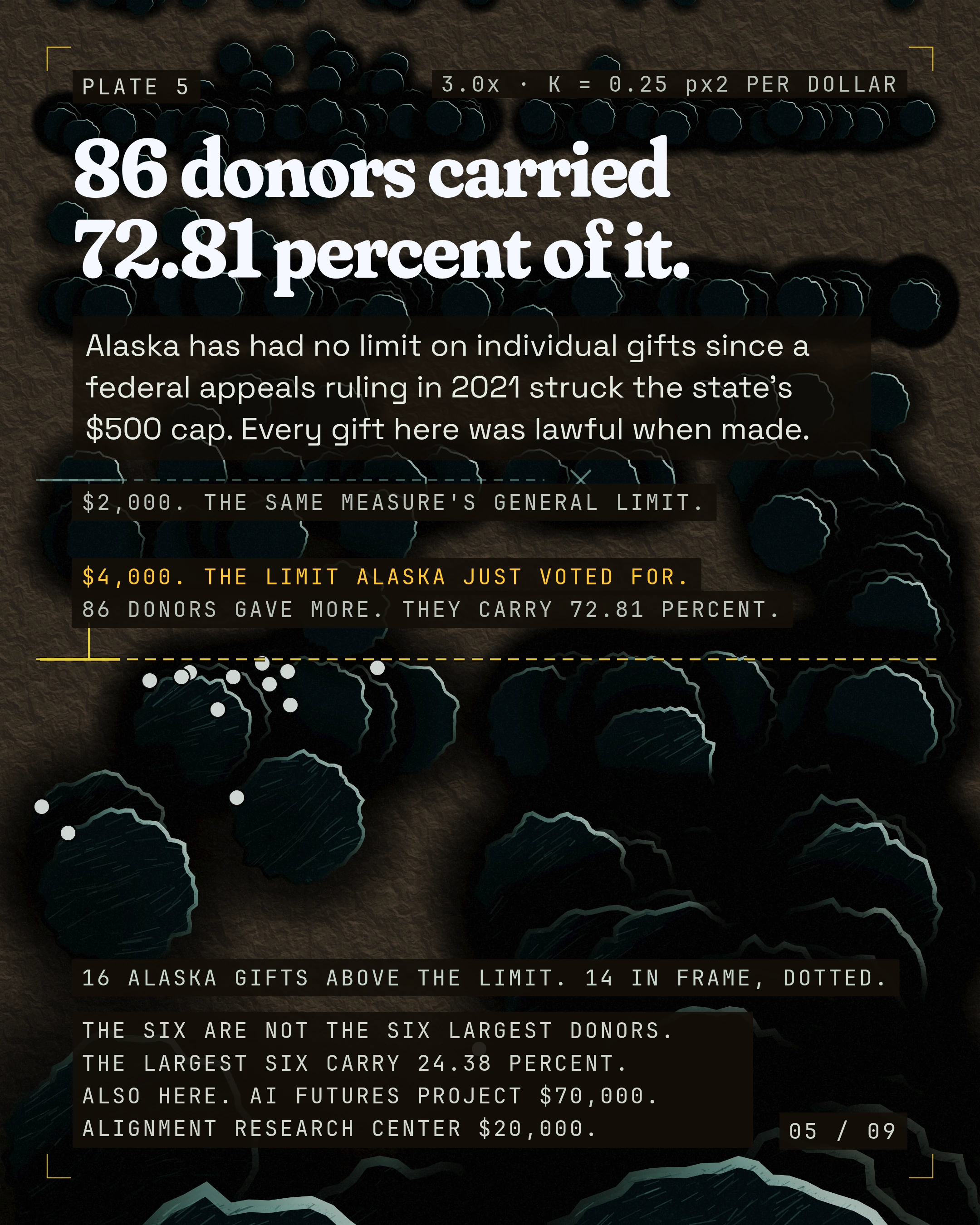
It takes the 105 largest Alaska donors, summing to $372,960.85, to match what the six gave.
86 donors gave more than $4,000 in total and supplied $1,732,397.04, 72.81 percent of the money. Sixteen of the 86 are Alaskan and seventy are not.
Anthropic is the largest named employer in the record at $372,000, more than twice the next one, Jane Street at $155,000.
The same record holds $70,000 across two gifts from Eli Lifland of the AI Futures Project and $20,000 from Eric Neyman of the Alignment Research Center, so the AI money in this campaign is wider than one company.
Bernadette Wilson, who finished third in the primary, raised $499,391.31 across 2,379 transactions, of which 53.15 percent came from Alaska addresses.
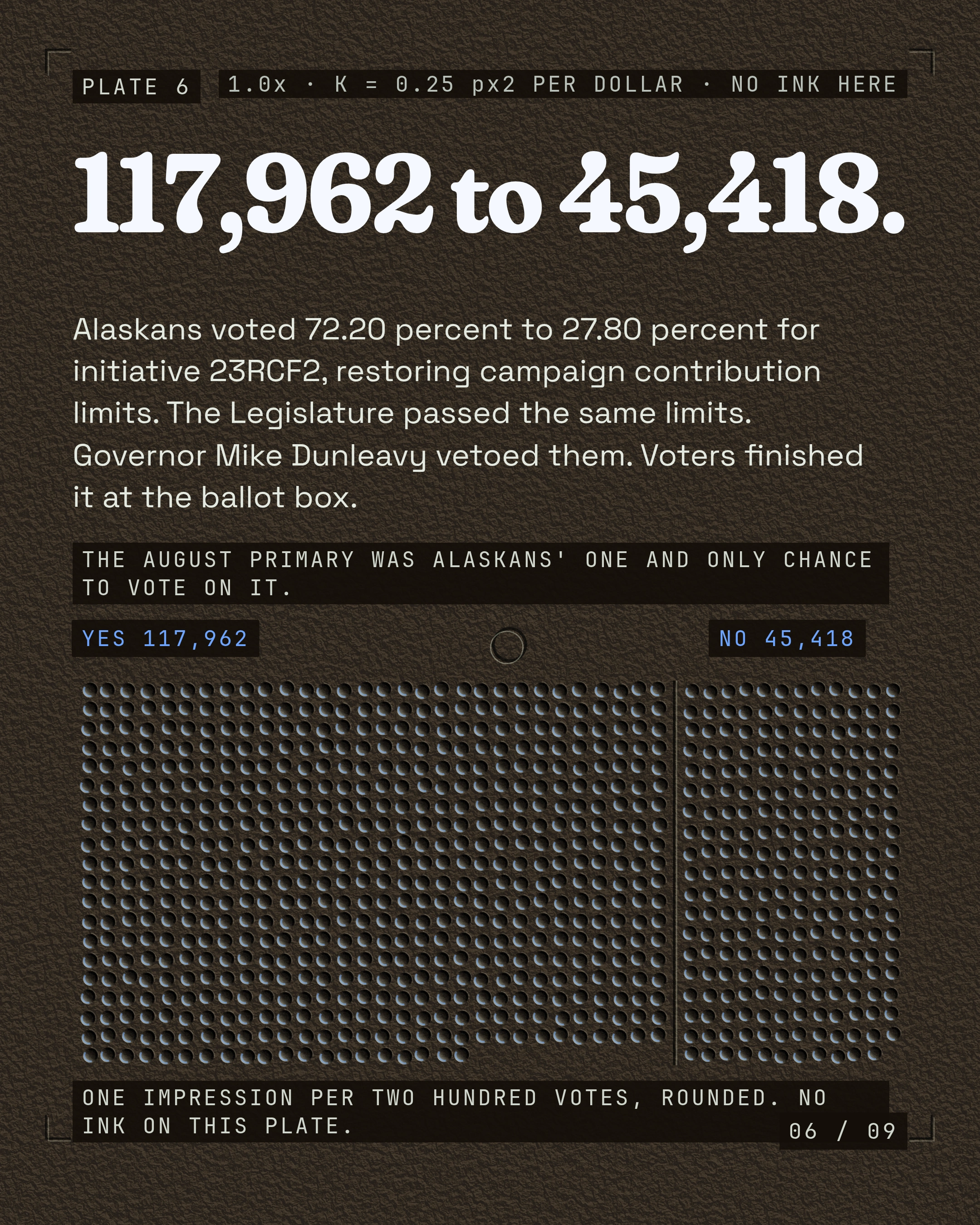
Alaska ballot initiative 23RCF2 is titled An Act restoring campaign contribution limits for campaigns for state and local office, and its sponsors are Bruce Botelho, David Monson and Calvin Schrage.
The measure passed with 117,962 votes in favour and 45,418 against, and the Division of Elections lists its status as approved by voters.
Those counts are 72.20 percent in favour and 27.80 percent against, of 163,380 votes cast on the measure.
The measure sets a limit of $2,000 each election cycle on what an individual may give a candidate.
For a joint governor and lieutenant governor ticket the individual limit is $4,000 each election cycle rather than $2,000, and the limit for a group is $8,000.
Measured against that $4,000 limit the six gifts run from 8 times it to 25 times it, and together they equal 93 maximum contributions.
Jonathan Kreiss-Tomkins and Zac Johnson finished first in the August 18th, 2026 governor primary with 37,006 votes, 22.5 percent of 164,303 cast across seventeen tickets.
Four tickets are certified for the November 3rd, 2026 general election, Bronson and Church, Kreiss-Tomkins and Johnson, Taylor and English, and Wilson and Shower.
Tom Begich and Julia Hnilicka, who finished second in the primary with 34,172 votes, are not on that certified general election list.
The measure's own applicability section says it does not apply to contributions made to influence the outcome of any election that occurred on or before its effective date.
The six Anthropic employer donors are not the six largest donors to the campaign. The six largest carry 24.38 percent of the money against the Anthropic bloc's 15.63 percent.
3,262 donors appear in the record, and the 86 who gave more than $4,000 are exactly the 86 largest.
Of the 4,604 transactions in the record, 4,588 are positive contributions and the remainder are refunds or adjustments, which is why the gross of the positive gifts, $2,389,277.70, is higher than the net of $2,379,290.20.
Dave Bronson and Josh Church are certified for the November 3rd, 2026 general election ballot for governor and lieutenant governor.
Treg Taylor and Candi English are certified for the November 3rd, 2026 general election ballot for governor and lieutenant governor.
Bernadette M. Wilson and Michael K. Shower are certified for the November 3rd, 2026 general election ballot for governor and lieutenant governor.
Jonathan Kreiss-Tomkins and Zac Johnson are certified for the November 3rd, 2026 general election ballot for governor and lieutenant governor.
The measure's limits are adjusted for inflation once a decade.
Alaska Public Media reported on the night of the vote that the measure would take effect after the November general election.
The August 18th primary was the only vote Alaskans got on the measure.
Alaska has had no limit on individual campaign contributions since a federal appeals court ruling in 2021 that declared the state's voter approved $500 per year limit unconstitutionally low.
Governor Mike Dunleavy vetoed a bill passed by the Legislature in 2026 that sought identical limits, saying it would not do enough to limit self funded candidates from donating to their own campaigns.
Kreiss-Tomkins has proposed banning data centre construction in Alaska until the Legislature passes comprehensive regulation on data centre development.
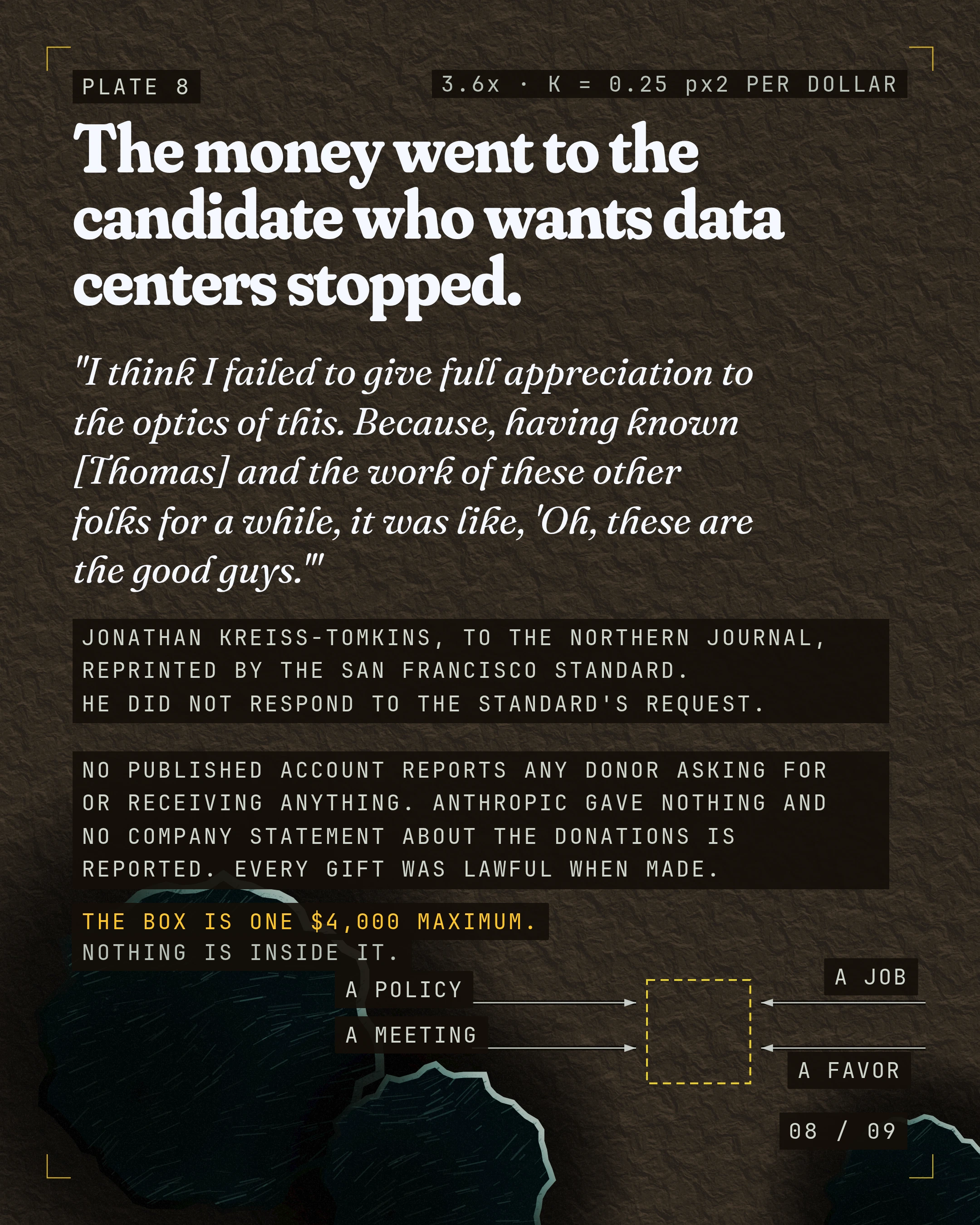
Asked about the donations, Kreiss-Tomkins said he failed to give full appreciation to the optics of this, and that having known Thomas and the work of these other folks for a while, it was like, oh, these are the good guys.
Kreiss-Tomkins did not respond to the San Francisco Standard's request for comment, so the remark above is his only published response.
Anthropic the company is not reported to have said anything about the donations, and the gifts are from individuals rather than from the company.
No published account reports that any of the six donors asked for or received a policy, a meeting, a job or any other favour.
The six gifts were lawful when they were made, because Alaska had no individual contribution limit at the time.
Beats
This article is on Alaska data centers · Defense and federal AI in Alaska · Alaska AI research and science · Alaska AI policy and legislation. Each beat page keeps every decision and every article on that subject in one place.