Every Notice Went Up
Who has to be told before somebody changes the weather over the southern Kenai? The answer is not the borough underneath.
The deck
SWIPE, SCROLL OR CLICK A SLIDE TO GO FULLSCREEN · 9 SLIDES
The story
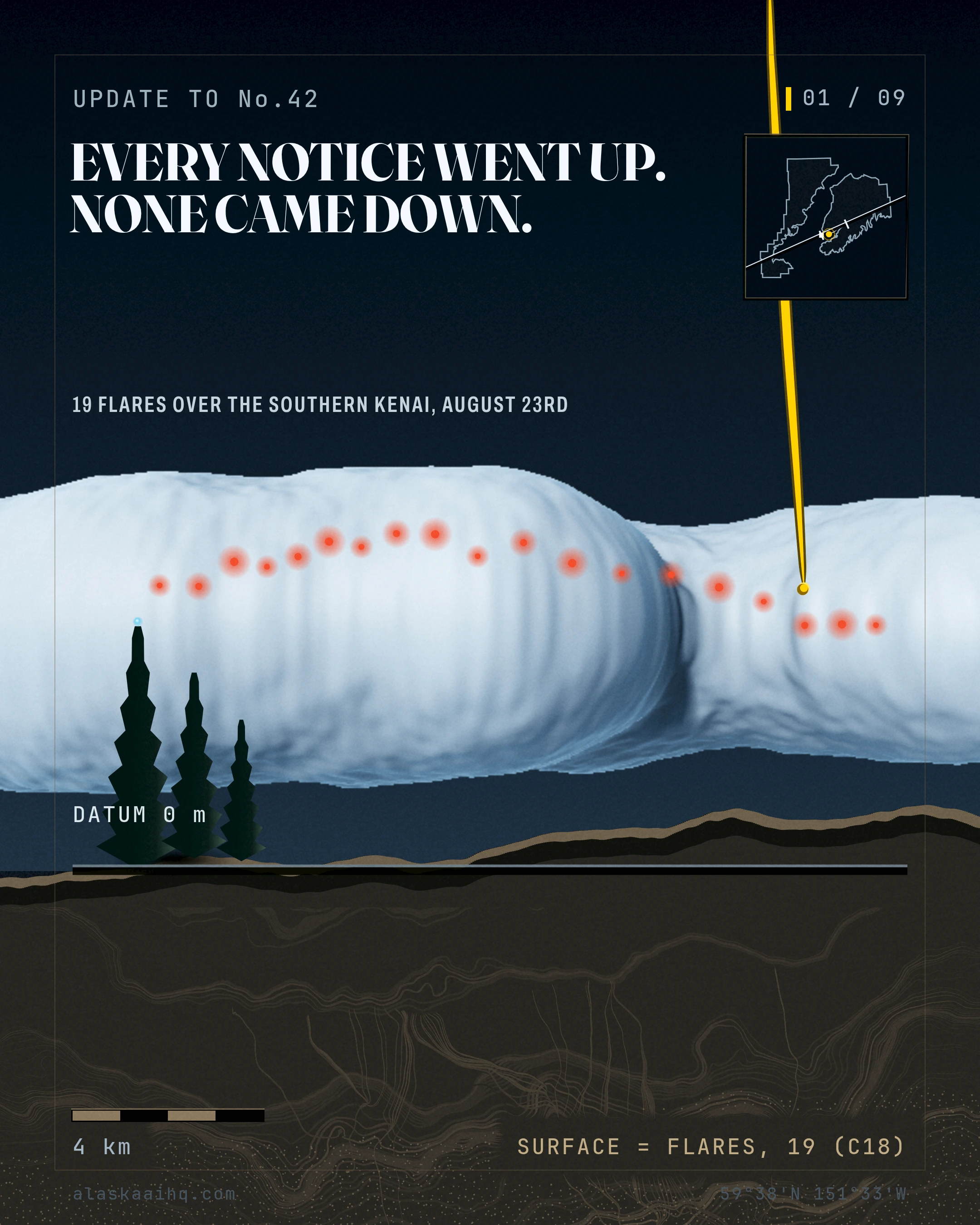
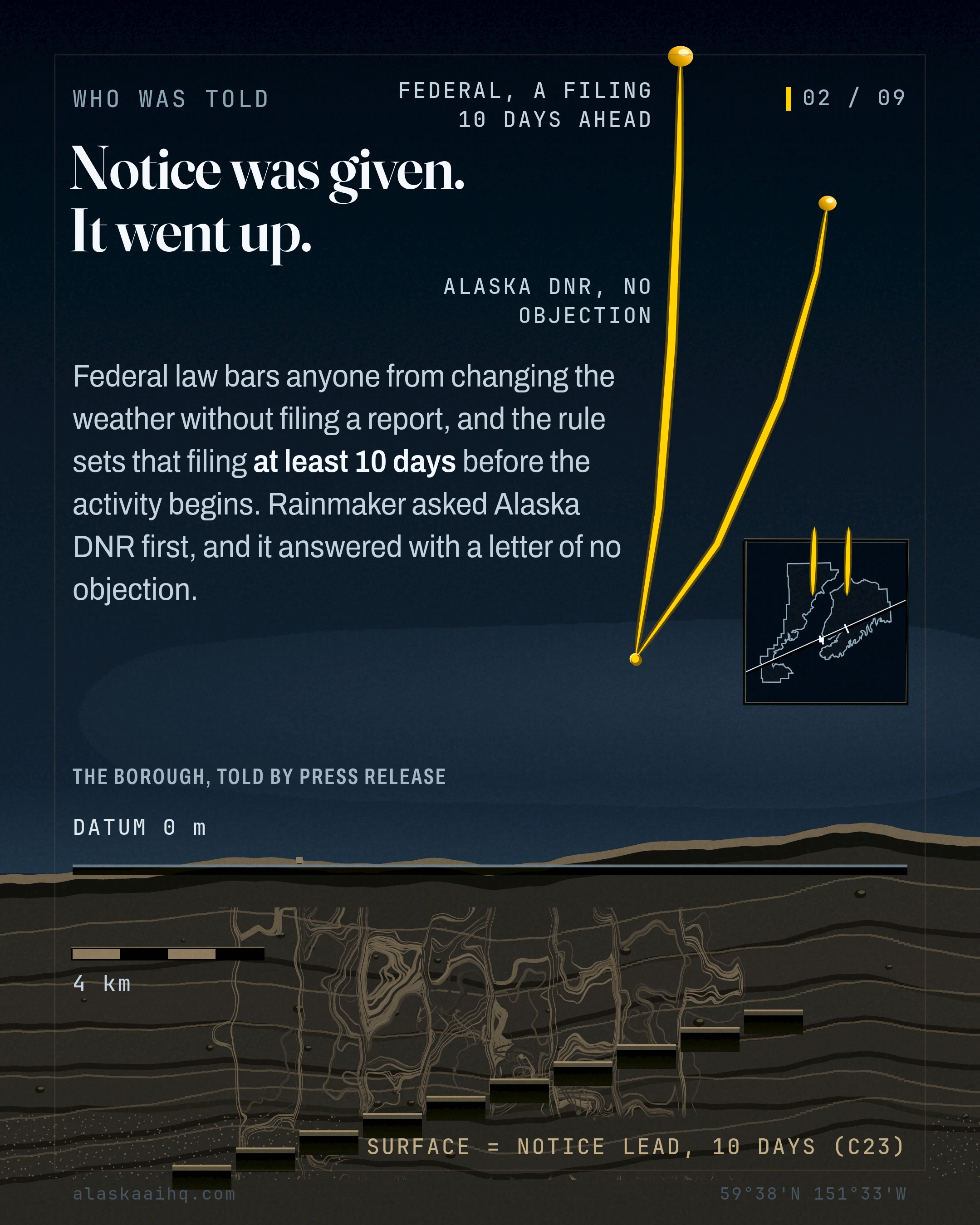
On August 23rd, 19 flares put about 374 grams of silver iodide into the clouds. Federal law takes a filing at least 10 days out. Rainmaker asked Alaska DNR first and got a letter of no objection. The borough found out from the press release.
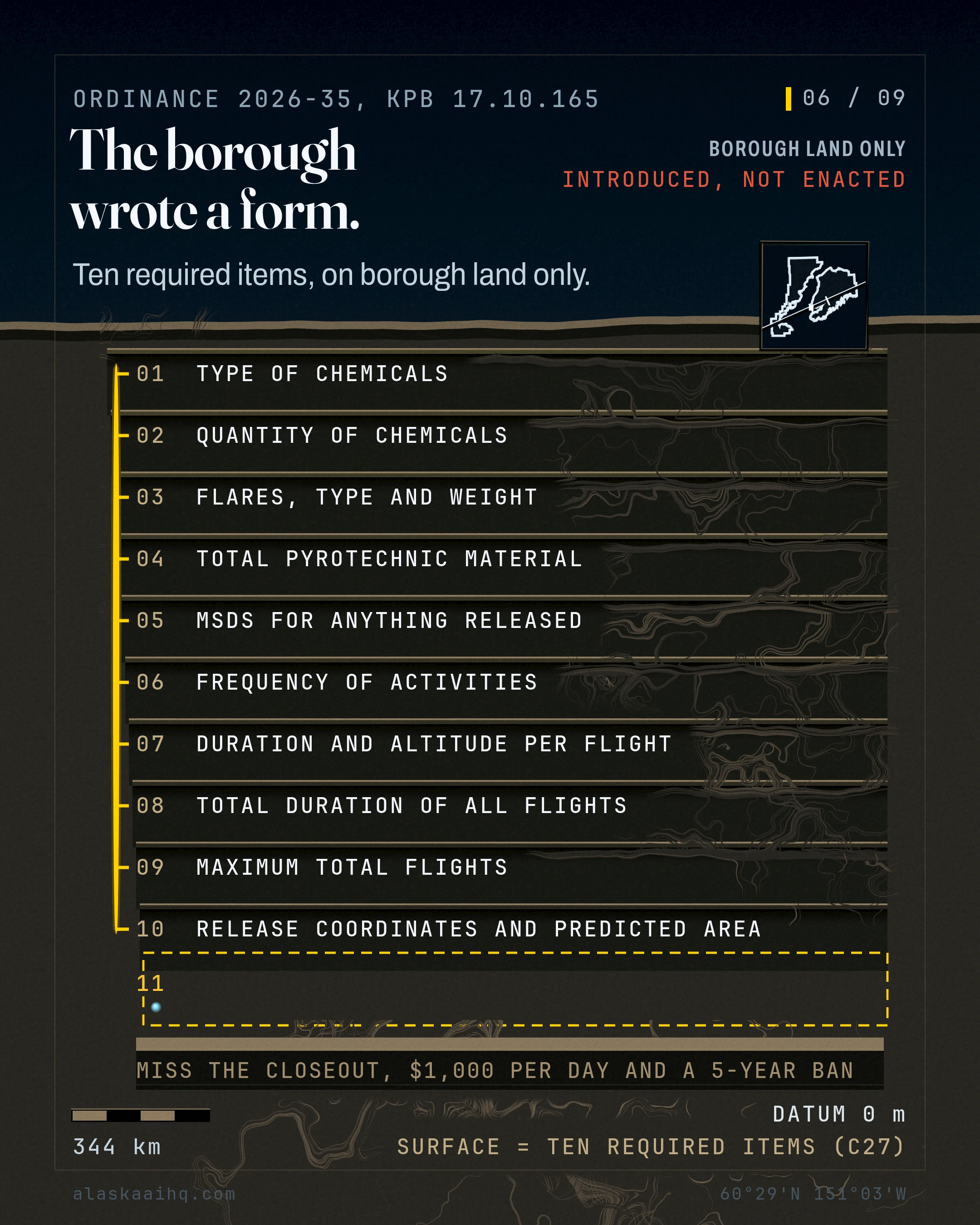
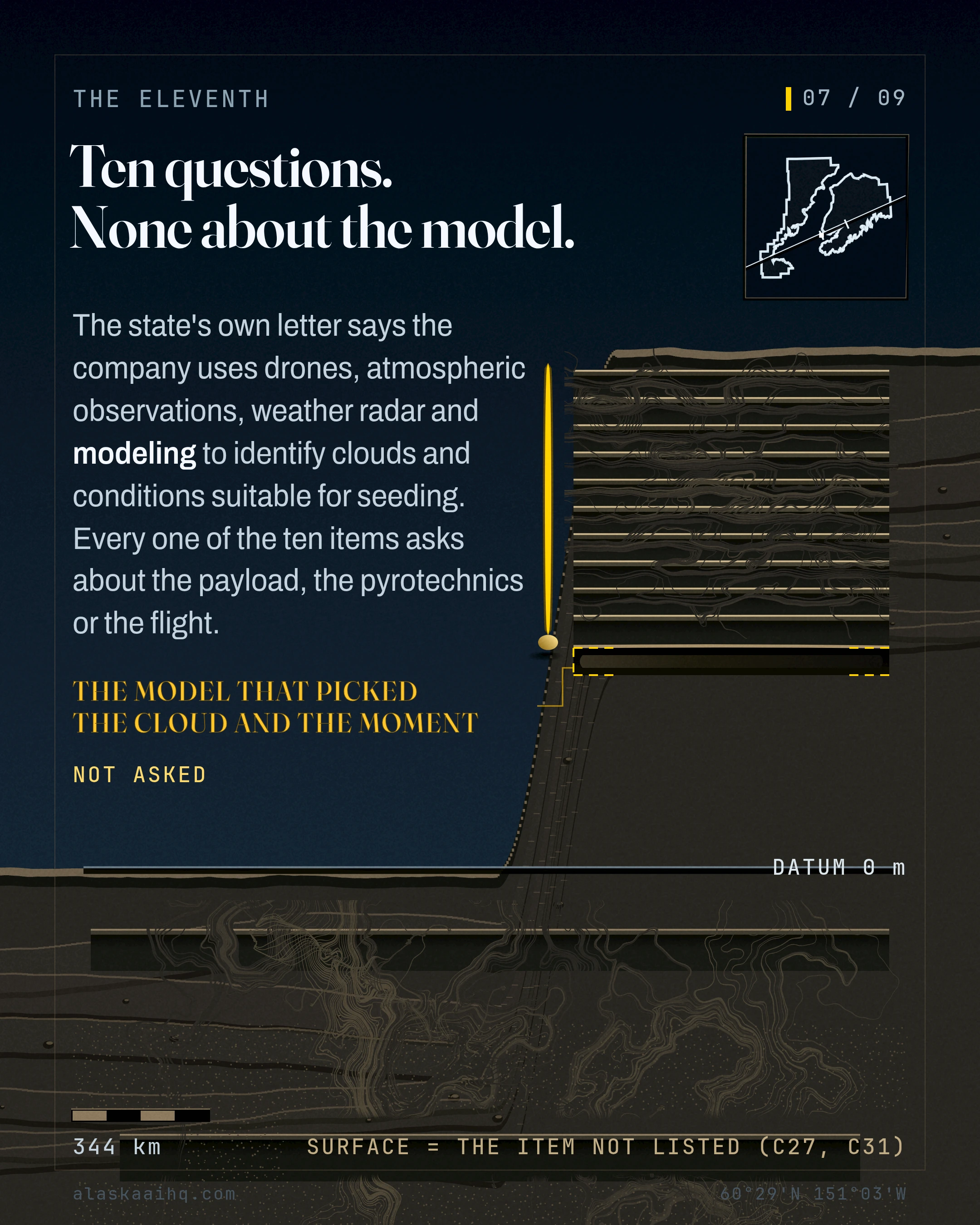
The state reviewed it and found no violation. Alaska has no law of its own and no bill among this session's 856. The borough wrote the one rule it can enforce, ten questions about chemicals, flares and coordinates, on borough land only. None asks about the modeling that picks the cloud.
The ten items as the ordinance writes them, what the state found, and the blank in the form.
The hearing is October 20th. Who belongs on that address line before the next flight?
What we verified
38 CLAIMS, EACH RE-FETCHED FROM ITS SOURCE BEFORE THIS DECK SHIPPED
The Kenai Peninsula Borough Assembly meeting that took up both weather modification measures was held Tuesday, September 15th.
Resolution 2026-046 was adopted by the Kenai Peninsula Borough Assembly on September 15th.
The vote on Resolution 2026-046 was 7 Yes, 0 No, 2 Absent.
Both weather modification measures were placed on the Assembly's consent agenda, the block of items it deems routine and approves by one motion.
Ordinance 2026-35 was introduced by the Mayor and Assembly member Niesen.
Resolution 2026-046 asks the Alaska Legislature to consider prohibiting the intentional release of any substance into the atmosphere for the express purpose of affecting temperature, weather or the intensity of sunlight.
Resolution 2026-046 asks the Legislature, as an alternative to a ban, to set notice and permitting requirements carrying civil or criminal penalties.
Resolution 2026-046 asks Alaska's congressional delegation to direct a review of federal law to strengthen notice, reporting and approval requirements before the activities take place.
Ordinance 2026-35 was introduced and set for public hearing on September 15th and has not been enacted.
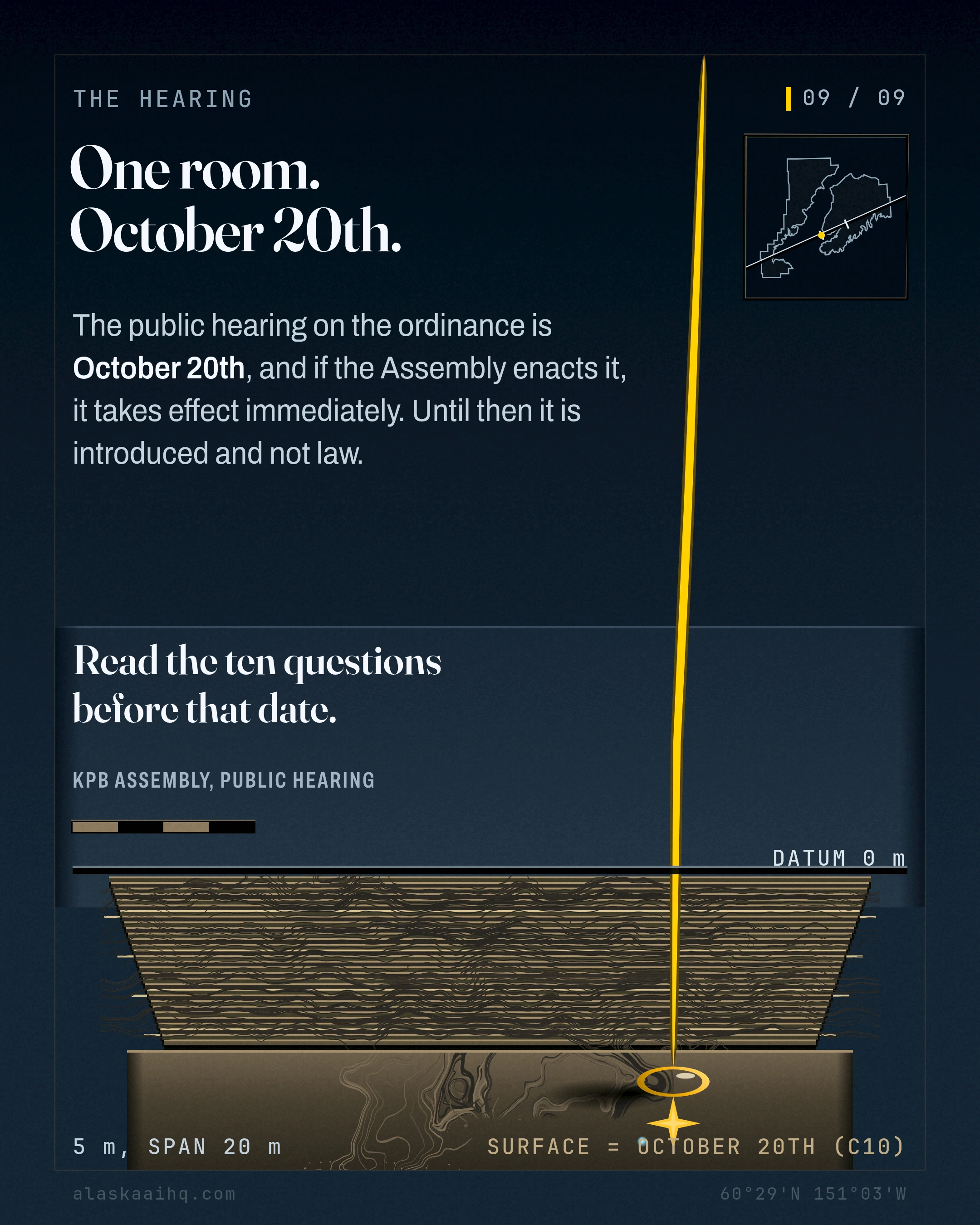
The public hearing on Ordinance 2026-35 is set for October 20th.
Ordinance 2026-35 would enact a new borough code section, KPB 17.10.165, reaching weather modification and geoengineering activities on borough lands.
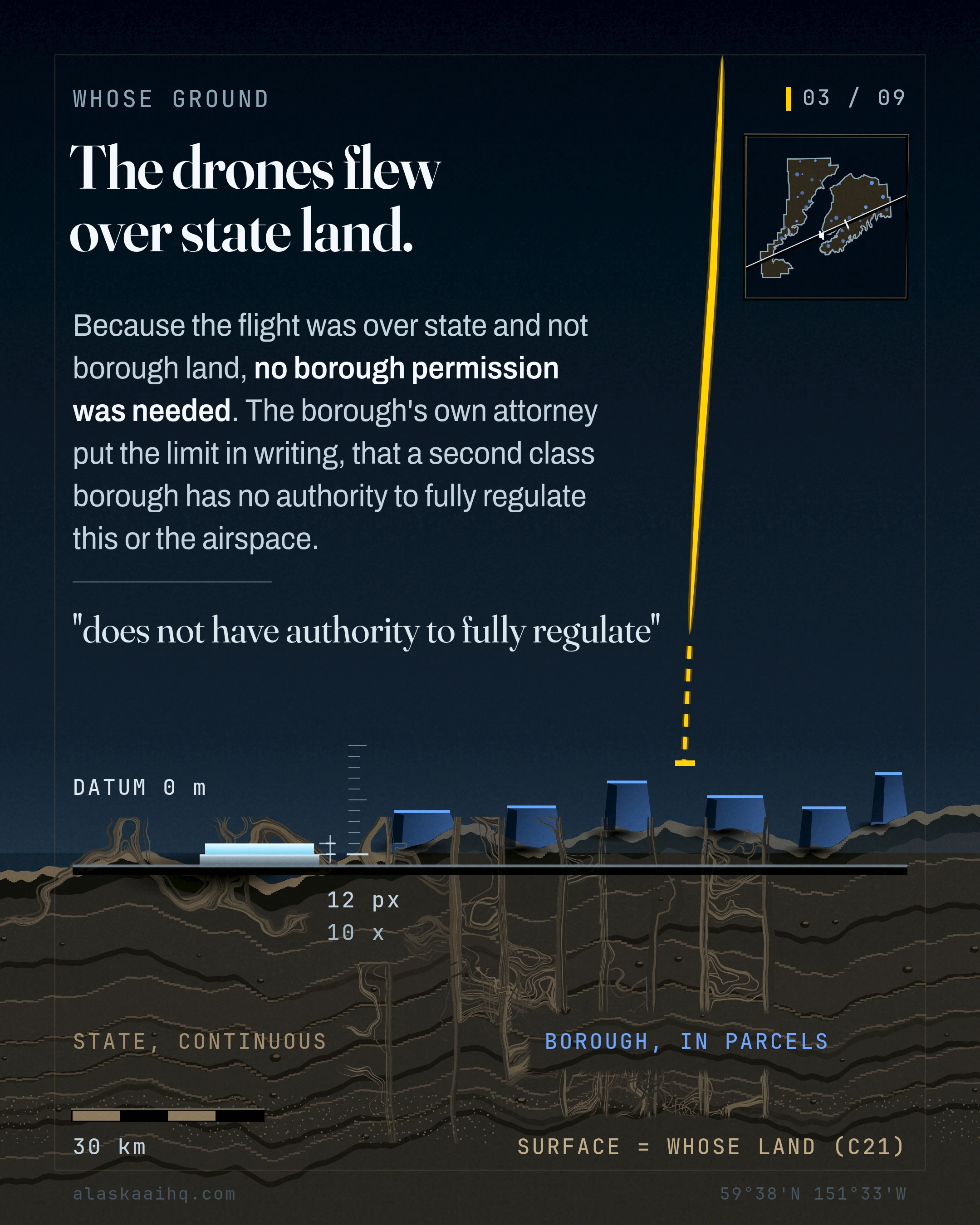
The borough's own attorney wrote that as a second class borough the Kenai Peninsula Borough does not have authority to fully regulate weather modification activities or airspace rights.
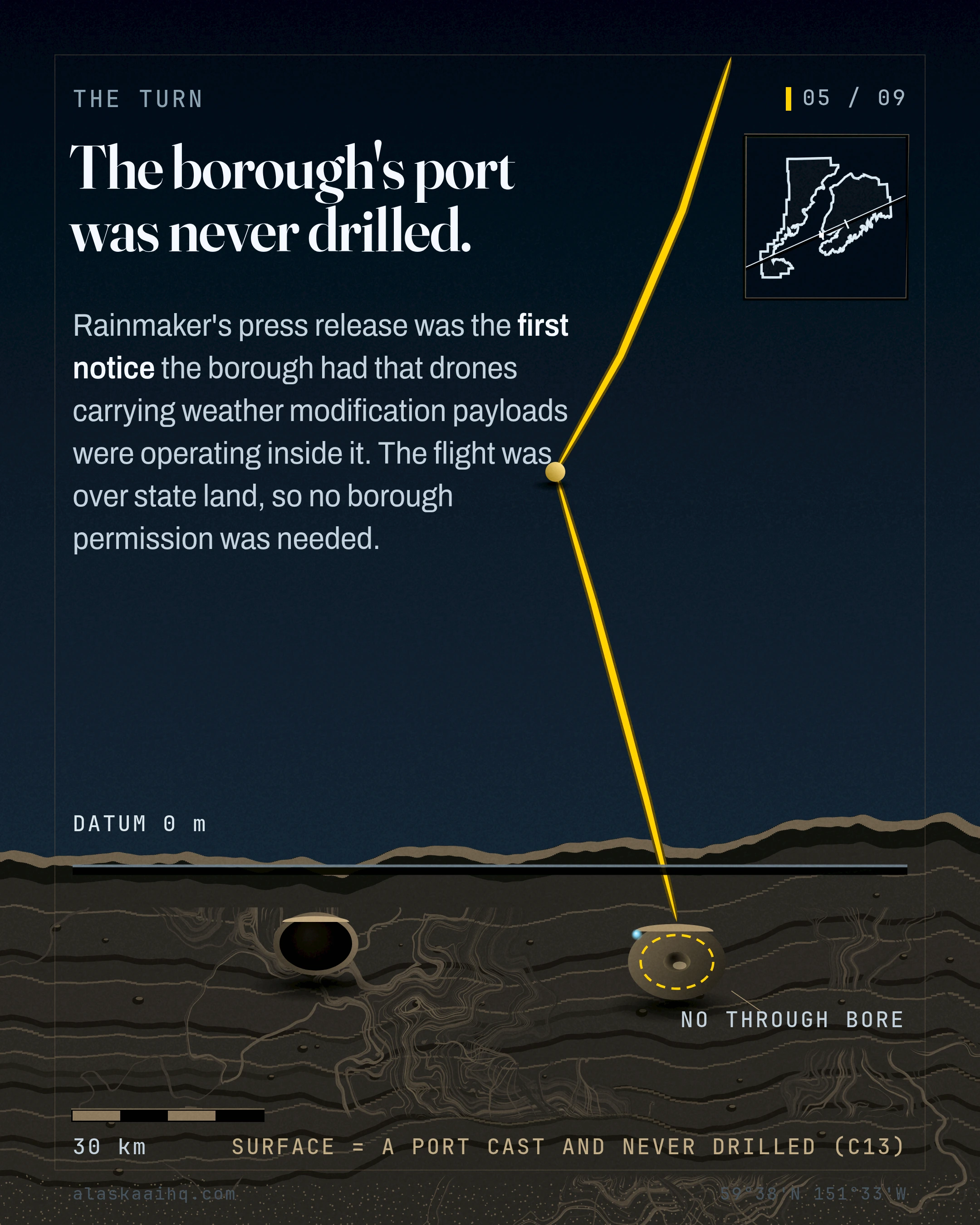
Rainmaker's press release was the first notice the Kenai Peninsula Borough received that drones carrying weather modification payloads were operating inside the borough.
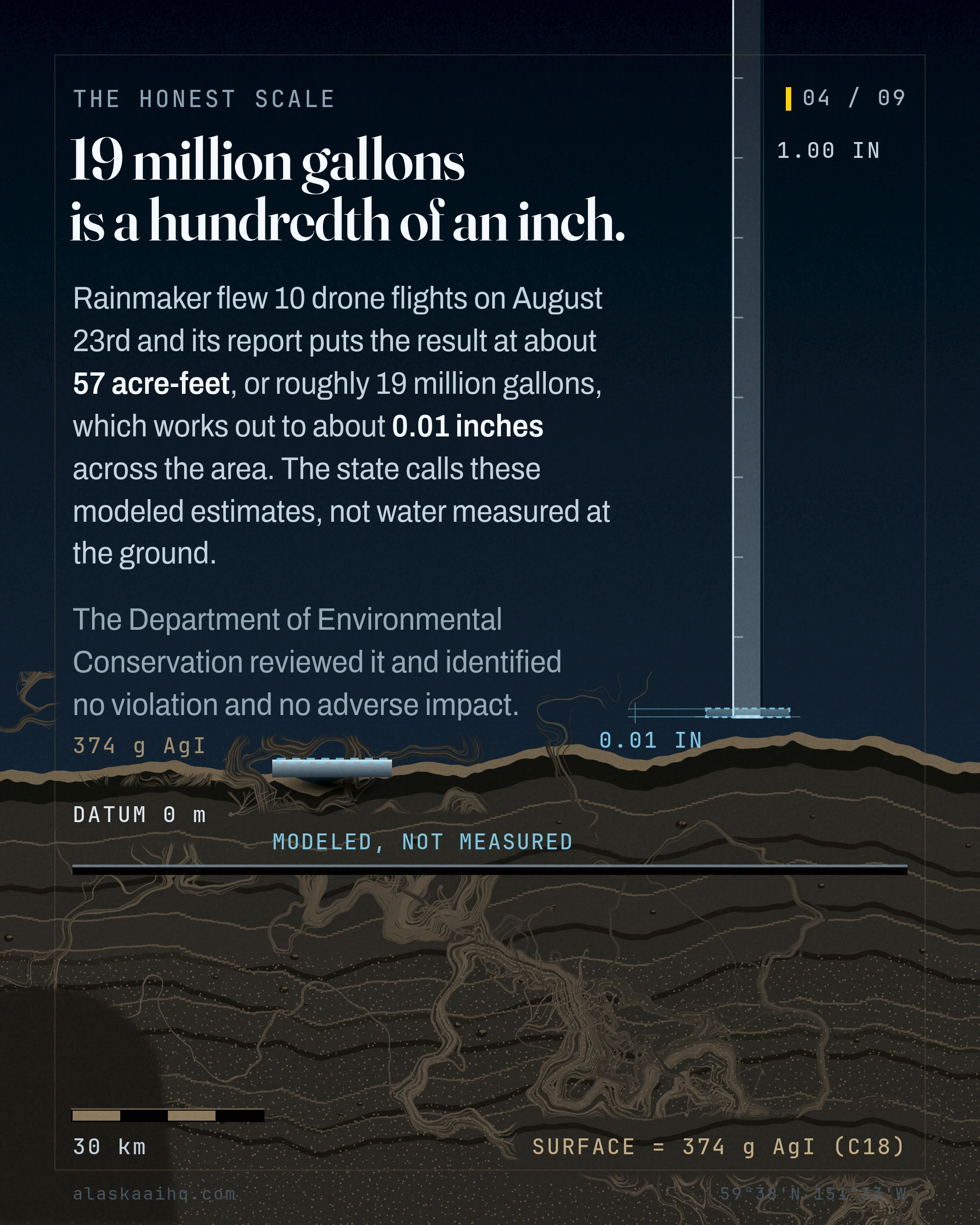
Rainmaker conducted its Kenai Peninsula cloud seeding on August 23rd over the course of 10 drone flights.
Alaska DEC reported that Rainmaker estimated a mean of approximately 57 acre-feet of additional precipitation, or approximately 19 million gallons of water.
Alaska DEC reported that Rainmaker's estimate corresponds to approximately 0.01 inches of precipitation across the relevant area.
Alaska DEC described Rainmaker's precipitation figures as modeled estimates and not the same as a direct measurement of water collected at the ground.
Rainmaker's technical report states that 19 flares dispersed approximately 374 grams of silver iodide in total on the August 23rd Kenai operation.
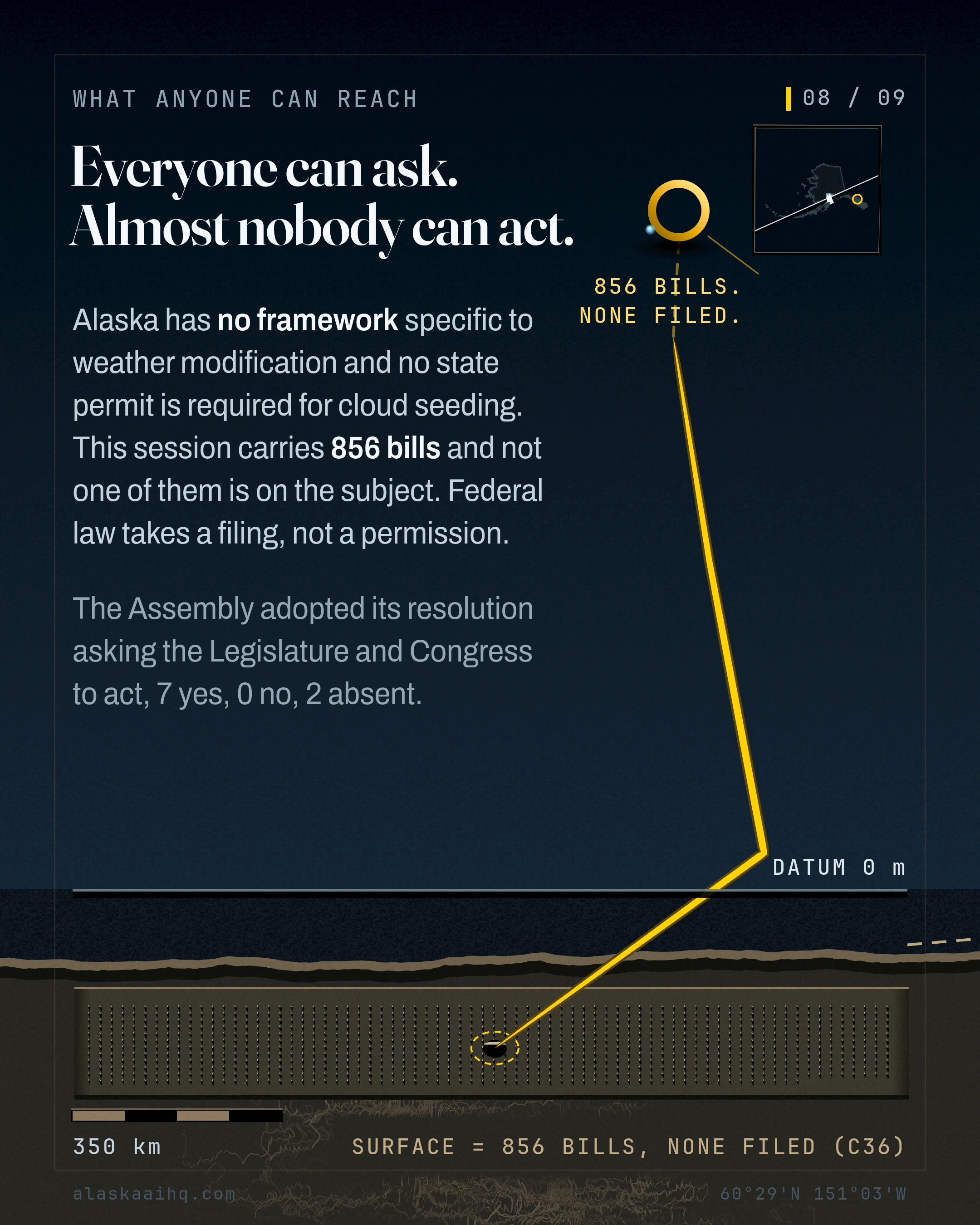
Alaska has no regulatory framework specific to weather modification and no state permit is required solely for cloud seeding.
Rainmaker contacted the Alaska Department of Natural Resources before its Alaska activities and received a letter of no objection from DNR.
Federal law says no person may engage in weather modification in the United States without submitting reports to the Secretary of Commerce, and allows the Secretary to require them before, during and after the activity.
The implementing regulation requires an initial report at least 10 days before a weather modification activity begins.
The Alaska Department of Environmental Conservation stated that the federal reporting framework is not a comprehensive federal permitting program for cloud seeding.
Resolution 2026-046 states that federal notice information is not shared with impacted municipalities before the activity begins.
Resolution 2026-046 records that Rainmaker used at least 19 red flares released by drones without giving borough officials specific notice of the activities, payloads or chemicals.
Ordinance 2026-35 would require ten items in an application for a borough commercial lease or land use permit to conduct weather modification.
Ordinance 2026-35 would prohibit weather modification and geoengineering outright on borough lands open for casual use.
Ordinance 2026-35 would carry a $1,000 per day fine and a five year application ban for failing to file the required closeout information.
Ordinance 2026-35 defines weather modification and geoengineering to include cloud seeding, solar radiation modification and stratospheric aerosol injection.
Alaska DEC wrote that Rainmaker's materials describe using drones, atmospheric observations, weather radar and modeling to identify clouds and atmospheric conditions that may be suitable for seeding.
Alaska DEC said it has not identified a violation or an adverse impact requiring action under its existing authorities.
Alaska DEC wrote that Rainmaker acknowledged communication with state officials and legislators before its operations would have been appropriate.
Alaska DEC said Rainmaker represented that it operates under permitting or licensing frameworks in Colorado, Utah, Idaho, Oregon and Texas.
The Alaska Legislature's own bill system carries no weather modification bill in session 34.
Ordinance 2026-35 would take effect immediately on enactment.
Because the drones flew over state rather than borough land, Rainmaker did not need borough permission for the test.
Mayor Peter Micciche said of the cloud seeding, No one knew what was going to occur prior to it occurring.
Alaska Public Media reported that Rep. Sarah Vance has drafted a bill she would introduce if reelected that would set weather modification requirements including local notification.
Beats
This article is on Alaska land and permitting for AI · Defense and federal AI in Alaska · Alaska AI research and science · Alaska AI policy and legislation. Each beat page keeps every decision and every article on that subject in one place.