Priority, Not Permission
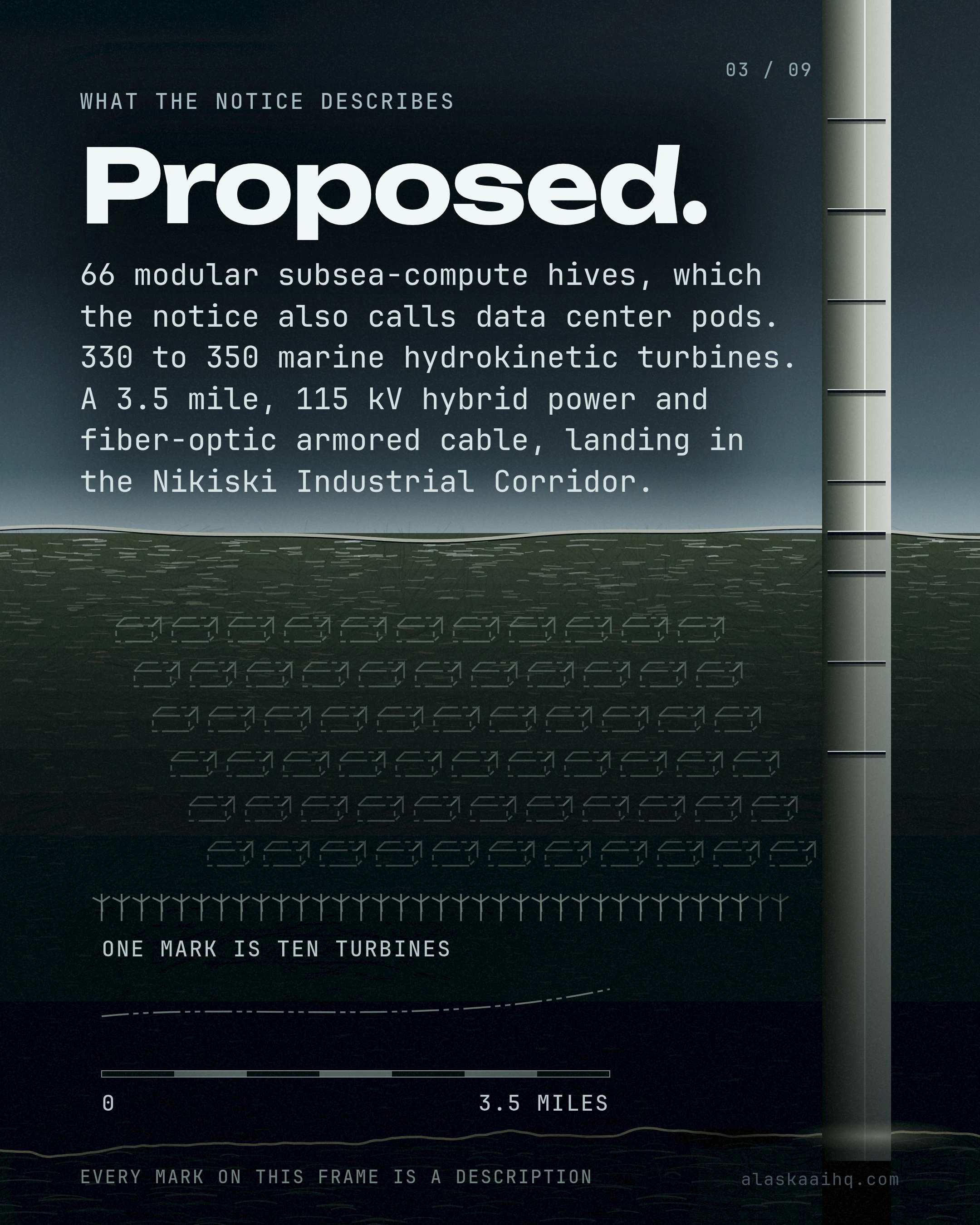
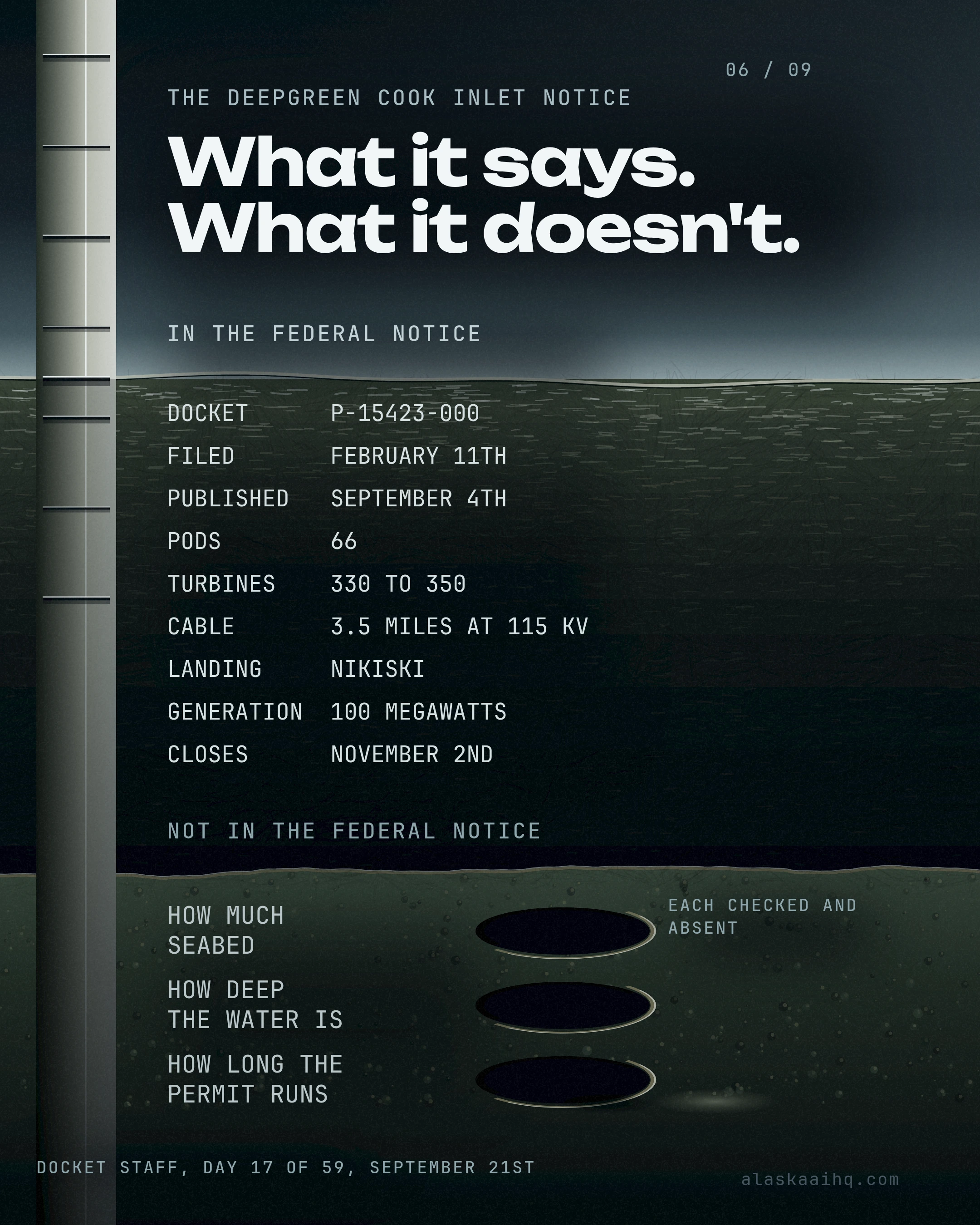
66 data center pods. 330 to 350 turbines. 3.5 miles of cable. The federal notice never says how much seabed.
The deck
SWIPE, SCROLL OR CLICK A SLIDE TO GO FULLSCREEN · 9 SLIDES



The story
Nothing is being built on the floor of Cook Inlet.
FERC says the sole purpose of a preliminary permit is "priority to file a license application." It authorizes no land-disturbing work and no entry onto lands or waters owned by others. The notice doesn't say how deep the water is or how long the permit runs. Alaska Energy Authority says it will file to intervene and oppose. It says it has had no communication with the applicant.
The record is one federal notice with three blanks in it, and one September 14th newspaper report quoting Curtis W. Thayer for the state.
Comments on FERC docket P-15423-000 close 5:00 p.m. Eastern on November 2nd. The window takes competing applications for the same site. Who does it serve more, objectors or a rival?
What we verified
27 CLAIMS, EACH RE-FETCHED FROM ITS SOURCE BEFORE THIS DECK SHIPPED
The proposal is docketed at FERC as Project No. 15423-000.
DeepGreen Cook Inlet SPV, LLC has applied to FERC for a preliminary permit under section 4(f) of the Federal Power Act.
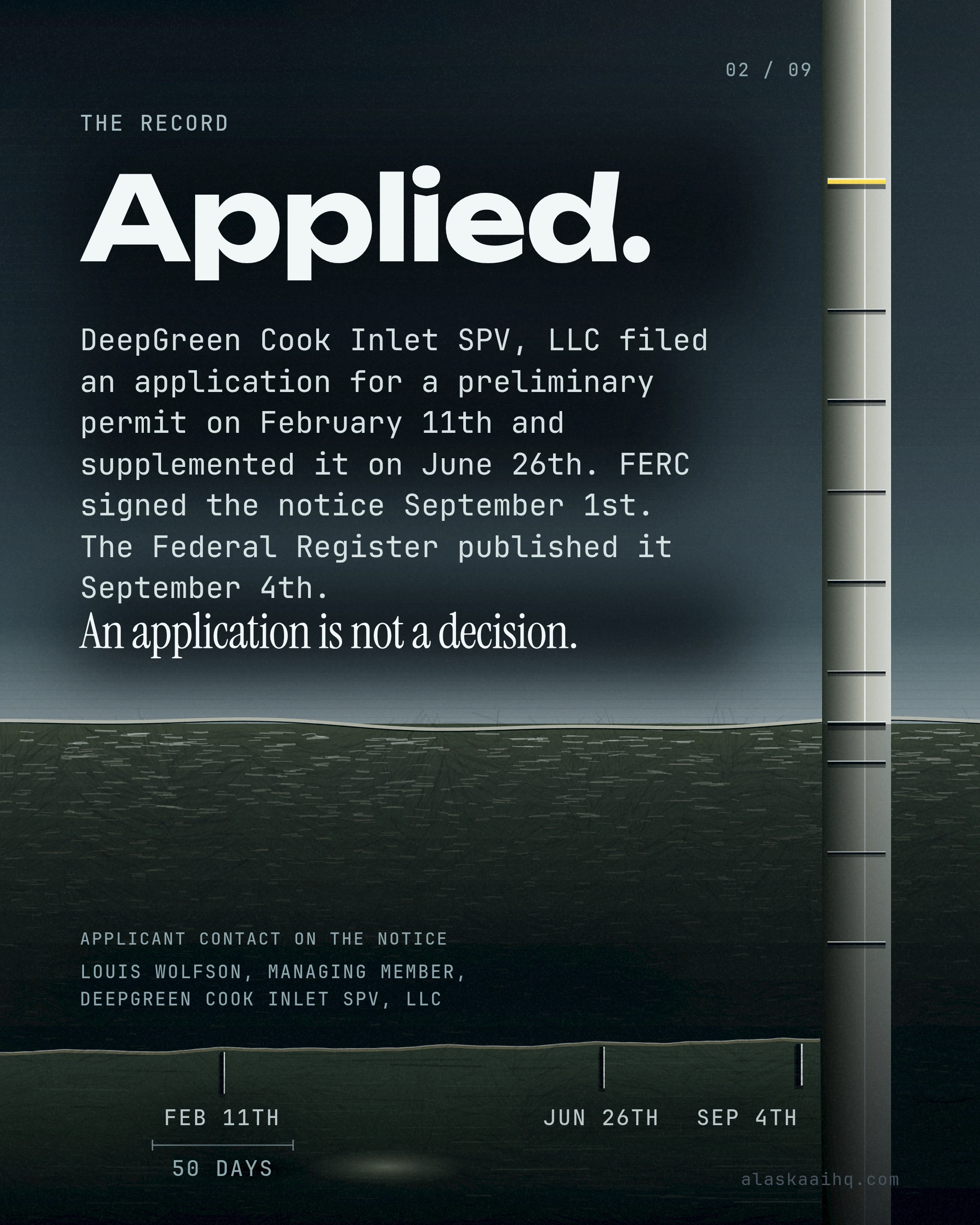
The application was filed on February 11th and supplemented on June 26th.
The applicant calls the proposal the DeepGreen Cook Inlet Subsea-Compute & Infrastructure Hub Project.
The application proposes to study the feasibility of a project to be located in the Upper Cook Inlet, East Foreland Corridor, Kenai Peninsula Borough, Alaska.
The proposed project as described to FERC would include approximately 330 to 350 marine hydrokinetic turbines.
The proposed project as described to FERC would include 66 modular subsea-compute hives, which the notice also calls data center pods.
The proposed project as described to FERC would include a subsea cable approximately 3.5 miles long.
The proposed subsea cable is described as a 115 kV hybrid power and fiber-optic armored cable.
The proposed subsea cable would come ashore in the Nikiski Industrial Corridor.
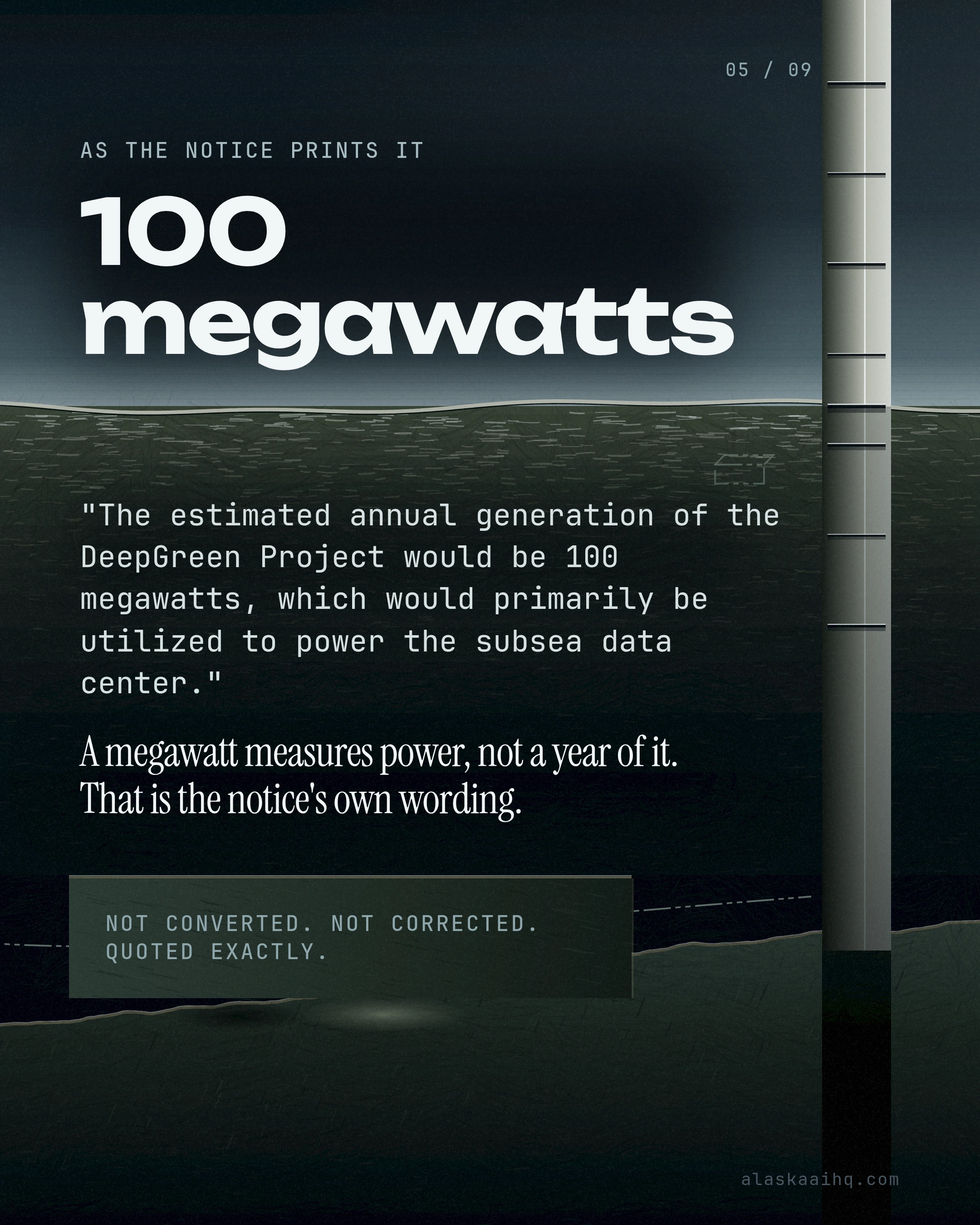
FERC's notice states that the estimated annual generation of the DeepGreen Project would be 100 megawatts, primarily to power the subsea data center.
FERC states that the sole purpose of a preliminary permit is to grant the permit holder priority to file a license application during the permit term.
FERC states that a preliminary permit does not authorize the holder to perform any land-disturbing activities or to enter upon lands or waters owned by others without the owners' express permission.
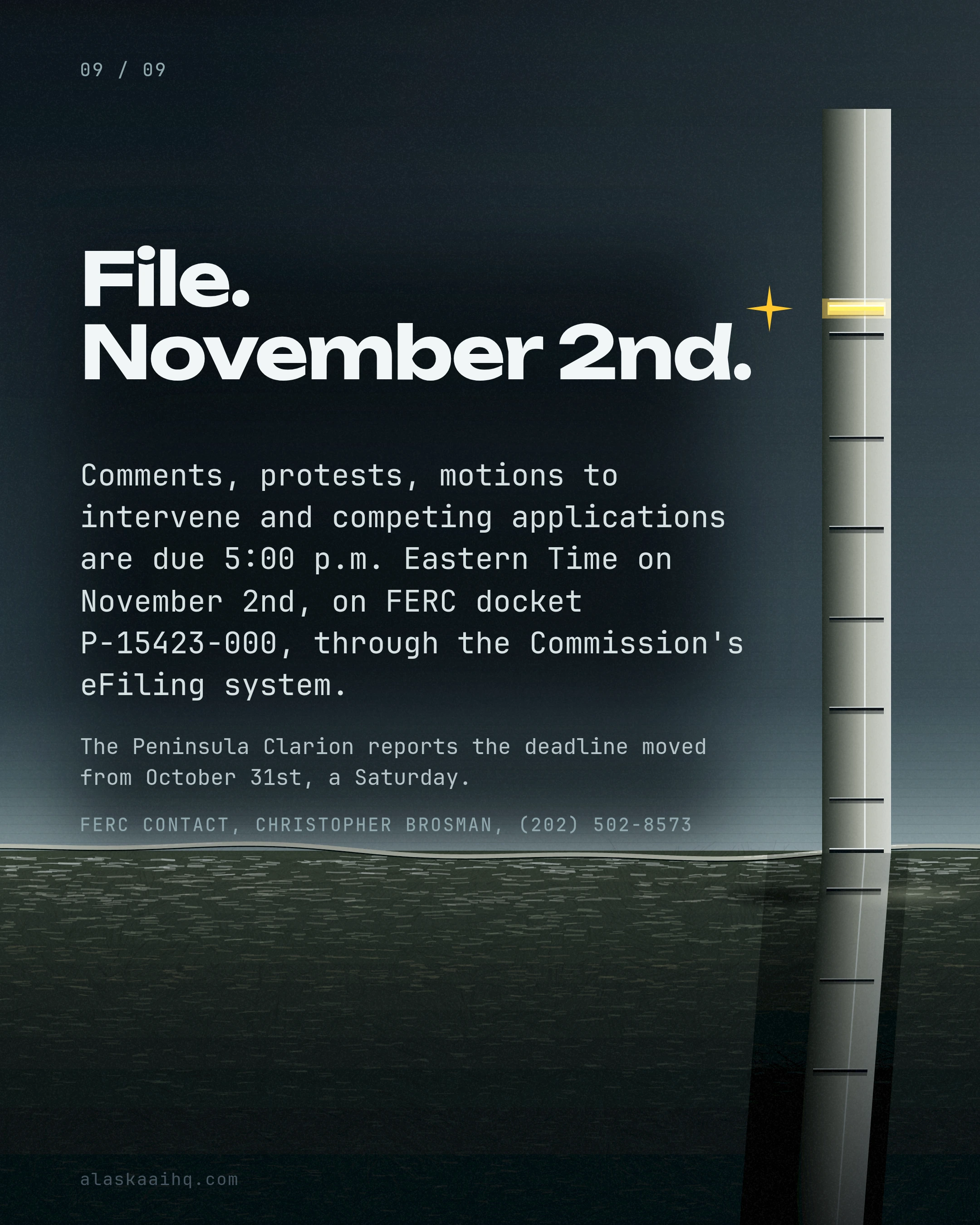
The deadline for filing comments, motions to intervene, competing applications and notices of intent is 5:00 p.m. Eastern Time on November 2nd.
FERC states that competing applications and notices of intent must meet the requirements of 18 CFR 4.36.
FERC directs the public to file comments, motions to intervene, notices of intent and competing applications through the Commission's eFiling system.
The FERC contact named on the notice is Christopher Brosman, reachable at (202) 502-8573.
The applicant contact named on the notice is Louis Wolfson, Managing Member of DeepGreen Cook Inlet SPV, LLC.
The notice is dated September 1st and signed by Carlos D. Clay, Deputy Secretary, and it was published in the Federal Register on September 4th.
The Peninsula Clarion reported that the filing deadline was moved from October 31st because that date falls on a Saturday.
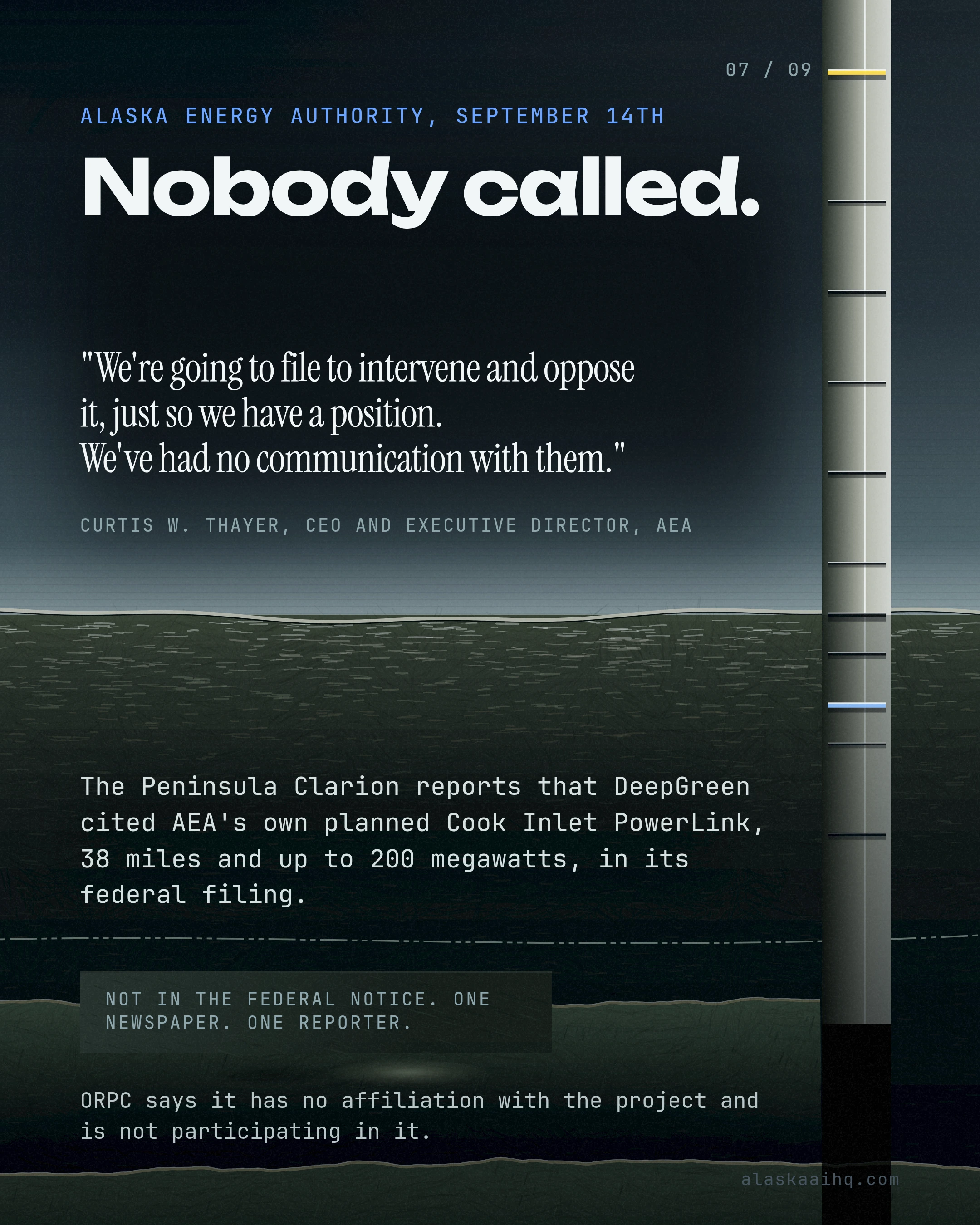
Alaska Energy Authority CEO and Executive Director Curtis W. Thayer said the authority will file to intervene and oppose the application.
Thayer said the Alaska Energy Authority has had no communication with the applicant.
The Peninsula Clarion reported that DeepGreen referenced the Cook Inlet PowerLink in its federal filing while AEA said it has had no discussions with the company.
The Peninsula Clarion described AEA's Cook Inlet PowerLink as a planned 38 mile underwater transmission connection between the Kenai Peninsula and the Anchorage Matanuska Susitna region.
The Peninsula Clarion reported that the planned Cook Inlet PowerLink would have capacity to move up to 200 megawatts in either direction.
ORPC CEO Stuart Davies said ORPC has no affiliation with the DeepGreen project and is not participating in its development, permitting, financing or deployment.
The Peninsula Clarion reported that a preliminary permit would give the company priority to pursue a future license while it studies feasibility and would not authorize construction, land-disturbing work or entry onto property owned by others.
Beats
This article is on Alaska data centers · Alaska power and the grid · Alaska land and permitting for AI · Defense and federal AI in Alaska. Each beat page keeps every decision and every article on that subject in one place.