A Bigger Tank, Not a Bigger Engine. Bradley Lake and 2030
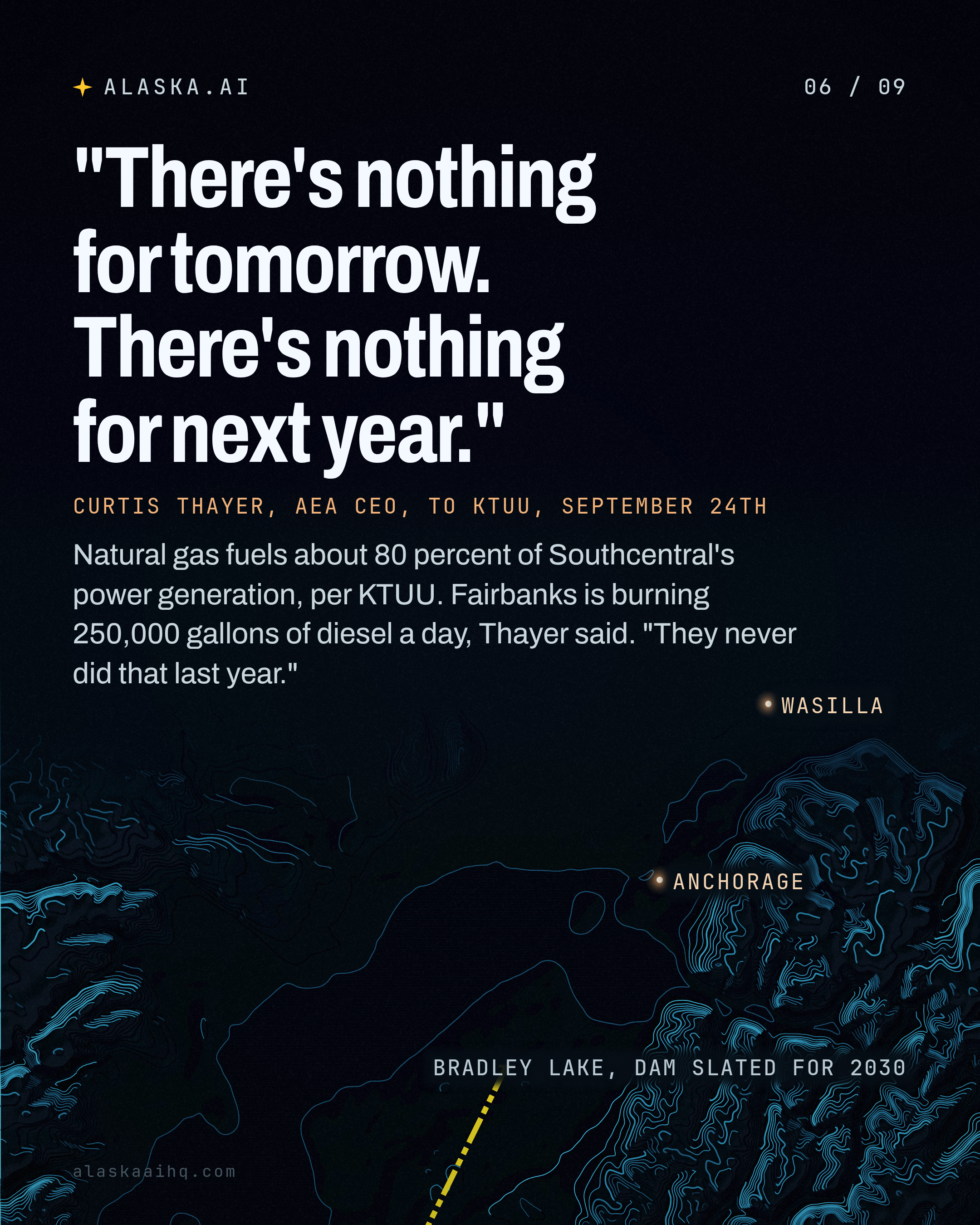
Fairbanks is burning 250,000 gallons of diesel a day, AEA's Curtis Thayer says.
The deck
SWIPE, SCROLL OR CLICK A SLIDE TO GO FULLSCREEN · 9 SLIDES
The story
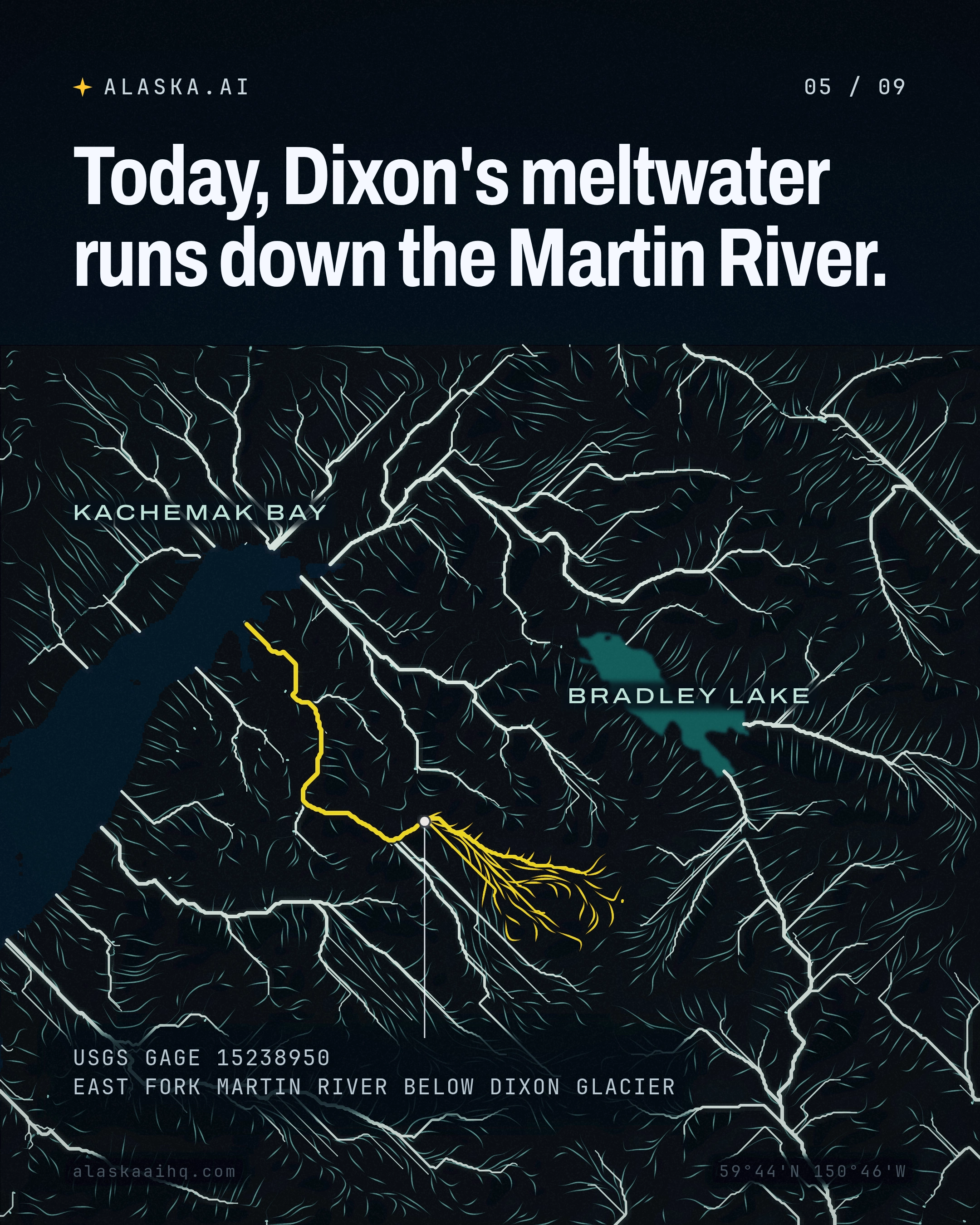
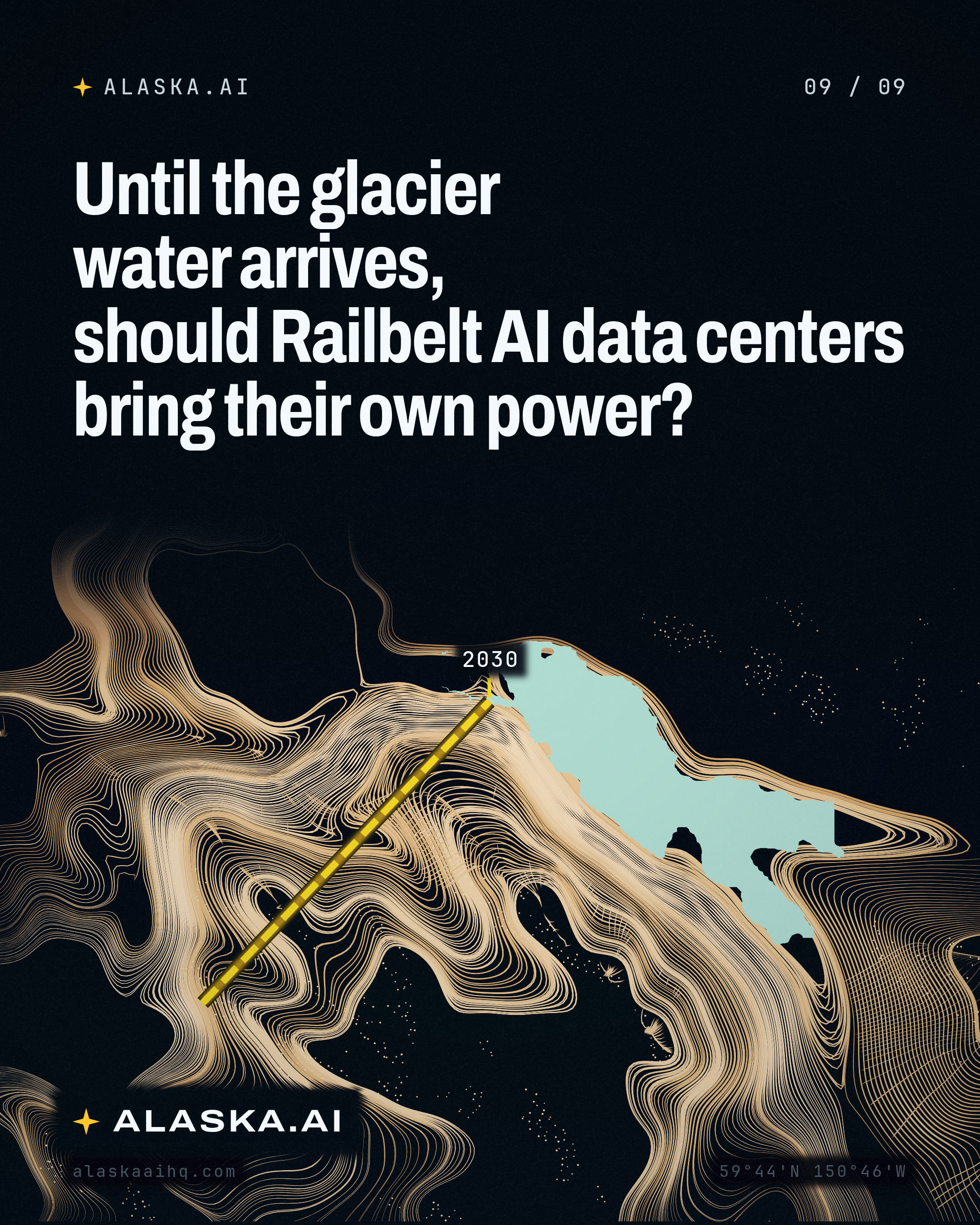
On a relief map and a cutaway, a proposed 4.6-mile tunnel carries Dixon Glacier water to Bradley Lake for more energy, not more megawatts, ending on a 1991 to 2032 calendar that splits what exists from what is only filed.
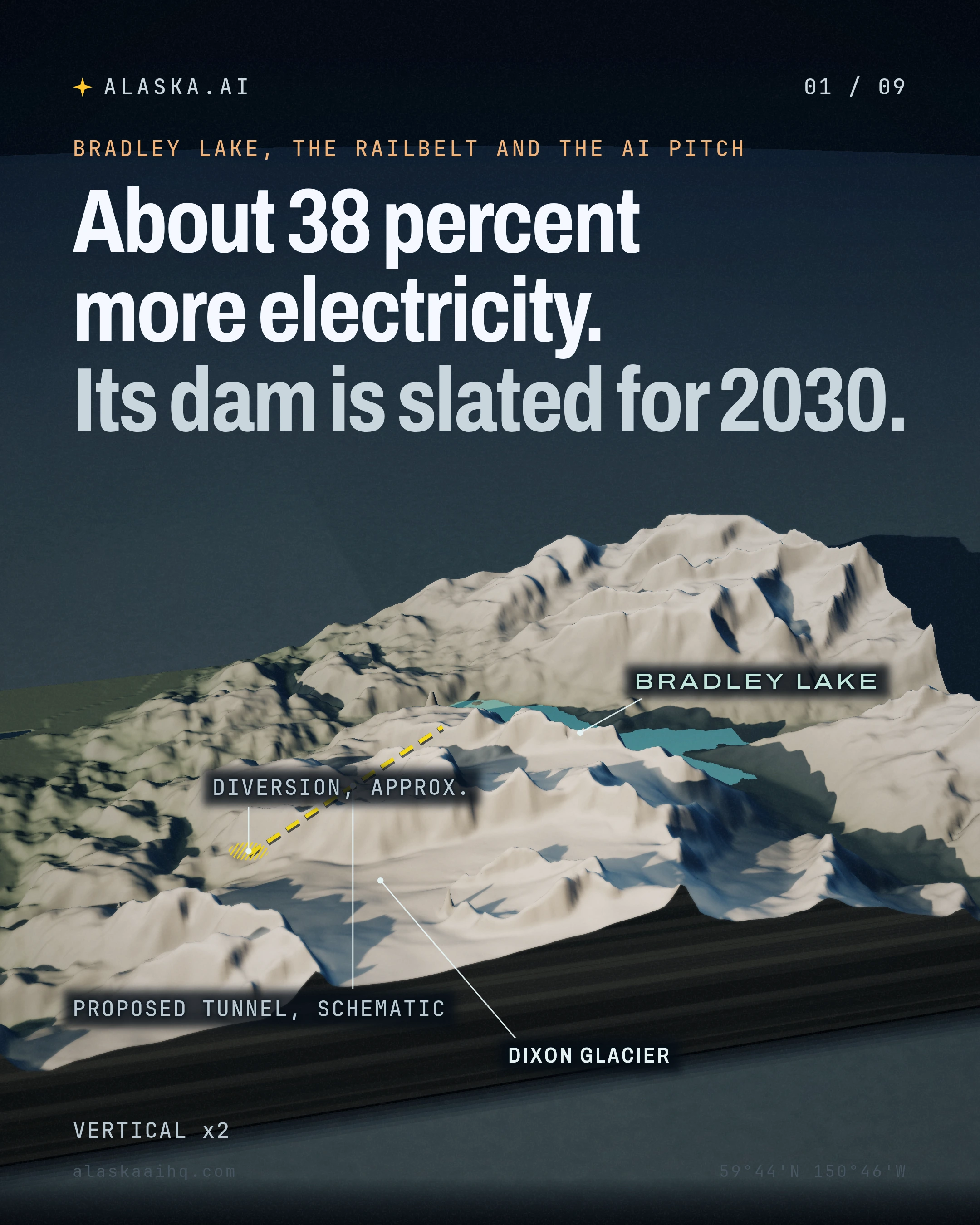
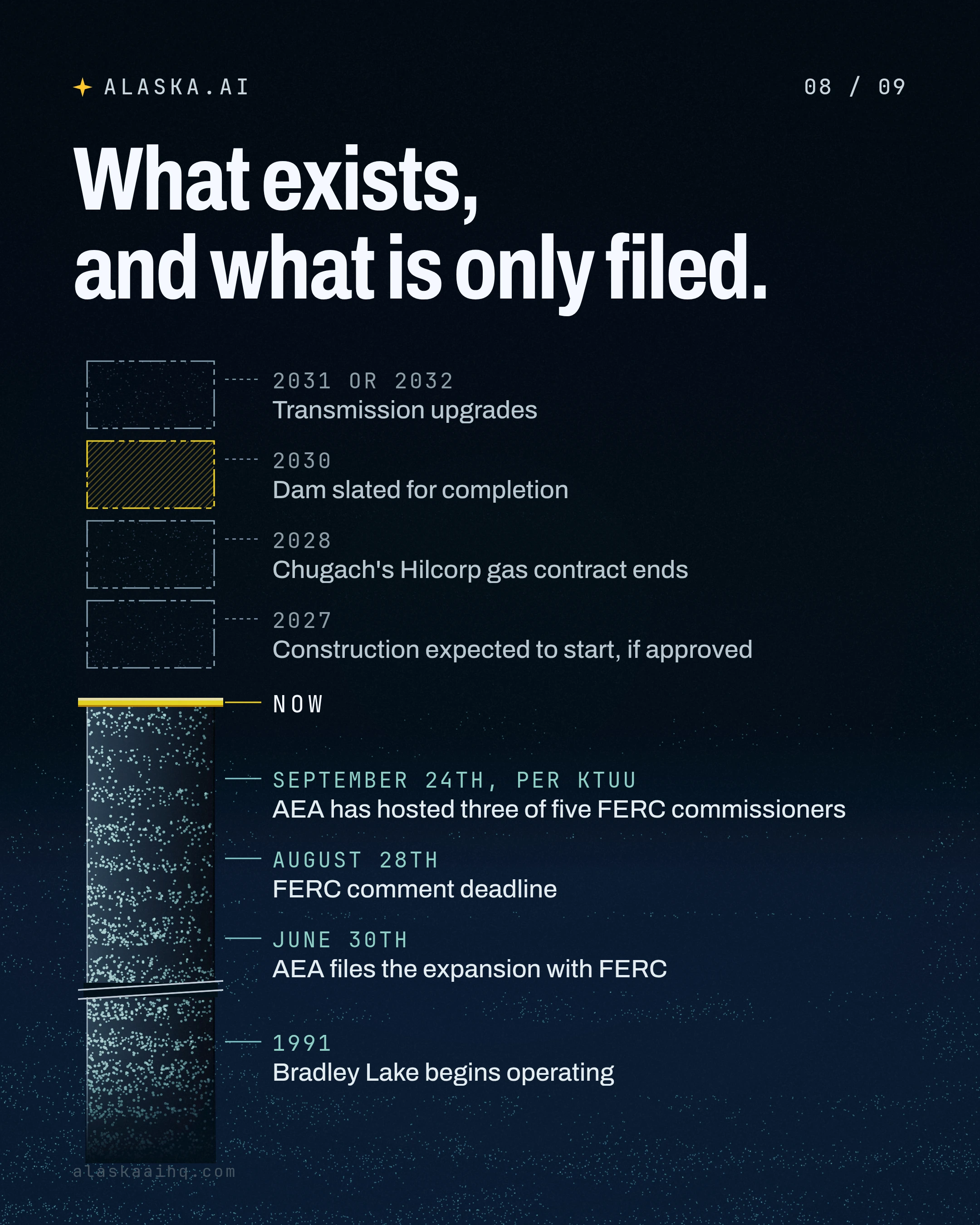
Construction is expected to start in 2027 pending federal approvals. Chugach's Hilcorp gas contract ends in 2028. The dam is slated for 2030 and its transmission upgrades for 2031 or 2032. At the far end waits what FERC puts at about 38 percent more electricity a year while capacity barely moves.
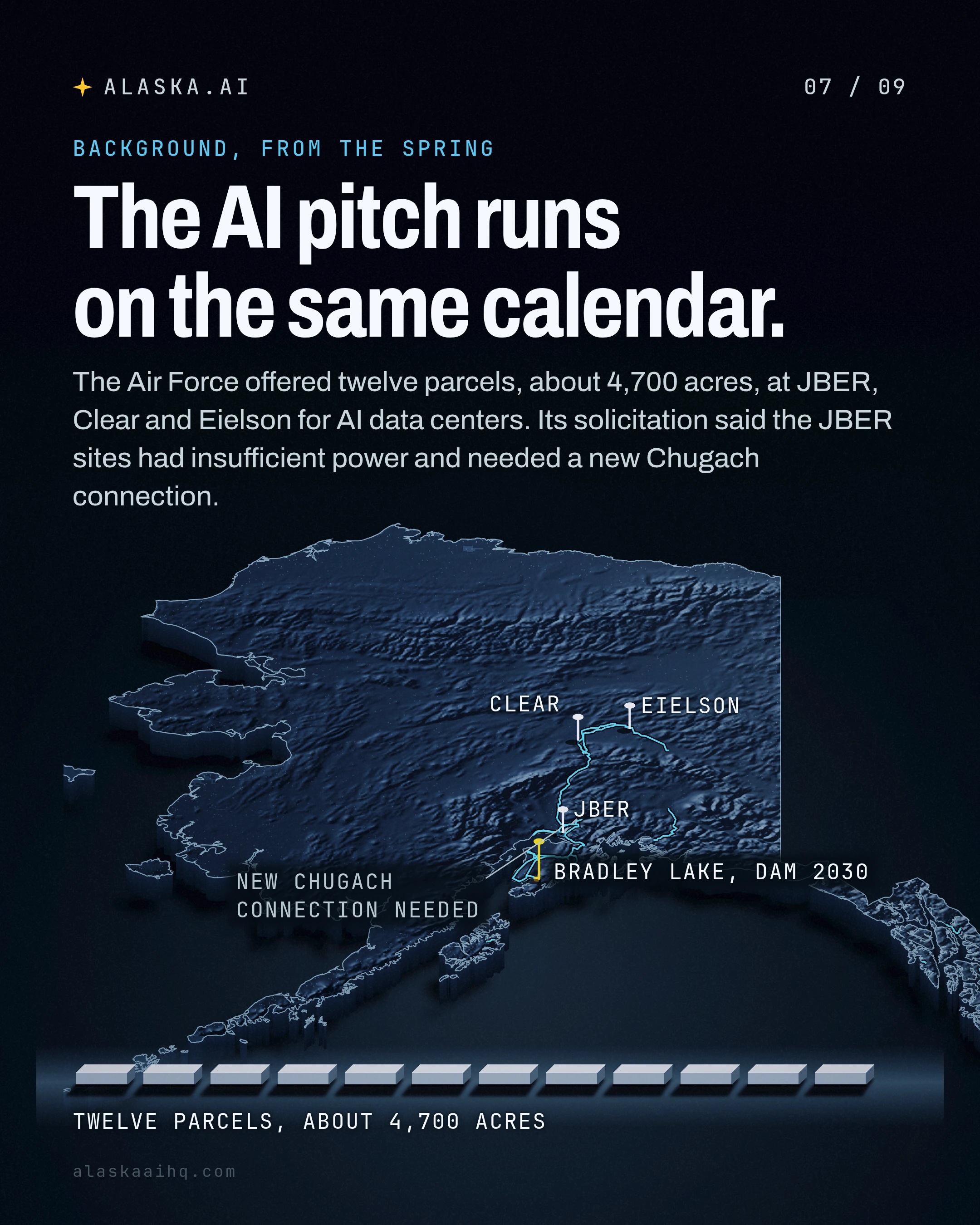
In between sit twelve parcels the Air Force offered for AI data centers this spring, about 4,700 acres. Its solicitation said the JBER sites had "insufficient power."
Until the glacier water arrives, should Railbelt AI data centers bring their own power?
What we verified
73 CLAIMS, EACH RE-FETCHED FROM ITS SOURCE BEFORE THIS DECK SHIPPED
Bradley Lake has 120 MW of installed capacity.
AEA filed its Bradley Lake expansion amendment application with FERC on June 30th under project number P-8221-124.
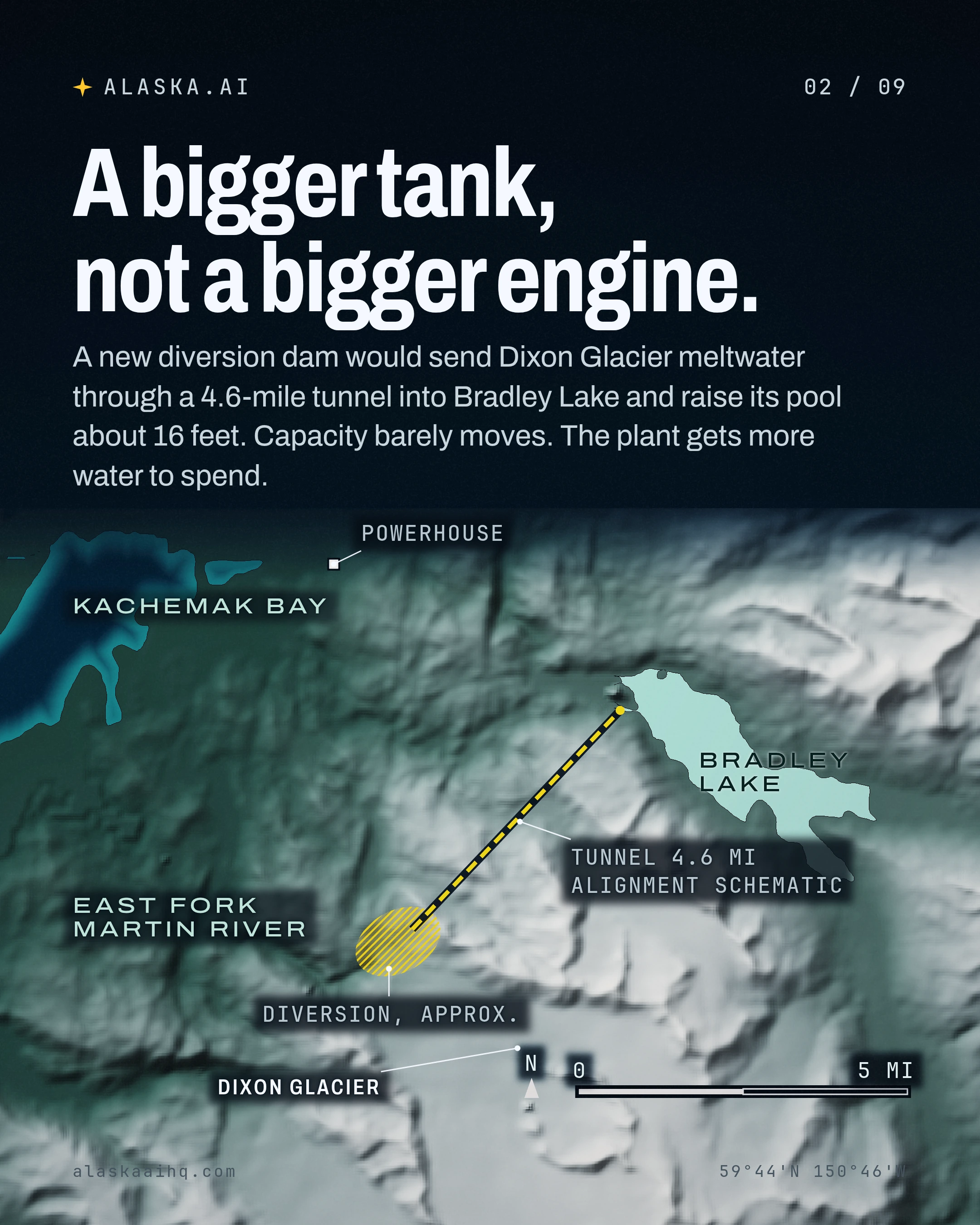
The expansion would build a new diversion dam to send Dixon Glacier meltwater and runoff into Bradley Lake.
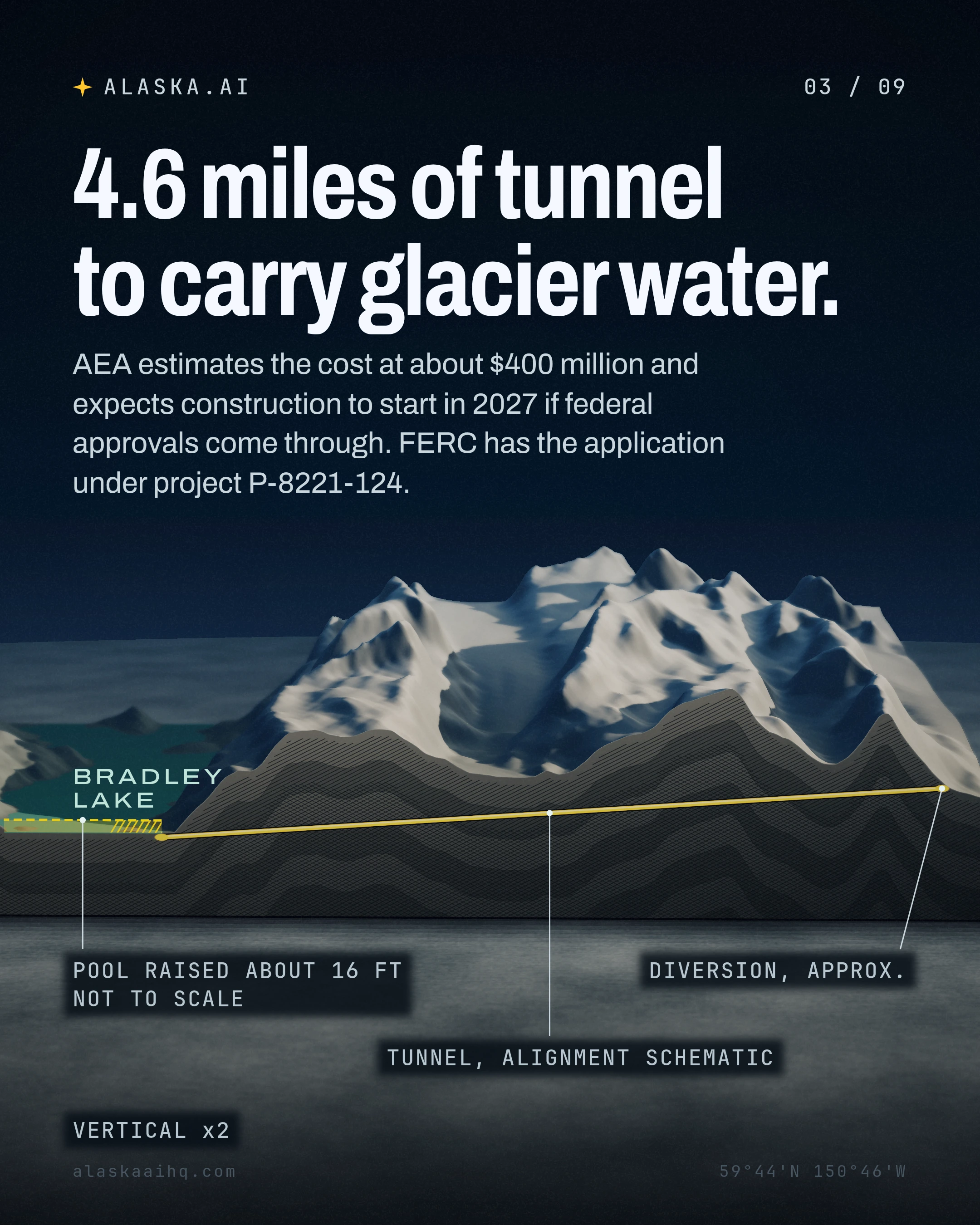
The expansion would raise Bradley Lake's normal maximum operating pool by about 16 feet.
The expansion would add a 0.3 MW micro-hydro turbine in one of Bradley Lake Dam's fishwater release valves.
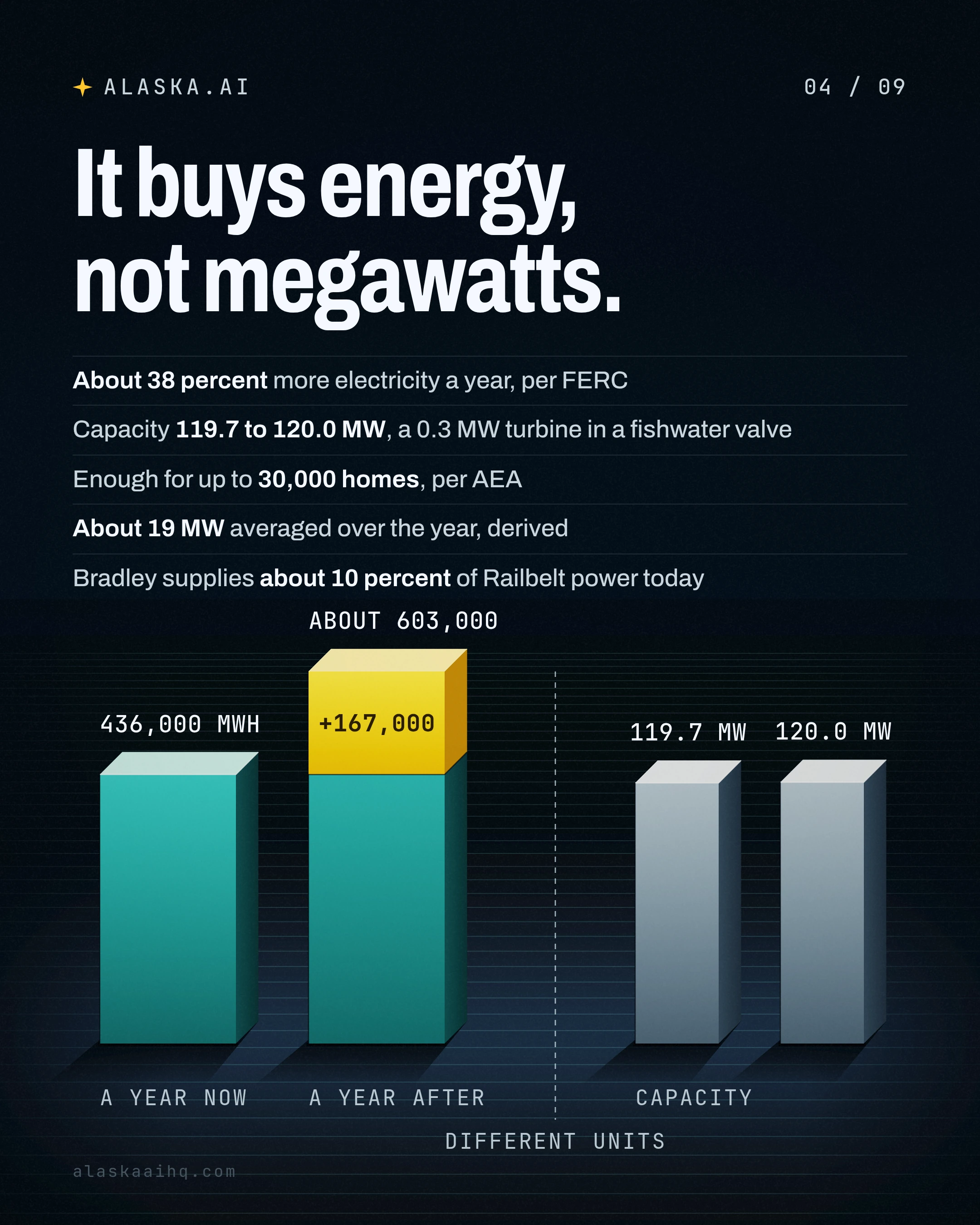
The expansion would raise Bradley Lake's installed capacity from 119.7 MW to 120.0 MW.
FERC's notice says the expansion would raise Bradley Lake's average annual power generation by approximately 38 percent.
FERC set the comment deadline on the amendment application for August 28th at 5 p.m. Eastern.
The Dixon diversion's estimated construction cost is about $400 million.
AEA estimates three years of study and permitting followed by three years of construction.
The Dixon diversion would be located five miles southwest of Bradley Lake.
The Dixon diversion would be about 27 miles northeast of Homer on the Kenai Peninsula.
From 1995 through 2020 Bradley Lake averaged 392,000 megawatt-hours a year.
Bradley Lake provides about 10 percent of the total annual power used by Railbelt utilities.
Bradley Lake began operating in 1991.
Bradley Lake's power has cost about four cents per kilowatt-hour.
On July 20th AEA announced it had filed a Final Amendment Application with FERC for the Bradley Lake Expansion Project.
AEA says the expansion would add about 167,000 MWh a year, bringing Bradley Lake to about 603,000 MWh.
AEA says Bradley Lake currently generates about 436,000 MWh a year.
AEA says the added energy could power up to 30,000 homes.
The expansion would use a diversion dam near Dixon Glacier and a 4.6-mile tunnel to carry water into Bradley Lake.
Bradley Lake supplies power to five Railbelt utilities, namely Chugach Electric, Golden Valley Electric, Homer Electric, Matanuska Electric and Seward Electric.
AEA says construction on the expansion is anticipated to begin in 2027, pending federal approvals.
The Railbelt's five load-serving electric utilities are interconnected across nearly 700 miles.
The Railbelt is home to nearly three-fourths of Alaska's population.
The Railbelt Reliability Council describes the Railbelt grid as islanded.
Alaska DNR issued a preliminary decision on STAK Energy Corporation's lease application ADL 422741.
The STAK Energy lease would run 50 years.
The STAK Energy lease covers a 715.4-acre parcel about 26 miles south of Deadhorse along the Dalton Highway.
STAK's proposed natural gas-powered data center would be behind the meter and not interconnected to the Railbelt or any other Alaska grid.
USGS stream gage 15238950, East Fork Martin River below Dixon Glacier near Homer, sits at 59 41 34.07 N, 150 55 06.11 W (NAD83), altitude 1,338 feet.
UAA's RAISE mini-grant partner statement of need was due September 21st.
RAISE mini-grant awards will be announced November 2nd.
Any Alaskan organization outside the university may apply, including businesses, Alaska Native organizations, K-12 schools, governments and nonprofits.
The mini-grants are part of UAA's Rural AI Solutions and Engagement project funded by NSF award 2433241.
NSF award 2433241 is titled Collaborative Research EPIIC Rural AI Solutions and Engagement (RAISE) and went to the University of Alaska Anchorage.
UAA's share of the RAISE award is $380,000.
The RAISE award runs from August 1st, 2024 through July 31st, 2027.
UA's Faculty Initiative Fund awarded $29,989 to Alpana Desai and Marie Lowe of UAA for an AI community planning system for rural Alaska.
The Desai and Lowe project works with Alakanuk, a Yup'ik community on the Yukon River Delta threatened by erosion.
The Faculty Initiative Fund awarded $29,998.84 to Andrew Harnish of UAA for the Second UA Statewide AI Symposium.
The Alaska Energy Authority has hosted three of the five FERC commissioners at Bradley Lake.
The commissioner visits were prompted by a longstanding requirement from Senators Lisa Murkowski and Dan Sullivan that nominees visit Alaska before confirmation.
The KTUU story was written by Augusta McDonnell and published the evening of September 24th.
KTUU reported that the expansion work will increase Bradley Lake's water capacity by 40 percent.
Dam construction for the Bradley Lake expansion is slated for completion in 2030.
Transmission line upgrades tied to the expansion will not wrap up until 2031 or 2032.
Curtis Thayer said Fairbanks is using 250,000 gallons of diesel a day because there isn't enough natural gas to ship there.
Thayer said Fairbanks did not burn diesel at that rate last year.
Natural gas fuels about 80 percent of electric power generation in Southcentral Alaska.
Roughly 75 percent of Alaska's population relies on the interconnected Railbelt transmission network.
KTUU describes the Railbelt population as stretching 600 miles from Homer north to Fairbanks.
AEA and the Alaska Housing Finance Corporation are rolling out $74 million in federal grants this fall for appliance rebates and weatherization upgrades.
AEA and Railbelt utilities are spending about a billion dollars on construction projects this year.
Curtis Thayer is CEO and executive director of the Alaska Energy Authority.
Thayer said there is nothing for tomorrow and nothing for next year.
Thayer said the projects meant to change the energy picture are within a four- to five-year window.
Thayer said Alaskans will have to turn off the lights and turn down the heat to conserve natural gas during a long cold period.
Thayer said Alaskans can't keep all their thermostats at 72 degrees.
Thayer warned that in a two-week stretch of 20-below weather in Anchorage, voluntary consumer cutbacks would be essential to keep the system running.
Thayer said a long cold streak or cold snap would require conservation.
Spencer Perry is an assistant professor of economics and policy at the University of Alaska Anchorage.
Perry said diesel fuel has been constrained by conflicts in the Middle East and the war between Russia and Ukraine.
Officials say Southcentral will likely need to import liquefied natural gas as a bridge fuel.
An Air Force solicitation said the JBER data center sites have insufficient power and would need a new connection to Chugach Electric.
Chugach Electric's gas supply contract with Hilcorp Alaska is set to end in 2028.
The Air Force offered five sites at JBER ranging from about 60 to nearly 200 acres.
The Air Force identified about 4,700 acres for AI data centers on Air Force and Space Force installations in Alaska.
Twelve parcels were identified across JBER, Clear Space Force Station and Eielson Air Force Base.
The symposium's Friday September 25th program at UAA was free and open to the public, with most sessions online.
The symposium's AI and Alaska session covered rural connectivity and compute, Alaska Native language and data sovereignty, and locally controlled models.
Futurist Bryan Alexander was announced as the symposium keynote speaker.
The symposium's Saturday sessions covered UA teaching, research funding and information security, and Sunday closed with a strategy session for the statewide AI advisory council.
Beats
This article is on Alaska data centers · Alaska power and the grid · Defense and federal AI in Alaska · Alaska AI research and science. Each beat page keeps every decision and every article on that subject in one place.