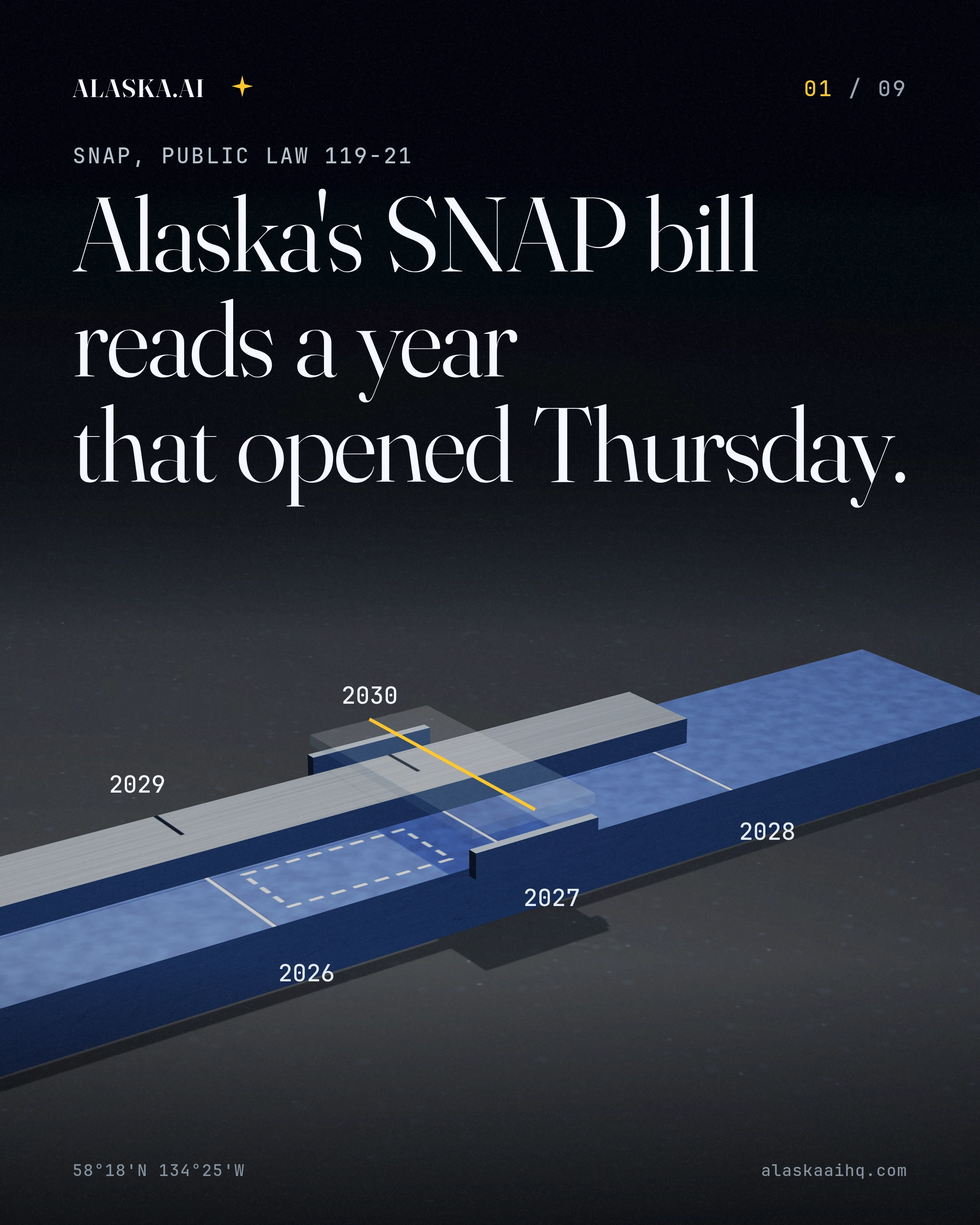
Alaska's SNAP Bill Reads a Year That Opened Thursday
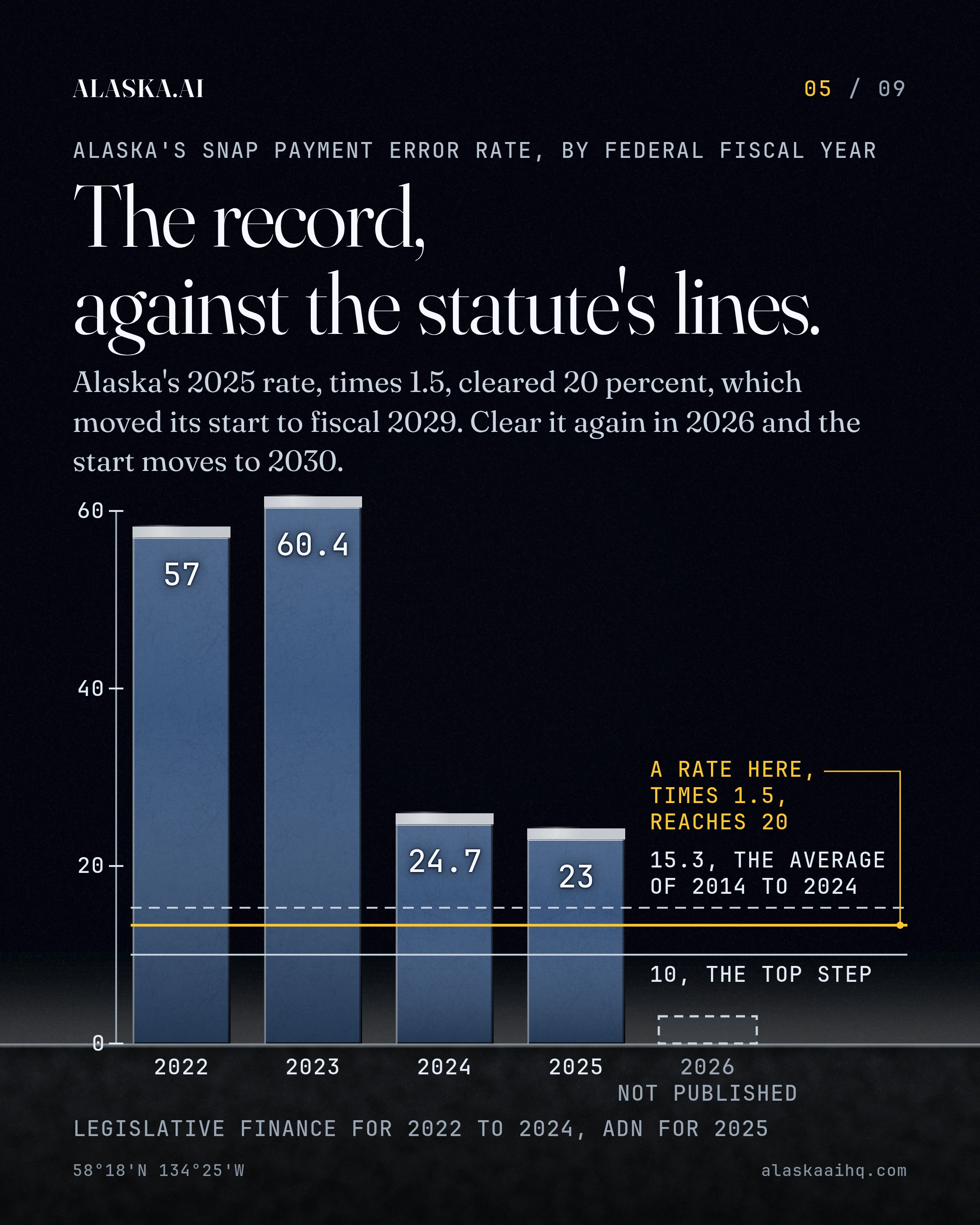
Alaska's SNAP payment error rate ran 57, 60.4, 24.7 and 23 percent from 2022 to 2025.
The deck
SWIPE, SCROLL OR CLICK A SLIDE TO GO FULLSCREEN · 9 SLIDES
The story
All four clear 10 percent, where Public Law 119-21 has a state pay 15 percent of benefit costs. The 2025 rate was the nation's highest and pushed Alaska's share to fiscal 2029. Fiscal 2026's unpublished rate decides whether that becomes fiscal 2030.
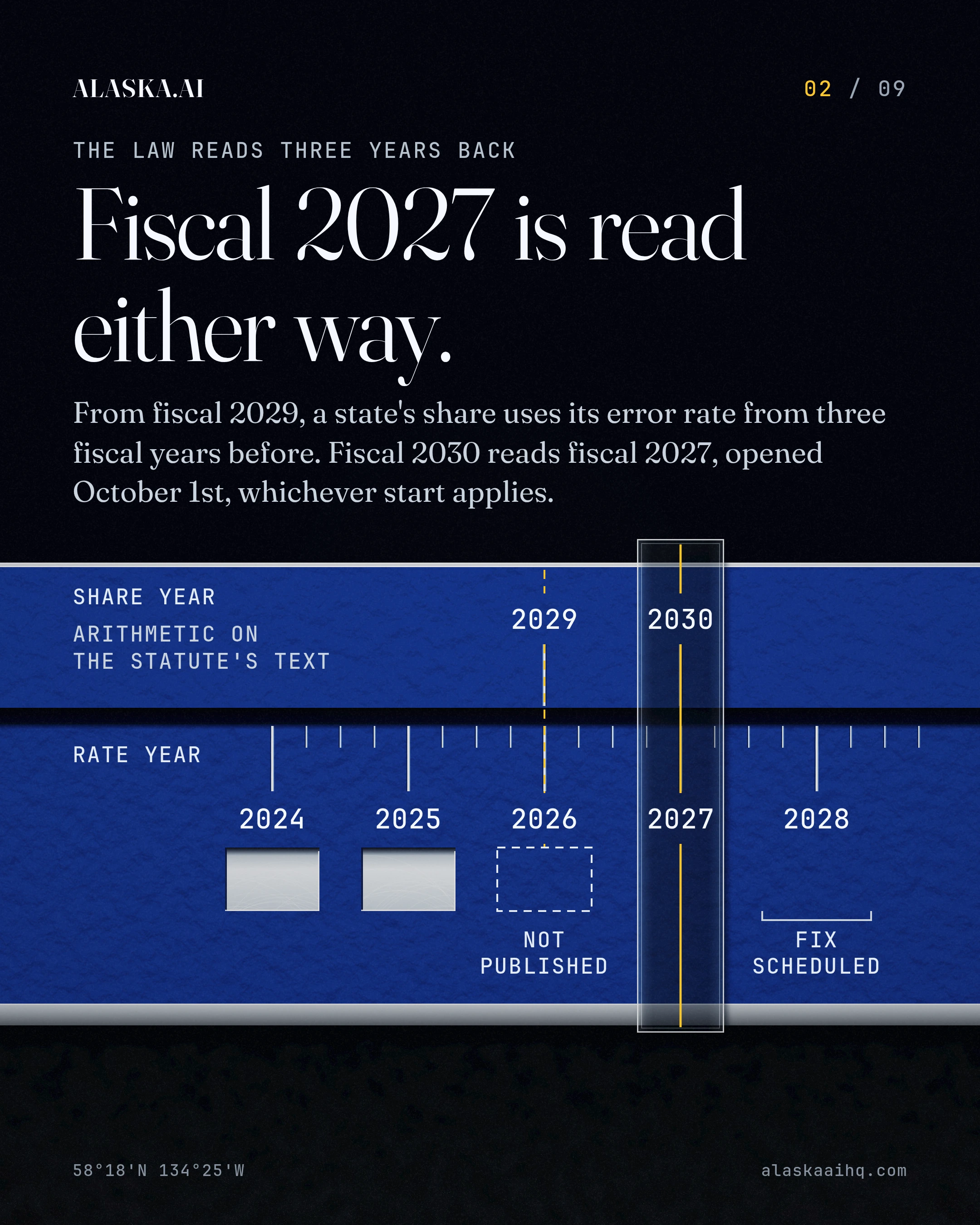
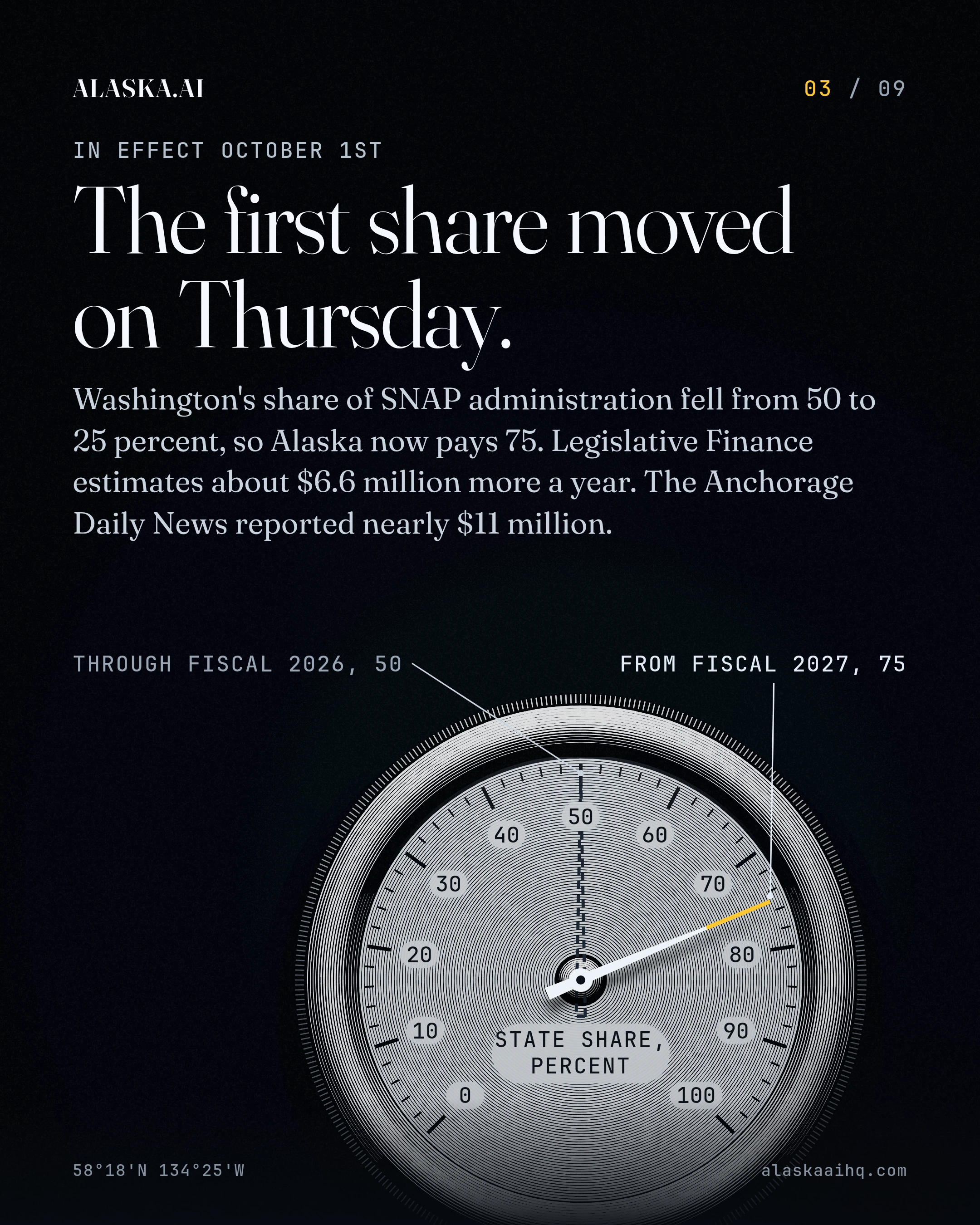
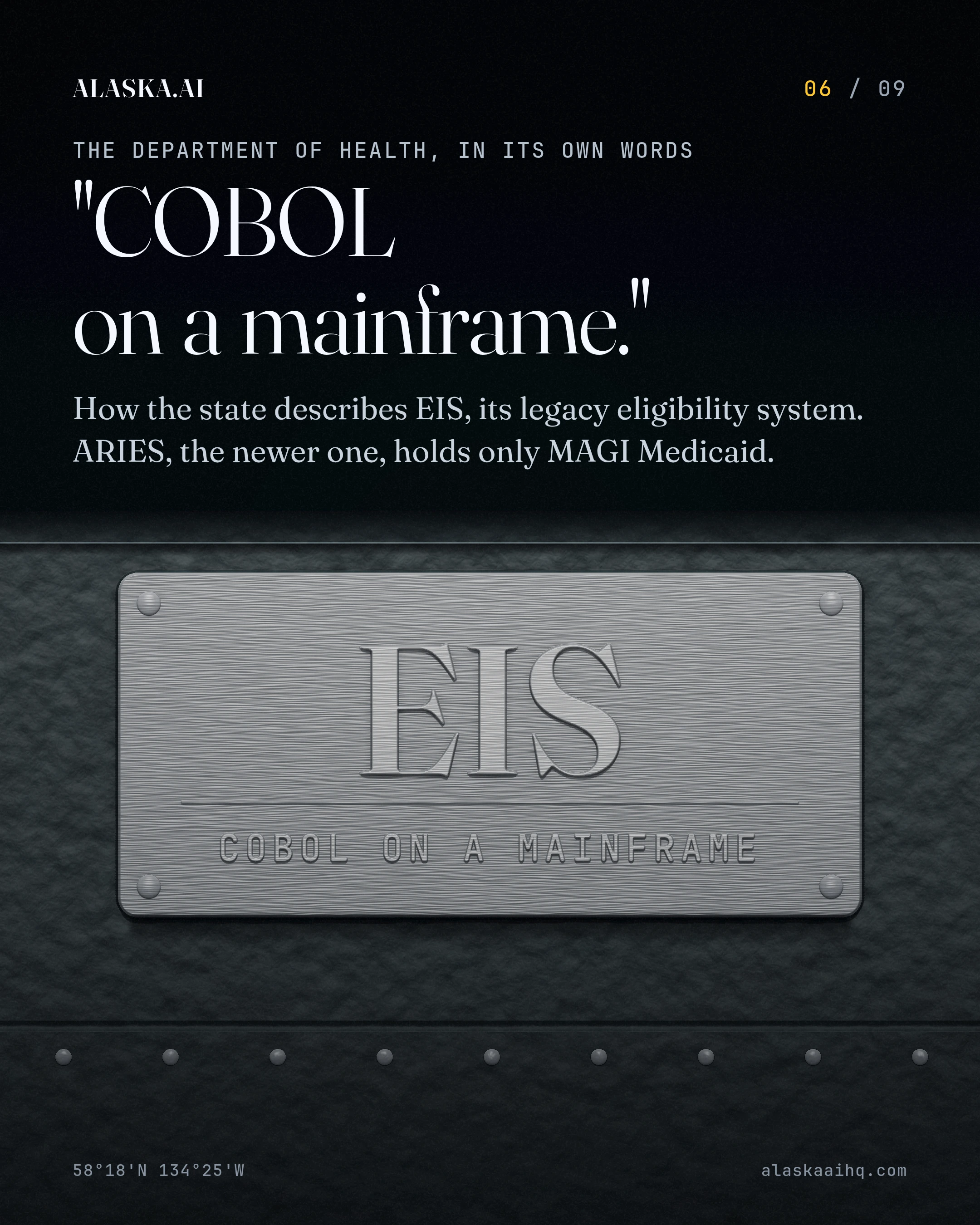
From fiscal 2029 that share reads the rate from three fiscal years earlier. Fiscal 2030's share reads fiscal 2027 either way. The state's fix for what it calls "COBOL on a mainframe" is scheduled for 2028. Fiscal 2027 opened October 1st, the day Alaska's share of running SNAP went from 50 to 75 percent.
Steel instruments read the law's shares and Alaska's record, then the state's system, staffing and 2028 fix.
With fiscal 2027 already counting, what should Alaska change in how it decides SNAP cases before 2028?
What we verified
57 CLAIMS, EACH RE-FETCHED FROM ITS SOURCE BEFORE THIS DECK SHIPPED
Public Law 119-21 sets the federal share of state SNAP administrative costs at 50 percent through fiscal year 2026 and 25 percent from fiscal year 2027 onward.
Alaska's Legislative Finance Division says federal fiscal year 2027 begins October 1st, 2026, when SNAP administrative cost sharing changes to 25 percent federal and 75 percent state.
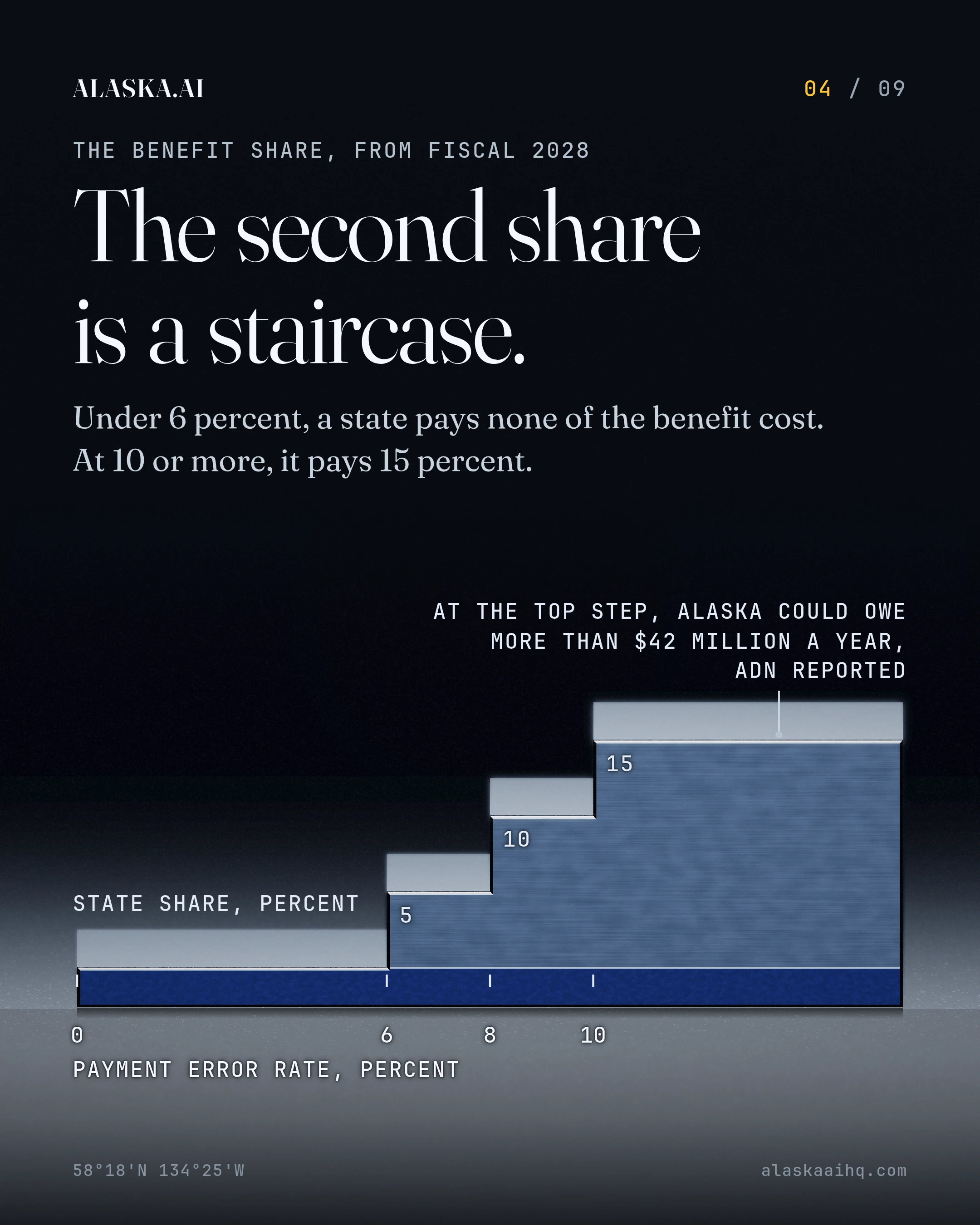
Under Public Law 119-21, a state with a SNAP payment error rate under 6 percent pays none of the benefit cost once the state cost share applies, starting in fiscal year 2028.
Under Public Law 119-21, a state with a payment error rate of at least 6 percent but under 8 percent pays 5 percent of SNAP benefit costs.
Under Public Law 119-21, a state with a payment error rate of at least 8 percent but under 10 percent pays 10 percent of SNAP benefit costs.
Under Public Law 119-21, a state with a payment error rate of 10 percent or more pays 15 percent of SNAP benefit costs.
From fiscal year 2029 on, the law sets each state's SNAP benefit cost share using its payment error rate from the third fiscal year before.
The law delays the benefit cost share to fiscal year 2029 for any state whose fiscal year 2025 payment error rate, multiplied by 1.5, is 20 percent or more.
The law moves the start to fiscal year 2030 for any state whose fiscal year 2026 payment error rate, multiplied by 1.5, is also 20 percent or more.
Alaska's SNAP payment error rate was 57 percent in federal fiscal year 2022, according to the Legislative Finance Division.
Alaska's SNAP payment error rate was 60.4 percent in federal fiscal year 2023, according to the Legislative Finance Division.
Alaska's SNAP payment error rate was 24.7 percent in federal fiscal year 2024, according to the Legislative Finance Division.
Alaska's SNAP error rate averaged 15.3 percent between federal fiscal years 2014 and 2024, according to the Legislative Finance Division.
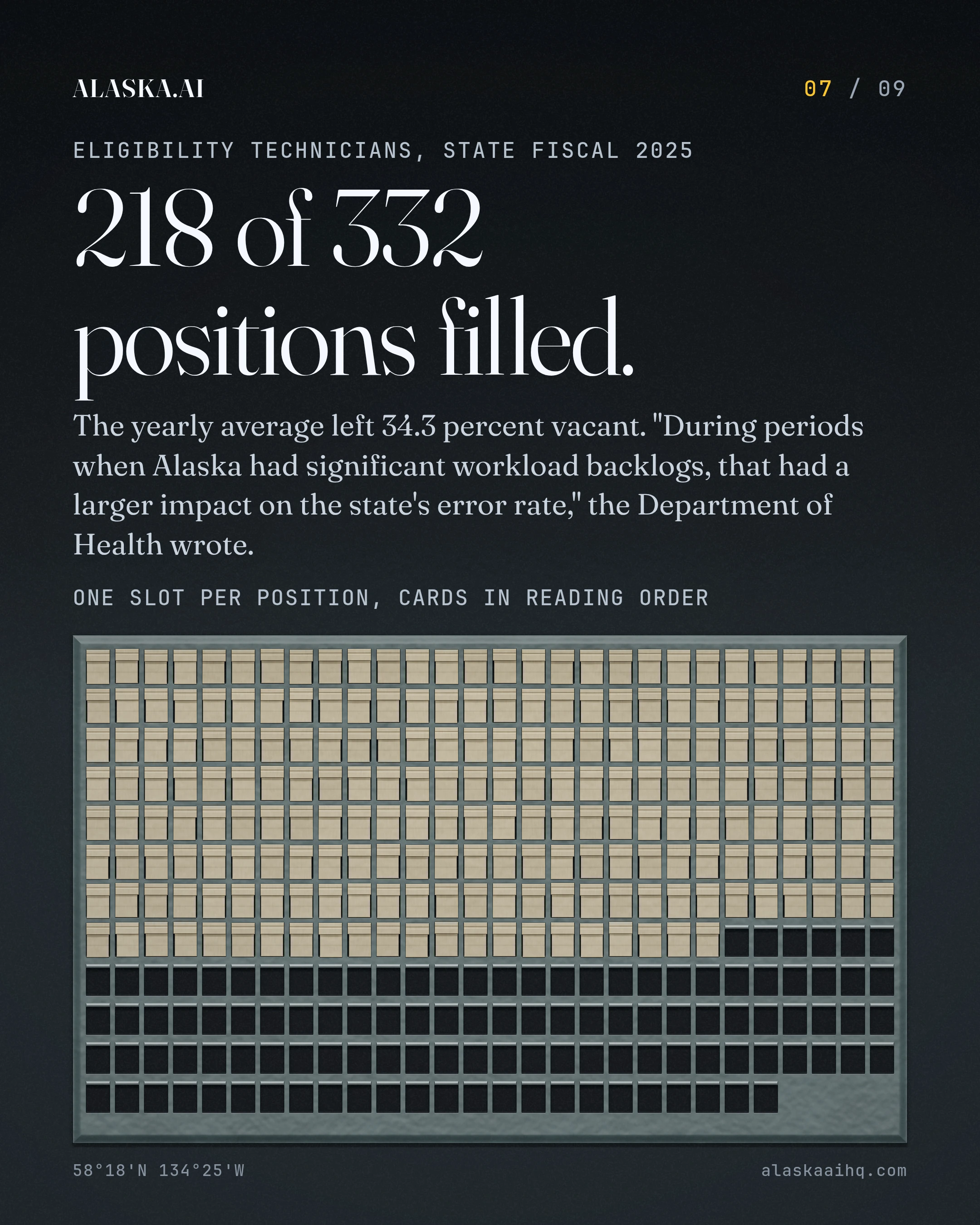
The average vacancy rate among Alaska's eligibility technician positions in Public Assistance Field Services was 34.3 percent in state fiscal year 2025.
Alaska had 332 active eligibility technician positions in state fiscal year 2025 and an average of 218 of them filled.
The total cost of administering SNAP in Alaska averaged 26.5 million dollars a year over the last five years, according to the Legislative Finance Division.
The Legislative Finance Division estimates Alaska's annual share of SNAP administrative costs will rise by about 6.6 million dollars in state fiscal year 2027.
Alaska was fined nearly 12 million dollars in 2024 for its high SNAP error rates.
Alaska was fined 4.6 million dollars in 2025 for its SNAP error rate in 2024.
Alaska's Department of Health says its legacy eligibility system, EIS, is built in COBOL on a mainframe and is difficult to change.
Alaska's Department of Health says a prior contractor migration left it with a partially implemented eligibility system, ARIES, that contains only MAGI Medicaid.
The Department of Health says the state determines eligibility in two systems, which forces a good deal of manual workarounds.
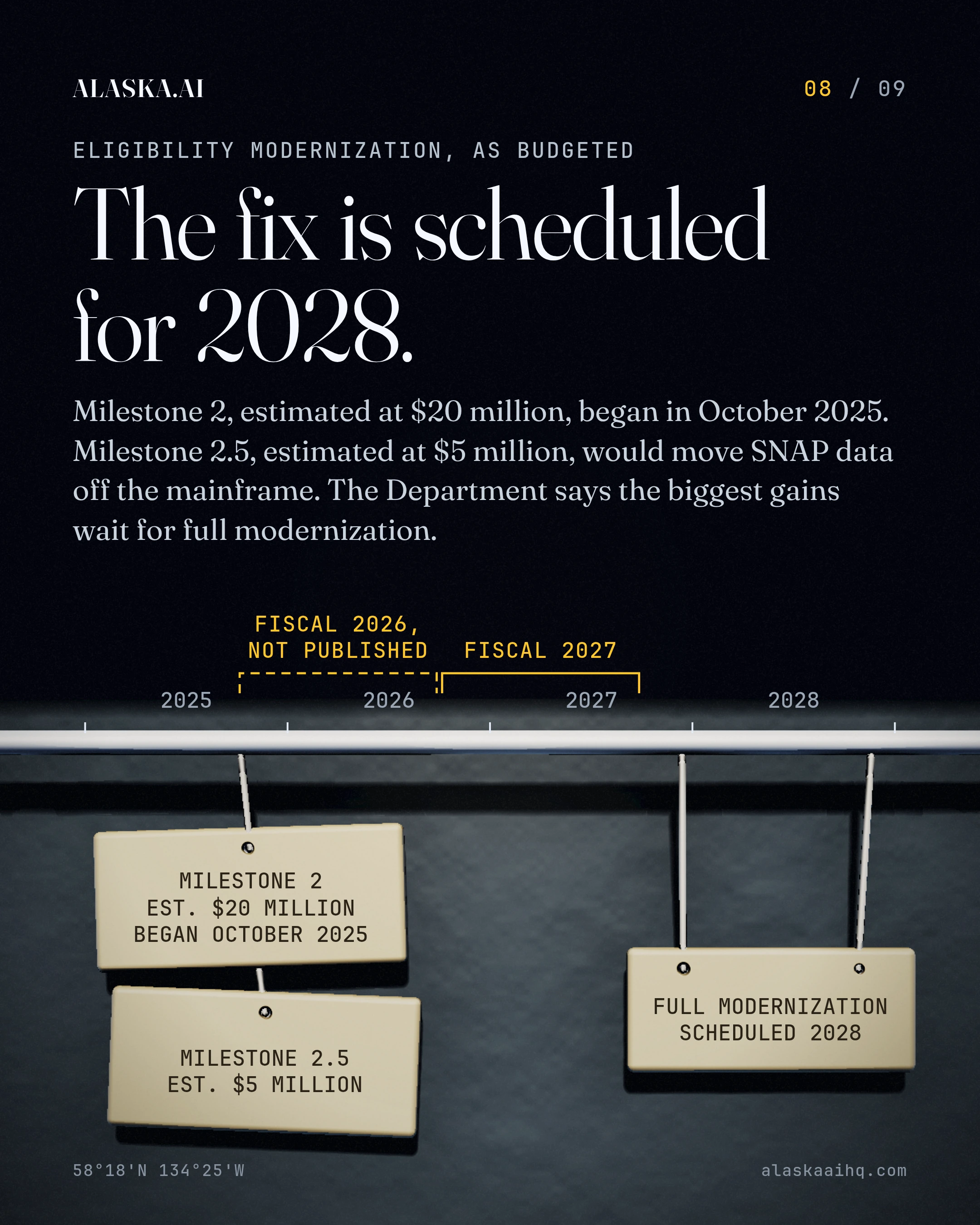
Alaska's Department of Health estimated a budget of 20 million dollars for Milestone 2 of its eligibility modernization, a time and materials contract.
The Department of Health says its Milestone 2 procurement is complete and the project began in October 2025.
The Department of Health estimated a budget of 5 million dollars for Milestone 2.5, a time and materials contract planned to run about 18 months.
Milestone 2.5 is meant to migrate SNAP and non-MAGI Medicaid beneficiary data and reports from the mainframe into a modern data repository that is accessible by API.
Nava announced it won a two-and-a-half-year contract with the Division of Public Assistance in Alaska's Department of Health to support eligibility system modernization.
Nava co-founder and chief operating officer Sha Hwang said nearly one-third of Alaskans rely on Medicaid.
ADF&G released Yukon River Fall Update #9, Fall Fishery Announcement #25, on September 22nd.
ADF&G says the Yukon fall chum run is projecting to be greater than 900,000 fish, well above the upper end of the drainagewide escapement goal range.
ADF&G says the Canadian-origin share of Yukon fall chum is 15 percent, well below the historical average of 30 percent.
Genetic mixed stock analysis applied to Pilot Station sonar estimates indicates about 914,000 fall chum were in the Yukon through September 7th, above the median of 822,000 for that date.
Eagle sonar counted a cumulative 19,000 fall chum as of September 21st, below the median of 49,000 for that date.
Teedriinjik (Chandalar) River sonar counted 168,300 fall chum as of September 21st, above the median of 139,600.
ADF&G projects the 2026 Yukon coho run at 116,000 fish, well below the historical average run index of 212,000.
The treaty objective for fall chum on the mainstem Yukon River is 70,000 to 104,000 fish.
ADF&G says the mainstem of the Porcupine River will stay closed until the Fishing Branch River escapement goal is projected to be met.
NPR reported on October 1st that states must now cover 75 percent of SNAP operational costs while federal funding shrinks by half.
By the federal government's own calculations, the administrative cost change will cut federal SNAP spending by 16.9 billion dollars over five years, according to NPR.
Alaska erred in 23 percent of SNAP payments made in 2025, the Anchorage Daily News reported.
The Associated Press reported that Alaska had the highest SNAP payment error rate in the nation, at over 23 percent, and would benefit from the delay.
AP reported that states with error rates of at least 13.34 percent last year get a delay in their cost share until at least fiscal year 2029.
Alaska had the highest SNAP payment error rate in the nation for the fourth consecutive year, the Anchorage Daily News reported.
The Anchorage Daily News reported that the administrative cost shift is set to increase Alaska's SNAP expenses by nearly 11 million dollars a year.
SNAP serves more than 66,000 Alaskans, roughly 9 percent of the state's population, the Anchorage Daily News reported.
The Anchorage Daily News reported, citing Alaska Department of Health data, that Alaska could owe more than 42 million dollars a year for SNAP benefits if its error rate is not below 10 percent when the cost share begins.
The Anchorage Daily News reported that Alaska would owe 28 million dollars if its error rate is between 8 and 10 percent.
The Anchorage Daily News reported that Alaska would owe nearly 17 million dollars if its error rate is between 6 and 8 percent.
Department of Health spokesperson Mirna Estrada wrote that the most significant error rate improvements will not show until modernization is fully implemented, work scheduled for completion in 2028.
Estrada wrote that workload backlogs had a larger impact on Alaska's error rate during the periods when they were significant.
The Anchorage Daily News reported that Senators Dan Sullivan and Lisa Murkowski negotiated the reprieve delaying the cost share until 2029 for states with the highest error rates.
The Center for Biological Diversity, the Alaska Commercial Fisheries Conservation Alliance and the Kenai Peninsula Borough have filed motions to intervene against DeepGreen's Cook Inlet application, ADN reported.
DeepGreen Cook Inlet released plans for a 100-megawatt subsea data center with as many as 350 underwater turbines, ADN reported.
FERC accepted DeepGreen's preliminary permit application for Cook Inlet on September 1st, opening a two-month public comment period, ADN reported.
Comments, motions to intervene and competing applications can be filed online with FERC through November 2nd, ADN reported.
The Alaska Commercial Fisheries Conservation Alliance's motion says DeepGreen did not assess effects on the more than 1,300 active commercial fishing permits in Upper Cook Inlet, ADN reported.
Cooper Freeman, Alaska director of the Center for Biological Diversity, said the project does not belong in the inlet.
Beats
This article is on Defense and federal AI in Alaska · Alaska AI policy and legislation. Each beat page keeps every decision and every article on that subject in one place.