Fairbanks Votes Tuesday. Six Voices on AI Data Centers
The only item on both halves of Fairbanks' priority list is a data center moratorium. The land offered for AI is the Air Force's.
The deck
SWIPE, SCROLL OR CLICK A SLIDE TO GO FULLSCREEN · 9 SLIDES





The story
The October 6th vote doesn't decide whether data centers come. It picks who asks the borough's questions.
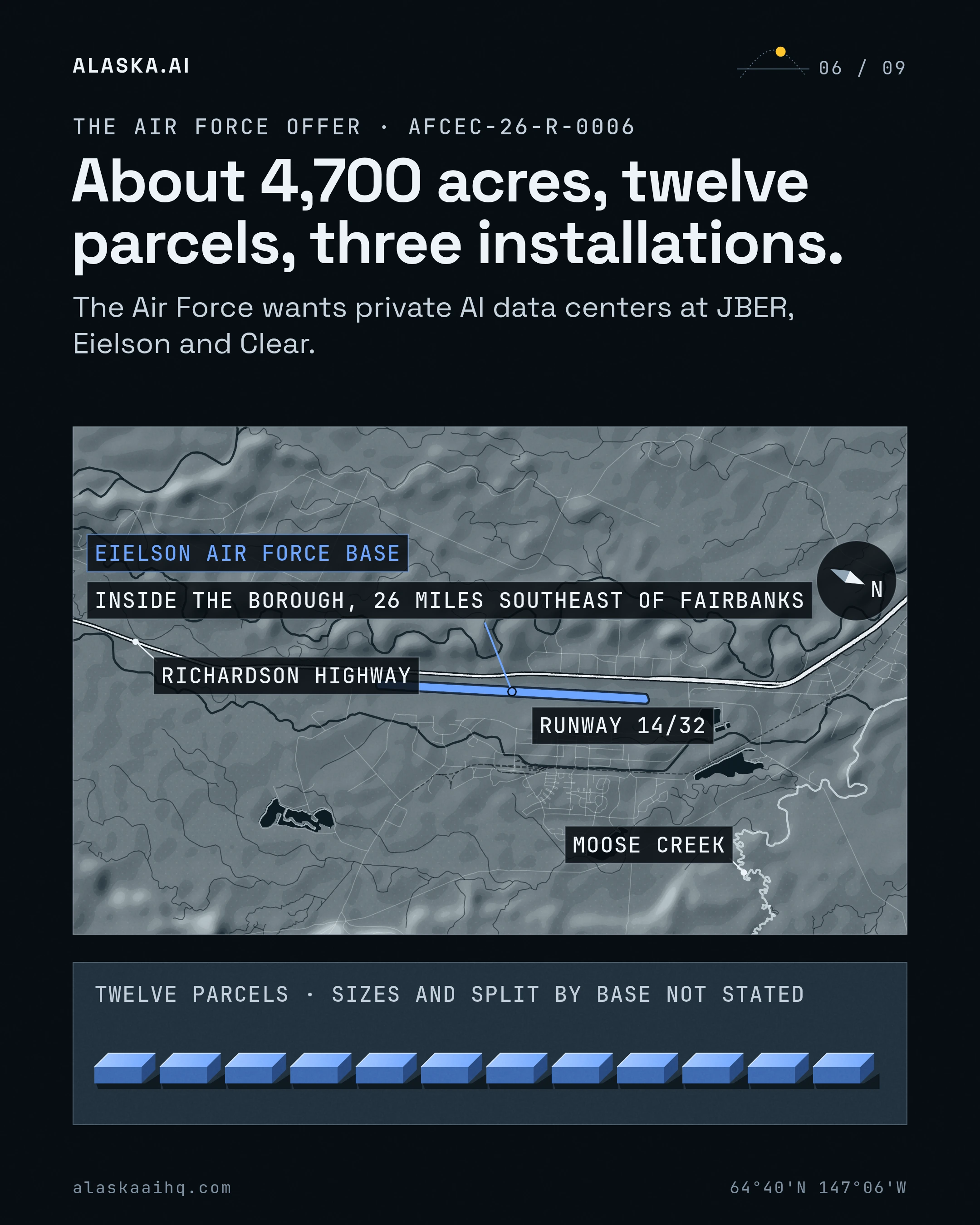
The moratorium is a request among 25 priorities. Its text names state-owned or municipal lands. The Air Force offered to lease about 4,700 acres for AI data centers, including Eielson inside the borough.
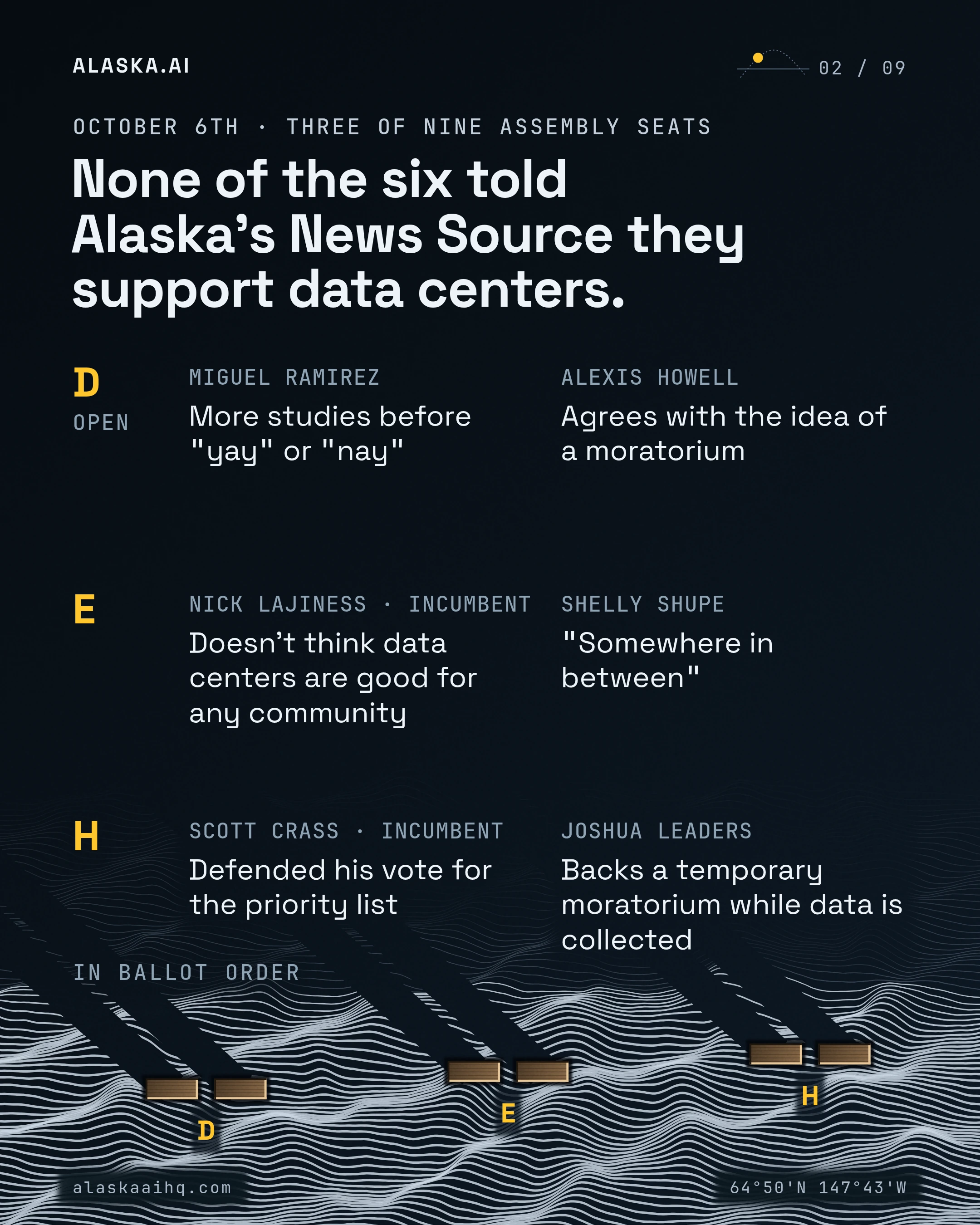
Miguel Ramirez and Alexis Howell, Nick LaJiness and Shelly Shupe, Scott Crass and Joshua Leaders run for three Assembly seats. None of the six told Alaska's News Source they support data centers.
Four frames give all six candidates equal room. One maps Eielson inside the borough.
Which of electrical demand, water, noise and air quality should the winners take to the Air Force first?
What we verified
57 CLAIMS, EACH RE-FETCHED FROM ITS SOURCE BEFORE THIS DECK SHIPPED
The Fairbanks North Star Borough regular election is on Tuesday, October 6th.
Polls are open from 7 a.m. to 8 p.m. on election day.
The October 6th ballot includes Proposition 3, a citizens' initiative to require hand counting of all ballots and prohibit electronic tabulation.
Three Borough Assembly seats are on the ballot, Seats D, E and H, each for a 3-year term.
Miguel Ramirez and Alexis Howell are the two candidates for Assembly Seat D.
Scott Crass is the Assembly's Presiding Officer.
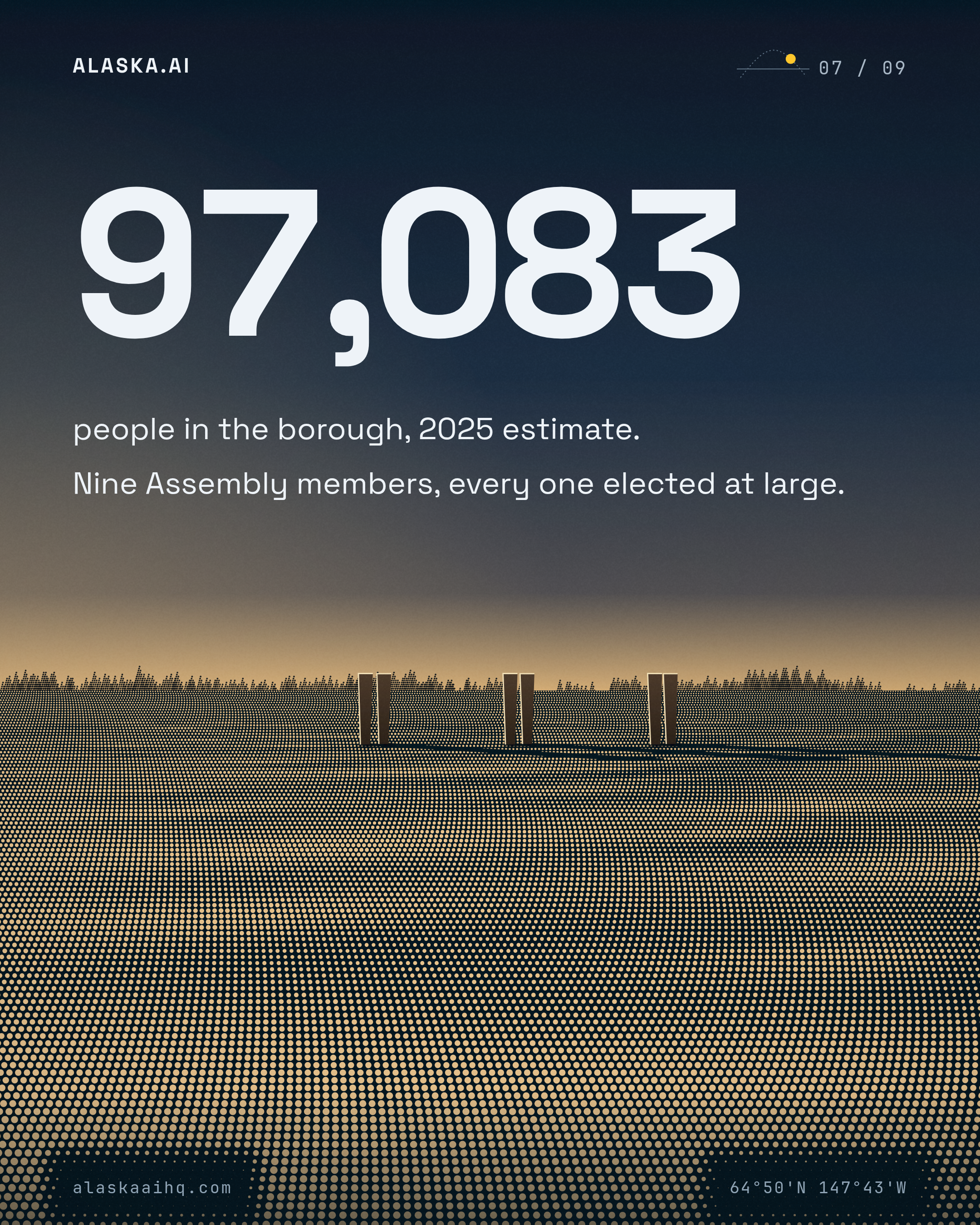
The Fairbanks North Star Borough Assembly has nine members elected at large.
The Assembly adopted Resolution 2026-25, identifying its legislative priorities, at its August 27th regular meeting.
Resolution 2026-25 supports a moratorium on permitting, leasing or building new commercial data centers on state-owned or municipal lands in Alaska.
The moratorium would last until the state and local governments adopt standards on six named impacts, from electrical demand and water to noise and air quality.
The Air Force solicitation AFCEC-26-R-0006 seeks lease proposals for AI data centers at JBER, Eielson Air Force Base and Clear Space Force Station.
The Assembly's next regular meeting after the election is on October 8th.
A second regular Assembly meeting is scheduled for October 22nd.
The Fairbanks North Star Borough had an estimated 97,083 residents in 2025.
Begich's DATA Act of 2026 would let manufacturers run fully self-contained grid-of-one power systems.
The Fairbanks North Star Borough includes Eielson Air Force Base and Fort Wainwright among its communities.
Eielson Air Force Base is 26 miles southeast of Fairbanks.
NSF obligated $3,824,575 to the University of Alaska Anchorage for an AI-driven critical mineral recovery project.
The UAA-led project will combine microbiology and AI to recover rare earth elements from coal mining waste, with UAF, Montana Tech and the University of Wyoming.
NSF obligated $913,037 to the University of Alaska Fairbanks as the companion award on the critical mineral project.
NSF obligated $1,772,170 to the University of Alaska Fairbanks for GAIA, an AI-driven geophysics framework led there by Carl Tape.
The GAIA team will test its system on landslides in Alaska and the Pacific Northwest.
NSF obligated $1,588,147 to the University of Alaska Fairbanks for a fire weather toolkit to advance controlled burning in Alaska.
The fire weather team will use machine learning on historical weather data to map hazardous fire weather and safe prescribed burn windows across Alaska.
NSF awarded $50,000 to the University of Alaska Fairbanks for an I-Corps project on explainable AI that maps underwater depth from satellite imagery.
NSF's RAISE award gave the University of Alaska Anchorage $380,000 in 2024 to build rural AI partnerships.
RAISE created an Alaska AI Solutions Consortium that funds research through a mini-grant program.
Full proposals for the 2026-27 RAISE mini-grants are due October 7th.
RAISE will announce its 2026-27 mini-grant awards on November 2nd.
The Village of Alakanuk Tribe partnered on a 2025-26 RAISE mini-grant called ARCTIC, AI for rural community transformation and infrastructure coordination.
Nome Joint Utilities System partnered on a RAISE mini-grant using machine learning to predict the thermal conductivity of warming permafrost.
Seat D is an open seat because its current holder, Liz Reeves, isn't on the ballot.
Incumbent Nick LaJiness faces Shelly Shupe for Assembly Seat E.
Incumbent Scott Crass faces Joshua Leaders for Assembly Seat H.
According to Alaska's News Source, the Assembly voted 6-1 to adopt its 2027 legislative priorities.
The data center moratorium is the only item that appears in both the state and federal halves of the Assembly's priority list.
The Assembly's 2027 legislative priority list totals 25 items across its state and federal sections.
Presiding Officer Scott Crass told KUAC the moratorium request was intended to include federal lands as well.
Seat D candidate Alexis Howell agreed with the idea of a moratorium.
Howell, arguing the borough's grid is already struggling, said "I would hate to see us dump a data center on top of that."
Seat D candidate Miguel Ramirez said he can't say "yay" or "nay" because more studies need to be done.
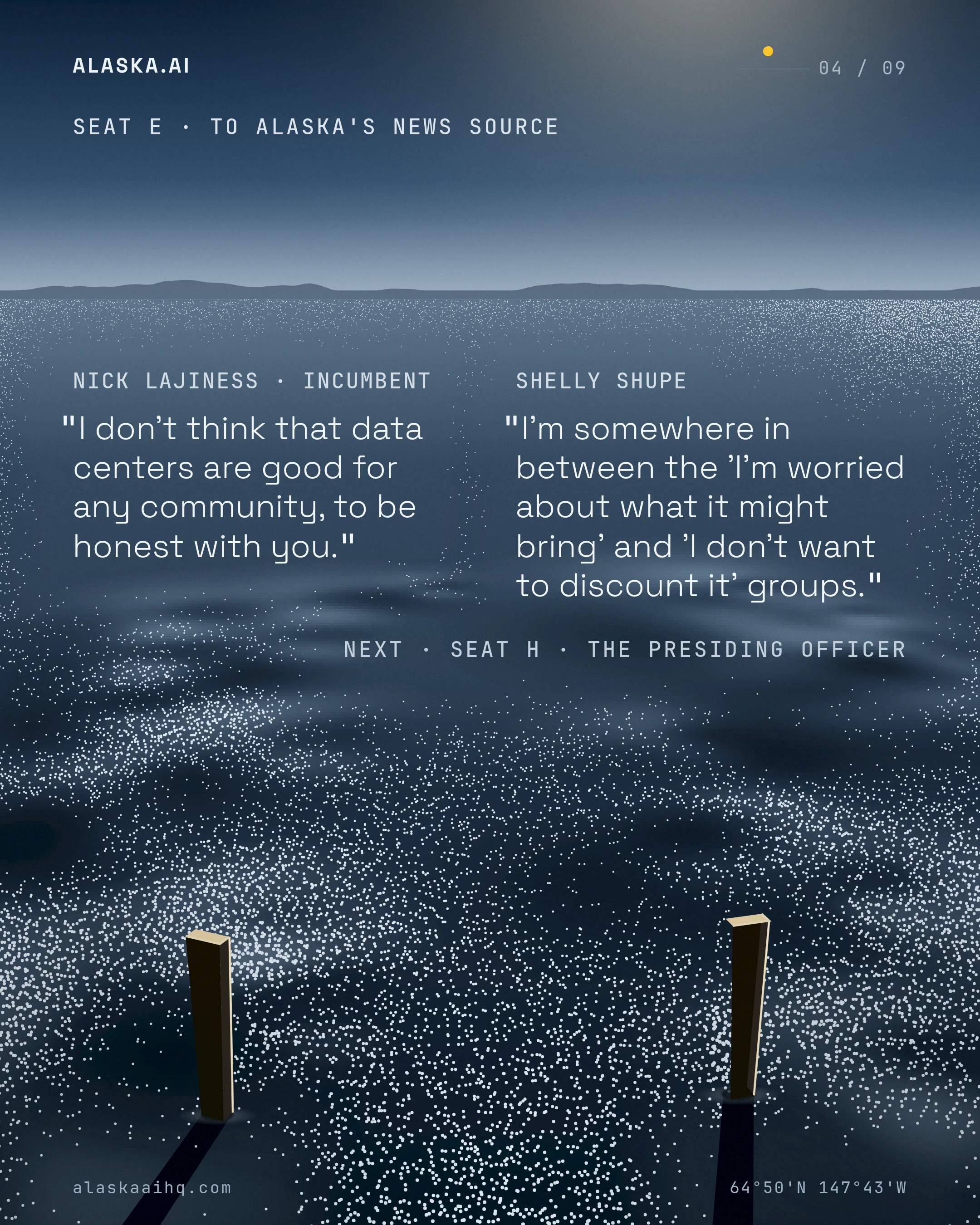
Seat E incumbent Nick LaJiness said "I don't think that data centers are good for any community."
Seat E challenger Shelly Shupe said she is "somewhere in between" those worried about data centers and those who don't want to discount them.
Seat H incumbent Scott Crass said "Energy costs in our community have skyrocketed."
Crass called a project that would consume more energy than the entire town "absolutely terrifying at first blush."
Seat H challenger Joshua Leaders said the impact on infrastructure, the power grid and water needs a serious look to see if the benefit outweighs the cost.
Leaders supports a temporary moratorium while data is collected.
None of the six Assembly candidates quoted by Alaska's News Source expressed outright support for data centers.
The Pentagon has offered to lease about 4,700 acres of government land in Alaska to private companies for data centers.
No data center projects have been awarded under the Air Force leasing offer.
Twelve parcels across the three Alaska installations have been identified for potential data center development.
U.S. Senator Lisa Murkowski said she is not a proponent of data centers at JBER or Interior installations because of an insecure energy base.
Fairbanks already has some of the highest utility costs in the nation, according to KUAC.
Eielson Air Force Base could become the first U.S. military installation powered at least partly by a 5-megawatt microreactor.
Public comments on the Eielson microreactor site were due by September 30th.
Independent U.S. House candidate Bill Hill said he doesn't want data centers to get tax breaks or build vast complexes without local input and support.
Seat H incumbent Scott Crass defended his vote in favor of the legislative priorities.
Beats
This article is on Alaska data centers · Defense and federal AI in Alaska · Alaska AI policy and legislation. Each beat page keeps every decision and every article on that subject in one place.