Alaska's Second Wire Has a Passenger List
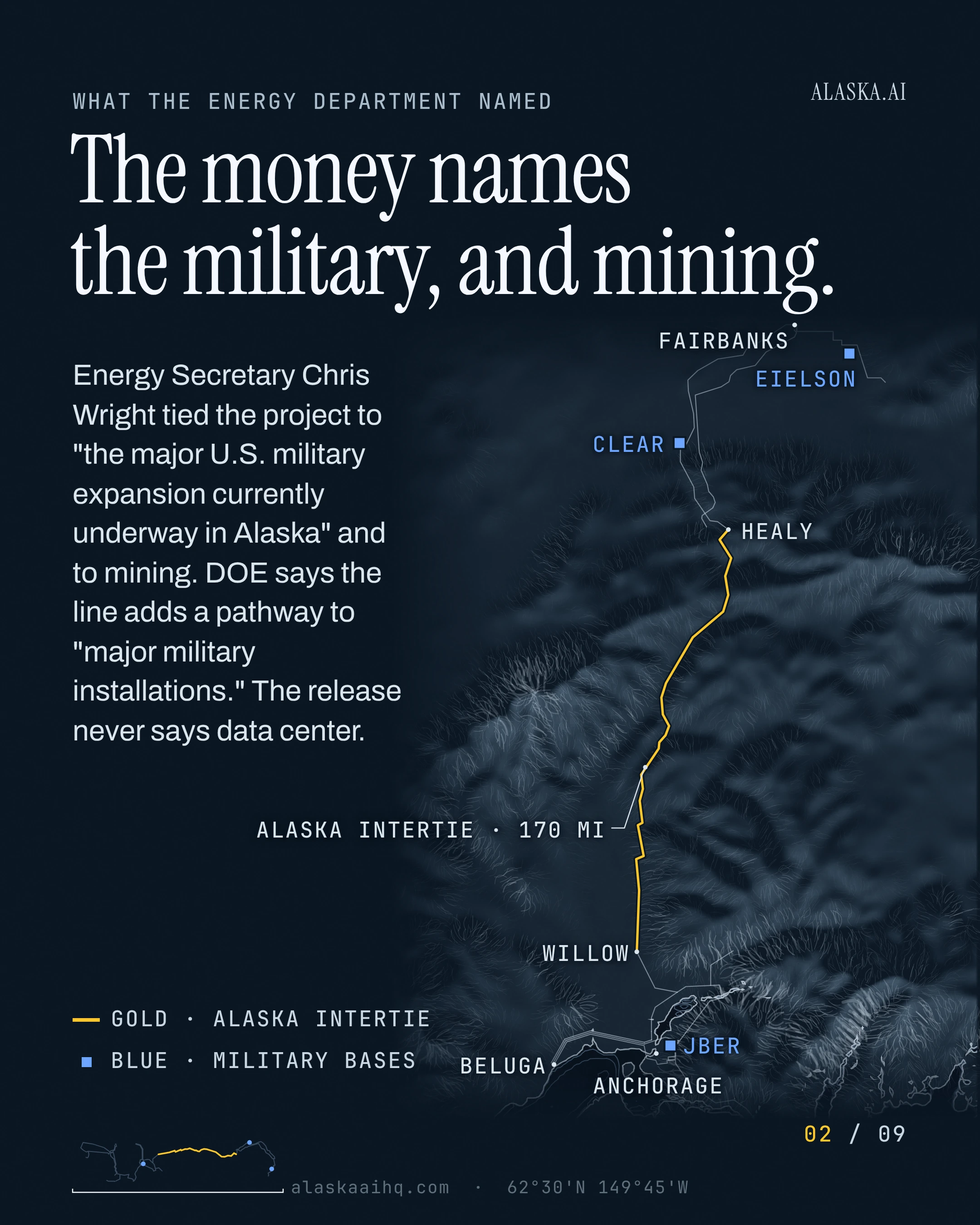
Alaska's planned second power line would end at Healy, south of Clear and Eielson, where the Air Force offered land for AI data centers.
The deck
SWIPE, SCROLL OR CLICK A SLIDE TO GO FULLSCREEN · 9 SLIDES



The story
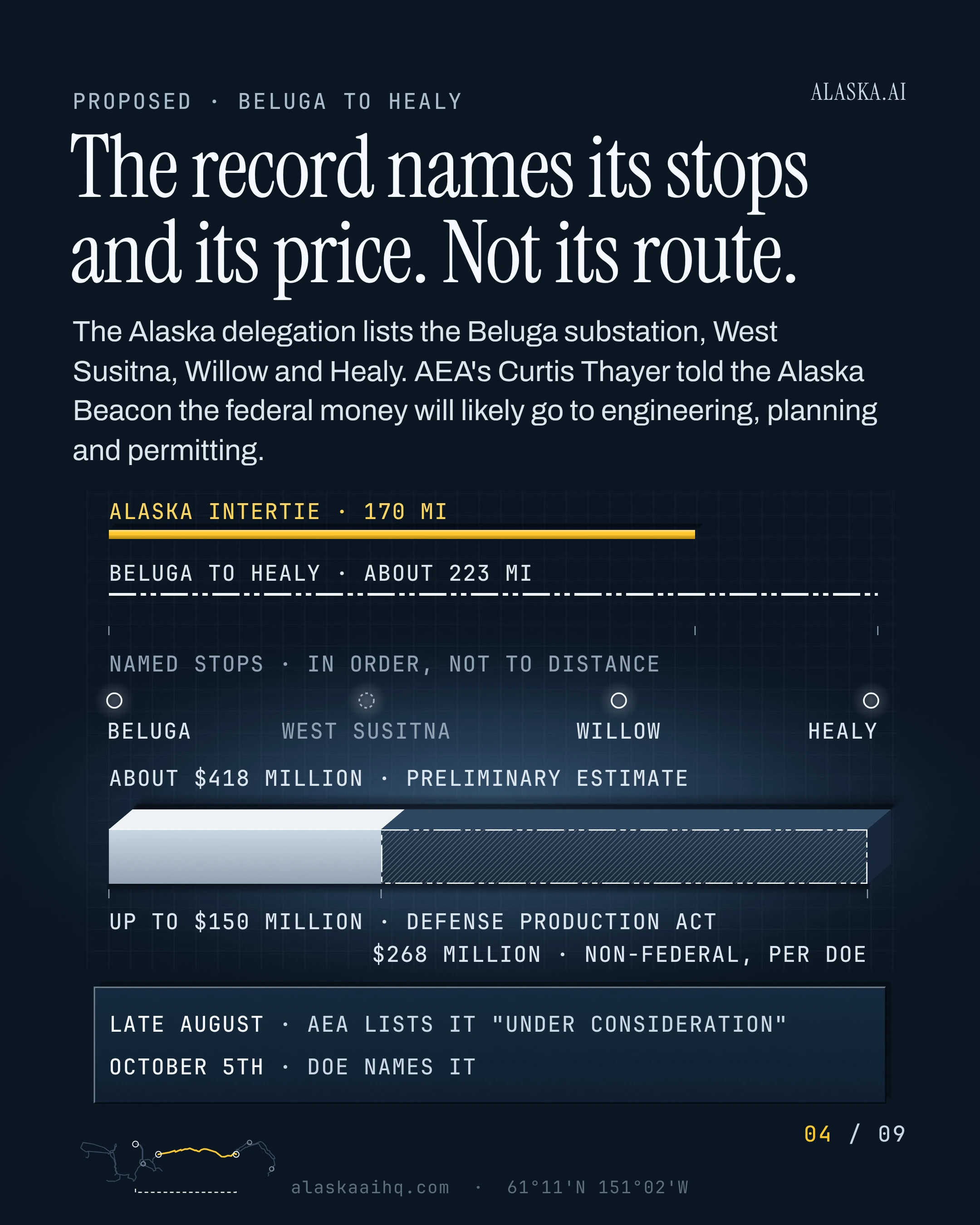
It would run about 223 miles from Beluga through West Susitna and Willow.
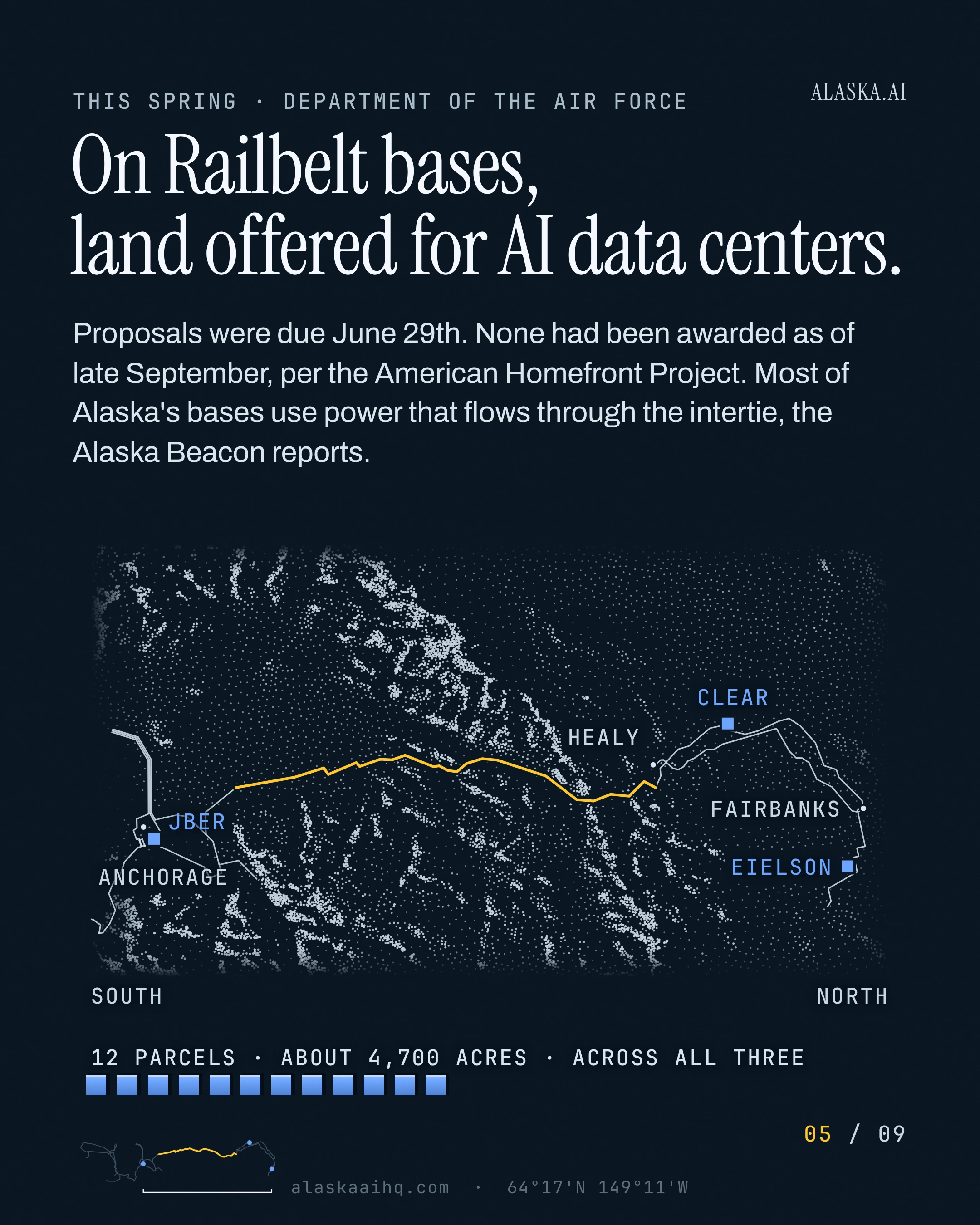
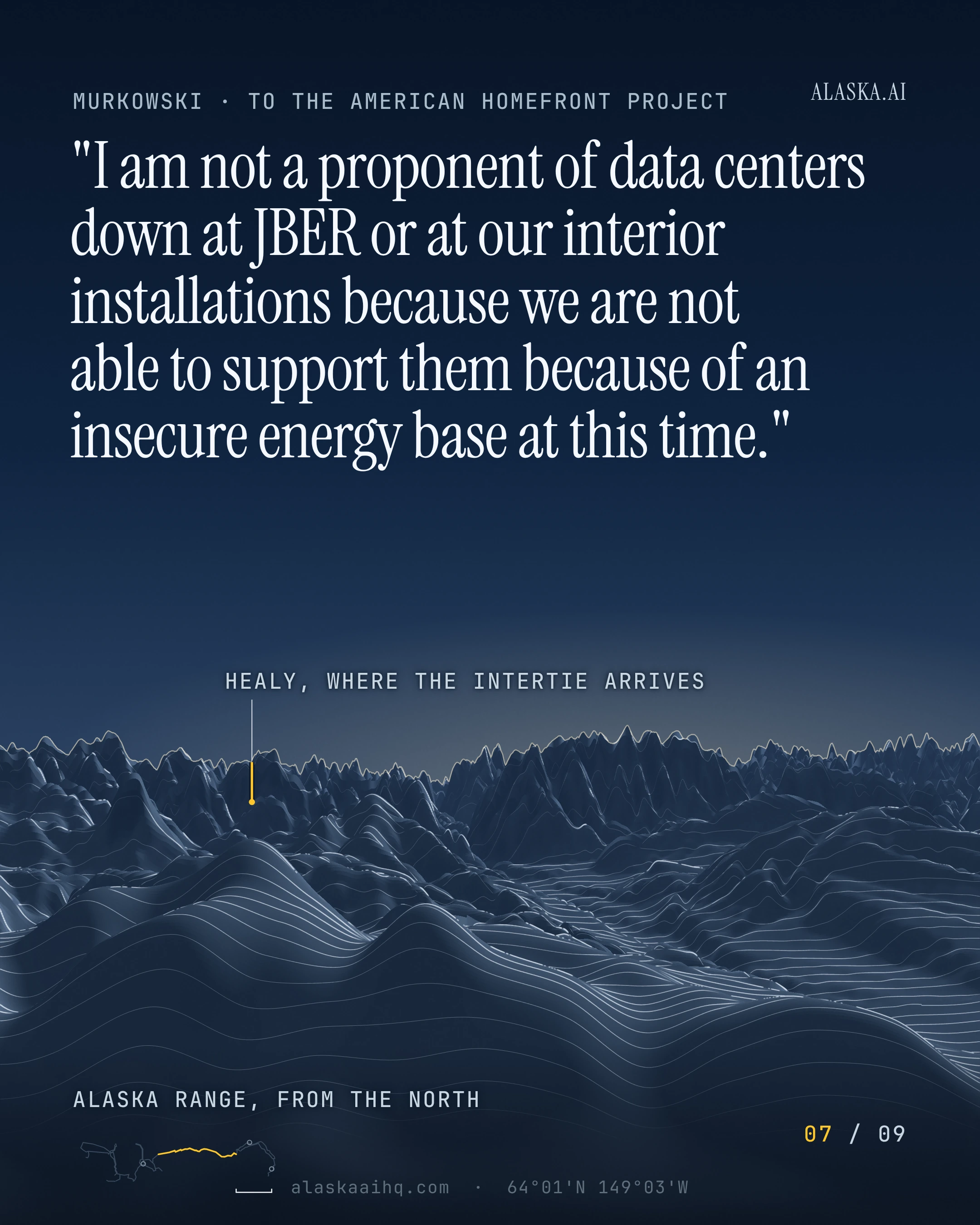
Clear, Eielson and JBER hold the 12 parcels offered this spring. Lisa Murkowski told the American Homefront Project she isn't a proponent of data centers there because of "an insecure energy base at this time."
The Energy Department intends up to $150 million, citing the military and mining.
The wire is still in planning. The land had no award by late September. No record behind the wire says data center.
Today's intertie, the new wire's stops and money, three bases and Murkowski's sentence, then five records, two saying data center.
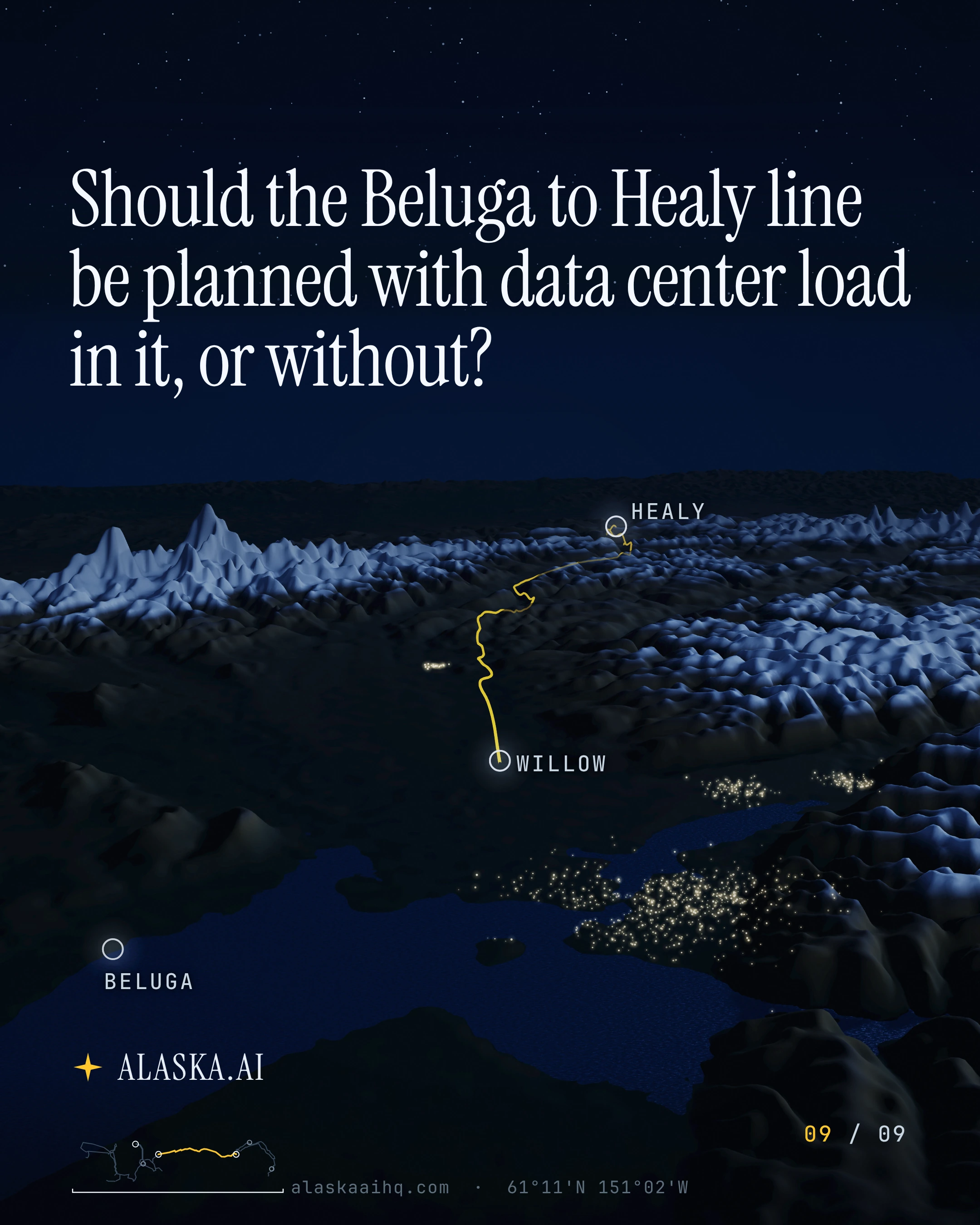
Why is the record for a Defense Production Act line silent on data centers offered for Railbelt bases?
What we verified
46 CLAIMS, EACH RE-FETCHED FROM ITS SOURCE BEFORE THIS DECK SHIPPED
The U.S. Department of Energy announced on October 5th its intent to deploy Defense Production Act funding for a second high-voltage connection between Southcentral and Interior Alaska.
The DOE funding for the Alaska Energy Authority's Beluga-Healy Transmission Project is up to $150 million.
DOE says the project pairs its funding with $268 million in non-federal funding.
DOE puts the planned total investment in the Beluga-Healy line at $418 million, a preliminary planning estimate.
The Beluga-Healy project would build approximately 223 miles of new transmission line.
DOE says the new line would strengthen grid reliability for approximately 75 percent of Alaska's population.
DOE says $1 billion in federal funding has been appropriated for energy-related projects deemed critical to national security.
Presidential Determination No. 2026-10 identifies transmission lines, conductors, substations, and power-control and protection equipment as essential to national defense.
Energy Secretary Chris Wright said the project will support the U.S. military expansion underway in Alaska as well as mining and other resource development.
Wright said that thanks to Senator Sullivan he received an extensive briefing from the Alaska Energy Authority during a visit to Anchorage in August.
Assistant Secretary Katie Jereza of DOE's Office of Electricity said Alaska's grid needs another way to keep power moving.
DOE says the new line would give grid operators an additional pathway between Alaska's most densely populated communities and major military installations.
In a presentation to Secretary Wright, AEA listed the Beluga to Healy Transmission Line as under consideration among future opportunities.
AEA described the Beluga to Healy line as adding transmission redundancy along the Railbelt corridor.
AEA's presentation to Wright reported $348.9 million in total awarded DOE funding committed through AEA.
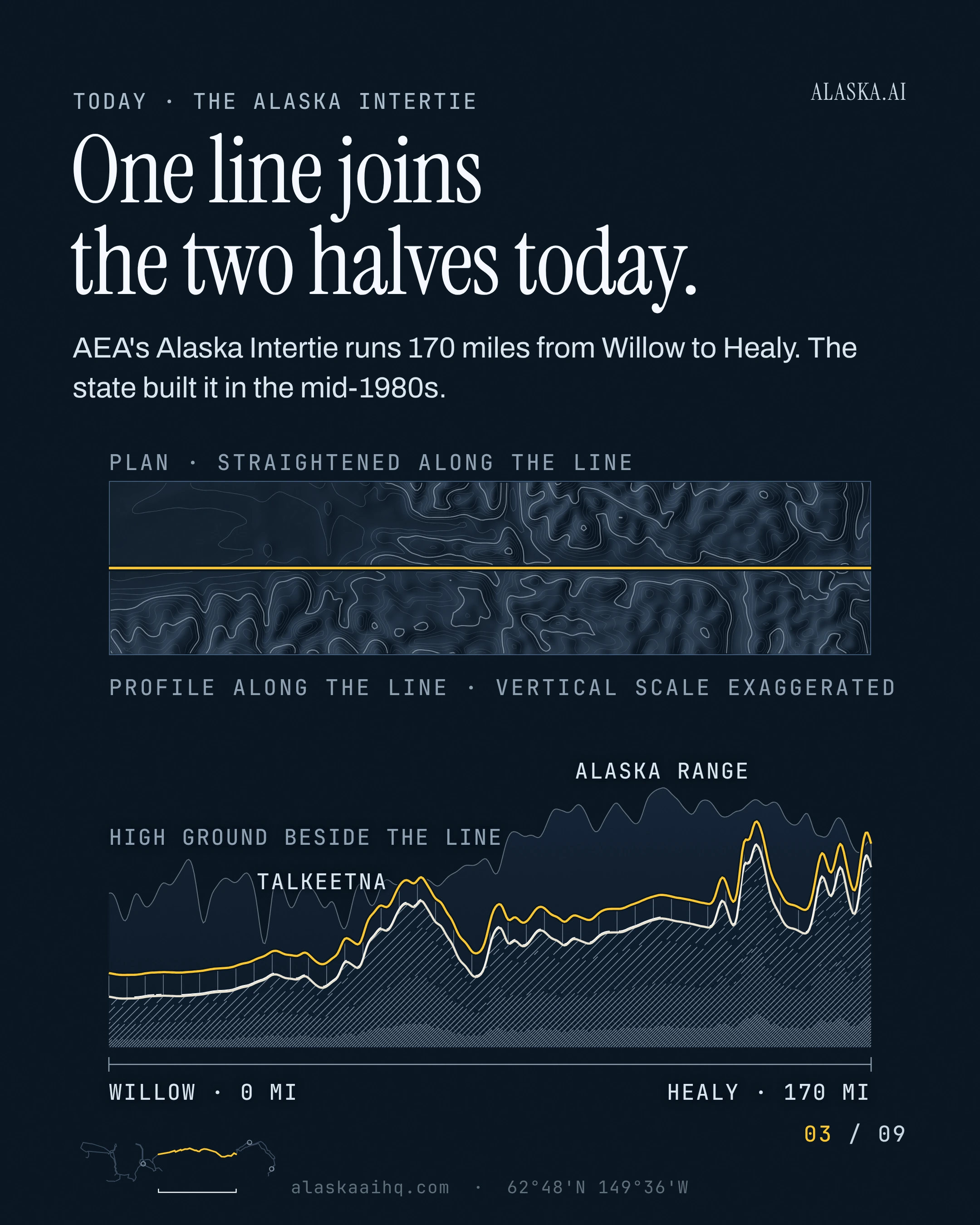
The existing Alaska Intertie is a 170-mile line between Willow and Healy owned by the Alaska Energy Authority.
The Alaska Intertie is built as a 345 kV transmission line but operates at 138 kV.
The Alaska Intertie was constructed in the mid-1980s.
The Alaska Intertie was built with $124 million in State of Alaska appropriations.
The Alaska Intertie carries Bradley Lake and economy power north into the Golden Valley Electric Association system.
The Department of the Air Force offered approximately 4,700 acres of underutilized land across JBER, Eielson Air Force Base and Clear Space Force Station for AI data centers.
The Air Force identified twelve parcels for potential AI data center development at the three Alaska installations.
The U.S. Army Corps of Engineers Alaska District posted a request for information titled EIE490 Microreactor Synchronization, Eielson AFB, Alaska on October 2nd.
The Corps notice concerns a 45 MWth and 5 MWe nuclear microreactor initiative at Eielson Air Force Base.
The Eielson microreactor work would extend the heating, power, communications and water systems to support plant operation.
Responses to the Eielson microreactor request for information are due October 16th at 2 PM Alaska time.
UAF announced on October 5th that it joins a $6 million National Science Foundation project with UAA, Montana Technological University and the University of Wyoming.
UAF's portion of the project, led by environmental engineering professor Srijan Aggarwal, is supported by nearly $913,000.
In the project, AI will predict how readily rare earth elements can be recovered and will drive controls that adjust bioreactor operation as conditions and energy availability change.
The project is one of eight receiving a combined $39.9 million to strengthen research capacity across 16 jurisdictions.
NSF award 2614749 to the University of Alaska Anchorage is $3,824,575, with Brandon Briggs as principal investigator.
NSF award 2614749 runs from September 1st, 2026 through August 31st, 2030.
The NSF award abstract says the project applies reinforcement-learning controllers within a bioprocess digital twin integrated with microgrid simulators.
NSF award 2614751 to the University of Alaska Fairbanks is $913,037, with Srijan Aggarwal as principal investigator.
NSF award 2614750 to Montana Technological University is $1,260,800.
The planned line would run from the Beluga substation through West Susitna and Willow to existing infrastructure in Healy.
The Railbelt currently relies on a single transmission corridor between Southcentral and Interior Alaska.
Alaska Energy Authority executive director Curtis Thayer said the new federal money will likely go toward engineering, planning and permitting.
Thayer said the announcement came as a surprise and that he did not know until Monday that AEA had won.
Alaska's existing intertie was built in the 1980s and is used primarily to ship lower-cost hydropower and natural gas power north to Fairbanks.
Most of Alaska's military bases use energy that flows through the intertie, according to the Alaska Beacon.
The Pentagon has offered to lease about 4,700 acres of government land in Alaska to private companies for data centers.
As of September 28th, no Alaska military data center lease projects had been awarded, according to the American Homefront Project.
Senator Lisa Murkowski said she is not a proponent of data centers at JBER or Alaska's interior installations because of an insecure energy base.
Fairbanks North Star Borough Mayor Grier Hopkins said whether local concerns about data centers reach the Pentagon is a different question from whether the bases listen locally.
Proposals under Air Force solicitation AFCEC-26-R-0006 for AI data center development at JBER, Eielson and Clear were due June 29th, 2026.
Beats
This article is on Alaska data centers · Alaska power and the grid · Alaska land and permitting for AI · Defense and federal AI in Alaska. Each beat page keeps every decision and every article on that subject in one place.