Alaska's Newest Rare-Earth AI Won't Hunt for Ore
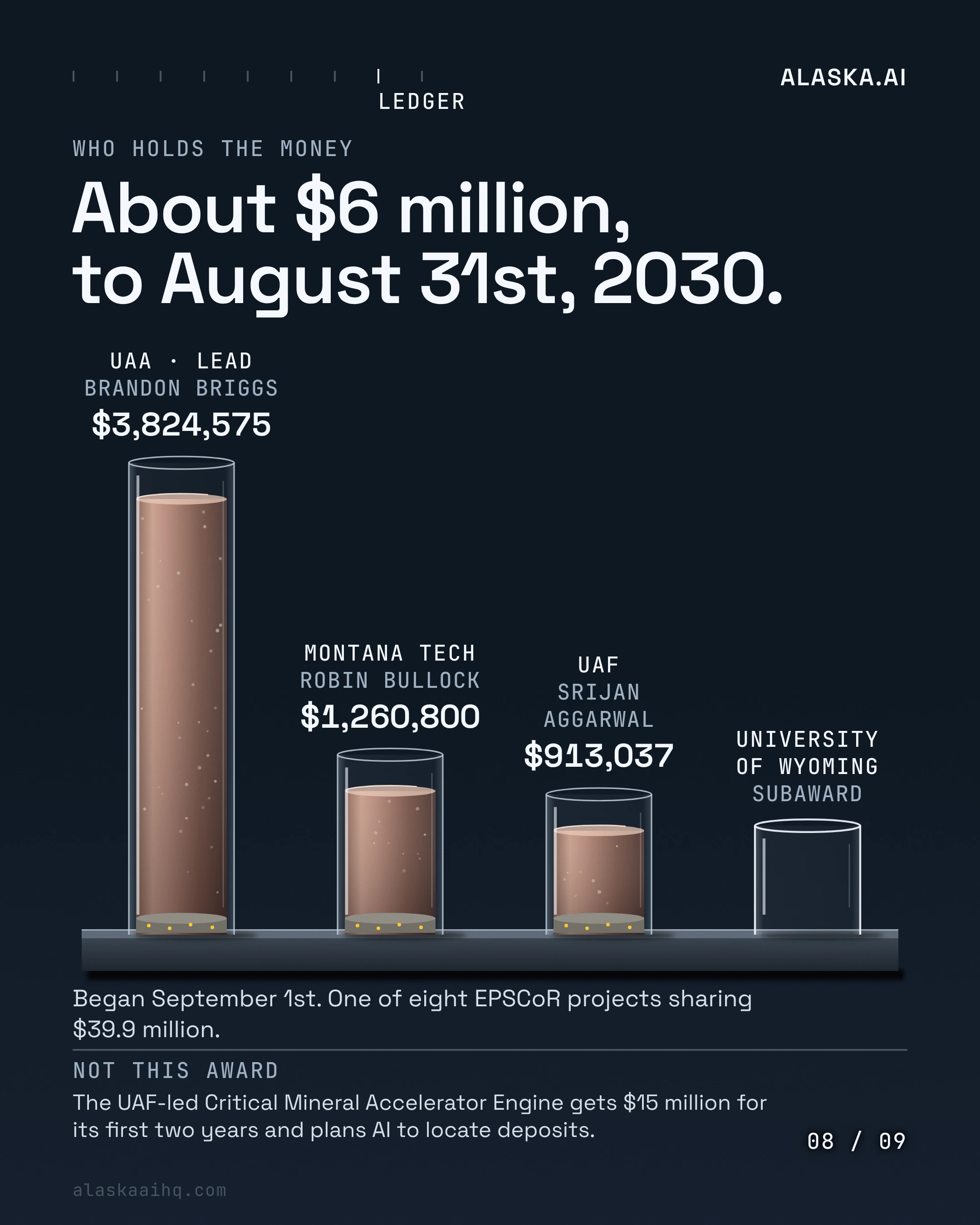
Brandon Briggs's UAA team holds $3,824,575 of a $6 million NSF bet on microbes and AI for rare earths in coal refuse and ash.
The deck
SWIPE, SCROLL OR CLICK A SLIDE TO GO FULLSCREEN · 9 SLIDES




The story
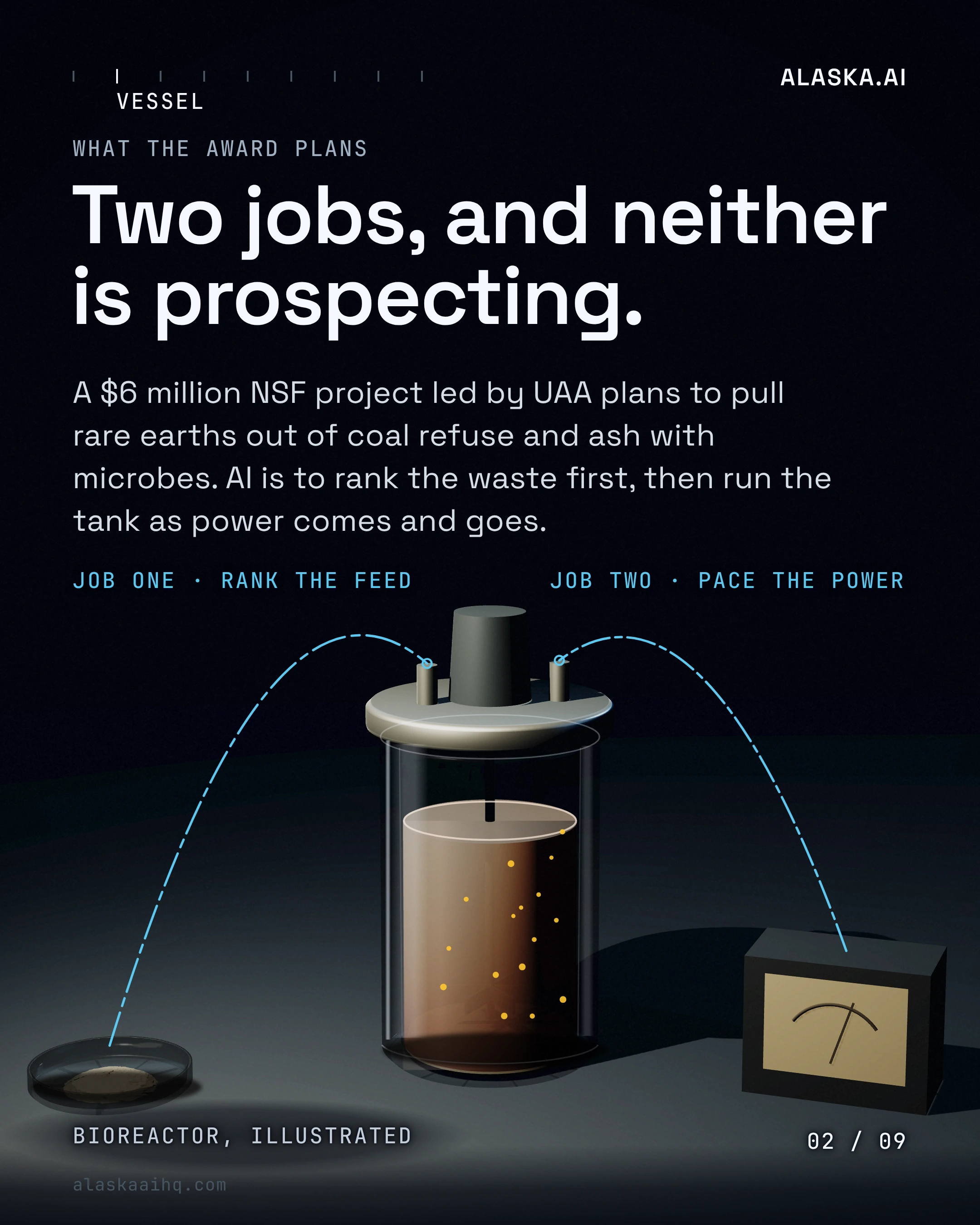
Montana Tech and UAF hold the rest. The AI is to screen feedstocks with a Virtual Assay. Its controllers are to learn on microgrid simulators and adjust the bioreactor as available power changes. Deposit hunting with AI is a different NSF effort (the UAF-led Critical Mineral Accelerator Engine).
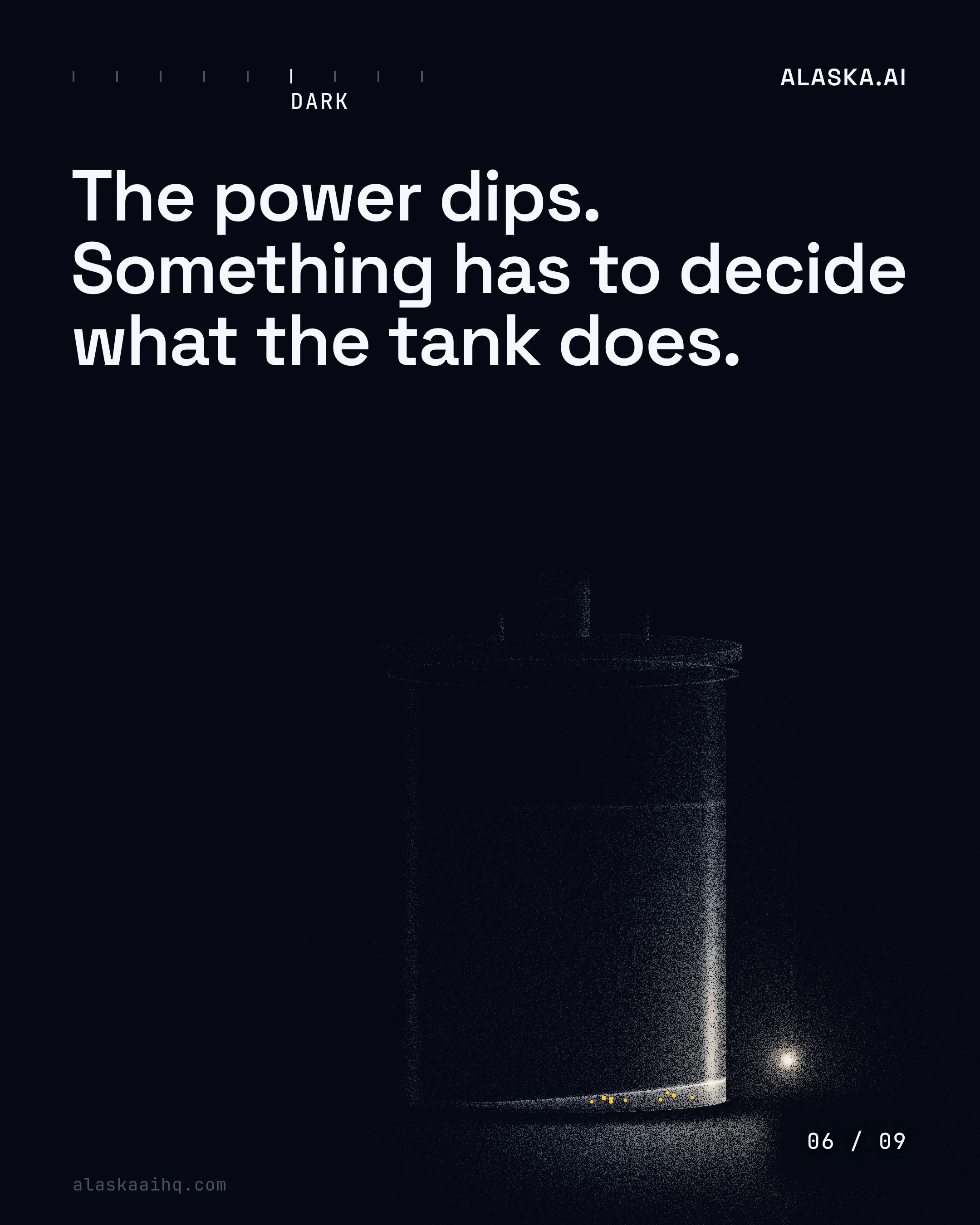
The award calls the system energy-constrained. In Alaska that means a tank that has to adapt when the power dips. Srijan Aggarwal leads UAF's part. Nothing is built yet. The award ends August 31st, 2030. Grade it on that date.
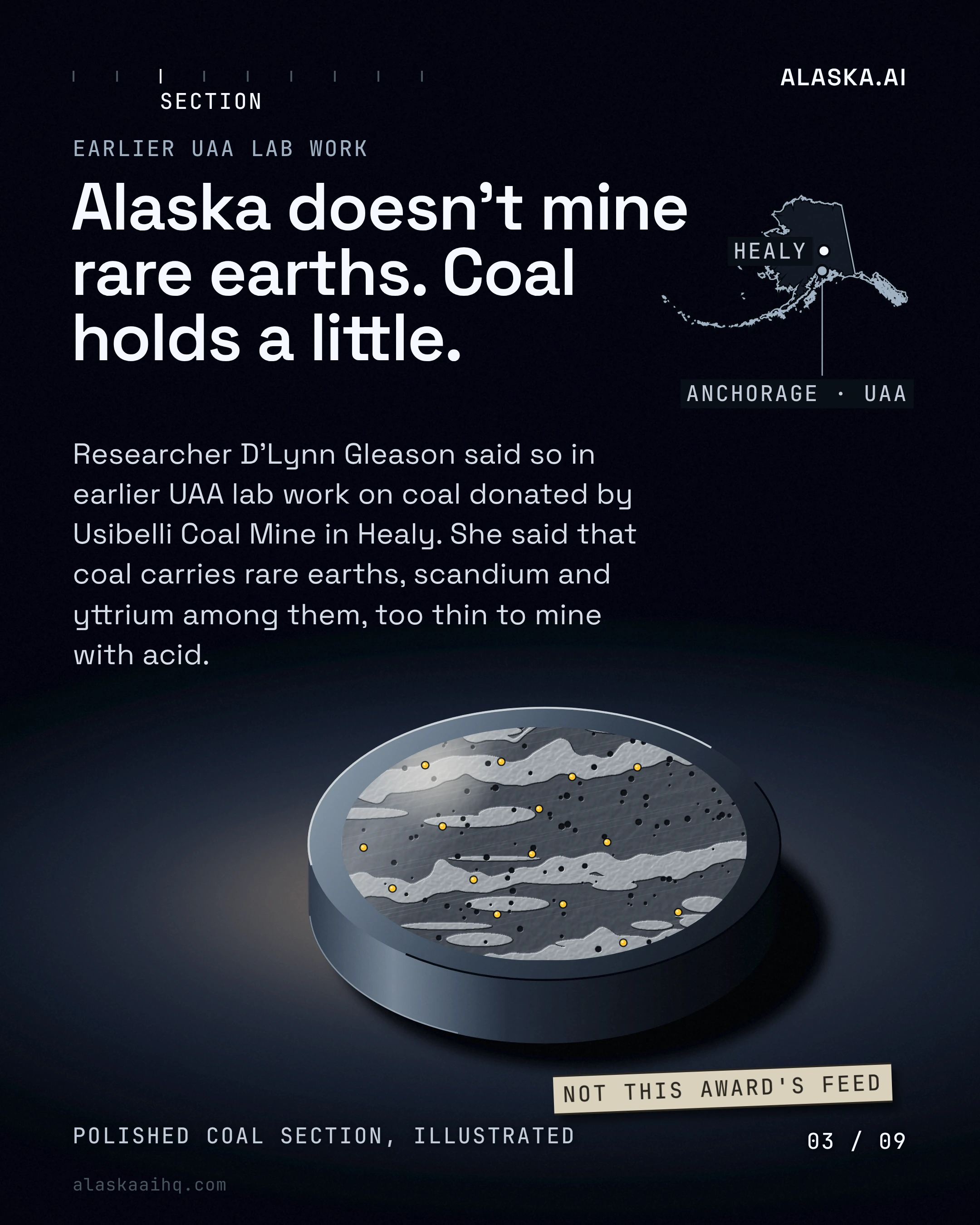
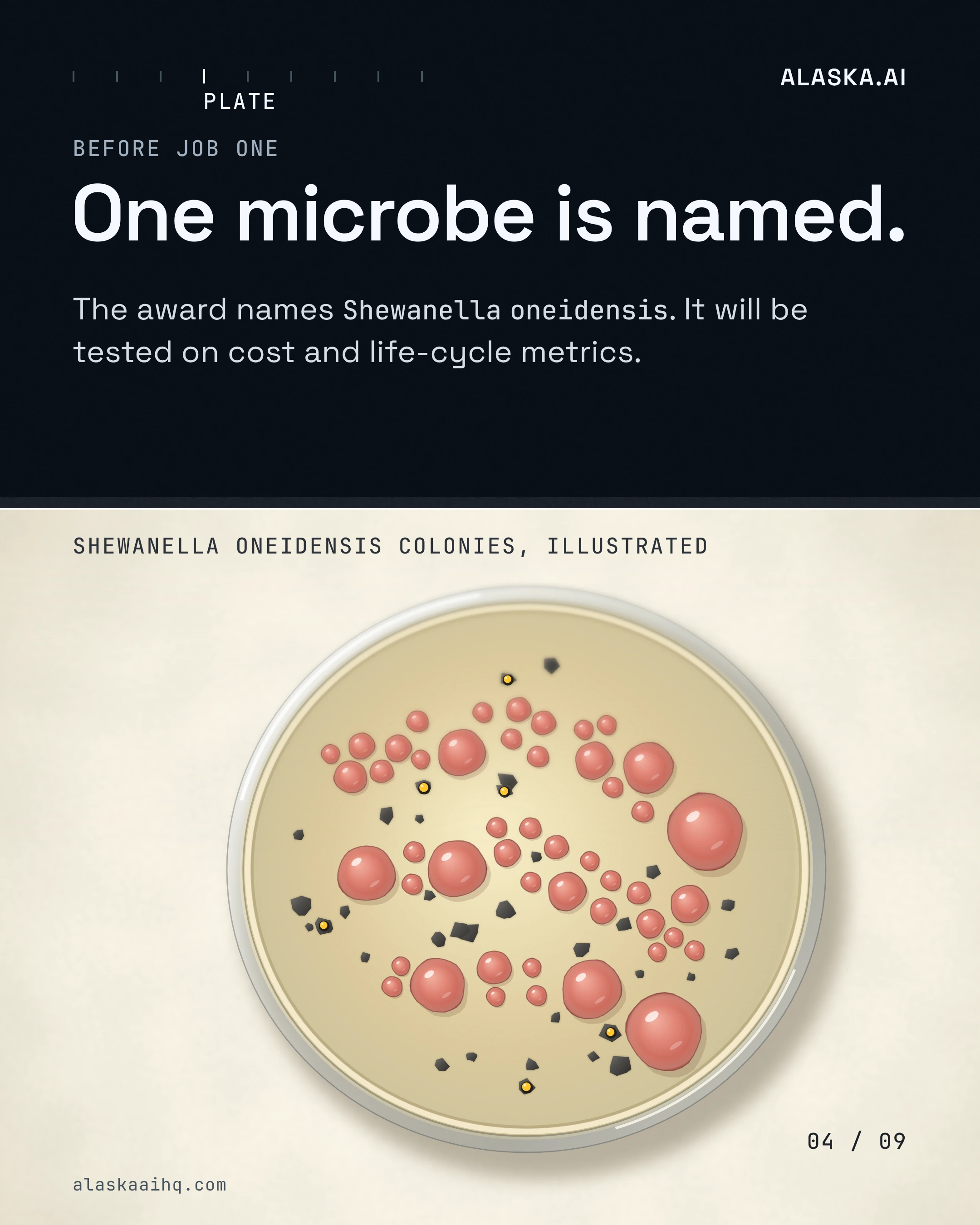
Pictured are a grain of coal ash, Healy coal from earlier UAA lab work, the one named microbe, both AI jobs and who holds the money.
Which Alaska microgrid should host those controllers first?
What we verified
62 CLAIMS, EACH RE-FETCHED FROM ITS SOURCE BEFORE THIS DECK SHIPPED
NSF award 2614749 went to the University of Alaska Anchorage.
Brandon Briggs is the principal investigator on the UAA award.
The UAA award carries an estimated total of $3,824,575.
NSF dated the UAA award August 5th.
The award period begins September 1st.
The award period ends August 31st, 2030, making it a four-year project.
The award is funded through the NSF EPSCoR Focused EPSCoR Collaborations track.
The three linked NSF awards share the project title Transformative Bioprocessing and AI-Driven Frameworks for Sustainable Critical Mineral Recovery.
NSF award 2614751 went to the University of Alaska Fairbanks.
The UAF award is $913,037.
Srijan Aggarwal, a UAF professor of environmental engineering, leads UAF's portion as a principal investigator.
NSF award 2614750 gives Montana Technological University $1,260,800.
Robin Bullock is the principal investigator on the Montana Tech award.
The award abstract says UAA leads the project in partnership with UAF, Montana Technological University and the University of Wyoming.
NSF lists the University of Wyoming as a subawardee on the project.
The UAA award lists four co-principal investigators, one of them Tyler C Brown with a University of Wyoming email address.
UAF describes the project as a $6 million NSF-funded effort.
UAF's share of the work sits at its Institute of Northern Engineering.
The project aims to recover rare earth elements from domestic coal refuse and ash using microbes.
The abstract plans a predictive Virtual Assay to screen feedstocks.
The abstract plans reinforcement-learning controllers inside a bioprocess digital twin linked to microgrid simulators.
The project will test extraction by the bacterium Shewanella oneidensis against techno-economic and life-cycle metrics.
The abstract frames the goal as a predictive, energy-constrained system.
The abstract names a Smart Bio-Refinery framework and a Virtual Pilot Plant as project outputs.
The abstract plans a federally compliant University Recharge Facility.
Workforce plans include industry-aligned micro-credentials and a Tri-State Field Course.
The award abstract says the U.S. relies heavily on foreign sources for rare earth elements.
UAF says AI will help predict how readily rare earth elements can be recovered from different materials.
UAF says the team will develop controls that adjust bioreactor operation as conditions and energy availability change.
The project is one of eight NSF EPSCoR projects sharing a combined $39.9 million.
UAF says this EPSCoR award is separate from, and in addition to, NSF support for the UAF-led Critical Mineral Accelerator Engine.
Aggarwal said "This collaboration brings together expertise that no single institution could provide on its own."
Aggarwal said "We're connecting environmental engineering, microbiology, mineral processing and AI."
NSF announced $39.9 million in EPSCoR Focused EPSCoR Collaborations awards in August.
The eight awards span research teams in 16 NSF EPSCoR jurisdictions.
Coal used in UAA's earlier rare-earth biomining research was donated by Usibelli Coal Mine in Healy.
A UAA graduate researcher said Usibelli coal has relatively high concentrations of rare earth elements, including scandium and yttrium.
Gleason said Alaska does not currently mine rare earth elements.
Gleason said the coal's rare earths sit at concentrations too small to mine with acid efficiently.
Bacteria for the earlier UAA thesis came from Kennicott Glacier and Root Glacier in Wrangell-St. Elias National Park.
The separate UAF-led NSF Critical Mineral Accelerator Engine receives $15 million in its first two years.
The Engine could receive up to $160 million over 10 years.
The Engine plans to use artificial intelligence to help locate mineral deposits.
NSF solicitation 26-513 will make only one AI Infrastructure Hub award per state or multi-state region.
Hub proposals request 5 years and a total budget between $4 million and $12 million.
NSF estimates 10 hub awards.
The first full proposal deadline is November 4th.
NSF last updated the solicitation page on October 5th.
NSF award 2433241, Rural AI Solutions and Engagement (RAISE), gives the University of Alaska Anchorage $380,000.
Kenrick Mock is principal investigator on the RAISE award.
UAA's Alaska AI Solutions Consortium set October 7th as the full proposal deadline for its RAISE community partner mini grants.
RAISE mini grant awards are to be announced November 2nd.
The crowdsourced DeFlock map shows eight Flock cameras within the Municipality of Anchorage, according to the Anchorage Daily News.
ADN reported four of the cameras at the Midtown Lowe's and four at the Tikahtnu Commons Lowe's.
Lowe's says it typically keeps license plate reader data no more than 90 days.
Competing surveillance measures from Mayor Suzanne LaFrance's administration and a group of Assembly members are expected to go to an Assembly vote on October 20th.
A recall petition against Mayor LaFrance still needs 7,225 signatures before a December 7th deadline.
Someone cut down a newly installed camera at the Lowe's at 10900 Old Seward Highway.
The camera was cut down at about 11:28 p.m. on October 4th, according to the report APD confirmed.
Flock said it began installing license plate reader cameras for a private customer in Alaska the week before.
APD says it does not use Flock cameras and has no access to the store's video feed.
Police Chief Sean Case told the Assembly on August 4th that APD's system is "completely different" from Flock.
Beats
This article is on Alaska power and the grid · Alaska AI research and science. Each beat page keeps every decision and every article on that subject in one place.