Who Sets the Clock on a Plate Read
In the Anchorage mayor's version of the surveillance ordinance, a plate data "limit" is a reason, not a number.
The deck
SWIPE, SCROLL OR CLICK A SLIDE TO GO FULLSCREEN · 9 SLIDES





The story
The city's plate reader policy must limit storage "based on articulable operational needs." The sponsors' S-1 text names no number either.
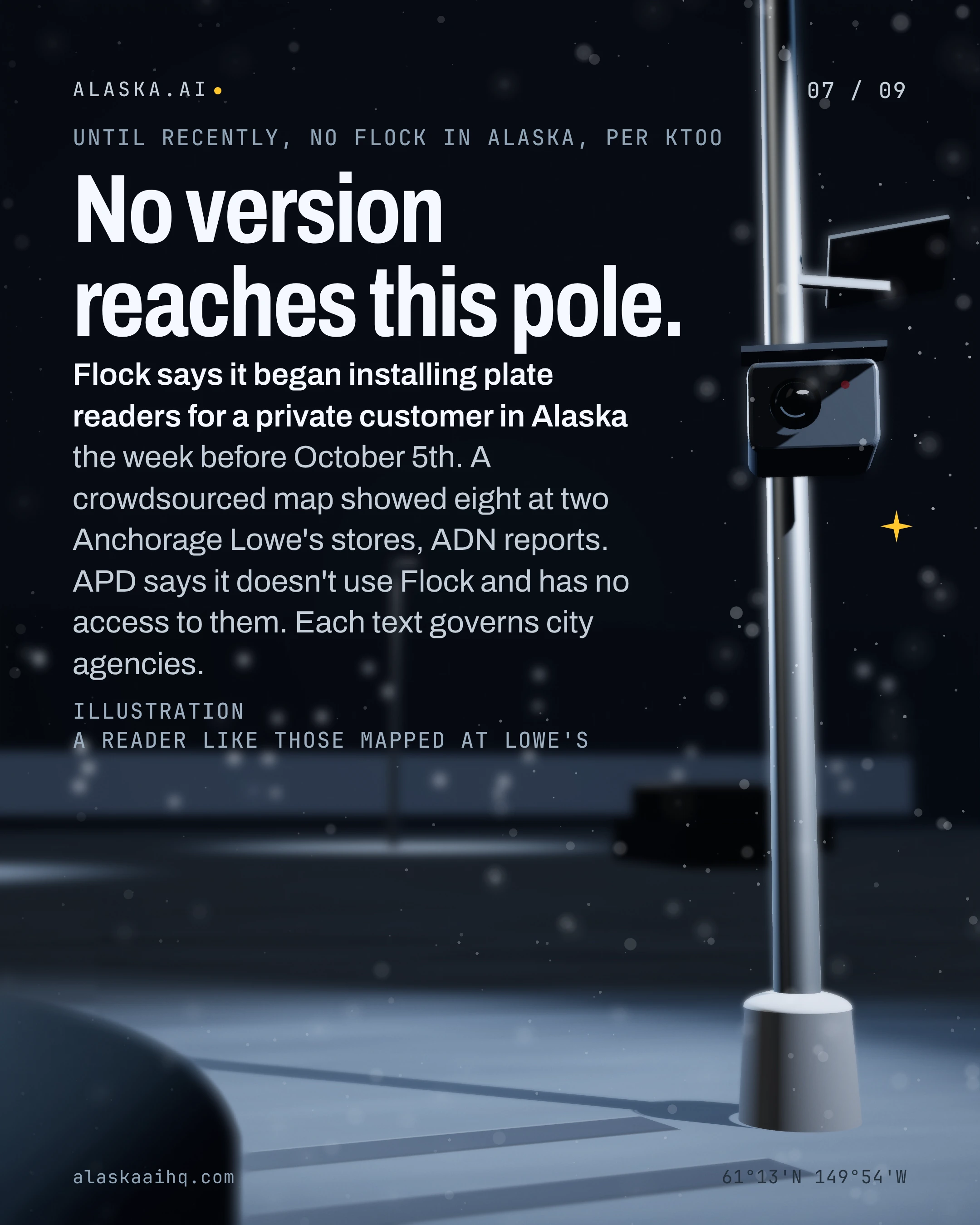
Flock says it began installing plate readers for a private customer the week before October 5th. A crowdsourced map showed eight at two Anchorage Lowe's stores.
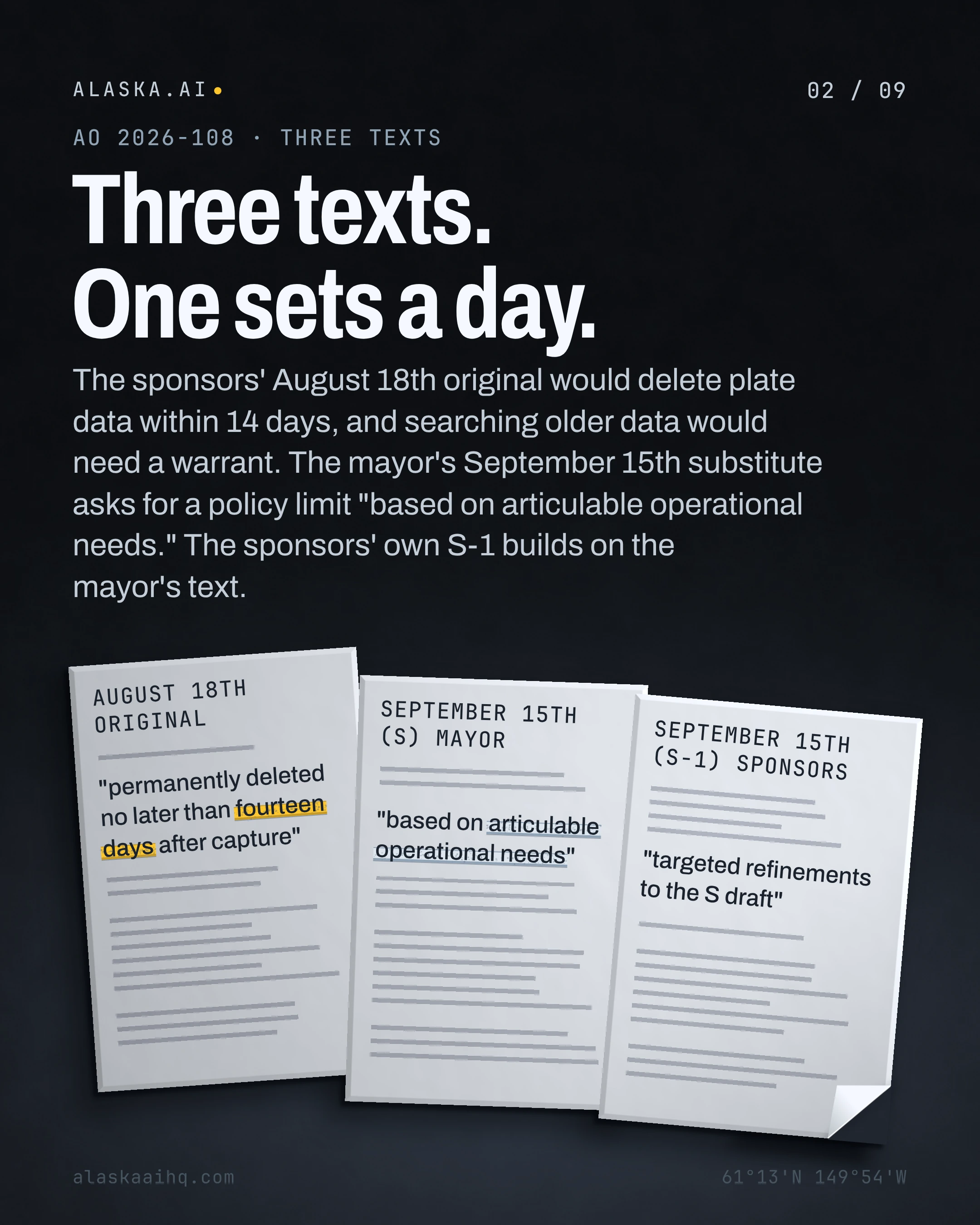
In the August 18th original, "limit" means 14 days and then deletion.
APD says it has no access to plate readers at privately owned locations.
Whatever "limit" means after October 20th, it will govern city readers, not store readers.
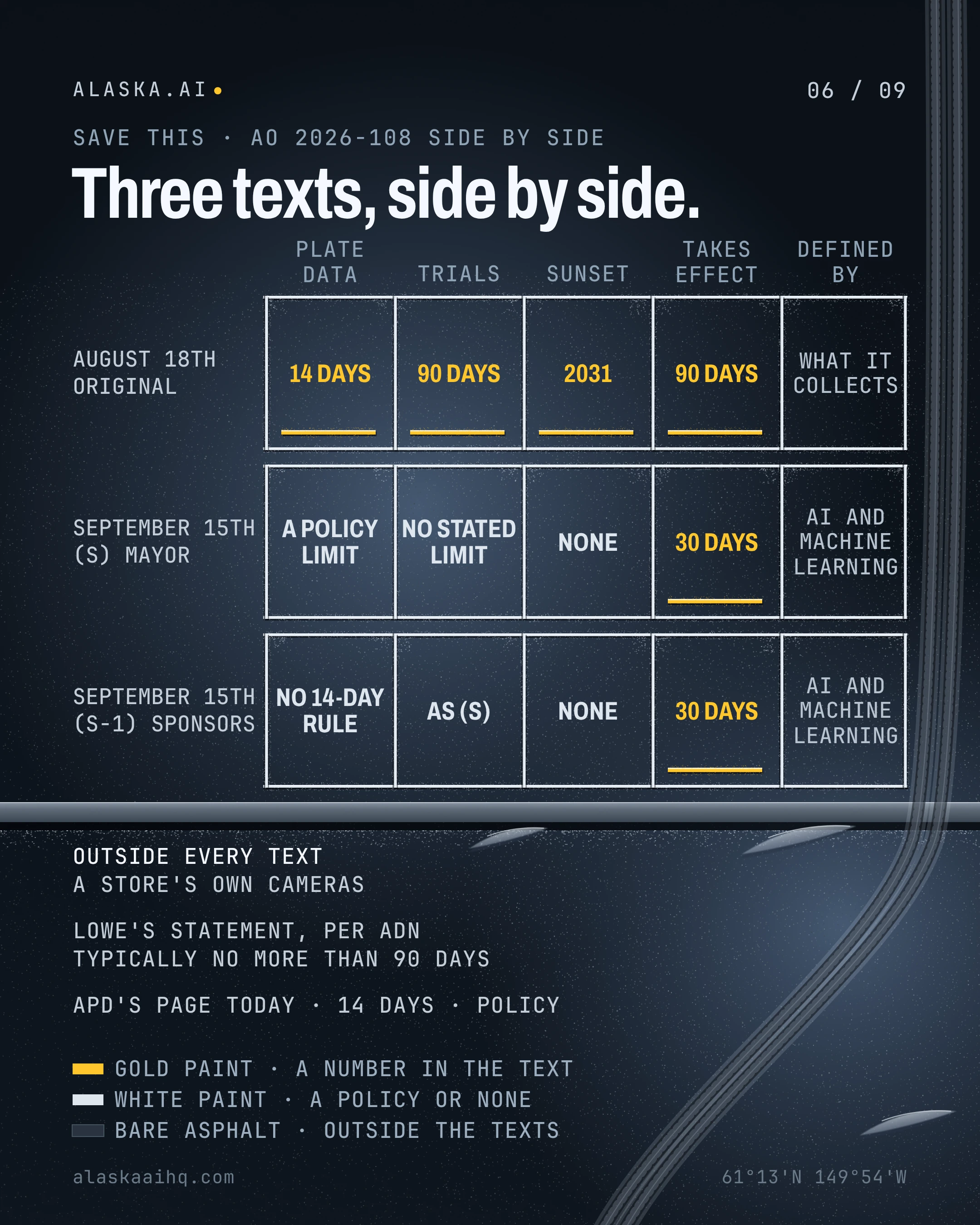
The three texts' clocks, the September definition built on AI, APD's 14-day policy and the store readers none reach.
Should Anchorage's plate data rules ever reach a reader on private property?
What we verified
85 CLAIMS, EACH RE-FETCHED FROM ITS SOURCE BEFORE THIS DECK SHIPPED
Anchorage ordinance AO 2026-108, as introduced, repeals and replaces Anchorage Municipal Code chapter 3.102 and amends section 7.15.040.
The original AO 2026-108 was submitted by Assembly Members Keith McCormick and Sydney Scout and Vice Chair Daniel Volland, for reading on August 18th.
The original AO 2026-108 requires captured license plate data to be permanently deleted no later than fourteen days after capture.
The sponsors' memo says license plate reader data, camera footage and Real Time Crime Center recordings would have to be deleted within fourteen days unless designated as evidence or preserved under a warrant, litigation hold or public records request.
Under the original AO 2026-108, a search of plate data more than fourteen days old would also require a warrant issued on probable cause.
The original AO 2026-108 limits real-time plate reader alerts to a hot list of five categories, stolen vehicles or plates, AMBER or Silver Alert subjects, people with outstanding felony warrants, and vehicles in active felony or missing person investigations.
The original AO 2026-108 bars using plate readers to investigate or enforce any suspected misdemeanor, minor offense, infraction or civil violation.
The original AO 2026-108 would end the city's plate reader authorization on January 1st, 2031, unless the Assembly renews it by ordinance.
The original AO 2026-108 requires Assembly approval before any city agency acquires surveillance technology, including through a free trial, demonstration or beta test.
The original AO 2026-108 lets the Assembly grant a temporary approval of new surveillance technology for no longer than 90 days, by resolution after a public hearing.
The original AO 2026-108 requires an annual compliance audit by the municipal ombudsman, or by internal audit at the Assembly's direction.
The original AO 2026-108 requires the mayor or a designee to submit an Annual Surveillance Report no later than June 1st each year.
Under the original AO 2026-108, the chief of police must certify in each annual report that automated deletion is configured and working.
The original AO 2026-108 bars city agencies from joining, contributing data to or querying any external surveillance data network.
The original AO 2026-108 defines surveillance technology as any software, device or system used to collect, retain, analyze, process or share information that can be associated with any individual, vehicle or group.
The original AO 2026-108 defines a license plate reader system to include fixed, mobile, semi-stationary, aerial and handheld systems, and any system that searches vehicles by traits other than the plate number.
The original AO 2026-108 bars city agencies from using predictive analytics to forecast where crime will happen.
The original AO 2026-108 makes it unlawful for the city or its staff to use facial recognition with any real-time surveillance or surveillance technology.
Under the original AO 2026-108, registering a private camera with the city doesn't let the city access it, and an integrated live feed needs the owner's written, informed and revocable consent.
The original AO 2026-108 would cut off live camera access automatically after sixty minutes, with each renewal limited to thirty minutes.
The original AO 2026-108 gives people harmed by a violation a right to sue for at least $1,000 per violation or $10,000, whichever is greater.
The original AO 2026-108 would take effect ninety days after passage, except its Assembly approval requirement, which would apply immediately.
The city's public notice set a public hearing on AO 2026-108 for the Assembly's September 1st regular meeting.
The Anchorage Assembly's own ordinance page says it voted to postpone further action on AO 2026-108 to October 20th.
Mayor LaFrance's substitute, AO 2026-108(S), was submitted by the Assembly chair at the mayor's request, prepared by the Department of Law, for reading on September 15th.
The mayor's memo says the substitute amends chapter 3.102 rather than repealing and replacing it.
The mayor's substitute requires the city's plate reader policy to limit storage of non-evidence data based on articulable operational needs, without setting a number of days.
The mayor's substitute defines surveillance technology as technology that conducts surveillance using fully or partially automated machine learning, artificial intelligence or similar technology.
The mayor's memo says the substitute focuses the definition on technologies that use artificial intelligence or other automated tools to locate and identify people.
The mayor's substitute defines a license plate reader as a specialized camera and data system that captures and reads vehicle plates using optical character recognition.
The mayor's substitute bars any contract that would materially expand a covered surveillance technology's capabilities without prior Assembly approval.
The mayor's substitute exempts tests, pilots and evaluations of an expanded capability from that approval, so long as they aren't used for new surveillance of the public, and sets no time limit on them.
On September 15th the three sponsors laid on the table an S-1 version that they describe as targeted refinements to the mayor's S draft, keeping its overall structure and intent.
The sponsors' S-1 version strikes the original title's promises to limit the retention of surveillance data and to prohibit participation in external surveillance data networks.
APD's Safe Anchorage page states that APD doesn't use Flock cameras.
APD's Safe Anchorage page says all license plate data its readers scan is automatically deleted after 14 days.
APD's Safe Anchorage page says the Anchorage Assembly banned municipal use of facial recognition technology in 2023.
NOAA's Alaska Fisheries Science Center published a conversation with Acting Director Dr. Jamal Moss on its 2026 fisheries assessment process on October 7th.
The Alaska Fisheries Science Center says it is addressing capacity challenges by pairing near-infrared spectroscopy with trained machine learning models to read otolith rings.
NOAA says Alaska produces more than half the seafood caught off the coast of the United States.
NOAA puts the average wholesale value of Alaska's seafood at nearly $4.75 billion a year from 2020 through 2024.
The center plans a cooperative research workshop in Spring 2027 with industry, fishers, scientists and coastal communities.
A 2023 NOAA study found the near-infrared and AI method estimates a fish's age in 30 to 50 seconds per otolith.
Researchers scanned 8,617 walleye pollock otoliths collected from 2014 to 2018 to train and test the models, according to NOAA.
NOAA scientists examine up to 40,000 otoliths from more than 15 species each year to determine fish ages.
The mayor's substitute AO 2026-108(S), as filed for September 15th, contains no fourteen-day deletion rule and no 2031 sunset for license plate readers.
The sponsors' S-1 version laid on the table September 15th, AO 2026-108(S-1), contains no fourteen-day deletion rule and no 2031 sunset for license plate readers.
The sponsors' S-1 version uses the same definition of surveillance technology as the mayor's substitute, tied to machine learning, artificial intelligence or similar technology.
The mayor's substitute requires the administration to send the Assembly its plate reader policy, and any material change to it, within 30 days.
The mayor's substitute would take effect 30 days after the Assembly passes it.
Under the mayor's substitute, a complaint about a violation starts a 45-day clock for the city to investigate and act.
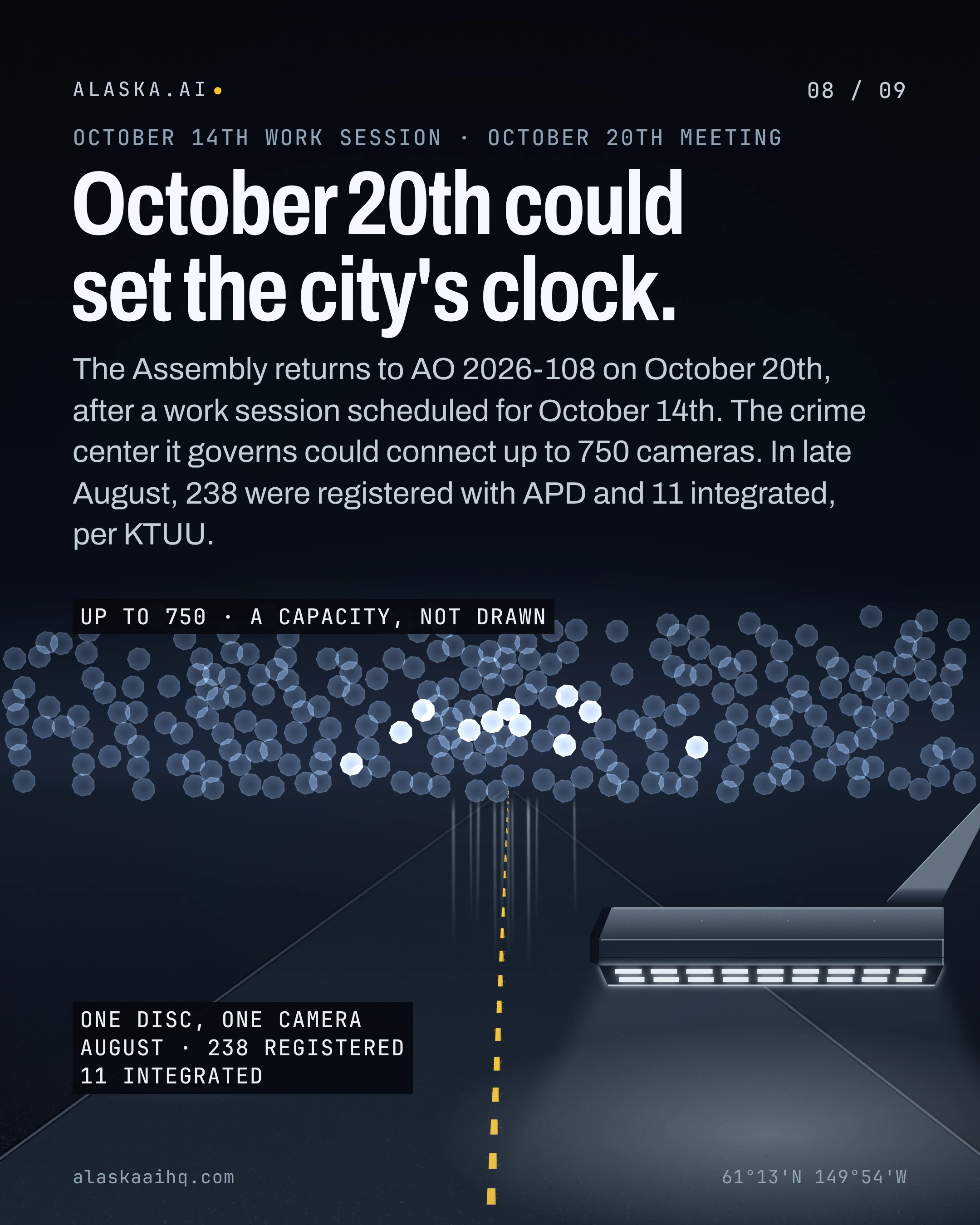
The Assembly's ordinance page lists a second work session on AO 2026-108, its alternative versions and amendments for Wednesday, October 14th.
The mayor's substitute lets APD keep data from a voluntarily provided private camera feed only if it is collected and stored as evidence in a case, and requires written authorization.
The mayor's substitute requires the annual report to state how many private cameras were registered with the Real Time Crime Center at the end of the year before.
The sponsors' S-1 version would also take effect 30 days after the Assembly passes it.
The sponsors' S-1 version keeps the mayor's exemption for tests, pilots and evaluations of an expanded capability, with no stated time limit.
The sponsors' S-1 version also requires APD to send the Assembly its plate reader policy within 30 days of any material change.
The sponsors' S-1 version also gives the city 45 days after a complaint to act before a private suit is available.
The Assembly voted unanimously in mid September to postpone further discussion of surveillance regulations to its October 20th regular meeting, according to the Anchorage Daily News.
Two surveillance proposals, one from Mayor Suzanne LaFrance's administration and one from a group of Assembly members, are expected to go before the Assembly for a vote on October 20th, according to the Anchorage Daily News.
Police Chief Sean Case said APD's license plate readers are enabled only in dashcams on patrol vehicles, according to Alaska's News Source.
As of late August, 238 cameras were registered with APD and 11 were integrated with its Real Time Crime Center, according to Alaska's News Source.
The Assembly voted 8 to 4 to approve just under $600,000 to expand APD's Real Time Crime Center, according to Alaska Public Media.
The expanded crime center system could reach up to 750 cameras across the city, according to Alaska Public Media.
In August, Chief Sean Case told the Assembly that Flock did not have a presence in Alaska at all, according to the Anchorage Daily News.
A newly installed camera at the South Anchorage Lowe's at 10900 Old Seward Highway was cut down late on October 4th, according to a report Lowe's filed with police.
APD confirmed the downed device was a Flock camera and not a municipal streetlight, according to Alaska's News Source.
Flock said that the week before, it had begun installing license plate reader cameras for a private customer in Alaska.
Flock said its private customers can't access law enforcement data.
Flock spokesperson Andrew Smith said every customer owns its data and controls who it is shared with, according to the Anchorage Daily News.
APD spokesperson Regina Romero said the department has no access to license plate reader cameras installed at privately owned locations, according to the Anchorage Daily News.
The crowdsourced DeFlock map showed eight license plate reader cameras in the Municipality of Anchorage, four at the Midtown Lowe's and four at the Lowe's in Tikahtnu Commons, according to the Anchorage Daily News.
Lowe's privacy statement says it keeps license plate reader data typically no more than 90 days and doesn't sell it, according to the Anchorage Daily News.
The municipal clerk's office certified a recall petition against Mayor LaFrance on Monday, October 5th, according to the Anchorage Daily News.
Recall organizers cite the LaFrance administration's failure to turn over required surveillance technology reports on time, according to the Anchorage Daily News.
The recall effort still needs 7,225 signatures by December 7th to reach the April ballot, according to the Anchorage Daily News.
Until recently Alaska was the only state without any Flock cameras, according to KTOO.
The five cameras the DeFlock map showed in Juneau as of October 7th are all in city-owned parking garages and are made by Genetec, not Flock, according to KTOO.
Juneau Deputy City Manager Robert Barr said "We don't have Flock cameras, and we don't have any plans to install them."
Assembly Member Keith McCormick told NewsNation "In Alaska, privacy isn't a privilege, it's a state constitutional right."
About half of the audience polled at a Mat-Su Sentinel candidate forum favored prohibiting large AI and data center developments in areas such as Mat-Su, and most of the rest backed strict regulations.
The Sentinel forums hosted 22 candidates for Alaska House Districts 25 through 30 and Senate Districts M and O.
About 200 residents attended the state-focused forum held Sunday, October 4th, at the Glenn Massey Theater in Palmer.
A state proposal would move 30 square miles of rural land near Houston, Willow and Meadow Lakes from the Department of Natural Resources to AIDEA, with scalable data centers among the listed possible uses.
An ordinance to block data center construction within Houston city limits failed 4-2, according to the Mat-Su Sentinel.
Beats
This article is on Alaska AI research and science · Alaska AI policy and legislation. Each beat page keeps every decision and every article on that subject in one place.