One Gigawatt, to Scale
UAF's new guide counts a state transportation container of drone imagery as a data center.
The deck
SWIPE, SCROLL OR CLICK A SLIDE TO GO FULLSCREEN · 10 SLIDES
The story
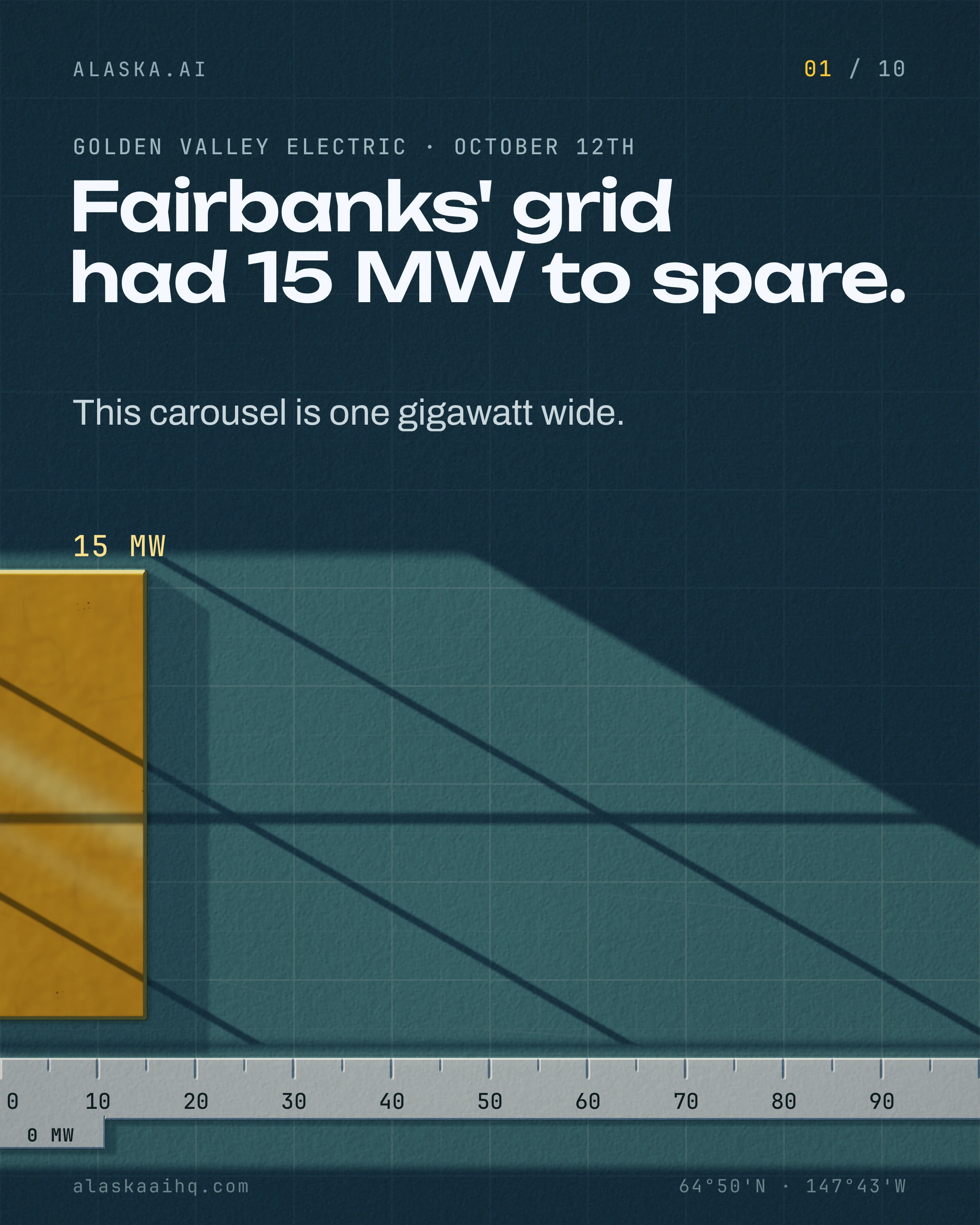
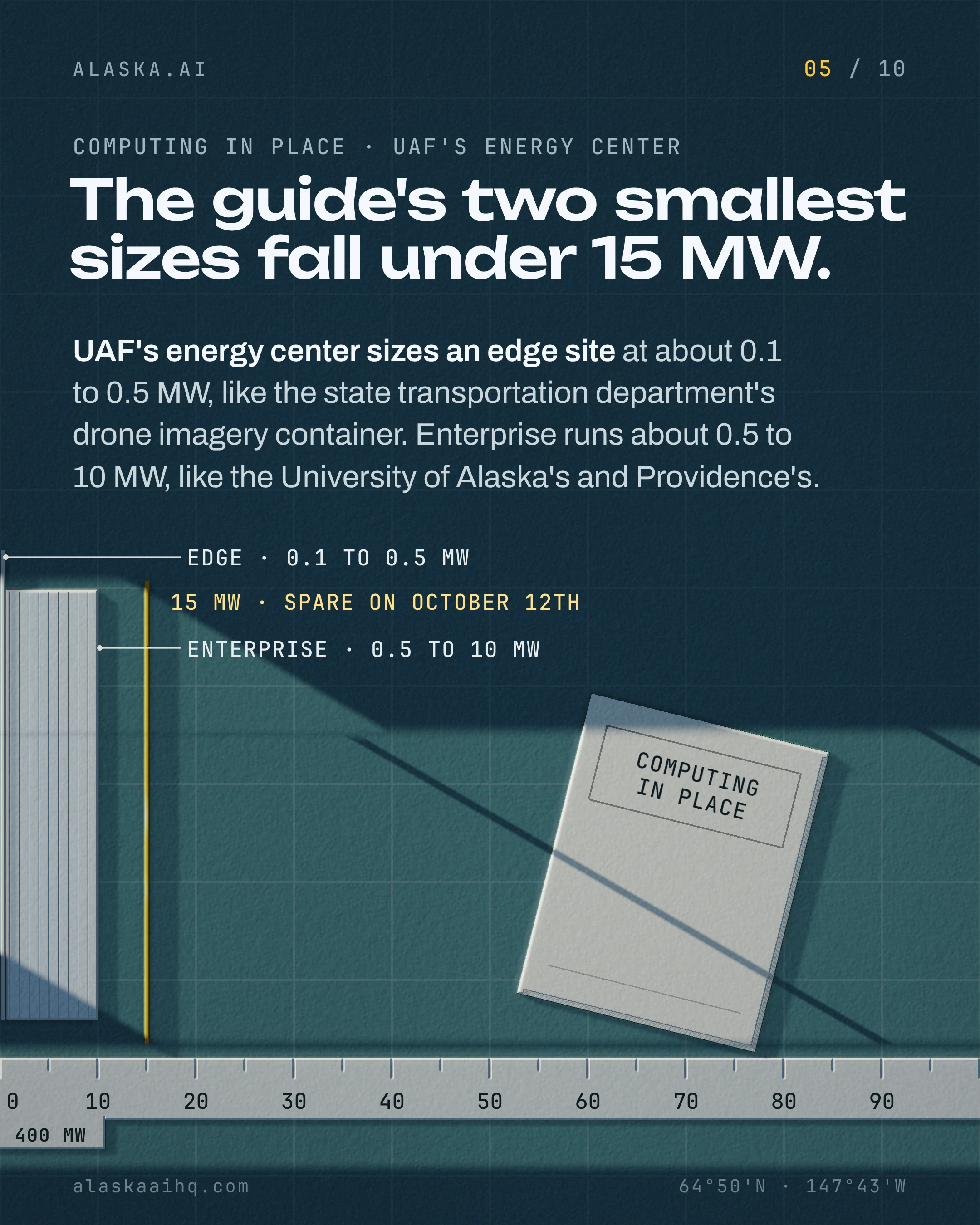
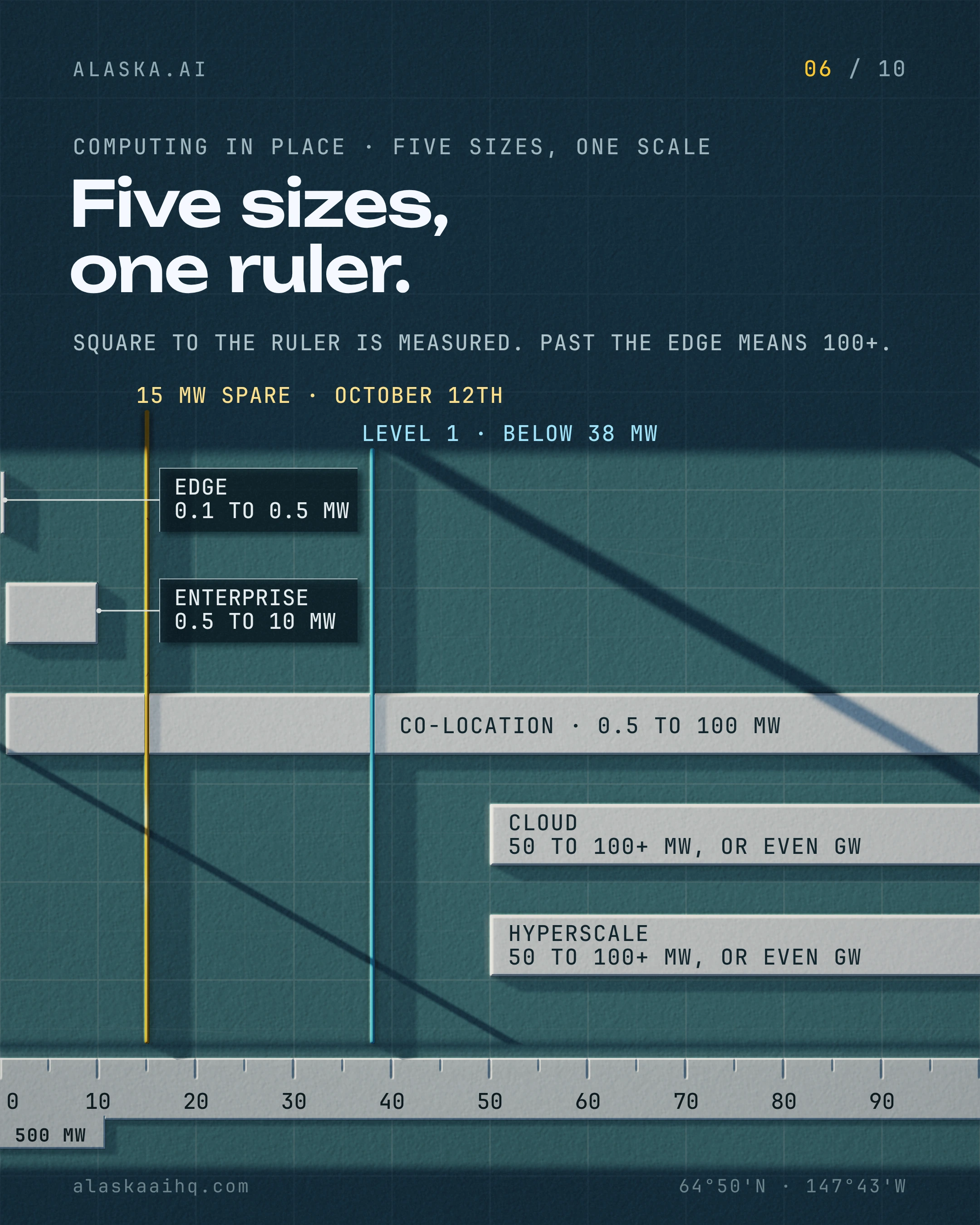
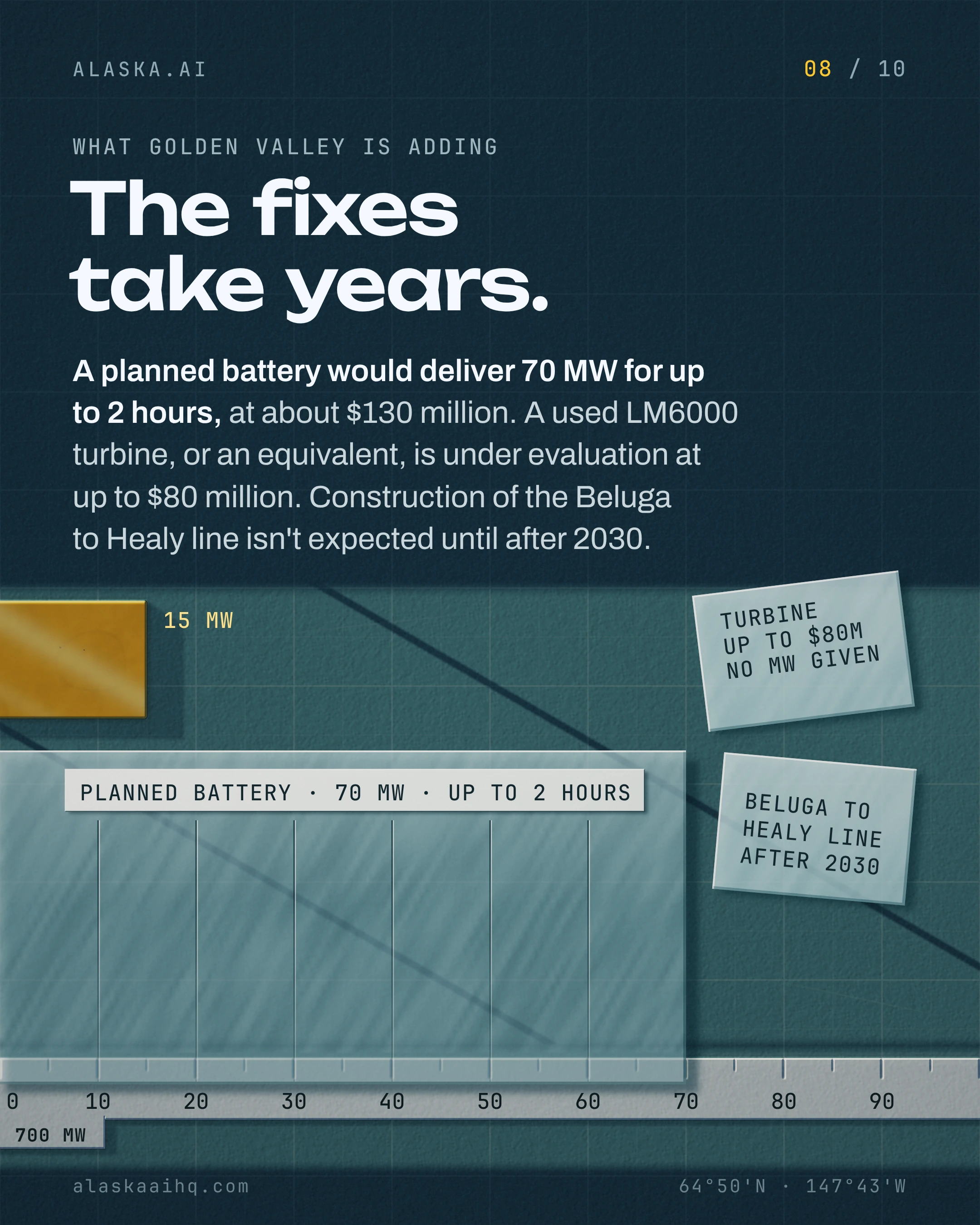
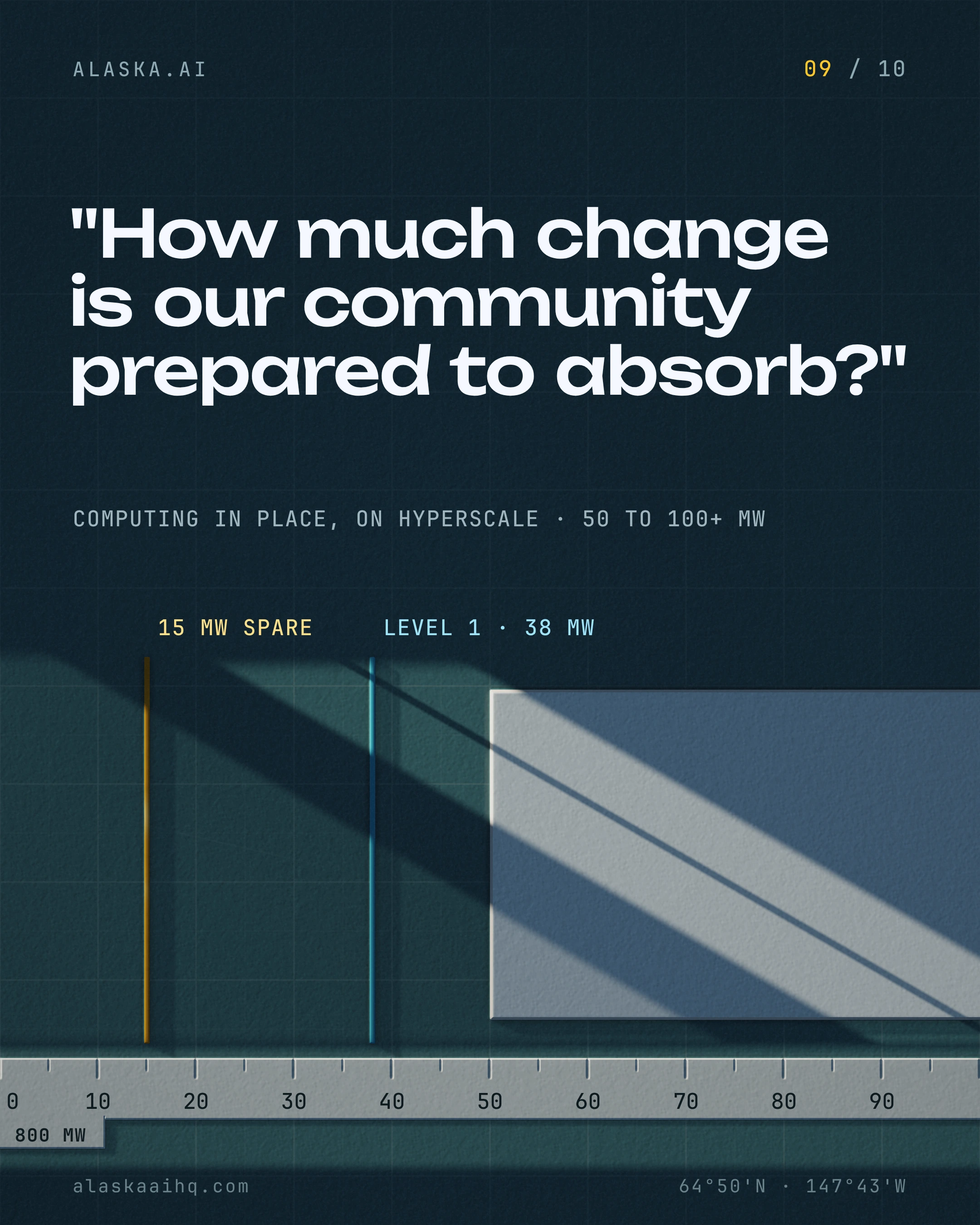
Its type is edge, the bottom rung at about 0.1 to 0.5 MW. Enterprise runs 0.5 to 10 MW and holds the University of Alaska and Providence Hospital. Golden Valley Electric had 15 MW to spare at its first Energy Emergency Alert on October 12th. Its planned battery would supply 70 MW for up to 2 hours.
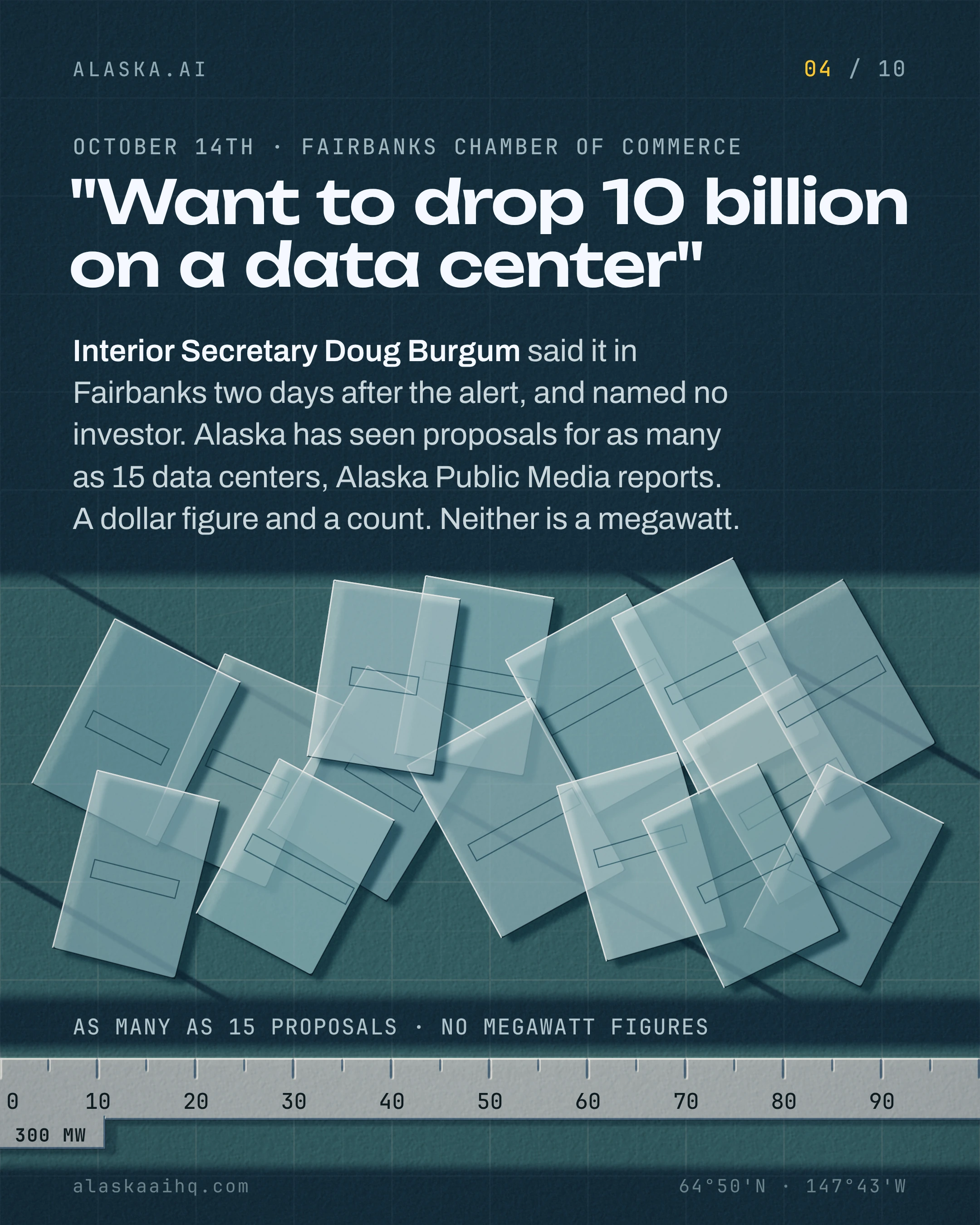
Hyperscale runs 50 to 100+ MW or even gigawatts, with none operating in Alaska. Interior Secretary Doug Burgum said people "want to drop 10 billion on a data center". He named no investor, and 10 billion fits no rung.
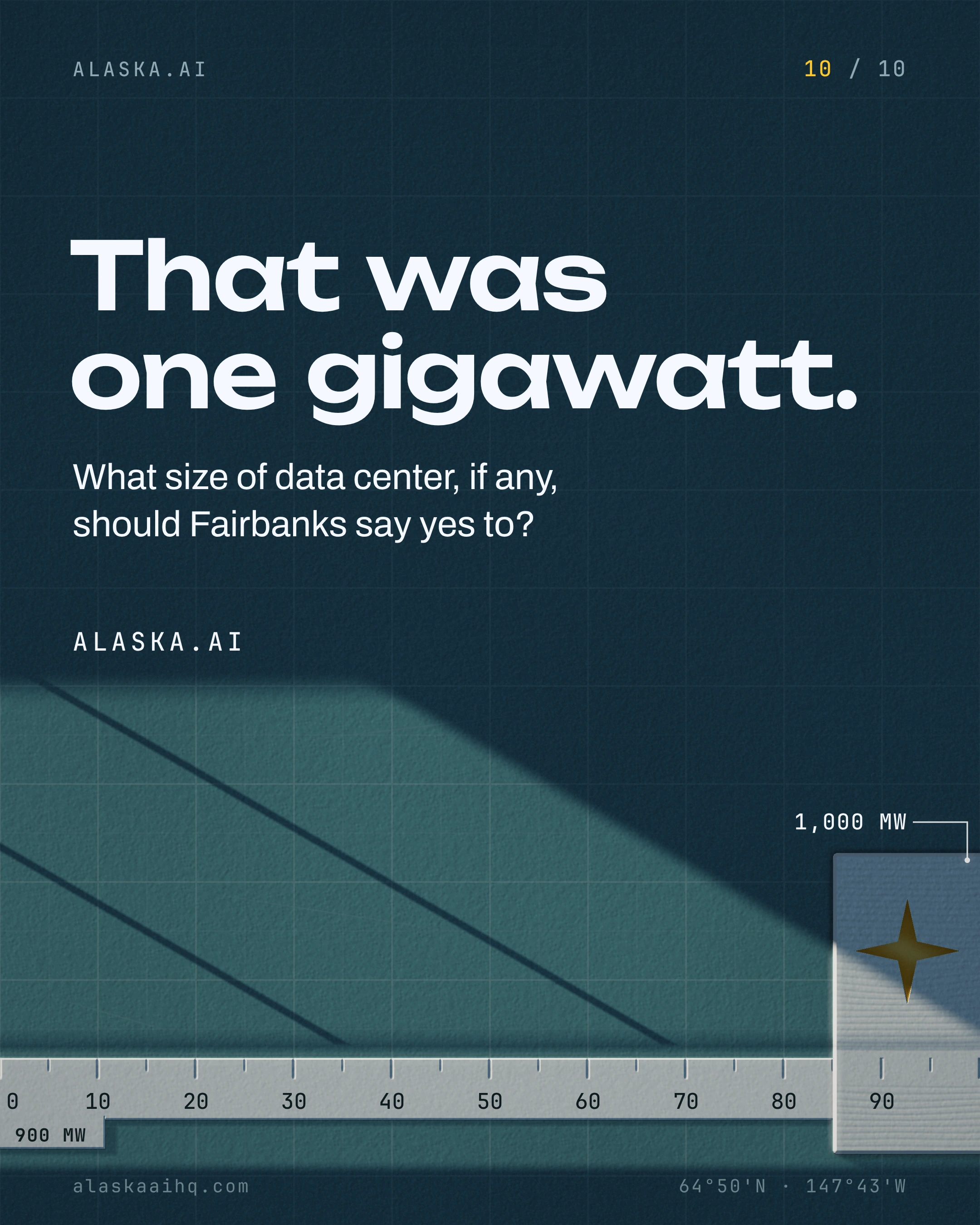
Every frame is 100 MW wide at one scale, so the carousel is one gigawatt long. On it are the 15 MW cushion, five data center sizes and a planned 70 MW battery.
What size of data center, if any, should Fairbanks say yes to?
What we verified
55 CLAIMS, EACH RE-FETCHED FROM ITS SOURCE BEFORE THIS DECK SHIPPED
Golden Valley Electric Association issued its first ever Energy Emergency Alert on October 12th.
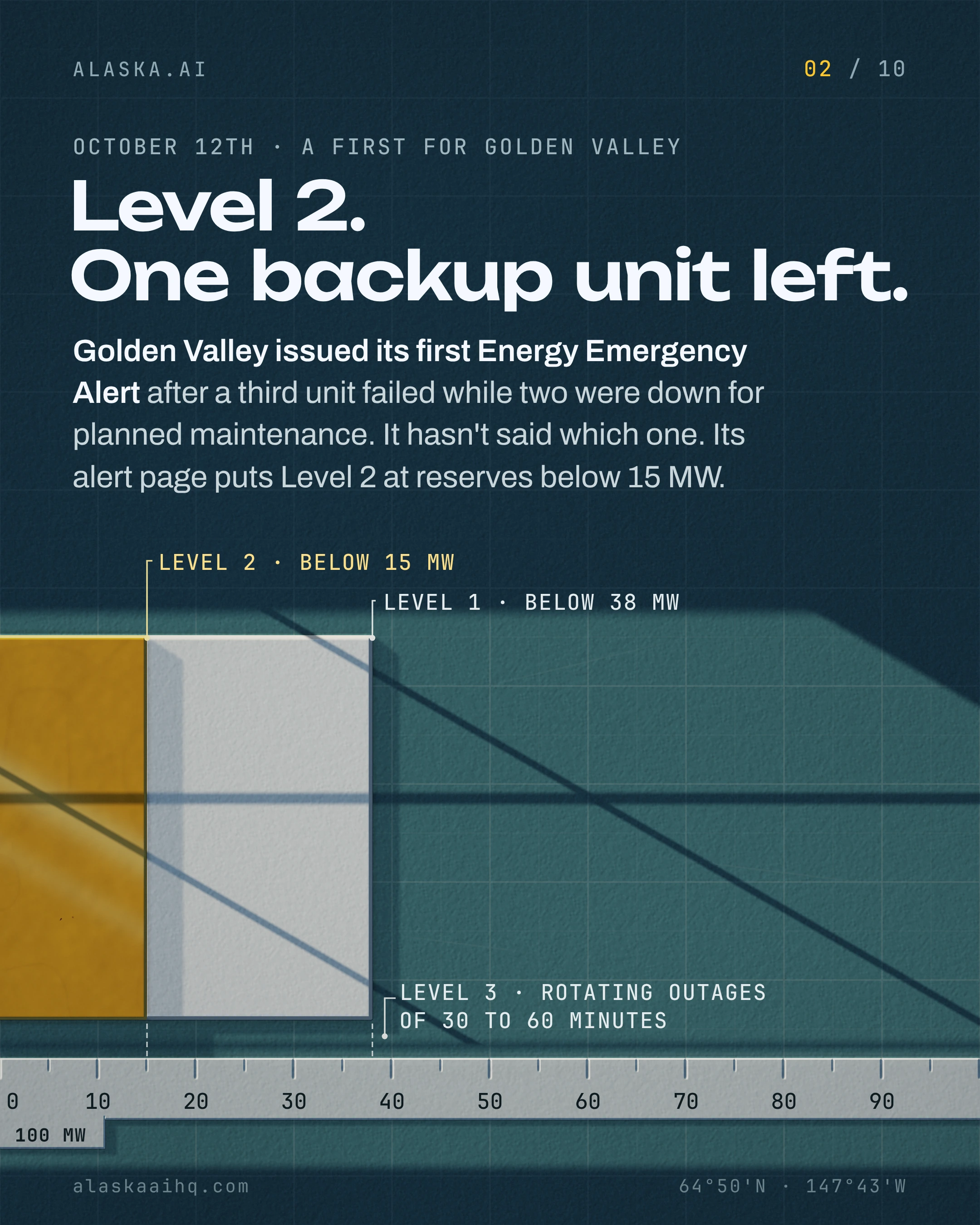
The October 12th alert was a Level 2 alert, triggered when a third GVEA generating unit unexpectedly went offline.
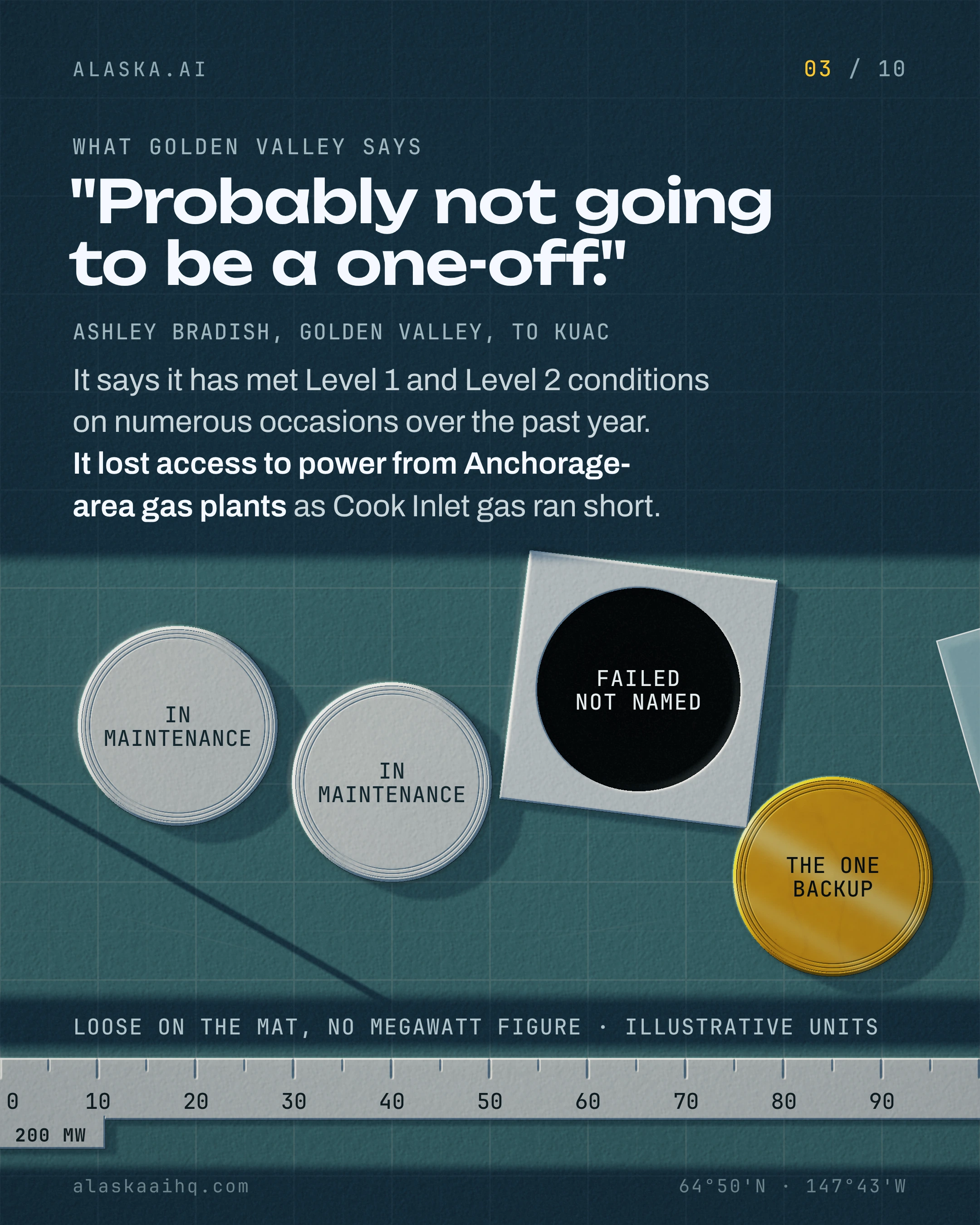
Two GVEA generating units were offline for planned maintenance when the alert was issued.
GVEA's alert page defines Level 1, the Energy Advisory, as available generation reserves below 38 MW that are not expected to recover within two hours.
GVEA's alert page defines Level 2, the Energy Watch, as available generation reserves below 15 MW that are not expected to recover within two hours.
GVEA's alert page defines Level 3, the Energy Warning, as generation reserves unavailable and not expected to recover within 30 minutes, which starts its Controlled Load Shed Program.
GVEA's news release says Level 1 means its backup power supply is limited to two generation units.
GVEA's news release says Level 2 means its backup power supply is limited to one generation unit.
At Level 3 GVEA would rotate outages of 30 to 60 minutes through designated zones.
GVEA says it has experienced conditions consistent with Level 1 and Level 2 alerts on numerous occasions over the past year.
GVEA's board approved additional baseload generation with a maximum project cost of $80 million.
GVEA is evaluating a used LM6000 turbine or an equivalent for that added baseload generation.
GVEA's planned battery energy storage system would provide 70 megawatts of temporary power.
GVEA's planned battery would supply that power for up to 2 hours.
GVEA estimates the battery project will cost about $130 million.
After loan forgiveness and tax credits GVEA expects the battery's cost to members to fall to around $18 million.
GVEA says it lost access to power from Anchorage area gas plants because of natural gas shortages in Cook Inlet.
By 10:40 a.m. on October 14th GVEA's alert page showed Level 0, normal operations.
The University of Alaska Fairbanks Alaska Center for Energy and Power prepared Computing in Place, a conversation guide on data centers for Alaskans, dated October 2026.
The guide runs 61 pages and its lead author is Leasi Vanessa Lee Raymond.
UAF announced the guide on October 14th, saying it was developed by the Alaska Center for Energy and Power.
The guide was published on Zenodo on October 6th under a Creative Commons Attribution 4.0 license.
The guide's work relates to Office of Naval Research award N00014-22-1-2049.
ACEP convened a two day discussion of Alaska leaders in June 2026 that informed the guide.
The guide says a small facility supporting a hospital or Tribal government is different from a hyperscale facility serving global customers.
The guide frames four questions, namely what computing Alaska needs, what resources should support it, who should control it, and what if anything Alaskans want to provide to the rest of the world.
The guide sizes an edge data center at approximately 0.1 to 0.5 MW in Alaska.
The guide cites the Alaska Department of Transportation and Public Facilities containerized edge data center, used to store drone imagery, as an Alaska example of the edge type.
The guide sizes an enterprise data center at approximately 0.5 to 10 MW in Alaska.
The guide names the University of Alaska data center and the Providence Hospital data center as enterprise examples in Alaska today.
The guide sizes a co-location data center at approximately 0.5 to 100 MW.
The guide sizes a cloud data center at 50 to 100 or more MW, or even gigawatts, in Alaska.
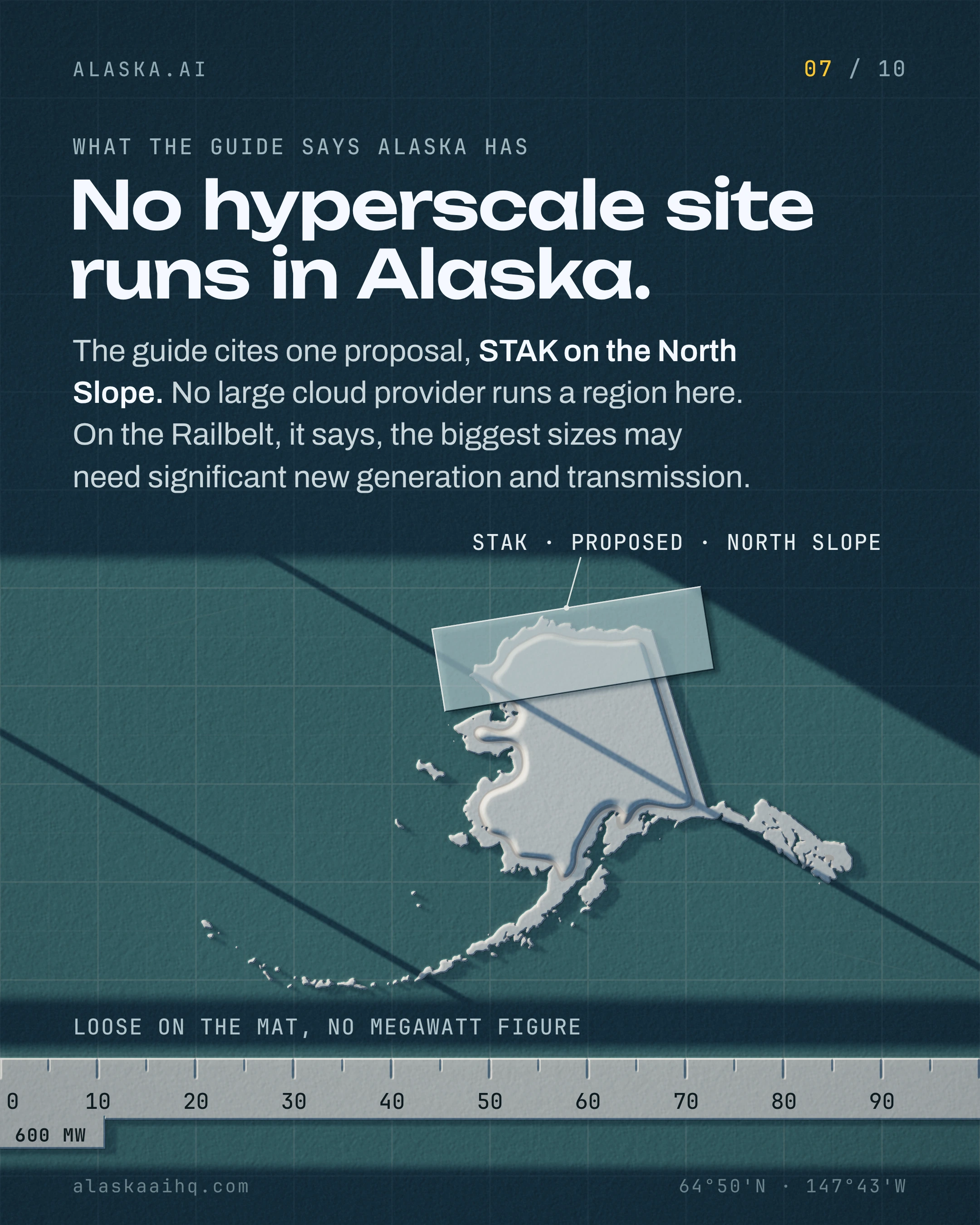
The guide says no large commercial cloud providers currently operate cloud regions in Alaska.
The guide says no operational hyperscale facilities currently exist in Alaska and cites the STAK proposal on the North Slope as a proposed example.
The guide sizes a hyperscale data center at 50 to 100 or more MW, or even gigawatts, in Alaska.
The guide's question for the hyperscale type is "How much change is our community prepared to absorb?"
The guide says hyperscale AI or cloud scale projects on the Railbelt may require significant new power generation and transmission beyond what exists today.
The guide says large scale data centers are unlikely to be economically feasible in remote communities running diesel powered microgrids without transformative investment.
The guide says Alaska's energy limits come from the cost and complexity of developing and connecting its resources rather than from a lack of resources.
A Department of Energy project will build approximately 223 miles of new transmission line connecting Beluga and Healy.
The Beluga to Healy line combines up to $150 million in Defense Production Act funding with $268 million in non-federal funding.
KUAC reported that GVEA was left with a cushion of 15 megawatts of reserve generating capacity when it issued the alert.
KUAC reported the alert would remain in effect through Wednesday, October 14th.
GVEA spokesperson Ashley Bradish told KUAC the alert is "probably not going to be a one-off."
Bradish told KUAC that GVEA's generation situation is "not a quick fix."
GVEA would not say which unit failed or why, citing new state standards on what utilities may make public, according to Alaska's News Source.
GVEA said the problem behind the shortage will take years to fix, according to Alaska Public Media.
Interior Secretary Doug Burgum spoke at a Fairbanks Chamber of Commerce event on the evening of Wednesday, October 14th.
Burgum told the Fairbanks audience, "We have people knocking on our door that want to drop 10 billion on a data center, and they don't want any tax breaks."
Alaska Public Media reported that Burgum pitched the Interior as a location for large scale AI data centers.
Alaska has seen proposals for as many as 15 data centers, including on military land, according to Alaska Public Media.
In July state officials received more than 500 public comments on a proposed North Slope data center and power plant.
In August the Fairbanks North Star Borough Assembly passed a resolution asking the Alaska Legislature to impose a moratorium on data centers.
Democratic gubernatorial candidate Jonathan Kreiss-Tomkins, who attended Burgum's speech, said "I think we should pause."
Construction of the second intertie isn't expected until after 2030, according to the Alaska Beacon.
Beats
This article is on Alaska data centers · Alaska power and the grid · Alaska AI research and science. Each beat page keeps every decision and every article on that subject in one place.