Houston's 19,950 acres, and the answer owed October 26th
Commissioner Crowther, your department would keep a take-back clause on 885 acres at Port MacKenzie and waive it on 19,950 acres at Houston.
The deck
SWIPE, SCROLL OR CLICK A SLIDE TO GO FULLSCREEN · 9 SLIDES


The story
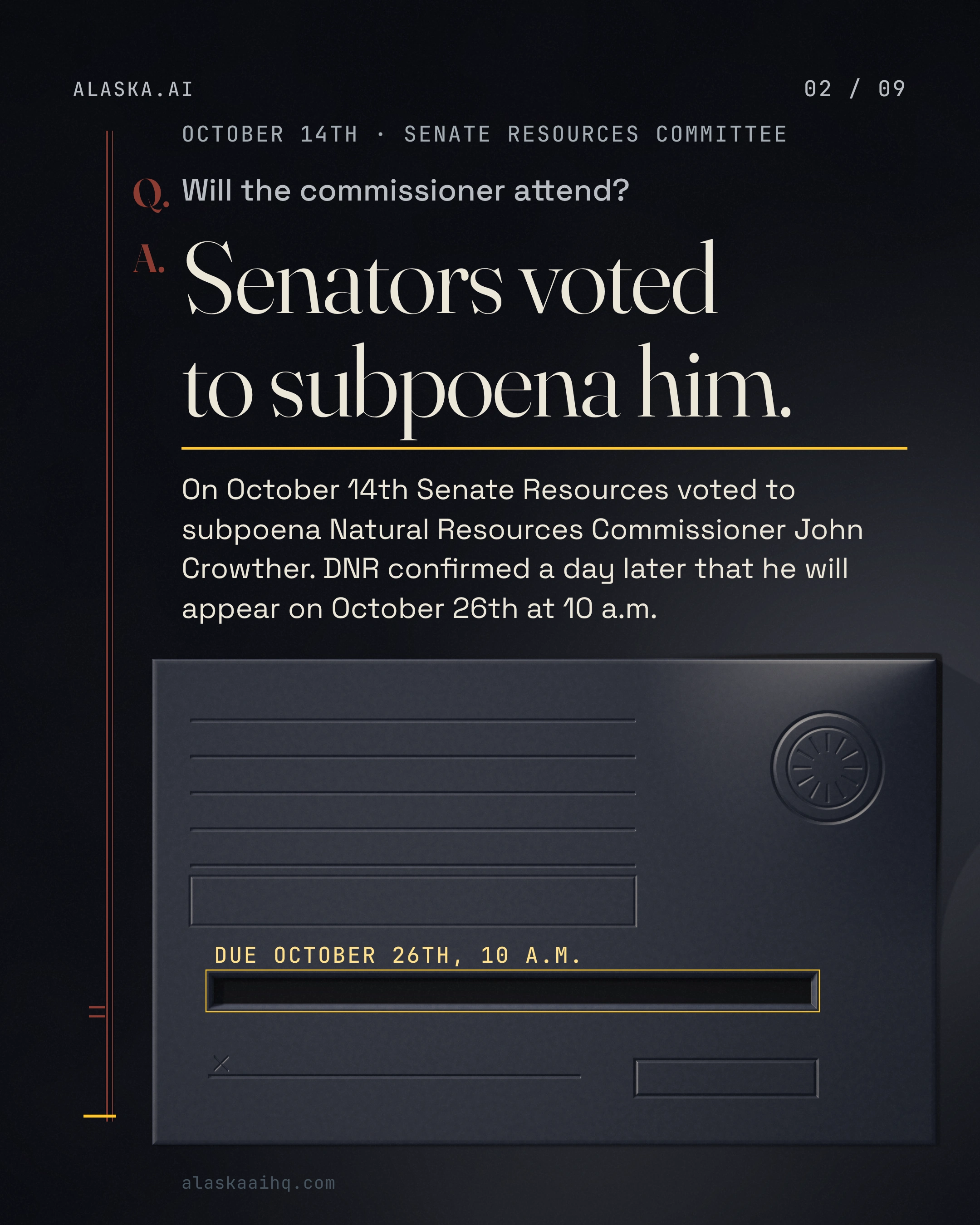
Senate Resources voted to subpoena you. You're due October 26th at 10 a.m.
What does the state get? Nothing for the land itself. AIDEA would pay survey and closing costs.
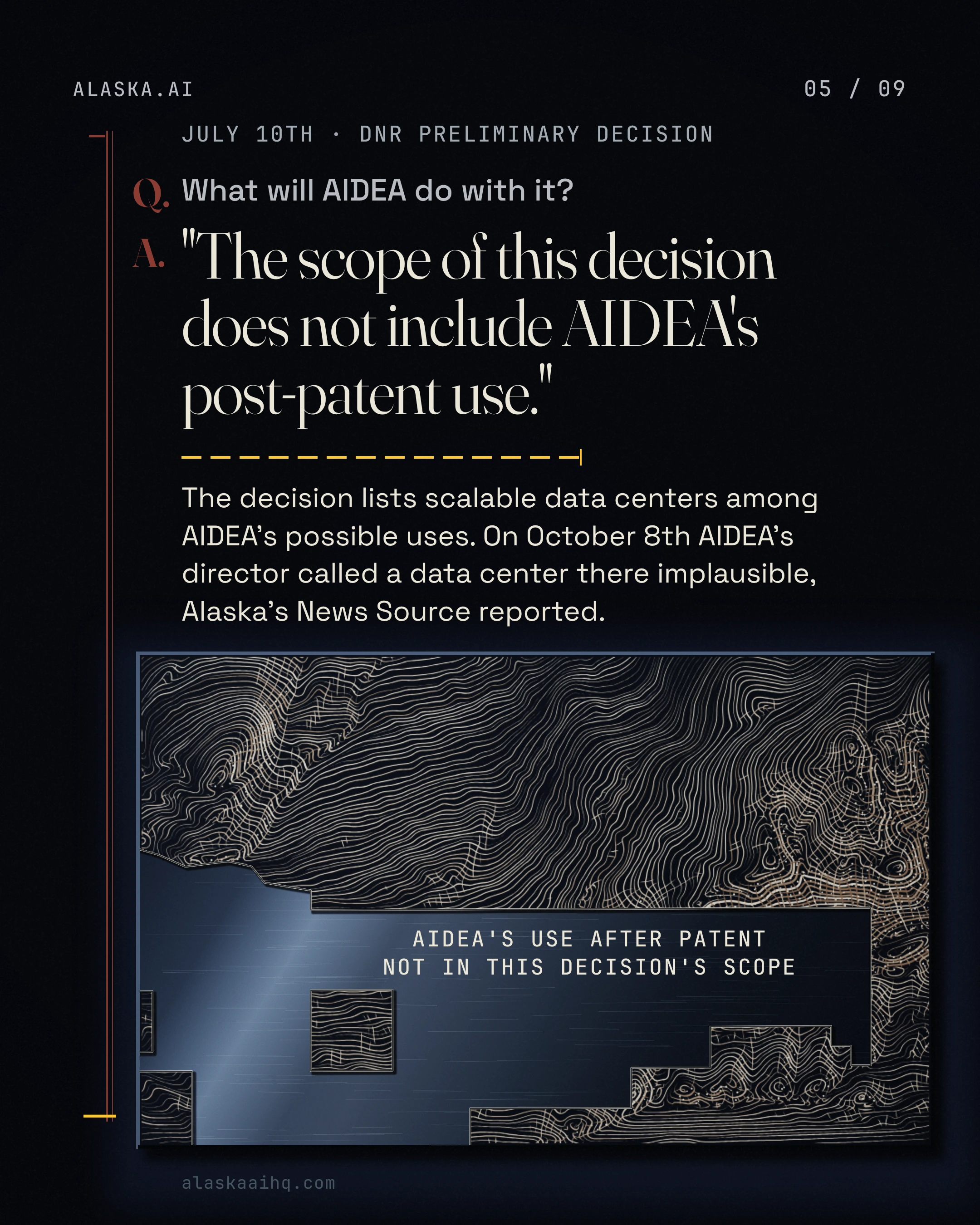
What is it for? Your department's decision says its scope does not include AIDEA's post-patent use.
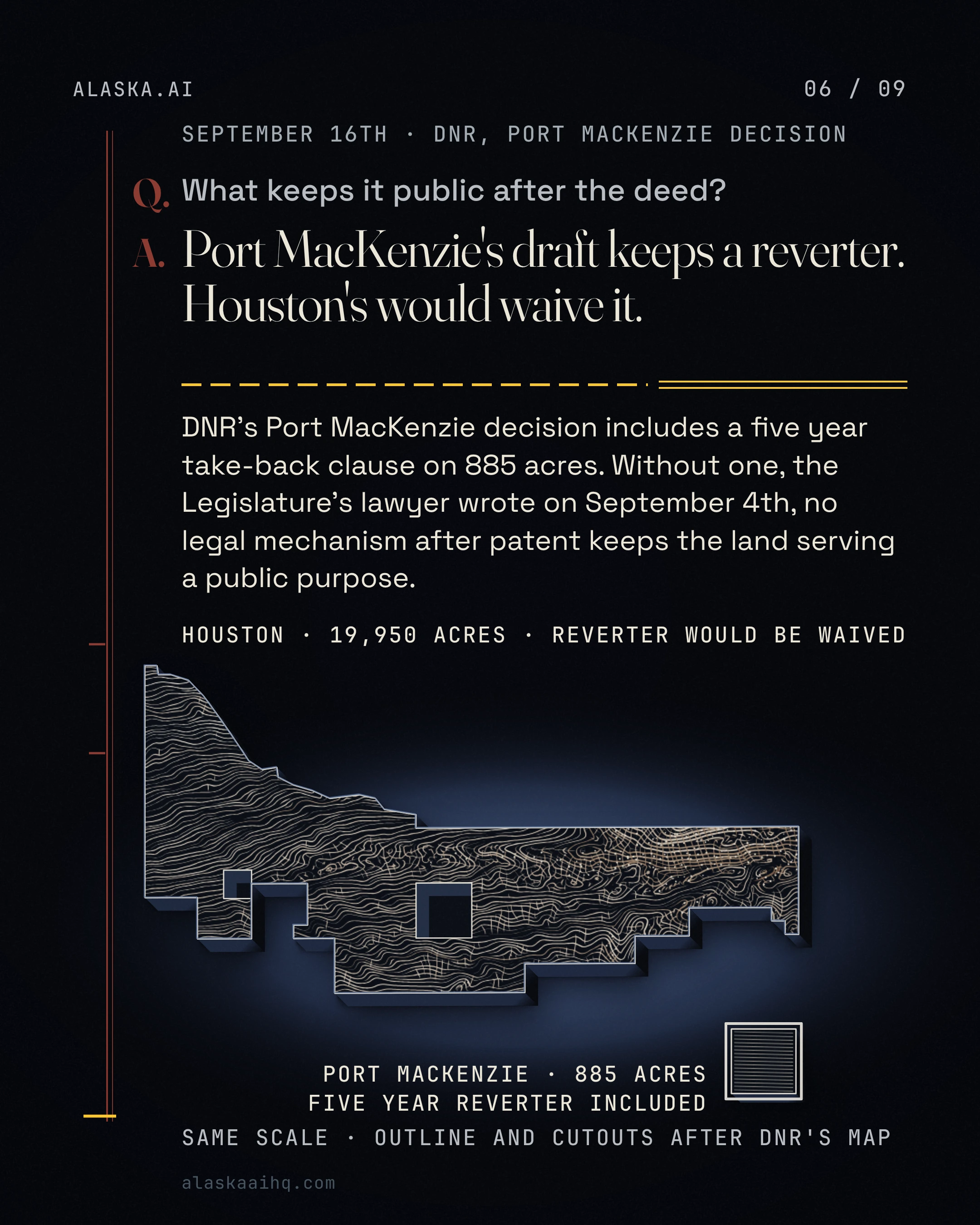
Can the state take it back? At Port MacKenzie, if AIDEA doesn't use it within five years. At Houston, not if the waiver stands. The written reason is that a reverter would limit AIDEA's bonding.
First comes DNR's refusal to attend and the subpoena, then the land and its price, the committee's size test, both reverters and the dated record.
Is easier bonding for AIDEA worth giving up the state's take-back on about 31 square miles?
What we verified
86 CLAIMS, EACH RE-FETCHED FROM ITS SOURCE BEFORE THIS DECK SHIPPED
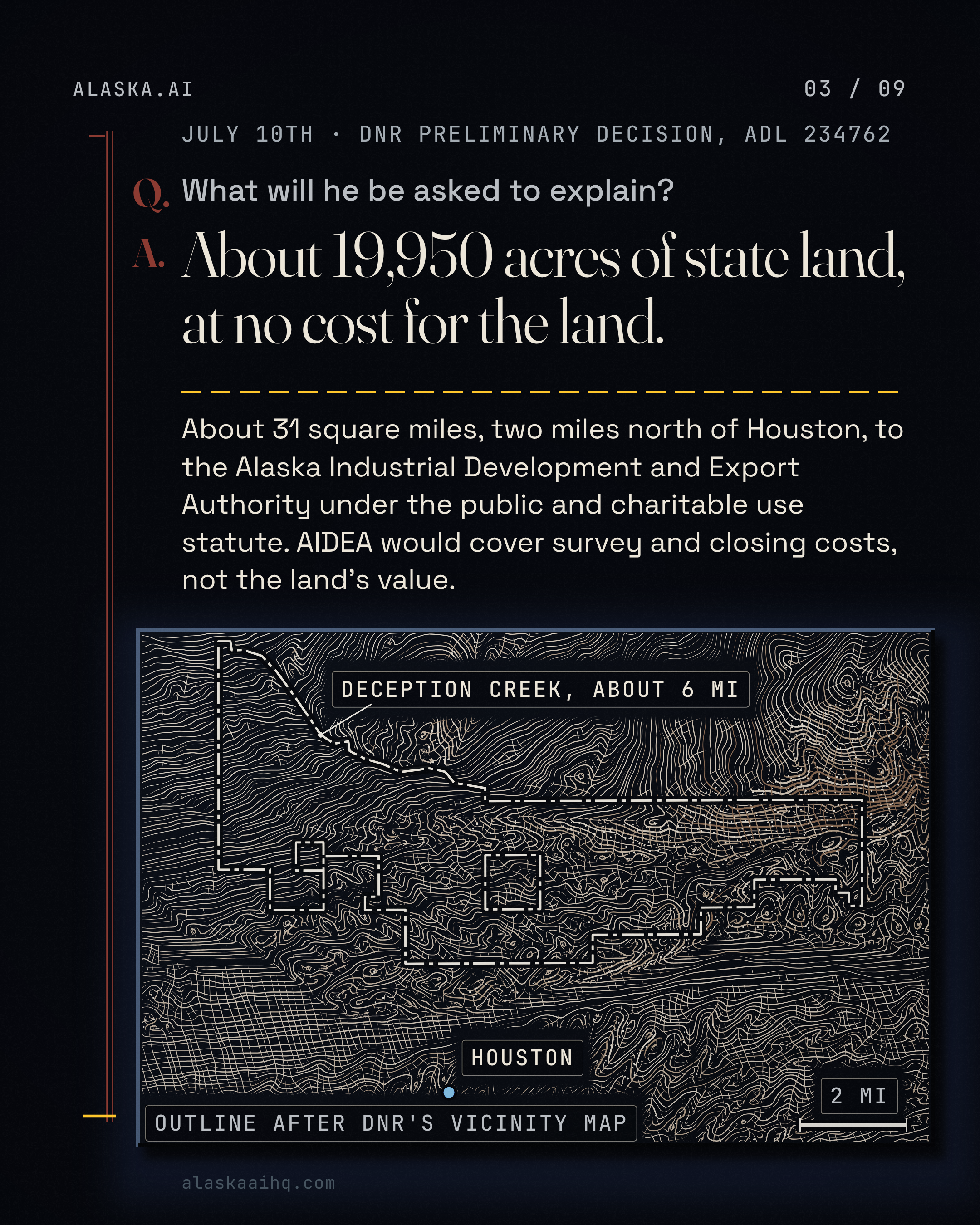
DNR proposes to convey approximately 19,950 acres of state-owned land in the Matanuska-Susitna Borough to AIDEA.
The Houston parcel lies approximately two miles north of the City of Houston.
DNR would make the Houston conveyance noncompetitively and at no cost under AS 38.05.810(a), the Public and Charitable Use statute.
AIDEA would make no payment for the value of the Houston land but would cover administrative, survey, platting and closing costs.
DNR's preliminary decision says the commissioner shall waive the state's reversionary interest in the Houston land.
DNR wrote that keeping a reverter clause would limit AIDEA's ability to use its bonding authority and financing options.
AS 38.05.810(g) requires the commissioner to retain a reversionary interest on these disposals unless it is waived by written determination.
DNR proposes to reclassify about 15,100 acres of the Houston parcel as Settlement land.
DNR's preliminary decision states that its scope does not include AIDEA's use of the land after it is patented.
Scalable data centers are among the uses DNR's decision lists for AIDEA's proposed Houston district.
The parcel's northern boundary runs east along Deception Creek for about six miles to the foothills of the Talkeetna Mountains.
The parcel's western boundary lies approximately two miles east of the Parks Highway.
The portion of the parcel in Township 18 North, Range 3 West totals about 7,375.87 acres.
The portion of the parcel in Township 19 North, Range 3 West totals about 4,172 acres.
The portion of the parcel in Township 18 North, Range 2 West totals about 8,386.96 acres.
About 1,600 acres of the parcel are described by a plat approved by the U.S. Surveyor General's Office in Juneau in 1915.
Other sections of the parcel are described by a plat approved by the U.S. Surveyor General's Office in Juneau in 1917.
DNR says the Little Susitna River south of the site flows at about 50 CFS in winter and up to 2,000 CFS in summer.
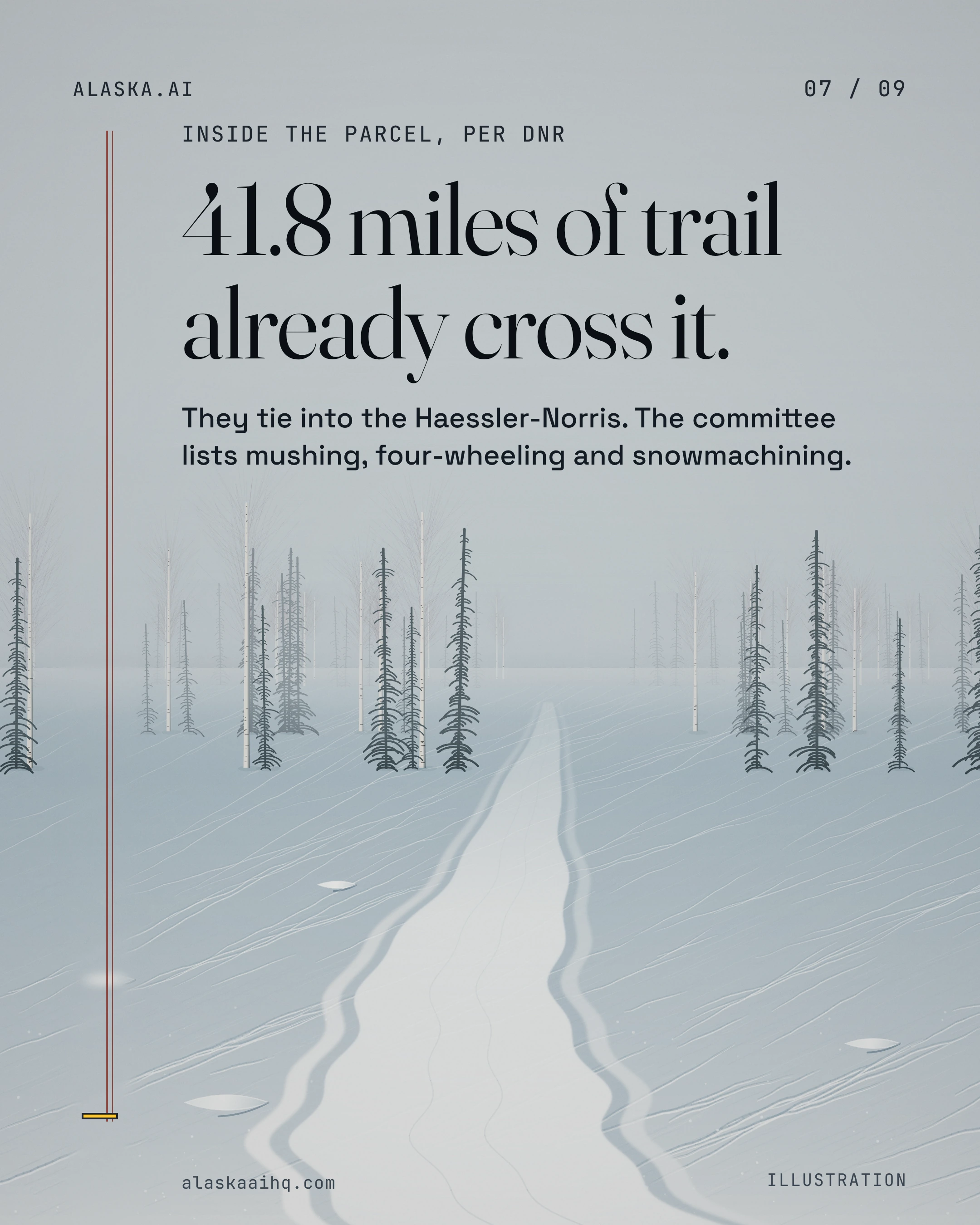
DNR counts approximately 41.8 miles of documented trails within the parcel that tie into networks such as the Haessler-Norris.
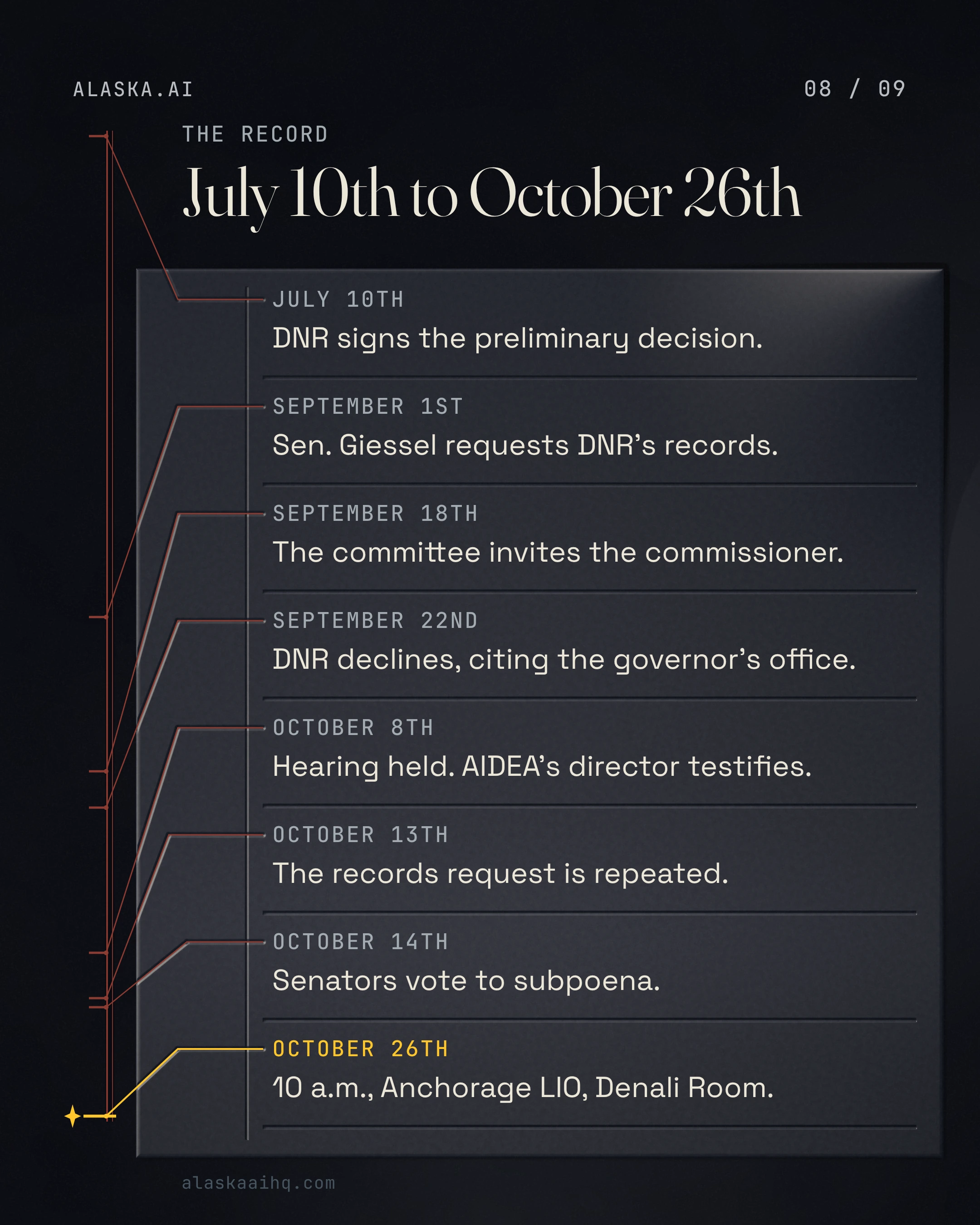
DMLW Director Christy Colles signed the Houston preliminary decision for public notice on July 10th.
Sand, gravel and rock are not part of the state's mineral reservation and would go to AIDEA with the land.
AIDEA's own fact sheet describes the listed uses for the Houston land as possibilities and not commitments.
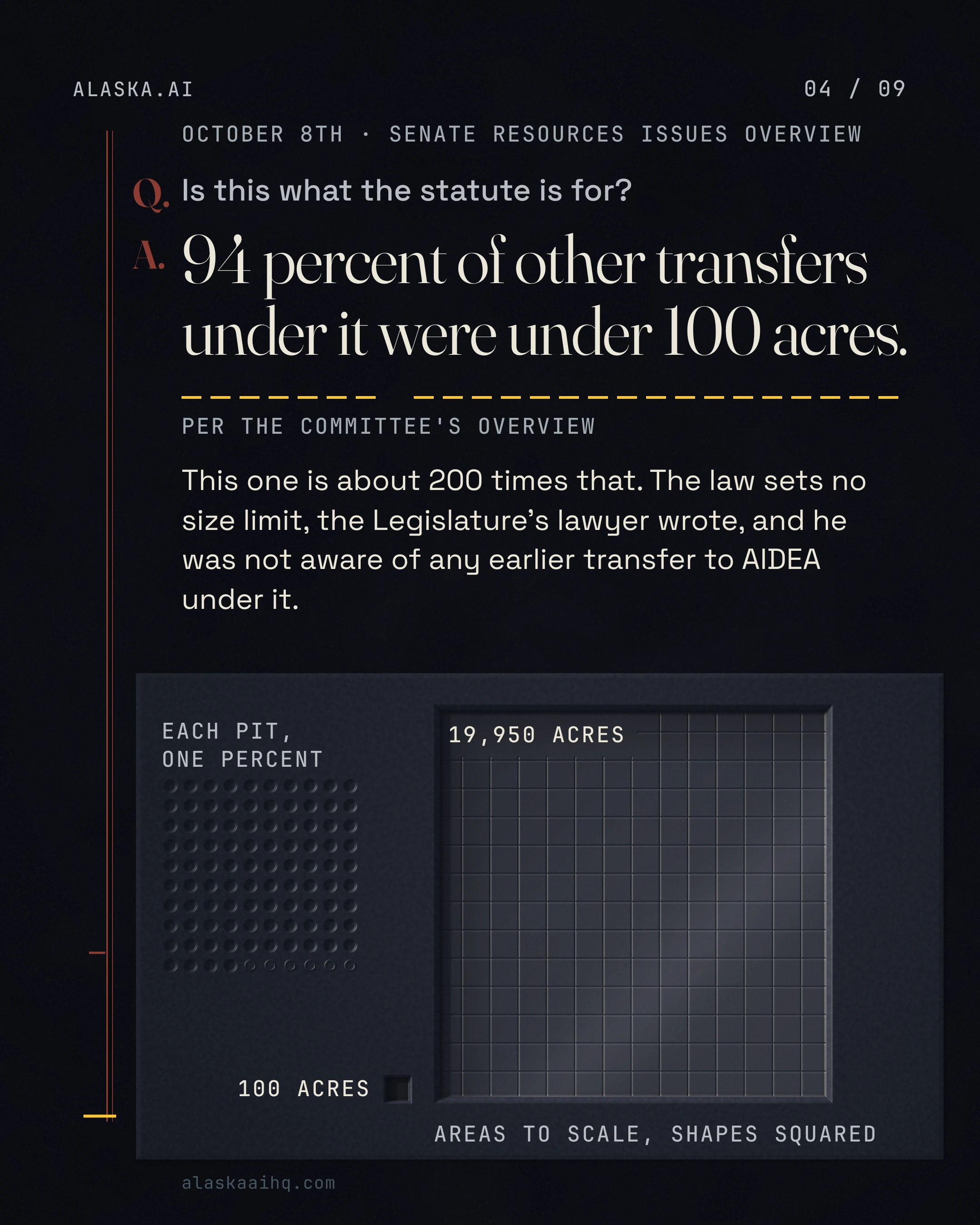
The Senate Resources Committee's issues overview says 94 percent of other transfers under this statute were under 100 acres.
The committee's issues overview says the Houston transfer covers about 31 square miles.
The committee's issues overview says about 37 percent of the Houston area is wetlands.
The committee's issues overview says the area holds more than 40 miles of public trails used for mushing, four-wheeling and snowmachining.
The committee's issues overview says AIDEA now says there is no data center planned.
The committee's issues overview says the Houston city council voted unanimously to oppose the land transfer.
The Mat-Su Borough Assembly voted to oppose the Houston transfer.
According to the committee, the governor's SB 224 and HB 276, which sought below-market land transfers for commercial development, did not move from either Resources Committee.
DNR adopted its public purpose regulation, 11 AAC 98.010, on March 14th.
Clause 4 of 11 AAC 98.010 counts support for private commerce or industry that contributes to economic development as a public purpose.
AS 38.05.810(a) requires the commissioner to ensure that disposals under it serve a public purpose and are in the public interest.
Senator Cathy Giessel sent Commissioner Crowther a public records request about the AIDEA and AHFC transfers on September 1st.
Giessel's office notes say DNR sent an initial response on September 10th and nothing after that.
On September 18th Giessel's office invited Crowther to the October 8th hearing, set for 1 to 3 p.m. at the Anchorage LIO.
On September 22nd Crowther's office declined the invitation, saying the governor's office had not given permission to attend.
On October 9th Giessel invited Crowther to speak to Senate Resources on October 26th at 10 a.m. at the Anchorage LIO.
On October 13th Giessel's office repeated its September 1st request for information to DNR.
A September 4th Legislative Legal Services memo says DNR limited its review to exclude AIDEA's use of the land after conveyance.
The Bullard memo concludes that without an analysis of likely uses the conveyance may raise legal issues.
The Bullard memo says the statute sets no limit on the amount of land that may be conveyed.
Bullard wrote that he was not aware of any prior transfer of land to AIDEA under AS 38.05.810.
Bullard wrote that without a reversionary interest there is no post-patent legal mechanism to keep the land serving a public purpose.
In a July 30th letter quoted by the committee, AIDEA Executive Director Randy Ruaro wrote that no project had been approved or selected.
DNR has separately proposed a no-cost conveyance of approximately 885 acres near Port MacKenzie to AIDEA.
Unlike the Houston decision, DNR's Port MacKenzie preliminary decision keeps a reverter if AIDEA does not use the land within five years.
Public comment on the Port MacKenzie preliminary decision closes at 5 p.m. on October 21st.
The University of Alaska published five principles behind its AI guidelines on October 16th.
The University of Alaska's guidelines cover using generative AI in communications work.
UA's five principles are authenticity, discernment, accountability, transparency and respect.
UA's transparency principle says AI use necessitates clear disclosure.
UA's accountability principle says every individual, and ultimately the institution, is responsible for what it publishes.
DNR's vicinity map for the Houston parcel counts 19,949 total acres in its soil analysis.
DNR's vicinity map classes 62.6 percent of the Houston parcel, 12,490 acres, as upland.
DNR's vicinity map classes 37.0 percent of the Houston parcel, 7,385 acres, as wetland.
DNR's vicinity map classes 0.4 percent of the Houston parcel, 74 acres, as water.
DNR's vicinity map labels the two parts of the parcel the Houston West Site and the Houston East Site.
The Legislature's meeting schedule lists the October 26th Senate Resources meeting at 10 a.m. in the Denali Room of the Anchorage Legislative Information Office.
The Legislature's meeting schedule lists a joint House and Senate Resources meeting on October 8th at 1 p.m. and a Senate Resources meeting on October 14th at 10 a.m., both in the Anchorage LIO Denali Room.
The Senate Resources Committee voted on Wednesday, October 14th, to subpoena Commissioner Crowther.
Five senators voted in favor of the subpoena during the October 14th meeting.
Sen. Bill Wielechowski made the motion to subpoena Crowther.
DNR confirmed on Thursday, October 15th, that Crowther would appear at the October 26th hearing.
The committee's next meeting is scheduled for October 26th at 10 a.m.
AIDEA Executive Director Randy Ruaro testified on October 8th that the rumored data center is implausible because there is no excess energy supply.
KTUU reports that Ruaro testified that no developer, tenant, power source or site plan exists for the Houston land.
Giessel said the transfer is a violation of the Legislature's appropriation authority.
Giessel said one of her big concerns is that this is a huge conveyance of public land.
Giessel said the University of Alaska charges a private Mat-Su developer $586,740 a year to lease 829 acres.
Giessel estimated the nearly 20,000 acres are worth roughly $14 million a year in foregone state revenue.
Terra Energy's payment on its 829-acre UA lease near Port MacKenzie would increase to $586,000 a year once operations begin.
DNR was reviewing more than 2,100 public comments on the Houston transfer.
University leadership planned to submit a finalized AI policy draft for approval at the November regents meeting.
If approved, the draft UA policy would require all three campuses to have an AI plan for students, faculty and staff.
UA Chief Information Technology Officer Ben Shier called AI one of the most profound technology shifts the university has seen.
Alaska DNR favors ENSTAR's proposal over Hilcorp's for gas storage in the Kenai Loop field.
DNR issued its preliminary finding on the Kenai storage proposals on Tuesday, October 13th.
Written comments on DNR's Kenai storage preliminary finding are due by 5 p.m. on November 13th.
The City of Kenai says it owns the Kenai Loop reservoir pore space.
Kenai City Manager Terry Eubank raised the dispute in an October 7th letter to DNR Commissioner Crowther.
DNR said the Kenai Loop field once held around 32.5 billion cubic feet of gas.
The Kenai Loop gas field sits partially under the Kenai airport.
The Kenai storage project is estimated to cost $240 million.
DNR's Haley Paine said ENSTAR's proposal was the one the division found to be in the state's best interest.
Houston, Alaska, lies at about 61.608 degrees north and 149.774 degrees west, along the George Parks Highway and the Little Susitna River.
Beats
This article is on Alaska data centers · Alaska land and permitting for AI · Alaska AI policy and legislation. Each beat page keeps every decision and every article on that subject in one place.