One Rock, Two Readings of the Kenai Loop Gas Storage Lease
Under Kenai's airport, ownership changes once, then splits.
The deck
SWIPE, SCROLL OR CLICK A SLIDE TO GO FULLSCREEN · 9 SLIDES




The story
The city owns the surface. The state got the oil and gas estate by federal patent on August 25th, 1986.
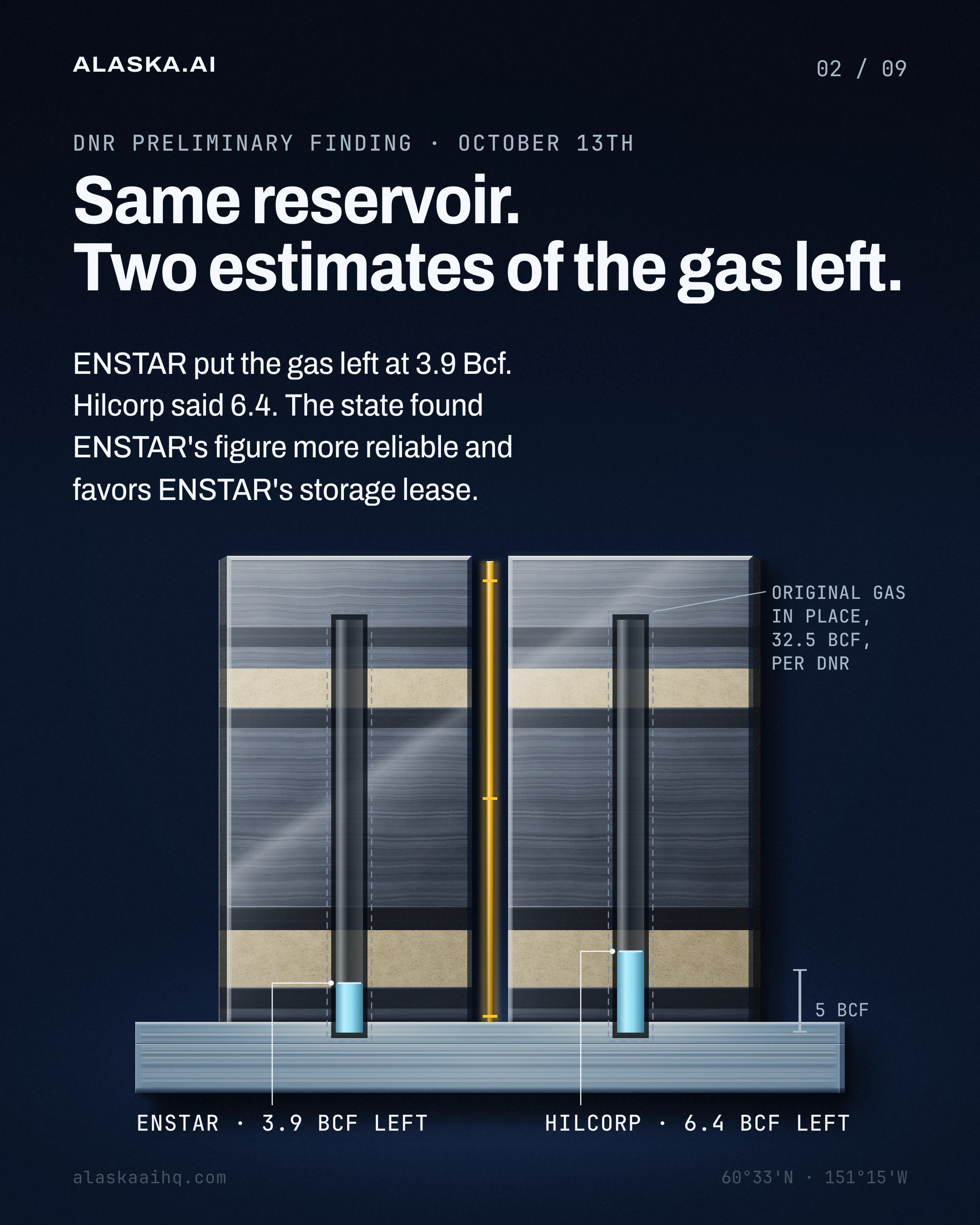
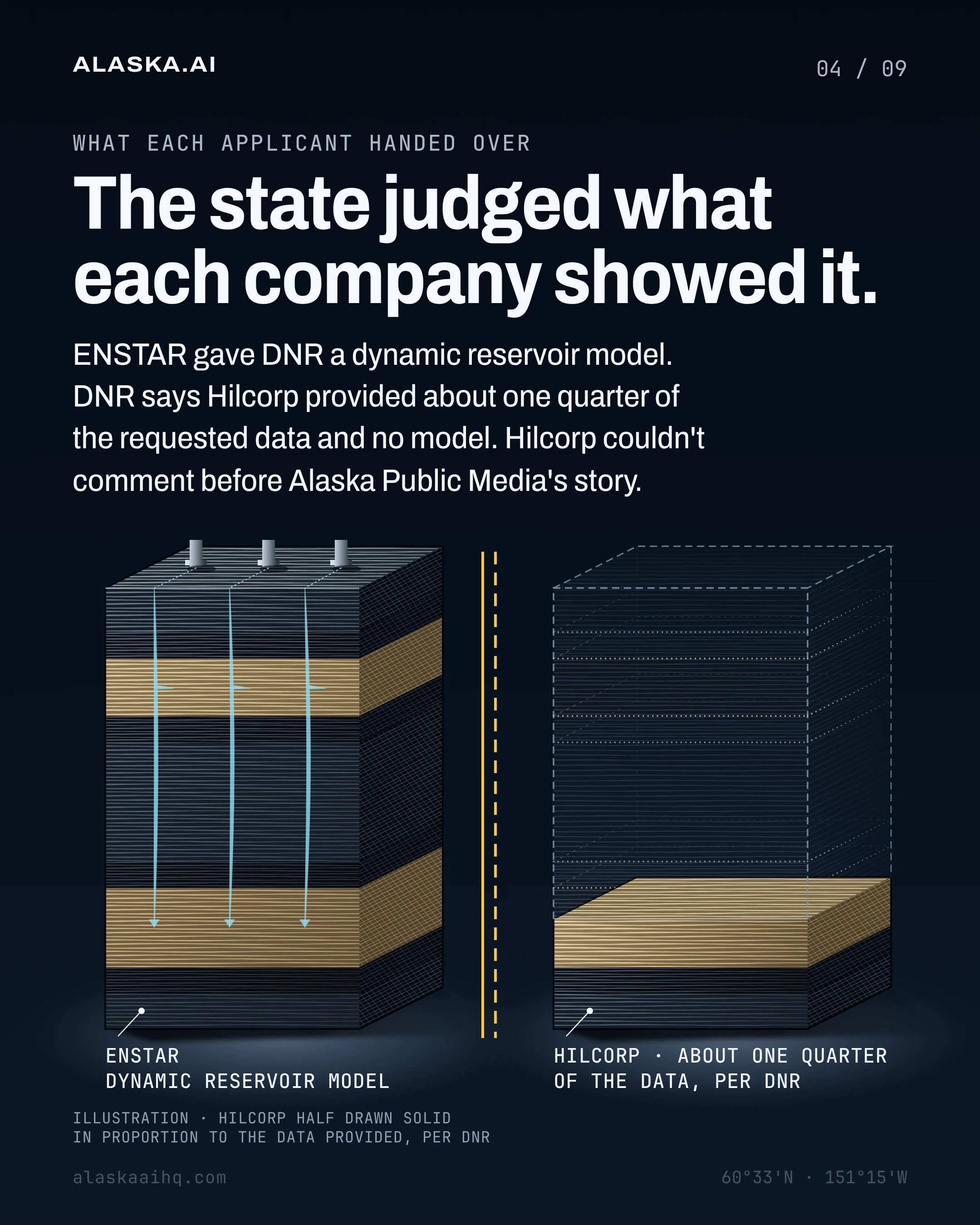
ENSTAR and Hilcorp want the Kenai Loop sands 8,600 to 10,500 feet below sea level for gas storage. By DNR's count Hilcorp gave about one quarter of the requested data and no dynamic model like ENSTAR's. DNR found ENSTAR's 3.9 Bcf estimate of gas left more reliable than Hilcorp's 6.4 and preliminarily favors ENSTAR. Evidence was the right test.
DNR asserts clear state authority over the pore space. City Manager Terry Eubank says Kenai owns it, on a Pioneer Law opinion. No model settles a deed.
Nothing is leased yet. Comments are due 5 p.m. November 13th.
Both estimates, each side's evidence, both plans and the pore space claim.
Will Kenai Loop store gas before the deed fight reaches court?
What we verified
74 CLAIMS, EACH RE-FETCHED FROM ITS SOURCE BEFORE THIS DECK SHIPPED
The Alaska DNR Division of Oil and Gas preliminarily found that leasing the Kenai Loop gas storage formation to ENSTAR would best serve the state's interest.
The preliminary written finding is dated October 13th.
ENSTAR filed its Kenai Loop gas storage lease application on May 7th.
Hilcorp filed its competing application for the same storage lease on May 11th.
Both applications sought to use the same reservoir for natural gas storage.
DNR said only one operator can feasibly develop and manage storage in a single subsurface reservoir.
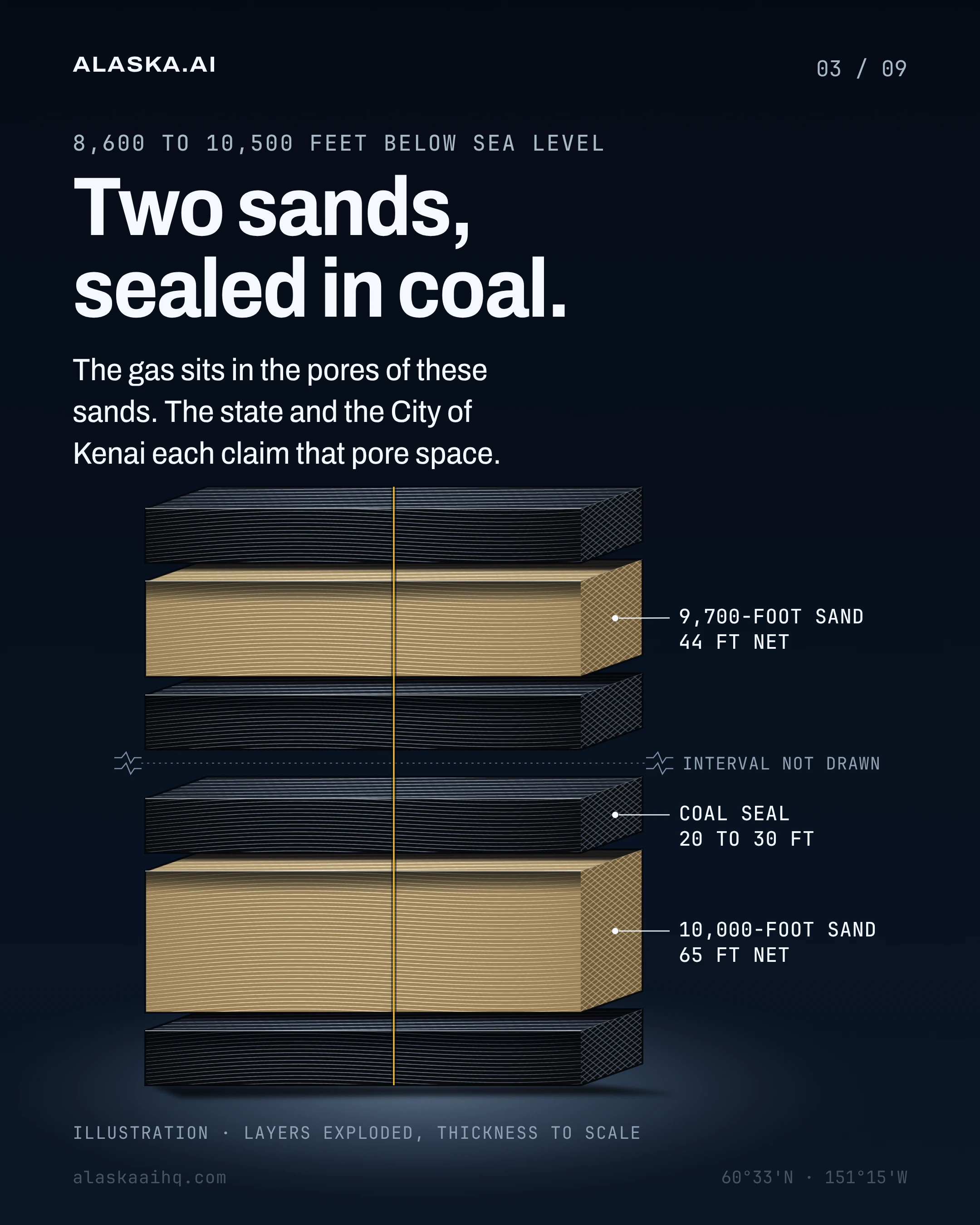
The storage formation lies in the Upper Tyonek Formation between 8,600 and 10,500 feet true vertical depth subsea.
The shallower 9,700-foot sand averages 44 feet of net reservoir thickness.
The deeper 10,000-foot sand averages 65 feet of net reservoir thickness.
Coal layers averaging 20 to 30 feet thick provide the seals that contain gas in the formation.
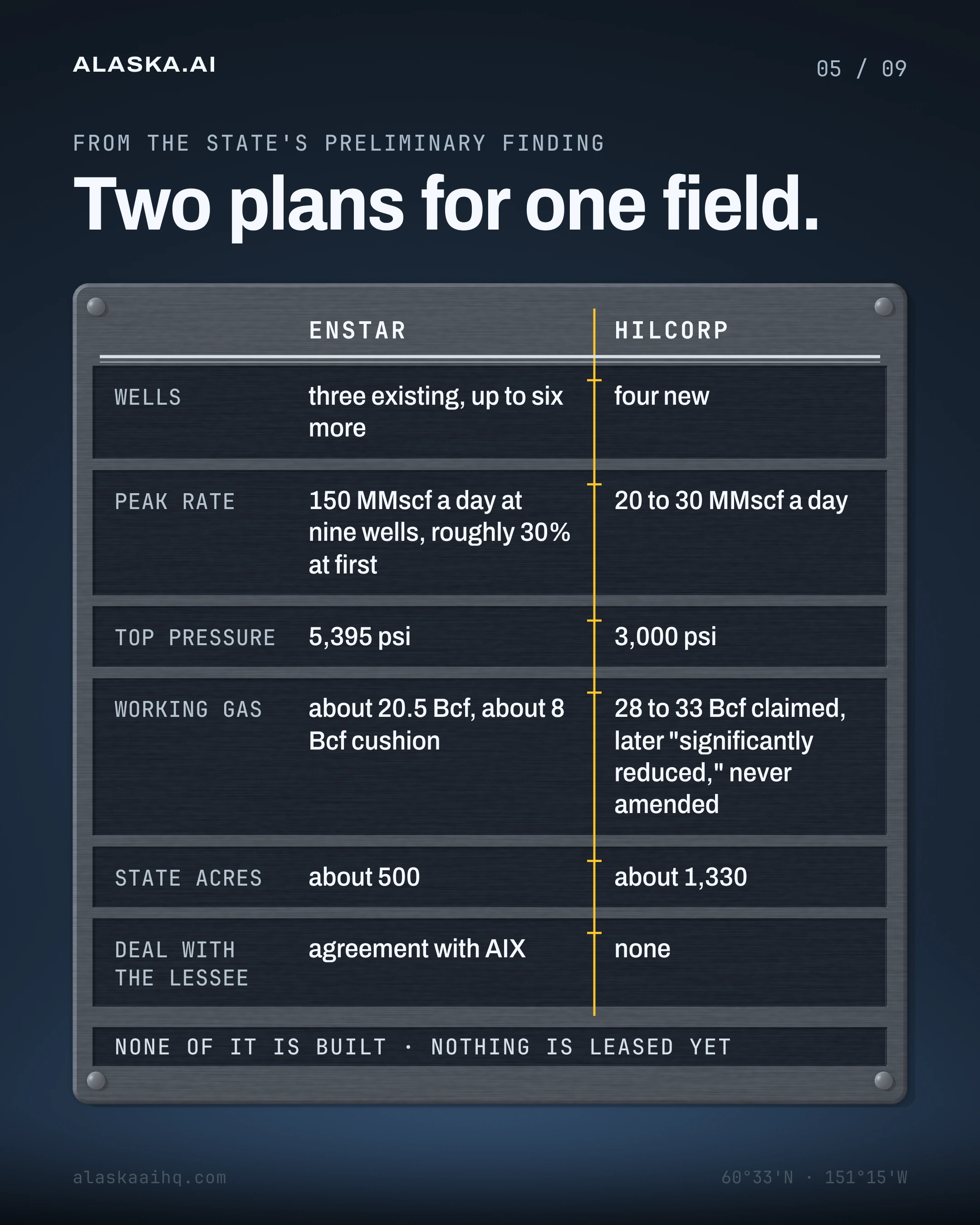
ENSTAR's proposed project area contains about 500 acres of state-owned mineral estate.
Hilcorp's larger proposed project area contains about 1,330 acres of state-owned mineral estate.
ENSTAR estimated about 3.9 billion cubic feet of native gas remains in the Kenai Loop reservoir.
Hilcorp estimated about 6.4 billion cubic feet of native gas remains in the reservoir.
DNR said Hilcorp's higher estimate relied on fewer pressure data points.
The Director concluded ENSTAR's remaining gas estimate is the more reliable one.
DNR said Hilcorp provided about one quarter of the requested data and information.
At a September 3rd technical meeting, Hilcorp told DNR it did not have a solid understanding of the reservoir geometry.
ENSTAR provided results of a dynamic reservoir model showing injection and production rates.
DNR said Hilcorp did not present a dynamic model.
Fully built out with nine wells, ENSTAR plans peak withdrawal and injection capacity of 150 million standard cubic feet per day.
In the initial three-well phase, ENSTAR's rates would be roughly 30 percent of full capacity.
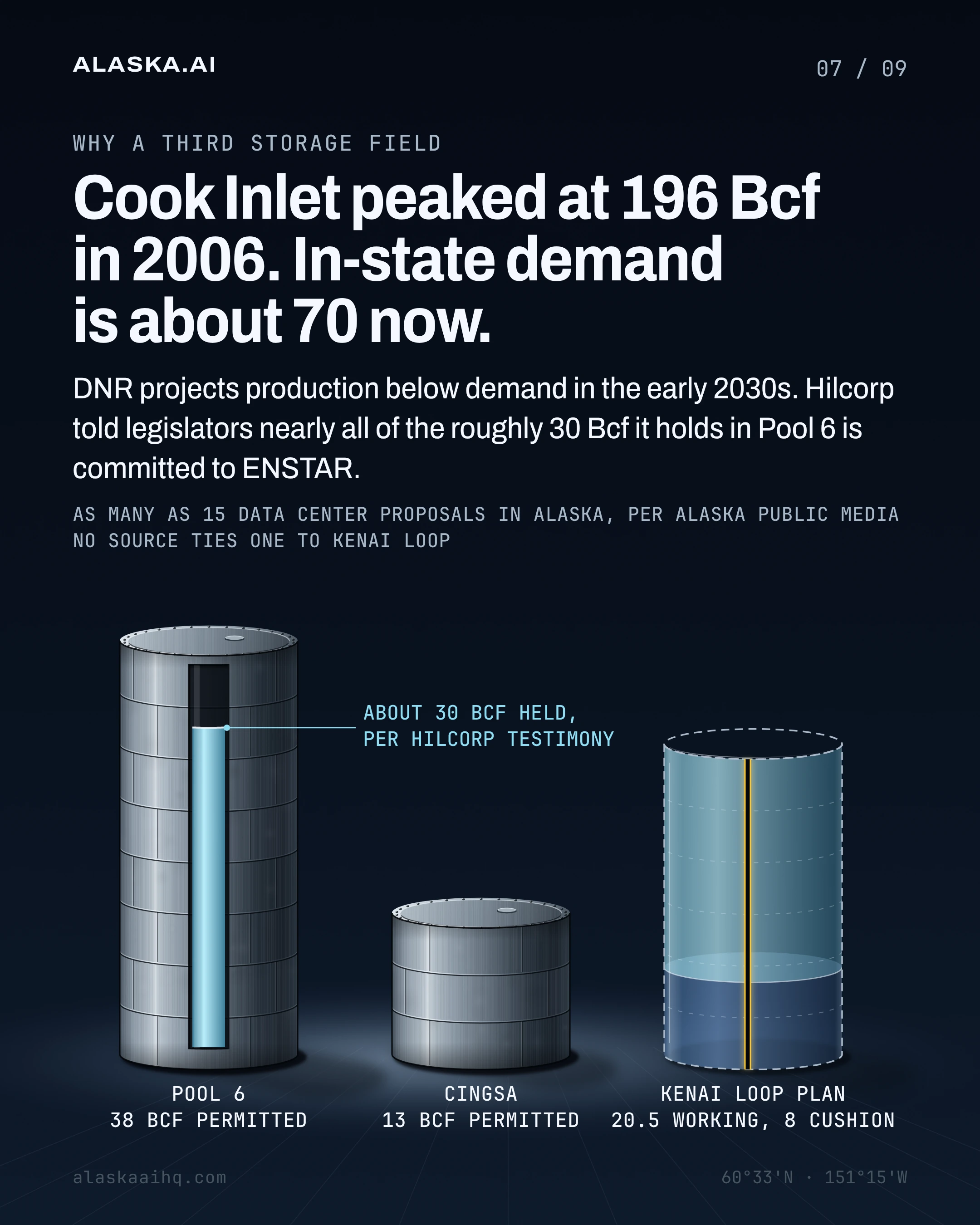
ENSTAR's total working gas volume would be about 20.5 billion cubic feet.
ENSTAR's plan would keep about 8 billion cubic feet of cushion gas in the reservoir.
ENSTAR proposes operating the field up to its discovery pressure of 5,395 pounds per square inch.
ENSTAR's initial plan reuses three existing wells, with up to six more possible in a later phase.
Hilcorp proposed drilling four new wells for its storage facility.
Hilcorp's initial application put its working gas volume at about 28 to 33 billion cubic feet.
Hilcorp's application listed a maximum withdrawal rate of 20 to 30 million standard cubic feet per day.
Hilcorp's application listed a maximum operating pressure of 3,000 psi.
Hilcorp proposed having its facility ready for commercial operation by late 2028.
At the September 3rd meeting Hilcorp presented significantly reduced working volumes but never amended its application.
Cook Inlet's two existing regulated gas storage facilities are permitted for about 38 and 13 billion cubic feet.
The two existing facilities have a combined delivery rate of about 345 million cubic feet per day.
Annual gas production in the Cook Inlet basin peaked at 196 billion cubic feet in 2006.
In-state demand for Cook Inlet gas is roughly 70 billion cubic feet a year.
A DNR forecast projects Cook Inlet production falling below regional demand beginning in the early 2030s.
Hilcorp testified on September 10th that it had about 30 billion cubic feet of gas stored in Kenai Pool 6.
Hilcorp said nearly all of that stored gas was committed to ENSTAR for later delivery.
ENSTAR told legislators the CINGSA storage facility had a significant well sanding incident on January 14th, 2024.
The federal government conveyed the oil and gas estate beneath the Kenai Airport to the state by Patent No. 50-86-0386 on August 25th, 1986.
DNR issued oil and gas lease ADL 391094 covering the Kenai Loop field effective October 1st, 2007.
Lease ADL 391094 comprises 1,048.640 acres.
The proposed gas storage lease is numbered ADL 394695.
ENSTAR's application presented an agreement with AIX, the current lessee, to acquire its interest for gas storage.
Hilcorp's application included no agreement with AIX, the existing lessee.
The Director found the state has clear authority over the pore space tied to its oil and gas estate and may authorize gas storage there.
DNR directed ENSTAR to negotiate a comprehensive surface use agreement with the City of Kenai.
DNR set the original gas in place in the storage formation at 32.5 billion cubic feet.
Under the proposed terms the lessee would pay a minimum annual fee of $10,000 plus $5,000 for each additional well drilled.
The lessee would also pay an annual volume fee of $0.012 per thousand standard cubic feet of non-native gas produced.
The preliminary finding is signed by Haley Paine, Director of the Division of Oil and Gas.
Public comments on the preliminary finding are due by 5 p.m. on November 13th.
The notice describes about 500 acres of state-owned subsurface storage reservoir in sections 32, 33 and 34 of Township 6 North, Range 11 West.
After reviewing comments the Director will make a final determination on the lease to ENSTAR.
DNR's finding says portions of the Kenai Loop oil and gas lease lie beneath the surface of the Kenai Airport, which the City of Kenai owns.
Kenai City Manager Terry Eubank wrote to DNR Commissioner John Crowther on October 7th about the ownership dispute.
The City of Kenai says it owns the reservoir pore space, citing an opinion from Pioneer Law LLC.
Eubank wrote there is a very real possibility of conflicting leases that could lead to lengthy and expensive litigation.
Eubank called the omission of disputed ownership from the preliminary recommendation misleading and detrimental.
The Kenai Loop gas field sits partially under the Kenai airport.
Cook Inlet's two other storage facilities, both in Kenai, have a combined capacity of around 52 billion cubic feet.
Two of CINGSA's wells failed in 2024, straining the rest of the facility.
Southcentral utilities expect natural gas demand to outpace supply.
ENSTAR has said it could fall 18 days short of supply this winter depending on temperatures.
Division of Oil and Gas director Haley Paine said ENSTAR presented the proposal DNR found to be in the state's best interest.
ENSTAR spokesperson Harley Hedlund said ENSTAR will continue working with DNR as it considers public comments.
Hilcorp was unable to comment before Alaska Public Media's October 16th story was published.
In July the Regulatory Commission of Alaska said in a 17-page order that ENSTAR had not provided enough information about its Kenai Loop storage project.
ADN reported the proposed ENSTAR facility would cost $240 million.
ADN reported in July that the facility would initially hold 25 billion cubic feet of gas.
Alaska has seen proposals for as many as 15 data centers.
Interior Secretary Doug Burgum told a Fairbanks audience on October 14th that people want to drop 10 billion on a data center without tax breaks.
Golden Valley Electric Association issued its first-ever energy emergency alert on Monday, October 12th.
Beats
This article is on Alaska power and the grid · Alaska land and permitting for AI. Each beat page keeps every decision and every article on that subject in one place.