Named in Writing, Answered in Writing
"We're going to file to intervene and oppose it, just so we have a position," AEA's chief said of the proposed Cook Inlet AI data center.
The deck
SWIPE, SCROLL OR CLICK A SLIDE TO GO FULLSCREEN · 9 SLIDES





The story
Curtis W. Thayer said it to a reporter on September 14th. On October 7th, with 26 days left to file, the Alaska Energy Authority signed a motion that takes no position.
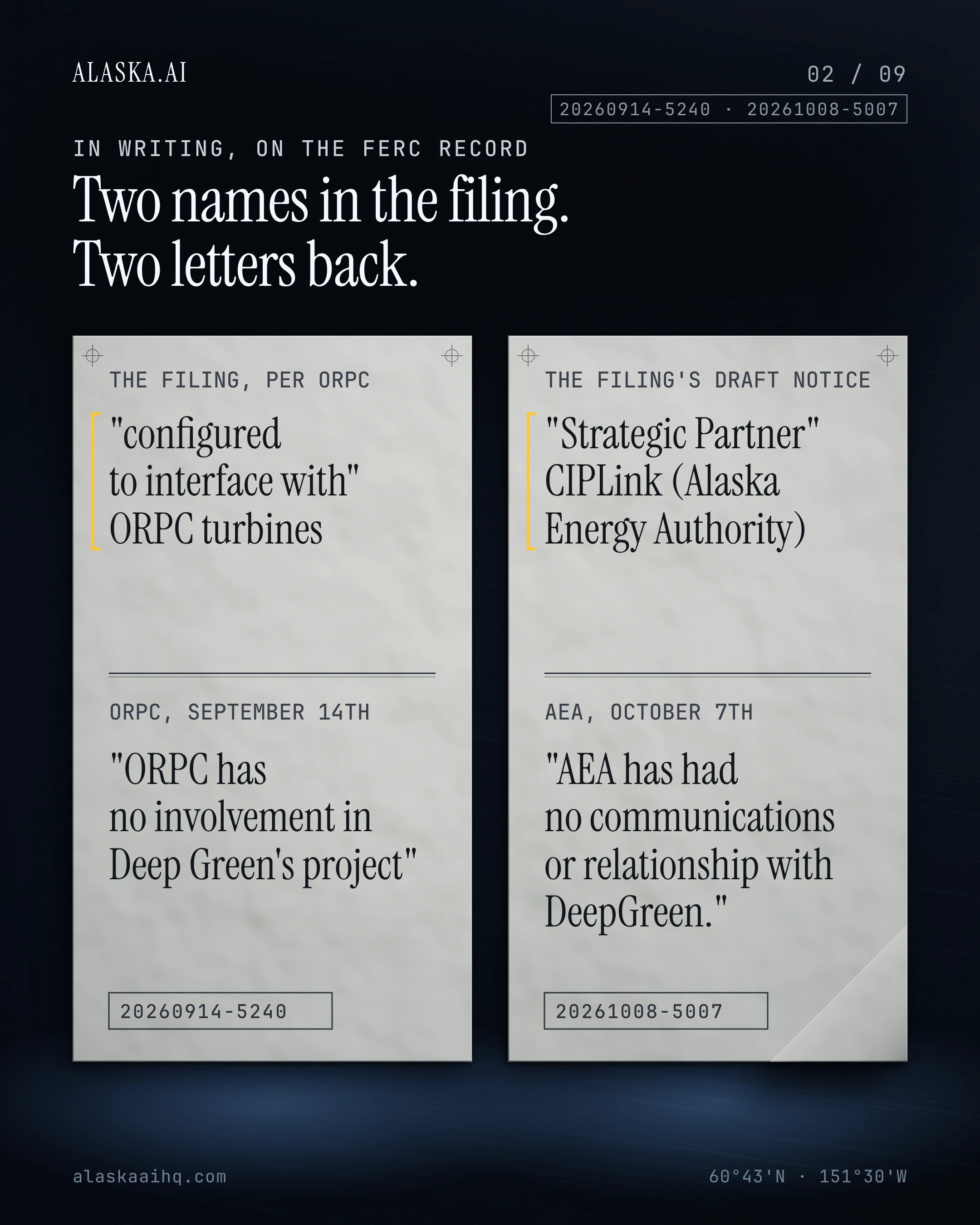
DeepGreen's application named AEA's CIPLink its "Strategic Partner." AEA told FERC it has had "no communications or relationship with DeepGreen."
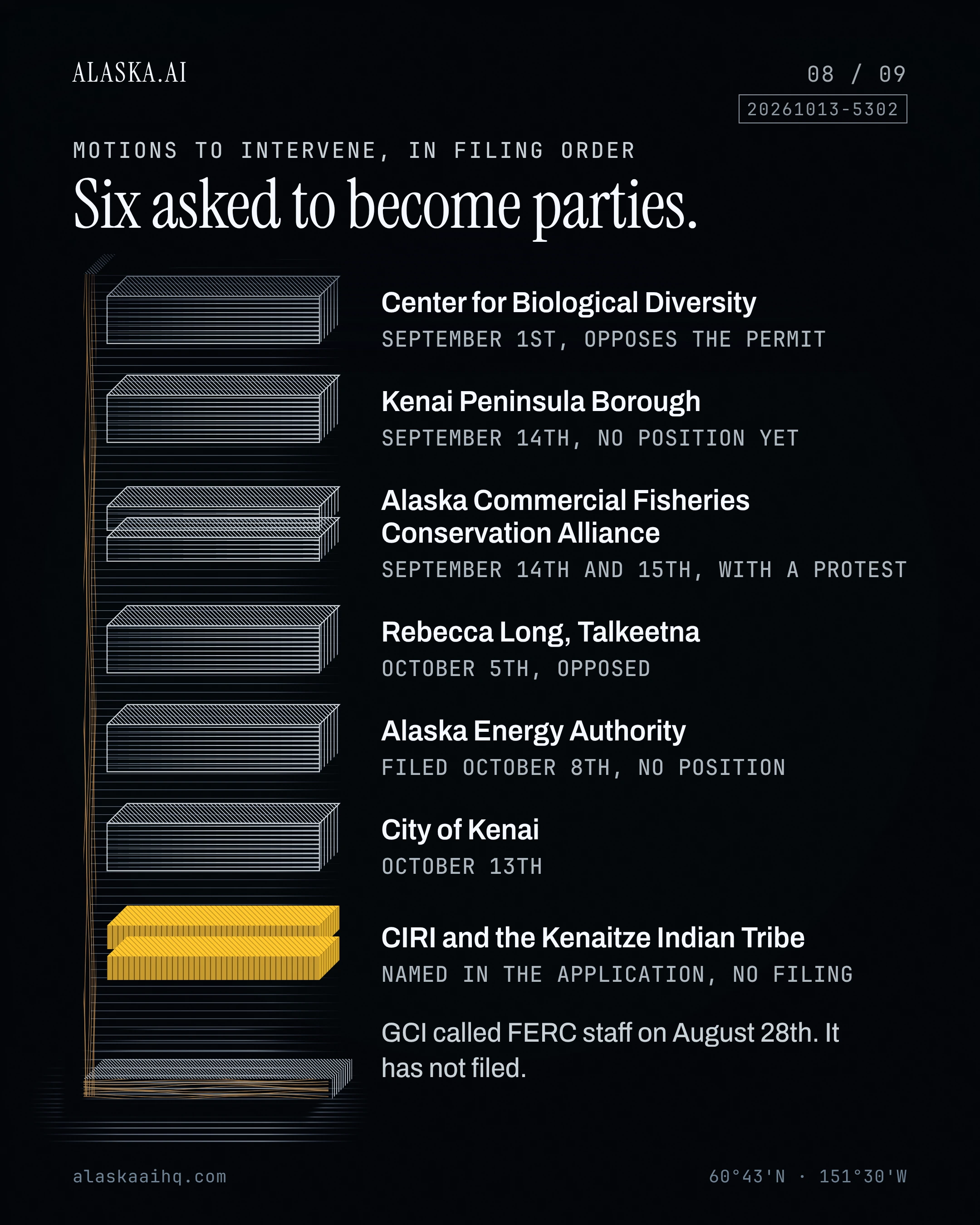
By October 22nd the docket held 134 filings. None came from CIRI or the Kenaitze Indian Tribe, named in the application as coordinating.
ORPC and AEA answer the lines that named them. The chief's words face AEA's motion, and the docket's 134 filings and six would-be parties follow.
Comments and motions close at 5 p.m. Eastern on November 2nd. What will AEA's filed position say by then?
What we verified
112 CLAIMS, EACH RE-FETCHED FROM ITS SOURCE BEFORE THIS DECK SHIPPED
DeepGreen Cook Inlet SPV LLC's application to FERC describes a 100.0 MW integrated tidal energy and subsea data center facility in Upper Cook Inlet, in the Nikiski and East Forelands corridor.
The application proposes about 330 to 350 marine hydrokinetic turbines.
The application proposes 66 modular pressure-vessel Hives that hold AI compute racks and are cooled by passive subsea immersion cooling.
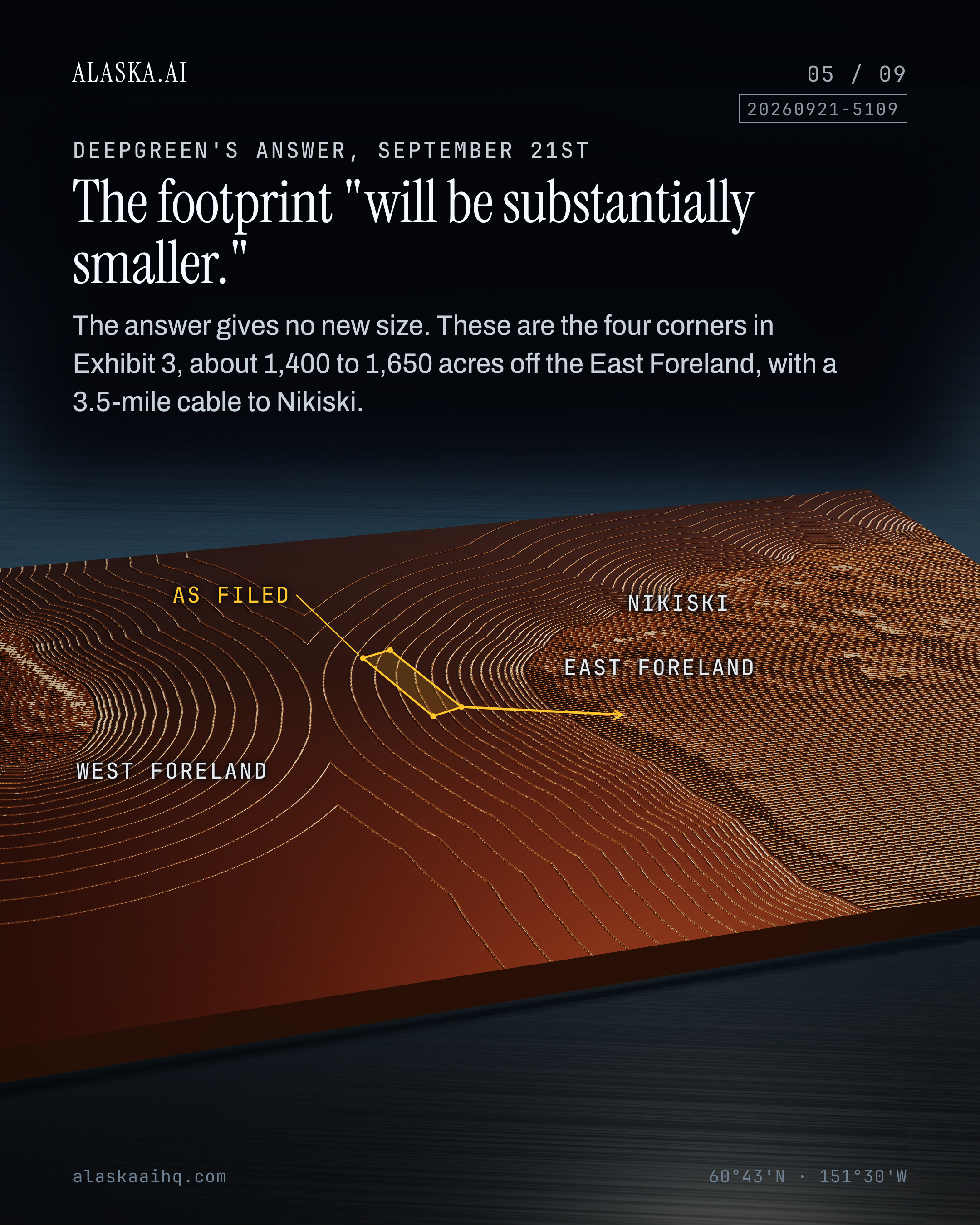
The application proposes a cable of about 3.5 miles, rated 115 kV, carrying both power and fiber optics from the hub to shore.
The application targets a cable landing on the Nikiski Industrial Corridor shoreline between the Agrium Kenai Nitrogen Operations and the Kenai LNG Plant.
Exhibit 3 of the application says the project boundary encloses about 1,400 to 1,650 acres centered on the deep-water Cook Inlet thalweg.
Exhibit 3 gives the project corners as 60°44'45" N 151°31'00" W, 60°45'00" N 151°29'45" W, 60°42'00" N 151°28'15" W and 60°41'45" N 151°29'30" W.
DeepGreen asked FERC for a 48-month permit term.
DeepGreen estimates its studies over the 48-month permit term would cost $4,500,000.
Phase I of the application's study schedule is agency and tribal consultation with NMFS and ADF&G, lasting 6 months.
Failing to file the required closeout information carries a $1,000 per day fine and a 5-year ban on applying for a commercial lease or land use permit.
Ordinance 2026-35 took effect immediately.
Rainmaker's own report says its drones released 19 flares carrying about 374.3 grams of silver iodide over the Kenai Peninsula on August 23rd.
Rainmaker's report estimates seeding produced a mean of 57.62 acre-feet of precipitation, a modeled figure from radar rather than a gauge measurement.
A FERC staff memo records an August 28th phone call with GCI Communication Corporation's senior corporate counsel about potential interests in the project, the preliminary permit process, and how GCI can comment.
Rebecca Long of Talkeetna, a personal use salmon fisher in the Susitna watershed, moved to intervene and stated that she is opposed to the project and the permit application.
Phase II of the study schedule is bathymetric and silt-scour modeling, lasting 12 months over months 6 to 18.
AEA's motion says it reserves the right to supplement, modify or clarify its position as more information becomes available.
DeepGreen's September 21st answer says the final footprint will be substantially smaller but gives no new size, acreage or boundary for it.
FERC's eLibrary lists the filings in P-15423 under accession numbers including 20260211-5060 for the application, 20260901-3051 for FERC's notice, 20260914-5240 for ORPC's comment, 20260921-5109 for DeepGreen's answer, 20261008-5007 for AEA's motion, 20261013-5302 for the City of Kenai's motion and 20261022-5150 for the last filing listed through October 22nd.
Phase III, the longest phase in the study schedule, is 24 months of baseline acoustic monitoring of beluga whales over months 12 to 36.
Phase IV of the study schedule is interconnection and CIPLink technical studies, lasting 12 months over months 24 to 36.
Phase V of the study schedule is preparation of the draft and final license application, lasting 12 months over months 36 to 48.
DeepGreen's cover letter says the project is designed to interface with the Alaska Energy Authority's Cook Inlet PowerLink, or CIPLink.
AEA describes CIPLink as its planned 38-mile, 200 MW high-voltage direct-current transmission line under Cook Inlet.
The application says the hub would serve as a firming load for CIPLink.
The filing summary in DeepGreen's draft notice lists CIPLink and the Alaska Energy Authority as its Strategic Partner.
DeepGreen's draft notice says the applicant is coordinating with CIRI and the Kenaitze Indian Tribe for environmental and cultural oversight.
The application's certificate of service lists the Kenaitze Indian Tribe and CIRI among seven recipients served by first-class mail on February 11th.
As listed on the FERC eLibrary docket for P-15423 on October 22nd, neither CIRI nor the Kenaitze Indian Tribe had a filing in the record.
ORPC told FERC it has no involvement in DeepGreen's project and has had no conversations with DeepGreen about integrating its turbines.
According to ORPC, a DeepGreen filing said the platform is configured to interface with ORPC's turbines.
The Alaska Energy Authority told FERC it has had no communications or relationship with DeepGreen.
AEA says it does not presently take a position for or against issuing the preliminary permit.
AEA's motion points out that DeepGreen's proposed notice identifies CIPLink and AEA as a Strategic Partner.
AEA says it owns the Sterling to Quartz Creek transmission line.
AEA says it holds capacity rights on the Soldotna to Sterling transmission line.
AEA says those lines and the Railbelt grid are critical to delivering power from the Bradley Lake Hydroelectric Project.
AEA's motion to intervene, signed by general counsel Mark Billingsley, is dated October 7th and was filed October 8th.
DeepGreen told FERC it has not executed, or claimed to have executed, a formal binding partnership, co-sponsorship or formal agency agreement with the Alaska Energy Authority.
DeepGreen says it conducted standard preliminary stakeholder and regulatory inquiries customary for early-stage projects.
DeepGreen says its references to ORPC were cited strictly as illustrative technical benchmarks.
DeepGreen confirms ORPC is not a co-applicant, sponsor, financial backer or binding project partner.
DeepGreen says the final operational array footprint will be substantially smaller than the study corridor in its filings.
DeepGreen's answer says the study work would be done during the three-year permit period.
DeepGreen told FERC that a preliminary permit confers zero development authority.
FERC's notice says the sole purpose of a preliminary permit is to give the holder priority to file a license application during the permit term.
FERC's notice says a preliminary permit does not authorize any land-disturbing activities or entry on others' lands or waters without permission.
The deadline for comments, motions to intervene and competing applications is 5 p.m. Eastern Time on November 2nd.
FERC's notice says anyone can submit a brief comment of up to 10,000 characters through eComment without registering first.
FERC's notice says the project's 100 megawatts would primarily power the subsea data center.
FERC's notice says spare electricity could go to the Alaska Railbelt grid through an interconnect at a dedicated terrestrial substation.
FERC's September 1st notice says DeepGreen filed its application February 11th and supplemented it June 26th.
FERC sent DeepGreen a deficiency letter on June 18th asking for more information within 45 days.
DeepGreen filed its response to the deficiency letter on June 26th.
FERC's September 1st letter told DeepGreen its application was accepted for filing as of June 26th.
According to the City of Eastport, FERC's June 18th deficiency letter said the application did not give dimensions or physical composition for the platform, turbines, docking cradle, hives or silt protection.
Eastport, Maine told FERC that DeepGreen is pursuing a very similar project there under docket P-15424, DeepGreen Western Passage SPV.
FERC's notice for the Eastport twin project, P-15424, describes up to 16 marine hydrokinetic turbine-generator units rated at 300 kilowatts each.
The Eastport City Council says the Commission's notice for the Maine project describes 34 subsea compute pods and about 1.5 miles of subsea power and fiber cable.
The Eastport City Council says it unanimously enacted ordinance provisions on September 9th prohibiting large-scale data centers, including underwater data centers, in the areas those provisions cover.
The Eastport City Council asked FERC to deny DeepGreen's preliminary permit application for the Maine project.
The Center for Biological Diversity told FERC there are fewer than 400 Cook Inlet beluga whales.
The Cook Inlet beluga population was listed as endangered under the Endangered Species Act in 2008.
NOAA Fisheries gives 331 whales as its best current abundance estimate for Cook Inlet belugas.
The Center for Biological Diversity says the underwater data center is proposed within the critical habitat of the Cook Inlet beluga whale.
The Center for Biological Diversity says NMFS considers Cook Inlet belugas one of nine marine species most at risk of extinction in the near future.
The Center for Biological Diversity told FERC it opposes the proposed preliminary permit.
The Kenai Peninsula Borough's motion describes the project as a proposed underwater AI data center.
The Kenai Peninsula Borough told FERC it does not take a position on the project at this stage.
The Alaska Commercial Fisheries Conservation Alliance says Upper Cook Inlet supports over 1,300 active limited entry commercial fishing permits.
The fishing alliance says the Upper Cook Inlet commercial fishery has historical annual revenues of about $9.5 million to $10 million.
The fishing alliance alleged that DeepGreen's application misrepresented its relationship with the Alaska Energy Authority.
The fishing alliance argues the project's 100 MW thermal load would equal about 341.2 million BTUs per hour of heat into Cook Inlet.
The fishing alliance says it was incorporated under Alaska law on September 10th, four days before it filed to intervene.
The alliance says its president filed under an emergency bylaw that allows FERC interventions without prior board approval.
The fishing alliance asserts that DeepGreen Cook Inlet SPV was incorporated in Delaware in January 2026, one month before it applied to FERC.
The fishing alliance filed a motion for leave to answer DeepGreen's September 21st answer on the same day.
The City of Kenai filed a motion to intervene in the DeepGreen proceeding on October 13th.
The City of Kenai acknowledges the project facilities in FERC's notice are not within the city's municipal boundaries.
The City of Kenai wrote that state analyses have identified declining available Cook Inlet gas supplies and a need for alternative energy sources for the Railbelt.
The City of Kenai wrote that the project could generate about 100 megawatts, with a portion potentially available to the Railbelt grid.
The City of Kenai told FERC that the project's potential effects on salmon migration and productivity are a legitimate municipal concern.
Talkeetna resident Rebecca Long moved to intervene on October 5th and said she opposes the project.
Rebecca Long's motion says the project's heat dissipation is projected at 876 gigawatt hours per year.
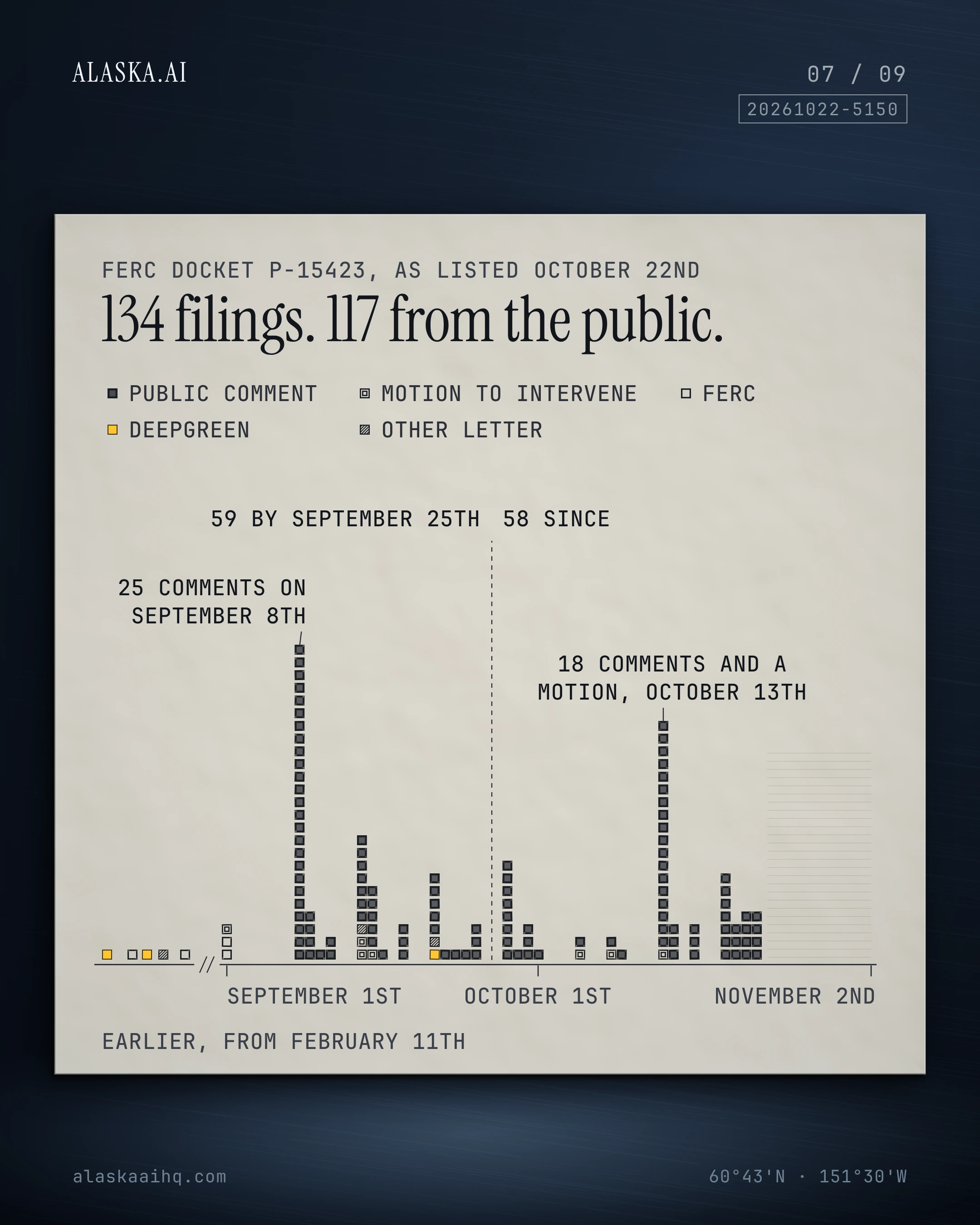
As listed on the FERC eLibrary docket at retrieval on October 22nd, P-15423 held 134 filings dated through October 22nd.
As listed on the docket at retrieval on October 22nd, 117 of those filings were individual public comments.
Of the 117 public comments, 59 were filed on or before September 25th and 58 after it.
Eighteen public comments were entered on October 13th, the most on any day since September 8th, and all 18 had been submitted over October 10th to 12th.
Twenty-five public comments were entered on September 8th, the busiest day on the docket.
Forty-two public comments were entered on the docket from October 13th through October 22nd.
As listed on the docket at retrieval on October 22nd, six parties had moved to intervene through seven motions.
FERC staff placed a memo on the docket recording an August 28th phone call with GCI Communication Corporation about the project.
In an Anchorage Daily News letter published October 19th, Rick Van Nieuwenhuyse of Fairbanks argued the data center should be built on land and its waste heat used for homes or hydroponic produce.
A change.org petition against the project, titled Stop the Underwater AI Data Center in Cook Inlet Beluga Habitat, was created on October 19th and showed 335 signatures when checked on October 23rd.
The Kenai Peninsula Borough Assembly enacted Ordinance 2026-35, as amended, on October 20th.
The assembly vote on Ordinance 2026-35 was 7 yes, 0 no, with 2 members absent.
Ordinance 2026-35 adds a new borough code section, KPB 17.10.165, on weather modification and geoengineering on borough lands, introduced by the mayor and assembly member Lenora Niesen.
The ordinance requires an application for a borough commercial lease or land use permit for weather modification to state the intended outcome and list the chemicals, flares, flight frequency and release coordinates.
The ordinance prohibits geoengineering and weather modification on borough lands open for casual use.
Mayor Peter Micciche told KDLL the borough's ability to limit weather modification and geoengineering is limited to borough lands for now.
KDLL reported that Alaska's Department of Natural Resources said cloud seeding is not addressed in state law and that it did not give Rainmaker permission.
Alaska Energy Authority chief executive Curtis W. Thayer told the Peninsula Clarion on September 14th that the authority would file to intervene and oppose the application.
Thayer also told the Clarion on September 14th that the authority had had no communication with DeepGreen.
Louis Wolfson told the Alaska Journal of Commerce in an email that a preliminary permit doesn't give DeepGreen permission to build anything.
Wolfson told the Alaska Journal of Commerce that a design putting the fishery or marine mammals at risk will never get licensed to operate.
Kenai Peninsula Borough Mayor Peter Micciche cited Cook Inlet's screaming eight-knot currents in doubting the project is viable.
Cooper Freeman of the Center for Biological Diversity told the Alaska Journal of Commerce the project just doesn't belong in the inlet.
As of early October, DeepGreen did not have a website or project page, the Alaska Journal of Commerce reported.
ACFCA president Russell Clark told the Alaska Journal of Commerce he first heard about the project through Facebook.
Micciche told the Alaska Journal of Commerce that borough leadership had heard from DeepGreen and scheduled plans to meet.
KUAC reported that Alaska has seen proposals for as many as 15 data centers.
Beats
This article is on Alaska data centers · Alaska power and the grid · Alaska land and permitting for AI. Each beat page keeps every decision and every article on that subject in one place.