The Sky Has No State Rule. The Ground Does Now.
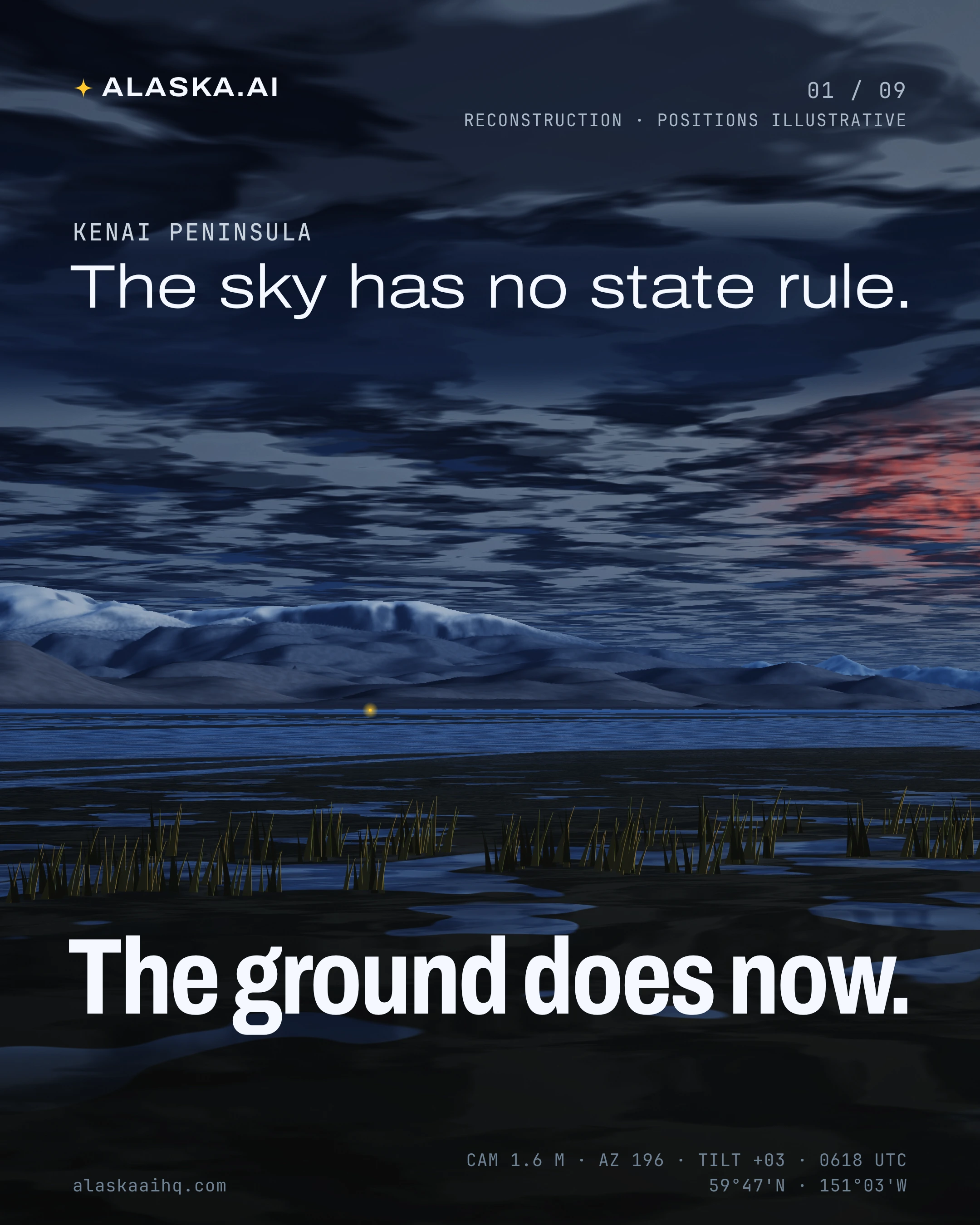
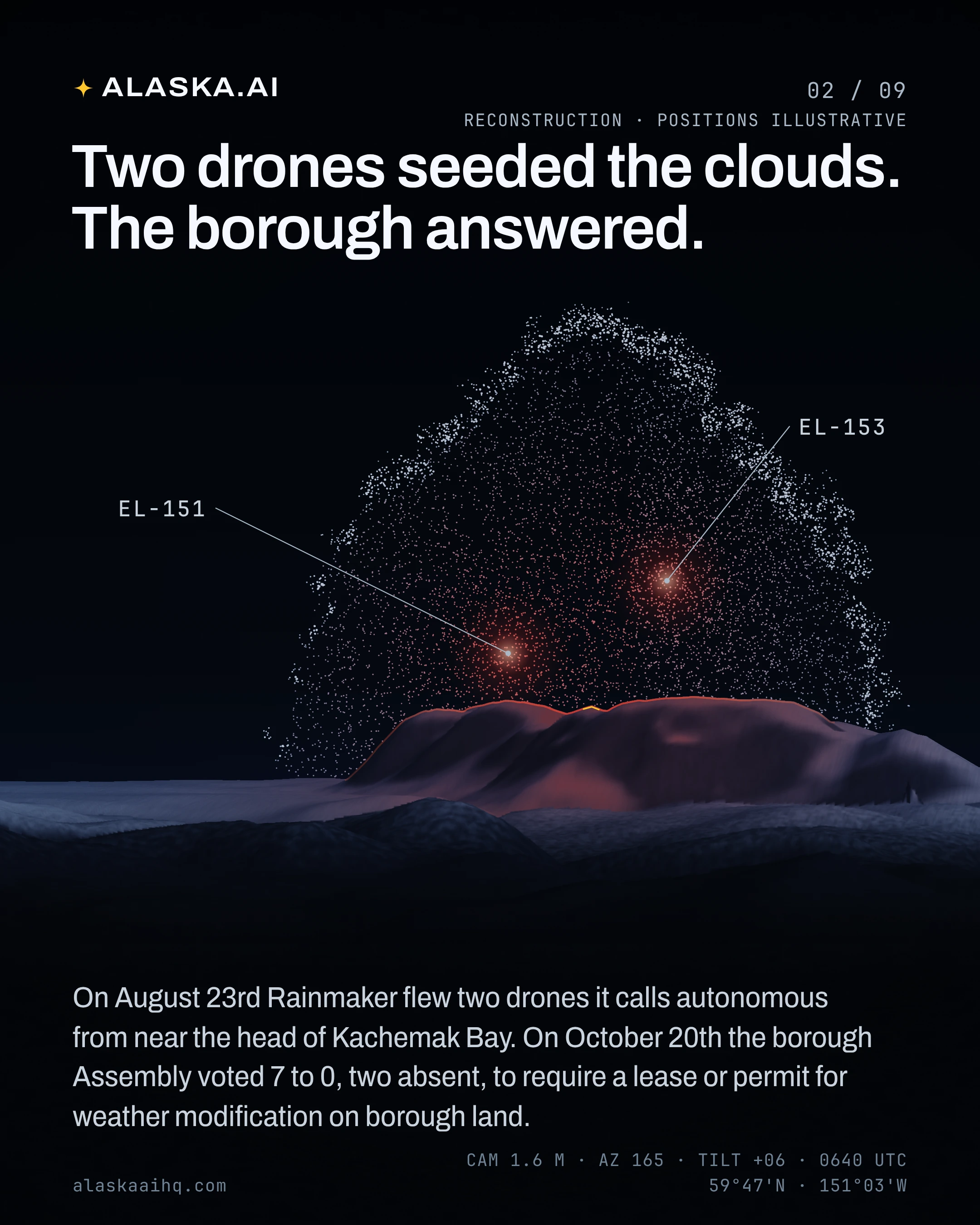
Drones seeded clouds over Kachemak Bay on August 23rd. On October 20th the Kenai Peninsula Borough's pending seeding rule passed 7 to 0.
The deck
SWIPE, SCROLL OR CLICK A SLIDE TO GO FULLSCREEN · 9 SLIDES

The story
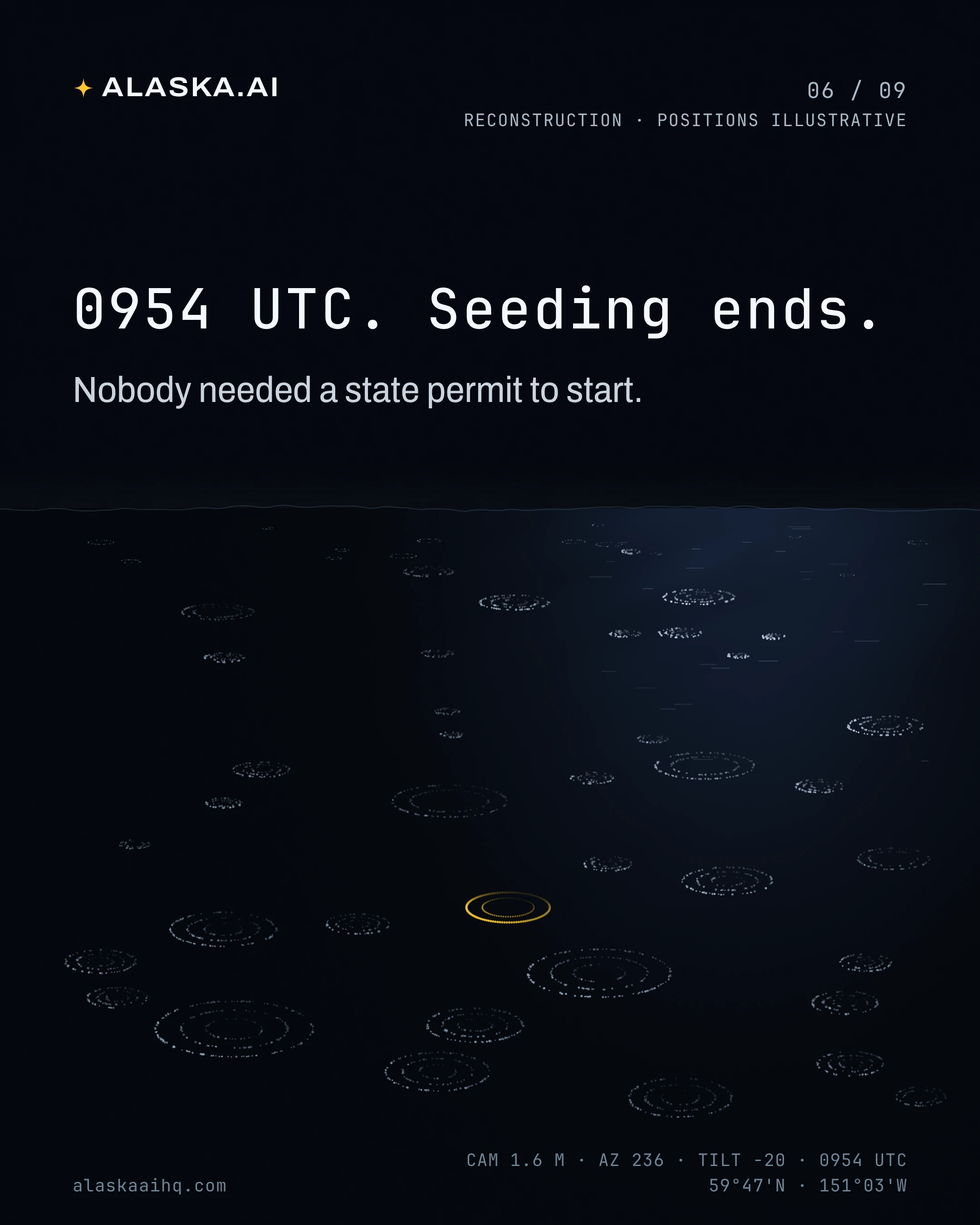
In the sky, two drones Rainmaker calls autonomous released 19 flares with about 374 grams of silver iodide. On the ground, the borough found out from Rainmaker's press release.
In the sky, no state rule applies and no DEC permit was needed. On the ground, seeding from borough land needs a lease or permit and ten disclosures down to each flare's serial number.
Inside are the night of the flights, the payload, a radar estimate against a rain gauge, each government's own words and the ten-line form.
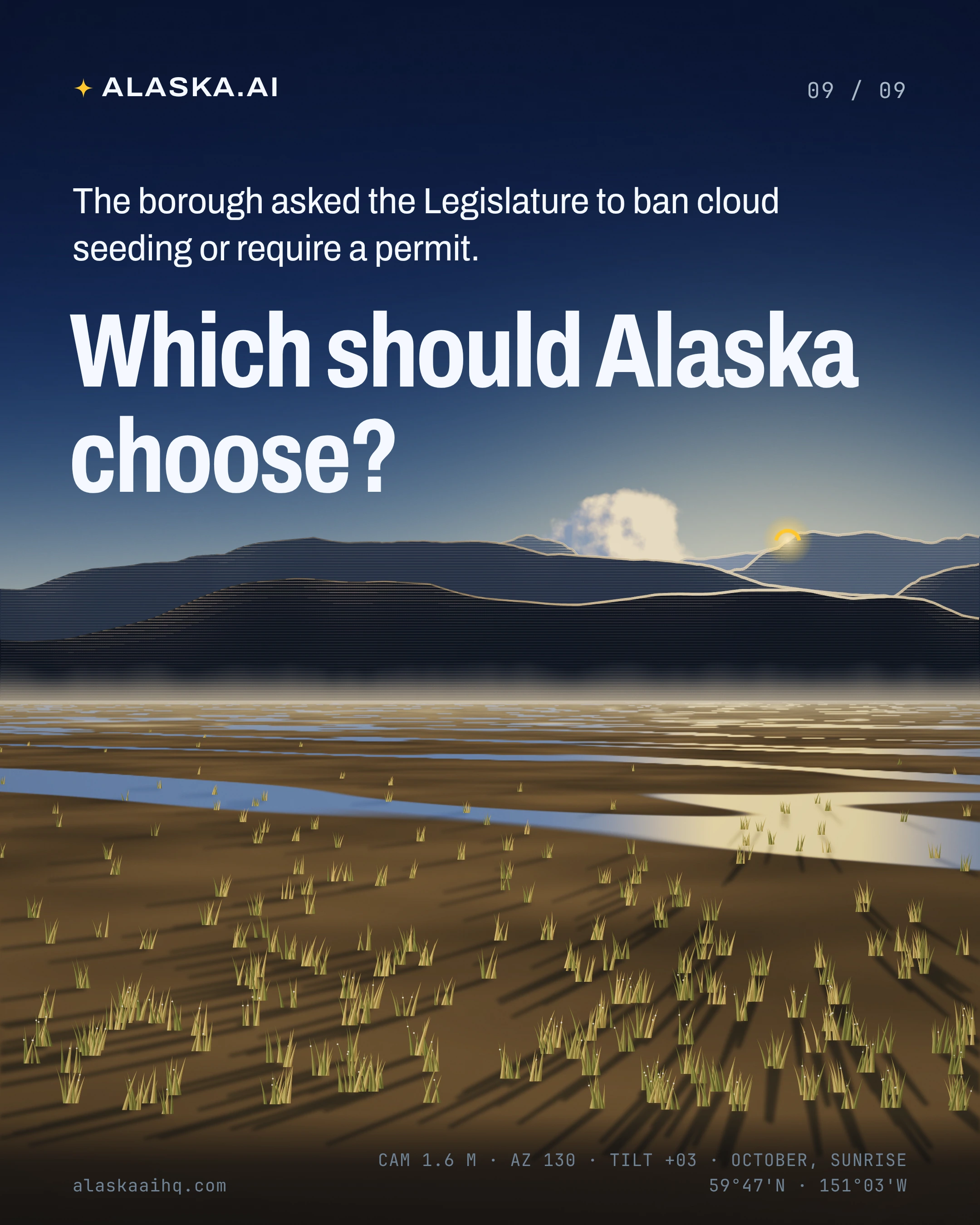
The borough asked the Legislature to ban cloud seeding or require a permit. Its ten disclosures are the right start. Should a state permit stop at those ten or need a yes from the borough under the flight?
What we verified
73 CLAIMS, EACH RE-FETCHED FROM ITS SOURCE BEFORE THIS DECK SHIPPED
The Kenai Peninsula Borough Assembly enacted Ordinance 2026-35 on October 20th.
The ordinance passed with 7 votes in favor, none against and 2 members absent.
Assembly members Berga, Cooper, Ecklund, Eicher, Niesen, Truesdell and Tunseth voted yes on the ordinance.
Assembly members Willy Dunne and Brent Hibbert were absent for the vote.
The Assembly first passed Niesen's motion to amend the ordinance and then passed Truesdell's motion to enact it as amended.
The October 20th Assembly meeting started at 6 p.m. in the Betty J. Glick Assembly Chambers.
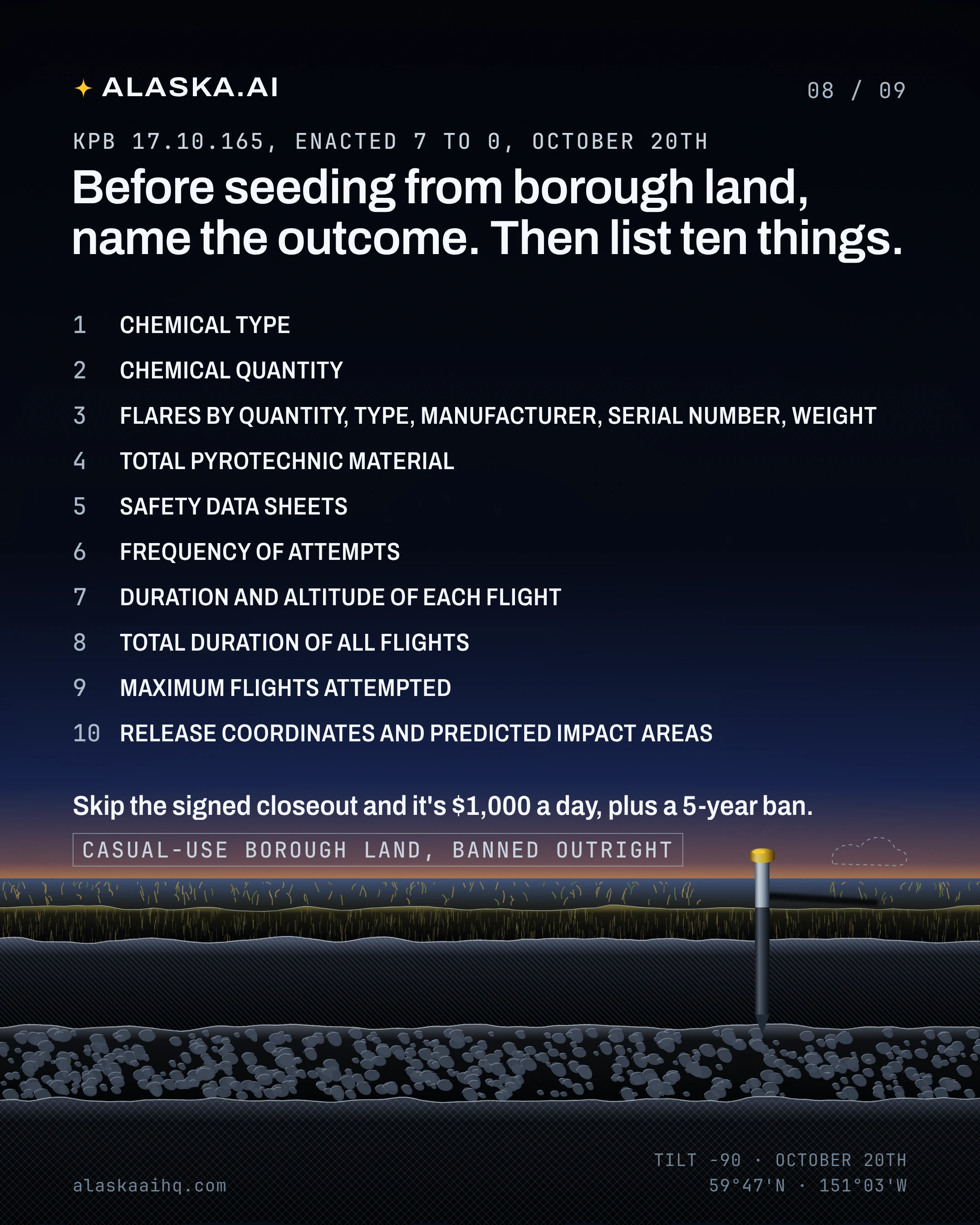
Ordinance 2026-35 adds a new section, KPB 17.10.165, to the borough code.
The new section governs applications for a commercial lease or commercial land use permit to use borough land for weather modification or geoengineering.
Applicants must state the intended outcome of the proposed weather modification or geoengineering activity.
An application must include 10 listed items of information.
Applicants must list the quantity, type, manufacturer, serial number and total weight of any flares.
Applicants must name the type and quantity of chemicals they will use and supply an MSDS for any material to be released.
Applicants must give release coordinates, including predicted impacted areas.
The ordinance prohibits weather modification and geoengineering on borough lands open for casual use.
The ordinance defines weather modification and geoengineering to include cloud seeding, solar radiation modification and stratospheric aerosol injection.
To close out a lease or permit after approved activities, the operator must file a signed confirmation summary statement with supporting documentation.
Failing to provide the required closeout information carries a fine of $1,000 for each day it is not provided.
Failing to provide the closeout information also brings a 5-year ban on applying for a commercial lease or commercial land use permit.
A memo dated October 8th from Assembly member Len Niesen and Mayor Peter Micciche proposed the amendment requiring applicants to identify the intended outcome.
Ordinance 2026-35 takes effect immediately.
Mayor Micciche and Assembly member Niesen introduced the ordinance on September 15th.
A borough legal memo says the ordinance was brought in response to commercial cloud seeding in the borough on August 23rd.
According to the borough legal memo, Rainmaker's press release was the first notice the borough received that drones carrying weather modification payloads were operating within it.
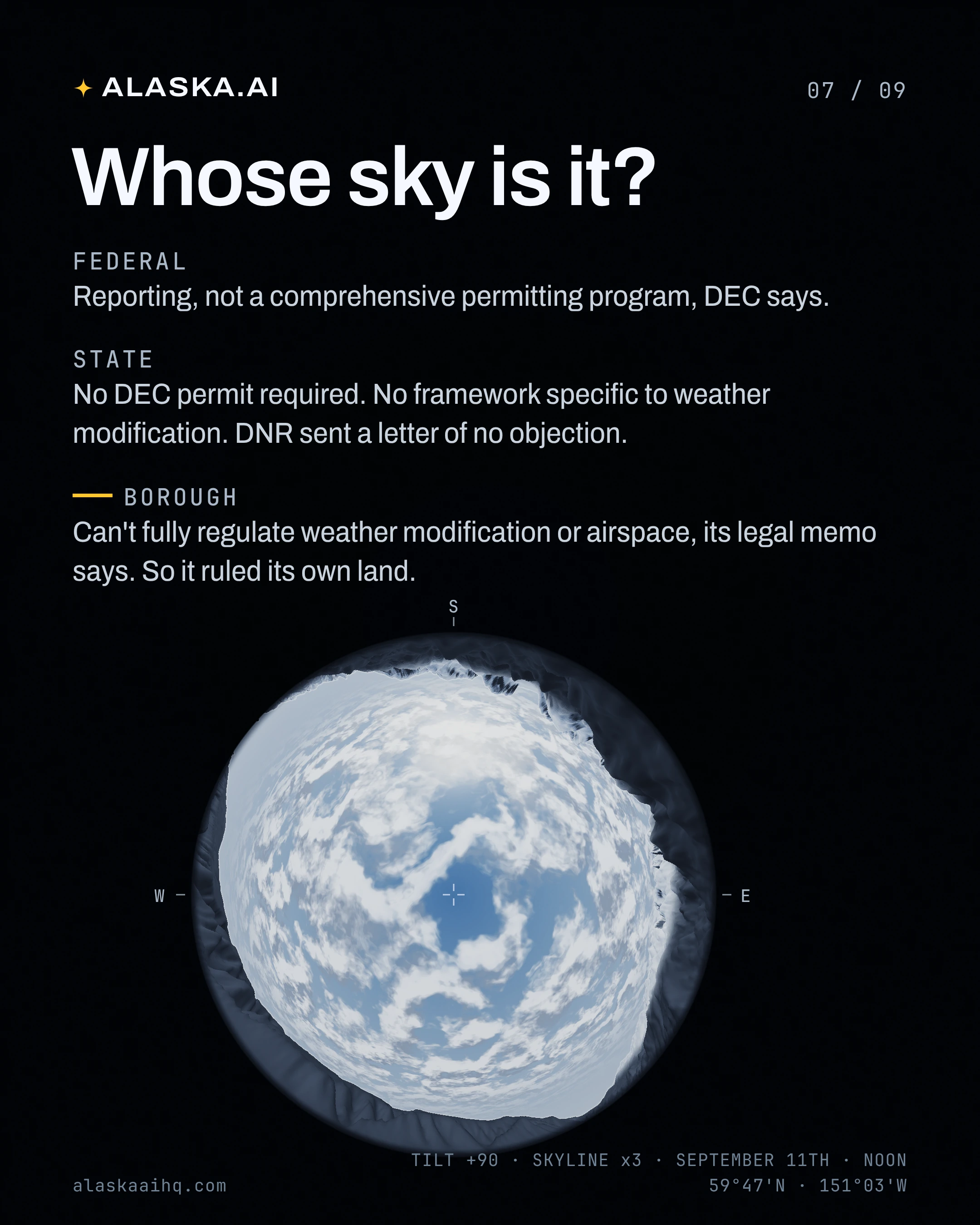
The borough legal memo says that as a second-class borough, Kenai Peninsula Borough lacks authority to fully regulate weather modification or airspace rights.
On September 15th the Assembly adopted Resolution 2026-046 by 7 votes to 0, with 2 absent.
Resolution 2026-046 urges the Legislature and the Governor to ban weather modification and geoengineering or, as an alternative, to require a permit for it.
The resolution asks Alaska's congressional delegation to review federal law to strengthen notice, reporting and approval requirements before such activities take place.
The resolution states that Rainmaker used at least 19 red flares released by drones without giving borough officials specific notice.
The resolution says federal law requires notice to the FAA and NOAA before weather modification, but that information is not shared with affected municipalities beforehand.
The resolution cites Tennessee's 2024 law and Florida's 2025 law as state bans on weather modification and geoengineering.
Alaska DEC Commissioner Randy Bates wrote that no DEC permit is currently required solely for cloud seeding.
The DEC letter states that Alaska has no regulatory framework specific to weather modification.
DEC said it had not identified evidence that Rainmaker's Kenai Peninsula activities caused an adverse impact to human health or the environment.
DEC describes the federal Weather Modification Reporting Act as setting reporting requirements, not a comprehensive federal permitting program.
According to the DEC letter, Rainmaker's technical report states that 19 flares dispersed about 374 grams of silver iodide.
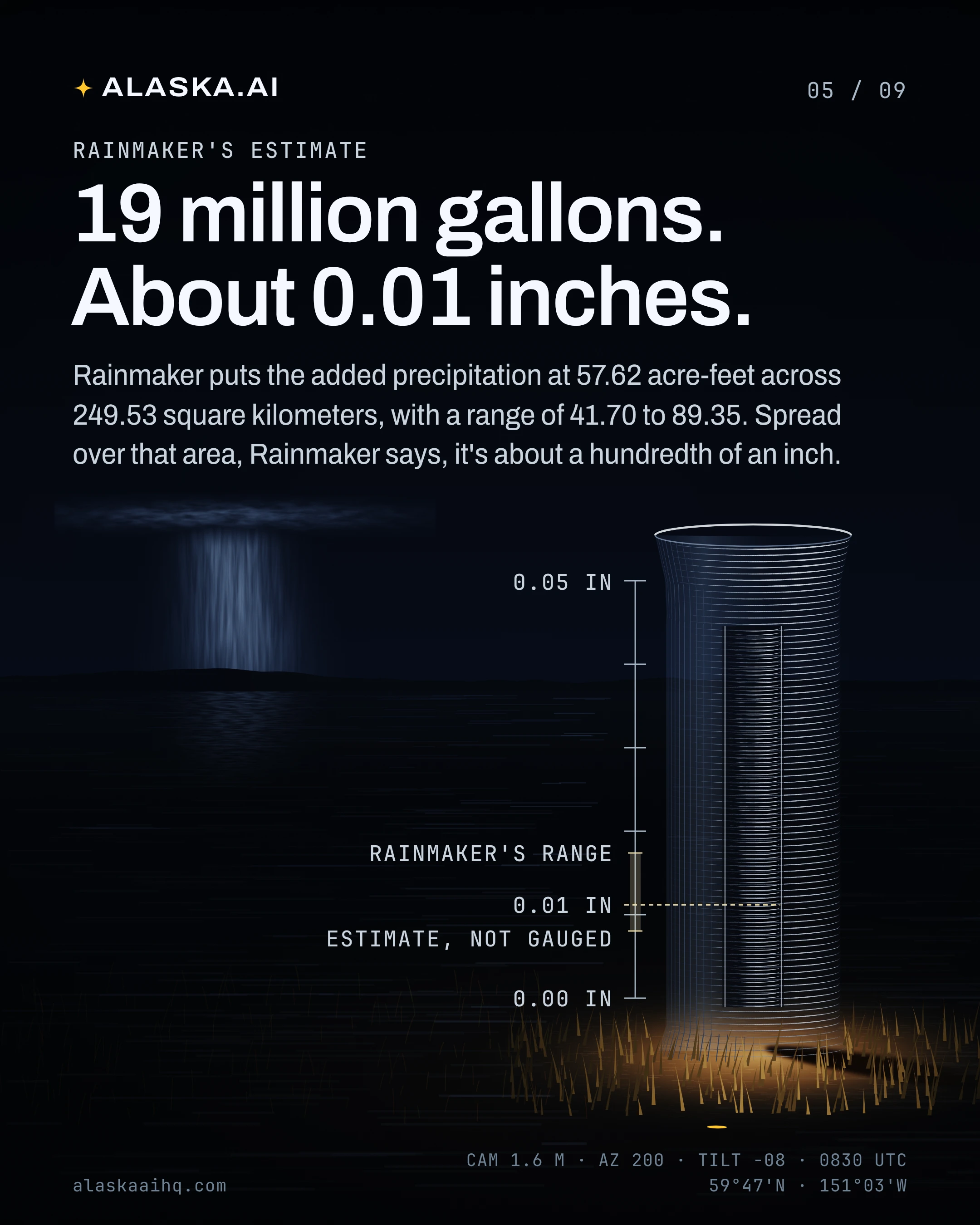
DEC notes that Rainmaker says its estimated 57 acre-feet, or about 19 million gallons, corresponds to about 0.01 inches of precipitation across the area.
According to the DEC letter, Rainmaker received a letter of no objection from the Alaska Department of Natural Resources before its Alaska activities.
DEC says Rainmaker acknowledged that communicating with state officials and legislators before its operations would have been appropriate.
DEC says Rainmaker represented that it operates under permitting or licensing frameworks in Colorado, Utah, Idaho, Oregon and Texas.
Rainmaker's technical report says it executed seven coordinated seeding missions over a three-hour period.
Rainmaker's report says drones EL-151 and EL-153 released 19 red flares across the seven missions.
Rainmaker's report says each flare dispersed about 19.7 grams of silver iodide, about 374.3 grams in total.
Rainmaker estimates the mean precipitation attributable to its seeding at 57.62 acre-feet.
Rainmaker's report gives a 5th to 95th percentile range of 41.70 to 89.35 acre-feet around its estimate.
Rainmaker's report puts the focused seeding period at 0618 to 0954 UTC on August 23rd.
Rainmaker's report says the area of seeded precipitation above 0.01 mm covered 249.53 square kilometers.
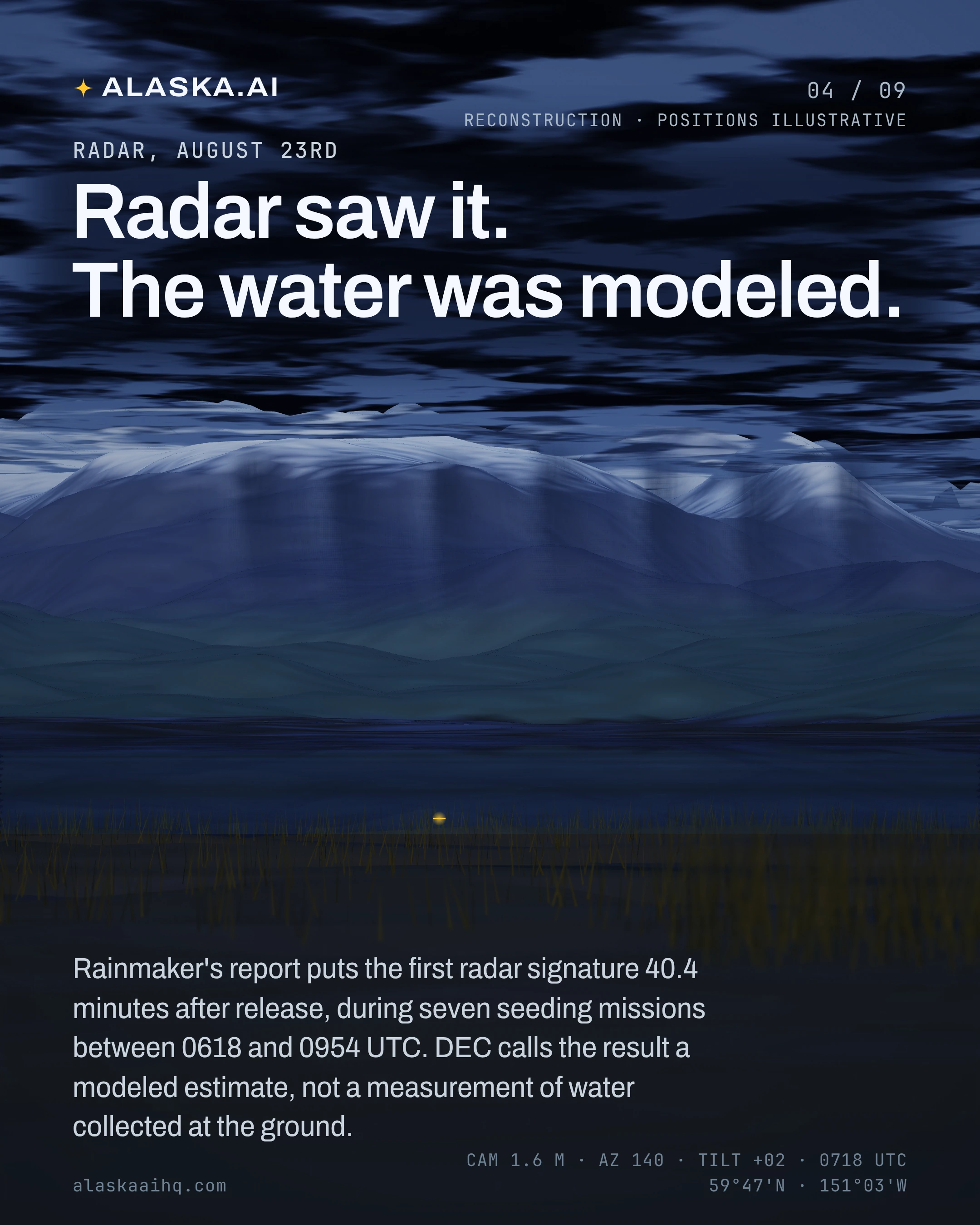
Rainmaker's report says the first radar seeding signature appeared 40.4 minutes after release.
Rainmaker's results post says the operation generated about 19 million gallons of water in three hours.
Rainmaker describes its Elijah drone as the first sub-55-pound UAV capable of autonomous, sustained high-altitude flight through severe icing.
Rainmaker petitioned the FAA for an exemption from 14 CFR section 107.36 in federal docket FAA-2025-1630.
The Anchorage Assembly continued debate on the mayor's substitute AO 2026-108(S) on October 20th until the end of the meeting without a final vote.
Debate on AO 2026-108(S) is scheduled to continue at the November 4th Regular Assembly Meeting under Unfinished Business.
Mayor Suzanne LaFrance sponsored the substitute AO 2026-108(S).
Assembly members McCormick and Scout and Vice Chair Volland sponsored both the original AO 2026-108 and the competing substitute AO 2026-108(S-1).
AO 2026-108 would regulate the city's use of surveillance technology, including automated license plate readers, real-time crime center operations and live camera monitoring.
Five draft amendments were published for the Assembly's October 14th worksession on AO 2026-108, one from member McCormick and four from Chair Brawley.
Item 4 of the application list is the total pyrotechnic material used.
Items 6 to 9 ask for the frequency of activities, the duration and altitude of individual flights, the total duration of all flights, and the maximum flights that will be attempted.
DEC says precipitation enhancement estimates are modeled estimates, not the same as a direct measurement of water collected at the ground.
Mayor Peter Micciche said the borough's ability to limit weather modification is confined to borough lands for now.
Micciche told KDLL that the FAA controls the skies.
Rainmaker CEO Augustus Doricko says the company received all applicable permits and permissions for the operation.
The FAA issued Rainmaker an exemption to drone flight rules, and a decision document was posted to the FAA docket on February 2nd.
The company launched its drones from two sites near the head of Kachemak Bay.
Rep. Sarah Vance of Homer says she will sponsor a bill establishing clear guidelines for weather modification if re-elected.
Flock began installing license plate reader cameras in Anchorage for a private customer in early October, according to a Flock spokesperson.
Interior Secretary Doug Burgum spoke at a Fairbanks Chamber of Commerce event on October 14th.
Burgum said people want to spend 10 billion on a data center in the area without tax breaks.
Golden Valley Electric Association issued its first-ever energy emergency alert on Monday, October 12th, urging conservation until Wednesday morning.
Gwen Holdmann wrote that GVEA's older diesel turbines at North Pole supplied about 3 percent of its electricity in 2014.
Holdmann wrote that by 2025 those diesel turbines supplied 15 percent of GVEA's electricity.
Holdmann wrote that GVEA's economy-power purchases from Southcentral have fallen to essentially zero since early 2025.
Holdmann wrote that the intertie carried roughly 540,000 megawatt-hours in 2014.
Beats
This article is on Alaska land and permitting for AI · Alaska AI policy and legislation. Each beat page keeps every decision and every article on that subject in one place.