96 Trillion Cubic Feet, No Way to Market
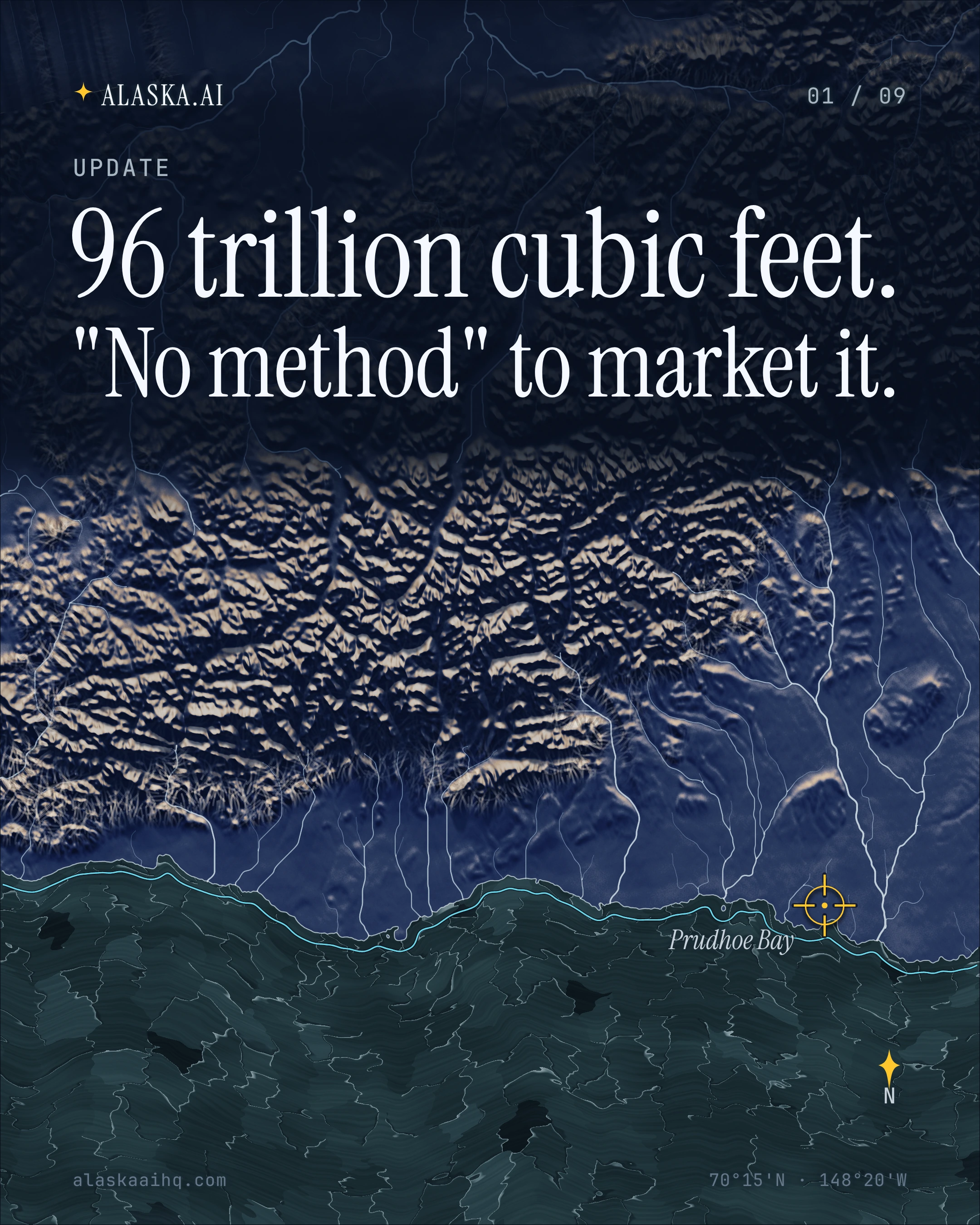
The USGS counts a mean 96 trillion cubic feet of undiscovered North Slope gas. The same fact sheet says it has no route to market at scale.
The deck
SWIPE, SCROLL OR CLICK A SLIDE TO GO FULLSCREEN · 9 SLIDES

The story
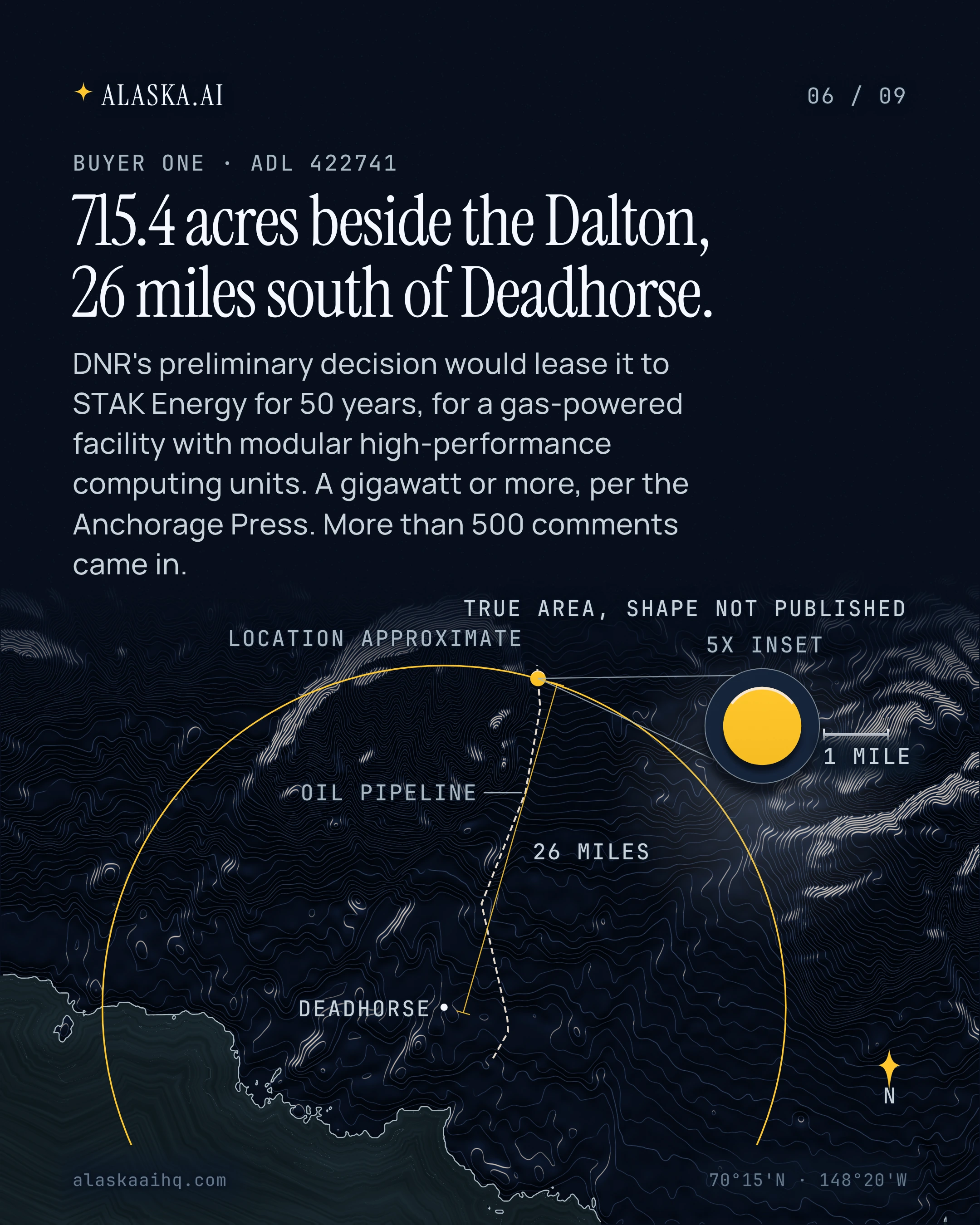
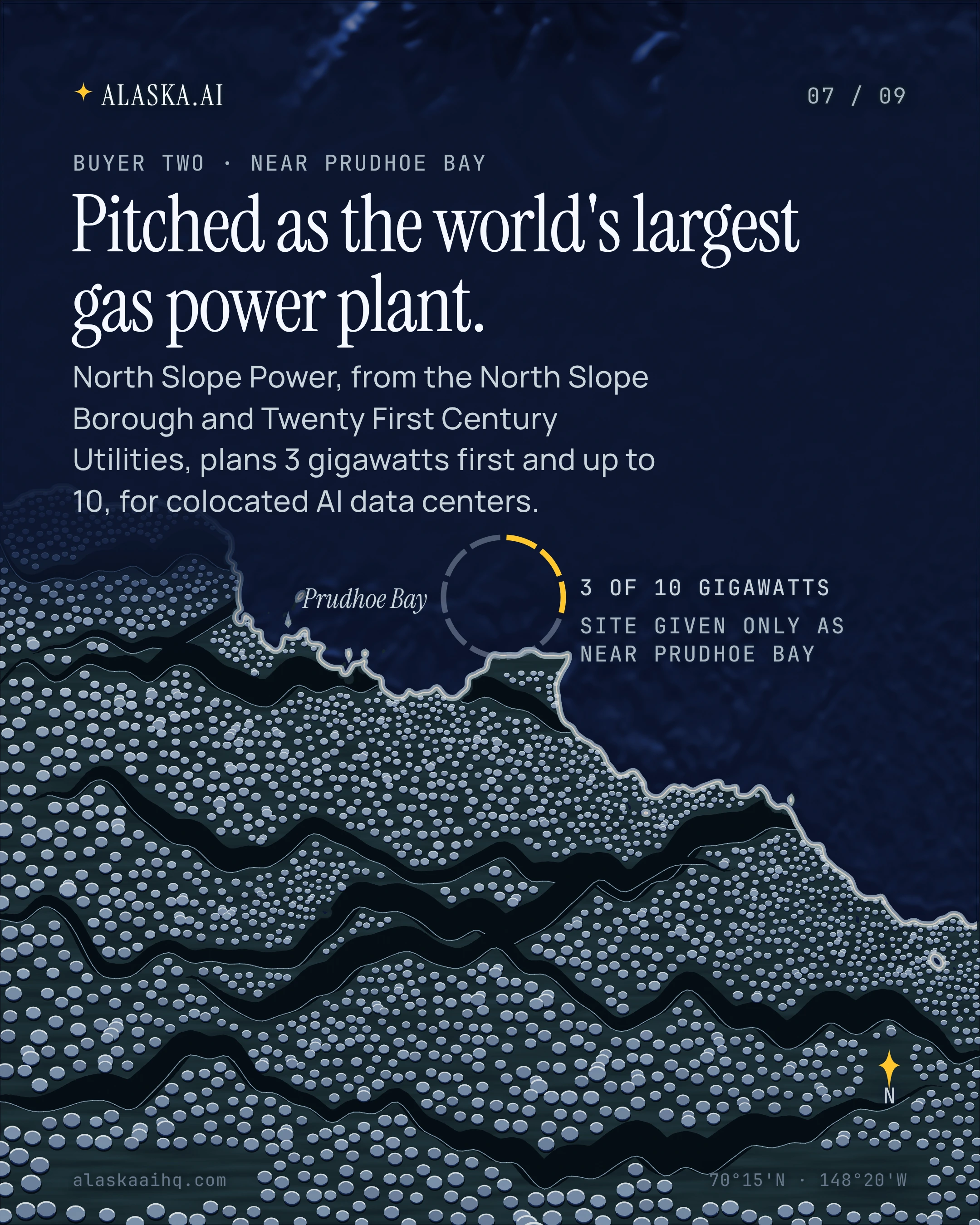
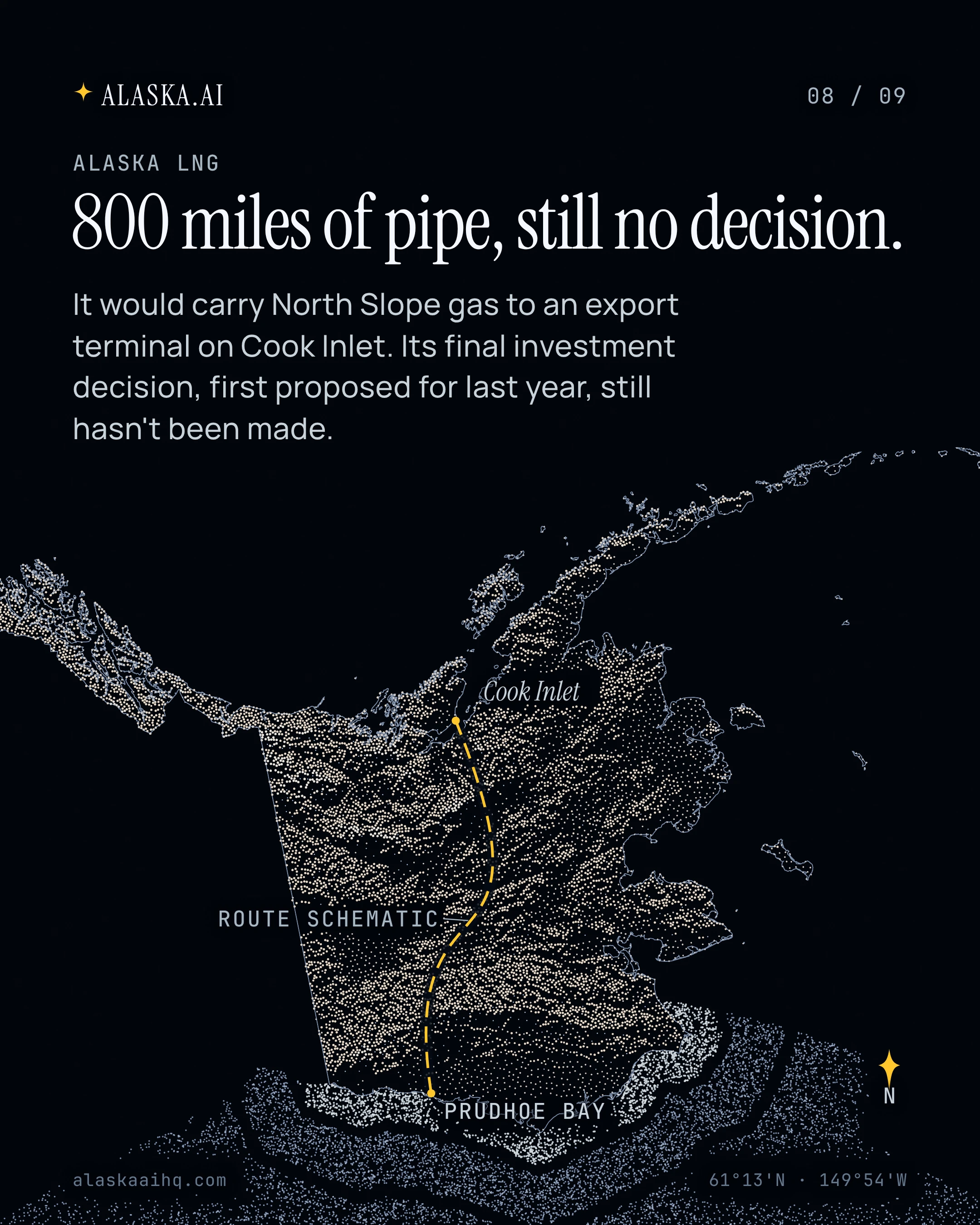
Nearest is the reservoir. Most gas raised with oil goes back into it. Next, near Prudhoe Bay, the North Slope Borough and Twenty First Century Utilities pitch North Slope Power at 3 to 10 gigawatts for AI data centers. Then STAK Energy, 26 miles south of Deadhorse, where DNR has preliminarily decided to offer a 50-year lease on 715.4 acres for a gas-powered plant with high-performance computing units. Last in line is Alaska LNG, whose 800-mile pipe to Cook Inlet has no final investment decision.
The USGS count and its 17.3 to 276.7 trillion cubic foot range, reinjected gas, both buyers and the pipe on south-up maps.
Should STAK's lease be signed before Alaska LNG has a final investment decision?
What we verified
66 CLAIMS, EACH RE-FETCHED FROM ITS SOURCE BEFORE THIS DECK SHIPPED
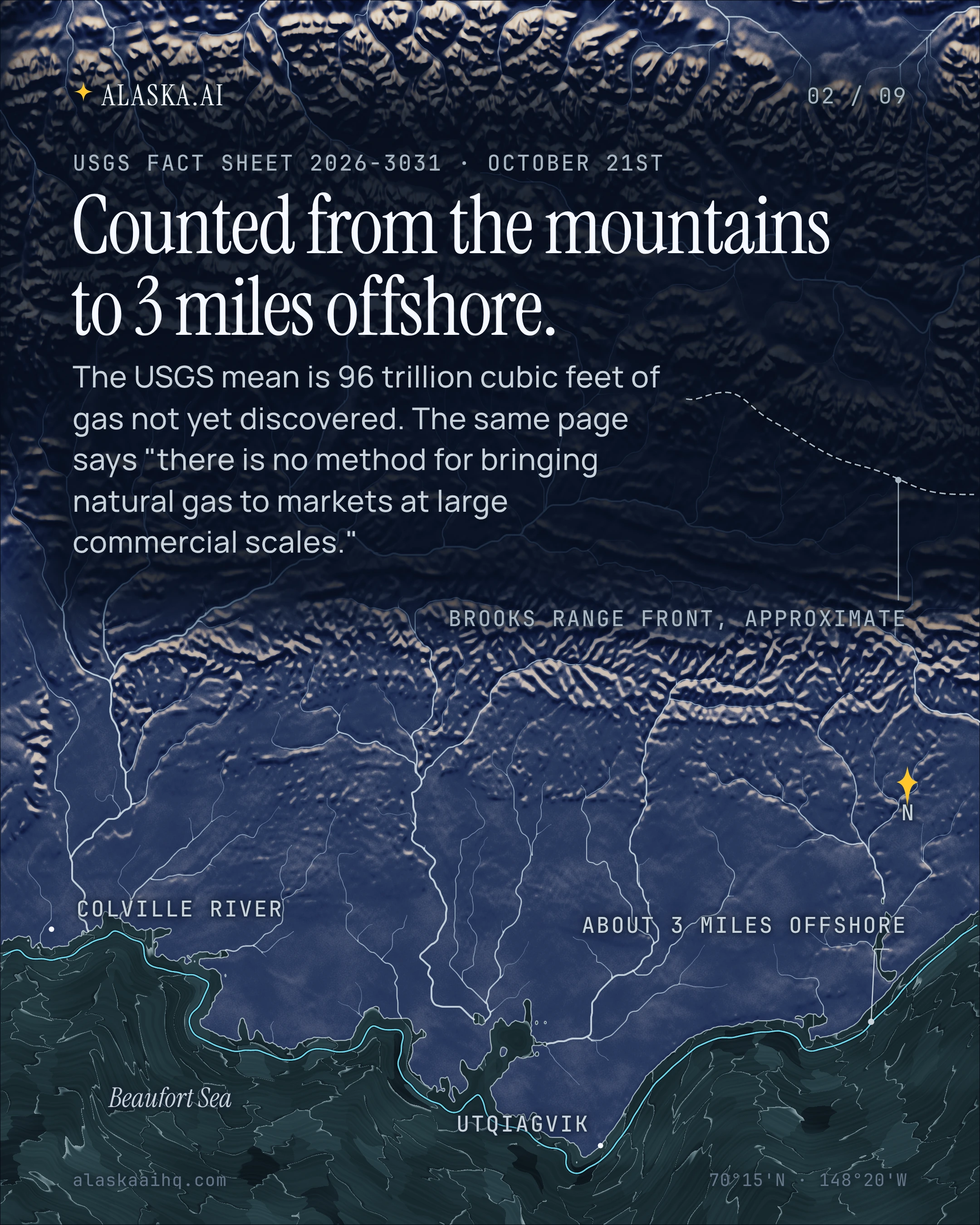
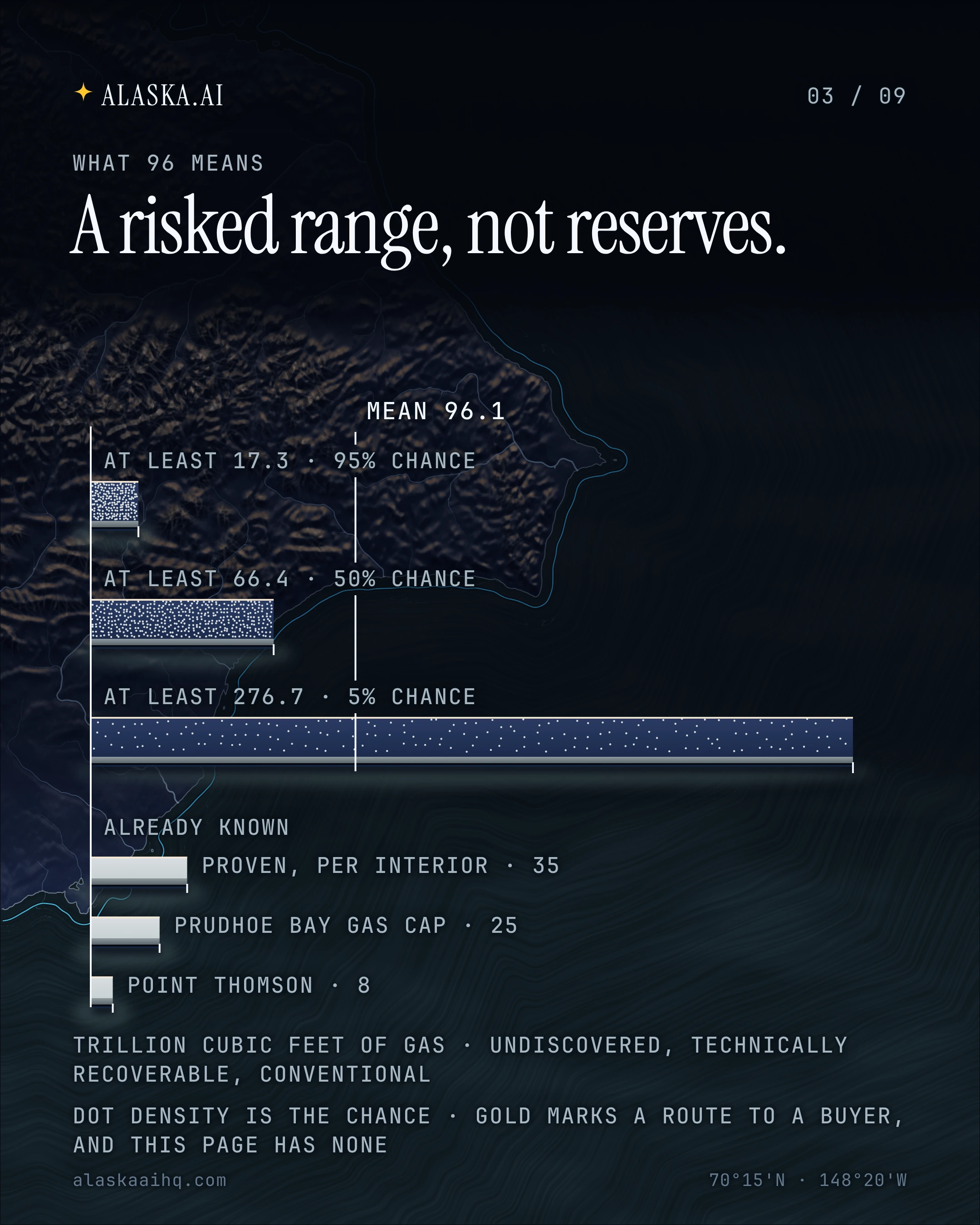
The USGS estimates a mean of 96 trillion cubic feet of undiscovered, technically recoverable conventional gas in the Northern Alaska Province, 96,094 billion cubic feet in its table, about 96.1 trillion.
The USGS range for undiscovered North Slope gas runs from 17,326 billion cubic feet at the F95 level to 276,681 billion cubic feet at the F5 level.
In the USGS tables, F95 means a 95 percent chance of at least the amount shown.
The USGS estimates a mean of 549 million barrels of undiscovered natural gas liquids in the Northern Alaska Province.
The same USGS assessment puts the mean undiscovered oil resource of the province at about 17 billion barrels.
The USGS divided the province into 21 assessment units in three sets, one for each stratigraphic sequence.
The assessment covers the whole province from the Brooks Range front north to the federal waters boundary about 3 miles off the Arctic coast, so it includes onshore land and state waters.
The estimate counts gas found with oil as well as gas found without oil, and covers conventional resources only.
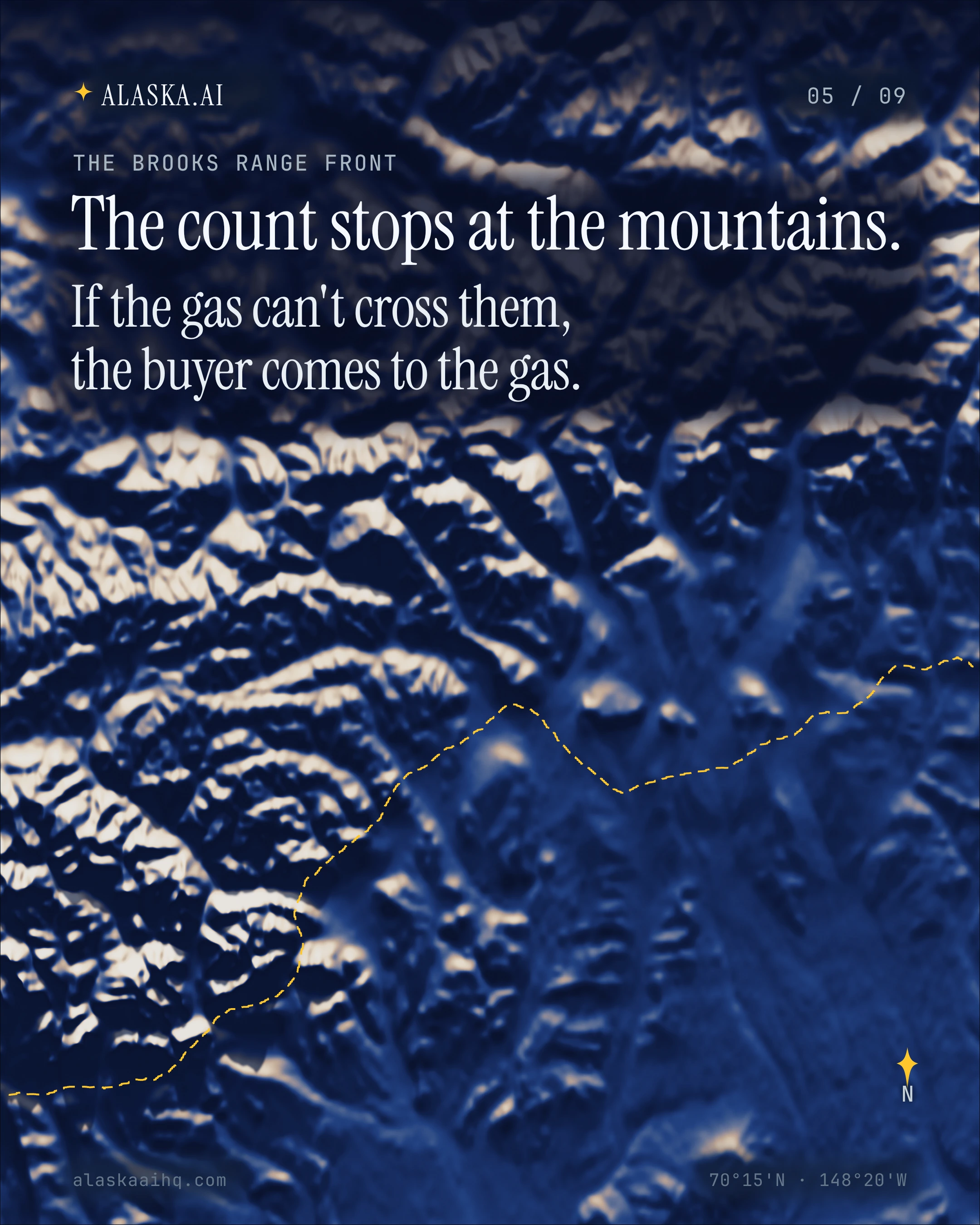
The USGS says that as of 2026 there is no way to bring North Slope gas to market at large commercial scale.
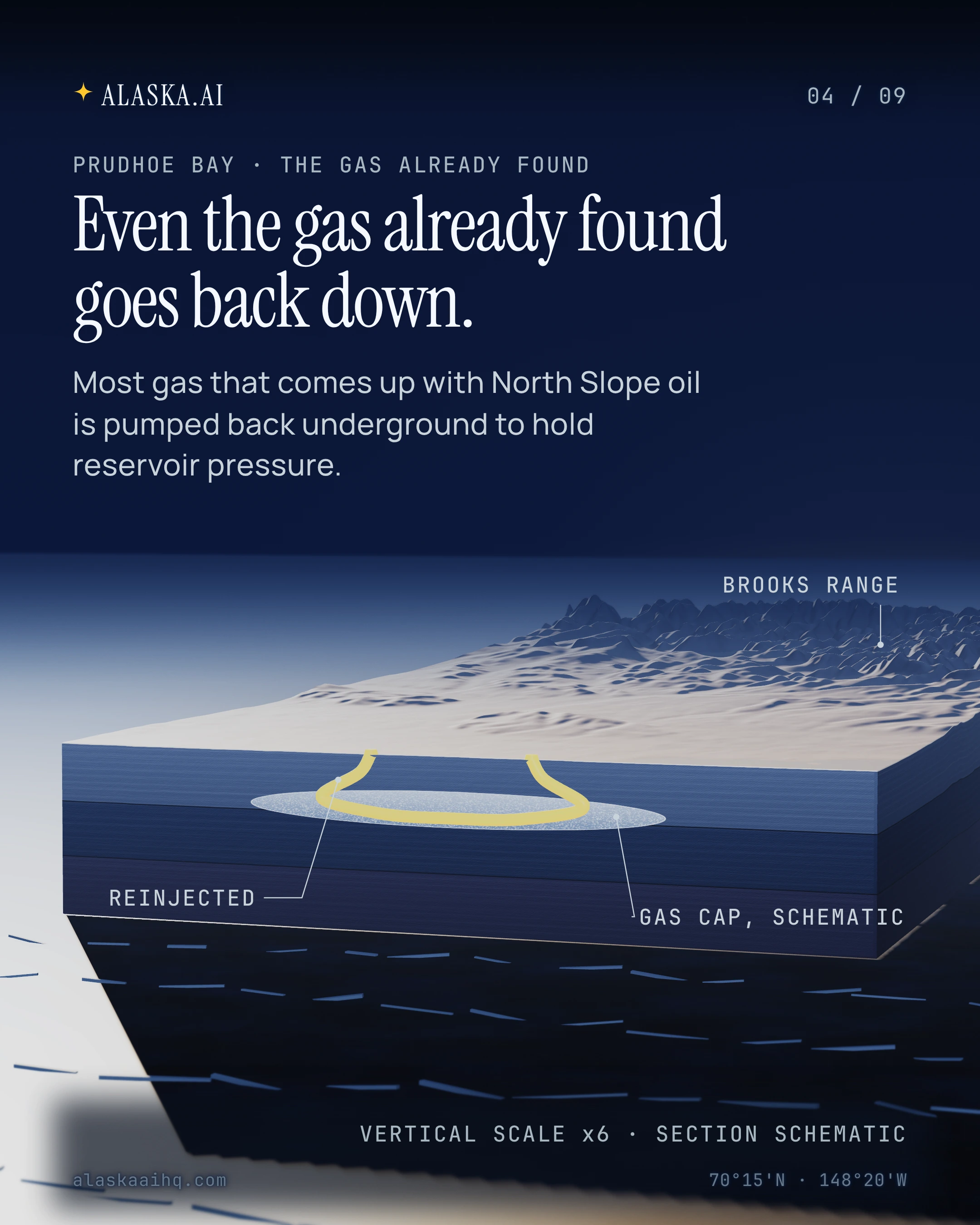
Most gas produced alongside North Slope oil is pumped back underground to keep reservoir pressure up.
The USGS puts the estimated ultimate recovery of the Prudhoe Bay gas cap at about 25 trillion cubic feet.
Interior says the 96 trillion cubic feet estimate is nearly three times the roughly 35 trillion cubic feet of proven North Slope gas reserves.
The Interior Department announced the USGS North Slope gas assessment on October 21st.
Interior Secretary Doug Burgum said Alaska's natural gas reserves can supply affordable, reliable, secure energy to Americans and U.S. allies.
USGS Director Ned Mamula said the agency's gas assessments point to resources industry hasn't discovered yet.
Alaska DNR's Division of Oil and Gas made a preliminary decision to offer STAK Energy Corporation a 50-year lease of state land under ADL 422741.
The proposed STAK Energy lease covers a 715.4-acre parcel.
The STAK Energy lease site sits beside the Dalton Highway about 26 miles south of Deadhorse.
DNR describes the STAK Energy project as a commercial natural gas-powered energy facility that includes modular high-performance computing units.
DNR extended the comment deadline on the STAK Energy lease to July 17th.
DNR issued a preliminary decision proposing to convey about 19,950 acres of state land near Houston to AIDEA.
The Houston conveyance would be a no-land-value transfer under the state's public and charitable use statute.
AIDEA's own fact sheet says no specific end use for the Houston land has been selected.
NOAA's Alaska Fisheries Science Center is using FT-NIR spectroscopy coupled with trained machine learning models to read otolith rings and age fish.
Ageing fish the traditional way means a scientist prepares the ear bones by hand and reads the rings under a microscope.
Alaska produces more than half the seafood caught off the U.S. coast, with an average wholesale value of nearly $4.75 billion a year from 2020 through 2024.
In 2018 NOAA said FT-NIR reads an otolith in 30 to 50 seconds, more than 10 times faster than traditional methods, with preliminary pollock efficiency gains of 600 to 800 percent.
The USGS assessment spans three stratigraphic sequences, the Ellesmerian, the Beaufortian and the Brookian.
The USGS defined 8 assessment units in the Ellesmerian sequence, 7 in the Beaufortian and 6 in the Brookian.
By the showrunner's sum of the Table 1 gas means, the Ellesmerian sequence holds 19,093 billion cubic feet of the undiscovered gas, the Beaufortian 32,013 and the Brookian 44,988.
By the showrunner's sum of Table 1, about 14,502 billion cubic feet of the undiscovered gas is associated with oil and about 81,592 billion cubic feet is not.
The single largest gas mean among the 21 units is the Beaufortian Deformed Central unit, 12,921 billion cubic feet of gas found without oil.
The USGS puts the estimated ultimate recovery of Point Thomson field at 8 trillion cubic feet of gas.
Existing gas discoveries across the Brooks Range foothills range from 4 to 600 billion cubic feet, per the USGS.
The USGS says several ways of bringing North Slope gas to market have been proposed, citing the Alaska LNG developer 8 Star Alaska.
The USGS gives the mean undiscovered oil of the province as 17,099 million barrels with a range of 3,044 to 46,617 million barrels.
The USGS median, the F50, for undiscovered North Slope gas is 66,357 billion cubic feet, about 66.4 trillion.
North Slope exploration has historically focused on oil, which is carried across Alaska by pipeline toward markets, the USGS writes.
The USGS dates the discovery of the Prudhoe Bay field to 1968.
USGS energy resources program coordinator Alicia Lindauer said the estimate is almost as much gas as the United States consumes in three years.
The Alaska Beacon reports that this is the first resource assessment for natural gas covering the whole North Slope.
State officials received more than 500 public comments on the proposed North Slope data center and power plant.
STAK Energy's generators could produce a gigawatt or more of power, according to the Anchorage Press.
STAK Energy chief strategy officer John Boyle said the project would cost more than $10 billion.
The Anchorage Press reports the STAK Energy power would serve artificial intelligence and cloud computing customers.
The North Slope Borough and Twenty First Century Utilities partnered to create North Slope Power.
North Slope Power proponents describe a 3 gigawatt first phase that could expand to 10 gigawatts.
North Slope Power is designed to supply colocated AI data centers and industrial load.
Proponents say North Slope Power would be the world's largest natural gas power plant, sited near Prudhoe Bay.
President Trump called Alaska LNG a U.S. federal government project in a social media post.
The Alaska LNG plan calls for an 800-mile pipeline carrying 20 million metric tons of gas a year from the North Slope to an export terminal on Cook Inlet.
Official estimates put the Alaska LNG project's cost between $44.5 billion and $54.5 billion.
Private developer Glenfarne owns 75 percent of Alaska LNG and the state-controlled Alaska Gasline Development Corp. owns the rest.
Alaska LNG's final investment decision, first proposed for last year, still hasn't been made.
Taiwan's economic affairs ministry said state-owned CPC will invest up to $4.4 billion in the Alaska LNG pipeline project.
AGDC president Frank Richards said negotiations were nearing conclusion on price and term for 6 million metric tons of gas a year for Taiwan.
Korean officials said the Alaska pipeline isn't yet confirmed as part of South Korea's U.S. investment deal.
DNR is still reviewing public comments on the Houston land transfer and the timeline for a decision is unclear.
The Houston City Council and Meadow Lakes Community Council voted unanimously in July to oppose the transfer.
The Willow Area Community Council passed a resolution in September to send the Mat-Su Borough a letter opposing the transfer.
AIDEA director Randy Ruaro testified that no developer, tenant, power source or site plan exists for the Houston land.
Ruaro called the rumored Houston data center implausible because there is no excess energy supply.
Senate Resources chair Cathy Giessel estimated the Houston land is worth about $14 million a year in state general fund revenue that would be forgone.
Giessel said the University of Alaska charges a private Mat-Su developer $586,740 a year to lease 829 acres.
The joint committee's subpoena of DNR Commissioner John Crowther passed with five yes votes.
The next committee meeting on the land transfer was scheduled for October 26th at 10 a.m.
Beats
This article is on Alaska data centers · Alaska power and the grid · Alaska land and permitting for AI. Each beat page keeps every decision and every article on that subject in one place.