What's Dated in the Houston Land Transfer and What Isn't
Alaska's Houston land transfer has a date for the lawsuit and the inauguration but not for the day 19,950 acres change hands.
The deck
SWIPE, SCROLL OR CLICK A SLIDE TO GO FULLSCREEN · 9 SLIDES







The story
Dated. On October 22nd a lawsuit cited seven sections of the Alaska Constitution. On October 26th DNR Commissioner Crowther called approval before December 7th "certainly possible." On December 7th a new governor is sworn in.
Not dated. DNR's final decision. Survey, plat, title and closing. An appeal open to more than 2,000 commenters. The State's answer due 40 days after service.
Crowther said surveying and the appeal period likely push the handoff into the next term.
Inside are Crowther's words, the complaint and its summons, the four steps to a deed and a ledger of what's dated and what isn't.
Should the governor leaving, the one arriving or a judge have the final say if the decision beats December 7th and the deed doesn't?
What we verified
79 CLAIMS, EACH RE-FETCHED FROM ITS SOURCE BEFORE THIS DECK SHIPPED
Eric Forrer and David Eastman filed their complaint against the land transfer on October 22nd, 2026.
The suit was filed in the Superior Court for the State of Alaska, First Judicial District at Juneau.
The case number is 1JU-26-01019 Civil.
The defendants are the State of Alaska, its Department of Natural Resources, and Governor Michael J. Dunleavy in his official capacity.
Juneau attorney Joseph W. Geldhof filed the complaint for the plaintiffs.
The complaint says the transfer violates seven sections of the Alaska Constitution, namely Art. I Sec. 7, Art. VIII Secs. 2, 9, 10 and 17, and Art. IX Secs. 6 and 7.
The land DNR proposes to convey is approximately 19,950 acres of state-owned land in the Matanuska-Susitna Borough.
The parcel lies approximately two miles north of Houston, Alaska.
The parcel sits within Township 18 North and Township 19 North of the Seward Meridian.
The complaint says DNR floated possible uses including data centers, advanced manufacturing, logistics hubs, utility development and gravel extraction.
The complaint alleges a complete lack of analysis of the power and energy the development would require.
The complaint names three local bodies that voted to oppose the transfer, the Mat-Su Borough Assembly, the Houston City Council and the Meadow Lakes Community Council.
The complaint says transferring the land to AIDEA without legislative authorization violates the separation of powers.
The plaintiffs ask for an injunction barring DNR from transferring the land without a finding of legitimate public purpose and legislative authorization.
The summons gives the State 40 days after receiving it to file an answer.
Plaintiff Eric Forrer is a former University of Alaska regent who lives in Juneau.
The proposed conveyance rests on AS 38.05.810(a), the public and charitable use statute.
AIDEA would make no payment for the value of the land but would cover administrative, survey, platting and closing costs.
DNR proposes to waive the state's statutory reversionary interest in the land.
The state would keep the mineral estate, including oil, gas, coal and geothermal resources.
AIDEA's fact sheet says no specific end use has been definitively selected for the land.
The fact sheet lists illustrative uses including rail-served logistics, utility, energy and technology infrastructure, advanced manufacturing and workforce housing.
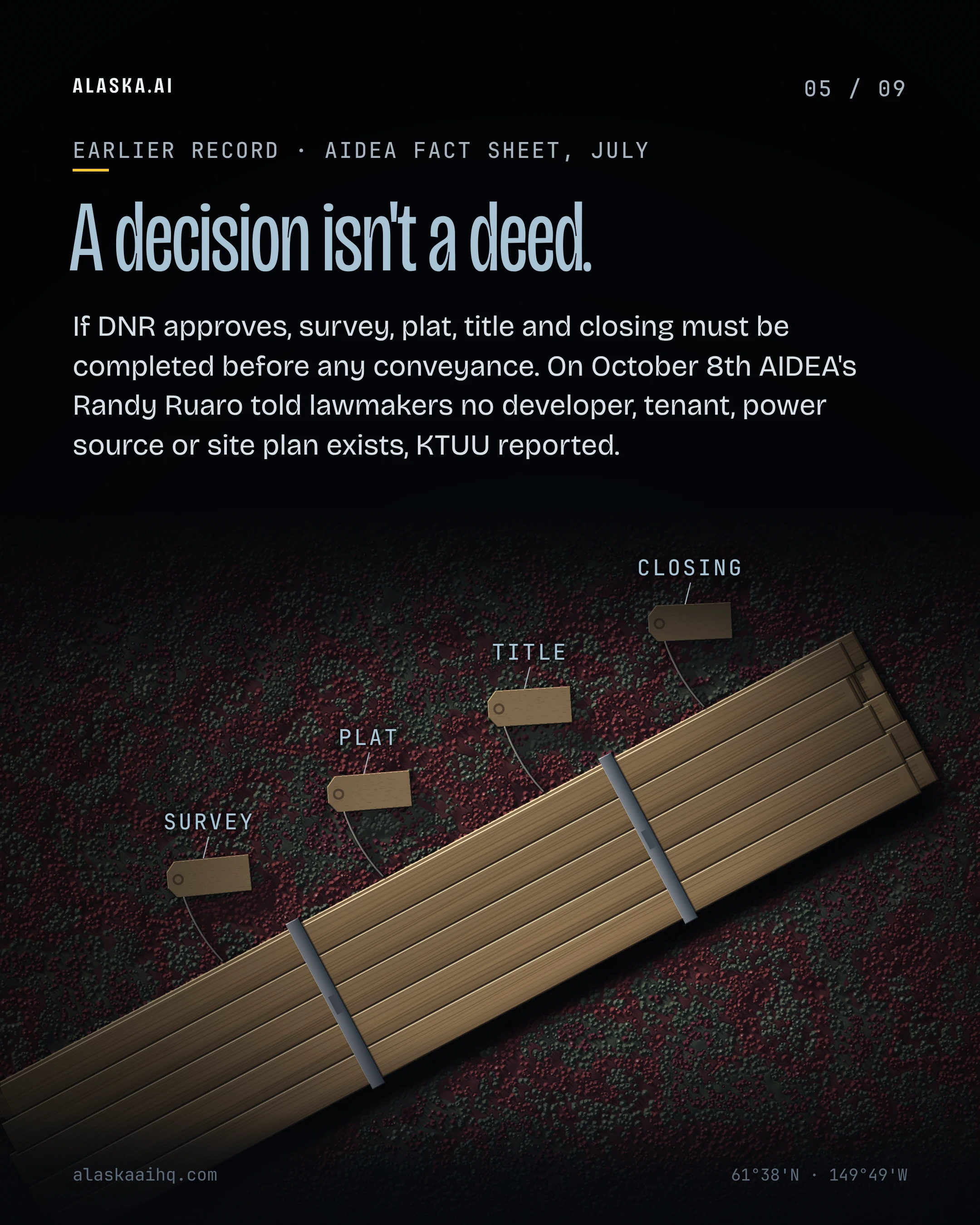
DNR must issue a Final Finding and Decision, and if it approves, survey, plat, title and closing steps must be completed before any conveyance.
DNR published the public notice on July 10th, 2026; written comment, first due August 19th, was extended to September 14th, 2026.
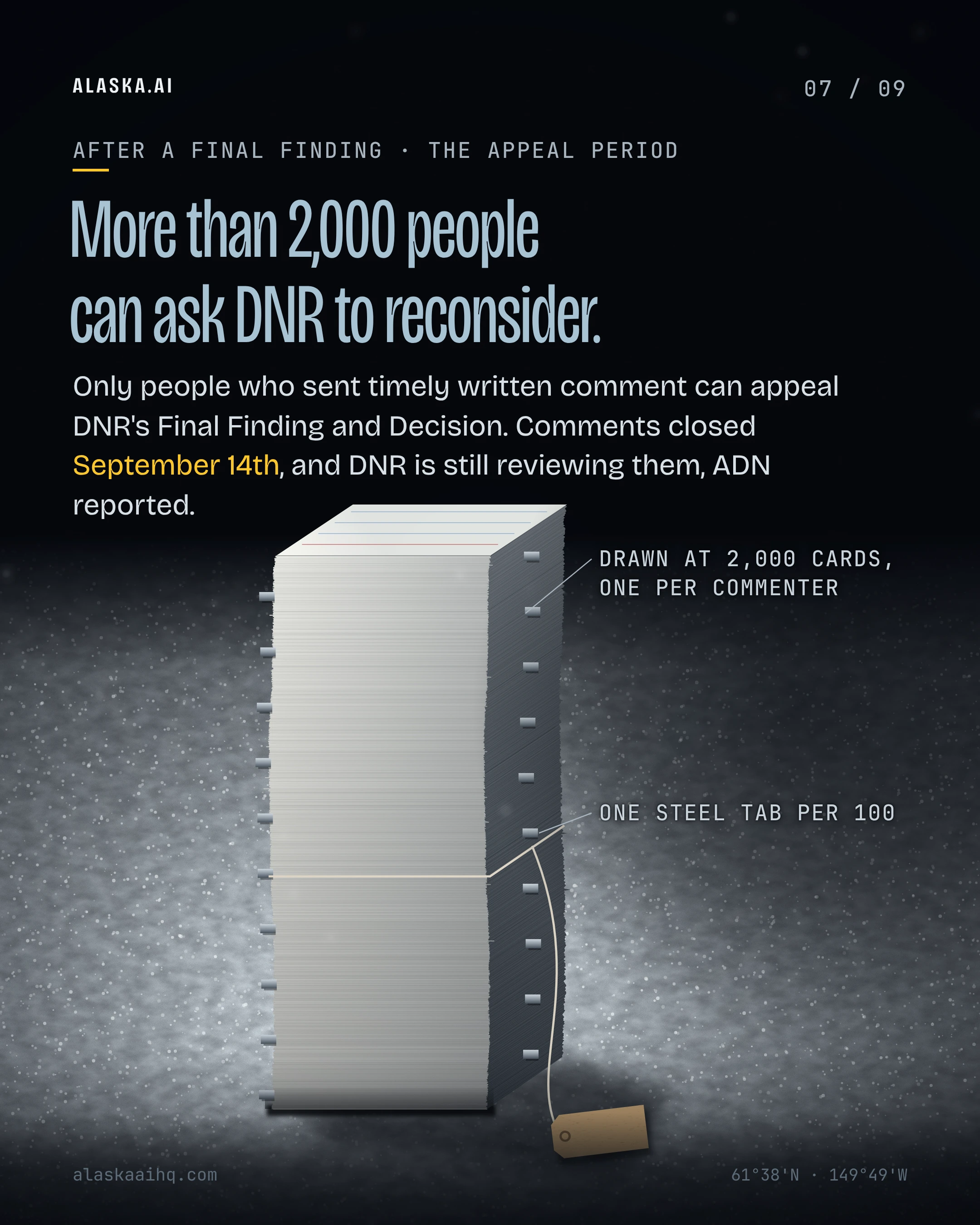
Only people who sent DNR timely written comment during the comment period can appeal the Final Finding and Decision.
NOAA's Alaska Fisheries Science Center holds an archive of 2.5 million otolith pairs dating back to the 1960s.
The otoliths in the archive come from 83 species.
NOAA scientists use Fourier Transform Near-Infrared Spectroscopy to streamline fish aging.
Machine learning algorithms correlate the otoliths' near-infrared spectral signatures directly to fish age.
NOAA says FT-NIR increases fish aging efficiency by 600 to 800 percent.
Acting AFSC Director Jamal Moss wrote that the center couples FT-NIR with trained machine learning models to read otolith rings.
Moss wrote that the more fish the center ages, the more accurate the data used in stock assessments.
Forrer said of the suit, "We sued just to stop him."
Forrer called the lawsuit a roadblock and a boulder in the road.
Forrer said the suit aims to stop Dunleavy from advancing the transfer before he leaves office in early December.
Forrer said a 2018 suit he brought against a bond plan to pay oil tax credits ended with an Alaska Supreme Court ruling in his favor in September 2020.
Forrer said the dispute is not a right or left issue.
DNR declined to comment on the suit because it had not yet been served.
AIDEA is not a named party in the suit.
The Mat-Su Sentinel reports four local bodies have passed resolutions opposing the transfer, adding the Willow Area Community Organization to the three the complaint names.
Reporting describes the parcel as 30 square miles of land abutting Houston, Willow and Meadow Lakes.
DNR Commissioner John Crowther appeared before the Senate Resources Committee after its members voted to subpoena him.
Crowther testified on Monday, October 26th.
Crowther said it was certainly possible the transfer could be approved before a new governor is sworn in.
A new governor is sworn in on December 7th.
Crowther said several steps will likely stretch the process beyond the inauguration and into the next governor's term.
The steps Crowther named include surveying the site and an appeal period.
Crowther also pointed to the ongoing lawsuit as a step that could prolong the process.
DNR received more than 2,000 public comments on the transfer, which are still under review.
Anyone among the more than 2,000 commenters has standing during the appeal period to ask that the transfer be reconsidered.
Crowther said using state land for development has been the governor's priority.
Earlier this year the Dunleavy administration changed a state regulation to allow a broader interpretation of what counts as a public purpose.
Senate Resources Chair Cathy Giessel obtained DNR records on internal deliberations through a records request, and they were released with heavy redactions.
Giessel said, "We are concerned that this is being urgently executed."
Sen. Bill Wielechowski said the broad reading of public purpose creates a giant loophole for AIDEA.
Crowther told senators that what AIDEA could do with the parcel is quite broad.
AIDEA's transfer application lists secure, scalable data centers among the possible uses.
A nonpartisan legislative attorney wrote a memo in September advising that the transfer may not be allowed under Alaska law.
Governor Dunleavy is term limited and cannot run for reelection.
Republican candidate Dave Bronson said he was generally supportive of the transfer but noted DNR could scale down the 20,000 acres in its final approval.
Republican candidate Treg Taylor said he fully supports the transfer.
Bernadette Wilson's campaign did not respond and Democrat Jonathan Kreiss-Tomkins could not be reached about the transfer.
The Senate Resources Committee voted on Wednesday October 14th to subpoena Crowther, and he was set to appear at a hearing on October 26th.
AIDEA Executive Director Randy Ruaro testified on October 8th that no developer, tenant, power source or site plan exists for the land.
Ruaro called the rumored data center implausible because there is no excess energy supply.
Giessel estimated the land is worth roughly $14 million a year in forgone revenue.
Giessel said the University of Alaska charges a private Mat-Su developer $586,740 a year to lease 829 acres.
KTNA reports the Houston City Council and Meadow Lakes Community Council voted unanimously in July to oppose the transfer.
Willow resident Ramey Smyth said the community needs air and water, which data centers are scheduled to contaminate.
In September Bernadette Wilson said she would never allow Alaska to be littered with hyperscale data centers.
In September Jonathan Kreiss-Tomkins said he supports a moratorium on data center development in Alaska.
The Petersburg Borough Assembly voted 6-0 on October 5th to have the borough manager draft an ordinance for a nine-month moratorium on certain data center development.
In a second 6-0 vote Petersburg directed the manager to draft Title 19 zoning amendments that address data centers.
Neither Petersburg vote takes effect until the moratorium and zoning changes return as ordinances and pass three readings.
Sitka city staff proposed a zoning code amendment that would define data centers and allow them by conditional use permit in five zoning districts.
Four Sitkans had submitted comments on the amendment, and three asked for an outright ban on data center development.
The Sitka Planning Commission recommended prohibiting the construction of data centers, at least for now.
The Wrangell Borough Assembly unanimously voted down a land lease for a privately run data center on June 9th.
The rejected Wrangell application came from Greensparc, which sought to build a 10,000-square-foot facility.
Beats
This article is on Alaska data centers · Alaska land and permitting for AI · Alaska AI policy and legislation. Each beat page keeps every decision and every article on that subject in one place.