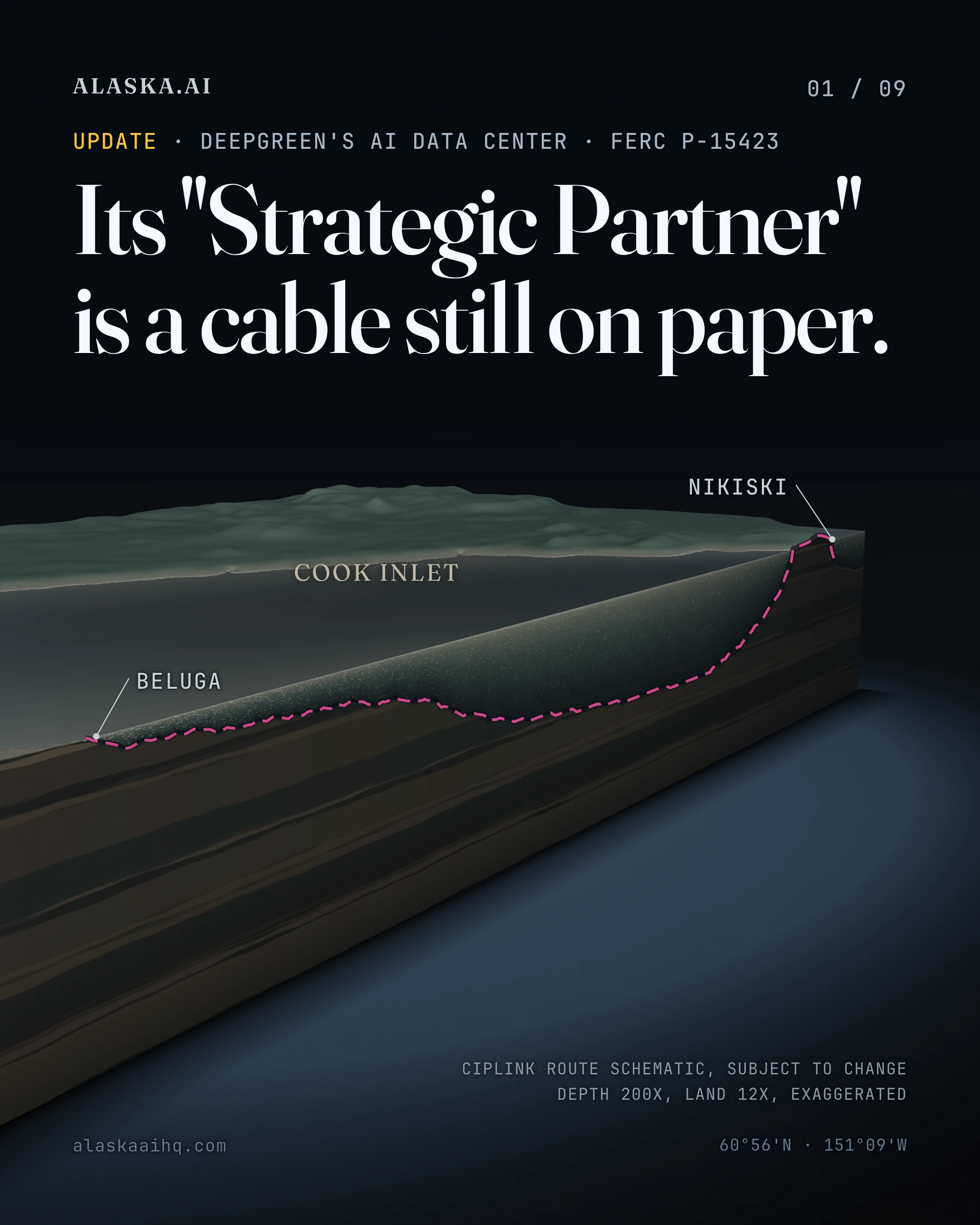
Its "Strategic Partner" is a cable still on paper
In February, DeepGreen's FERC filing for a Cook Inlet AI data center named AEA's planned undersea cable its "Strategic Partner."
The deck
SWIPE, SCROLL OR CLICK A SLIDE TO GO FULLSCREEN · 9 SLIDES




The story
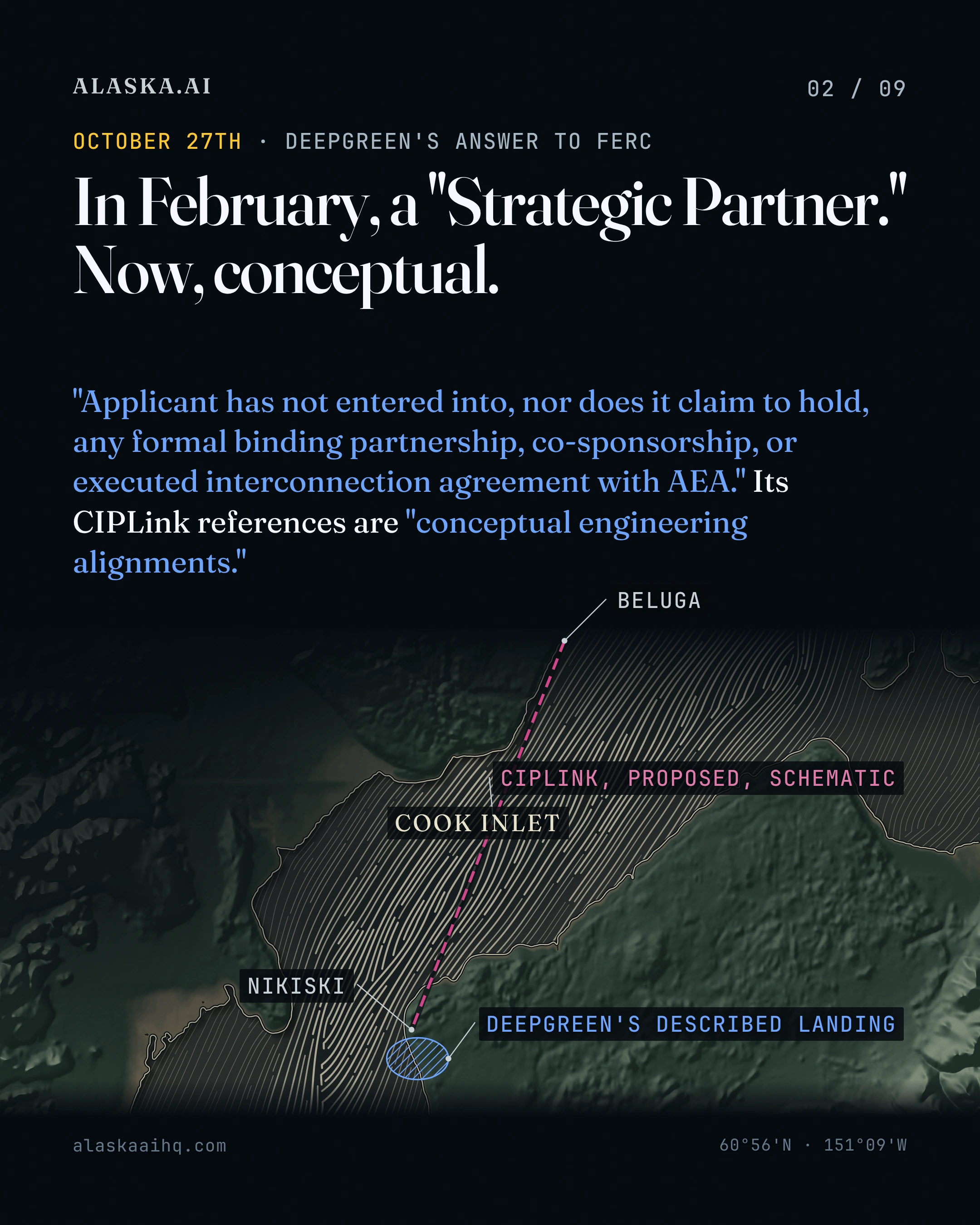
On October 27th, DeepGreen conceded no binding partnership with AEA, only "conceptual engineering alignments."
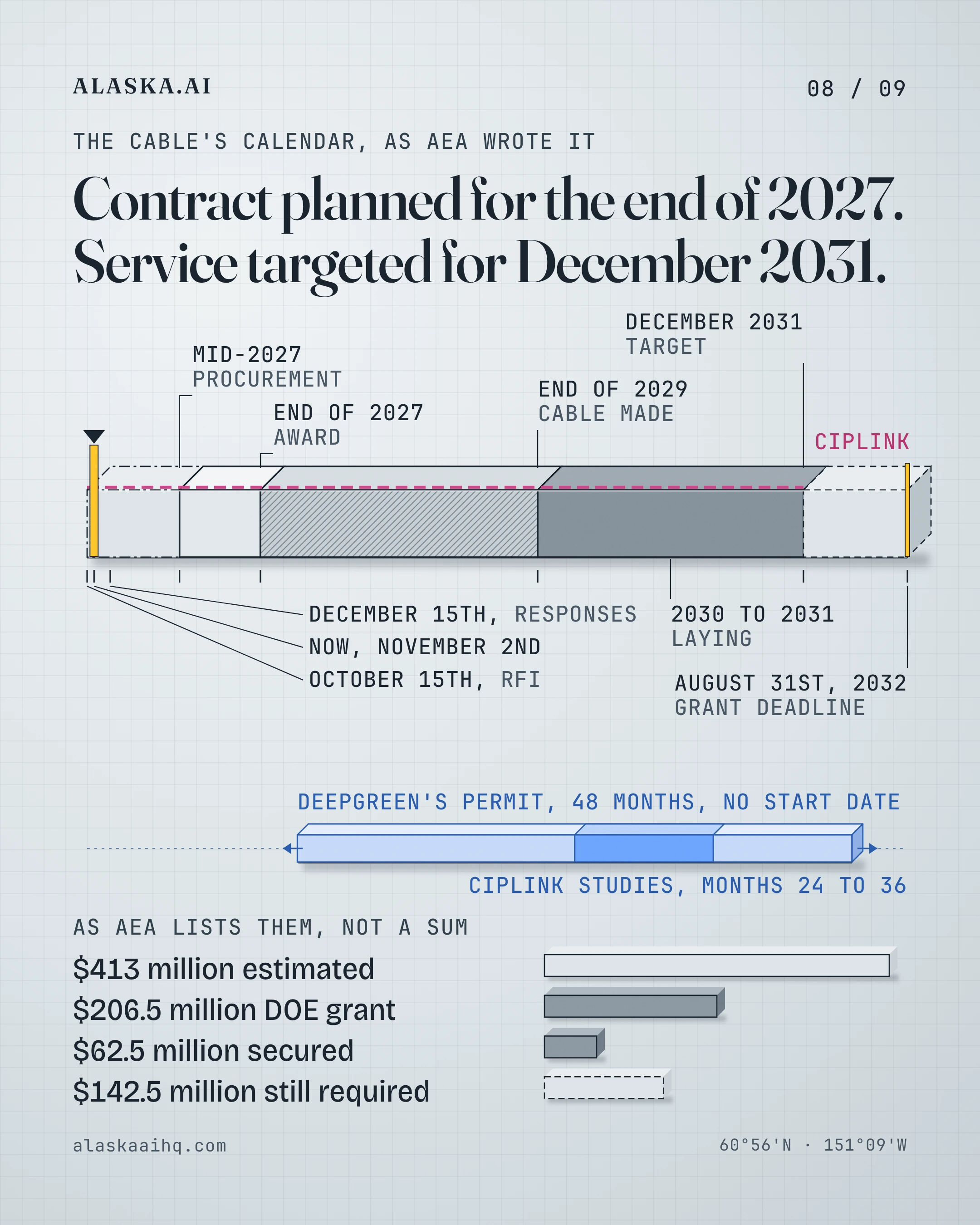
The partner is still a request for information. AEA plans the award for the end of 2027 and targets service for December 2031. The comment window closed November 2nd with 262 filings counted that evening, none a competing application.
DeepGreen's filings face AEA's cable, its Soldotna converter, the docket and AEA's calendar.
AEA says the cable would end the single point of failure between Kenai and Anchorage. Kenai Peninsula Borough Mayor Peter Micciche says his complaint is "being in the dark."
Is a borrowed partner harmless in a permit that builds nothing, or should FERC hold it against DeepGreen?
What we verified
76 CLAIMS, EACH RE-FETCHED FROM ITS SOURCE BEFORE THIS DECK SHIPPED
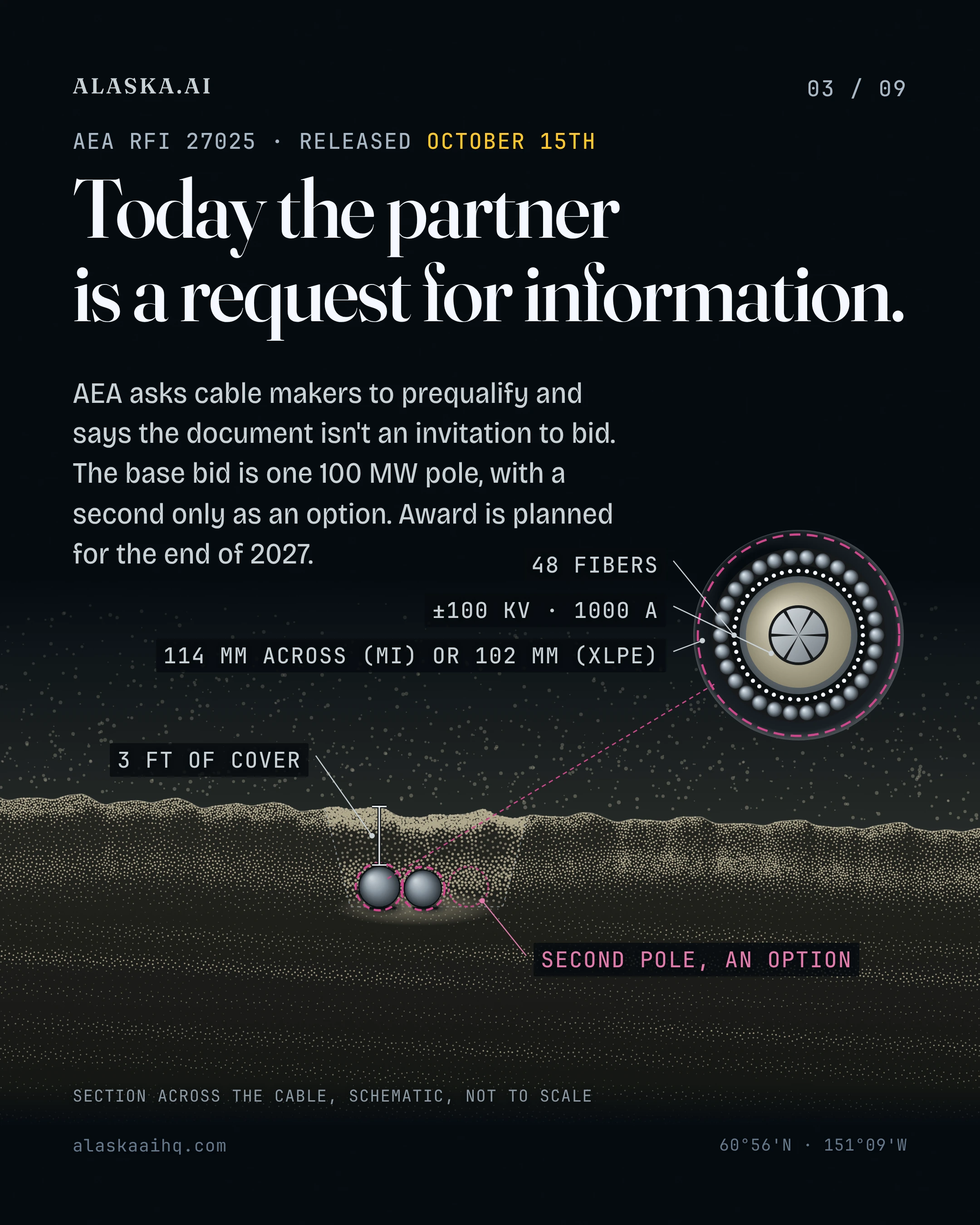
The Alaska Energy Authority published its CIPLink submarine cable prequalification and request for information, numbered 27025, on October 15th.
Responses to AEA's CIPLink cable RFI are due December 15th at 2 p.m. Alaska time.
AEA engaged Stantec Consulting Services in July 2025 to support CIPLink development, and that work produced the cable RFI.
AEA's RFI says it is not an invitation to bid, an offer or a commitment to proceed with procurement.
AEA's RFI describes CIPLink as an HVDC system crossing Cook Inlet between Beluga and Nikiski.
AEA says CIPLink has received federal funding through the Department of Energy's Grid Resilience and Innovation Partnerships program.
The base bid for CIPLink's submarine cable is a 100 MW asymmetrical monopole.
A second 100 MW pole, which would make a 200 MW bipole, is bid only as an additive alternate.
AEA's RFI puts the CIPLink submarine cable route at about 40 miles, or 64 km, from landfall to landfall.
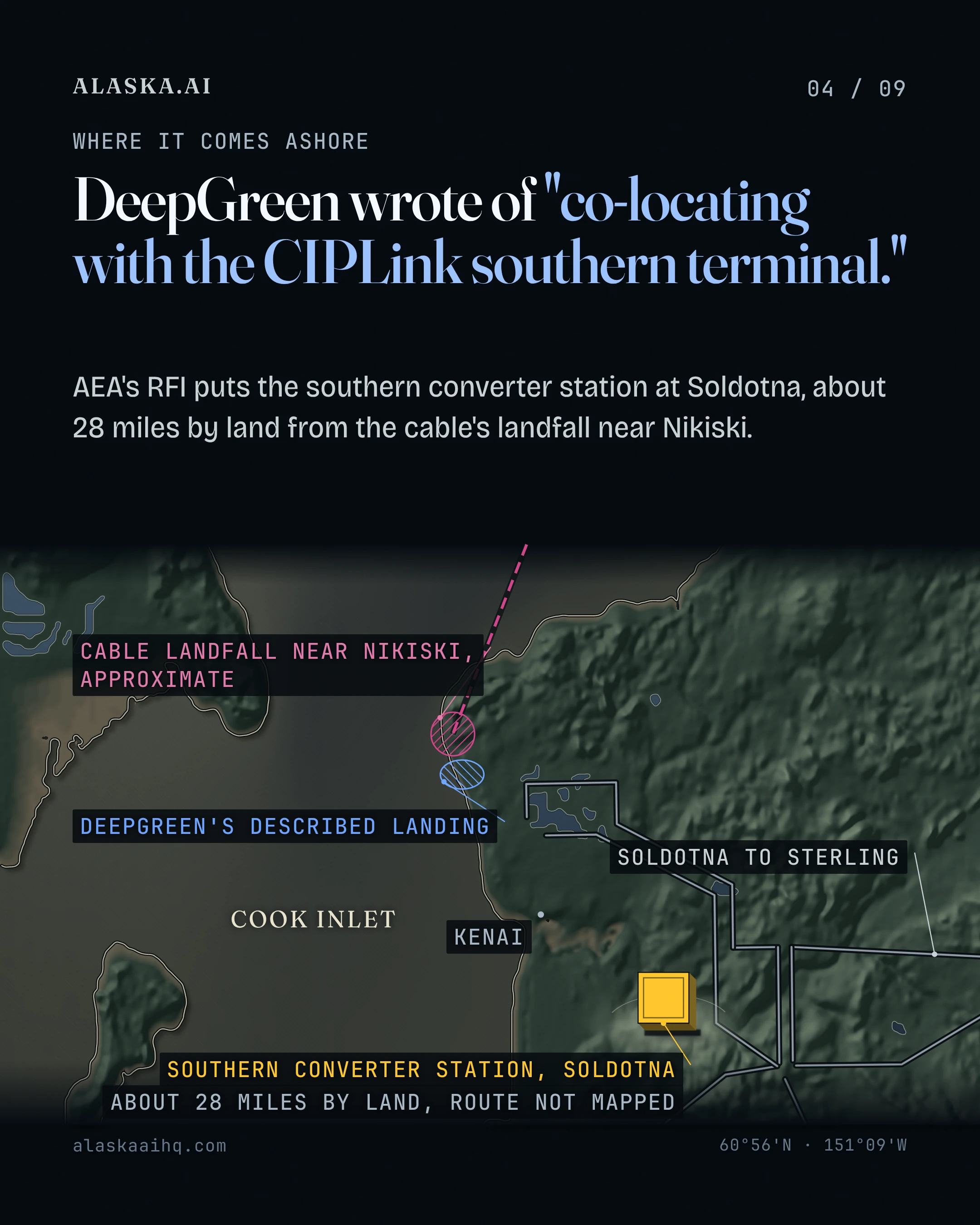
The RFI places CIPLink's southern converter station at Soldotna, about 28 miles by terrestrial line from the cable landfall near Nikiski.
AEA is targeting an in-service date of December 2031 for all CIPLink components.
AEA's RFI says the federal GRIP funding requires CIPLink to be fully completed by August 31st, 2032.
AEA expects to take the submarine cable engineering, supply and installation procurement to market in mid-2027.
AEA plans to award the submarine cable contract at the end of 2027.
AEA's schedule has submarine cable and accessory manufacturing finished by the end of 2029.
AEA's schedule has the submarine cable installed in 2030 and 2031.
AEA intends to complete CIPLink's environmental review and permit issuance in early 2029.
The RFI specifies a rated DC voltage of plus or minus 100 kV for the CIPLink submarine cable.
The cable route must cross at least three existing assets, namely GCI's Kodiak Kenai Fiber Link, Alaska Communications' AKORN cable and Hilcorp's Tyonek W10 pipeline.
The RFI says CIPLink's preliminary cable route runs adjacent to and west of the planned route of a proposed LNG line.
Respondents prequalify for future cable procurement with a score of 24 or more out of 40 and no category below 4.
AEA's RFI notes there are noise limits in Cook Inlet because of marine mammals.
AEA's RFI asks cable bidders how they would prevent ice scouring damage at the landfalls.
AEA's CIPLink project page lists the project status as In Development.
AEA says CIPLink would eliminate the current single point of failure between Kenai and Anchorage.
AEA's project page describes CIPLink's subsea cable as 38 miles long.
AEA says CIPLink would deliver up to 200 megawatts of bidirectional power transfer.
AEA's project page puts CIPLink's estimated cost at $413 million.
AEA's project page lists a federal Department of Energy grant of $206.5 million for CIPLink.
AEA's project page lists $62.5 million for CIPLink as secured.
AEA's project page lists an additional $142.5 million as still required for CIPLink.
AEA's project page gives CIPLink a target completion of 2032.
DeepGreen's application gives the project an installed capacity of 100.0 megawatts.
DeepGreen's application describes the project as a firming load for the Railbelt grid via the planned CIPLink.
DeepGreen's application says its landing site is strategically positioned to interface with AEA's CIPLink.
DeepGreen's application describes CIPLink as the planned 38-mile, 200 MW HVDC subsea line between Nikiski and Beluga.
DeepGreen's application says the hub would co-locate with the CIPLink southern terminal.
DeepGreen asked FERC for a 48-month preliminary permit term.
DeepGreen's study schedule places its interconnection and CIPLink technical studies in months 24 to 36 of the permit term.
DeepGreen estimates its studies over the 48-month permit term would cost $4,500,000.
The filing summary in DeepGreen's draft notice lists CIPLink and the Alaska Energy Authority as its Strategic Partner.
DeepGreen's October 27th answer says it has not entered into, and does not claim to hold, any formal binding partnership, co-sponsorship or executed interconnection agreement with AEA.
DeepGreen's answer says its references to CIPLink reflect conceptual engineering alignments and regional transmission possibilities under study.
DeepGreen's answer asks FERC to issue the preliminary permit for Project No. P-15423-000.
DeepGreen told FERC a preliminary permit authorizes zero physical hardware placement and zero construction.
DeepGreen's answer says the City of Kenai has not taken an opposing position on the application.
The Alaska Energy Authority told FERC it has had no communications or relationship with DeepGreen.
AEA told FERC it owns the Sterling to Quartz Creek transmission line.
AEA told FERC it holds capacity rights on the Soldotna to Sterling transmission line.
Cook Inletkeeper told FERC it opposes issuing the preliminary permit because of potential impacts on Cook Inlet beluga whales, their habitat and the watershed.
FERC's eLibrary listed 262 filings in docket P-15423 dated on or before November 2nd.
The docket held 134 filings dated on or before October 22nd, the date of the previous deck.
72 filings in docket P-15423 are dated November 2nd, the final day of the comment window.
Seven parties filed eight motions to intervene in docket P-15423, namely the Center for Biological Diversity, the Alaska Commercial Fisheries Conservation Alliance, the Kenai Peninsula Borough, Rebecca Long, AEA, the City of Kenai and Cook Inletkeeper.
Cook Inletkeeper's motion to intervene was filed on October 26th, the last of the eight motions.
No competing application or notice of intent to file one appeared in the P-15423 record by the November 2nd deadline.
FERC set 5 p.m. Eastern Time on November 2nd as the deadline for comments, motions to intervene and competing applications on DeepGreen's permit.
FERC's notice describes the project as about 330 to 350 marine hydrokinetic turbines.
FERC's notice describes an approximately 3.5-mile, 115 kV subsea cable from the hub to a landing site in the Nikiski Industrial Corridor.
FERC's notice says the sole purpose of a preliminary permit is to give the holder priority to file a license application.
AEA's RFI says the submarine cable route is subject to change as a result of marine surveys planned within the year.
AEA's RFI requires the HVDC submarine cables to carry 48 single-mode glass fibers for cable monitoring.
AEA's RFI assumes a cable outside diameter of 114 mm for a mass-impregnated cable and 102 mm for an XLPE cable, for installation planning.
AEA's RFI assumes the cable is buried 3 feet deep after it is laid across Cook Inlet.
AEA's RFI assumes each landfall is about 0.6 miles of horizontally drilled conduit with a maximum depth of 65 feet.
AEA's RFI gives the rated DC current of the cable as 1000 A.
AEA holds a pre-response conference for cable respondents on November 4th at 10:30 a.m. Alaska time.
DeepGreen filed its preliminary permit application with FERC on February 11th.
Petroleum News reported that $269 million of CIPLink's estimated $413 million had been secured, citing AEA.
Kenai Peninsula Borough Mayor Peter Micciche told Alaska's News Source that sloppy was how he would describe DeepGreen's approach at this stage.
Micciche told Alaska's News Source his complaint was being in the dark about a potentially very large development offshore in Cook Inlet.
Under a proposed exchange, Hilcorp would sell Enstar 1.2 billion cubic feet of gas previously allocated to MEA, no later than December 15th.
The exchange gas would be priced at $9 per mcf plus a $2.75 per mcf fee paid by Enstar to Hilcorp.
Without the exchange, Enstar would have about 3.7 billion cubic feet of gas in storage by the end of December.
Petroleum News reports that Enstar's typical stored gas range is 6 billion to 7 billion cubic feet.
Enstar would have to deliver equivalent payback volumes to MEA's storage account by March 31st, 2028.
Beats
This article is on Alaska data centers · Alaska power and the grid · Alaska land and permitting for AI. Each beat page keeps every decision and every article on that subject in one place.