Four candidates, three answers. No law yet.
Four candidates for Alaska governor gave three answers on data centers. A 20,000-acre land decision may not wait for the winner.
The deck
SWIPE, SCROLL OR CLICK A SLIDE TO GO FULLSCREEN · 9 SLIDES




The story
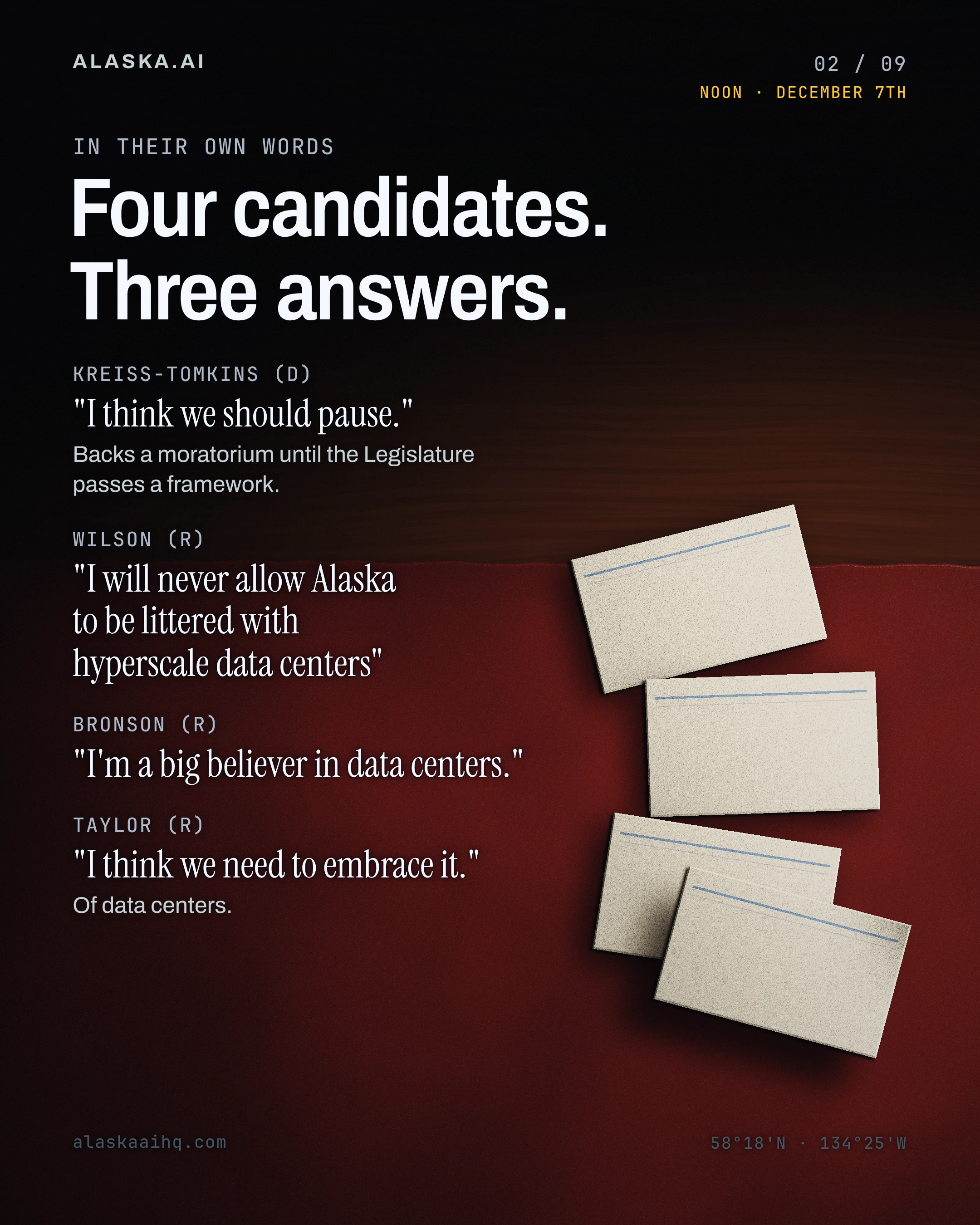
Kreiss-Tomkins wants a "pause." Wilson says "never" to hyperscale. Bronson is "a big believer" and Taylor would "embrace it."
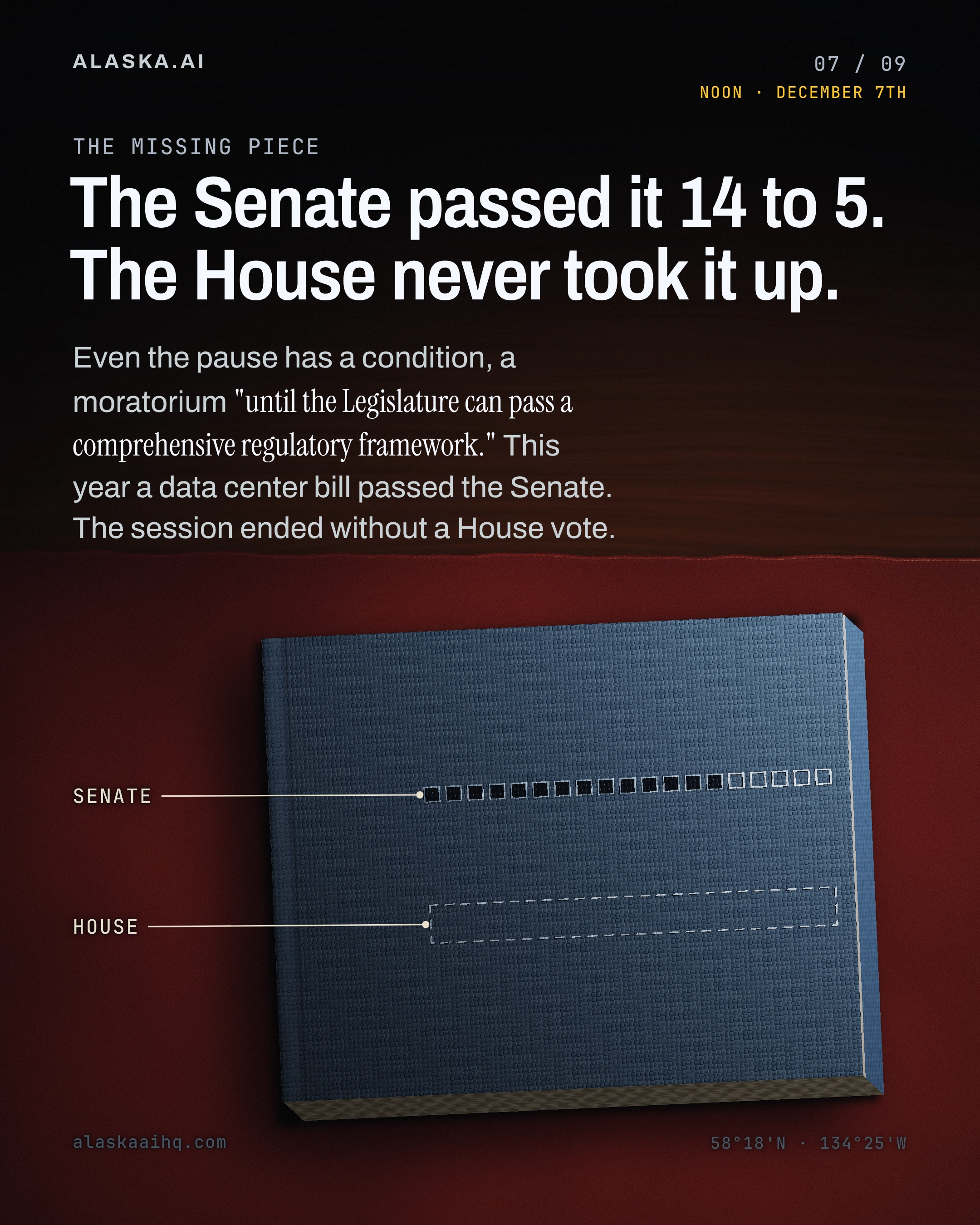
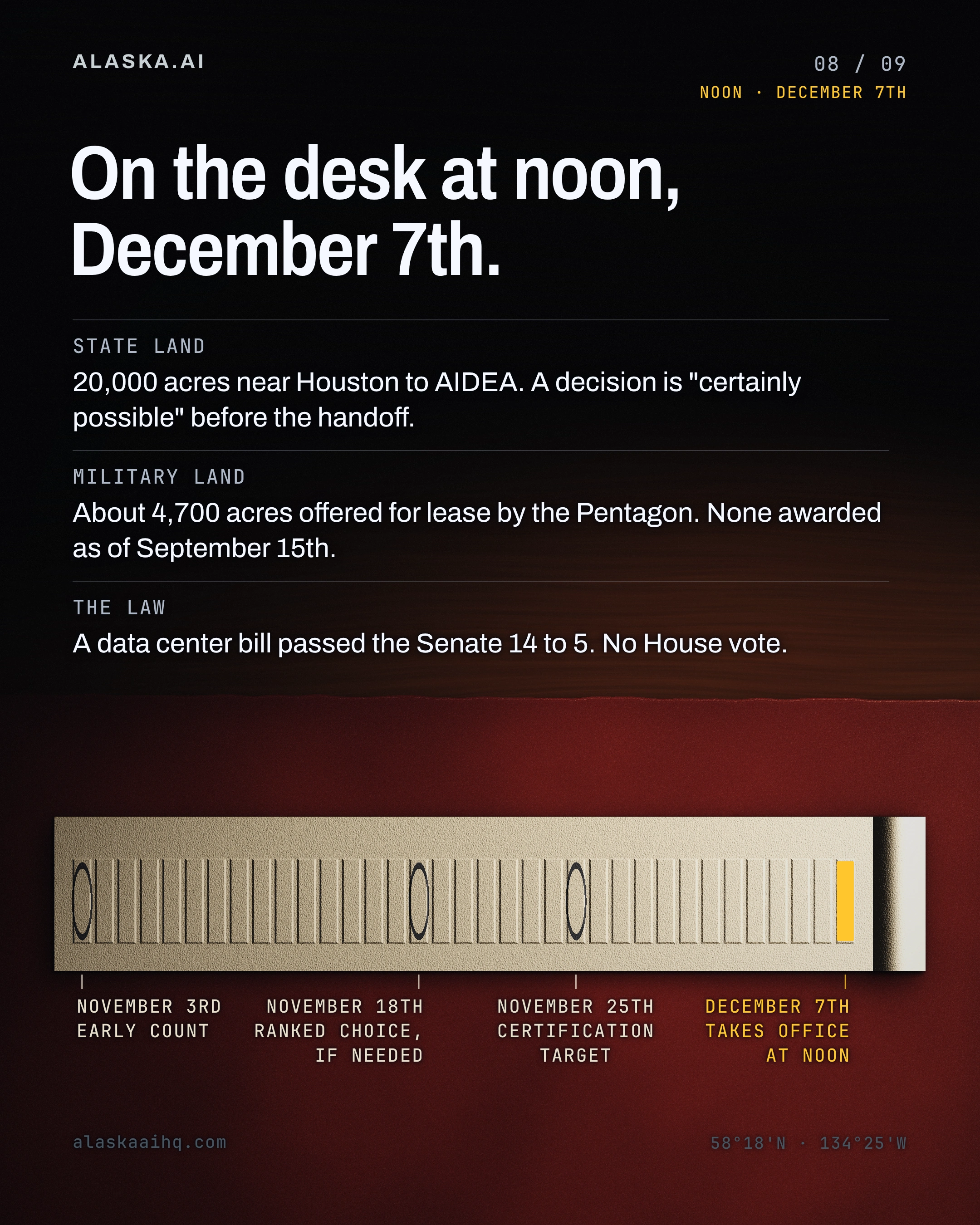
Ranked choice on November 18th, if needed, and certification by November 25th can settle who governs. Neither writes a data center law. The House never took up the bill the Senate passed 14 to 5.
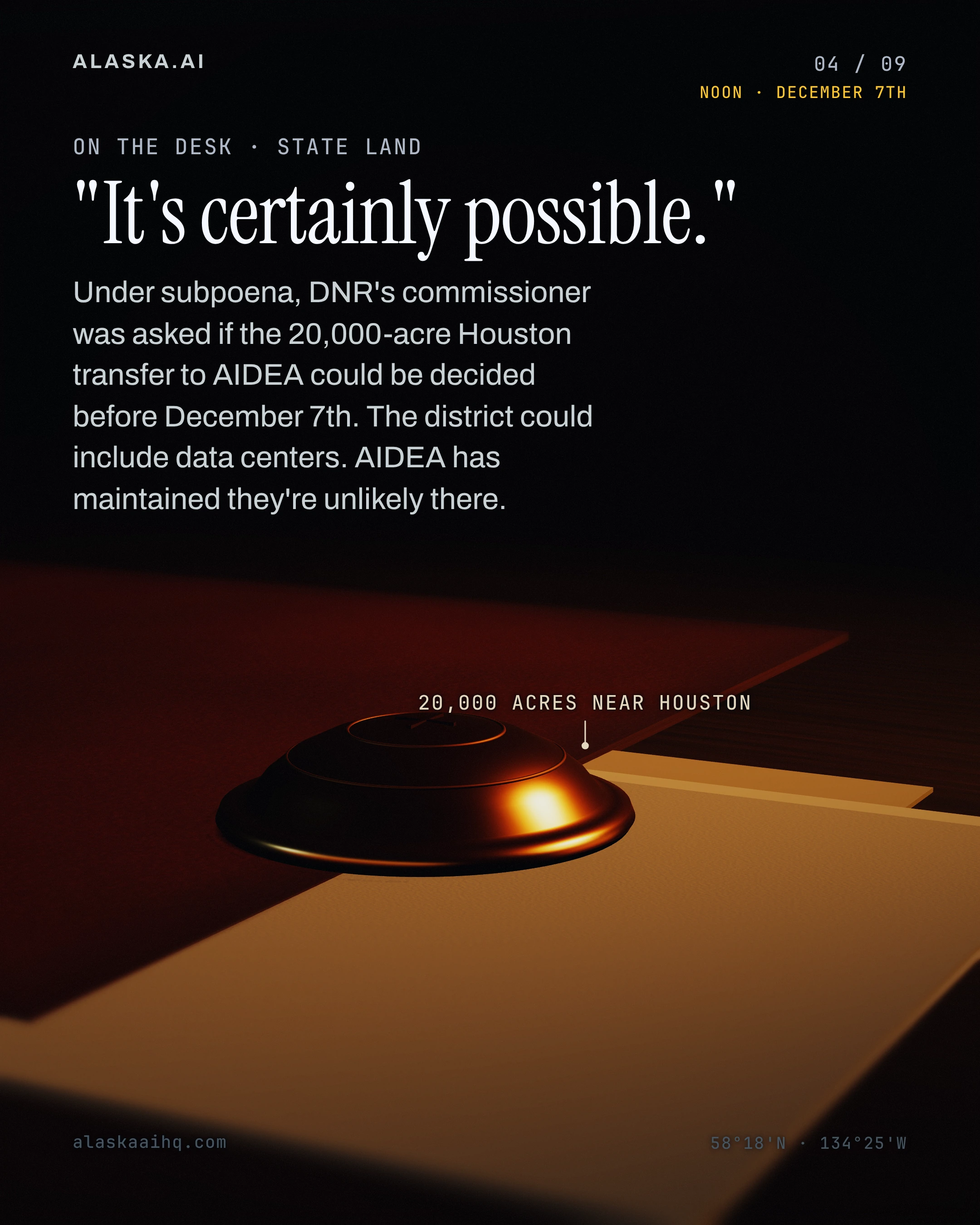
DNR's commissioner calls a Houston decision before noon December 7th "certainly possible." The site could include data centers. AIDEA has maintained they're unlikely.
Two frames hold the candidates' words. One each holds the early count, the DNR hearing, the Pentagon offer, a Fairbanks town hall of about 150 and the Senate vote.
What should a data center law require before DNR decides on Houston?
What we verified
50 CLAIMS, EACH RE-FETCHED FROM ITS SOURCE BEFORE THIS DECK SHIPPED
The Alaska Constitution sets the governor's four-year term to begin at noon on the first Monday in December after the election.
The University of Alaska Board of Regents meets November 4th through 6th on the University of Alaska Fairbanks campus.
UA Chief Information Technology Officer Ben Shier will present the latest version of UA's AI Engaged effort to the regents.
UA's AI Engaged statement establishes six guiding principles.
UA's AI Engaged statement establishes four investment priorities.
UA's AI Engaged statement establishes five system-wide expectations.
UA says AI Engaged preserves UAA, UAF and UAS responsibility for curriculum, academic integrity and faculty instructional judgment.
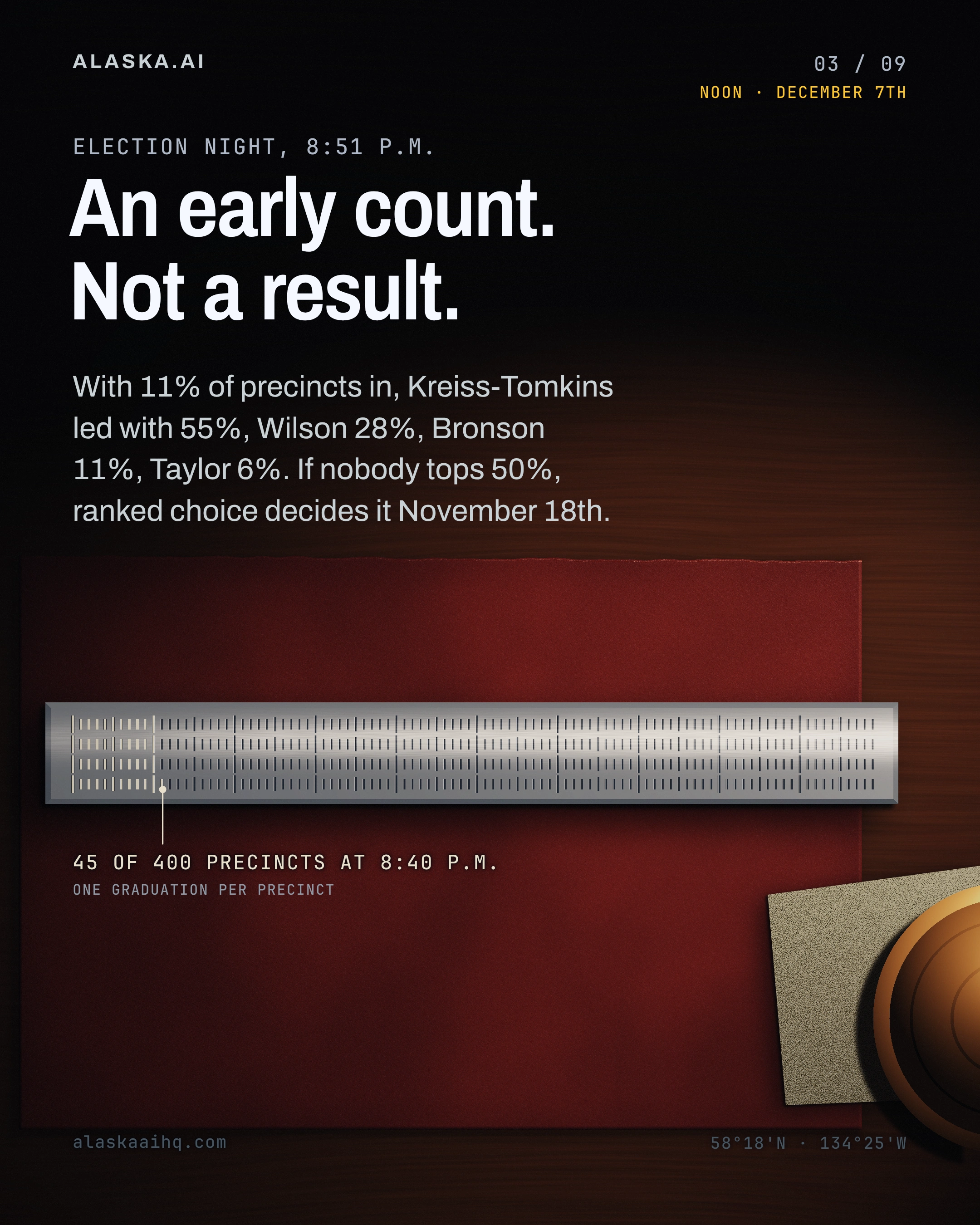
With 11% of precincts reporting on election night, Democrat Jonathan Kreiss-Tomkins led the first-round count for Alaska governor with 55% of the vote.
In the same early count, Republican Bernadette Wilson was second with 28%.
In the same early count, Republican Dave Bronson was third with 11%.
In the same early count, Republican Treg Taylor was fourth with 6%.
The Anchorage Daily News reported Kreiss-Tomkins at 55.3% of first-choice votes as of 8:40 p.m., with 45 of 400 precincts reporting.
The Anchorage Daily News reported just over 65,000 ballots counted as of Tuesday evening.
The Anchorage Daily News reported that Kreiss-Tomkins would become Alaska's first Democratic governor since 2002 if he keeps his lead.
If no governor candidate wins more than 50% in the first round, the race will be decided by ranked choice voting on November 18th.
The winner of the governor's race is set to take office at noon on December 7th.
Election officials plan to certify the general election by November 25th.
Based on historical trends, results reported on election night in Alaska tend to represent around 70% of the overall vote.
Kreiss-Tomkins said at a September 8th forum in Anchorage that he supports a moratorium on data center development in Alaska until the Legislature passes a regulatory framework.
Wilson said by text message that she would never allow Alaska to be littered with hyperscale data centers.
Bronson said he is a big believer in data centers.
Taylor said of data centers that Alaska needs to embrace it.
Taylor said data centers can produce a net savings to Alaska ratepayers.
Kreiss-Tomkins said in Fairbanks in mid-October that he thinks Alaska should pause on data centers.
Interior Secretary Doug Burgum said in Fairbanks on October 14th that people want to drop 10 billion on a data center without tax breaks.
The Alaska Senate voted 14 to 5 this year to pass a data center bill.
The Alaska House did not take up the Senate-passed data center bill before the legislative session ended.
The Pentagon has offered to lease about 4,700 acres of government land in Alaska to private companies for data centers.
The Pentagon wants up to a dozen new military data centers near Anchorage, Healy and Fairbanks.
As of September 15th, no Alaska military data center lease projects had been awarded.
Sen. Lisa Murkowski said she is not a proponent of data centers at JBER or Alaska's Interior military installations, citing an insecure energy base.
DNR Commissioner John Crowther appeared before the Senate Resources Committee under a rare legislative subpoena.
Asked whether DNR could decide the 20,000-acre Mat-Su transfer before a new governor takes office December 7th, Crowther said it is certainly possible.
The state could transfer 20,000 acres near Houston to AIDEA for a proposed industrial and energy district that could include data center development.
DNR is reviewing more than 2,100 public comments before a final decision on the Mat-Su transfer.
AIDEA officials have maintained that data centers are unlikely in the Mat-Su development because it lacks a reliable energy source.
Another 885 acres at Port MacKenzie are slated for no-cost transfer to AIDEA.
Kreiss-Tomkins had raised $1.8 million for his governor campaign by late July.
Six Anthropic employees collectively gave Kreiss-Tomkins $372,000, making them among his top contributors.
Kreiss-Tomkins's largest contribution, $100,000, came from an Anthropic employee.
Alaska's U.S. Senate race has drawn more money from employees of AI companies than any other 2026 Senate race, according to Stanford student journalists published by the Alaska Beacon.
At least 19 AI-company employees contributed approximately $119,000 to the campaigns of Sen. Dan Sullivan and Mary Peltola.
Peltola received at least $56,000 from AI-company employees, nearly all of it from Anthropic employees.
Sullivan received approximately $63,000 from AI-company employees for his campaign.
Another $35,000 in AI-company employee money went to Sullivan's leadership PAC, True North.
About 150 Fairbanks residents attended a data center town hall at the Wedgewood Resort on Thursday night, October 29th.
Legislators Scott Kawasaki, Maxine Dibert, Mike Prax and David Guttenberg attended the Fairbanks town hall.
Town hall organizer Sarah Hollister said the community's largest concern is that nobody asked them.
UAA associate professors Gregory Hartley and Joel Potter wrote in an Anchorage Daily News opinion piece that Anthropic's Claude generated the initial draft of UA's AI plan, a fact they say was concealed until October 9th.
According to the same op-ed, the UA Board of Regents will vote on November 5th on the AI plan.
Beats
This article is on Alaska data centers · Alaska land and permitting for AI · Defense and federal AI in Alaska · Alaska AI policy and legislation. Each beat page keeps every decision and every article on that subject in one place.