Anchorage Kept the 14 Days in Policy, Not Code
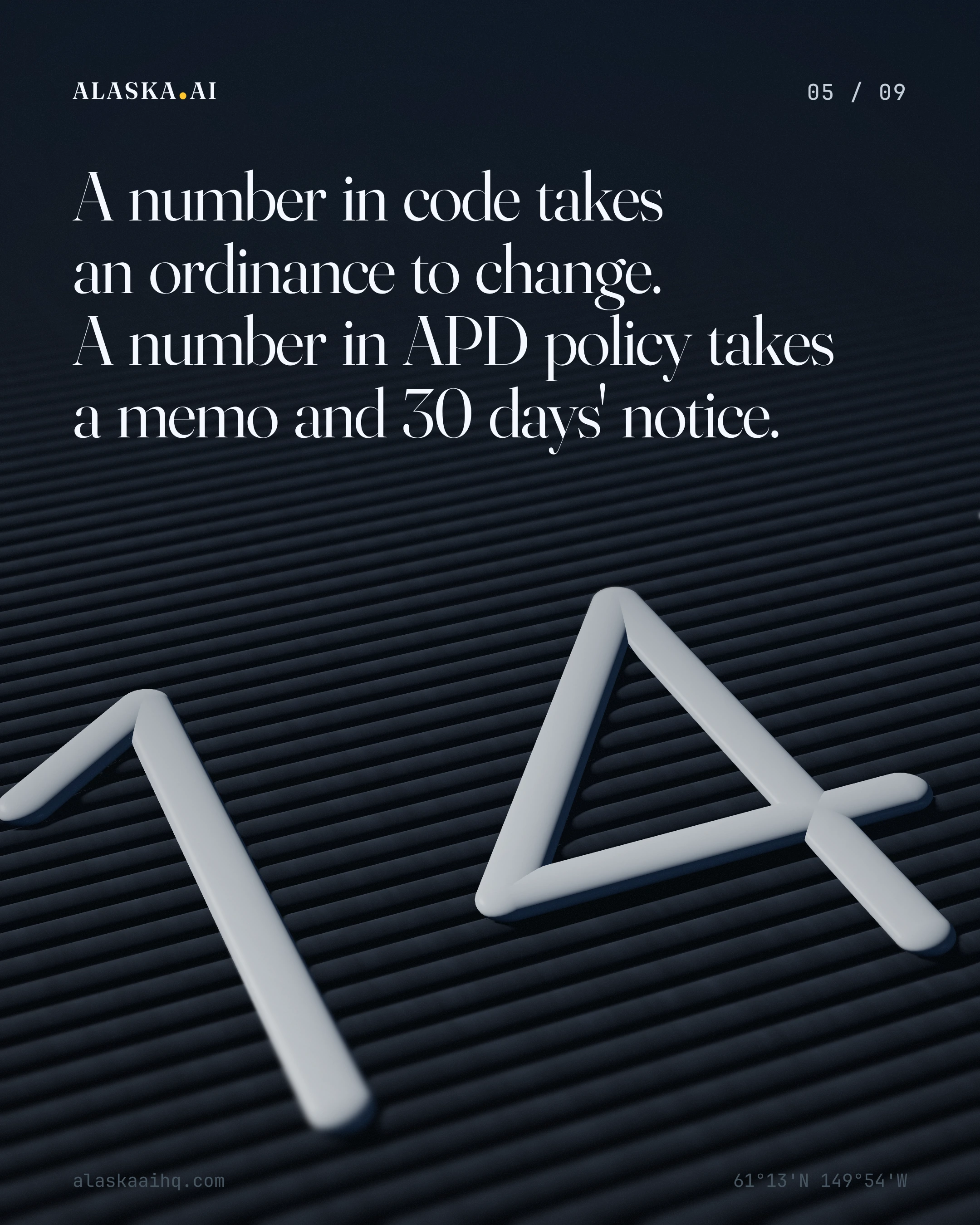
If you drive in Anchorage, a patrol car's plate reader can log your plate, and APD's own policy deletes it after 14 days.
The deck
SWIPE, SCROLL OR CLICK A SLIDE TO GO FULLSCREEN · 9 SLIDES






The story
An amendment to put that clock in city code was rejected. Alaska's News Source reports the ordinance passed 11 to 1.
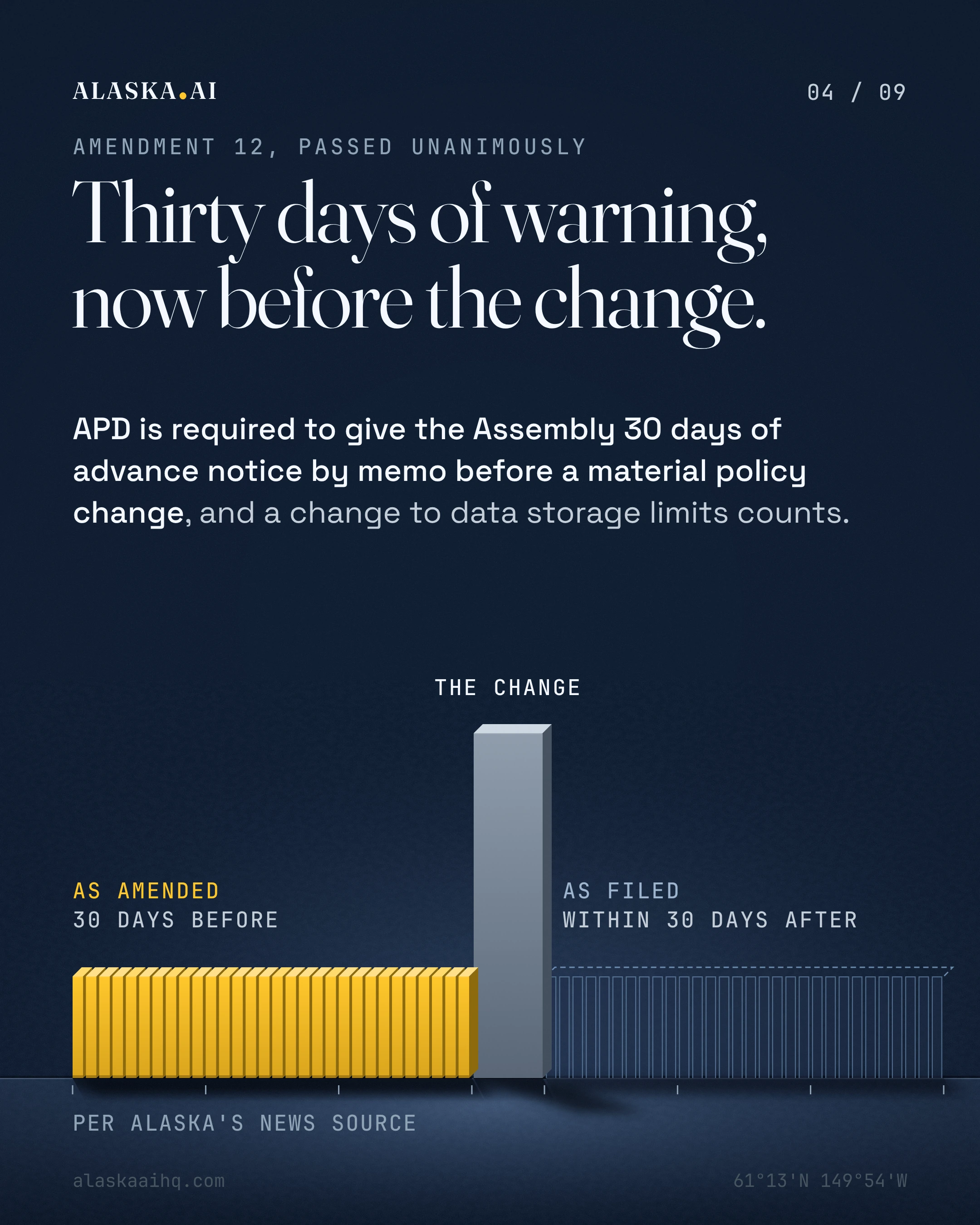
Erin Baldwin Day's Amendment 12, passed unanimously, requires a memo to the Assembly 30 days before APD changes a storage limit. The filed text gave notice within 30 days after.
The Anchorage Daily News reports a committee will meet monthly for a year to recommend, not discipline, and that APD relies more on AI to aid investigations. The city chose notice over numbers.
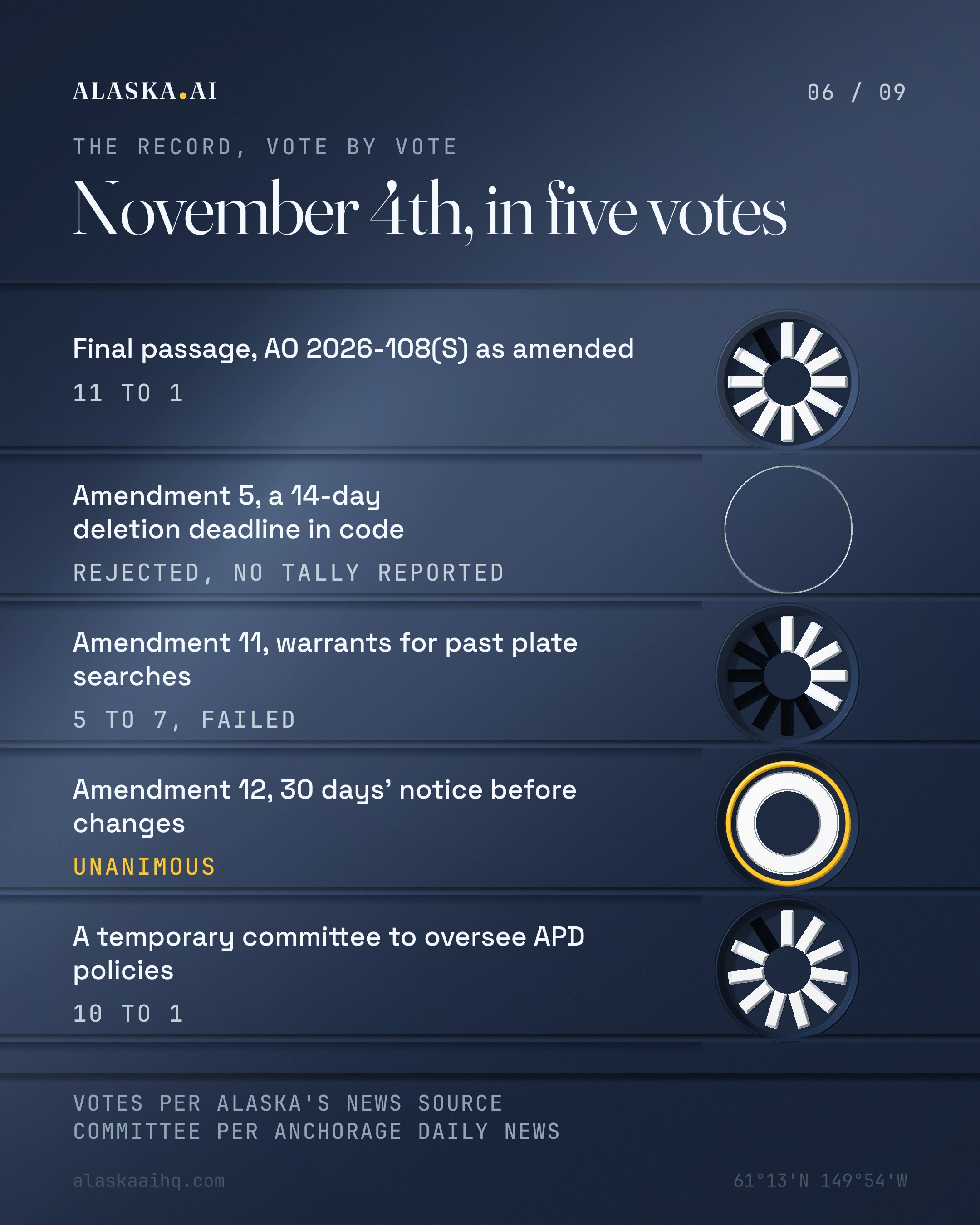
Five votes from November 4th sit beside the notice rule as filed and as amended, the committee's limits and the filed AI definition.
Should shortening the 14 days take only a memo, and lengthening it take an Assembly vote?
What we verified
66 CLAIMS, EACH RE-FETCHED FROM ITS SOURCE BEFORE THIS DECK SHIPPED
APD's Safe Anchorage page states that APD doesn't use Flock cameras.
APD's Safe Anchorage page says all license plate data its readers scan is automatically deleted after 14 days.
APD's Safe Anchorage page says the Anchorage Assembly banned municipal use of facial recognition technology in 2023.
APD's Safe Anchorage page says the Flock cameras appearing in Anchorage belong to private businesses and that APD has no access to their feeds.
APD's Safe Anchorage page says its plate reader system runs only in patrol vehicles equipped with a dash camera, with no fixed roadside readers.
The mayor's substitute, as filed September 15th, defined surveillance technology as technology that conducts surveillance using fully or partially automated machine learning, artificial intelligence or similar technology.
The mayor's memo on the substitute said it focuses the definition on technologies that use artificial intelligence or other automated tools to locate and identify people.
The mayor's substitute, as filed September 15th, required the plate reader policy to limit storage of non-evidence data based on articulable operational needs, without setting a number of days.
The mayor's substitute as filed September 15th contained no fourteen-day deletion rule and no 2031 sunset for license plate readers.
The mayor's substitute as filed September 15th required the administration to send the Assembly its plate reader policy within 30 days of any material change.
Under the mayor's substitute as filed September 15th, a complaint about a violation started a 45-day clock for the city to investigate and act.
The mayor's substitute as filed September 15th exempted tests, pilots and evaluations of an expanded capability from prior Assembly approval, with no stated time limit.
The mayor's substitute as filed September 15th would take effect 30 days after the Assembly passes it.
David Guttenberg, one of the officials Alaska's News Source named at the town hall, is a member of the Fairbanks North Star Borough Assembly.
Fairbanks North Star Borough Ordinance 2026-42, sponsored by Mayor Hopkins, would establish a temporary moratorium on land use permits for large scale data centers.
The October 22nd agenda refers Ordinance 2026-42 to the borough Planning Commission with a recommendation due back in 90 days.
The Alaska Energy Authority says Alaska received a $32.8 million federal grid resilience formula allocation for federal fiscal years 2025 and 2026.
AEA says the allocation is $12.8 million more than it had initially anticipated.
AEA says Alaska's allocation ranks third among all state allocations.
The U.S. Department of Energy's Office of Electricity announced about $967 million in grid resilience formula funding on October 20th, according to AEA.
AEA says Alaska has been awarded $39.8 million to date under the Grid Resilience Formula Grant Program, with six projects selected across two solicitations.
The Anchorage Assembly voted 11-1 to pass the administration-backed substitute ordinance AO 2026-108(S) as amended, according to Alaska's News Source.
The Assembly approved the police surveillance framework late on Wednesday night, November 4th.
The final vote came after a series of contentious 5-7 floor votes that defeated several amendments, according to Alaska's News Source.
Amendment 5, sponsored by Vice Chair Daniel Volland and Member Sydney Scout, would have written a mandatory 14-day data deletion deadline into municipal code.
Assembly members rejected Amendment 5, the 14-day deletion amendment.
Municipal Attorney Eva Gardner said APD already operates under a department policy that purges data after 14 days, according to Alaska's News Source.
Gardner argued that retention timelines must remain adaptable based on "articulable operational needs", according to Alaska's News Source.
Amendment 11 would have required officers to secure judicial warrants for retrospective searches of license plate reader databases.
Members voted 5-7 to defeat Amendment 11.
APD Chief Sean Case warned that requiring warrants for public road camera data would hamstring responses ranging from major threats to routine hit-and-runs, according to Alaska's News Source.
The Assembly voted unanimously to pass Amendment 12, sponsored by Assembly Member Erin Baldwin Day.
Amendment 12 requires APD to give the Assembly 30 days of advance notice, by informational memorandum, before implementing any material policy change.
Amendment 12 defines any change to data storage limits as a trigger that requires prior notice to the Assembly.
The approved ordinance bans sharing data out of state to enforce laws against conduct that is legal in Alaska, such as reproductive health care, according to Alaska's News Source.
The approved ordinance creates mandatory public reporting and Assembly oversight of police technology contracts and policies, according to Alaska's News Source.
APD operates its own automated license plate readers mounted on patrol vehicles, according to Alaska's News Source.
The Assembly voted 10-1 at its Wednesday regular meeting to create a temporary committee to oversee APD policies.
The committee was created by a resolution submitted by Assembly member Kameron Perez-Verdia.
Assembly member Keith McCormick was the only member to vote against the committee.
McCormick said of the new committee "It does seem a bit duplicative to me."
The resolution calls for the committee to meet publicly at least once a month.
The committee is set for an initial one-year term, after which the Assembly decides whether to extend or dissolve it.
The committee will include at least four Assembly members, including Perez-Verdia.
Assembly Chair Anna Brawley is to appoint at least three of the committee's members.
The committee's work is limited to evaluating new or existing rules and recommending changes to Anchorage police use-of-force and technology policies.
The committee is barred from taking part in disciplinary proceedings or investigating individual cases or APD personnel.
APD has started to rely more on new technological tools, including surveillance cameras throughout the city and artificial intelligence used to aid investigations, according to the Anchorage Daily News.
In September the city released a 121-page final report by a public safety consulting firm that found Anchorage police reported use-of-force incidents at higher rates than the Northwest's largest departments.
Assembly member Sydney Scout said of the October 20th meeting "I think we spent three hours getting through like, one and a half amendments."
Police Chief Sean Case said the original ordinance's reach could hamper APD's ability to adapt to technologies like dashboard-mounted license plate readers and commercial AI products, according to the Anchorage Daily News.
APD's greater reliance on technology has included incorporating artificial intelligence into casework procedures, according to the Anchorage Daily News.
The original August version of AO 2026-108 was sponsored by Vice Chair Daniel Volland, Sydney Scout and Keith McCormick.
Mayor Suzanne LaFrance's administration introduced its own surveillance ordinance, co-sponsored by Assembly members Yarrow Silvers and Jared Goecker.
The Assembly voted 8 to 4 in early September to approve funding to expand APD's Real Time Crime Center, according to Alaska Public Media.
The crime center expansion approved in September cost just under $600,000, according to Alaska Public Media.
At full capacity the expanded crime center could access up to 750 cameras across the city, according to officials quoted by Alaska Public Media.
As of late August, 238 cameras were registered with APD, according to Alaska's News Source.
As of late August, 11 cameras were integrated with APD, according to Alaska's News Source.
About 150 Fairbanks residents gathered on Thursday night, October 29th, at the Wedgewood Resort for a town hall on data centers.
A Fairbanks Daily News-Miner letter from Sarah Hollister announced the town hall for the evening of October 29th at Wedgewood Resort's Taiga Center.
Organizer Sarah Hollister told Alaska's News Source "Our largest concern is that nobody asked us."
Attendee Aimee Moore told Alaska's News Source "I would like to see regulations in place, very strict regulations put in place."
Attendee Randy Griffin backed building AI data centers in Alaska, saying "every little bit of development helps our economic prowess here in Alaska."
Speakers raised concerns about light, air, water and noise pollution, warming permafrost and the increased use of artificial intelligence, according to Alaska's News Source.
A November 1st News-Miner letter from Steve Wiseman argued that stopping data centers in Alaska would be like stopping the gold rush.
Beats
This article is on Alaska AI policy and legislation. Each beat page keeps every decision and every article on that subject in one place.