Who Drafted UA's AI Statement?
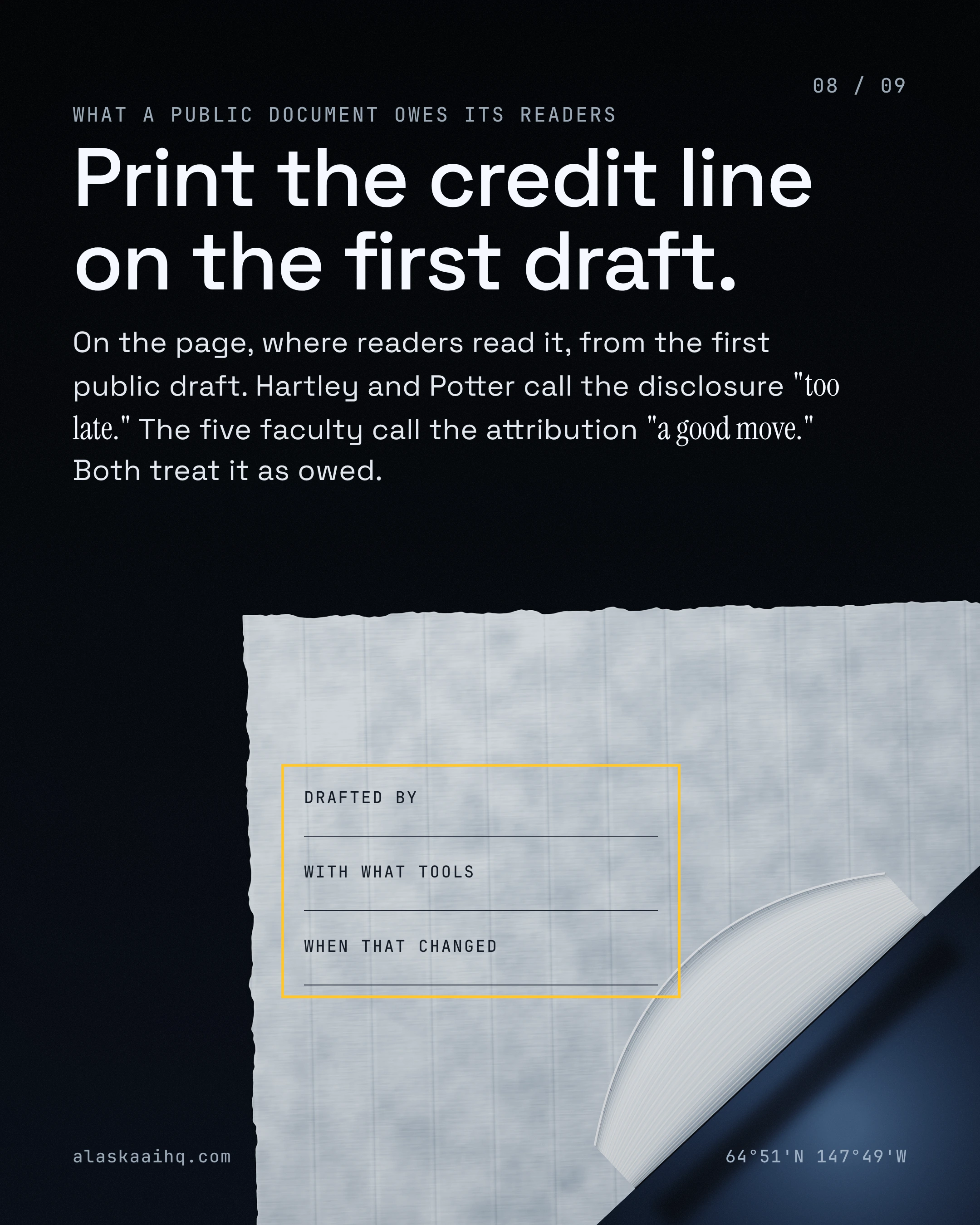
University of Alaska regents, your AI statement should have printed its credit line from the first draft.
The deck
SWIPE, SCROLL OR CLICK A SLIDE TO GO FULLSCREEN · 9 SLIDES
The story
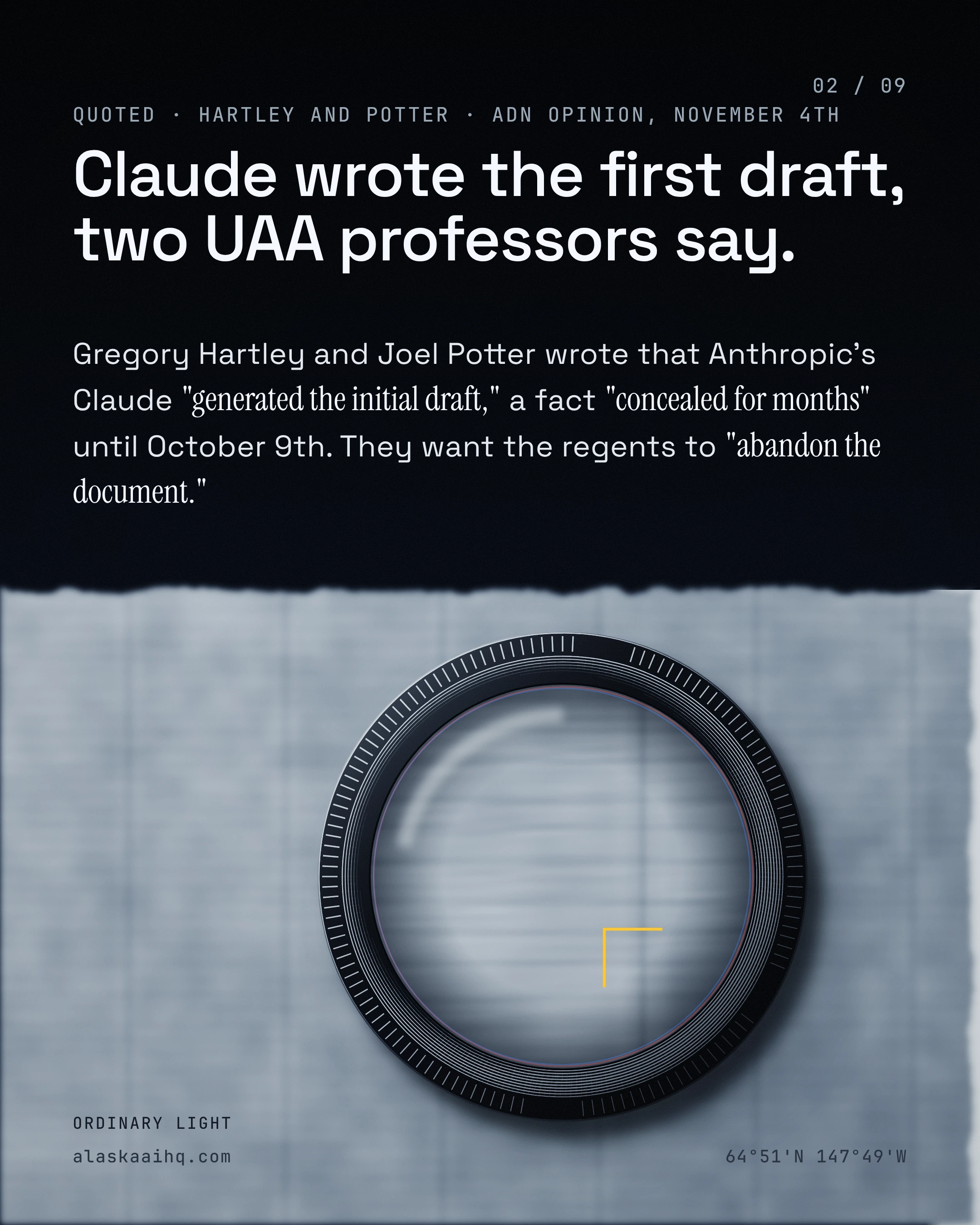
Who drafted AI Engaged? UAA professors Gregory Hartley and Joel Potter wrote that Anthropic's Claude generated the initial draft. They say that was concealed until October 9th.
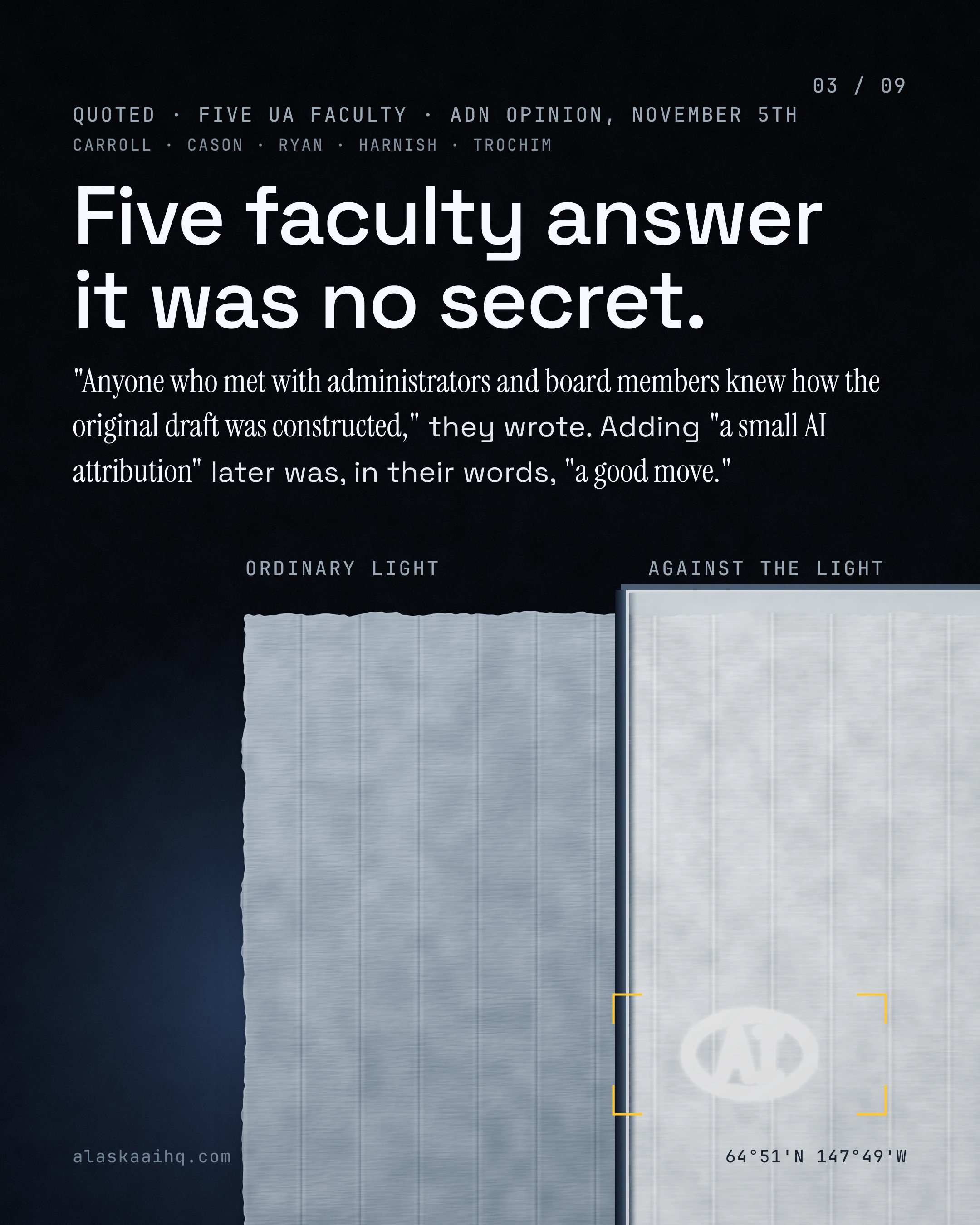
Was it hidden? Five UA faculty say it was not. Anyone who met with administrators and board members knew, they wrote. They called the later "small AI attribution" a "good move."
Who is right? Both can be true. That is the problem. Known in the room is not disclosed in public.
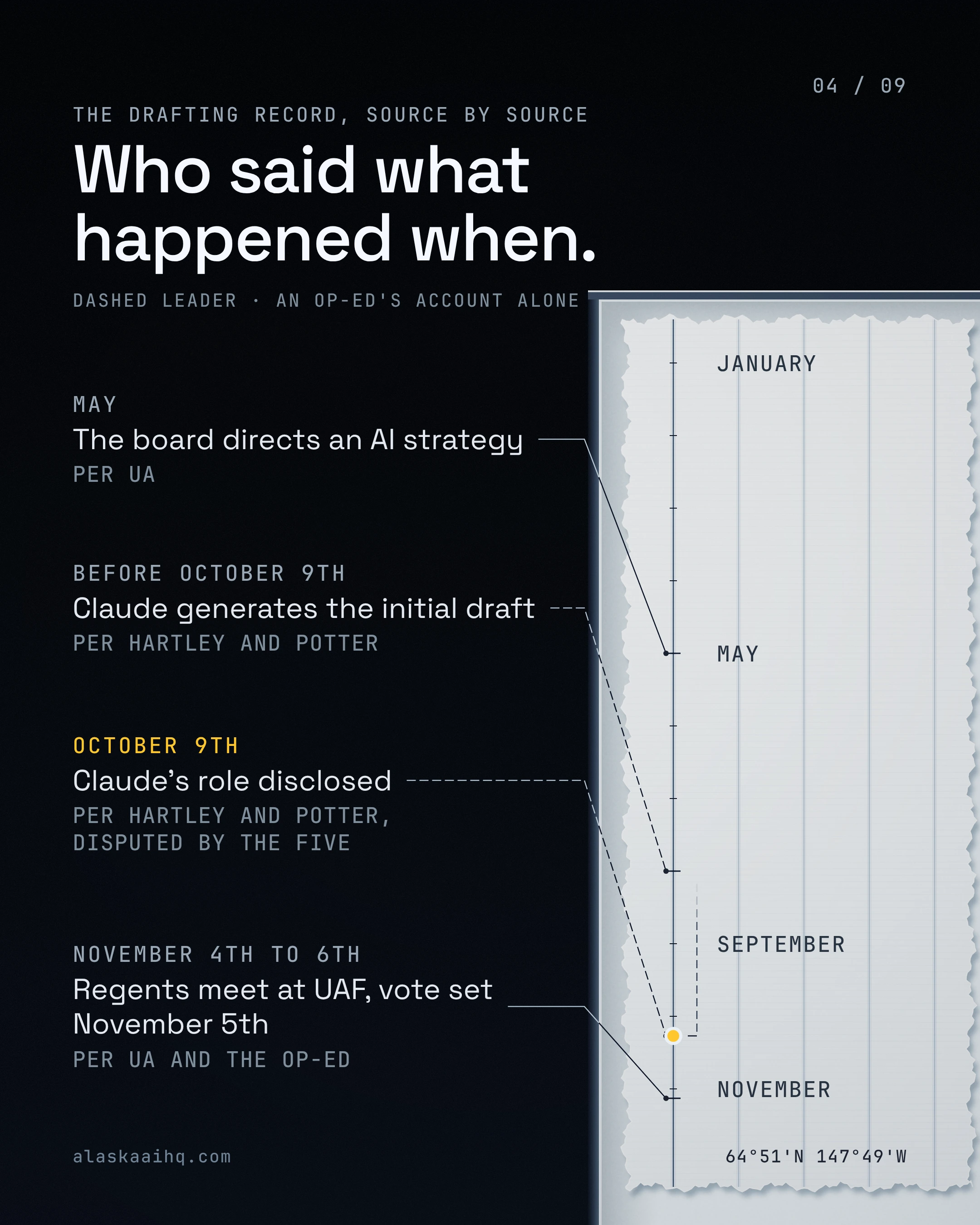
Both op-eds in their own words face a dated record tagged by source, then what the statement would set and the case for a credit line.
Should a printed credit line be a board rule for every UA document, or each drafter's call?
What we verified
45 CLAIMS, EACH RE-FETCHED FROM ITS SOURCE BEFORE THIS DECK SHIPPED
Hartley and Potter wrote that the University of Alaska Board of Regents would vote on November 5th on its AI statement.
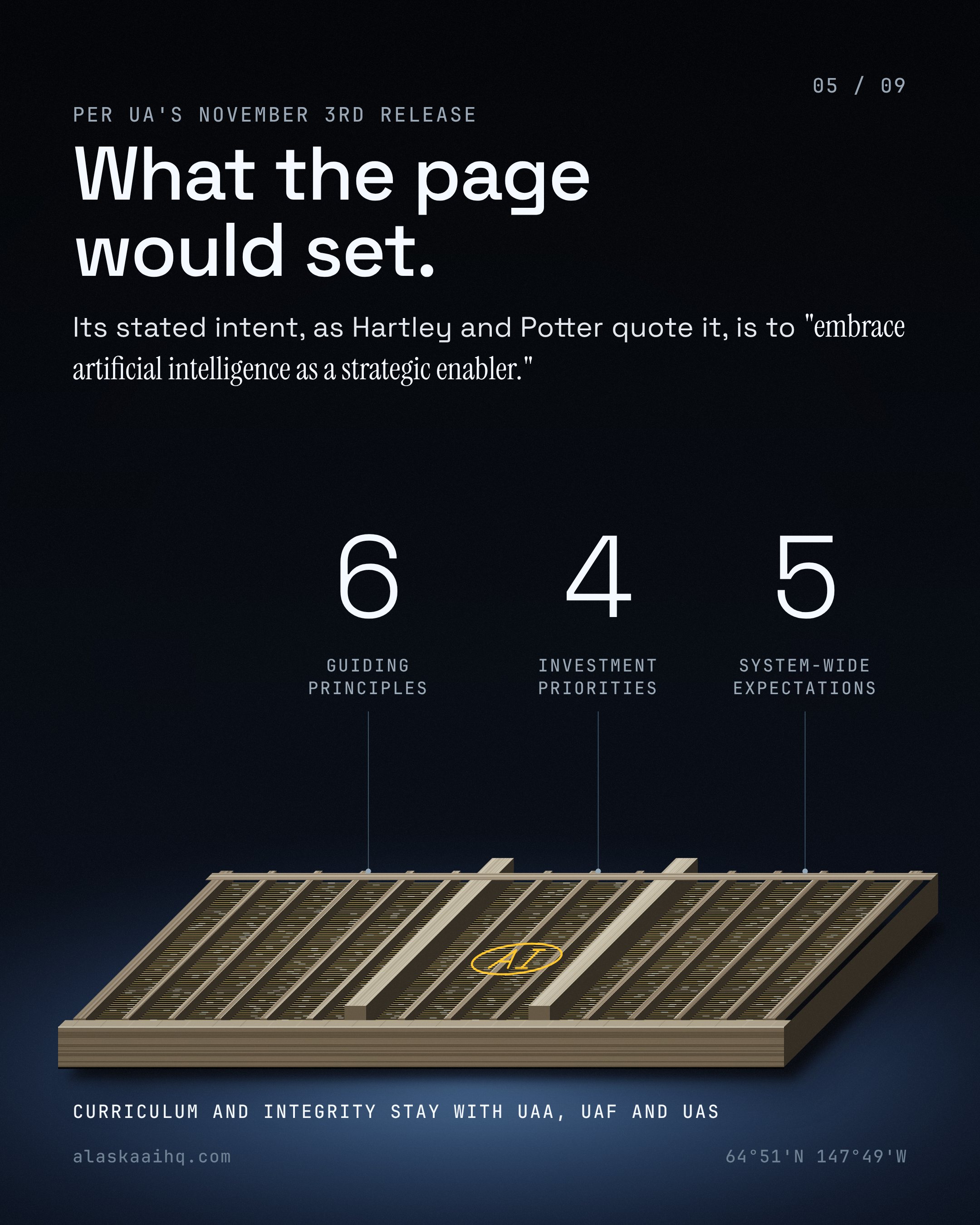
Hartley and Potter quote the statement as saying the Board of Regents declares its intent for the University of Alaska to embrace artificial intelligence as a strategic enabler of student success, institutional effectiveness, and Alaska's global leadership in arctic and climate science.
Hartley and Potter wrote that the board commissioned a strategic document called AI Engaged in June 2026.
Hartley and Potter wrote that Anthropic's Claude generated the initial draft of AI Engaged.
Hartley and Potter wrote that the use of Claude was concealed for months until October 9th.
Hartley and Potter wrote that the disclosure came too late and remains incomplete.
Hartley and Potter wrote that studies have documented a pro-AI bias in outputs from Claude and other large language models.
Gregory Hartley and Joel Potter are associate professors at the University of Alaska Anchorage.
Hartley and Potter wrote that the regents should abandon the document and establish safeguards against undue influence from Big Tech.
Hartley and Potter wrote that UA board members and administrative executives are not required to disclose financial holdings in education or technology companies.
Hartley and Potter wrote that more members of the UA community should have been directly involved in drafting UA's AI plan.
A rebuttal op-ed by five UA faculty members wrote that anyone who met with administrators and board members knew how the original draft was constructed.
The rebuttal authors wrote that AI use in drafting the statement was not concealed.
The rebuttal authors wrote that the regents were already pro-AI before the draft.
The rebuttal authors wrote that they would prefer the statement take a more neutral stance toward AI.
The rebuttal authors wrote that eventually adding a small AI attribution was a good move.
The rebuttal authors wrote that the work behind the statement began with a September 2025 AI symposium funded by the Faculty Alliance Faculty Initiative Fund.
The rebuttal authors wrote that the symposium produced the UA AI Coordinating Council.
James Ryan, one of the rebuttal authors, chairs the UA Statewide Advisory Committee and teaches writing at the University of Alaska Southeast.
The rebuttal authors wrote that UAF faculty member Jennifer Carroll and Chief Information Technology Officer Ben Shier gave a joint presentation to the regents in May.
The University of Alaska said its Board of Regents would meet in Fairbanks on the UAF campus from November 4th to 6th and consider new guidelines for AI use.
The University of Alaska said Chief Information Technology Officer Ben Shier would share the latest version of AI Engaged at the November meeting.
The University of Alaska said that in May the Board directed UA leadership to develop a cohesive strategy on artificial intelligence.
The University of Alaska said the AI statement establishes six guiding principles, four investment priorities and five system-wide expectations.
The University of Alaska said the statement preserves UAA, UAF and UAS responsibility for curriculum, academic integrity and faculty instructional judgment.
The University of Alaska said the final AI document incorporates feedback from students, faculty and staff across the system.
The University of Alaska Board of Regents is an 11-member volunteer board.
KTOO reported that the draft AI policy would require all three University of Alaska campuses to have an AI plan for students, faculty and staff.
KTOO reported in September that university leadership planned to submit a finalized draft for approval at the November regents meeting.
KTOO cited a 2025 Inside Higher Ed survey finding that about 85 percent of college students use generative AI in their coursework.
ADN reported that of 150 UAA students cited for academic misconduct, 119 used AI, according to a Dean of Students Office report released in August.
ADN reported that the AI cases accounted for 1.1 percent of the more than 10,500 students who attended UAA last semester.
ADN reported that the UAA report showed a 73 percent increase in AI use for plagiarism last year and a 56 percent increase in academic misconduct overall.
The UA system does not have a single policy governing AI use across more than a dozen campuses, ADN reported.
ADN reported that the draft guiding principles call for appropriate AI in every discipline and say humans must remain in the loop.
North of 60 Mining News reported that the UAF-led critical minerals engine was one of 12 teams chosen from 294 initial applications.
North of 60 Mining News reported that the NSF award provides $15 million over the first two years with the potential for another $145 million over the next decade.
North of 60 Mining News reported that the engine intends to advance AI-enabled technologies to accelerate mineral exploration.
North of 60 Mining News reported that Alaska hosts occurrences of 56 of the 60 minerals deemed critical to the United States.
North of 60 Mining News reported that the engine's network includes more than 50 partners, among them Teck Resources, operator of Red Dog.
Alaska Public Media reported that the Regulatory Commission of Alaska approved an exchange agreement among Enstar, Matanuska Electric Association and Hilcorp in late October.
Alaska Public Media reported that the agreement allows Enstar to buy about 1.2 billion cubic feet of natural gas.
Alaska Public Media reported that the deal boosts Enstar's year-end storage projection to about 5 billion cubic feet against a goal of 6 to 7 billion.
Alaska Public Media reported that Enstar must deliver the equivalent gas back to MEA by March 2028.
Alaska Public Media reported that MEA predicts the agreement will save its customers about $2 million between 2027 and 2029.
Beats
This article is on Alaska AI policy and legislation. Each beat page keeps every decision and every article on that subject in one place.