Alaska's STAK Lease, Priced by the Megawatt-Hour
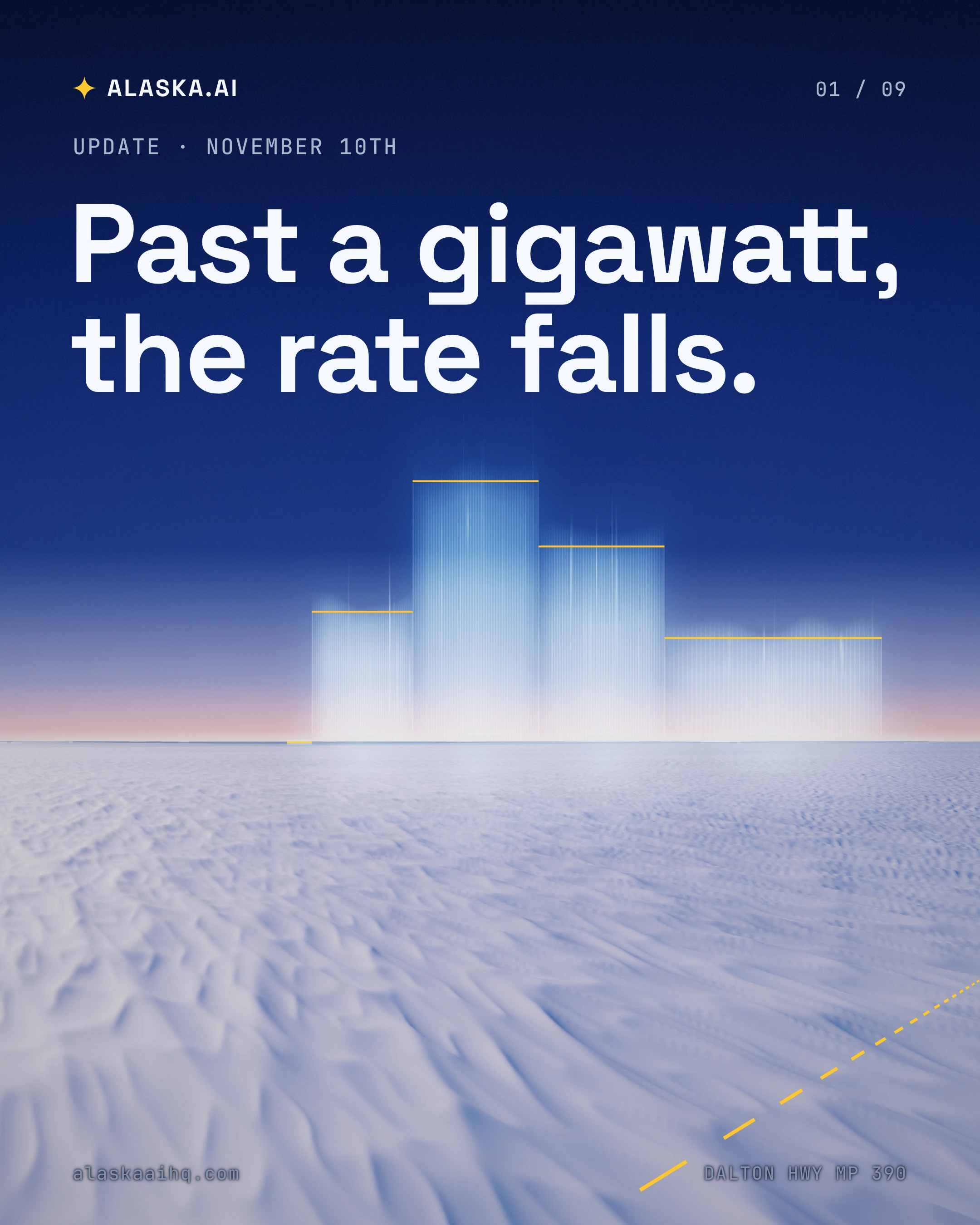
$0.40 a megawatt-hour, then $0.16. Alaska's new data center lease cuts its power surcharge once the campus passes a gigawatt.
The deck
SWIPE, SCROLL OR CLICK A SLIDE TO GO FULLSCREEN · 9 SLIDES
The story
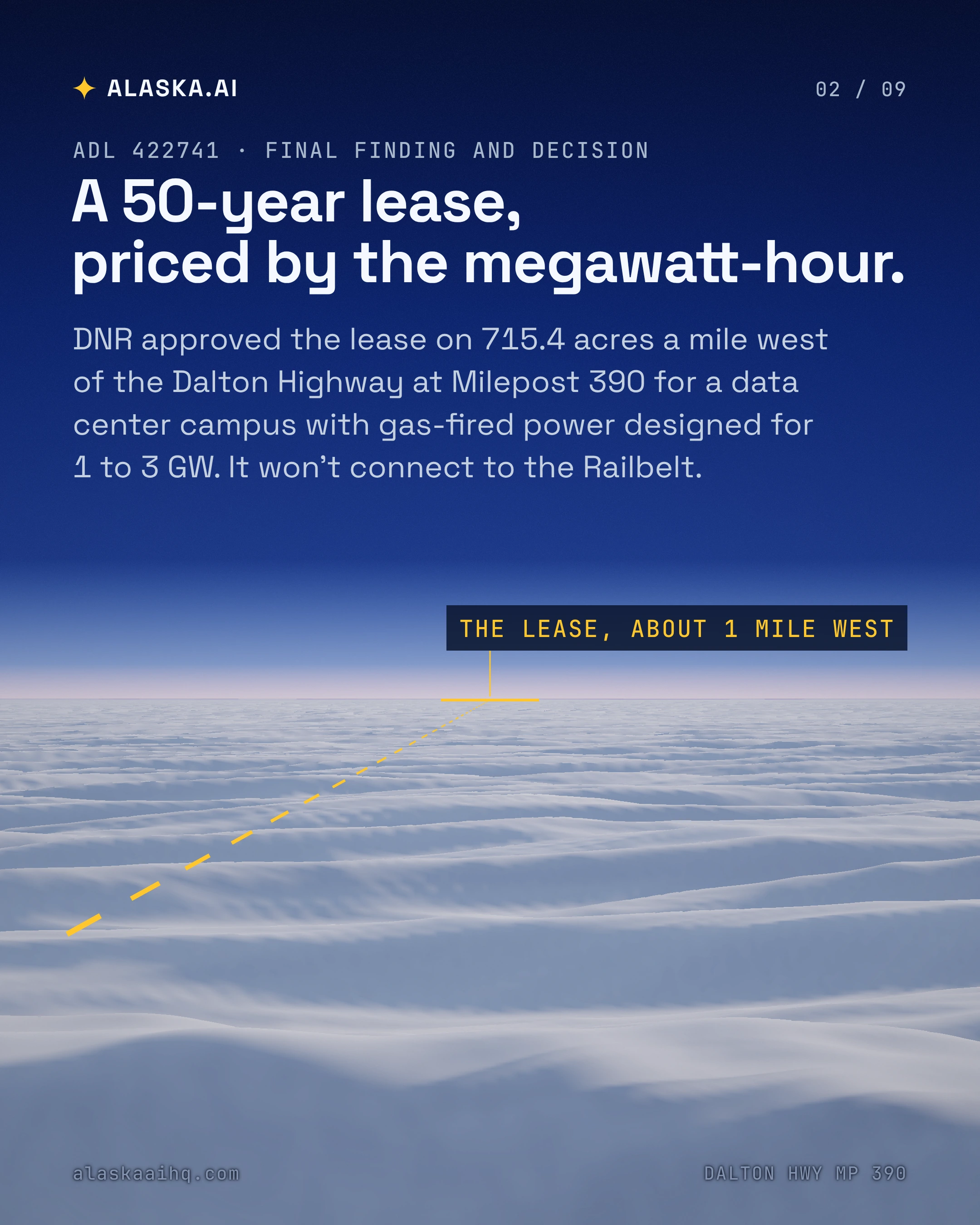
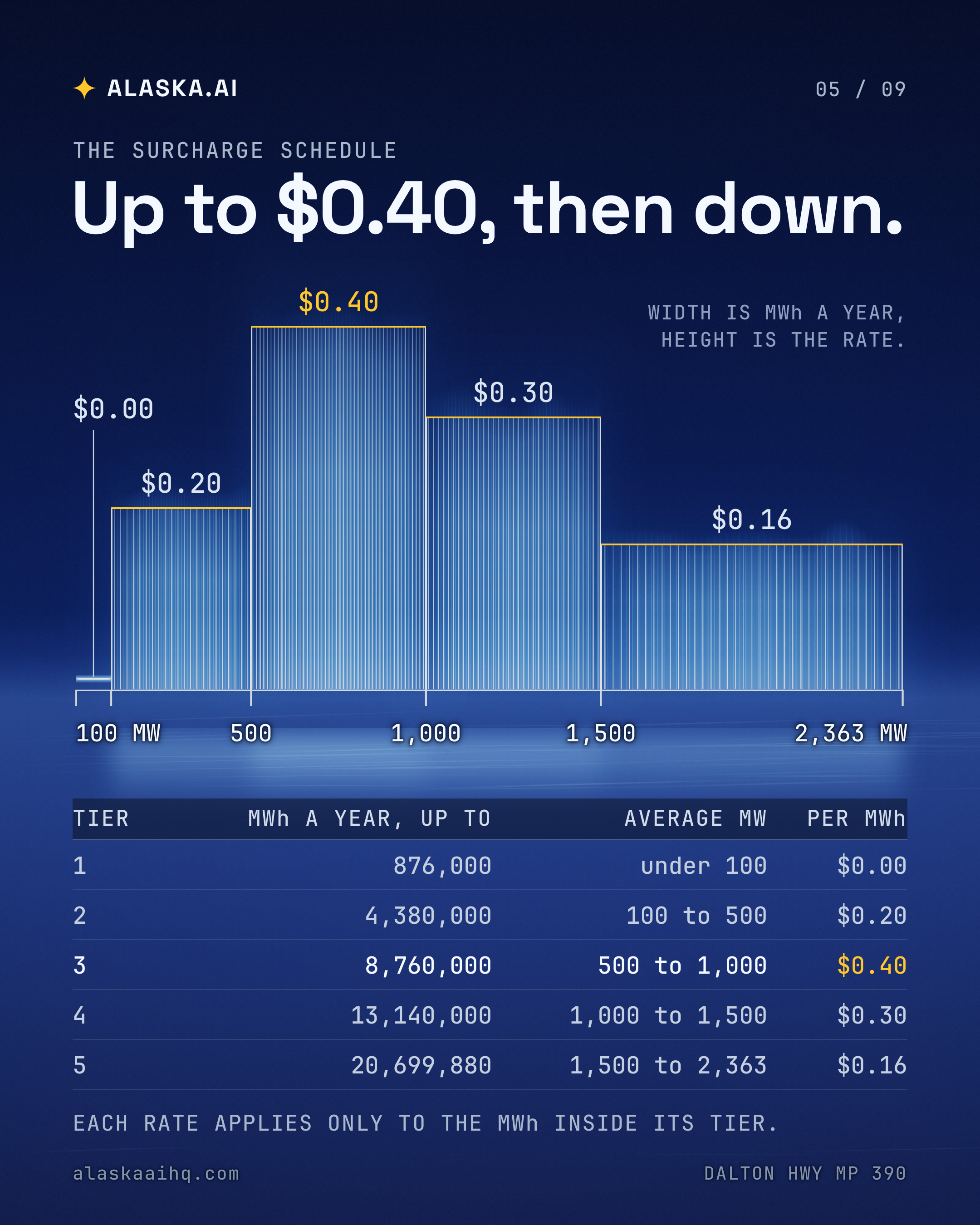
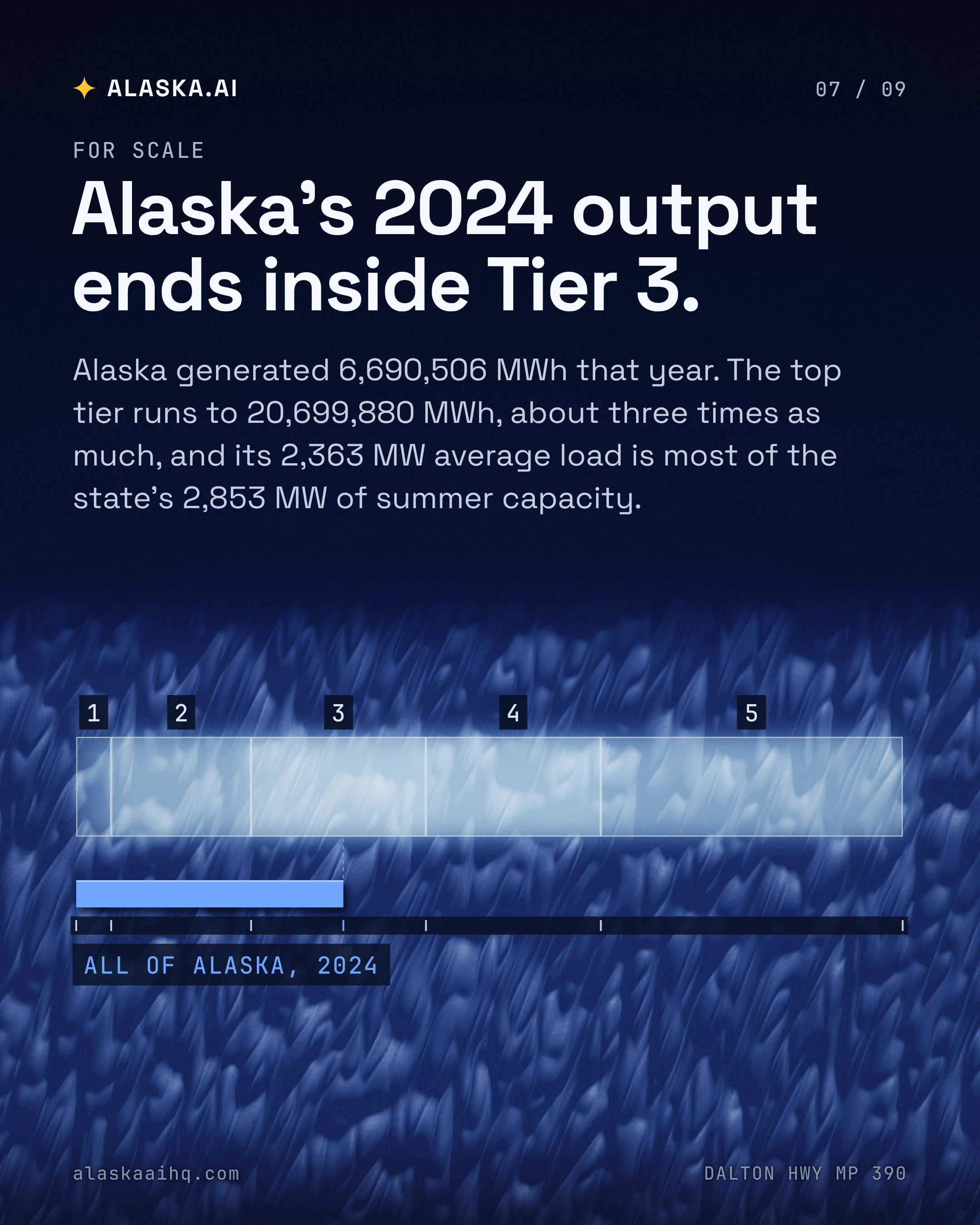
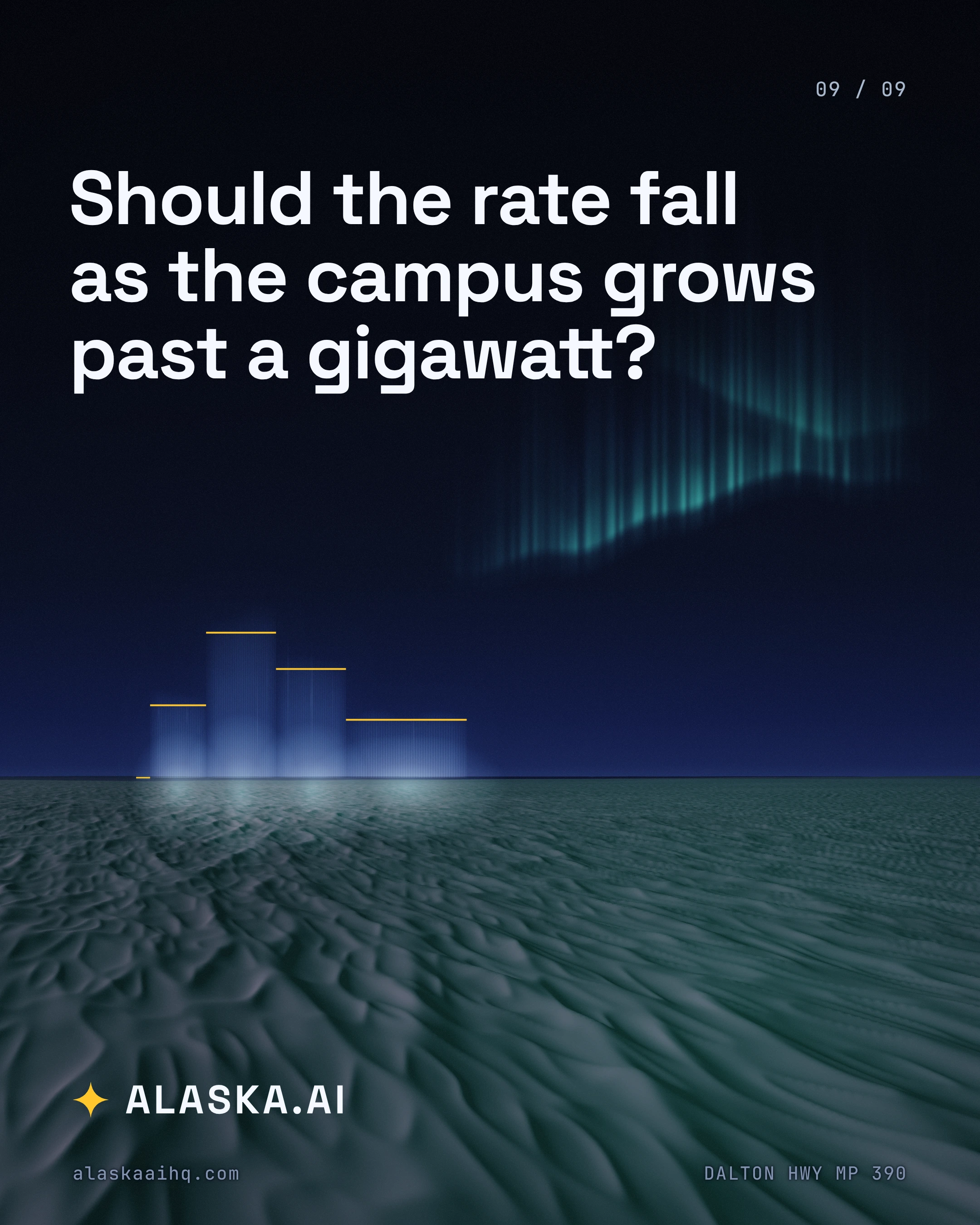
DNR approved the 50-year lease on November 10th for 715.4 acres a mile west of the Dalton at Milepost 390. STAK's rent is the larger of an appraised Base Rate and a surcharge on each megawatt-hour delivered to compute. No surcharge under 100 MW of average load. $0.20 to 500 MW. $0.40 to 1,000 MW. Then $0.30 and $0.16. DNR says the decline is meant to encourage the full planned buildout. The top tier ends at about three times all the electricity Alaska generated in 2024.
Five columns of light carry the tiers at true scale, beside DNR's reason for the drop, Alaska's 2024 output and the permits still ahead.
A fair incentive to finish the build, or the state charging less right where the load is largest?
What we verified
64 CLAIMS, EACH RE-FETCHED FROM ITS SOURCE BEFORE THIS DECK SHIPPED
Alaska DNR issued its Final Finding and Decision on ADL 422741 for STAK Energy Corporation on November 10th.
The decision finds that issuing STAK a 50-year negotiated lease is in the State's best interest.
The project site lies about one mile west of the Dalton Highway at Milepost 390.
The lease covers approximately 715.4 acres of state surface estate.
The lease site is approximately 26 miles south of Deadhorse.
The planned natural gas-fired power system is designed to produce 1 to 3 gigawatts of electricity.
The lease grant authorizes generation facilities with aggregate capacity up to three gigawatts to support hyperscale data centers and artificial intelligence computing facilities.
DNR received 1,205 public comments on the preliminary decision between May 12th and July 17th.
STAK's March 12th revised application raised the projected construction workforce from up to 500 to up to 1,500 workers.
The revised application replaced the earlier modular data center units with planned high-performance computing units.
Construction is expected to need a peak workforce of up to 1,500 workers.
Ongoing operations are anticipated to employ between 50 and 150 permanent personnel.
Construction capital expenditures are estimated at approximately $500 million.
The project will not be interconnected to the Railbelt or any other existing Alaska utility network.
The project is to be built in phases over an estimated six-year buildout period.
Fuel use at full operating capacity is anticipated at 350 to 500 million standard cubic feet of gas per day.
DNR says the lease would support the first gigawatt scale data center project in Alaska.
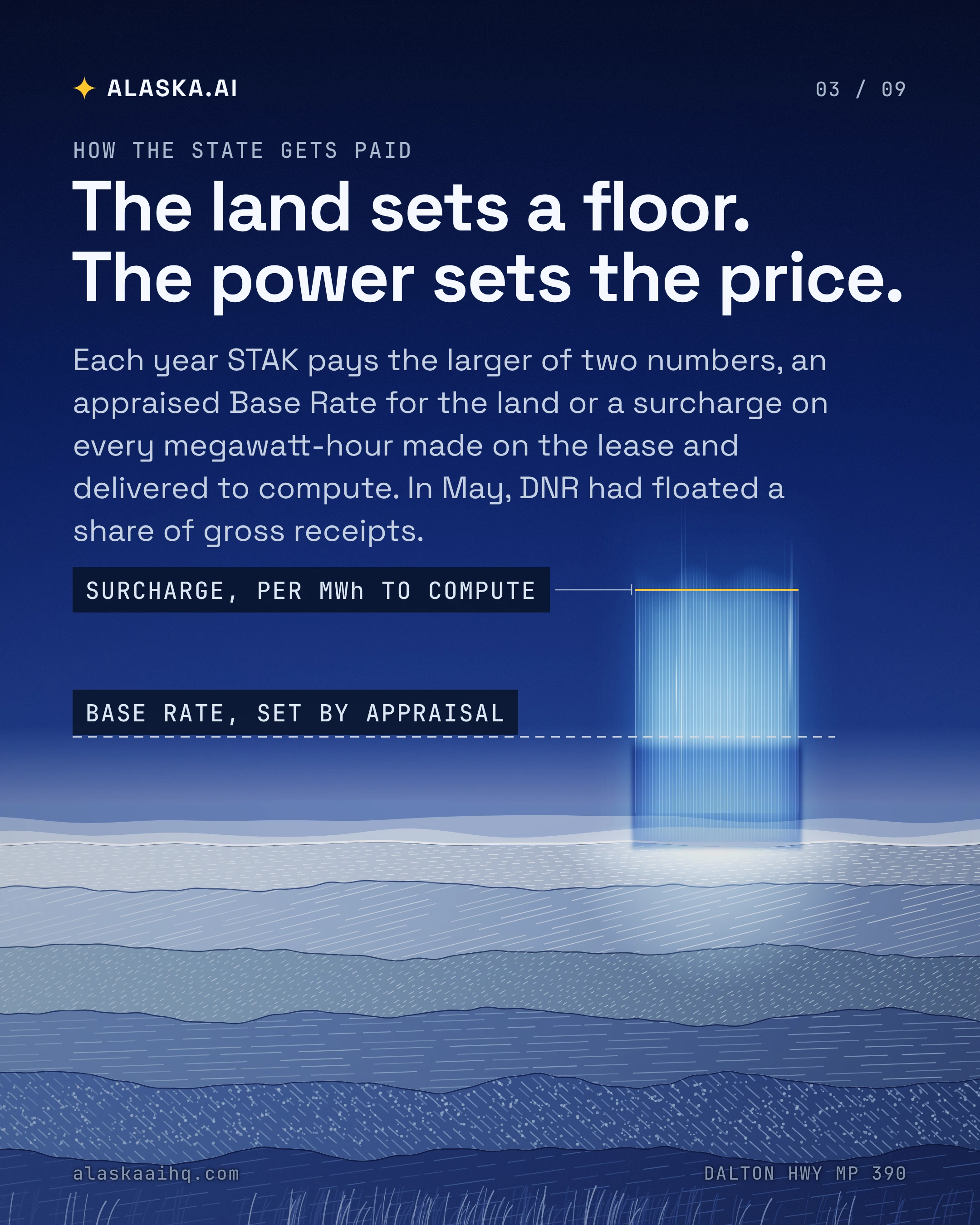
The final lease combines a Base Rate set by appraised land value with an additional Compute Power Sales Surcharge.
The May preliminary decision had contemplated that additional rental might be based on a percentage of gross receipts.
DNR says the Surcharge is designed to work like a gross-receipts approach while being simpler to administer and verify.
Compute power sales means the megawatt-hours of electricity generated on the leased premises, metered, and delivered to any data center, compute facility or other computing infrastructure.
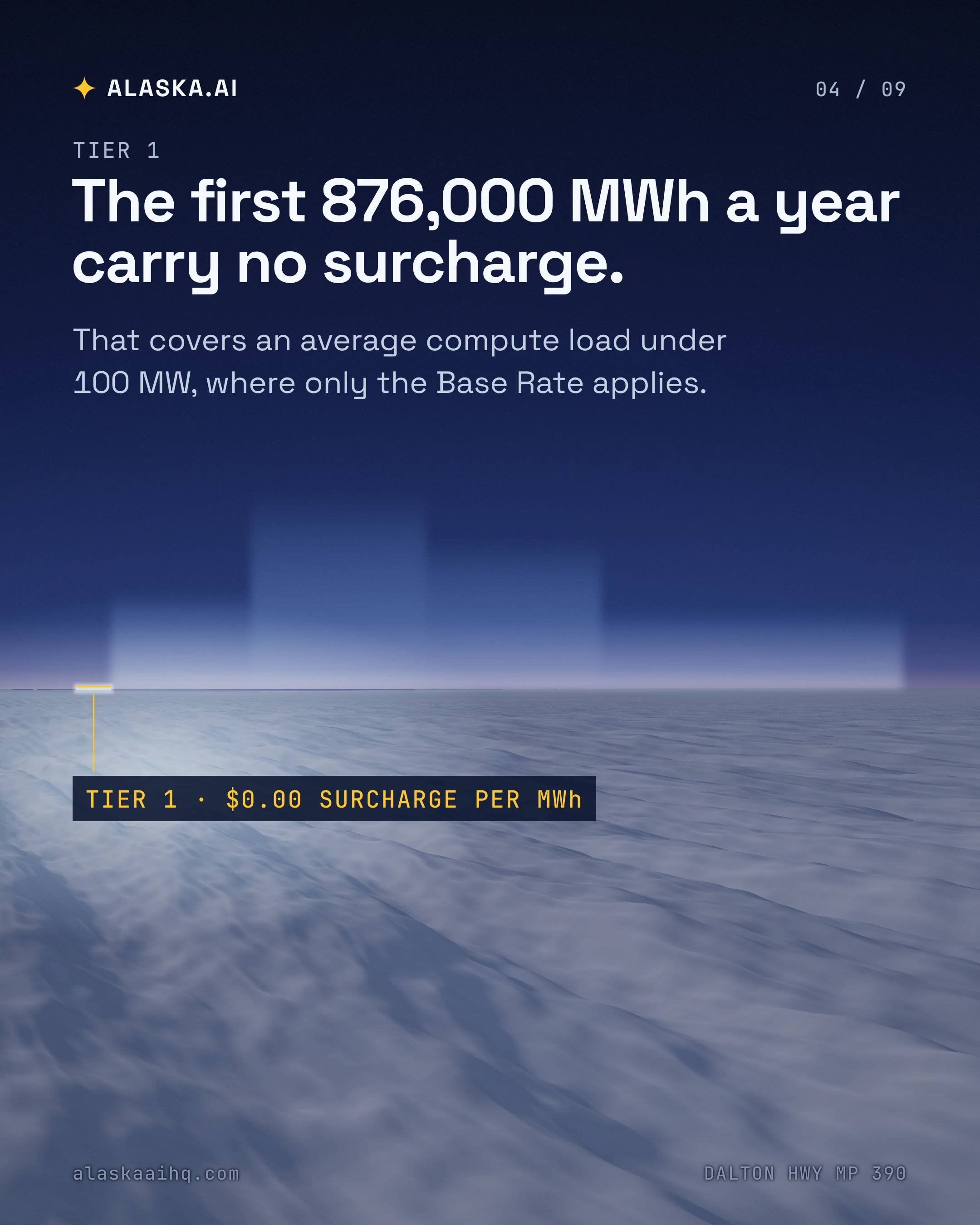
Surcharge Tier 1 covers 0 to 876,000 MWh of annual compute power sales, equivalent to an average load under 100 MW, at $0.00 per MWh.
Surcharge Tier 2 covers 876,001 to 4,380,000 MWh a year, equivalent to 100 to 500 MW, at $0.20 per MWh.
Surcharge Tier 3 covers 4,380,001 to 8,760,000 MWh a year, equivalent to 500 to 1,000 MW, at $0.40 per MWh.
Surcharge Tier 4 covers 8,760,001 to 13,140,000 MWh a year, equivalent to 1,000 to 1,500 MW, at $0.30 per MWh.
Surcharge Tier 5 covers 13,140,001 to 20,699,880 MWh a year, equivalent to 1,500 to 2,363 MW, at $0.16 per MWh.
Each surcharge rate applies only to the compute power sales within its own tier, and moving into a new tier does not change the charge on lower tiers.
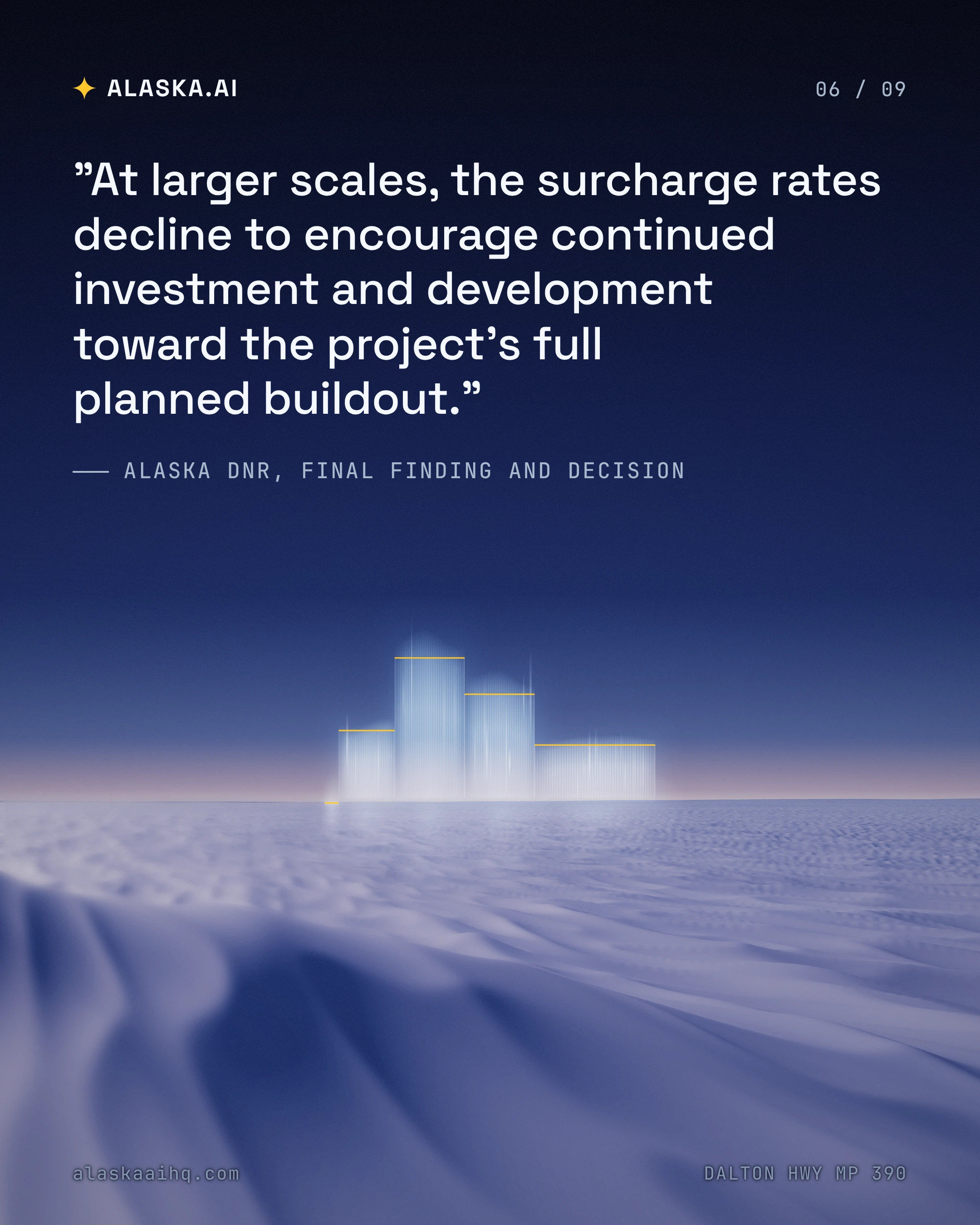
DNR says surcharge rates decline at larger scales to encourage continued investment toward full buildout.
No surcharge is assessed in the first tier, where only the Base Rate applies.
The Base Rate is the minimum annual payment and is credited against any Surcharge due in the same period, with STAK paying only the difference.
If the Surcharge for a period is less than the Base Rate, STAK gets no refund, credit or carryforward.
The surcharge tiers were built on anticipated compute power sales at full buildout rather than on the project's nameplate generating capacity.
STAK may ask to reopen the Surcharge if the State changes a law or policy that directly affects the project's economics.
An advance rental of $10 per acre per year applies during the Entry Authorization.
The five-year Entry Authorization counts inside the 50-year lease term and does not extend it.
Any sublease must first be approved in writing by DNR.
DNR says agreements with energy offtakers do not, merely by existing, count as a sublease of state land.
STAK must post an initial performance guaranty totaling $1,250,000.
STAK's cumulative impact analysis estimates dry air cooling will cut direct operational water use by 90 percent or more compared with evaporative cooling.
DNR says the facility will be visible from the Dalton Highway at roughly one mile.
DNR's Division of Oil and Gas says it is not the agency responsible for setting or enforcing greenhouse gas emission standards.
DNR says it is not obligated to conduct a general corporate or financial investigation of STAK beyond what bears on its best interest decision.
STAK says the lease area is approximately 60 air miles from Nuiqsut, the nearest permanent community.
DNR's Responses to Public Comments, attached to the decision, run 30 pages.
STAK will need a Clean Water Act Section 404 permit from the Army Corps of Engineers for wetlands, which DNR says must be resolved before construction.
DNR says the project is entirely privately financed and does not commit State appropriations.
STAK expects to need a Prevention of Significant Deterioration construction permit and a Title V operating permit from DEC for air emissions.
Alaska's net electricity generation in 2024 was 6,690,506 megawatthours.
Alaska's net summer generating capacity in 2024 was 2,853 megawatts.
Waymo says it will conduct closed-course evaluations in Alaska this season.
Waymo says it will collect heavy snowfall data in Alaska this season.
Waymo says the Alaska work is meant to further refine its cold-weather driving capabilities.
The Alaska Beacon reported that DNR approved the 50-year land lease on Tuesday.
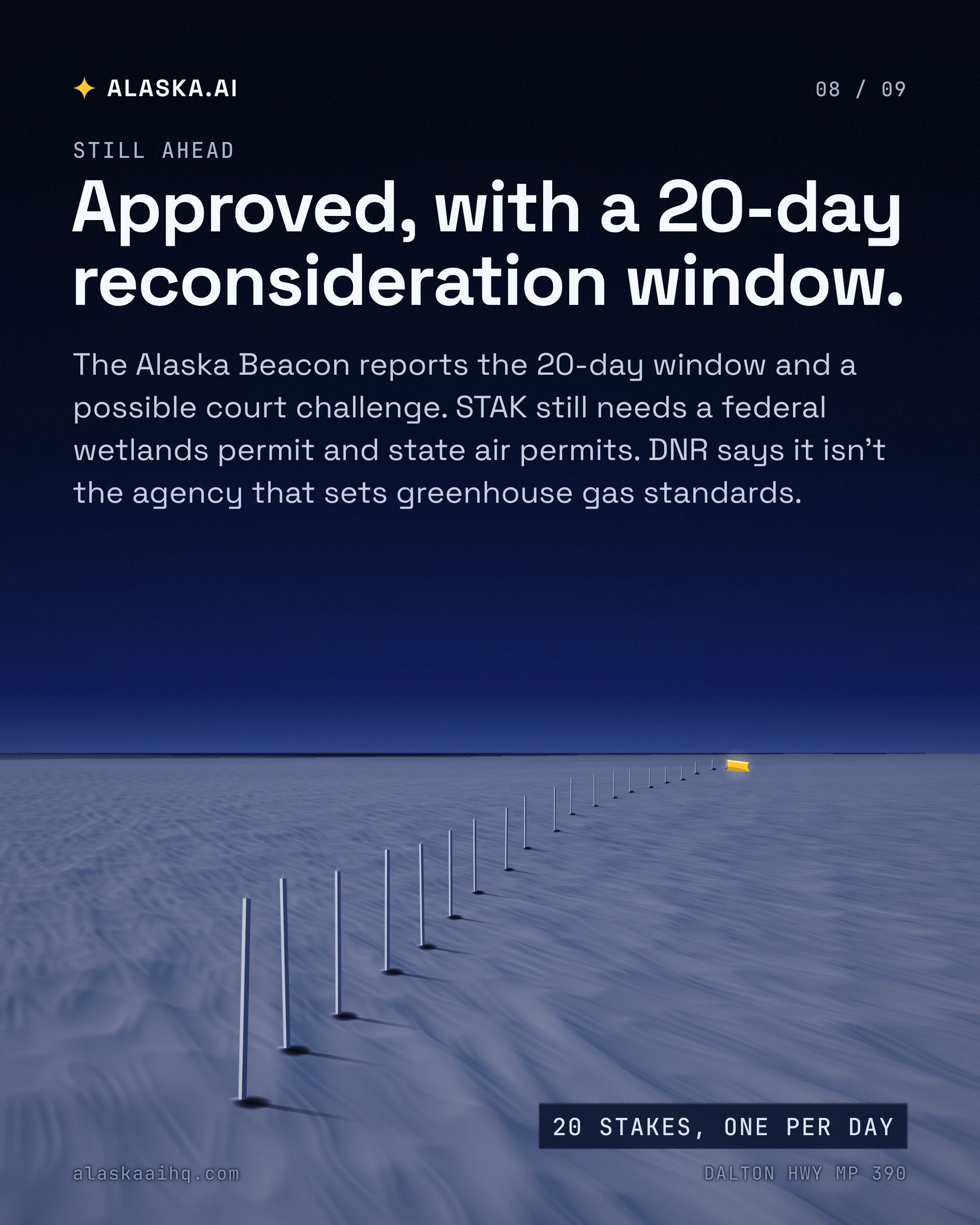
The decision is subject to a 20-day reconsideration period.
The Alaska Beacon reported that the decision could be challenged in court.
The Alaska Beacon reported that most of the more than 1,200 public responses opposed the proposal.
The Alaska Beacon reported that the project still needs further approvals, including a federal wetlands permit and a state air quality permit for the power plant.
John Boyle serves as chief strategy officer for STAK Energy.
Boyle previously served as commissioner of the Department of Natural Resources under Governor Mike Dunleavy.
Governor Dunleavy released a statement on Monday calling for data centers to be built in Alaska.
AIDEA is the sole owner of Alaska Data Corp. LLC, a corporation formed in March.
AIDEA partnered with Plural, a California-based startup whose chief executive is Adam Silver.
AIDEA board members voted earlier this year to send $20 million to Alaska Data Corp., as first reported by the Anchorage Press.
Dunleavy met with Plural chief executive Adam Silver at least seven times, including four times in Washington, D.C.
Beats
This article is on Alaska data centers · Alaska power and the grid · Alaska land and permitting for AI. Each beat page keeps every decision and every article on that subject in one place.