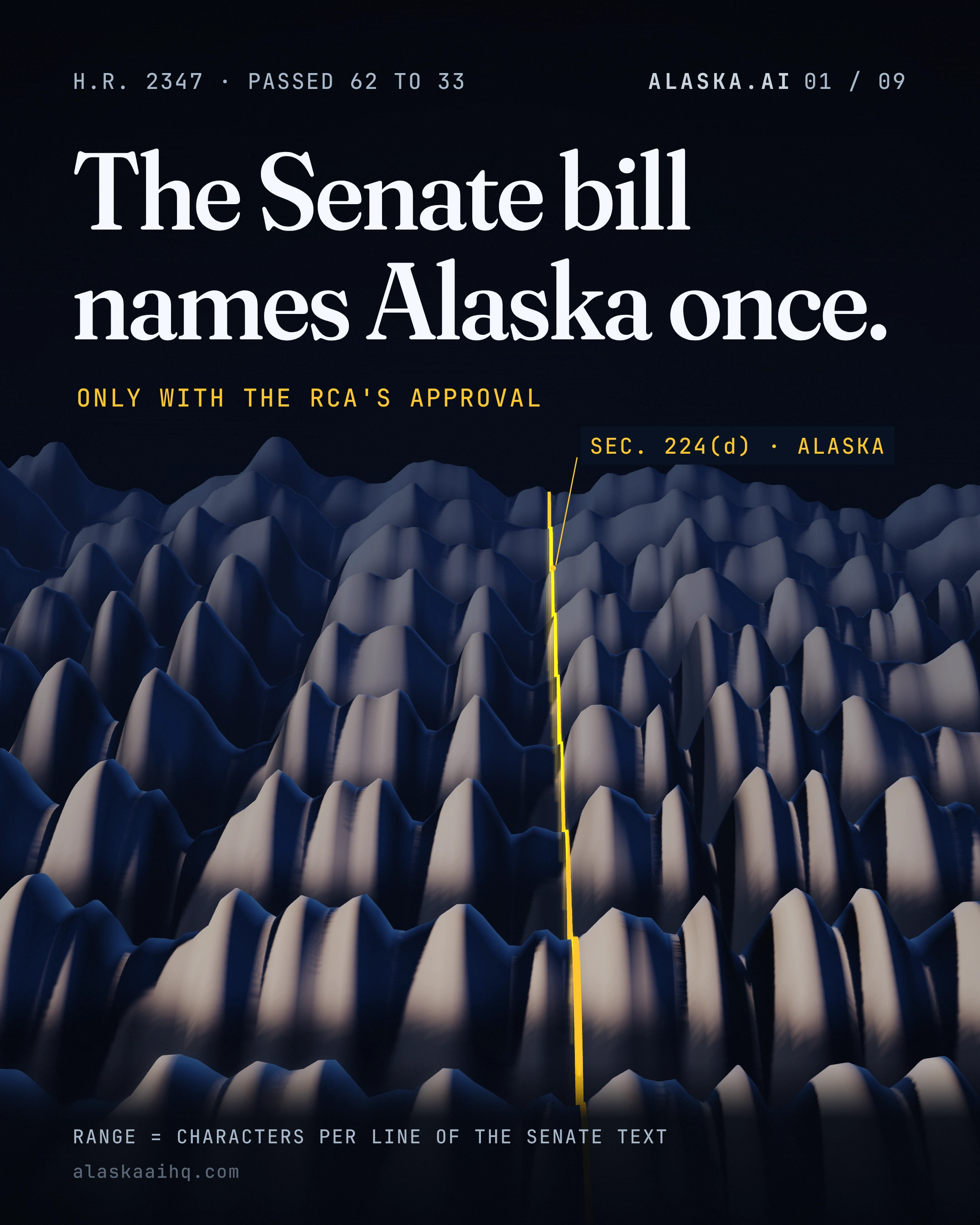
The Senate bill names Alaska once.
One subsection. That is the only place the Senate's energy bill names Alaska.
The deck
SWIPE, SCROLL OR CLICK A SLIDE TO GO FULLSCREEN · 9 SLIDES
The story
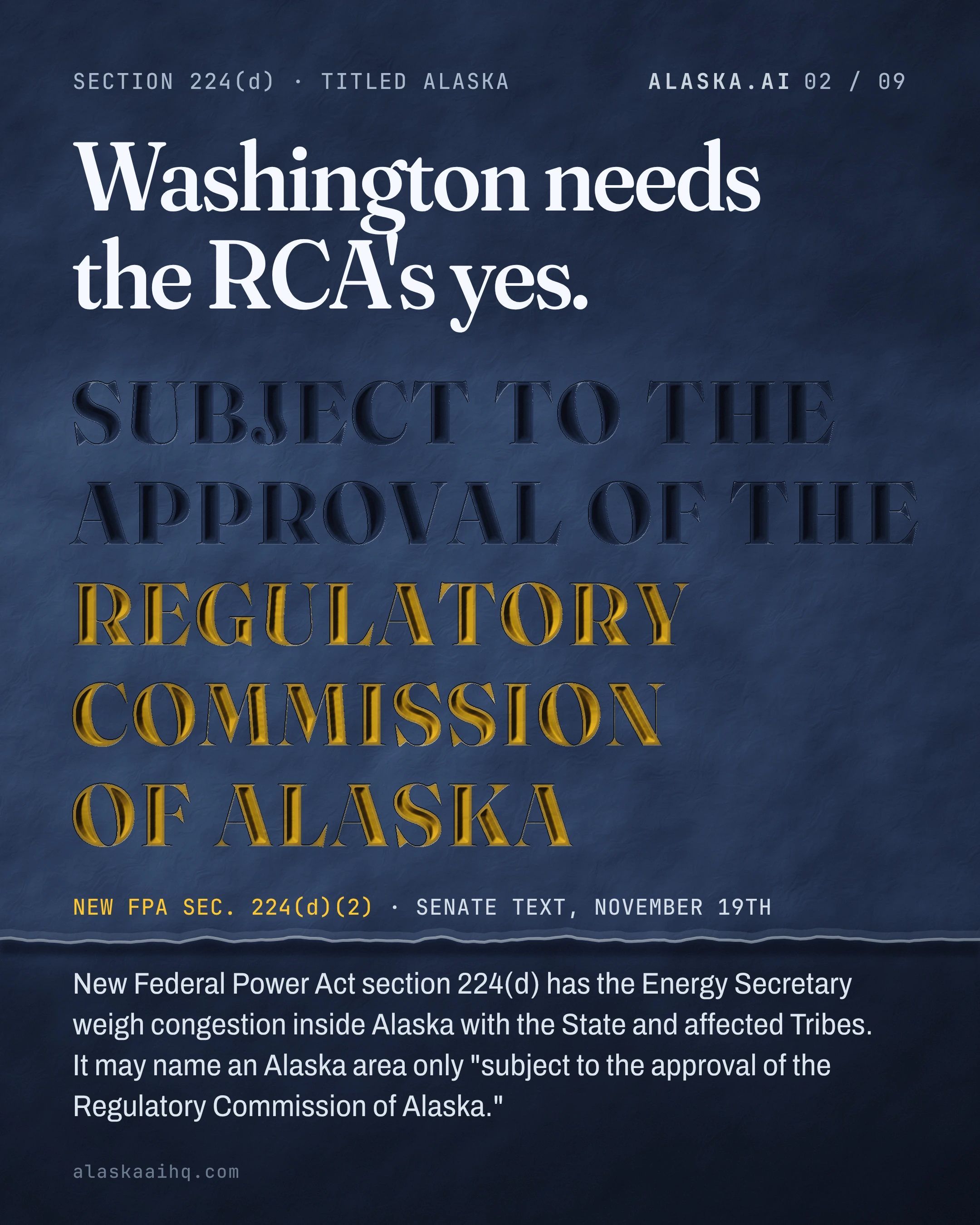
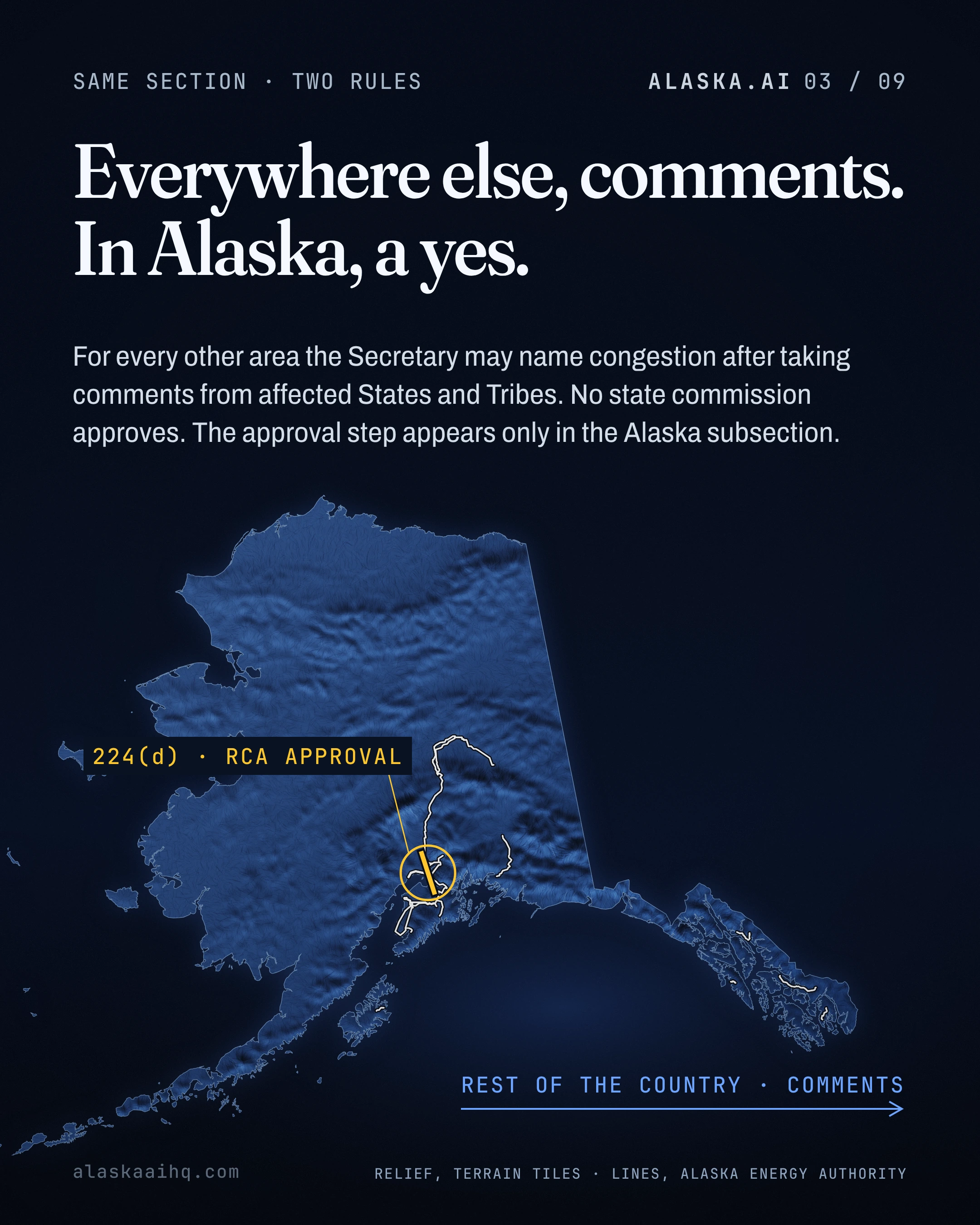
Section 224(d) lets the Energy Secretary identify an Alaska congestion area only "subject to the approval of the Regulatory Commission of Alaska." Elsewhere there is no state approval step, only comments.
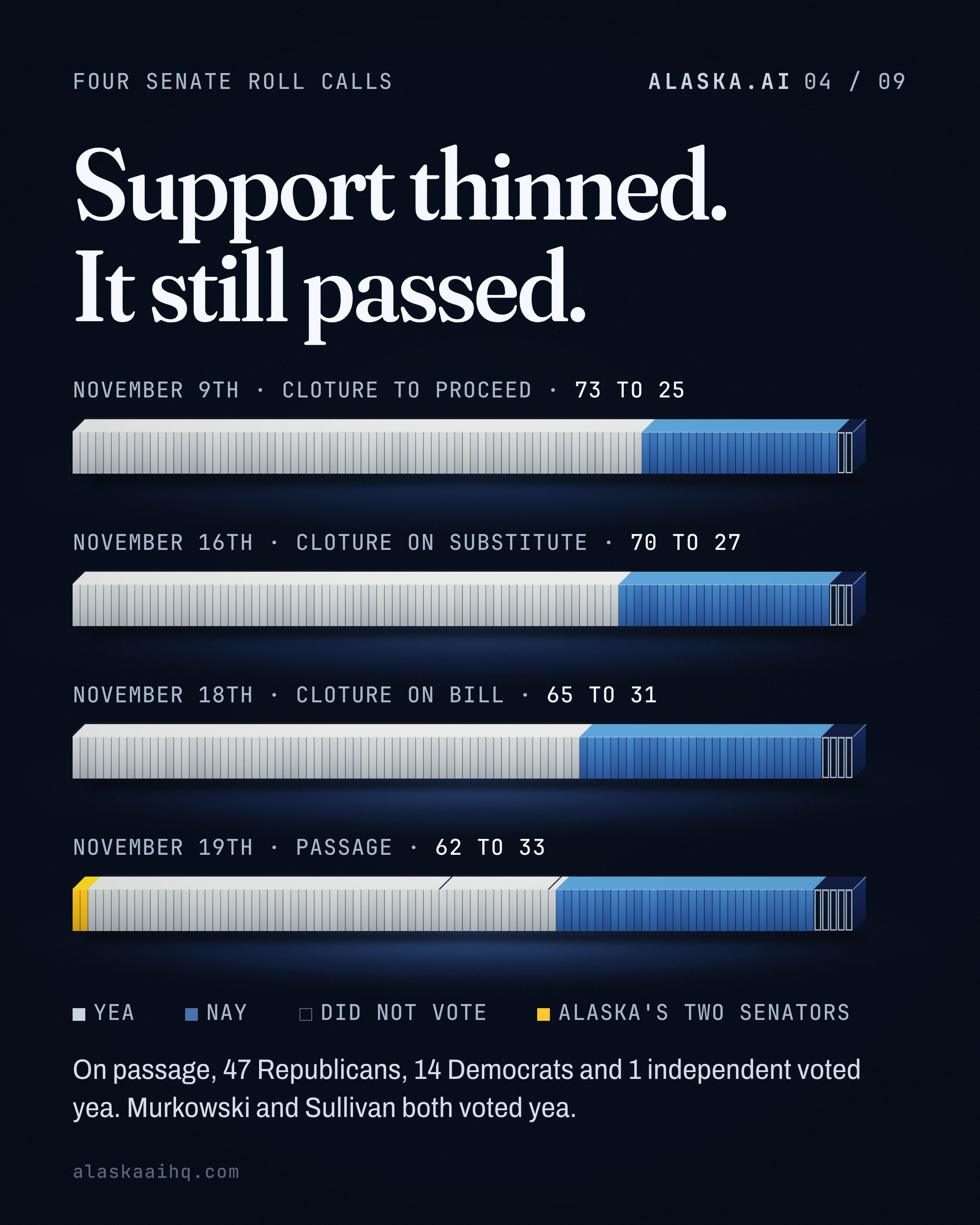
The Senate passed it 62 to 33 on November 19th. Murkowski and Sullivan voted yea.
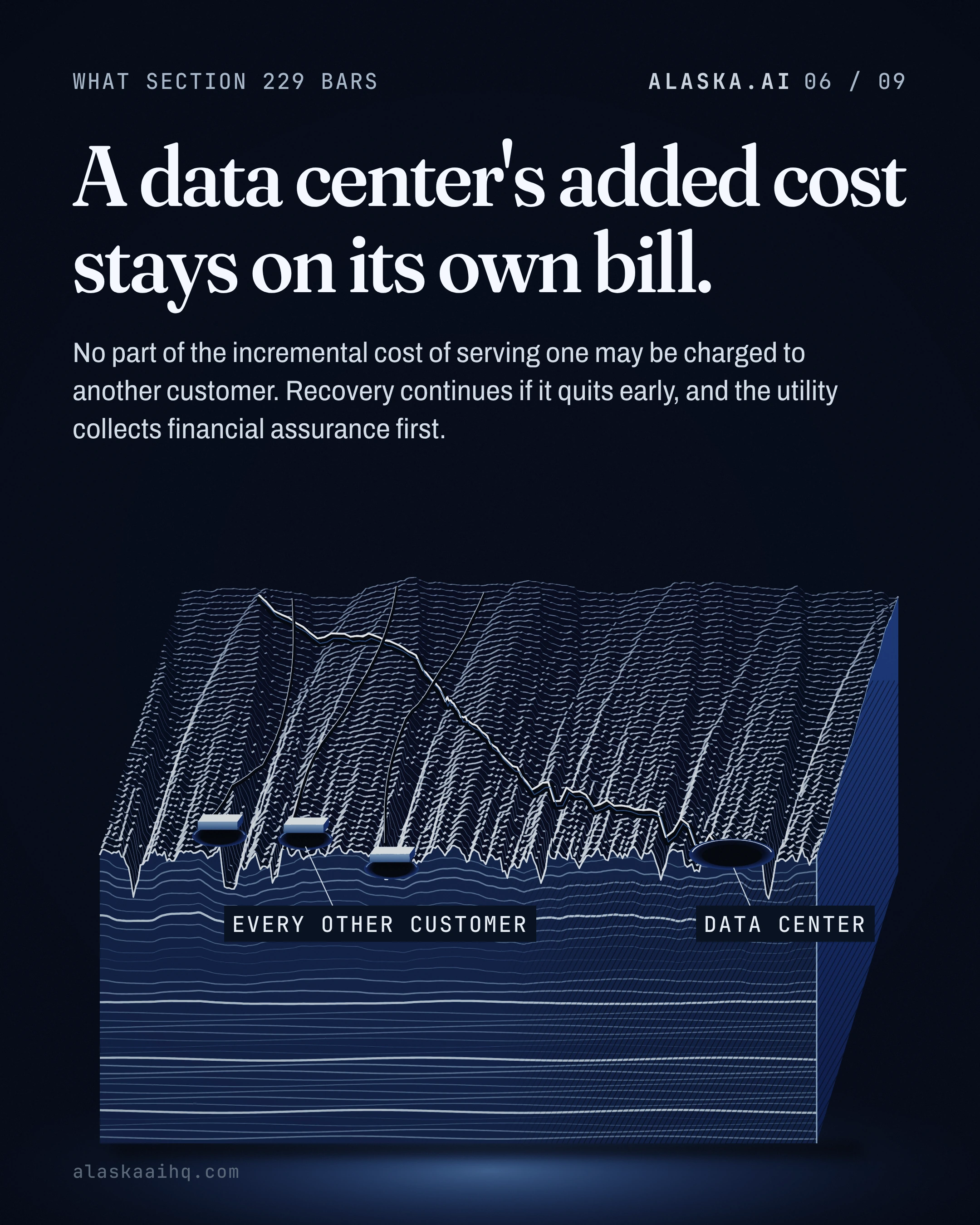
Section 229 bars charging other customers any part of a data center's incremental cost. The data center keeps paying if it quits early. A State may bill data centers as their own class on less favorable terms.
The clause in its own words opens the carousel, four Senate roll calls follow, and the data center cost rule closes it.
The bill now heads to the House. Does the RCA's approval step come back intact?
What we verified
61 CLAIMS, EACH RE-FETCHED FROM ITS SOURCE BEFORE THIS DECK SHIPPED
Senate roll call vote 257 on November 9th invoked cloture on the motion to proceed to H.R. 2347 by 73 votes to 25.
Senate roll call vote 264 on November 16th invoked cloture on Capito Amendment No. 6883, a substitute amendment to H.R. 2347, by 70 votes to 27.
Senate roll call vote 268 on November 18th invoked cloture on H.R. 2347 by 65 votes to 31.
Senate roll call vote 270 on November 19th passed H.R. 2347 as amended by 62 votes to 33.
S. 5653 was introduced in the Senate on September 30th.
Sen. Shelley Moore Capito introduced S. 5653 with Senators Lee, Whitehouse and Heinrich.
S. 5653 as introduced carried the short title Bipartisan American Affordability and Jobs Act of 2026.
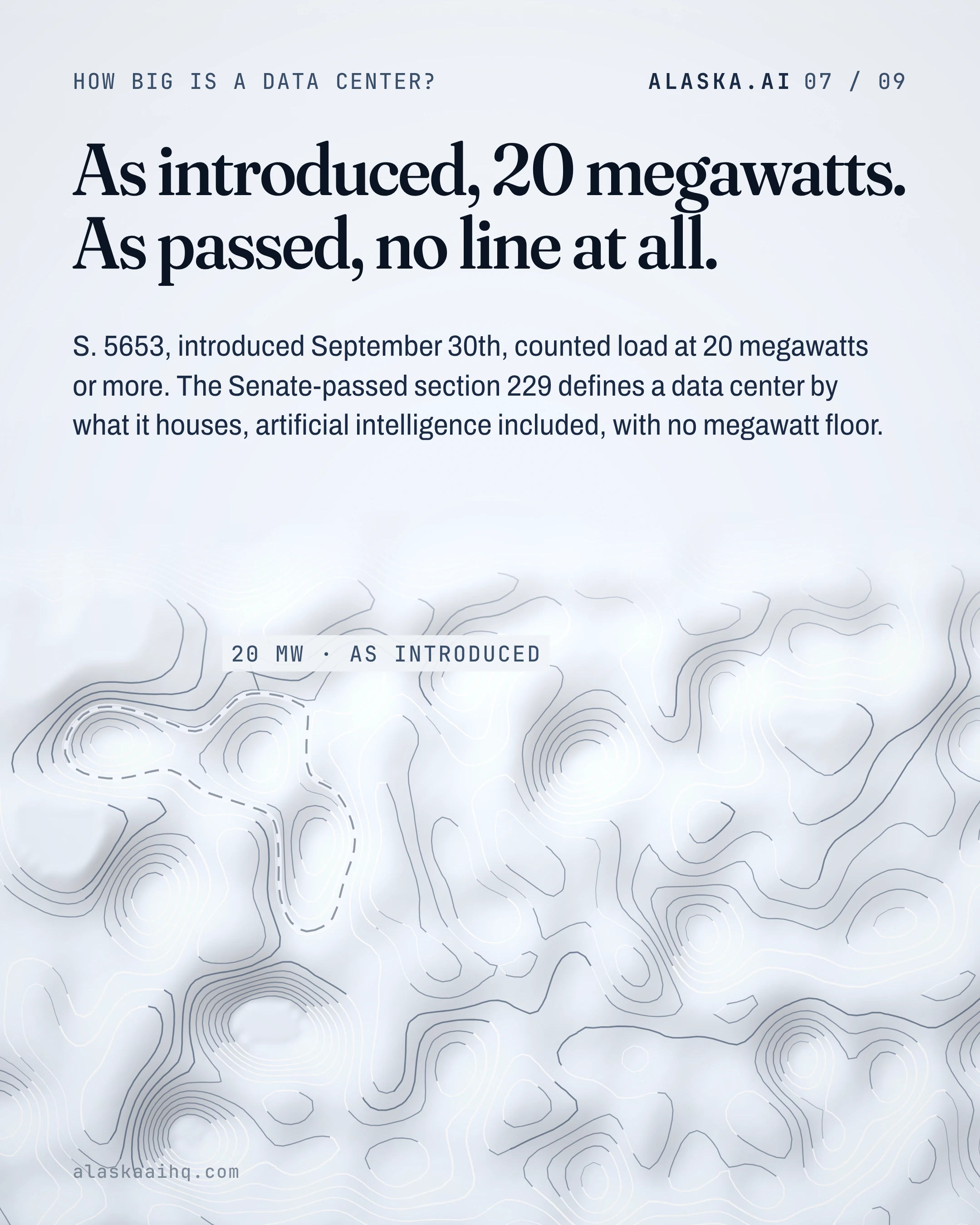
S. 5653 as introduced defined covered load as data center electric load that equals or exceeds 20 megawatts, or is reasonably expected to reach 20 megawatts at full buildout.
S. 5653 was referred to the Senate Committee on Energy and Natural Resources.
The Senate passed H.R. 2347, as amended, on November 19th by 62 votes to 33.
Senator Lisa Murkowski voted yea on Senate passage of H.R. 2347.
Senator Dan Sullivan voted yea on Senate passage of H.R. 2347.
Five senators did not vote on passage of H.R. 2347.
The Senate-passed text of H.R. 2347 may be cited as the Bipartisan American Affordability and Jobs Act.
Section 2103 adds a section 224 to the Federal Power Act requiring the Secretary of Energy to study electric transmission capacity constraints and congestion within 1 year of enactment and every 3 years after.
New Federal Power Act section 224(d), titled Alaska, requires the Secretary of Energy to consider intrastate transmission constraints and congestion within Alaska in consultation with the State of Alaska and affected Indian Tribes.
Under section 224(d), the Secretary may identify an Alaska area as transmission-constrained or congested only subject to the approval of the Regulatory Commission of Alaska.
For the rest of the country, section 224(b)(3) lets the Secretary identify constrained or congested areas after considering comments, with no state commission approval step.
New Federal Power Act section 229 is titled Ratepayer protection with respect to data centers.
Section 229 defines a computational load site as buildings at a single location that primarily contain IT infrastructure used for software services, artificial intelligence training, deployment and delivery, cryptocurrency mining or other data center computation.
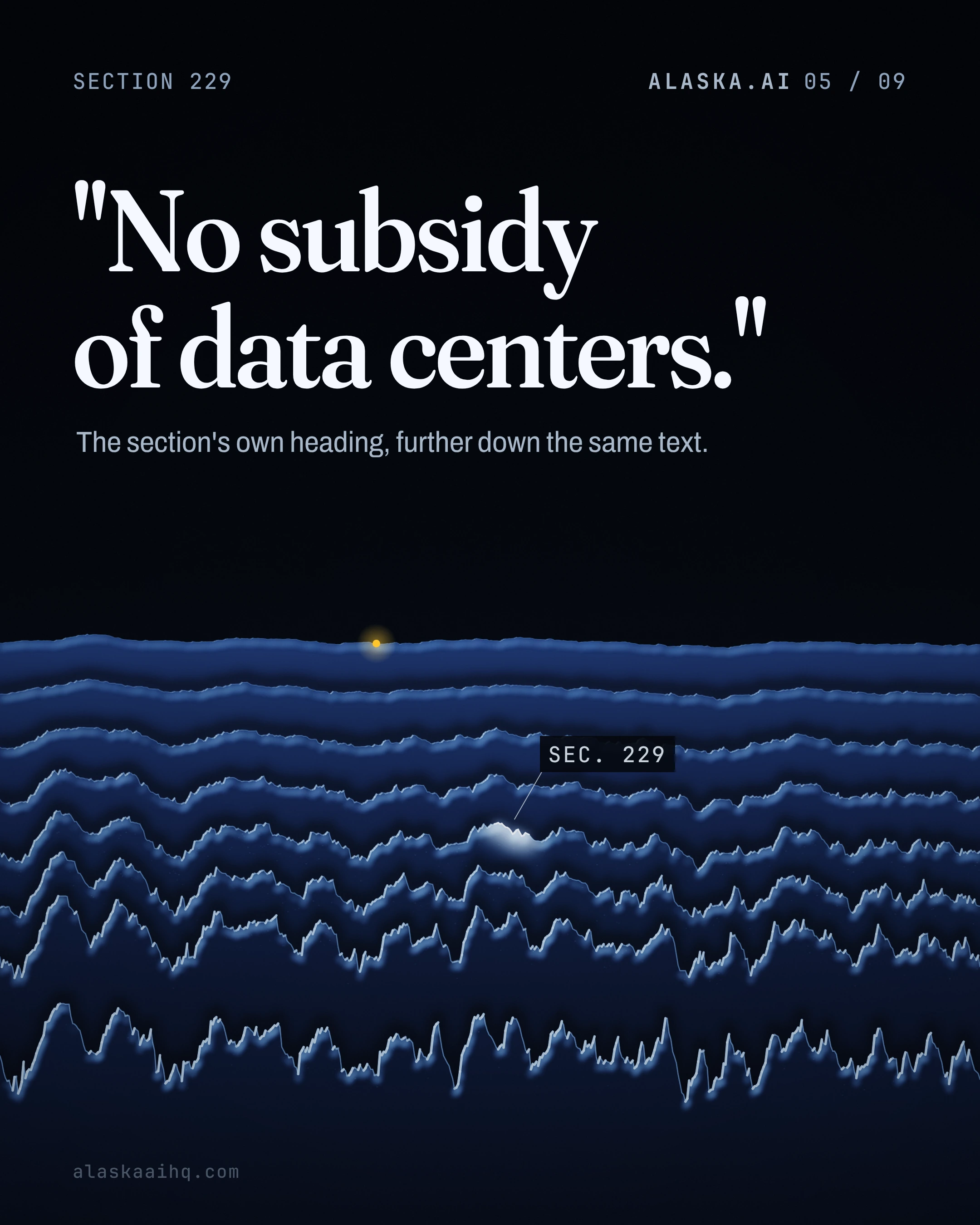
Section 229(b)(1), headed No subsidy of data centers, bars allocating any portion of the retail incremental cost of serving a computational load site to any other customer.
Section 229 defines retail incremental cost as the costs that would be avoided had the data center not been served, including generation, storage, transmission and distribution.
Section 229(b)(3) requires recovery of the full retail incremental cost to continue even if the data center ends its contract or stops buying power early.
Section 229(b)(4) requires a utility to obtain reasonable financial assurances from the data center before building or upgrading facilities to serve it.
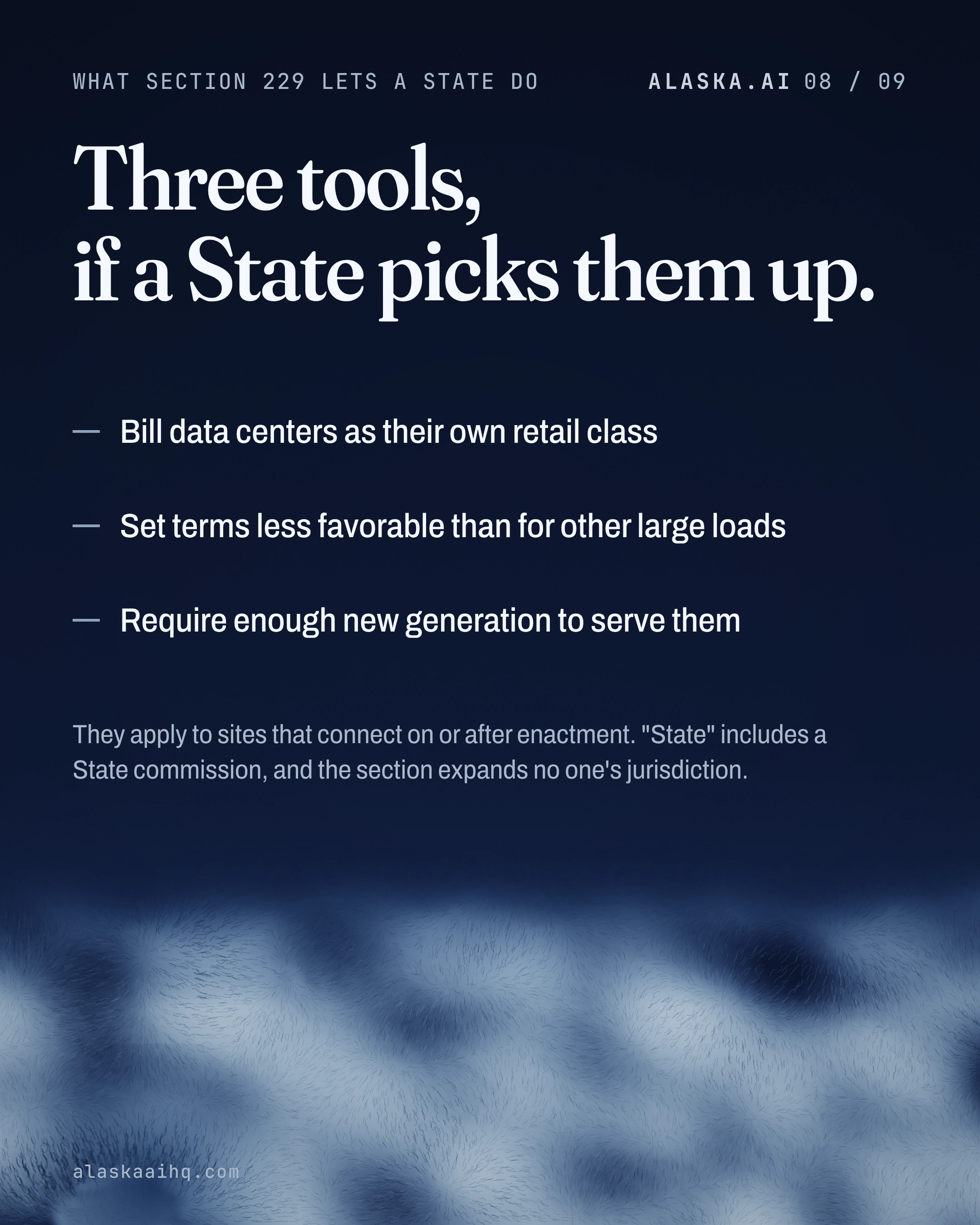
Section 229(d) lets a State treat data center owners and operators as a separate class of retail electric service with less favorable rates and priorities than other large loads.
Section 229 says a State includes an applicable State commission or other State authority over retail electric service.
Section 229(c)(1)(D) lets a State condition service to a data center on the data center procuring or building enough new generation to serve its own demand.
Section 229(f) applies the cost floor and the state powers to data centers that interconnect on or after enactment.
Section 229(e) says nothing in it expands or diminishes the jurisdiction of FERC or any State.
Section 229 as passed by the Senate sets no megawatt threshold in its definition of a computational load site.
Section 2114 requires the Energy Information Administration to revise Form 861 to separately include information from computational load sites before the first April 1st after enactment.
Section 2107 finds it is United States policy that computational load owners and operators bear the full cost of the electric service and infrastructure built to serve them.
Section 2107 requires FERC to issue a final rule on transmission rates for computational load customers within 1 year of its proposed rule.
The Senate's engrossed amendment to H.R. 2347 is dated November 19th, 2026.
The Senate-passed text of H.R. 2347 names Alaska in one subsection only, section 224(d).
On passage, 47 Republicans, 14 Democrats and 1 independent voted yea, and 2 Republicans, 30 Democrats and 1 independent voted nay.
NPR reported that the Bipartisan American Affordability and Jobs Act passed the Senate 62 to 33.
Fourteen Democrats and one independent joined most Republicans in supporting the bill.
Sen. Jeff Merkley said the bill "opens the gates to a flood of natural gas for data centers."
According to NPR, the cost of a kilowatt-hour has risen by more than 6 percent in the last year and 39 percent in the last five years.
As of November 20th, NPR reported that the bill now heads to the House.
The Associated Press reported that the Senate voted 73 to 25 to formally take up the energy bill.
House Democratic leader Hakeem Jeffries is expected to become speaker in January.
Jeffries' office said the bill "falls short" in several respects.
Sen. Martin Heinrich said "Americans can't afford to wait for lower electricity prices. We need to pass this bill now."
The Alaska Department of Natural Resources approved a 50-year land lease for a gas-powered computing data center on the North Slope on Tuesday, November 10th.
DNR says the North Slope data center will operate a 1 to 3 gigawatt generation system.
The North Slope data center would not be tied into the Railbelt electrical grid.
The North Slope data center's operators could sell power to customers in and around Prudhoe Bay.
The Alaska Beacon article links DNR's signed final finding and decision for lease ADL 422741.
The Fairbanks North Star Borough Planning Commission approved Mayor Grier Hopkins' proposed moratorium on permits for large-scale data centers.
The commission extended the mayor's proposed 12-month moratorium to 18 months.
The commission lengthened the administration's research deadline from six months to 10 months.
Hopkins said the Borough Assembly vote will likely take place on January 14th.
Hopkins said "If it comes in as purely for a government purpose, I believe that would be not subject to our moratorium."
Hopkins said "If it's for private sector use it might be different."
Hopkins said the borough is researching how to "turn that gray area black and white."
On November 16th, DNR Commissioner John Crowther notified BlueCrest that its Cosmopolitan Unit in Cook Inlet was cured and no longer in default.
BlueCrest's plan is designed to achieve first Tyonek gas production on or before March 31st, 2027.
On September 10th, BlueCrest executed a joint development agreement and drilling facility credit agreement with NBS Holding LLC.
DNR issued a notice of default and cure demand for the Cosmopolitan Unit on May 23rd, 2025.
Beats
This article is on Alaska data centers · Alaska power and the grid · Defense and federal AI in Alaska. Each beat page keeps every decision and every article on that subject in one place.