Alaska's AI budget order changes hands December 7th.
Alaska's order telling every agency to review spending with AI has no end date. A new governor inherits it on December 7th.
The deck
SWIPE, SCROLL OR CLICK A SLIDE TO GO FULLSCREEN · 9 SLIDES







The story
Leaving it alone is a decision too.
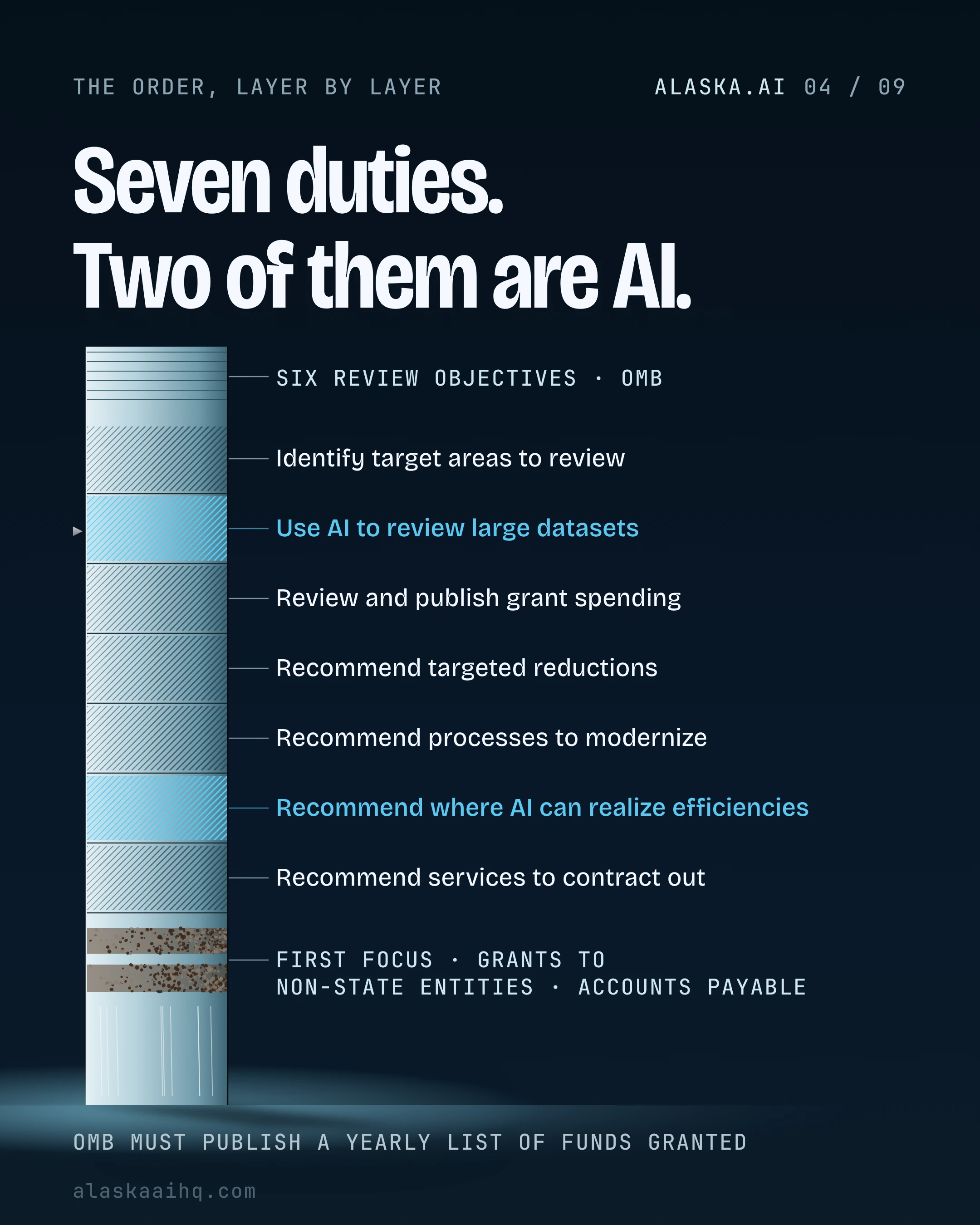
Mike Dunleavy signed Administrative Order 359 on August 4th, 2025. Every agency is told to use AI to see how state funds "are actually being spent." Two of its seven agency duties name AI. Grants to non-state entities and accounts payable are the first focus areas. The order puts the Office of Management and Budget in charge. On November 18th Governor-elect Kreiss-Tomkins named Alexei Painter to lead that office.
Swipe for the AI clause word for word, the order's seven duties and its own 2025 case, then the new budget director and the December 7th handoff.
Should a standing AI order over the budget stay one governor's call, or should the Legislature get a say?
What we verified
45 CLAIMS, EACH RE-FETCHED FROM ITS SOURCE BEFORE THIS DECK SHIPPED
Governor Mike Dunleavy signed Administrative Order 359 on August 4th, 2025.
AO 359 orders a statewide annual Government Efficiency Review of all executive branch agencies.
AO 359 directs every agency to use technology and artificial intelligence to review large datasets to determine how State of Alaska funds are actually being spent.
AO 359 directs agencies to recommend where technological or AI resources can realize efficiencies and better outcomes.
AO 359 requires OMB to annually publish a list of funds granted by agency, to what entities and for what purposes.
The AO 359 agency participation list contains seven duties.
AO 359 sets out six objectives for the Government Efficiency Review.
AO 359 names grants to non-State of Alaska entities as an initial focus area.
AO 359 names accounts payable as an initial focus area.
AO 359 applies to executive branch agencies including departments, boards, commissions and public corporations.
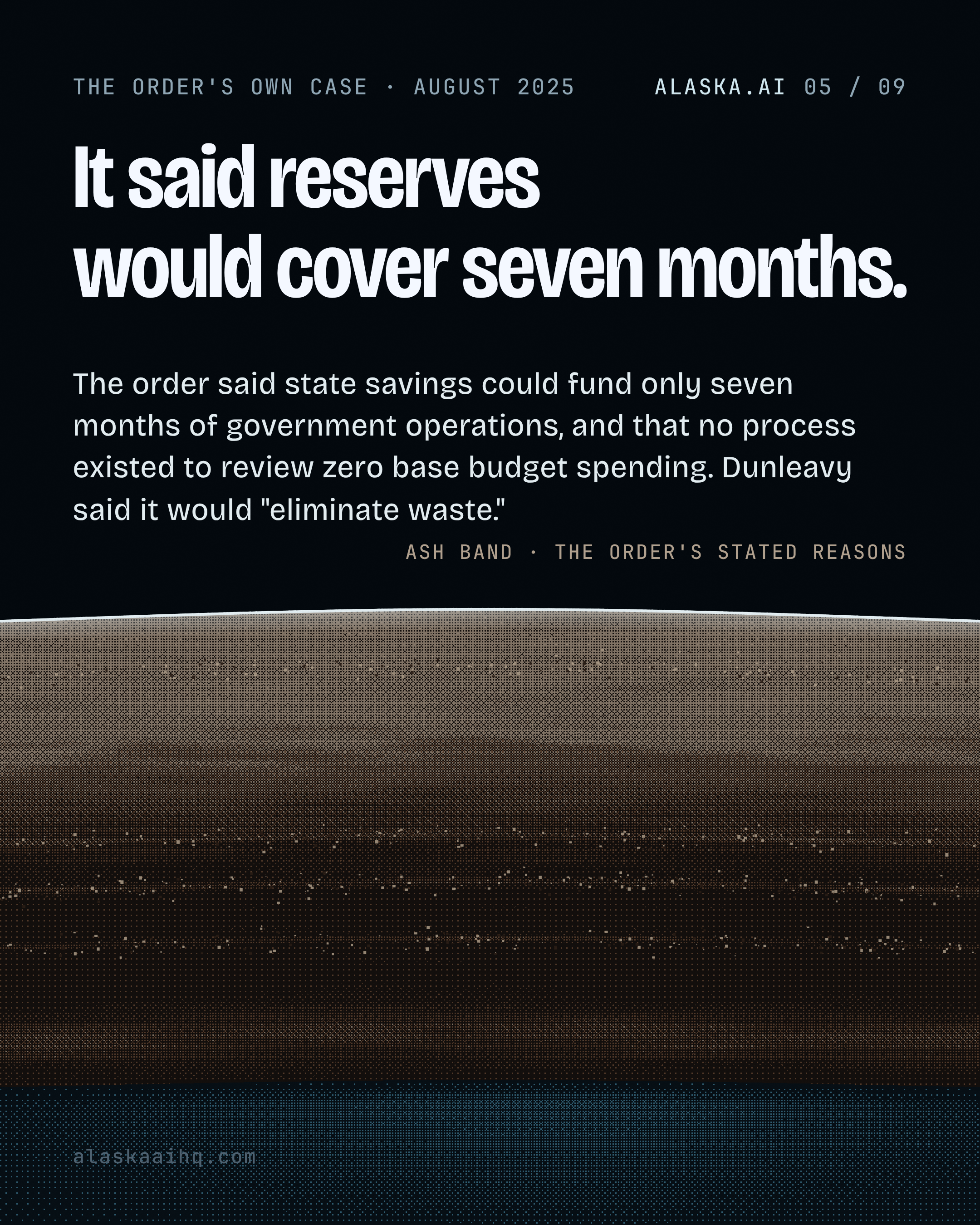
AO 359 says the state's savings accounts hold only enough reserves to fund seven months of government operations.
AO 359 took effect immediately and remains in effect until revoked.
The governor's office announced on August 4th, 2025 that Dunleavy issued two administrative orders on government efficiency and regulatory reform.
Dunleavy said the order ensures the state prioritizes critical needs, eliminates waste and safeguards its financial stability.
AO 359 makes the Office of Management and Budget responsible for implementing the order.
AO 359 tells OMB to annually lead an executive branch-wide review of base budget expenditures and practices.
AO 359 says the state has no process in place to review zero base budget appropriations and expenditures.
AO 359 tells every agency to review and publish how funds granted to non-state entities are being spent.
Two of the seven AO 359 agency duties name AI.
AO 359 tells agencies to recommend a targeted level of reductions through savings on wasteful and unnecessary spending.
AO 359 cites OPEC's December 2024 decision to increase output as a cause of falling oil revenues.
AO 359 tells OMB the review should modernize processes to fully integrate IT solutions.
Alaska's News Source reported in 2025 that agencies would be required to use technology and artificial intelligence to improve transparency and accountability.
The Petersburg Pilot reported that Dunleavy directed departments to use artificial intelligence software to help identify budget cuts.
Governor's spokesperson Grant Robinson said the review may result in eliminating grants to non-State of Alaska entities in some areas of the budget.
State Sen. Bill Wielechowski said finding efficiencies is what the governor was supposed to have been doing for the last seven years.
The Juneau Independent reported that AO 359 resembles DOGE-style mandates adopted in at least 26 states.
Governor-elect Jonathan Kreiss-Tomkins named Alexei Painter to lead the Office of Management and Budget.
Painter previously worked as an OMB analyst and as an economist in the Department of Revenue.
To take the job Painter is leaving his role with the Legislature, where he helped guide lawmakers' budget process.
Kreiss-Tomkins is set to take office on December 7th.
The Kreiss-Tomkins transition team received more than 300 resumes and over 400 ideas.
The Fairbanks North Star Borough Planning Commission approved Mayor Grier Hopkins' proposed moratorium on permits for large-scale data centers.
The planning commission extended the proposed data center moratorium from 12 months to 18 months.
The commission extended the borough administration's deadline for research and recommendations from six months to 10 months.
Hopkins said the assembly vote will likely happen on January 14th and that is when the moratorium clock would start.
Hopkins said a data center on Eielson Air Force Base built purely for a government purpose would likely not be subject to the borough moratorium.
Hopkins said the borough is working to turn the Eielson gray area black and white.
Mat-Su Borough officials sent a letter asking the state to reconsider transferring about 6,800 acres near Houston to AIDEA.
The borough letter says Point MacKenzie and portions of West Susitna offer more appropriate locations for these uses.
The letter cites 180 million dollars already spent on a rail bed near Point MacKenzie.
People who commented during the proposal process can request reconsideration by November 30th.
Borough Manager Mike Brown and Mayor Edna DeVries signed the letter.
On Wednesday November 18th Kreiss-Tomkins announced three first picks, Ira Slomski-Pritz as chief of staff, Alexei Painter as OMB director and Becky Windt Pearson as AIDEA adviser.
Becky Windt Pearson will have a leading role in the incoming administration's review of AIDEA's operations, governance and strategic direction.
Beats
This article is on Alaska AI policy and legislation. Each beat page keeps every decision and every article on that subject in one place.