Port MacKenzie's $311 million line, and its unnamed ends
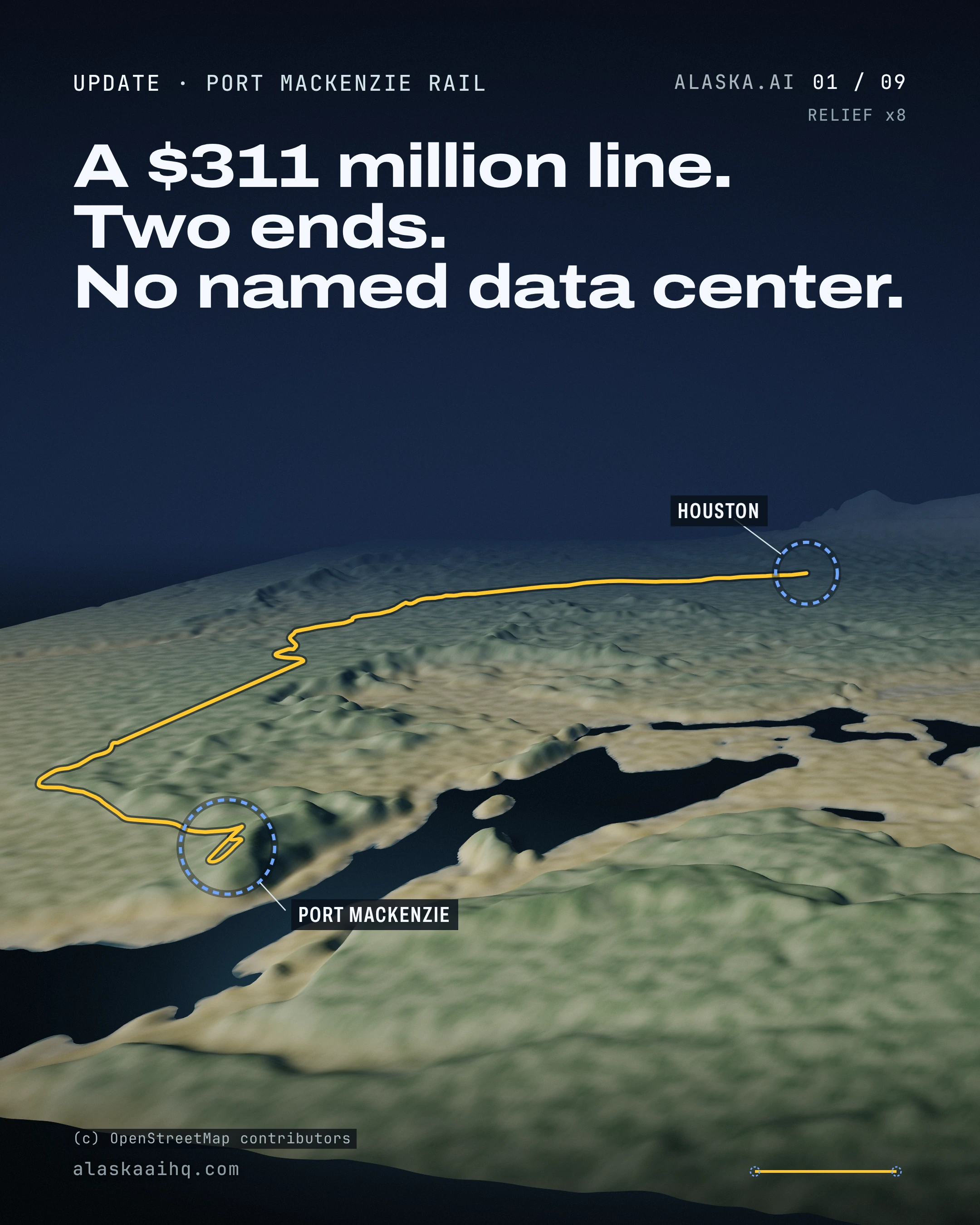
What is the $311 million Port MacKenzie rail line for if neither end has a named data center?
The deck
SWIPE, SCROLL OR CLICK A SLIDE TO GO FULLSCREEN · 9 SLIDES



The story
The Alaska Railroad's board gave the 32-mile line final approval last week. AIDEA says the Houston land could include an industrial hub or data centers, with no project identified. At the port the Alaska Beacon reports a coal-fired computing data center announced, developer unnamed.
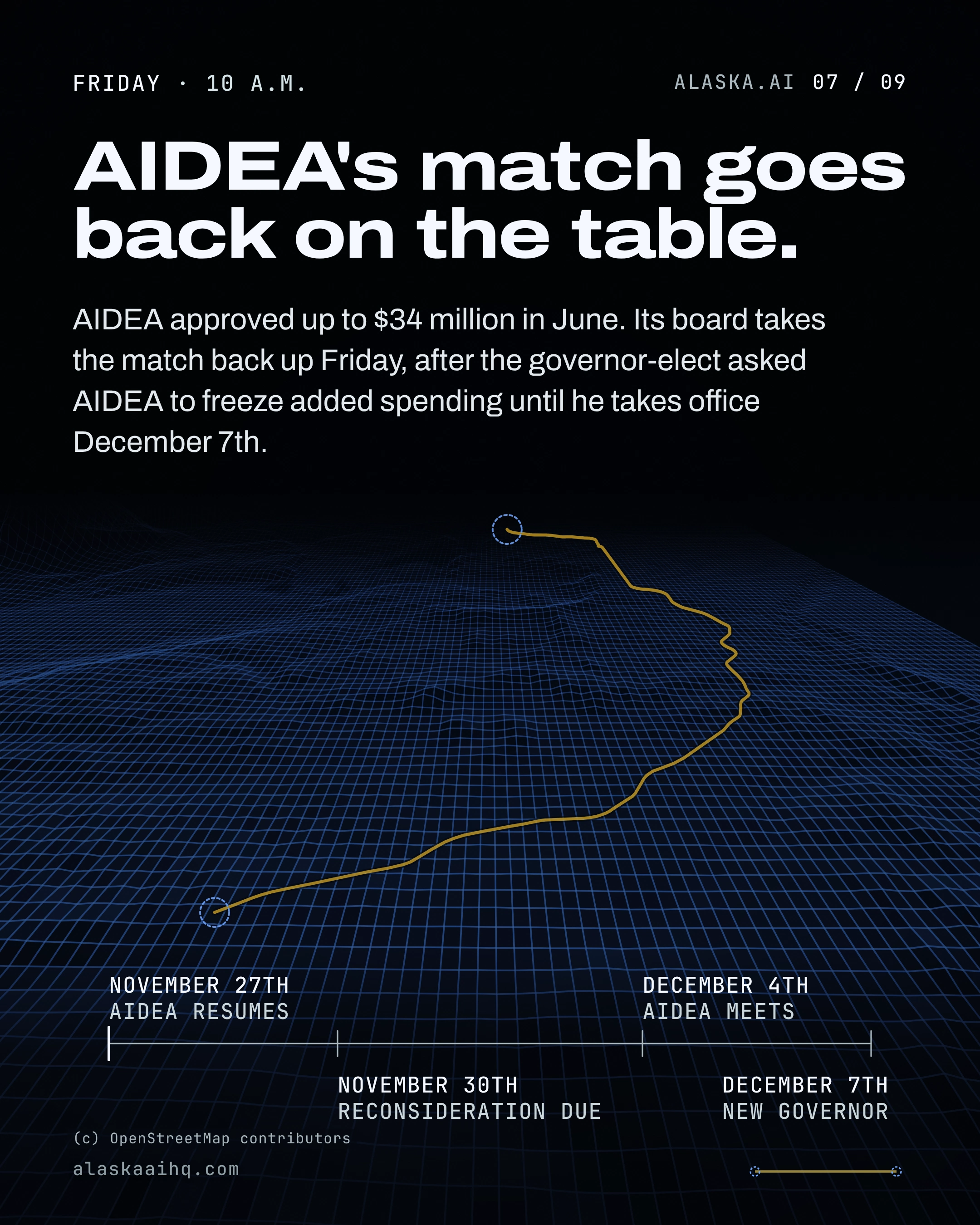
Friday, November 27th, 10 a.m. AIDEA's match returns to its board. November 30th. Requests to reconsider the Houston transfer are due. December 4th. AIDEA meets again. December 7th. The governor-elect who asked AIDEA to freeze added spending takes office.
Inside are the mapped route, who pays, both ends and the four dates.
Fund the line. Let the match wait for a name.
Is the $34 million ceiling AIDEA set in June a fair price before either end has a name?
What we verified
60 CLAIMS, EACH RE-FETCHED FROM ITS SOURCE BEFORE THIS DECK SHIPPED
AIDEA's Amended Resolution G26-07 approved the use of up to $34 million from the AIDEA Revolving Fund as a partial match for the Alaska Railroad's CRISI grant.
AIDEA's board passed the Port MacKenzie resolution unanimously on a roll call on June 17th.
At the June 17th AIDEA meeting O'Leary said the grant required a 20 percent match of as much as $60 million.
O'Leary attended the June 17th AIDEA meeting in person and spoke in support of the Port MacKenzie rail extension item.
Ruaro told the board that AIDEA is not the only match provider, with the Mat-Su Borough and the railroad also contributing.
In June O'Leary put the project's outlay at approximately $300 million.
AIDEA's November 24th board meeting is in recess and will resume at 10 a.m. on Friday, November 27th.
AIDEA's schedule lists the November 24th meeting as a continuation of its November 19th board meeting.
AIDEA's next regularly scheduled board meeting is Friday, December 4th.
The agenda for AIDEA's November 19th board meeting listed an Amended Second Resolution G26-07 on Port Mackenzie Infrastructure and Real Estate.
The Department of Energy selected Terra Energy Center Corporation's planned 1,250 MW coal plant with carbon capture in the Mat-Su Borough for engineering and design funding.
DOE's selection lists $89 million in federal funding for the Terra Energy Center project.
NMFS published a proposed rule redefining pelagic trawl gear off Alaska in the Federal Register on November 16th.
Comments on the pelagic trawl proposed rule are due by December 16th.
The proposed rule would allow sensors and electronic instruments designed to adjust the gear, exclude bycatch or minimize contact with the seafloor.
NMFS says live feed cameras that let operators see catch entering the net in real time have been widely adopted.
From 2019 to 2024, 147 vessels used pelagic trawl gear off Alaska.
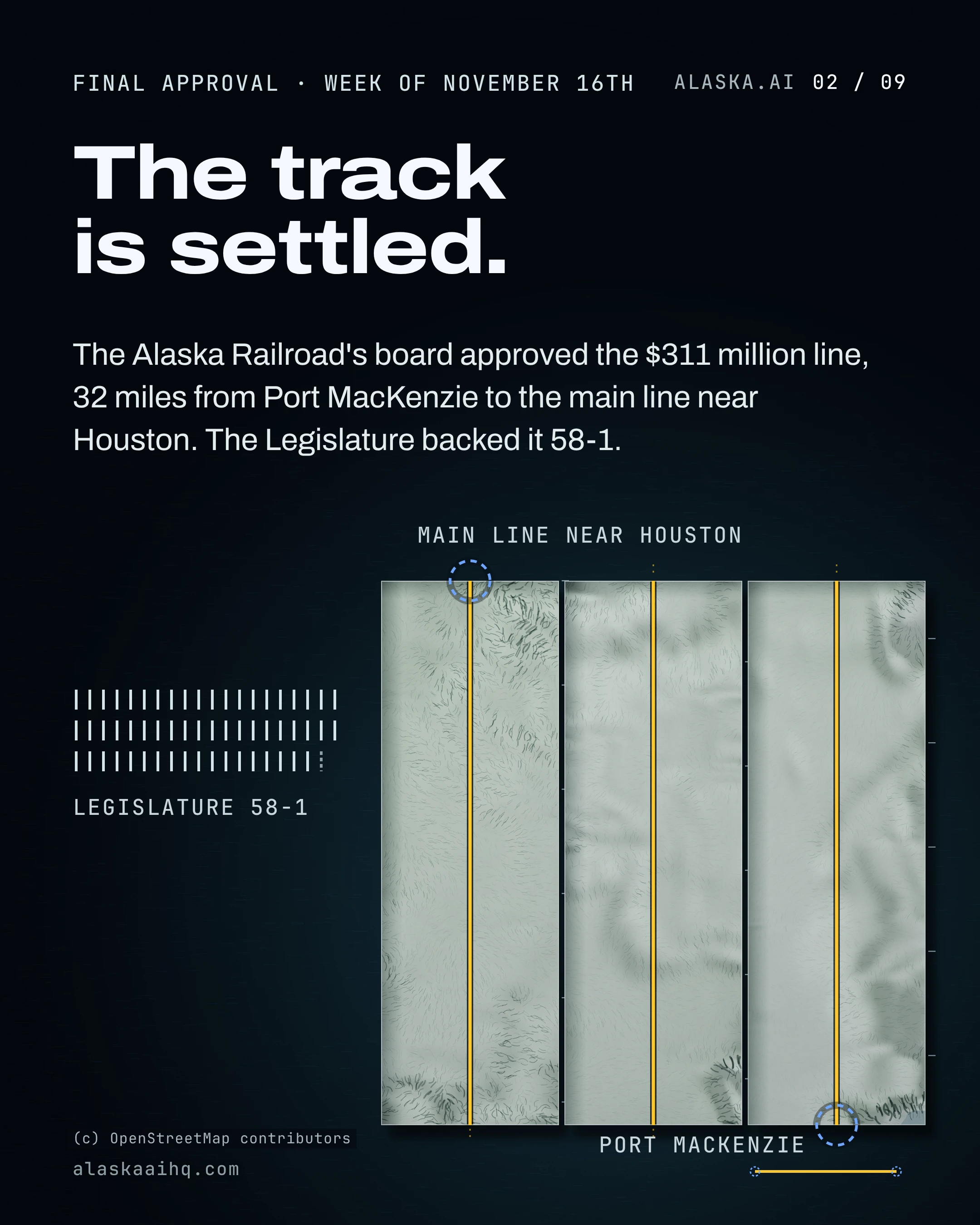
The Alaska Railroad's board of directors gave final approval to the $311 million Port MacKenzie rail line in the week of November 16th.
The 32-mile line will connect Port MacKenzie to the railroad's main line near Houston.
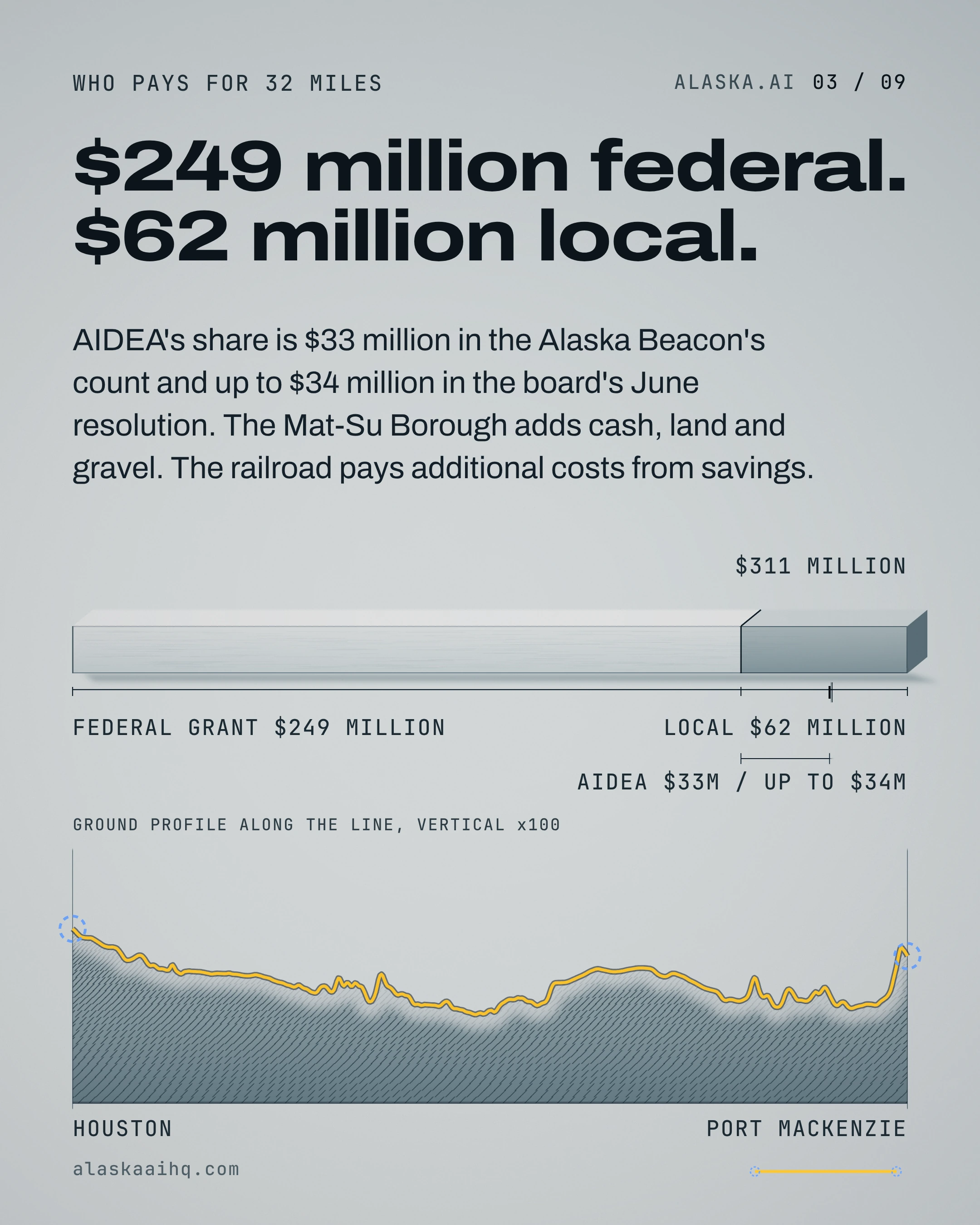
A $249 million federal grant will fund most of the rail extension.
AIDEA is expected to provide $33 million in matching funds to unlock the federal grant.
The Mat-Su Borough will provide cash, land and gravel to fulfill the remainder of the required match.
The Alaska Railroad will pay additional project costs from its savings.
Alaska Railroad CEO Bill O'Leary said the goal is to break ground this summer, depending on how fast the grantor agency moves.
O'Leary said the railroad expects to know the grantor agency's stance on its timeline in about a month to six weeks.
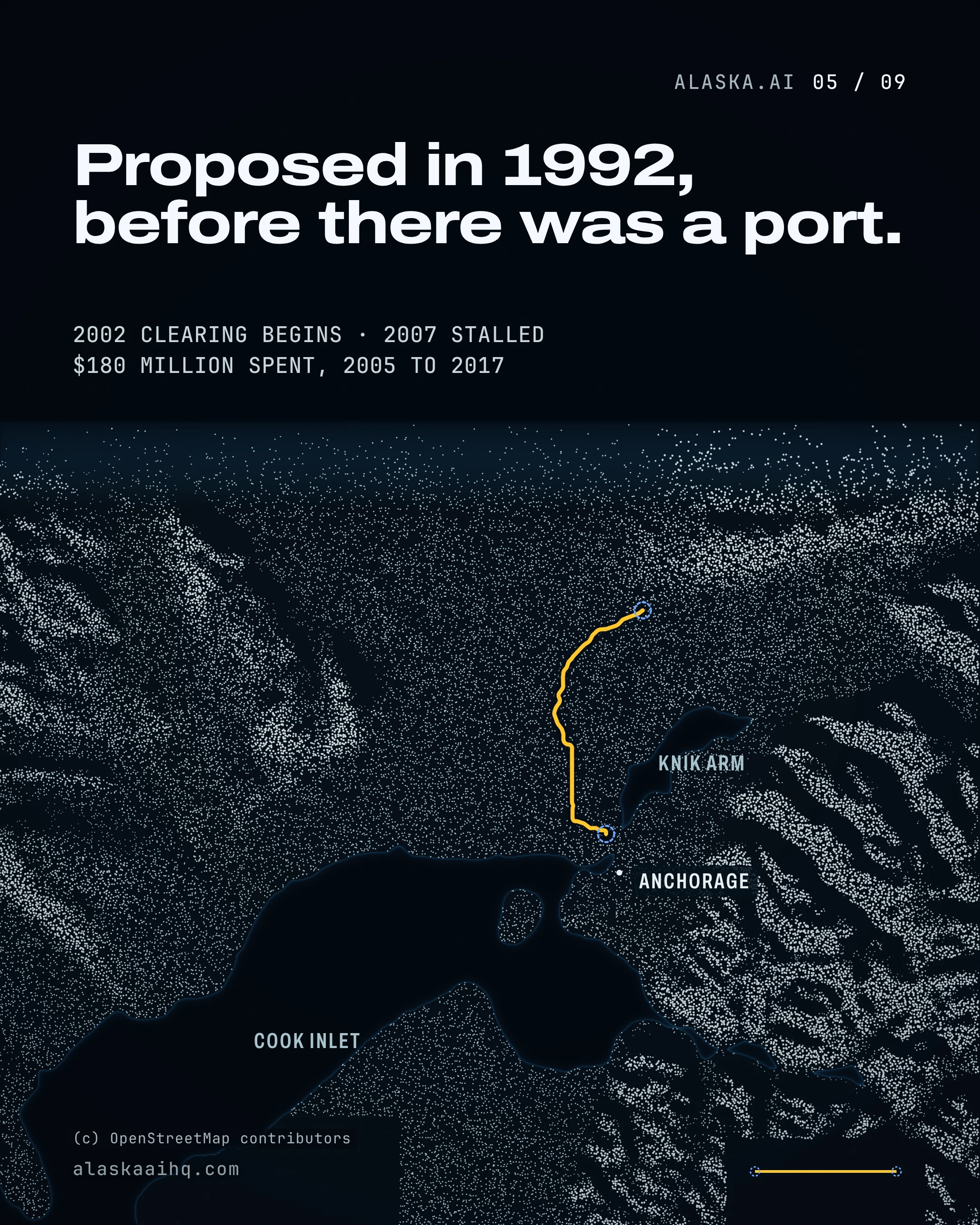
The rail spur was proposed as far back as 1992, before Port MacKenzie was built.
The project began moving forward in 2002, when proponents started clearing a 30-foot-wide right-of-way.
The project was poised to move forward in 2007, but local opposition and a lack of funding stopped it.
The Alaska Legislature voted 58-1 in favor of a resolution backing the rail line.
According to the Alaska Beacon, the developers of an antimony mine and of a coal-fired computing data center have announced construction projects at the port in anticipation of the rail line.
AIDEA voted to approve its share of the match on June 17th.
AIDEA's board was scheduled to discuss the rail match again at a meeting on Tuesday, November 24th.
Gov.-elect Jonathan Kreiss-Tomkins has asked AIDEA to pause spending actions until he takes office in early December.
O'Leary said he doesn't think the incoming governor will oppose the railroad project.
The grant was paid for with money approved for a rail program under the bipartisan infrastructure law.
Sen. Dan Sullivan called the grant a major win for the Mat-Su Borough and the state.
Sen. Lisa Murkowski said good things happen in Alaska when infrastructure is funded at the federal level.
The state spent $180 million on the rail line between 2005 and 2017.
The federal funding requires a $62 million local cost share.
Alaska Public Media reported in October that AIDEA agreed to cover about half of the $62 million local share.
The Mat-Su Borough's letter asking the state to reconsider the Houston land transfer was signed by Borough Manager Mike Brown and Mayor Edna DeVries.
The borough letter says Point Mackenzie and portions of West Susitna offer more appropriate locations for the proposed uses.
The borough letter notes that $180 million has been spent on a rail bed slated to receive about $249 million in new federal funding.
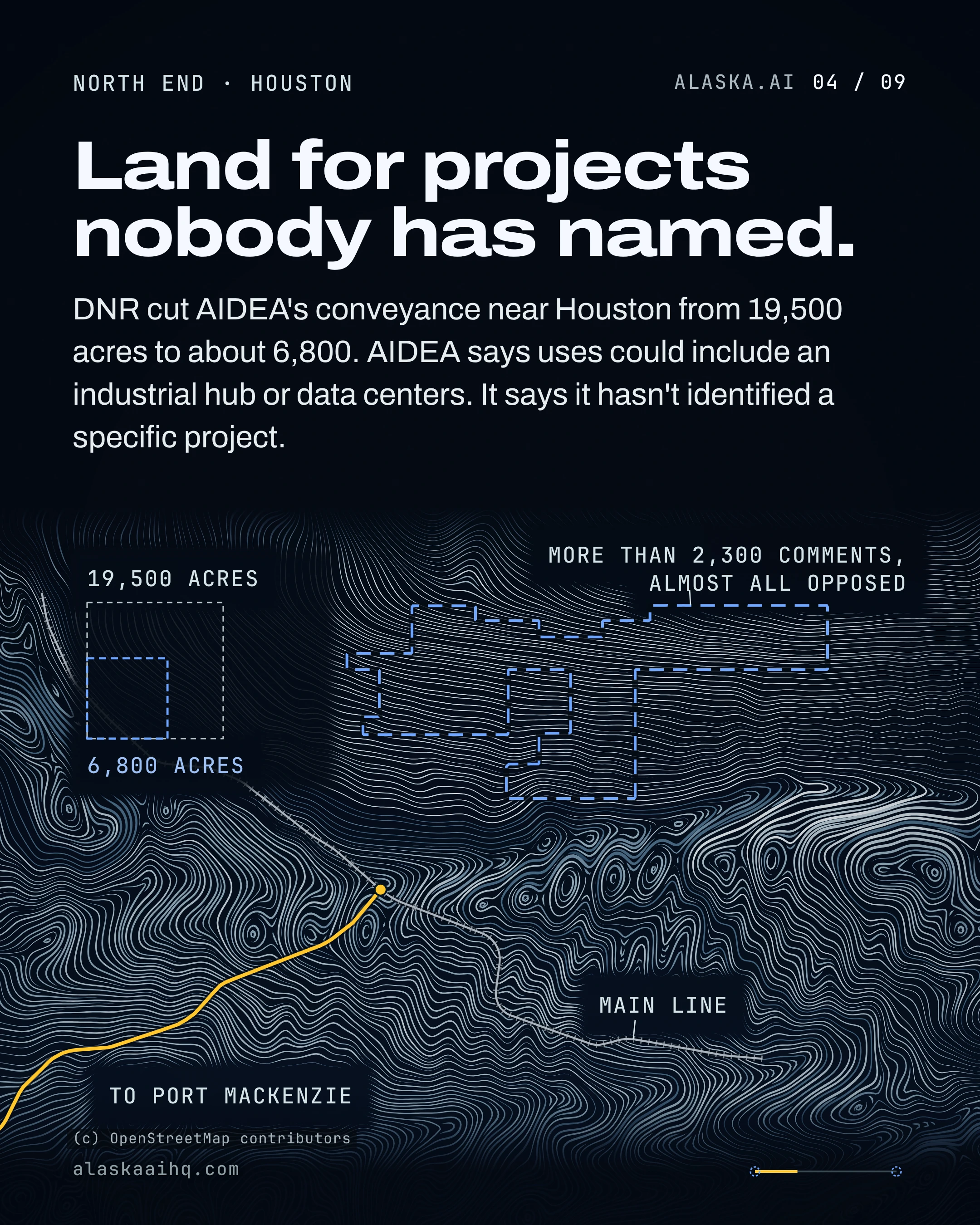
DNR approved a transfer of about 6,800 acres near Houston to AIDEA, scaled back from an initial proposal of almost 20,000 acres.
DNR received more than 2,300 public comments on the no-cost transfer, almost all of them opposed.
Anyone who commented on the transfer can request reconsideration by November 30th.
DNR has 30 days to respond to reconsideration requests.
The Houston land transfer is the subject of a pending lawsuit.
Kreiss-Tomkins, who is sworn in on December 7th, has said he would completely reassess everything AIDEA is looking at.
An AIDEA proposal says the Houston land could be used for projects not yet identified, which could include an industrial hub or data centers.
In July AIDEA said the Houston land could be used for a logistics hub, advanced manufacturing and scalable data centers.
AIDEA said it has not identified a specific project or projects for the Houston land.
DNR reduced the conveyance to AIDEA from 19,500 acres to approximately 6,800 acres.
Terra Energy Center Corporation is a branch of Flatlands Energy, a subsidiary of Alberta-based Alaska Asia Clean Energy Corporation.
Terra Energy Center Corporation holds a land-use permit on about 1,000 acres near Lake Lorraine at Point MacKenzie.
Alaska Business reported in April that Terra Energy Center Corporation isn't building a data center itself.
By overriding a mayoral veto in March, the Mat-Su Borough Assembly authorized staff to work with a company pitching a coal-fired power plant near Skwentna to serve large consumers such as a data center.
The Assembly let Terra Energy Center Corporation start a two-year joint international marketing effort with borough staff.
Kreiss-Tomkins asked AIDEA to freeze plans for additional spending before he takes office on December 7th.
The governor-elect's statement cited $200 million in AIDEA financial commitments since October.
Beats
This article is on Alaska data centers · Alaska power and the grid · Alaska land and permitting for AI. Each beat page keeps every decision and every article on that subject in one place.