Alaska's AI Land Rush, Four Rooms, One Open Door
Alaska got more than 500 public comments on a $10 billion North Slope AI data center. Fewer than a dozen said yes.
The deck
SWIPE, SCROLL OR CLICK A SLIDE TO GO FULLSCREEN · 9 SLIDES




The story
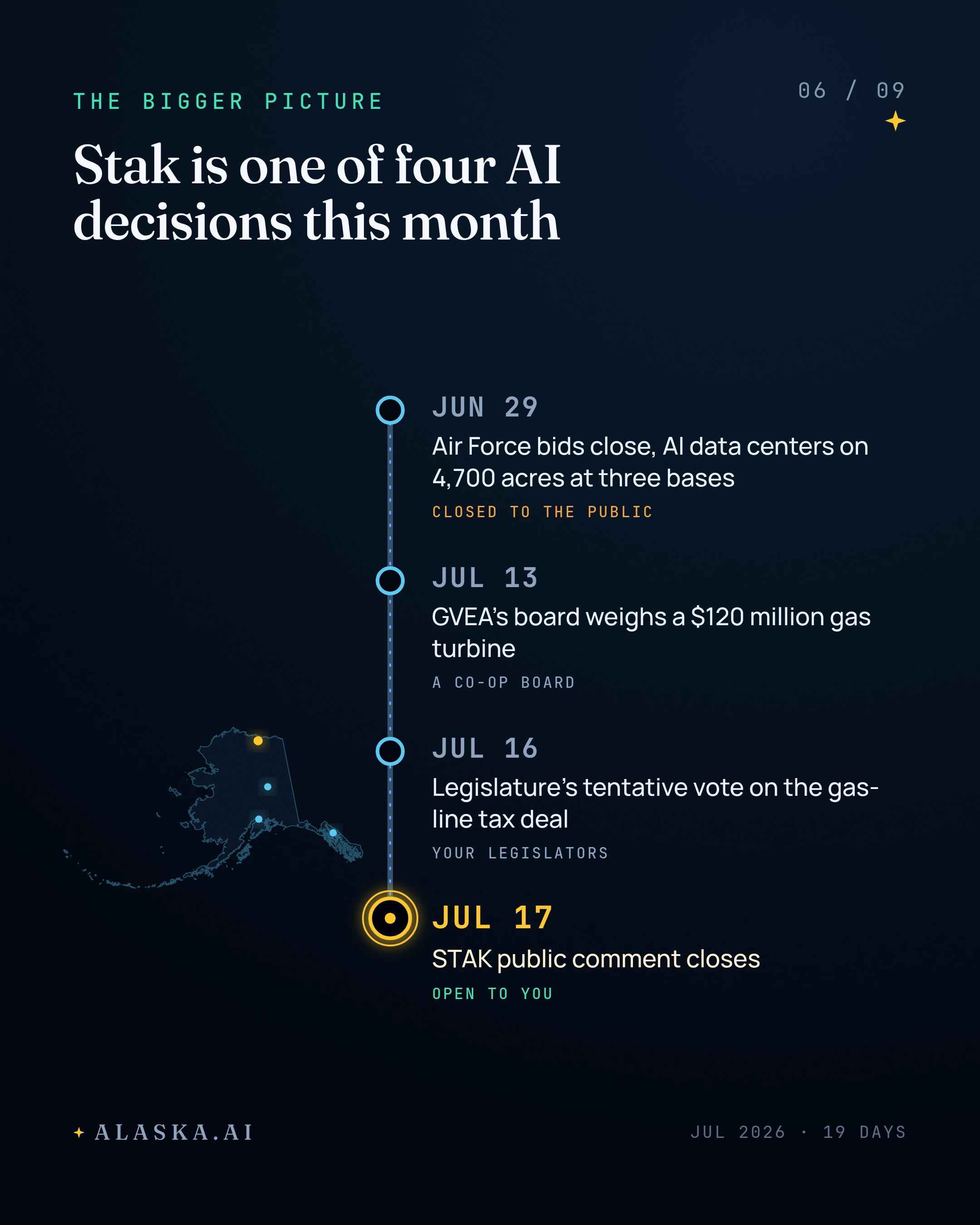
The state's comment window on Stak Energy's lease closes July 17. It is only one of four AI infrastructure decisions Alaska is making this month, and it is the only one that takes public comment at all.
This deck walks through the proposal, the 500 to 12 split, and the four rooms where Alaska's AI future is being decided this July.
Should Alaska's public land and gas power the AI boom, and who should get to decide?
What we verified
85 CLAIMS, EACH RE-FETCHED FROM ITS SOURCE BEFORE THIS DECK SHIPPED
More than 500 public comments were submitted to Alaska DNR on the Stak Energy lease before the preliminary deadline.
Fewer than a dozen of the public comments endorsed the Stak project.
DNR extended the ADL 422741 public comment deadline to 4:30 p.m. Alaska Daylight Time on July 17, 2026 (extension notice ID 224224).
The original comment deadline on the Stak preliminary decision was 4:30 p.m. on June 15, 2026 (original notice ID 223817, published May 12, 2026).
DNR said it extended the comment period because of significant public interest, comment volume, and requests for extension.
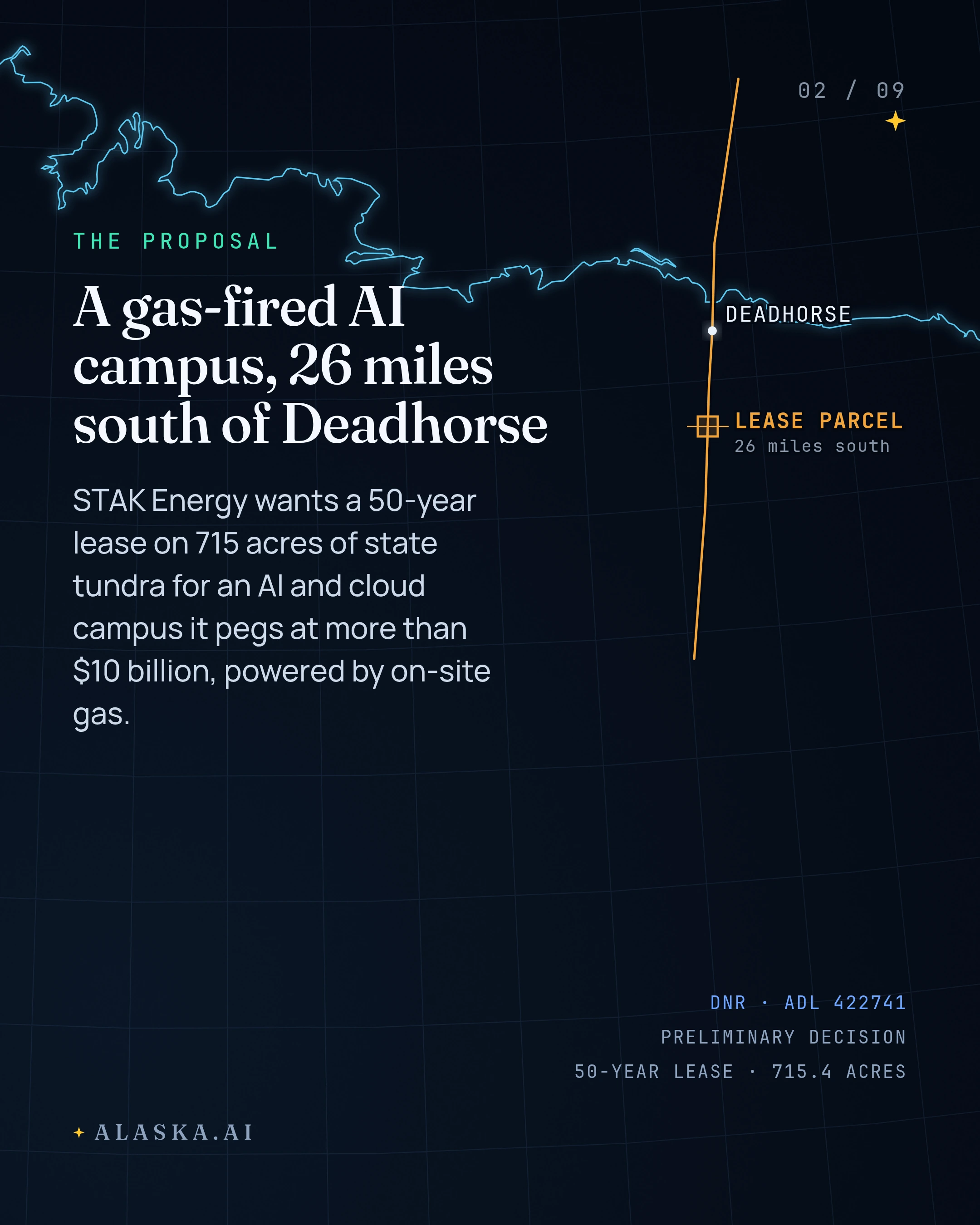
DNR's Division of Oil and Gas issued a preliminary decision to offer STAK Energy Corporation a 50-year lease.
The proposed lease covers a 715.4-acre parcel of state land.
The parcel sits adjacent to the Dalton Highway approximately 26 miles south of Deadhorse.
The docket is ADL 422741 with applicant STAK Energy Corporation; notice 223817 (published May 12, 2026) is the original preliminary decision notice and notice 224224 (published June 17, 2026) is the extension notice.
Stak's John Boyle said the full project would cost more than $10 billion.
Stak estimated approximately $500 million for initial site evaluation, engineering, gravel road and pad construction, and initial camp and support infrastructure.
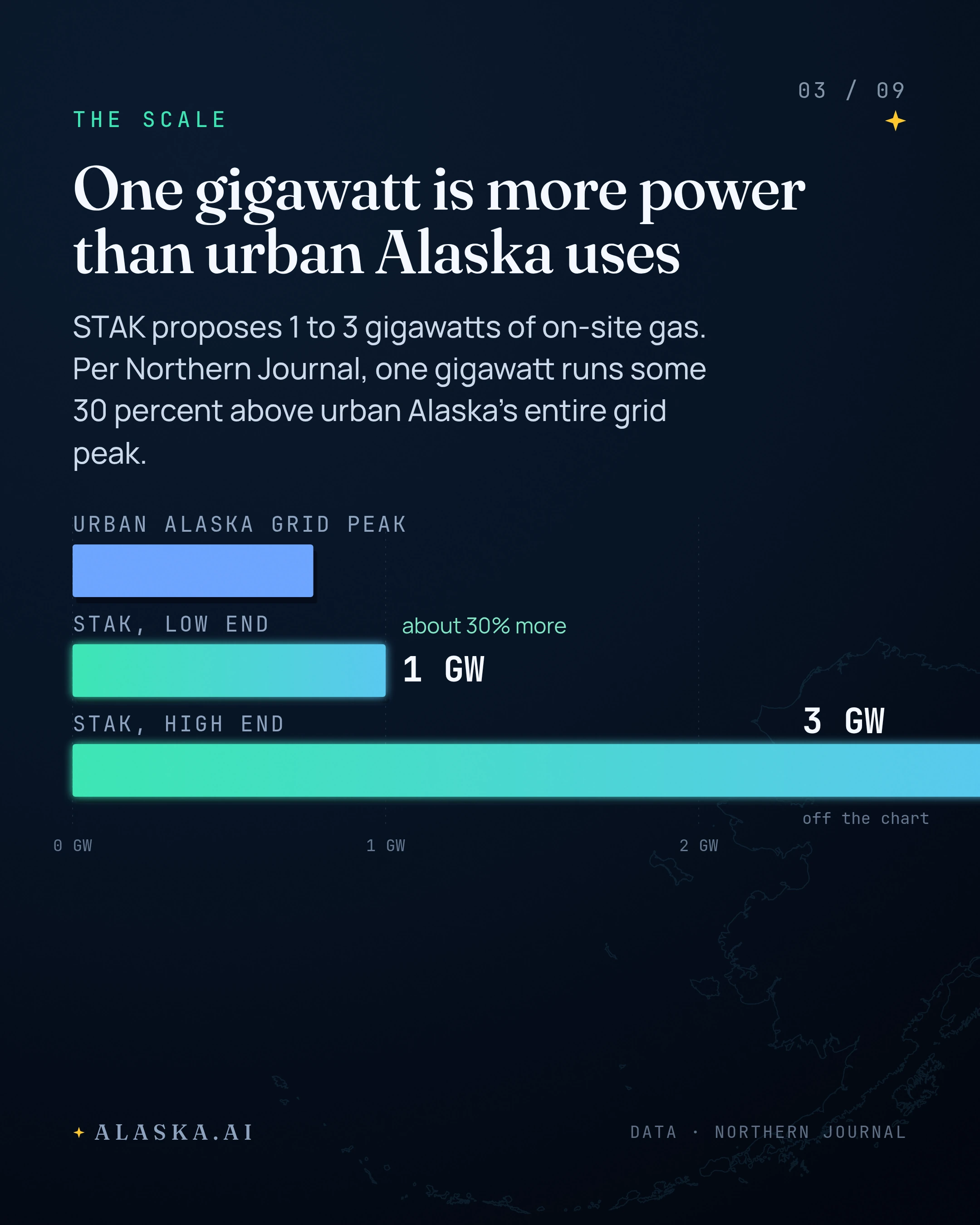
Stak proposes 1 to 3 gigawatts of on-site natural gas-fired generation.
Northern Journal reports that a gigawatt of generation is some 30% more than the peak demand of urban Alaska's entire grid.
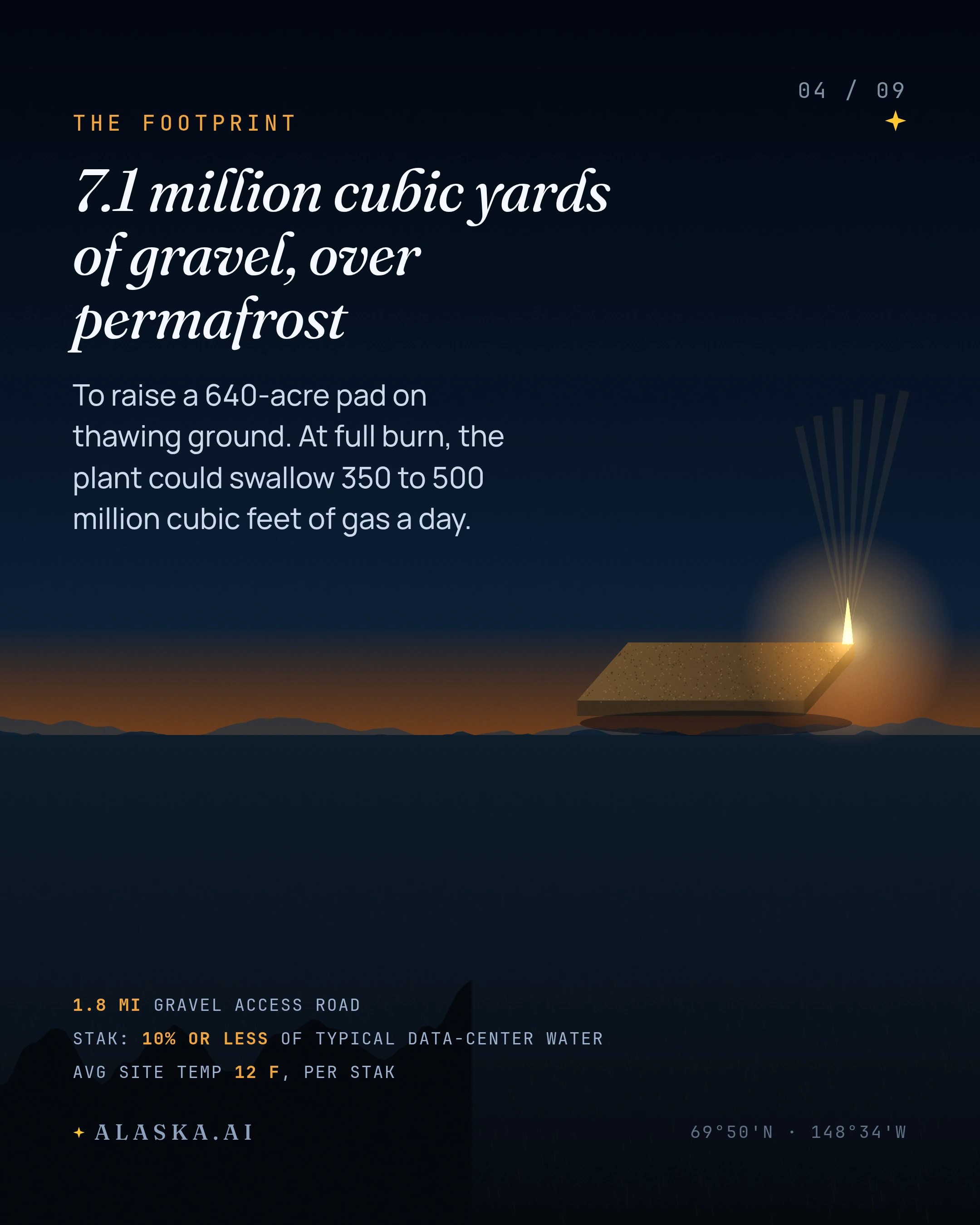
Lease documents indicate full simple-cycle operation could consume roughly 350 to 500 million standard cubic feet of gas per day.
That daily gas burn annualizes to approximately 128 to 183 billion cubic feet per year.
The project would require roughly 7.1 million cubic yards of gravel fill.
Plans include a roughly 640-acre gravel pad.
Plans include a 1.8-mile gravel access road.
John Boyle said most comments were form letters lacking substance.
John Boyle is Stak's chief strategy officer and previously served as commissioner of Alaska's Department of Natural Resources from 2023 to 2025.
Opposition comments carried subject lines including 'HELL NO! To ANY DATA CENTERS' and 'NO AI'.
One commenter urged the state to 'incorporate some AI (Alaskan intelligence) into making this decision'.
One commenter noted their message was written 'with my own brain and fingers typing'.
Comments arrived from Kodiak, Kotzebue, Seward, Valdez, and the North Slope village of Nuiqsut.
Formal opposition or concern also came from the Northern Alaska Environmental Center, the Alaska Public Interest Research Group, and the Alaska chapter of Backcountry Hunters and Anglers.
According to Stak, average annual temperatures at the proposed site are 12 F.
Stak expects the development to need 10% or less of the water that typical data centers use for cooling.
After the deadline passes, DNR will assess the comments before making a final decision on the lease.
Stak said in a statement that it 'is committed to being a responsible steward of the land entrusted to us'.
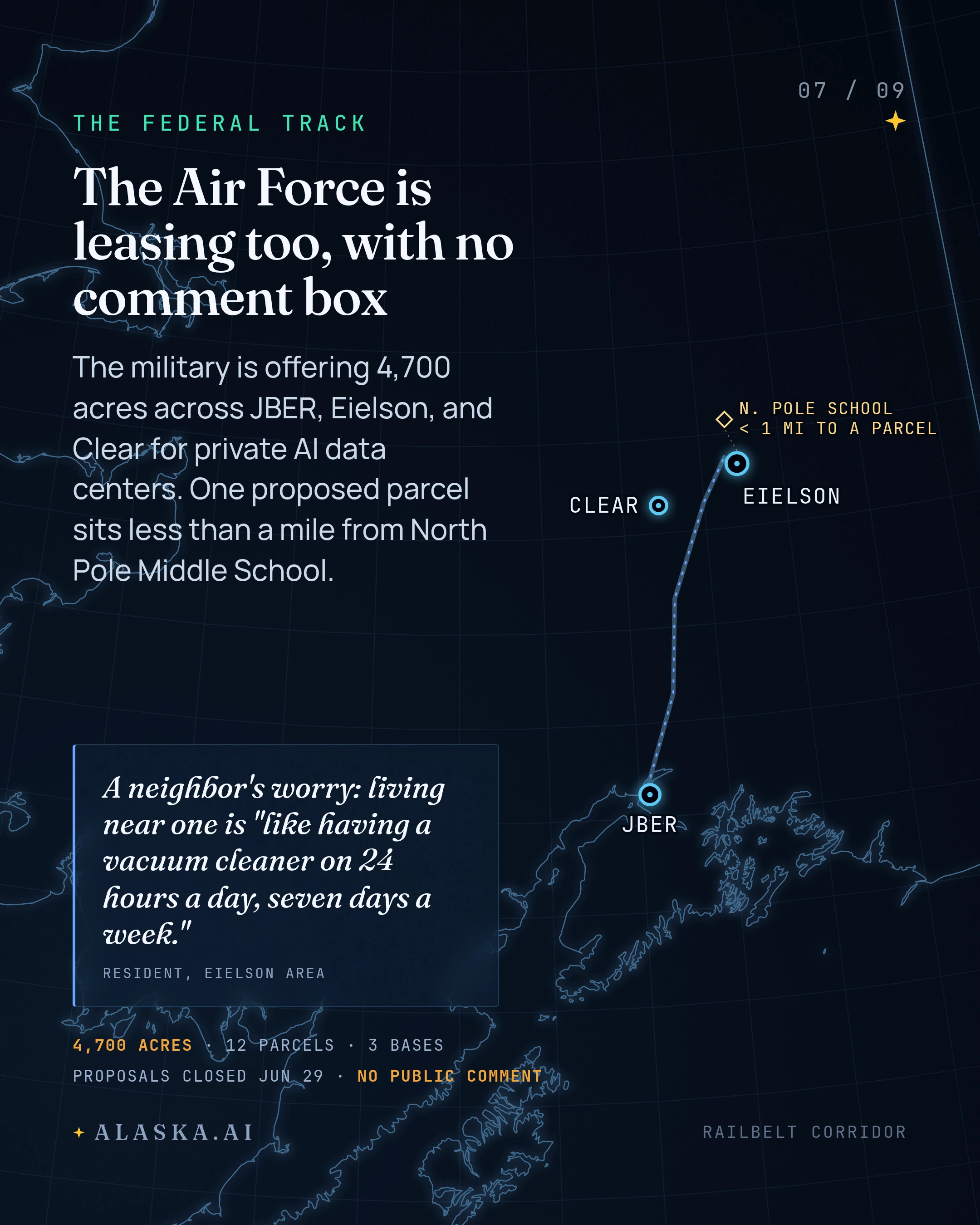
The Department of the Air Force is offering approximately 4,700 acres of underutilized land at JBER, Eielson AFB, and Clear Space Force Station for AI data centers.
Twelve parcels have been identified for potential development under the program.
The Air Force announced the Alaska AI data center Enhanced Use Lease opportunity on April 10, 2026.
The Air Force released its Request for Lease Proposal on June 5, 2026.
Developer lease proposals were due June 29, 2026.
The RFLP identifies five potential parcels in the Eielson AFB area.
Four parcels are under consideration around Clear Space Force Station, including one that would connect to the GVEA grid from the Parks Highway.
One Eielson-area parcel is less than a mile from North Pole Middle School.
Resident Sarah Hollister said living near data centers is described as like having a vacuum cleaner running around the clock.
Sarah Hollister raised concern about data center heat discharge affecting permafrost.
Hollister pointed out that three of the proposed sites would be expected to use the GVEA grid and asked whether that would affect members' bills.
JBER commander Col. Lisa Mabbutt said Alaska is expected to receive up to $8 billion in Air Force investments over the next five years.
Under Secretary of the Air Force Matthew Lohmeier toured JBER and Eielson AFB June 22 through 24, 2026.
GVEA recommended that any major loads be connected to its 138-kilovolt line.
The Air Force plans to choose proposals that minimize and mitigate impact and risk to the surrounding community, with utilities remaining accessible and affordable.
GVEA's board will weigh whether to invest in a fuel-based generator during an executive session on July 13, 2026.
A new LM6000 unit would cost GVEA about $120 million.
An LM6000 can generate between 45 and 58 megawatts depending on the model.
Costs to construct a new gas turbine power plant jumped 195% from 2019 to 2026, per a Bloomberg News report cited by the News-Miner.
Turbine order waitlists have pushed into the early 2030s, per a Bloomberg News report cited by the News-Miner.
Demand for the turbine units has increased due to a surge in large data centers that require a guaranteed power supply, per a Bloomberg News report.
At its April 2026 board meeting, GVEA approved $50,000 to reserve an order spot for an LM6000 combined-cycle turbine.
GVEA's fuel and purchased power charge rose by about 61 percent effective June 1, 2026.
The increase costs the average residential member nearly $46 more per month.
GVEA's power plant fuel prices roughly doubled from about $2.50 to $5.10 per gallon.
House-Senate conference committee members unveiled a draft compromise AKLNG tax bill on Thursday, July 2, 2026.
The draft compromise would replace the state's property tax with a volumetric tax on gas after five years of operation or once flow reaches 500 million cubic feet per day, whichever comes first.
The draft extends the construction completion deadline for the gas line and phase one from 2032 to December 31, 2034.
Phase one of the project is an 807-mile gas line from the North Slope to Cook Inlet.
Glenfarne owns 75% of the Alaska LNG project.
Lawmakers are tentatively planning House and Senate floor votes on the compromise bill for Thursday, July 16, 2026.
Lawmakers are in a second special session called by Gov. Mike Dunleavy, scheduled to end July 19, 2026.
Dunleavy has called the corporate income tax provision a 'poison pill' and pledged to veto any bill that includes it.
The governor and the developer have said the S corp tax in the draft will hurt the project's ability to secure financing.
On the Wood River, an automated drone emerges from its box at exactly 8:30 a.m. and takes off on an automated flight path.
The team expects to need several thousand drone images for the computer-vision model to learn to reliably identify a fish.
Alaska Fish and Game has been tracking salmon escapement since 1955.
Tower technicians count each passing salmon with a hand-clicker in 10-minute intervals.
Tower crews rotate through continuous shifts over 24 hours.
Most escapement counts across Bristol Bay currently come from nine Fish and Game counting tower sites.
The pilot is run with the University of Washington's Fisheries Research Institute, the Bristol Bay Regional Seafood Development Association, and the Bristol Bay Economic Development Corporation.
Norm Van Vactor is a project lead on the drone counting pilot.
In the project's next phase, the crew will test their models against Fish and Game tower counting data.
BBRSDA's drone salmon-monitoring project received a $70,000 Seafood Industry Climate Award grant from the Acme Smoked Fish Foundation.
According to the funder, the drone project enables managers to detect salmon run timing up to 24 hours earlier.
The 2026 preseason forecast expects a Bristol Bay total run of 44.05 million sockeye.
The Bristol Bay run had reached 17,011,218 sockeye through July 1, 2026, as reported July 2.
Wood River tower crews counted 123,489 sockeye on Wednesday, July 1, bringing their cumulative count to 1,884,747 fish.
Alaska's 2026 primary election is August 18, 2026.
Incumbent Gov. Mike Dunleavy is term-limited and ineligible to seek a third consecutive term.
Alaska saw over 9,000 lightning strikes in a single day in late June 2026, amid a week of prolific lightning.
A U.S. Forest Service Uncrewed Aircraft System module from Boise, Idaho was assigned to fly reconnaissance, mapping, and infrared missions on the Polly Fire.
The Cecil Fire is approximately 724 acres and 100% contained, with 18 personnel assigned, as of July 6, 2026.
A UAS drone flight on July 6, 2026 detected no remaining heat on the Cecil Fire.
A permafrost digital twin under a Utqiagvik road embankment was built from a pair of one-kilometer fiber-optic cables that collected temperature and seismic data from September 2021 to June 2024.
The digital twin approach more accurately predicted the embankment permafrost's unfrozen water content, ground temperature changes, and heat movement.
Beats
This article is on Alaska data centers · Alaska power and the grid · Alaska land and permitting for AI · Defense and federal AI in Alaska · Alaska AI policy and legislation. Each beat page keeps every decision and every article on that subject in one place.