Alaska data centers and your power bill, on the grid or off
A data center on the North Slope cannot touch your Anchorage power bill. One in the Mat-Su can.
The deck
SWIPE, SCROLL OR CLICK A SLIDE TO GO FULLSCREEN · 9 SLIDES



The story
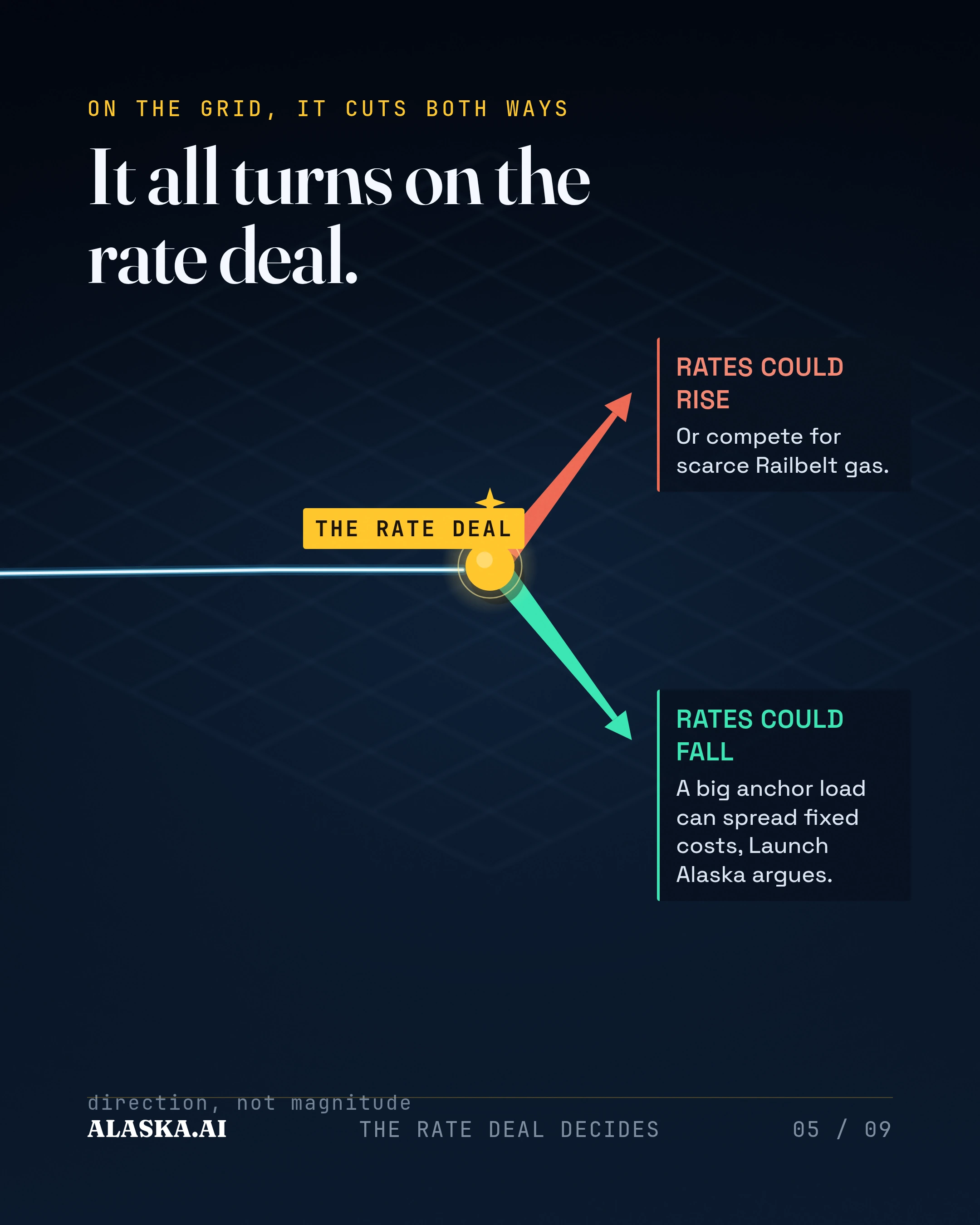
The difference is not the size of the load, it is one wire. Off-grid projects self-generate and never reach the Railbelt. On-grid ones plug into the same network you pay into. There the answer still splits two ways, and the rate deal decides which.
This deck walks through both Alaska projects in the news, the on-grid versus off-grid split, and why the build-versus-ban fight skips the lever that actually sets your rate.
So what should Alaska require first, a rate deal on every big new load, or nothing until the count grows?
What we verified
16 CLAIMS, EACH RE-FETCHED FROM ITS SOURCE BEFORE THIS DECK SHIPPED
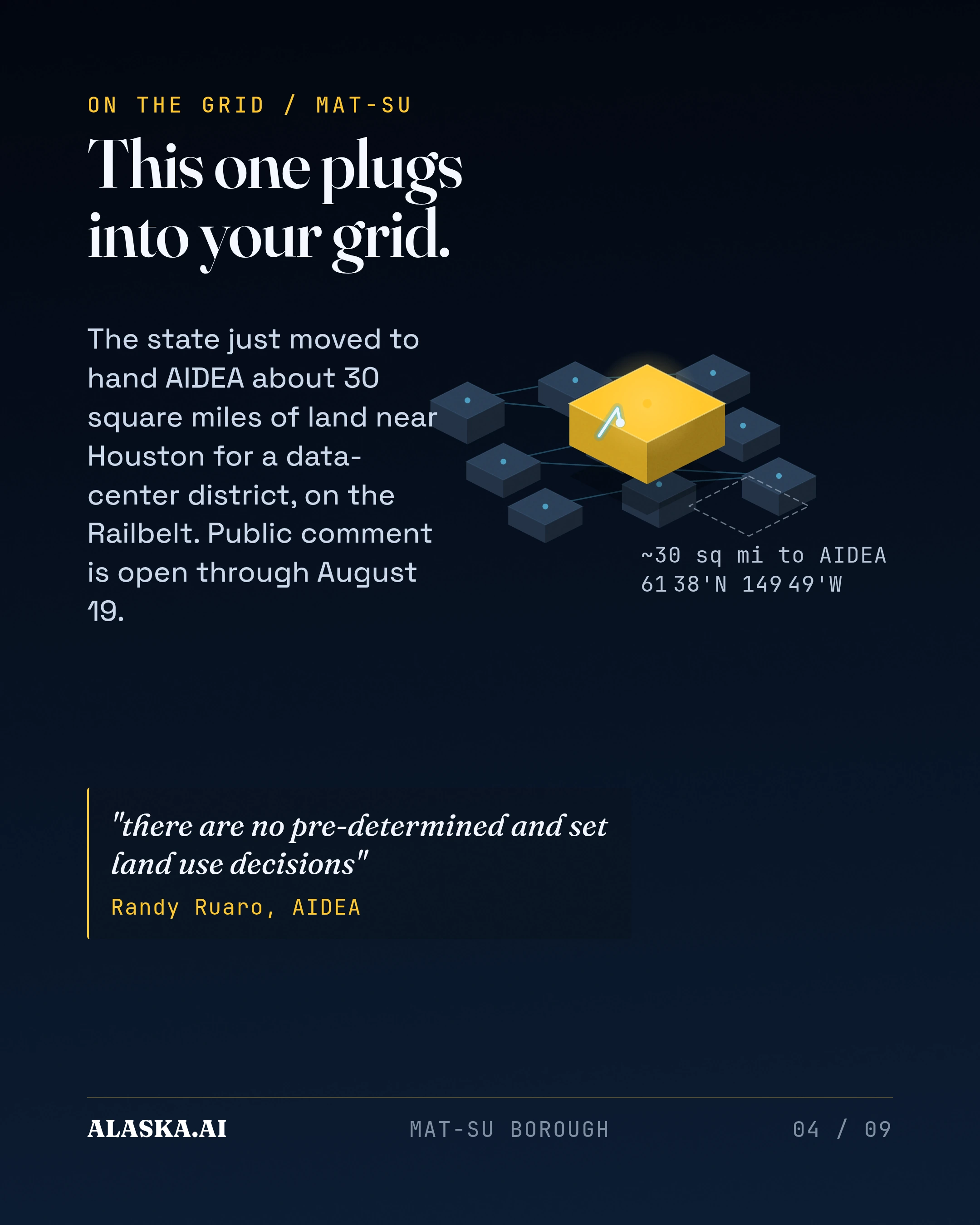
Alaska's DNR moved to transfer about 30 square miles of state land north of Houston in the Mat-Su to AIDEA for a multi-use industrial and energy development district that includes data centers.
AIDEA Executive Director Randy Ruaro said there are no pre-determined and set land use decisions made by AIDEA.
The DNR preliminary decision on the Mat-Su transfer runs 41 pages.
Public comment on the Mat-Su land transfer is open through 5 p.m. on August 19, 2026, on the Alaska DNR website.
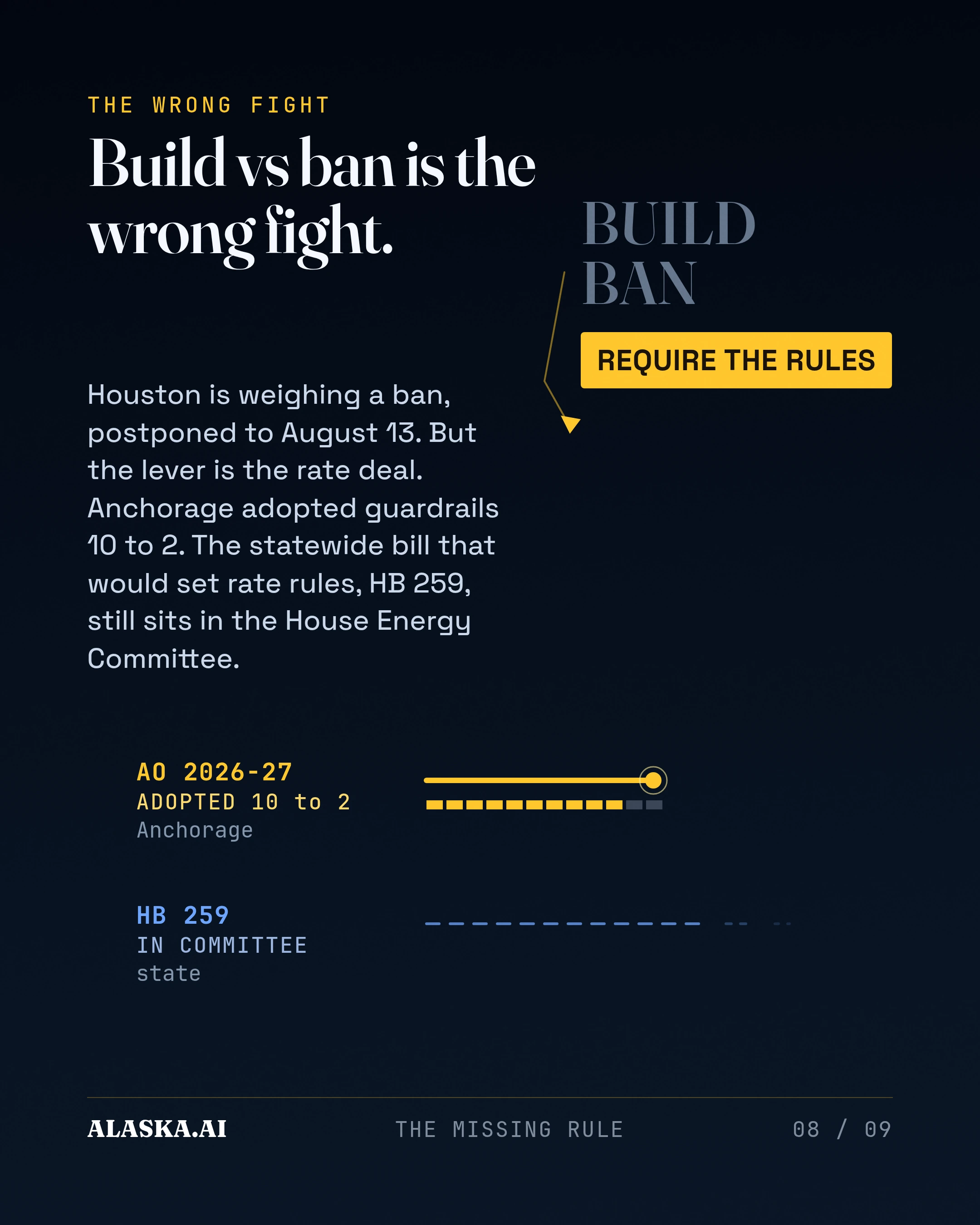
A Houston City Council member named Johansen introduced an ordinance in June to ban data centers within city limits, and the council voted to postpone the measure to its August 13 meeting.
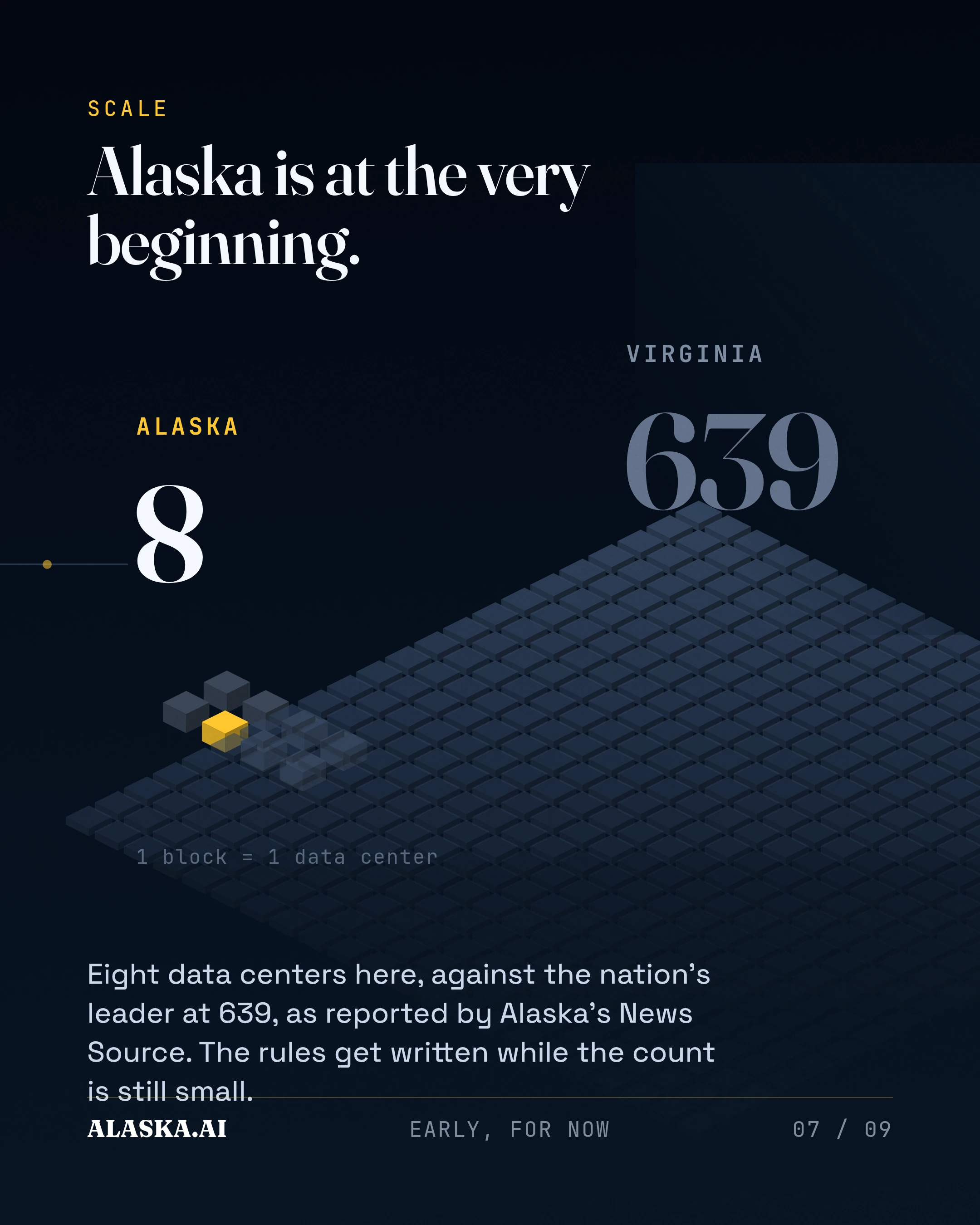
Alaska currently has 8 data centers compared with Virginia's nation-leading 639.
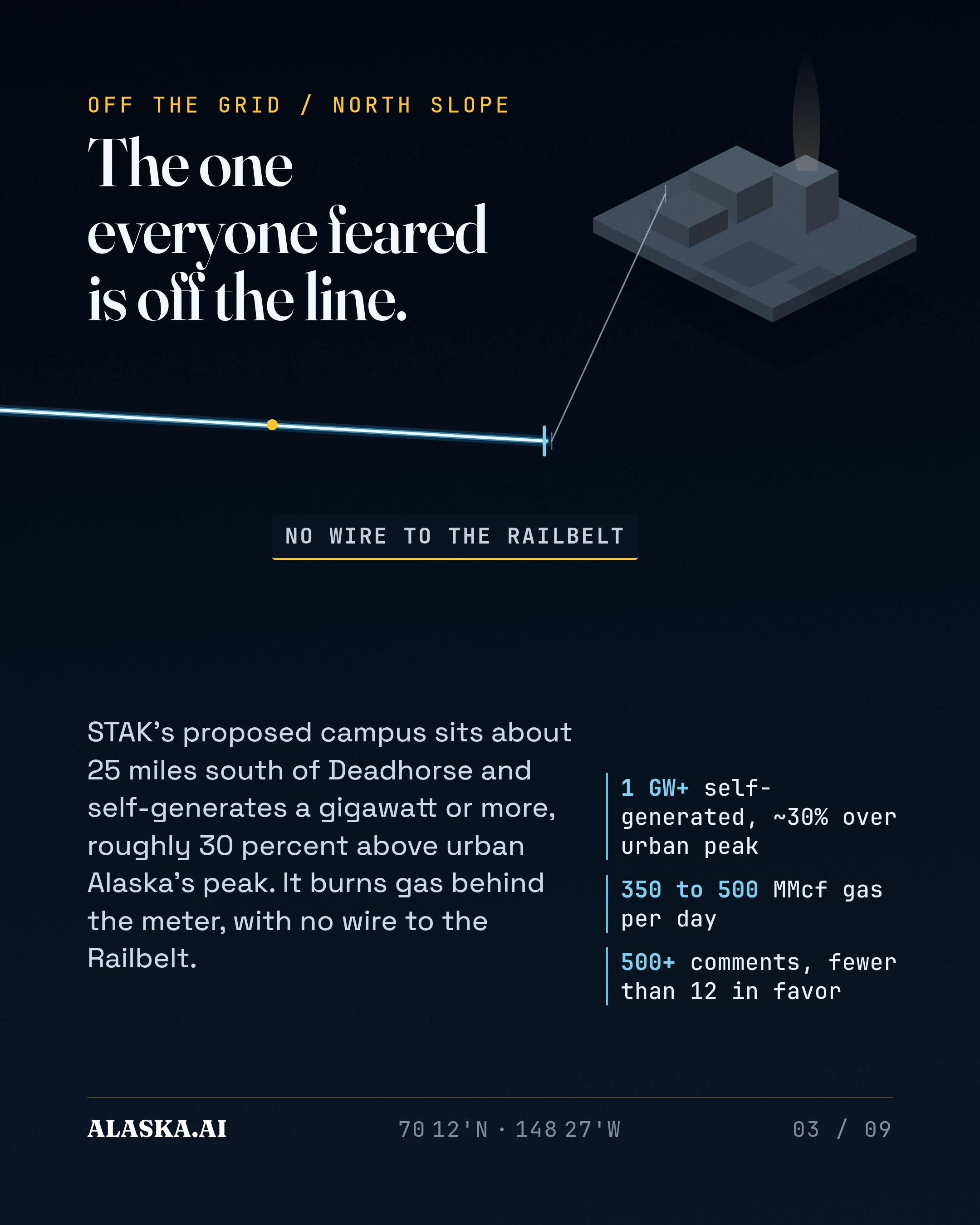
STAK Energy's proposed North Slope AI and cloud campus sits about 25 miles south of Deadhorse just off the Dalton Highway and would self-generate a gigawatt or more of power, roughly 30 percent more than the peak demand of urban Alaska's entire grid.
STAK Energy is seeking a 50-year lease of approximately 715.4 acres of state land for the campus.
The STAK campus would consume roughly 350 to 500 million standard cubic feet of North Slope gas per day.
The STAK public comment window closed July 17, 2026, having drawn more than 500 comments with fewer than a dozen in support, and STAK's John Boyle said some comments were form letters lacking substance.
Because the STAK North Slope project is off-grid and self-generating hundreds of miles from urban Alaska, reporting states its fuel sales would have no direct impact on city dwellers' electricity prices.
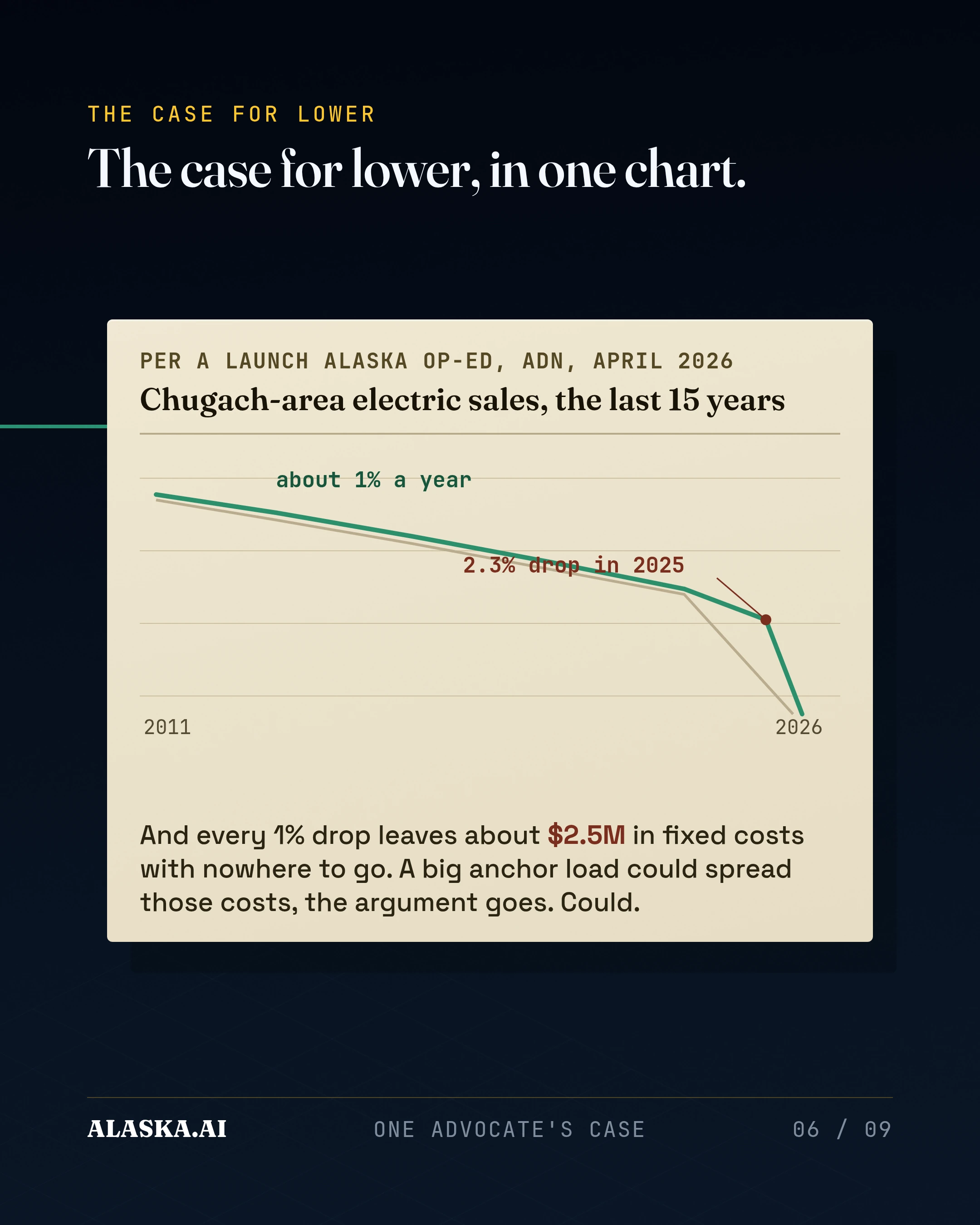
In an April 2026 ADN opinion piece, Launch Alaska's Penny Gage wrote that Chugach-area electric sales have declined about 1 percent a year for roughly 15 years, dropped another 2.3 percent in 2025, and that every 1 percent reduction leaves about 2.5 million dollars in fixed costs with nowhere to go, arguing a large new anchor load could spread those costs and lower rates.
The Railbelt already faces a shortage of locally produced gas, which is why adding large new load raises a gas-supply concern rather than a wires concern.
A state bill by Rep. Donna Mears introduced in January 2026, HB 259, would set utility rate-setting guidelines and community-benefit standards for large data centers, but it was referred to the House Energy Committee and has not advanced.
In March 2026 the Anchorage Assembly adopted ordinance AO 2026-27 in a 10 to 2 vote, confining data centers to commercial and industrial zones, requiring landscaping buffers and enclosed power equipment, and requiring written statements from electric and water utilities that the grid has sufficient system capacity.
On July 16, 2026, Governor Dunleavy called a third Alaska LNG special session, to convene July 27, after the House deadlocked 19 to 19 and the Senate passed a gas-tax bill 11 to 8 that included a 9.4 percent pass-through tax he rejected.
Beats
This article is on Alaska data centers · Alaska power and the grid · Alaska land and permitting for AI · Alaska AI policy and legislation. Each beat page keeps every decision and every article on that subject in one place.